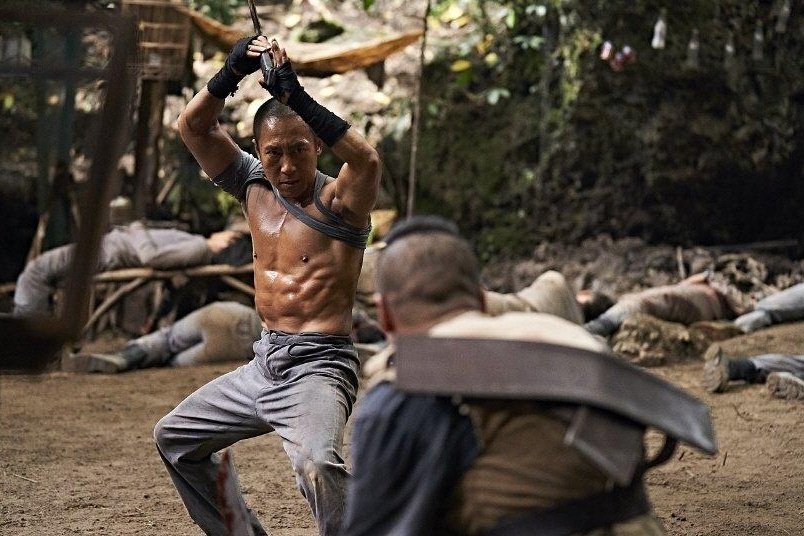
At first glance, Revenger looks like an unusual entry in Netflix’s Korean movie collection. It has a Korean cast and Korean dialogue, but its tropical island setting, brutal hand-to-hand combat, and survival-style atmosphere make it feel very different from the Korean crime thrillers most international viewers are familiar with.
That impression is not entirely wrong.
Released in 2018, Revenger is a South Korean action film directed by Lee Seung-won and starring Bruce Khan, Park Hee-soon, and Yoon Jin-seo. But unlike a conventional Korean gangster movie, it places martial arts and physical combat at the center of almost everything.
So why does it feel so different? And what is really happening on the mysterious island of Soorado?
1. What Is Revenger (2018) About?
Revenger follows Kim Yool, a former police officer whose family was murdered by a ruthless criminal named Carlos Kun.
Consumed by revenge, Yool deliberately enters Soorado Island, a remote prison where some of the most dangerous death-row criminals are held.
The island has its own brutal order. There is no meaningful law, and the prisoners live under the power of whoever is strong enough to control them.
Yool has one objective: find Carlos Kun and make him pay.
But reaching his enemy means surviving an entire island filled with violent criminals.
2. Why Does Revenger Feel Different from Other Korean Movies?
The biggest difference is its genre identity.
Many internationally recognized Korean crime films build tension through investigation, character relationships, social conflict, or psychological suspense.
Revenger takes a much simpler route.
Its central attraction is the physical ability of its leading character. The film repeatedly places Yool in situations where he must fight his way through groups of armed opponents.
The tropical environment, isolated prison community, and relentless combat make the movie feel closer to an international martial arts survival film than a typical Korean crime thriller.
3. Is Revenger Actually a Korean Movie?
Yes.
Revenger is officially a South Korean film, directed by Lee Seung-won and released in Korean theaters on December 6, 2018.
Netflix also classifies it as a Korean movie and lists Korean as its original audio language.
However, the film’s visual atmosphere can create a different impression.
Parts of the production were filmed in Indonesia, and the Indonesian locations contribute to the tropical island environment that dominates the story.
The important distinction is that filming in Indonesia does not make the movie an Indonesian production. Its official film identity remains South Korean.
4. The Bruce Khan Factor
The most important reason Revenger feels unusual is Bruce Khan.
He plays Kim Yool, but his contribution goes beyond acting. He is also credited as a screenwriter and action director.
That matters because the film is built around the physical abilities of its leading performer.
Yool is not presented as a detective who happens to know how to fight. He is closer to a one-man fighting force who can take on multiple opponents through speed, technique, and physical power.
The result is a movie where the action performer becomes the center of the entire production.
5. Soorado Island: A Prison Without Real Rules
Soorado is not presented as an ordinary prison.
It is an isolated place where dangerous criminals have created their own hierarchy. Carlos Kun sits at the top, exercising control through fear and violence.
The island functions almost like a small lawless society.
For Yool, entering Soorado is not simply a prison transfer. It is a deliberate move into enemy territory.
He knows that the normal rules of policing no longer apply there.
6. Who Is Carlos Kun?
Carlos Kun, played by Park Hee-soon, is the central antagonist.
He is responsible for the tragedy that drives Yool’s revenge mission. His power on Soorado comes from his ability to control other prisoners and eliminate anyone who challenges him.
Kun is more than a criminal waiting to serve a sentence.
He has turned the island into his territory.
His confrontation with Yool is therefore not just a personal revenge story. It is also a struggle over who gets to control the island.
7. Why Does Yool Enter the Island?
Yool’s decision is driven by revenge.
Rather than waiting for an opportunity to reach Kun from outside, he deliberately places himself inside the same prison environment.
This creates the film’s central contradiction.
Yool was once a law enforcement officer, but to reach the man he wants to kill, he must enter a world where law has almost disappeared.
He is willing to sacrifice his former identity to get close to his enemy.
8. The Complication: Mali and Jin
Yool’s mission becomes more complicated when he encounters Mali, played by Yoon Jin-seo, and her daughter Jin.
Mali has a personal reason to distrust him. Yool was the police officer who sent her to the island while she was pregnant.
This creates an uncomfortable relationship between the characters.
Yool may be seeking revenge against Kun, but he is not an innocent outsider in the lives of everyone trapped on Soorado.
His previous actions have consequences.
9. Why Does Mali Distrust Yool?
Mali’s anger comes from her past.
She sees Yool as someone connected to the system that placed her and her daughter in this dangerous environment.
Even if Yool has his own tragic history, that does not automatically erase what Mali has suffered.
This relationship gives the film a small emotional conflict beyond the main revenge plot.
It also reminds viewers that Yool’s mission affects people who have their own reasons to survive.
10. Bau and the Island’s Other Survivors
Kim In-kwon plays Bau, one of the figures connected to the group of survivors living away from Kun’s direct control.
Bau provides a different energy from the film’s darker characters.
His presence introduces moments of humor and a more communal side to the island’s population.
The survivors are not simply waiting for a hero to rescue them. They have developed their own ways of living under the threat of Kun’s power.
Yool’s arrival changes the balance of that fragile community.
11. Why Does the Action Feel So Different?
The film’s fighting style is one of its defining characteristics.
Instead of relying mainly on gun battles or elaborate crime investigations, Revenger emphasizes kicks, throws, close-range combat, and physical confrontations.
Bruce Khan’s martial arts background is central to this approach.
The camera often stays close enough to show the movements and impacts of the fights.
This gives the action a more direct, physical quality than the heavily edited action sequences found in many contemporary thrillers.
12. Is Revenger Similar to The Raid?
The comparison is understandable.
Both films use confined or isolated environments, dangerous opponents, and intense physical combat.
However, they are not connected productions, and they have different storytelling approaches.
The Raid is built around a tightly structured assault on a criminal building. Revenger uses a remote prison island as the setting for a revenge story.
The comparison is useful for describing the kind of action experience viewers might expect, but it should not be mistaken for a production relationship.
13. Why Does the Story Feel Simpler Than the Action?
This is one of the film’s most noticeable weaknesses.
The central plot is easy to understand: Yool wants revenge, Kun controls the island, and the two men are moving toward a final confrontation.
But some supporting characters and subplots receive less development than their roles seem to promise.
The movie often feels more interested in moving from one action location to another than in exploring the emotional consequences of every event.
That is why viewers who expect a complex Korean crime thriller may find the story surprisingly thin.
14. What Happens at the End of Revenger?
Spoilers ahead.
The final conflict brings Yool face to face with Carlos Kun.
By this point, the revenge mission has become a direct assault on Kun’s power structure. Yool fights through the remaining opposition and finally confronts the man responsible for destroying his family.
Yool defeats and kills Kun.
The ending completes the central revenge objective, but it does not transform Soorado into a conventional, orderly place overnight.
The survivors’ future is tied to what remains after Kun’s control is broken.
Jin is reunited with her mother, and the surviving islanders have a chance to move forward without Kun’s immediate domination.
Yool, having completed his personal mission, leaves the island.
15. Does Revenger Have a Post-Credit Scene?
There is an interesting detail in the discussion of the film’s ending.
AsianWiki viewer comments mention a brief image of Yool in a robe in a dusty, windswept location after the main credits begin. One viewer wondered whether it showed his life after leaving the island or another destination.
However, the available descriptions do not establish a definitive explanation for that image.
It is safest to treat it as an ambiguous closing image or possible epilogue rather than claim that it confirms a sequel.
If you watch the film on Netflix, pay attention to the very end rather than stopping as soon as the main story finishes.
16. Final Verdict: A Korean Movie with an Unusual Martial Arts Identity
Revenger is a Korean film, but it does not feel like the Korean crime movies that international audiences usually associate with the industry.
Its tropical locations, isolated prison setting, and Bruce Khan’s action-centered performance give it a distinct identity.
The movie’s story is relatively straightforward, and some supporting characters could have been developed further. But its purpose is clear: deliver a physical martial arts revenge film.
That is why the comparison with Indonesian-style action cinema can make sense, even though Revenger remains a South Korean production.
The real question is not whether Revenger is Korean. It is why Korean cinema has produced so few action films that look and feel quite like this one.
For viewers who enjoy martial arts movies more than complicated crime plots, Revenger is an unusual title worth discovering.