For years, the debate over artificial intelligence and jobs sounded theoretical.
Would AI replace programmers?
Would accountants disappear?
Would customer service jobs be automated?
Would highly educated professionals be protected?
Now, American workers are beginning to give a much clearer answer about how they feel.
They are getting worried.
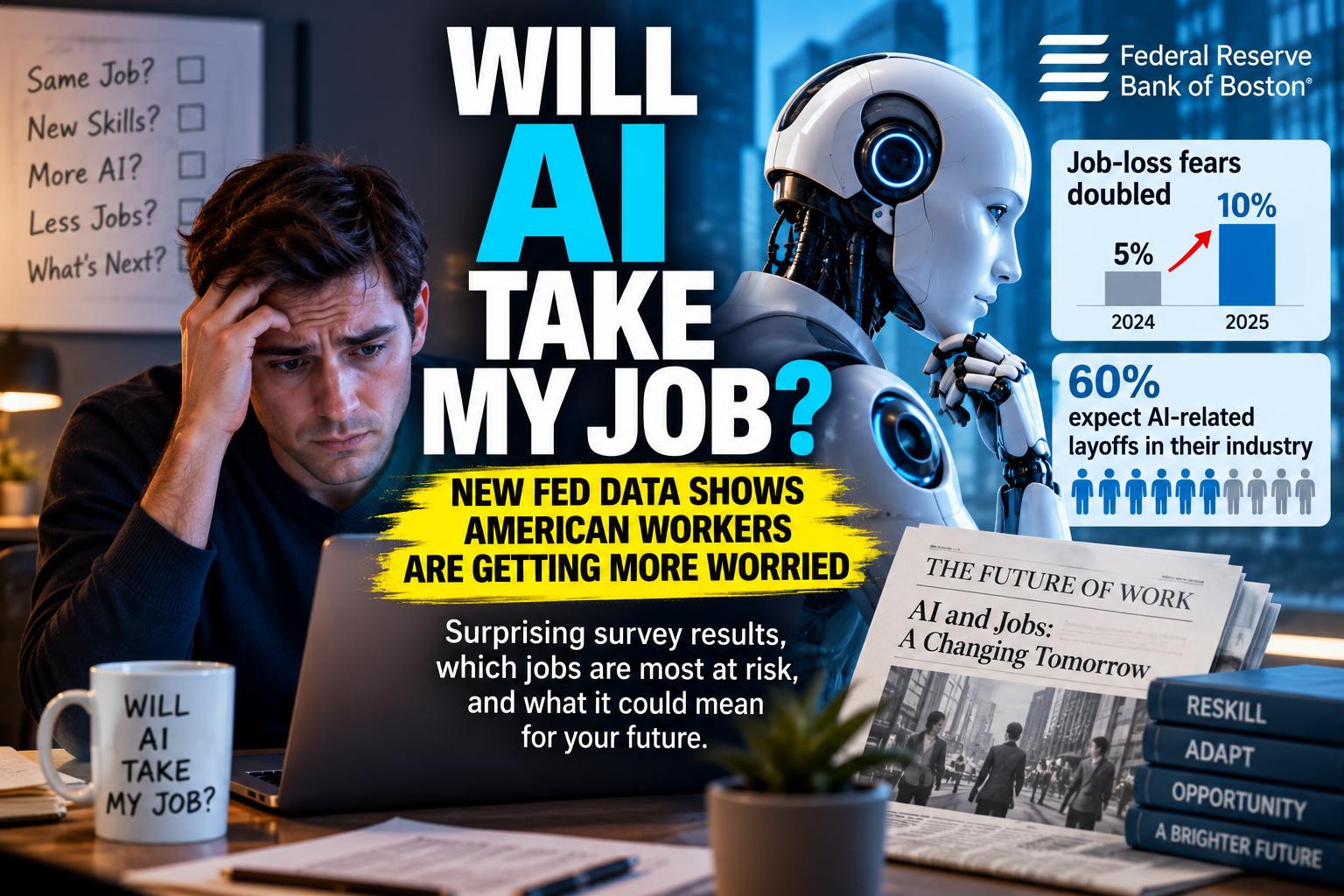
New research released by the Federal Reserve Bank of Boston shows that the share of U.S. workers worried about personally losing their job because of artificial intelligence nearly doubled in just one year.
And the fear becomes much larger when workers are asked about their entire industry.
60% expect AI-related layoffs or fewer workers in their industry.
Perhaps even more surprising:
Workers with doctorates and professional degrees are now among those expressing significant concern.
So is AI actually coming for American jobs?
Or are workers more frightened than the evidence currently justifies?
The answer is more complicated than either extreme.
AI Job-Loss Fear Nearly Doubled in One Year
The Federal Reserve Bank of Boston released two new research briefs on September 2, 2026.
The research used a special module of the New York Fed’s Survey of Consumer Expectations, a nationally representative internet-based survey of roughly 1,300 U.S. household heads.
Researchers compared responses collected in December 2024 with responses from December 2025.
The change was striking.
At the end of 2024, about:
5% of workers
said they were worried about losing their own jobs because of AI.
One year later, that figure had risen to:
just over 10%.
In other words, the share nearly doubled.
And according to the researchers, the increase was visible across almost every industry, education level and age group.
But 60% Think AI Could Reduce Jobs in Their Industry
This may be the most important number in the entire report.
Only around 10% said:
“AI could cost me my job.”
But when workers were asked about their broader industries, the answer changed dramatically.
60% expected AI-related layoffs or a decrease in the number of workers in their industry.
That tells us something interesting about how Americans currently perceive AI.
Many workers apparently think:
“My job may survive — but somebody else’s job probably won’t.”
That gap between personal confidence and industry-wide pessimism could become increasingly important as companies expand AI adoption.
Even PhD Holders Are Worried About AI
One of the most surprising findings involves highly educated workers.
There has long been an assumption that automation primarily threatens repetitive or lower-skilled work.
Generative AI has challenged that assumption because it can perform tasks involving writing, coding, analysis, research and communication.
The Fed survey provides an interesting clue.
In the 2024 survey, none of the respondents holding doctorates or professional degrees reported concern about personally losing their jobs to AI.
One year later:
More than 11% of professional-degree holders were concerned.
And among doctorate holders:
14% were worried about losing their jobs because of AI.
That does not prove 14% of PhD-level jobs will disappear.
It measures fear, not actual future job losses.
But the change in perception is significant.
AI anxiety is no longer confined to workers performing routine tasks.
Which Industries Are Most Worried?
The Boston Fed research found notable differences between industries.
In the 2025 survey, the largest shares of workers worried about personally losing their jobs were found in:
Consumer services — 23%
Leisure services — 21%
Firm services — 15%
But there is another revealing comparison.
Only small percentages of workers in some sectors feared losing their own jobs.
For example, only about 3% of respondents in trade, manufacturing and transportation expressed concern about their personal jobs.
Yet:
65% expected layoffs or fewer workers across their industry.
Again, workers appear much more pessimistic about the future of their industries than about their own immediate employment.
Is AI Actually Eliminating Jobs Yet?
This is where the story becomes more complicated.
Fear of losing a job is not the same as actually losing one.
The Boston Fed researchers themselves emphasize that the long-term labor-market effects of AI remain uncertain.
Their results suggest workers generally expect AI to restructure jobs rather than eliminate human labor on a massive scale.
And recent U.S. labor-market data does not currently show economy-wide mass layoffs caused by AI.
Initial unemployment claims remain relatively low, and Reuters reported this week that the overall U.S. labor market remained stable even as hiring became more cautious.
So the evidence does not support a simple headline such as:
“AI is already destroying millions of American jobs.”
But that does not mean nothing is changing.
Entry-Level White-Collar Jobs May Be an Early Warning
One area deserves particular attention: jobs for younger college graduates.
Recent research highlighted by the Financial Times using Dallas Fed work found weakness in job postings for occupations considered highly exposed to AI.
Job postings for AI-exposed positions had fallen relative to less-exposed jobs, with recent graduates and people attempting to switch jobs particularly affected.
That raises a different possibility.
AI disruption may not initially appear as millions of workers suddenly being fired.
Instead, it could appear through:
fewer new positions,
less hiring,
smaller entry-level teams,
workers not being replaced when they leave,
and
companies expecting existing employees to accomplish more with AI.
That kind of labor-market change can be much harder to see in headline unemployment statistics.
The Workers Most Afraid of AI Are Not Necessarily the Ones Who Use It Best
This is perhaps the most useful finding for individual workers.
The Boston Fed researchers examined whether workers believed AI had made them more productive.
Interestingly, workers who reported the strongest productivity improvements from AI tended to feel more secure, not less.
The workers who appeared most worried were those who had begun using AI for some tasks but had not experienced substantial productivity gains.
Think about the difference.
Worker A
AI can barely perform anything important in the job.
That worker may feel relatively safe because AI cannot easily substitute for their work.
Worker B
AI performs some of the worker’s tasks, but the employee does not become dramatically more productive.
That worker may think:
“If AI can already do part of what I do, why does the company still need me?”
Worker C
AI allows the worker to produce substantially more valuable work.
That employee may instead think:
“AI makes me more valuable to the company.”
The survey suggests Worker B may have the greatest reason for anxiety.
Workers Who Get the Biggest AI Productivity Boost Are Asking for Raises
There is another fascinating result.
Workers who reported the strongest productivity gains from AI were also more likely to say they were considering asking for higher pay.
Among workers reporting the greatest productivity improvement, researchers estimated about a:
14% likelihood of saying they were more likely to ask for a raise.
For workers in the four lower productivity categories, the estimate ranged from roughly 1.9% to 6.4%.
There is an important limitation.
Only around 6% of workers in the sample belonged to the group reporting the strongest productivity gains.
Still, this gives us a very different way of thinking about AI and employment.
The future may not simply divide workers into:
Humans vs. AI.
It could increasingly divide workers into:
people who can use AI to multiply their productivity
and
people whose tasks can be performed by AI without creating much additional human value.
AI Fear Is Also Changing How Americans Think About Money
The second Boston Fed research brief uncovered another unexpected result.
Economists might expect people who fear losing their jobs to save more money.
If you believe unemployment could be coming, building an emergency fund seems logical.
But the survey found the opposite relationship.
The share of workers expecting to save a smaller percentage of their earnings during the following year increased from:
11% in late 2024
to
21% in late 2025.
Workers concerned about losing their jobs because of AI were also significantly more likely to expect their saving rate to decline.
Why?
The researchers suggest affordability pressures may be part of the explanation.
People worried about both job security and their ability to afford everyday goods may simply have less money available to save.
AI Anxiety and the Cost of Living May Be Reinforcing Each Other
This part of the research is especially important.
Participants were asked whether they could afford the same quantity and quality of goods and services as the previous year.
Workers who reported both:
AI-related job-loss anxiety
and
affordability problems
were twice as likely to expect their savings rate to decline compared with respondents who faced affordability difficulties but were not worried about AI-related job loss.
That suggests AI anxiety is becoming more than a technology issue.
It may also be becoming a household-finance issue.
A worker who believes AI could threaten future income while rent, food, insurance and other expenses remain expensive may become more cautious about spending, changing jobs or taking financial risks.
So, Will AI Take Your Job?
There is no honest universal answer.
Some jobs will almost certainly change substantially.
Some tasks will disappear.
Some positions may require fewer employees.
Some entirely new jobs will emerge.
And many existing jobs may remain but become increasingly AI-assisted.
The Boston Fed research does not predict that 60% of Americans will lose their jobs.
That would be a serious misreading of the data.
The 60% figure means that six in ten surveyed workers expected some AI-related layoffs or a decline in the number of workers in their industry.
That is very different from saying 60% of jobs will disappear.
Which Jobs Are Most Vulnerable to AI?
Rather than asking whether an entire profession will disappear, it may be more useful to examine individual tasks.
Jobs may face greater disruption when a large portion of their work consists of tasks such as:
- drafting routine text
- summarizing documents
- basic data analysis
- repetitive customer communication
- standard research
- simple coding
- document classification
- routine administrative work
But even in these occupations, automation does not necessarily mean the entire job disappears.
A worker may simply spend less time performing one task and more time on another.
The Boston Fed research points toward exactly this type of restructuring.
The Better Question May Be: Can AI Make You More Valuable?
For individual workers, this may be the most important lesson in the data.
The survey suggests that the people experiencing the strongest productivity gains from AI are also among those who feel relatively secure.
That changes the question from:
“Can AI do my job?”
to:
“Can I use AI to become substantially better at my job?”
Those are very different questions.
Imagine two employees doing similar work.
One avoids AI completely.
The other learns how to use it for research, first drafts, data organization, repetitive tasks and quality checking — while retaining human judgment and expertise.
If the second employee can produce more valuable work in less time, AI may strengthen that person’s position rather than immediately threaten it.
That will not be true for every occupation.
But the Fed findings suggest productivity could be one of the key variables separating AI anxiety from AI opportunity.
Why Workers Are Turning Against AI
The early excitement around generative AI was largely about what the technology could do.
Write an email.
Generate an image.
Summarize a report.
Write code.
Analyze data.
But the conversation is changing.
Workers are increasingly asking a different question:
“What happens to me when my employer realizes AI can do part of my work?”
That explains why public attitudes toward workplace AI may become more complicated even while adoption continues to increase.
A technology can simultaneously:
increase productivity,
increase company profits,
help some employees,
and
make other employees fear for their jobs.
All four can be true at the same time.
The Biggest AI Employment Change May Be Smaller Than a Mass Layoff — but More Widespread
When people imagine AI replacing jobs, they often picture a dramatic announcement:
“10,000 employees replaced by AI.”
The actual transition may be quieter.
A company once hired ten junior analysts.
Now it hires seven.
A department loses two employees.
They are not replaced.
A customer-service team handles twice as many inquiries because AI manages simple questions.
A programmer uses AI tools to complete work that previously required several junior developers.
No single event looks like an employment apocalypse.
But repeated across thousands of companies, these small changes could gradually reshape the labor market.
That is why hiring patterns, entry-level opportunities and task changes may eventually be as important as headline layoff numbers.
What Should Workers Do Now?
Panic is not a useful strategy.
Ignoring AI probably isn’t one either.
The Fed research provides a more practical clue.
Workers who reported achieving substantial productivity improvements with AI were comparatively optimistic about their job security.
That suggests a reasonable strategy:
Learn where AI can remove low-value work from your job.
Then concentrate more time on the parts AI still struggles with:
judgment, accountability, relationships, physical execution, creativity, domain expertise, negotiation and understanding context.
The safest position may not be having a job that never encounters AI.
It may increasingly be becoming the person who knows how to use AI while still providing something AI cannot easily replace.
The Bottom Line
American workers are clearly becoming more concerned about artificial intelligence and employment.
The Boston Fed’s latest survey research found that:
AI-related personal job-loss fears nearly doubled from 5% to just over 10%.
60% expected AI-related layoffs or fewer workers in their industry.
14% of doctorate holders reported concern about losing their jobs to AI.
And workers dealing with both AI anxiety and affordability pressures were particularly pessimistic about their ability to save money.
But the same research also offers an important counterpoint.
Workers who believed AI had dramatically increased their productivity tended to feel more secure.
So the biggest question of the AI revolution may not ultimately be:
“Will AI take my job?”
It may be:
“What happens to my job when someone using AI can do significantly more than someone who doesn’t?”
We still don’t know exactly how many jobs artificial intelligence will create, eliminate or transform.
But one thing is becoming much clearer.
American workers are no longer treating that question as science fiction.
Official Research
Federal Reserve Bank of Boston — Workers’ Perspectives on AI and Job-Loss Fears
Federal Reserve Bank of Boston — AI, Affordability and Saving Expectations
K-Beauty Shopping
Interested in Korean skincare, cosmetics and beauty products? Explore K-Beauty products at OLIVE YOUNG Global.
Shop K-Beauty at OLIVE YOUNG Global
If you purchase through the link above, the site operator may receive a commission at no additional cost to you.