Ask ChatGPT a question.
Get an answer.
Close the app.
It feels almost weightless.
But somewhere behind that simple interaction, powerful computers inside massive data centers are running calculations, consuming electricity and generating heat.
And heat has to be removed.
That is where water enters the story.
For years, headlines have warned that artificial intelligence has a surprisingly large water footprint.
Then OpenAI CEO Sam Altman offered a dramatically different number.
According to Altman, the average ChatGPT query uses about:
0.000085 gallons of water.
That is roughly 0.32 milliliters — far less than a teaspoon.
More recently, Altman made the comparison even more memorable:
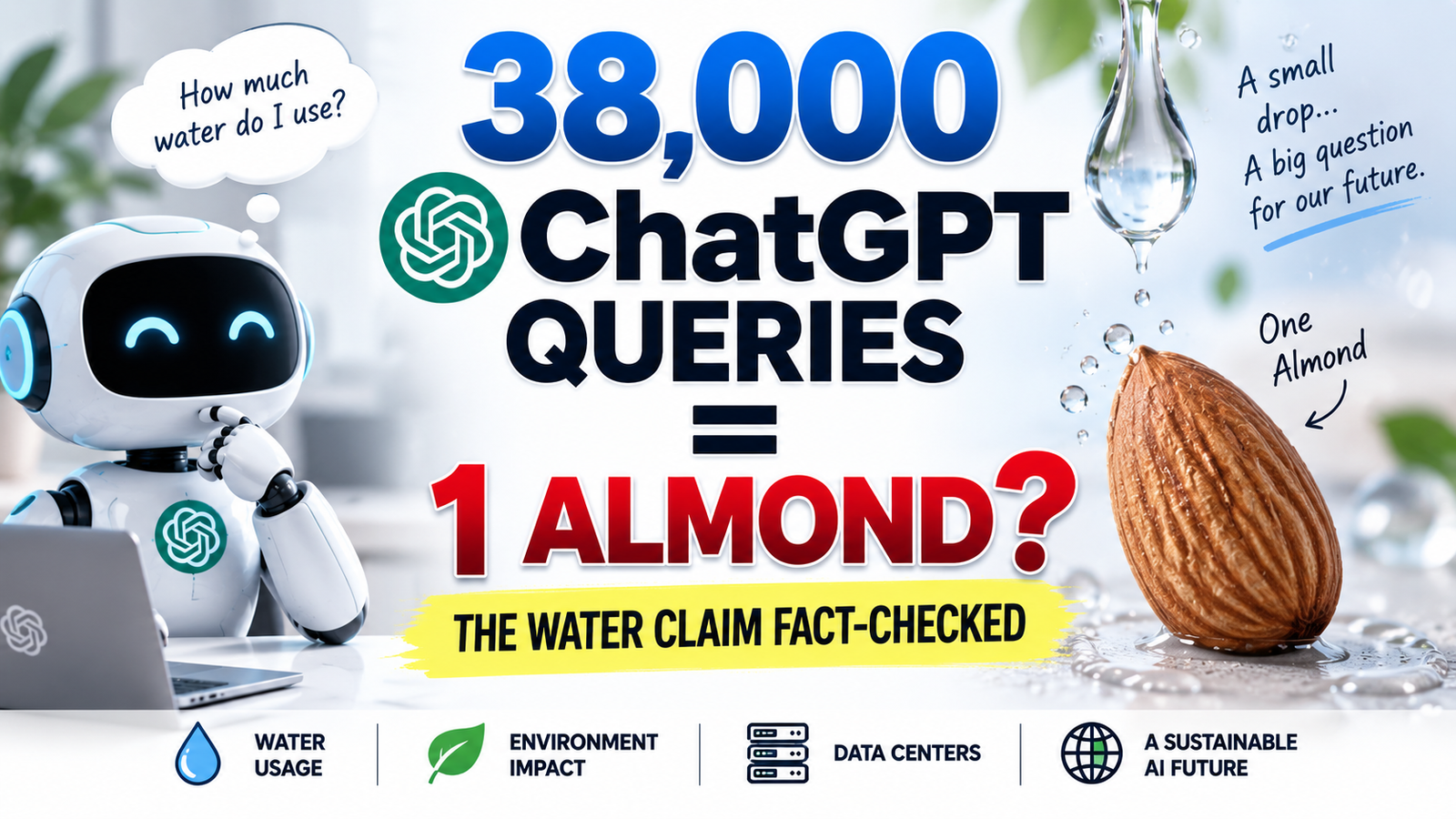
It would take roughly 38,000 ChatGPT queries to use as much water as producing a single California almond.
If true, that would make many viral claims about ChatGPT’s water consumption sound wildly exaggerated.
But is it actually true?
The answer is more complicated.
Altman’s figure is possible under a particular accounting method, but independent experts say there is currently not enough public information about OpenAI’s infrastructure to verify the claim.
And the disagreement reveals a much bigger problem:
Nobody agrees on exactly what should count as AI’s water use.
How Much Water Does Sam Altman Say One ChatGPT Query Uses?
The number did not appear out of nowhere.
In a post titled The Gentle Singularity, Altman wrote that an average ChatGPT query consumes approximately:
0.34 watt-hours of electricity
and
0.000085 gallons of water.
He described the water amount as roughly one-fifteenth of a teaspoon.
Converted to metric units, 0.000085 gallons is approximately:
0.32 milliliters per query.
That is tiny.
A teaspoon holds about 5 milliliters.
At Altman’s estimate, you could make more than a dozen average ChatGPT queries before reaching even one teaspoon of water.
And that is how we arrive at the almond comparison.
Where Does the “38,000 ChatGPT Queries = One Almond” Claim Come From?
In a recent interview, Altman argued that concerns about AI water consumption do not withstand scrutiny and offered California almond production as a comparison.
His claim:
roughly 38,000 ChatGPT queries use as much water as producing one almond.
CalMatters examined the claim as California lawmakers considered new rules that would require greater disclosure of data-center water use.
The comparison is extremely effective because almonds themselves have become a symbol of water-intensive agriculture in drought-prone California.
And mathematically, the claim follows from Altman’s earlier ChatGPT estimate.
If one query uses approximately 0.32 mL of water, then:
38,000 × 0.32 mL ≈ 12.2 liters.
So Altman’s comparison implies that producing one almond involves roughly that order of water consumption under the agricultural assumptions being used.
But this is where things get complicated.
Can We Verify the 38,000-Query Number?
Not really.
At least not with the public information currently available.
CalMatters interviewed experts who said there is simply not enough transparent data about data-center water use to independently confirm Altman’s calculation.
UC Riverside professor Shaolei Ren, who researches the environmental footprint of AI computing, pointed out that many variables can change water consumption dramatically.
They include:
- where the data center is located
- outside temperature
- cooling technology
- electricity source
- prompt length
- model being used
- computational complexity
- response length
That means there is no universal physical law saying:
One ChatGPT query = exactly 0.32 mL of water.
It is an average estimate provided by Altman.
And OpenAI has not publicly released enough underlying infrastructure data for outside researchers to reproduce the number independently.
That distinction is critical.
The figure has been stated by OpenAI’s CEO.
It has not been independently verified as a universal ChatGPT measurement.
Why Does ChatGPT Need Water at All?
ChatGPT does not literally drink water.
The water footprint comes primarily from the infrastructure needed to run AI.
Large AI models operate in data centers filled with computing hardware.
Those processors consume electricity.
Electricity becomes heat.
Too much heat can damage equipment and reduce performance.
So data centers require cooling.
Some cooling systems use water to remove heat from the facility.
Water can evaporate during that process, which means it is consumed rather than immediately returned to the same local water supply.
But that is only the first part of the story.
Direct Water vs. Indirect Water: The Most Important Distinction
When someone asks:
“How much water does ChatGPT use?”
there are actually at least two different questions.
1. Direct water consumption
This is water used at the data center itself, primarily for cooling.
2. Indirect water consumption
Electricity has to be generated somewhere.
Depending on the energy source and power plant, producing that electricity can also require water.
Therefore, researchers examining AI’s total environmental footprint may include water associated with electricity generation.
This creates enormous differences between estimates.
A company might report a relatively low figure based primarily on direct operational water consumption.
An academic researcher might calculate a larger footprint after including indirect water associated with power generation and other infrastructure.
Both numbers can describe something real.
They are simply measuring different boundaries.
This Is Why You See Wildly Different ChatGPT Water Estimates
You may have encountered claims online suggesting that a short ChatGPT conversation can consume a bottle of water.
Then Altman says tens of thousands of queries equal one almond.
How can both claims exist?
Because researchers may be measuring different things.
One influential 2023 academic paper estimated the water footprint of large AI models and argued that training GPT-3 in Microsoft data centers could directly evaporate roughly 700,000 liters of freshwater.
The researchers also warned that AI’s global water footprint could become substantial as demand scales.
But those estimates were based on different models, infrastructure assumptions, locations and accounting methods than Altman’s newer per-query figure.
They should not be treated as measurements of exactly the same thing.
This is one reason headlines such as:
“Every ChatGPT question uses X bottles of water”
should be treated cautiously.
There is no single number that applies to every query everywhere.
A Simple Question and a Hard Question Do Not Cost the Same
This point is often overlooked.
Consider these two prompts.
Prompt A
“What is the capital of France?”
Now compare it with:
Prompt B
“Analyze these 80 pages of financial statements, compare five companies, calculate valuation ratios and write a detailed investment report.”
Calling both of those “one query” hides an enormous amount of information.
The second task may require much more computation.
Reasoning models can also consume substantially more energy than lightweight models.
A 2025 study benchmarking the environmental footprint of different large language models found dramatic differences depending on the model and workload.
For example, researchers estimated that some reasoning models consumed many times more energy for long prompts than smaller, more efficient models.
So when you see an average such as:
0.34 watt-hours per ChatGPT query
remember the word:
average.
Your actual interaction may require substantially more or less computation.
Location Matters Too
Imagine two identical AI servers.
One operates in a cool region.
The other operates during a hot California summer.
Their cooling requirements may be different.
Now imagine one data center uses evaporative cooling while another uses a system designed to minimize water consumption.
Again, the water footprint changes.
Electricity also matters.
Power grids use different combinations of:
natural gas,
nuclear,
hydroelectric,
solar,
wind,
coal
and other energy sources.
Those sources can have very different water requirements.
Research into data-center water efficiency has shown that location and electricity generation mix can dramatically change the water footprint of the same AI workload.
So asking:
“How much water does AI use?”
can be a little like asking:
“How much fuel does a trip use?”
The answer depends on the vehicle, distance, speed and route.
But Aren’t Data Centers Using Huge Amounts of Water?
Yes.
And this is where Altman’s tiny per-query number can be misleading if viewed without scale.
Even if an individual query consumes very little water, ChatGPT is not used once.
AI systems operate at enormous scale.
CalMatters cited Congressional Research Service figures showing U.S. data centers directly consumed roughly:
17 billion gallons of water in 2023
up from approximately:
5.6 billion gallons in 2014.
Another estimate cited in the same reporting suggested hyperscale data centers could consume around 150 billion gallons from 2025 through 2030.
Not all of that water is for AI.
Data centers existed long before ChatGPT.
They power cloud computing, streaming, websites, databases, financial systems and countless other digital services.
But AI is contributing to rapid expansion of data-center infrastructure.
So two statements can simultaneously be true:
One AI query may have a very small footprint.
and
Billions of AI interactions can collectively require significant resources.
The Scale Problem Changes Everything
Let’s use Altman’s own number.
If one query uses:
0.000085 gallons
then 1 million queries would represent about:
85 gallons of water.
One billion queries would represent about:
85,000 gallons.
And 100 billion queries would represent about:
8.5 million gallons.
Again, that calculation simply scales Altman’s stated average. It does not prove the average itself is correct.
But it demonstrates an important environmental principle:
Tiny × enormous scale can still become large.
A single Google search uses little energy.
One streamed video seems insignificant.
One AI query may use a tiny amount of water.
The environmental question changes when billions of people perform those actions repeatedly.
Peak Water Demand May Matter More Than Annual Consumption
There is another issue that makes this story more complicated than comparing ChatGPT with almonds.
Local water systems do not only care about annual consumption.
They must be capable of supplying water during periods of peak demand.
AI data centers can require more cooling during hot weather — exactly when communities may also face higher water demand.
Research discussed by CalMatters suggests the additional peak capacity required by data-center cooling could become a significant challenge for some local water systems.
This matters especially in regions already facing:
drought,
population growth,
aging water infrastructure,
or limited supply.
A national average can therefore hide serious local impacts.
A data center consuming water in a water-rich region is not necessarily equivalent to the same facility drawing treated drinking water in a drought-stressed community.
Could Data Centers Use Less Water?
Yes.
There are cooling technologies that can substantially reduce direct water consumption.
For example, dry cooling systems can reduce reliance on evaporative water cooling.
But there is often a tradeoff.
Using less water can sometimes require more electricity.
And generating that additional electricity may itself have an environmental footprint.
Ren told CalMatters that less water-intensive cooling could reduce direct water use substantially, but the energy tradeoff has to be considered.
This illustrates why AI sustainability is difficult to summarize with one viral statistic.
Reducing:
water
may increase:
electricity consumption.
Reducing electricity consumption may require:
new hardware or infrastructure.
Environmental accounting is rarely one-dimensional.
California Is Now Asking Data Centers for More Transparency
The almond comparison is especially timely because California lawmakers are debating data-center water disclosure.
Lawmakers recently passed measures aimed at increasing transparency around where data centers obtain water and how much they expect to use.
One proposal would require operators seeking permits to disclose water sources and usage.
Another would require developers to disclose water plans before certain new data centers receive local approval.
The measures were awaiting Gov. Gavin Newsom’s decision when CalMatters published its fact-check.
This is directly relevant to Altman’s claim.
The fundamental problem experts repeatedly identify is not simply whether AI uses too much water.
It is:
We don’t have enough standardized public data to know exactly how much it uses.
Is an Almond Really a Fair Comparison?
It is memorable.
Whether it is useful is another question.
Agriculture and data centers use water differently.
Almond trees consume irrigation water over a growing season.
Data centers can require highly treated municipal water for cooling.
Agricultural water demand and urban water infrastructure also affect communities differently.
The water required to produce an almond varies by:
location,
weather,
irrigation efficiency,
year,
and methodology.
CalMatters noted that agricultural estimates themselves vary substantially over time and geography.
So:
38,000 ChatGPT queries = one almond
should not be interpreted as a universal scientific conversion.
It is a comparison based on particular assumptions.
So Is Sam Altman’s Claim False?
We don’t currently have enough evidence to say that.
But we also don’t have enough public evidence to independently confirm it.
That is the most accurate conclusion.
Altman’s underlying number — approximately 0.000085 gallons per average query — comes from OpenAI’s CEO.
Independent researchers do not have access to enough detailed OpenAI infrastructure data to reproduce the calculation.
CalMatters’ fact-check therefore concluded that the claim cannot be adequately verified with currently available public information.
So the responsible conclusion is not:
❌ “Altman lied.”
Nor is it:
❌ “The almond comparison proves AI barely uses water.”
It is:
OpenAI says its average query uses very little water, but the company has not provided enough public data for outside experts to independently verify the figure.
Does This Mean AI Water Concerns Are Exaggerated?
Some viral claims almost certainly oversimplify the issue.
Statements implying that every simple ChatGPT question consumes a huge bottle of water can ignore improvements in hardware efficiency, cooling technology and model inference.
But dismissing the entire water issue would also be a mistake.
AI demand is growing extraordinarily quickly.
Data centers are expanding.
More powerful reasoning models require more computation.
And infrastructure is increasingly being built in communities where electricity and water availability are political issues.
The real question is therefore not:
“Does one ChatGPT query destroy the environment?”
It obviously does not.
The better question is:
“What happens when billions of AI interactions require an enormous global infrastructure operating 24 hours a day?”
That is the scale at which environmental impact becomes meaningful.
What We Actually Know
After separating the claims from the evidence, the picture looks like this.
What OpenAI’s CEO says:
An average ChatGPT query uses approximately 0.34 Wh of electricity and 0.000085 gallons — around 0.32 mL — of water.
What Altman recently claimed:
Roughly 38,000 ChatGPT queries would use as much water as producing one California almond.
What independent experts say:
There is not enough publicly available information about OpenAI’s data-center operations to independently verify that comparison.
What broader data shows:
Data centers collectively consume large and growing quantities of water, although AI represents only part of total data-center activity.
What research tells us:
Water consumption varies substantially by model, workload, location, cooling system and electricity source.
Those facts can all be true at the same time.
The Bigger Problem Isn’t One ChatGPT Question
The debate over AI’s environmental impact often becomes trapped between two extreme narratives.
One side says:
“Every AI question wastes huge amounts of water.”
The other says:
“AI uses practically nothing. Stop worrying about it.”
Reality is more complicated.
Modern computing is becoming dramatically more efficient.
A single AI interaction can have a very small environmental footprint.
But the number of interactions is exploding.
And enormous new data centers are being constructed to satisfy that demand.
That means efficiency improvements and total consumption can rise at the same time.
Cars can become more fuel-efficient while total gasoline consumption remains high if people drive more.
AI can become more water-efficient per query while total AI-related water demand increases because usage grows much faster.
The Bottom Line
So, does ChatGPT really use less water than an almond?
According to Sam Altman’s estimate: yes — by a huge margin per query.
He says the average ChatGPT query uses roughly 0.32 milliliters of water, leading to the striking comparison that about 38,000 queries equal the water footprint of one California almond.
But there is an important catch.
Independent researchers currently cannot verify that number from public data.
The actual footprint of an AI interaction can change depending on the model, prompt, data center, weather, cooling system and electricity source.
And measuring only direct cooling water may produce a very different number from an analysis that includes the water used to generate electricity.
So perhaps the most important number in this entire debate isn’t 38,000.
It’s the number we still don’t have:
A transparent, independently verifiable measure of how much water major AI systems actually consume.
Until companies disclose more standardized infrastructure data, viral claims from both sides should be treated cautiously.
One ChatGPT question probably isn’t draining a reservoir.
But billions of AI queries — and the massive data-center buildout required to serve them — make the water question worth asking.
Sources & Further Reading
For the original estimate, see Sam Altman — The Gentle Singularity. For the latest independent examination of the 38,000-query claim, see CalMatters — Fact check: Is Sam Altman right that almonds use more water than ChatGPT queries?. Academic background on AI’s direct and indirect water footprint is available in the research on Making AI Less “Thirsty”.
K-Beauty Shopping
Interested in Korean skincare, cosmetics and beauty products? Explore K-Beauty products at OLIVE YOUNG Global.
Shop K-Beauty at OLIVE YOUNG Global
If you purchase through the link above, the site operator may receive a commission at no additional cost to you.