Federal Reserve

  • Why Are Americans Feeling Worse About the Economy While Stocks Keep Rising?

    Something strange is happening in the U.S. economy.

    American consumers are becoming increasingly pessimistic.

    The University of Michigan’s preliminary Consumer Sentiment Index fell to 47.8 in September 2026, down from 51.7 in August. Expectations for the future deteriorated even more sharply, while consumers’ expectations for inflation over the next year jumped from 4.0% to 4.6%.

    Yet Wall Street told a very different story.

    On Friday, the S&P 500, Nasdaq and Dow all rose more than 1%.

    So how can both things be true?

    Why can Americans feel increasingly worried about the economy while stocks continue to rise?

    The answer is surprisingly simple:

    The stock market and the average household are measuring two very different things.


    Americans Are Becoming More Worried About the Economy

    First, the numbers.

    The University of Michigan’s preliminary September survey showed:

    • Consumer Sentiment Index: 47.8
    • August reading: 51.7
    • Current Economic Conditions: 50.9
    • Consumer Expectations: 45.8

    The headline index is down 13.2% from September 2025.

    The particularly important number may be expectations.

    Consumers aren’t only unhappy about their current situation.

    They are becoming more worried about what comes next.

    The Expectations Index dropped from 51.5 in August to just 45.8 in September.

    Why?

    Two issues are hitting households particularly hard:

    fuel prices and inflation fears.

    University of Michigan survey director Joanne Hsu said renewed fuel-price pressures and trade tensions were leading consumers to expect more pressure on their finances.


    Inflation Is Back at the Center of the Problem

    The timing matters.

    U.S. consumer prices rose 0.4% in August, while annual CPI inflation stood at 3.4%.

    But consumers aren’t only reacting to the official inflation rate.

    They’re reacting to the prices they actually encounter.

    Gasoline.

    Food.

    Housing.

    Insurance.

    Car payments.

    Credit cards.

    Those expenses affect how wealthy—or poor—a household feels every month.

    And energy has become particularly painful.

    Oil prices surged during the week amid conflict in the Middle East before retreating on Friday. Brent crude had reached nearly $110 per barrel before pulling back toward $104.

    For a household filling its car every week, that isn’t an abstract economic statistic.

    It’s money disappearing from the checking account.


    But Why Are Stocks Rising?

    This is where the apparent contradiction begins to make sense.

    The stock market does not ask:

    “How comfortable does the average American household feel today?”

    Investors are asking different questions:

    How much money will companies earn?

    What will interest rates do next?

    Are inflation numbers better or worse than investors expected?

    What will happen six or twelve months from now?

    That distinction is crucial.

    On Friday, the CPI report wasn’t necessarily good for households.

    Inflation was still elevated.

    But it was close enough to market expectations that investors were relieved it wasn’t significantly worse.

    Reuters reported that U.S. stocks rose 1% or more after the inflation report, while Treasury yields retreated from their highs.

    In other words:

    Consumers can dislike an economic number while investors like the same number.


    Wall Street Trades Expectations, Not Happiness

    Imagine investors expect something terrible.

    Then something merely bad happens.

    Stocks can rise.

    Why?

    Because the result was:

    better than feared.

    This is one of the strangest things about financial markets for people who don’t follow them every day.

    A headline might say:

    “Inflation rises.”

    And stocks rise.

    Another headline might say:

    “Company profits increase.”

    And the stock falls.

    The reason is expectations.

    If investors had already expected inflation to be even worse, a less-bad inflation report can create relief.

    If investors expected a company’s earnings to rise 30%, a 20% increase can disappoint them.

    Markets constantly compare reality with expectations.

    Households don’t.

    A family doesn’t care whether gasoline prices were “better than Wall Street expected.”

    They care about how much it costs to fill the tank.


    The Federal Reserve Makes the Divide Even More Complicated

    There’s another important factor:

    interest rates.

    August’s inflation report increased expectations that the Federal Reserve could raise rates at its next meeting.

    Markets were pricing roughly an 85% probability of a quarter-point rate increase following the CPI report, according to Reuters.

    Higher interest rates can hurt households through:

    • mortgages,
    • auto loans,
    • credit cards,
    • business borrowing,
    • and other forms of debt.

    But financial markets think several moves ahead.

    Investors don’t only ask whether rates will rise next week.

    They ask:

    What happens after that?

    Will inflation cool?

    Will the Fed stop hiking?

    Will corporate earnings remain strong?

    Will oil prices fall?

    Will economic growth survive?

    That’s why stock prices can move in a direction that seems completely disconnected from today’s household experience.


    The Stock Market Is Not the U.S. Economy

    This is probably the most important point.

    People often use the stock market as shorthand for “the economy.”

    They’re not the same thing.

    The U.S. economy includes hundreds of millions of people, millions of businesses, workers, renters, homeowners and consumers.

    The stock market represents the expected value of publicly traded companies.

    And the largest companies have an enormous influence on major indexes.

    A household struggling with groceries and gasoline can therefore coexist with a highly profitable technology company.

    Both realities can be true simultaneously.

    Wall Street can be doing well while Main Street feels terrible.


    There Is Also a Wealth Divide

    Stocks don’t benefit everyone equally.

    Americans who own significant stocks through brokerage accounts, retirement plans or other investments can benefit when markets rise.

    Someone without meaningful financial assets doesn’t receive that benefit.

    They may experience:

    higher groceries + higher gasoline + expensive housing + expensive borrowing

    without receiving much of the upside from:

    rising stocks.

    That helps explain why a booming market doesn’t automatically produce booming consumer confidence.

    For some households, a rising S&P 500 may increase their wealth.

    For others, it is little more than a headline.


    Why Consumer Sentiment Matters Anyway

    It would be easy to dismiss consumer sentiment as simply a survey of people’s feelings.

    That would be a mistake.

    Consumer spending is an enormous part of the U.S. economy.

    If people become worried enough about their finances, they may eventually change their behavior.

    They may postpone:

    a new car,
    a vacation,
    a home renovation,
    a major appliance,
    or other discretionary purchases.

    If millions of households make those decisions simultaneously, weaker sentiment can eventually become weaker spending.

    And weaker spending can eventually affect corporate profits.

    That’s where the two worlds can reconnect.

    Wall Street can ignore unhappy consumers for a while.

    It cannot ignore them forever if they stop spending.


    What Could Eventually Make Stocks Fall?

    The current gap between consumer anxiety and stock prices doesn’t necessarily continue indefinitely.

    Several things could bring the two closer together.

    1. Consumers actually reduce spending

    Feeling pessimistic is one thing.

    Changing spending behavior is another.

    If retail sales and discretionary spending weaken materially, corporate earnings could suffer.

    2. Oil stays expensive

    Energy affects almost everything.

    Transportation costs rise.

    Businesses pay more.

    Consumers have less money available for other purchases.

    Persistent high oil prices could therefore hit both households and corporate profits.

    3. Interest rates remain high

    The benchmark 10-year U.S. Treasury yield recently approached 5%, a level closely watched by investors.

    High bond yields can make borrowing more expensive and also make bonds more attractive compared with stocks.

    4. Corporate earnings weaken

    Ultimately, earnings remain one of the strongest supports for stock prices.

    If companies continue producing strong profits, markets can remain resilient even when consumers are unhappy.

    But if consumer weakness finally reaches company earnings, investors may react very differently.


    So Is Wall Street Wrong or Are Consumers Wrong?

    Probably neither.

    They’re answering different questions.

    Consumers are saying:

    “My life feels more expensive, and I’m worried it will get worse.”

    Investors are saying:

    “Given everything we already expected, what are companies likely to earn in the future?”

    Those statements do not contradict each other.

    And that’s the key to understanding the strange U.S. economy of 2026.

    The economy can simultaneously contain:

    strong companies,
    rising stocks,
    high borrowing costs,
    persistent inflation,
    and unhappy consumers.


    The Number to Watch Next

    One number will be particularly interesting from here:

    consumer spending.

    Consumer sentiment tells us how people feel.

    Spending tells us what they do.

    If Americans continue spending despite their pessimism, the disconnect between Wall Street and household sentiment could continue.

    But if deteriorating confidence finally causes consumers to pull back significantly, the story could change.

    Because eventually:

    lower spending → weaker company revenue → weaker earnings

    can reach Wall Street too.

    That’s when today’s strange disconnect could start disappearing.


    Final Takeaway

    So why are Americans feeling worse about the economy while stocks keep rising?

    Because households and Wall Street experience the economy differently.

    Consumers feel the economy through:

    gas prices, groceries, rent, mortgages, wages and monthly bills.

    Investors view it through:

    earnings, interest rates, expectations and future growth.

    Right now, those two perspectives are pointing in different directions.

    September’s consumer sentiment reading of 47.8 shows just how worried households have become.

    Meanwhile, stocks can still rise when economic data is merely better than investors feared.

    But there’s one question worth watching:

    What happens if worried Americans finally stop spending?

    That’s when Main Street’s pessimism could become Wall Street’s problem.
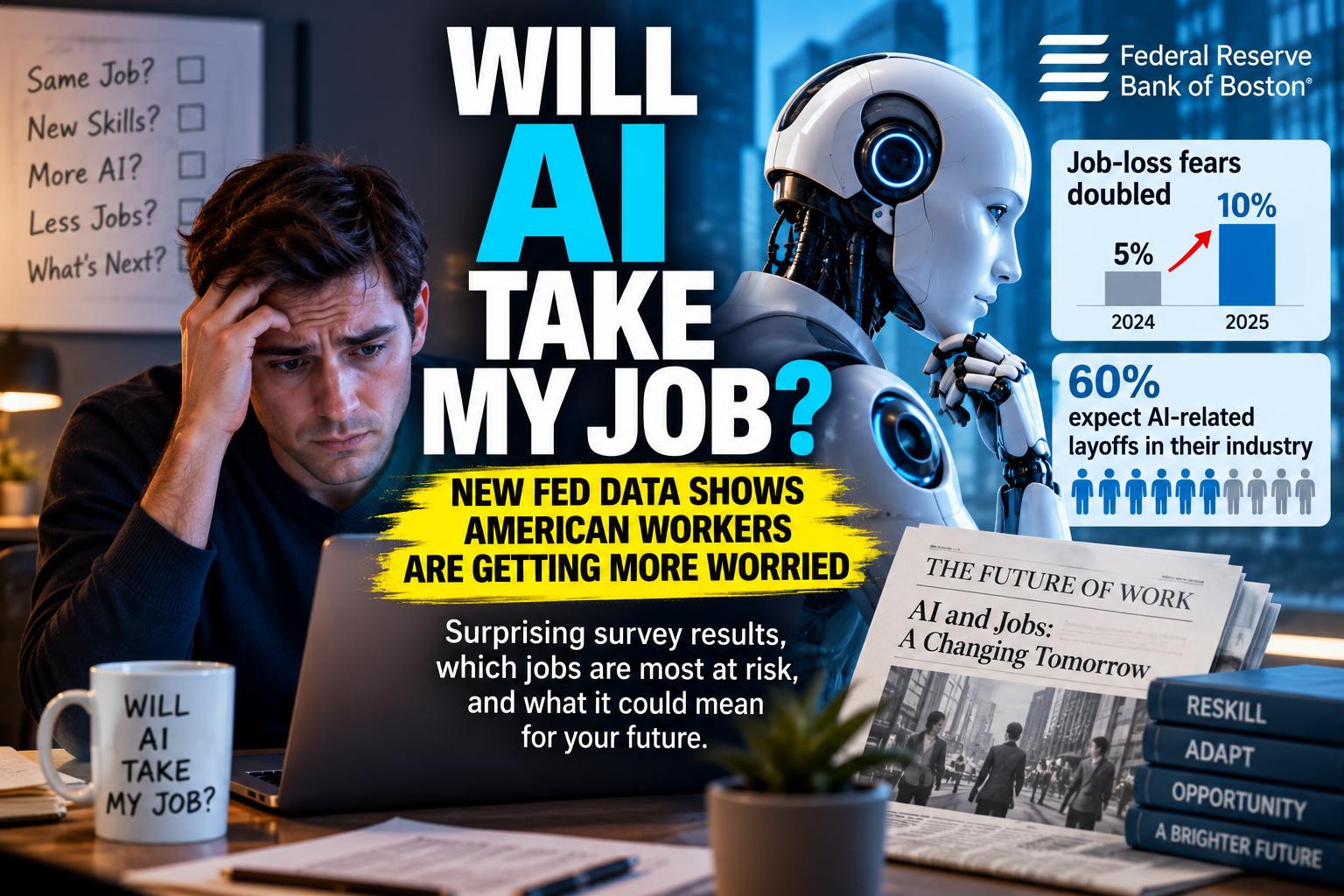
  • Will AI Take My Job? New Fed Data Shows American Workers Are Getting More Worried

    Will AI Take My Job? New Fed Data Shows American Workers Are Getting More Worried

    For years, the debate over artificial intelligence and jobs sounded theoretical.

    Would AI replace programmers?

    Would accountants disappear?

    Would customer service jobs be automated?

    Would highly educated professionals be protected?

    Now, American workers are beginning to give a much clearer answer about how they feel.

    They are getting worried.

    New research released by the Federal Reserve Bank of Boston shows that the share of U.S. workers worried about personally losing their job because of artificial intelligence nearly doubled in just one year.

    And the fear becomes much larger when workers are asked about their entire industry.

    60% expect AI-related layoffs or fewer workers in their industry.

    Perhaps even more surprising:

    Workers with doctorates and professional degrees are now among those expressing significant concern.

    So is AI actually coming for American jobs?

    Or are workers more frightened than the evidence currently justifies?

    The answer is more complicated than either extreme.


    AI Job-Loss Fear Nearly Doubled in One Year

    The Federal Reserve Bank of Boston released two new research briefs on September 2, 2026.

    The research used a special module of the New York Fed’s Survey of Consumer Expectations, a nationally representative internet-based survey of roughly 1,300 U.S. household heads.

    Researchers compared responses collected in December 2024 with responses from December 2025.

    The change was striking.

    At the end of 2024, about:

    5% of workers

    said they were worried about losing their own jobs because of AI.

    One year later, that figure had risen to:

    just over 10%.

    In other words, the share nearly doubled.

    And according to the researchers, the increase was visible across almost every industry, education level and age group.


    But 60% Think AI Could Reduce Jobs in Their Industry

    This may be the most important number in the entire report.

    Only around 10% said:

    “AI could cost me my job.”

    But when workers were asked about their broader industries, the answer changed dramatically.

    60% expected AI-related layoffs or a decrease in the number of workers in their industry.

    That tells us something interesting about how Americans currently perceive AI.

    Many workers apparently think:

    “My job may survive — but somebody else’s job probably won’t.”

    That gap between personal confidence and industry-wide pessimism could become increasingly important as companies expand AI adoption.


    Even PhD Holders Are Worried About AI

    One of the most surprising findings involves highly educated workers.

    There has long been an assumption that automation primarily threatens repetitive or lower-skilled work.

    Generative AI has challenged that assumption because it can perform tasks involving writing, coding, analysis, research and communication.

    The Fed survey provides an interesting clue.

    In the 2024 survey, none of the respondents holding doctorates or professional degrees reported concern about personally losing their jobs to AI.

    One year later:

    More than 11% of professional-degree holders were concerned.

    And among doctorate holders:

    14% were worried about losing their jobs because of AI.

    That does not prove 14% of PhD-level jobs will disappear.

    It measures fear, not actual future job losses.

    But the change in perception is significant.

    AI anxiety is no longer confined to workers performing routine tasks.


    Which Industries Are Most Worried?

    The Boston Fed research found notable differences between industries.

    In the 2025 survey, the largest shares of workers worried about personally losing their jobs were found in:

    Consumer services — 23%

    Leisure services — 21%

    Firm services — 15%

    But there is another revealing comparison.

    Only small percentages of workers in some sectors feared losing their own jobs.

    For example, only about 3% of respondents in trade, manufacturing and transportation expressed concern about their personal jobs.

    Yet:

    65% expected layoffs or fewer workers across their industry.

    Again, workers appear much more pessimistic about the future of their industries than about their own immediate employment.


    Is AI Actually Eliminating Jobs Yet?

    This is where the story becomes more complicated.

    Fear of losing a job is not the same as actually losing one.

    The Boston Fed researchers themselves emphasize that the long-term labor-market effects of AI remain uncertain.

    Their results suggest workers generally expect AI to restructure jobs rather than eliminate human labor on a massive scale.

    And recent U.S. labor-market data does not currently show economy-wide mass layoffs caused by AI.

    Initial unemployment claims remain relatively low, and Reuters reported this week that the overall U.S. labor market remained stable even as hiring became more cautious.

    So the evidence does not support a simple headline such as:

    “AI is already destroying millions of American jobs.”

    But that does not mean nothing is changing.


    Entry-Level White-Collar Jobs May Be an Early Warning

    One area deserves particular attention: jobs for younger college graduates.

    Recent research highlighted by the Financial Times using Dallas Fed work found weakness in job postings for occupations considered highly exposed to AI.

    Job postings for AI-exposed positions had fallen relative to less-exposed jobs, with recent graduates and people attempting to switch jobs particularly affected.

    That raises a different possibility.

    AI disruption may not initially appear as millions of workers suddenly being fired.

    Instead, it could appear through:

    fewer new positions,

    less hiring,

    smaller entry-level teams,

    workers not being replaced when they leave,

    and

    companies expecting existing employees to accomplish more with AI.

    That kind of labor-market change can be much harder to see in headline unemployment statistics.


    The Workers Most Afraid of AI Are Not Necessarily the Ones Who Use It Best

    This is perhaps the most useful finding for individual workers.

    The Boston Fed researchers examined whether workers believed AI had made them more productive.

    Interestingly, workers who reported the strongest productivity improvements from AI tended to feel more secure, not less.

    The workers who appeared most worried were those who had begun using AI for some tasks but had not experienced substantial productivity gains.

    Think about the difference.

    Worker A

    AI can barely perform anything important in the job.

    That worker may feel relatively safe because AI cannot easily substitute for their work.

    Worker B

    AI performs some of the worker’s tasks, but the employee does not become dramatically more productive.

    That worker may think:

    “If AI can already do part of what I do, why does the company still need me?”

    Worker C

    AI allows the worker to produce substantially more valuable work.

    That employee may instead think:

    “AI makes me more valuable to the company.”

    The survey suggests Worker B may have the greatest reason for anxiety.


    Workers Who Get the Biggest AI Productivity Boost Are Asking for Raises

    There is another fascinating result.

    Workers who reported the strongest productivity gains from AI were also more likely to say they were considering asking for higher pay.

    Among workers reporting the greatest productivity improvement, researchers estimated about a:

    14% likelihood of saying they were more likely to ask for a raise.

    For workers in the four lower productivity categories, the estimate ranged from roughly 1.9% to 6.4%.

    There is an important limitation.

    Only around 6% of workers in the sample belonged to the group reporting the strongest productivity gains.

    Still, this gives us a very different way of thinking about AI and employment.

    The future may not simply divide workers into:

    Humans vs. AI.

    It could increasingly divide workers into:

    people who can use AI to multiply their productivity

    and

    people whose tasks can be performed by AI without creating much additional human value.


    AI Fear Is Also Changing How Americans Think About Money

    The second Boston Fed research brief uncovered another unexpected result.

    Economists might expect people who fear losing their jobs to save more money.

    If you believe unemployment could be coming, building an emergency fund seems logical.

    But the survey found the opposite relationship.

    The share of workers expecting to save a smaller percentage of their earnings during the following year increased from:

    11% in late 2024

    to

    21% in late 2025.

    Workers concerned about losing their jobs because of AI were also significantly more likely to expect their saving rate to decline.

    Why?

    The researchers suggest affordability pressures may be part of the explanation.

    People worried about both job security and their ability to afford everyday goods may simply have less money available to save.


    AI Anxiety and the Cost of Living May Be Reinforcing Each Other

    This part of the research is especially important.

    Participants were asked whether they could afford the same quantity and quality of goods and services as the previous year.

    Workers who reported both:

    AI-related job-loss anxiety

    and

    affordability problems

    were twice as likely to expect their savings rate to decline compared with respondents who faced affordability difficulties but were not worried about AI-related job loss.

    That suggests AI anxiety is becoming more than a technology issue.

    It may also be becoming a household-finance issue.

    A worker who believes AI could threaten future income while rent, food, insurance and other expenses remain expensive may become more cautious about spending, changing jobs or taking financial risks.


    So, Will AI Take Your Job?

    There is no honest universal answer.

    Some jobs will almost certainly change substantially.

    Some tasks will disappear.

    Some positions may require fewer employees.

    Some entirely new jobs will emerge.

    And many existing jobs may remain but become increasingly AI-assisted.

    The Boston Fed research does not predict that 60% of Americans will lose their jobs.

    That would be a serious misreading of the data.

    The 60% figure means that six in ten surveyed workers expected some AI-related layoffs or a decline in the number of workers in their industry.

    That is very different from saying 60% of jobs will disappear.


    Which Jobs Are Most Vulnerable to AI?

    Rather than asking whether an entire profession will disappear, it may be more useful to examine individual tasks.

    Jobs may face greater disruption when a large portion of their work consists of tasks such as:

    • drafting routine text
    • summarizing documents
    • basic data analysis
    • repetitive customer communication
    • standard research
    • simple coding
    • document classification
    • routine administrative work

    But even in these occupations, automation does not necessarily mean the entire job disappears.

    A worker may simply spend less time performing one task and more time on another.

    The Boston Fed research points toward exactly this type of restructuring.


    The Better Question May Be: Can AI Make You More Valuable?

    For individual workers, this may be the most important lesson in the data.

    The survey suggests that the people experiencing the strongest productivity gains from AI are also among those who feel relatively secure.

    That changes the question from:

    “Can AI do my job?”

    to:

    “Can I use AI to become substantially better at my job?”

    Those are very different questions.

    Imagine two employees doing similar work.

    One avoids AI completely.

    The other learns how to use it for research, first drafts, data organization, repetitive tasks and quality checking — while retaining human judgment and expertise.

    If the second employee can produce more valuable work in less time, AI may strengthen that person’s position rather than immediately threaten it.

    That will not be true for every occupation.

    But the Fed findings suggest productivity could be one of the key variables separating AI anxiety from AI opportunity.


    Why Workers Are Turning Against AI

    The early excitement around generative AI was largely about what the technology could do.

    Write an email.

    Generate an image.

    Summarize a report.

    Write code.

    Analyze data.

    But the conversation is changing.

    Workers are increasingly asking a different question:

    “What happens to me when my employer realizes AI can do part of my work?”

    That explains why public attitudes toward workplace AI may become more complicated even while adoption continues to increase.

    A technology can simultaneously:

    increase productivity,

    increase company profits,

    help some employees,

    and

    make other employees fear for their jobs.

    All four can be true at the same time.


    The Biggest AI Employment Change May Be Smaller Than a Mass Layoff — but More Widespread

    When people imagine AI replacing jobs, they often picture a dramatic announcement:

    “10,000 employees replaced by AI.”

    The actual transition may be quieter.

    A company once hired ten junior analysts.

    Now it hires seven.

    A department loses two employees.

    They are not replaced.

    A customer-service team handles twice as many inquiries because AI manages simple questions.

    A programmer uses AI tools to complete work that previously required several junior developers.

    No single event looks like an employment apocalypse.

    But repeated across thousands of companies, these small changes could gradually reshape the labor market.

    That is why hiring patterns, entry-level opportunities and task changes may eventually be as important as headline layoff numbers.


    What Should Workers Do Now?

    Panic is not a useful strategy.

    Ignoring AI probably isn’t one either.

    The Fed research provides a more practical clue.

    Workers who reported achieving substantial productivity improvements with AI were comparatively optimistic about their job security.

    That suggests a reasonable strategy:

    Learn where AI can remove low-value work from your job.

    Then concentrate more time on the parts AI still struggles with:

    judgment, accountability, relationships, physical execution, creativity, domain expertise, negotiation and understanding context.

    The safest position may not be having a job that never encounters AI.

    It may increasingly be becoming the person who knows how to use AI while still providing something AI cannot easily replace.


    The Bottom Line

    American workers are clearly becoming more concerned about artificial intelligence and employment.

    The Boston Fed’s latest survey research found that:

    AI-related personal job-loss fears nearly doubled from 5% to just over 10%.

    60% expected AI-related layoffs or fewer workers in their industry.

    14% of doctorate holders reported concern about losing their jobs to AI.

    And workers dealing with both AI anxiety and affordability pressures were particularly pessimistic about their ability to save money.

    But the same research also offers an important counterpoint.

    Workers who believed AI had dramatically increased their productivity tended to feel more secure.

    So the biggest question of the AI revolution may not ultimately be:

    “Will AI take my job?”

    It may be:

    “What happens to my job when someone using AI can do significantly more than someone who doesn’t?”

    We still don’t know exactly how many jobs artificial intelligence will create, eliminate or transform.

    But one thing is becoming much clearer.

    American workers are no longer treating that question as science fiction.


    Official Research

    Federal Reserve Bank of Boston — Workers’ Perspectives on AI and Job-Loss Fears

    Federal Reserve Bank of Boston — AI, Affordability and Saving Expectations


    K-Beauty Shopping

    Interested in Korean skincare, cosmetics and beauty products? Explore K-Beauty products at OLIVE YOUNG Global.

    Shop K-Beauty at OLIVE YOUNG Global

    If you purchase through the link above, the site operator may receive a commission at no additional cost to you.