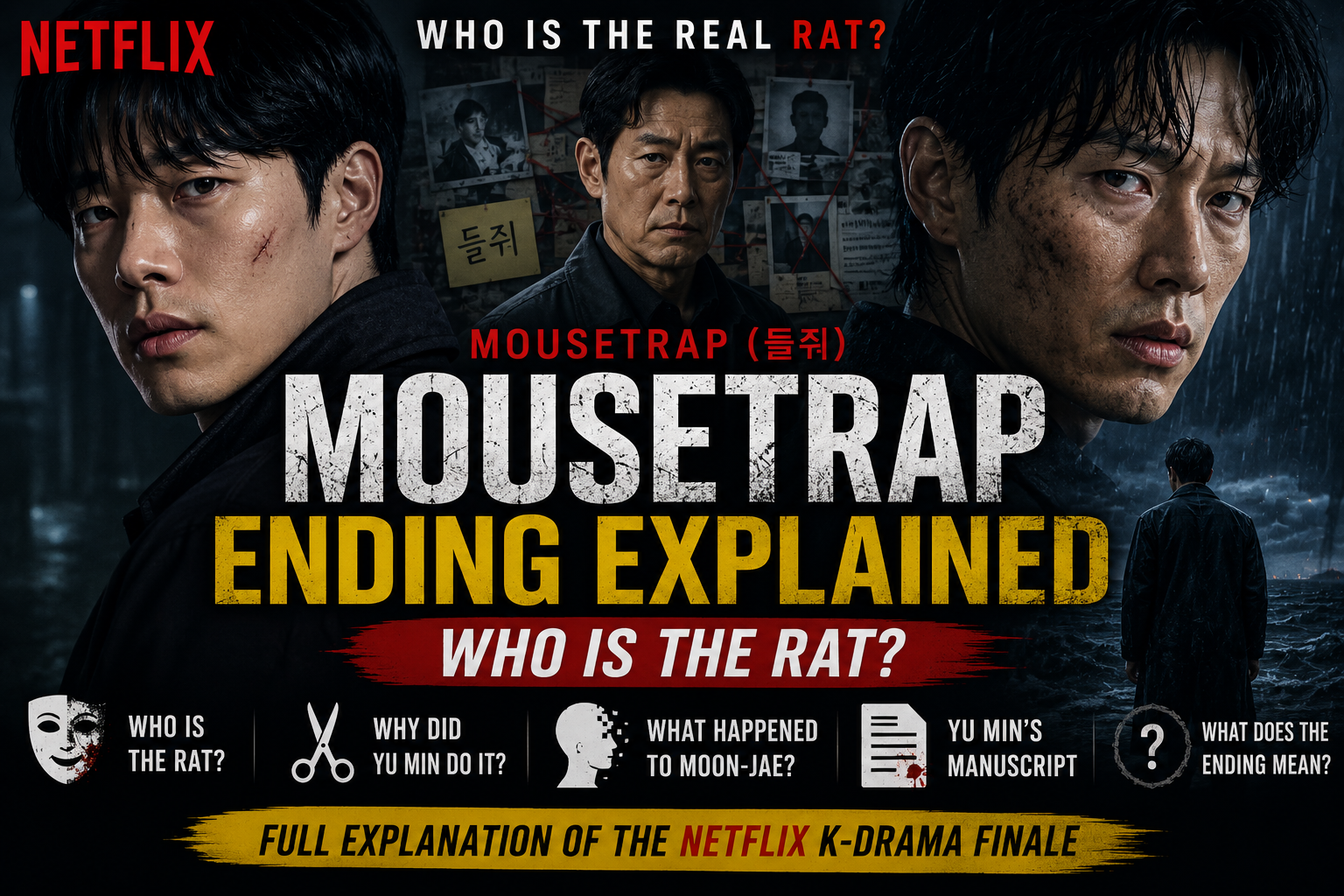
Warning: Major spoilers for all 10 episodes of Netflix’s Mousetrap (들쥐) follow.
Netflix’s Korean thriller Mousetrap spends most of its 10 episodes making us believe Je Moon-jae is the victim of a terrifying identity theft.
Someone has taken his name, his face, his money and seemingly his entire life.
But the finale turns that premise upside down.
The man chasing an impostor has spent much of his own life taking things that belonged to other people.
And that is the key to understanding the ending of Mousetrap.
Who Is The Rat in Mousetrap?
The person behind the present-day theft of Moon-jae’s identity is Yu Min.
But calling Yu Min simply “the villain” misses the biggest twist.
Yu Min and Moon-jae knew each other years earlier.
Moon-jae became jealous of Yu Min and ultimately took his writing and used it to build his own career as a successful novelist.
In other words:
Yu Min steals Moon-jae’s identity in the present — but Moon-jae had already stolen Yu Min’s work, experiences and future.
The series therefore deliberately reverses our understanding of victim and perpetrator.
Who Is the Real Villain in Mousetrap?
If you’re wondering who the real villain is in Mousetrap, the answer is more complicated than it first appears.
Yu Min is the antagonist behind the present-day identity theft, but Moon-jae may be the story’s real villain.
For most of the series, Yu Min appears to be the obvious villain. He steals Moon-jae’s identity, takes control of his money and turns his life into a nightmare.
But the finale changes how we understand their relationship.
Years earlier, Moon-jae stole Yu Min’s writing and used it to help build his own successful career as a novelist.
That means Yu Min’s actions are not random.
They are revenge.
This does not make everything Yu Min does morally justified. But it does blur the line between victim and villain.
Yu Min is the person attacking Moon-jae in the present.
Moon-jae, however, is the person whose earlier betrayal helped create the entire conflict.
So who is the villain in Mousetrap?
Yu Min is the immediate antagonist, but Moon-jae is arguably the deeper villain of the story.
That reversal is one of the central ideas of Mousetrap: the man we initially believe is the victim gradually becomes someone whose own actions are impossible to ignore.
Why Did Yu Min Steal Moon-jae’s Identity?
This is where the revenge becomes much more meaningful.
Yu Min isn’t simply trying to steal money.
He wants Moon-jae to experience what it feels like to have his own existence taken away.
Years earlier, Moon-jae stole Yu Min’s notebooks and writing and published the work under his own name.
That helped Moon-jae become an acclaimed novelist.
But the success was built partly on something that wasn’t truly his.
Yu Min’s revenge therefore mirrors Moon-jae’s original wrongdoing:
You stole my life. Now I will steal yours.
This is why the drama’s identity-theft premise works on two levels.
There is the literal theft of an identity.
And there is the deeper theft of another person’s talent, story and future.
What Happens Between Moon-jae and Yu Min?
Their conflict finally reaches its climax aboard a ship heading toward Jeju.
Yu Min intends to expose Moon-jae and disappear.
Moon-jae, however, cannot allow the life and identity he has constructed to collapse.
The confrontation becomes violent.
Yu Min ultimately falls into the sea.
His body is not recovered.
This creates one of the finale’s most important ambiguities.
Legally, Moon-jae has room to protect himself because there is no body providing definitive evidence of what happened.
But morally, the situation is completely different.
By this point, the audience knows enough about Moon-jae’s past to understand that the supposed victim we’ve followed throughout the series is far more complicated than he appeared.
Does Yu Min Die in Mousetrap?
The series leaves a small amount of ambiguity around Yu Min.
He falls into the sea during the final confrontation and his body is not recovered.
The most straightforward interpretation is that Yu Min is presumed dead.
However, the final scene deliberately brings Yu Min back into Moon-jae’s psychological world.
That doesn’t necessarily mean he physically survived.
And this distinction becomes important at the very end.
What Happens to Moon-jae?
On paper, Moon-jae appears to win.
He survives.
He gets his identity back.
He returns home.
And he avoids an immediate legal reckoning for what happened aboard the ship.
But this is not a happy ending.
Moon-jae discovers that reclaiming his legal identity doesn’t solve his real problem.
Because the central question was never simply:
“Who legally owns the name Je Moon-jae?”
The deeper question is:
“Who is Je Moon-jae without the things he took from other people?”
That’s much harder for him to answer.
Why Can’t Moon-jae Write?
This may be one of the most important details in the ending.
Moon-jae’s successful career as an author was built in significant part on Yu Min’s writing.
After everything that happens, Moon-jae is left facing something terrifying:
He has to write as himself.
And he struggles to do it.
Yu Min’s final manuscript becomes especially cruel because it forces Moon-jae to confront how much of the successful writer “Je Moon-jae” was constructed from somebody else’s talent and story.
The man who was terrified of having his identity stolen discovers that he may never have possessed a completely authentic identity in the first place.
What Does Yu Min’s Manuscript Mean?
Yu Min’s manuscript is more than another plot device.
It functions almost like a final trap.
The manuscript contains a story that reflects Moon-jae’s own past, including the plagiarism and deception behind his success.
If the truth comes out, the identity Moon-jae fought so desperately to recover could collapse anyway.
Moon-jae therefore faces an impossible situation.
He has recovered the name.
He has recovered the house.
He has recovered the public identity.
But he cannot recover the truth behind that identity.
And he cannot easily create a new story to escape it.
What Does the Final Scene Mean?
This is where Mousetrap becomes psychological horror.
Back in his apartment, Moon-jae hears violent pounding at the door.
When he looks through the peephole, he sees Yu Min’s face.
One interpretation supported by recent ending analyses is that this is not confirmation that Yu Min survived.
Instead, Yu Min has become a manifestation of Moon-jae’s guilt, fear and paranoia.
Moon-jae may have defeated Yu Min physically.
But he cannot eliminate what Yu Min represents.
His stolen writing.
His stolen success.
His lies.
And the knowledge that his identity can collapse at any moment.
That’s the real punishment.
So Who Is the Real “Rat”?
This is where the title becomes clever.
For most of the drama, Yu Min appears to be The Rat because he steals Moon-jae’s identity.
But by the ending, the meaning becomes less simple.
Moon-jae has also spent his life taking pieces of other people’s identities and making them his own.
So the question changes from:
Who is The Rat?
to:
Who has really been stealing from whom?
Some interpretations of the finale therefore see the title as ultimately pointing back toward Moon-jae himself rather than describing only Yu Min.
The Korean Folktale Makes the Ending Even Better
International viewers may miss one of the most interesting cultural layers.
The Korean title 들쥐 means “field mouse.”
The story draws inspiration from a Korean folktale about a mouse that eats a person’s discarded fingernail clippings and takes on that person’s appearance.
The series modernizes that idea.
Instead of asking whether a magical mouse can physically become a human being, Mousetrap asks:
What actually makes you “you”?
Your face?
Your fingerprints?
Your legal documents?
Your memories?
Your talent?
Or the story other people believe about you?
Yu Min can take Moon-jae’s external identity.
But Moon-jae had already taken parts of Yu Min’s internal identity.
That’s why the folktale fits the drama so well.
Does Mousetrap Have a Happy Ending?
No — at least not for Moon-jae.
Technically, he survives and gets much of his life back.
But psychologically he ends the story trapped.
His career rests on stolen work.
His past threatens his public identity.
Yu Min continues to haunt him psychologically.
And Moon-jae is left confronting the possibility that the successful person he spent years becoming was never entirely his own creation.
So Moon-jae wins the battle over his identity…
but loses the certainty of who he actually is.
Mousetrap Ending Explained in 30 Seconds
| Question | Answer |
|---|---|
| Who is The Rat? | Yu Min is behind the present-day identity theft |
| Why does he do it? | Revenge for what Moon-jae took from him |
| Did Moon-jae steal from Yu Min? | Yes — including his writing |
| What happens to Yu Min? | He falls into the sea and is presumed dead |
| Does Moon-jae survive? | Yes |
| Does Moon-jae get his identity back? | Yes, legally |
| Is it a happy ending? | No |
| What does the ending mean? | Moon-jae regains his name but remains trapped by the identity he built through deception |
FAQ
Who is the real Rat in Mousetrap?
Yu Min is responsible for stealing Moon-jae’s identity in the present-day storyline. However, the finale complicates the label because Moon-jae himself previously stole Yu Min’s writing and built part of his life around what he took.
Does Yu Min die?
Yu Min falls into the sea during the final confrontation and his body isn’t recovered. He is therefore presumed dead, although the drama intentionally leaves some psychological ambiguity around his presence in the final scene.
Does Moon-jae die?
No. Moon-jae survives the finale and returns home.
Why does Moon-jae see Yu Min at the end?
A strong interpretation is that Yu Min’s appearance represents Moon-jae’s guilt and paranoia rather than proving Yu Min physically survived.
What is the meaning of the Mousetrap ending?
Moon-jae succeeds in reclaiming his legal identity but cannot escape the lies and stolen work on which that identity was built. The ending suggests that proving who you are legally is very different from knowing who you truly are.