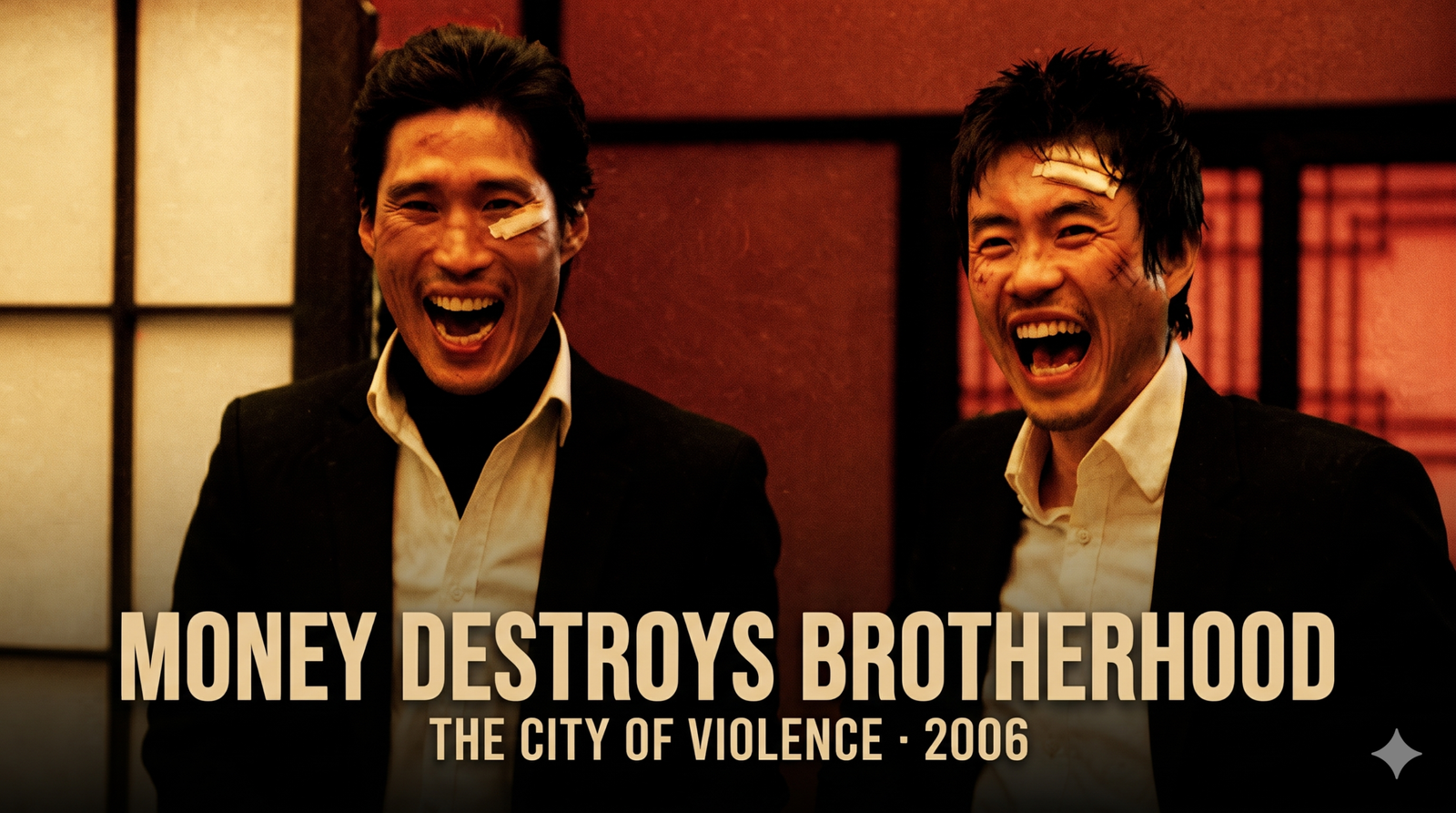
How Ryoo Seung-wan’s Korean Action Film Explores Friendship, Betrayal, and the Price of Growing Up
TTK Original — Beyond the Headlines
There is a particular kind of friendship that seems impossible to destroy.
It is formed when people are young, when they share the same streets, the same jokes, the same troubles, and the same dreams. They fight together, protect one another, and believe that nothing will ever come between them.
At that age, money seems unimportant. Social status has little meaning. The future is something everyone imagines together.
But time changes people.
Some become successful. Others remain trapped in the circumstances they once hoped to escape. Ambitions grow in different directions, and the friends who once stood shoulder to shoulder gradually begin to see the world differently.
Eventually, a question emerges that is far more painful than any physical confrontation:
Were we really friends for life, or were we simply people who had not yet been tested by the realities of life?
This is the emotional question at the heart of The City of Violence (2006), known in Korea as Jjak-pae (짝패).
Directed by Ryoo Seung-wan and starring Jung Doo-hong, Ryoo Seung-wan, and Lee Beom-soo, the film is remembered for its spectacular hand-to-hand combat and energetic action sequences.
But beneath the violence is a more melancholy story: the destruction of a brotherhood that once appeared unbreakable.
The film is not simply about old friends becoming enemies. It is about what happens when the people who shared your youth begin to value completely different things.
1. The Friendship We Believe Will Last Forever
The story begins with a death.
Tae-su, a detective working in Seoul, returns to his hometown after hearing that his old friend Wang-jae has been killed. At the funeral, he reunites with people from his youth, including Seok-hwan, Pil-ho, and Dong-hwan.
Their reunion brings back memories of the past.
They were once young men who shared a common world. Their friendship was built through experiences that outsiders could never fully understand.
This is an important emotional foundation.
When people grow up together, they do not simply remember the same events. They remember who they were before the world began assigning them different identities.
A childhood friend remembers your failures before you became successful. He knows the embarrassing stories, the foolish dreams, and the person you were before you learned how to present yourself to society.
That kind of familiarity can create extraordinary loyalty.
But it can also become uncomfortable.
As people change, an old friend can become a reminder of a past they would rather leave behind.
The City of Violence begins with nostalgia, but nostalgia is not necessarily comforting. Sometimes remembering the past makes the present even more painful.
2. Time Does Not Change Everyone in the Same Direction
The old friends have not simply grown older. They have entered different worlds.
Tae-su has become a police detective. Seok-hwan remains closely connected to the rough environment of their hometown. Pil-ho has accumulated influence and become involved in a major local development project.
Their differences are not merely professional.
They represent different relationships with power, ambition, and the future.
When they were young, their friendship existed on relatively equal terms. None of them had yet become powerful enough to dictate the conditions of the others’ lives.
But adulthood changes that balance.
Money creates opportunities. Opportunities create influence. Influence changes how people are treated.
A person who once stood beside his friends may eventually become someone they must negotiate with, depend on, or fear.
This is one of the film’s most revealing ideas.
Friendship may begin between equals, but what happens when life makes those friends unequal?
The film does not suggest that success automatically destroys loyalty. Nor does it claim that people who become wealthy must betray their past.
Instead, it presents a more uncomfortable possibility: when people acquire different amounts of power, the old rules of their relationships may no longer apply.
The friendship remains in memory, but its original conditions have disappeared.
3. Money Is Not the Only Villain. The Desire for Power Is More Dangerous.
It would be too simple to say that money alone destroys the friendship in The City of Violence.
Money is a tool. What matters is what people are willing to do to obtain it and what they believe they deserve once they have it.
The land development project connected to Pil-ho’s growing influence gives the conflict a larger meaning.
The hometown that once represented shared memories has become a place of business, competition, and control.
Land is no longer just the place where the friends grew up. It has become an economic asset.
The transformation is symbolic.
The same streets that once belonged to their youth now belong to a different set of interests. The people who once shared the town as friends are no longer standing on equal ground.
Development promises a better future, but the question is: a better future for whom?
When economic opportunity becomes connected to local power, relationships can become instruments. People are no longer valued only for who they are. They may also be judged by what they can provide, protect, or obstruct.
Pil-ho’s position illustrates this transformation.
He is not simply an old friend who has become wealthy. He represents a person whose relationship with power has changed the meaning of the past.
This is where the film’s title and its emotional conflict meet.
A brotherhood that once seemed permanent is now vulnerable to the interests that divide its members.
4. The Most Painful Betrayal Comes from Someone Who Knows You
A betrayal by a stranger is relatively easy to understand.
There is no shared history to protect and no childhood memory to complicate the judgment.
But betrayal by an old friend is different.
The person who hurts you is someone who once knew what mattered to you. He remembers the promises, the jokes, the struggles, and the moments when you trusted each other without hesitation.
That history makes the betrayal heavier.
In The City of Violence, the conflict is not simply between good people and bad people. It is between people whose shared past has become increasingly difficult to reconcile with their present choices.
This distinction matters.
If the characters had never been friends, their confrontation would be an ordinary crime story. Their shared history transforms it into something more personal.
Every fight carries an additional question:
How did we become people who could do this to each other?
The physical violence becomes an expression of a much older emotional wound.
The film’s action is therefore not separate from its drama. It is the physical language through which a broken relationship becomes visible.
5. Why the Film’s Action Feels Like a Story About Friendship
The City of Violence is famous for its elaborate fight sequences, but the action has a purpose beyond spectacle.
Ryoo Seung-wan and martial arts director Jung Doo-hong bring a physical intensity that makes the film feel almost like a celebration of action cinema itself.
The film draws on the traditions of Hong Kong martial arts movies and classic genre filmmaking. Its choreography, rhythm, and deliberately theatrical confrontations are central to its identity.
The result is energetic and sometimes playful.
Yet the emotional context changes how we experience those scenes.
At the beginning of a friendship, physical closeness can mean protection. Friends stand together, fight together, and take risks for one another.
By the end of this story, physical confrontation has become the opposite.
The same human bodies that once represented solidarity now become instruments of separation.
This creates an interesting contrast between the film’s style and its emotional meaning.
The action is exciting, but the relationships behind it are tragic.
The audience may enjoy the choreography while simultaneously recognizing that the characters have lost something that cannot easily be recovered.
That contradiction is one of the film’s most effective qualities.
6. The Dance Between Action and Performance
One of the film’s memorable stylistic features is its willingness to treat action as performance.
The choreography is not always presented as a realistic record of how an ordinary street fight would unfold. It often has the rhythm and visual design of a staged martial arts spectacle.
This is particularly important when considering the film’s broader relationship with genre cinema.
Ryoo Seung-wan does not hide his affection for older action traditions. He embraces their theatricality, their exaggerated confrontations, and their pleasure in carefully constructed physical movement.
For international viewers familiar with Hong Kong action cinema, the film offers recognizable influences while maintaining its own Korean setting and character relationships.
But there is a deeper reason this style works.
The characters are fighting over more than immediate survival. They are confronting the distance between who they once were and who they have become.
The choreography turns that emotional conflict into something visible.
A conversation might explain the betrayal. A fight allows the audience to feel its consequences.
The film’s action is therefore not merely an attraction added to the story. It is one of the ways the story communicates.
7. Was Their Friendship Ever as Strong as They Remembered?
This is perhaps the most uncomfortable question the film leaves behind.
When people look back on their youth, they often remember friendship as something pure.
They remember loyalty, shared hardship, and promises that seemed permanent.
But memory can simplify the past.
Perhaps the friends were never as united as they now believe. Perhaps their differences existed even when they were young, but those differences had not yet become important.
When everyone has similar circumstances, it is easier to believe that everyone shares the same values.
The real test arrives when the rewards become unequal.
One person wants money. Another wants loyalty. Someone else wants power, recognition, or simply a way to escape the life he once had.
At that point, the old friendship faces a difficult question: can it survive when the friends no longer want the same things?
The City of Violence does not offer a comfortable answer.
It suggests that shared memories can remain powerful even when shared values disappear.
That is why the story feels sadder than a conventional revenge thriller.
The characters are not simply losing a fight. They are losing the possibility of returning to a world in which they understood one another.
8. What Makes The City of Violence Distinctly Korean?
Although the film draws inspiration from international action traditions, its emotional foundation is rooted in a familiar Korean experience: the importance of school friendships and hometown relationships.
In Korean culture, the language of friendship often carries a strong sense of loyalty, shared history, and personal obligation.
The people who knew you before adulthood occupy a special position. They have memories that cannot be recreated through later relationships.
This does not mean that every Korean friendship follows the same pattern. But the cultural importance of long-standing personal relationships gives the film’s conflict a particular emotional resonance.
The hometown is also significant.
Returning to the place where one grew up can create the illusion that the past is still waiting.
The streets are familiar. The names are familiar. The people remember the same stories.
But the town itself has changed.
Economic development, criminal influence, and the pursuit of power have transformed the environment in which the friendships were formed.
The hometown becomes a metaphor for memory itself: familiar on the surface, but no longer the place it once was.
International viewers may recognize this feeling even if they have never lived in Korea.
Almost everyone knows the experience of returning to an old neighborhood and realizing that the place, the people, and perhaps even oneself have changed.
9. The Film’s Limitation Is Also Part of Its Identity
The City of Violence is not a film that spends equal time developing every emotional possibility.
Its narrative is compact, and its action sequences frequently take priority over extended psychological exploration.
Some viewers may find the characters’ motivations less developed than the film’s physical set pieces. Others may feel that the story relies on familiar crime and revenge conventions.
These are fair criticisms.
The film is not a detailed psychological study of every friendship that falls apart under economic pressure.
Nor should we pretend that every action sequence is a realistic representation of violence.
Its strength lies elsewhere.
It uses a recognizable genre framework to explore a familiar human experience: the distance between youthful loyalty and adult ambition.
The action is the film’s most visible attraction, but the broken friendship gives that action emotional weight.
Without the shared past, the fights would be entertaining but less meaningful.
Without the action, the film would lose the distinctive energy through which Ryoo Seung-wan expresses the conflict.
The two elements work together, even if they are not always perfectly balanced.
10. What Remains When the Brotherhood Is Gone?
There is something especially sad about friendships that end after many years.
A stranger can disappear from your life without leaving much behind.
An old friend cannot.
Even after the relationship is destroyed, the memories remain. You remember the person before the betrayal, and that memory makes it difficult to reduce him to the person he has become.
This is the emotional contradiction at the heart of The City of Violence.
The characters cannot simply forget their past. Yet they cannot return to it either.
Their shared youth becomes both a source of attachment and a reminder of what has been lost.
Perhaps the most painful part of growing older is discovering that people who once promised to stand beside you forever may eventually choose different lives.
And sometimes the distance between those lives becomes too great to cross.
Money may accelerate that separation. Power may deepen it. Ambition may make it irreversible.
But the deepest fracture occurs when people stop recognizing the values that once connected them.
That is why The City of Violence deserves to be remembered as more than an action film.
It is a story about the fragility of brotherhood, the changing meaning of loyalty, and the price people sometimes pay for the lives they choose.
We often believe that the friendships formed in our youth will survive anything. But perhaps we only discover their true strength when life gives us something different to choose.
And that leaves us with one final question:
If the friends who once shared everything can become enemies over money, was their friendship truly unbreakable—or had life simply not tested it yet?
Film Details
- Title: The City of Violence (짝패)
- Year: 2006
- Director: Ryoo Seung-wan
- Main Cast: Jung Doo-hong, Ryoo Seung-wan, Lee Beom-soo
- Genre: Action, Crime, Drama
- Runtime: 92 minutes
- Release Date: May 25, 2006
- Country: South Korea
Sources and Further Reading
- Korean Film Council (KOFIC) — The City of Violence (2006)
- Cine21 — The City of Violence (2006)
- Busan International Film Festival — The City of Violence Archive
- Bucheon International Fantastic Film Festival — The City of Violence
Editorial Note: This article offers an interpretation of the film’s themes. The connection between money, ambition, and the breakdown of friendship is an analytical reading of the story, not a claim that the film explicitly states that money alone caused every character’s choices.