Some songs invite covers.
Others seem to warn singers not to try.
Queen’s “Bohemian Rhapsody” belongs to the second category.
For nearly five decades, the song has occupied a unique place in popular music. Its opening piano, Freddie Mercury’s unmistakable vocal delivery, the operatic harmonies, and the explosive rock section have become part of music history.
The problem for anyone attempting a cover is obvious.
Listeners already know exactly how the song should sound.
They know when the harmonies arrive. They know when the opera begins. And they know what Freddie Mercury brought to the original recording.
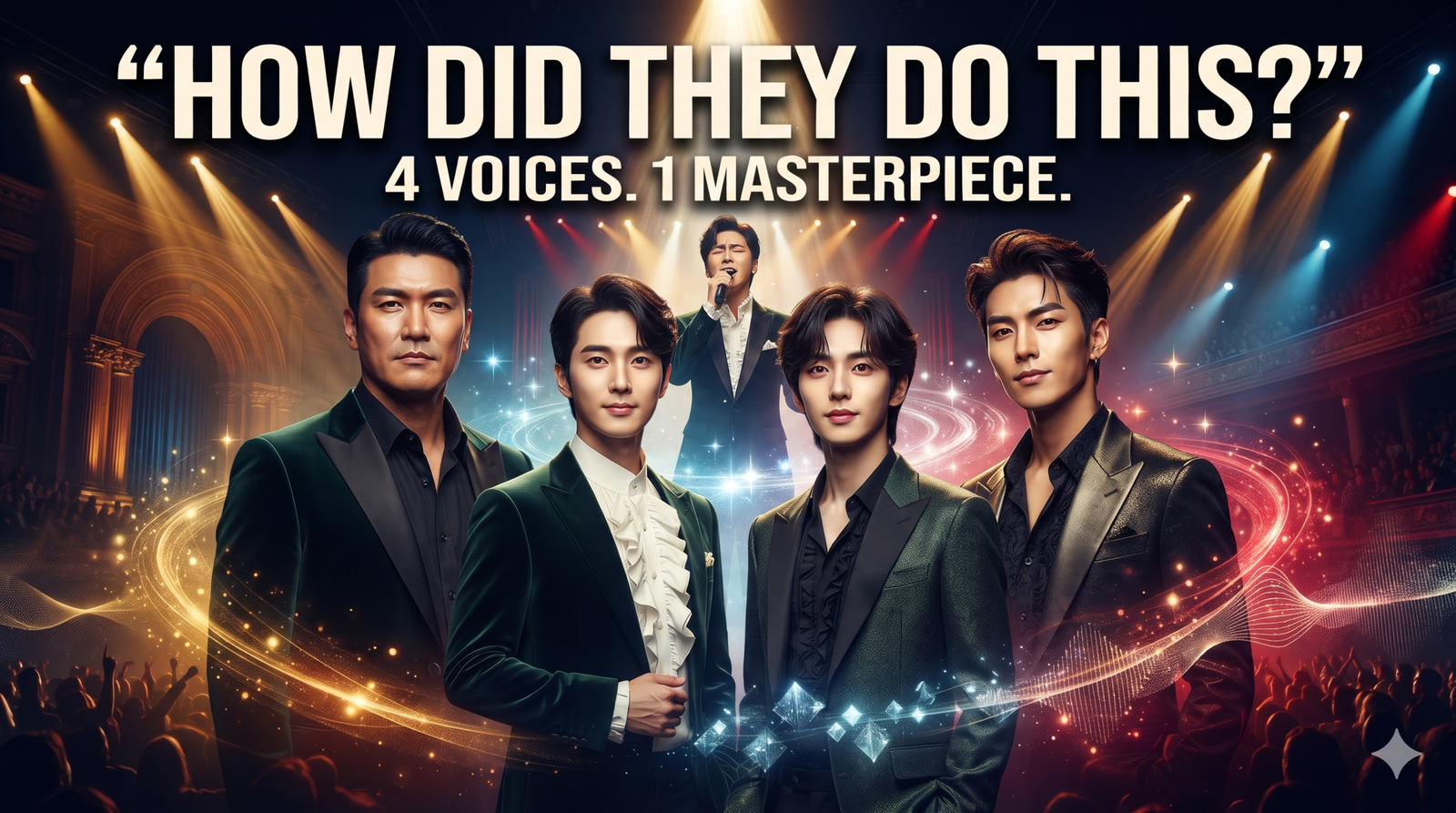
So when four Korean singers from Forestella chose “Bohemian Rhapsody” for KBS’s Immortal Songs on February 23, 2019, they were taking on something much bigger than a difficult song.
They were challenging one of the most recognizable musical arrangements ever recorded.
Yet their performance continues to attract attention years later.
The interesting question isn’t whether Forestella can replace Queen.
They cannot, and they don’t need to.
The real question is how four different voices managed to reveal something new inside a song that millions of people already thought they knew by heart.
1. The First Smart Decision: Don’t Try to Become Freddie Mercury
One of the biggest mistakes a singer can make when covering a legendary vocalist is attempting to imitate the original too closely.
Freddie Mercury wasn’t simply a technically gifted singer. His voice carried a particular combination of theatrical instinct, emotional intensity, musical freedom, and personality.
Trying to reproduce all of that would put almost any performer at a disadvantage.
Forestella approached the challenge differently.
Instead of finding one singer to imitate Mercury, they brought four contrasting vocal identities to the stage.
Ko Woo-rim provides an exceptionally deep bass foundation. Cho Min-gyu contributes a bright classical tenor quality. Kang Hyung-ho brings remarkable upper-register flexibility, while Bae Doo-hoon adds a contrasting baritone-to-tenor color.
These are not four interchangeable voices.
They occupy different musical spaces.
And that difference becomes the foundation of the arrangement.
Forestella doesn’t ask which member can sound most like Freddie Mercury.
It asks what happens when four distinctive singers approach the same musical architecture together.
That is a much more interesting creative decision.
2. Why “Bohemian Rhapsody” Is Almost Perfect for a Vocal Quartet
The structure of “Bohemian Rhapsody” is unusually demanding.
It moves through several musical identities without behaving like a conventional pop song.
A reflective piano opening develops into a vocal ballad. The arrangement then expands into an operatic sequence before breaking into hard rock and eventually returning to a quieter, more reflective ending.
The song constantly changes its emotional scale.
For a conventional solo vocalist, those transitions require enormous versatility.
For a group like Forestella, however, the structure creates an unusual opportunity.
Different voices can take responsibility for different musical colors.
The bass can establish depth beneath the harmony. A tenor can carry a melodic line. Another voice can introduce a contrasting phrase, while the upper register expands the emotional intensity.
The operatic section becomes especially important.
In Queen’s original recording, the layered vocal sound is central to the song’s identity. Forestella can approach that musical idea through four live voices, distributing lines and harmonies among individual singers.
This is not simply four people singing simultaneously.
It is a way of turning the arrangement into a conversation.
One voice establishes a musical idea. Another answers it. The harmony grows, changes direction, and becomes something larger than any single singer could create alone.
Forestella’s greatest advantage is therefore not just vocal range.
It is the ability to use contrasting vocal ranges as an arrangement tool.
3. The Difference Between Reproducing a Song and Reinterpreting Its Architecture
A successful cover needs more than accuracy.
It needs a reason to exist.
If Forestella had simply reproduced Queen’s recording as closely as possible, listeners would inevitably have compared the result with the original.
And that comparison would have been difficult to win.
Instead, the group preserved the recognizable melodic identity while introducing its own vocal character.
A Japanese Forestella archive documenting the 2019 performance notes that the arrangement retained much of the original melody while adding the group’s distinctive color. It also describes how the stage used visual elements that paid homage to Queen’s imagery.
That balance is important.
The performance does not attempt to destroy the original arrangement and rebuild everything from scratch.
It preserves enough of the familiar structure for listeners to recognize the song immediately.
Then it changes the scale of the experience.
The famous vocal passages become an opportunity to hear four different voices working together. The transitions gain a different kind of theatrical presence. The harmonies can feel almost orchestral because each singer contributes a separate vocal identity.
The result is neither a copy nor a complete rejection of Queen’s original.
It is a reinterpretation built on recognition.
And that may be the most effective way to approach a masterpiece.
4. Four Unusual Vocal Identities Become One Musical Instrument
Forestella’s members have very different vocal backgrounds and characteristics.
That diversity can sound like a disadvantage on paper.
A group with four contrasting voices might struggle to maintain a unified sound. One singer could overpower another. A dramatic high note could attract attention while the musical foundation becomes less convincing.
But the group’s arrangement makes those differences useful.
Ko Woo-rim’s bass provides more than an impressive low note. It gives the harmony weight and depth.
Kang Hyung-ho’s upper register creates a striking contrast, but its value comes from how it interacts with the other voices.
Cho Min-gyu’s classical tenor color adds brightness and precision.
Bae Doo-hoon’s more theatrical vocal character helps connect the different sections with a sense of musical movement.
The important point is that no single vocal feature explains the performance.
A very deep bass note can impress an audience once.
An unusually high note can produce an immediate reaction.
But neither is enough to sustain an entire performance of “Bohemian Rhapsody.”
What makes Forestella interesting is the space between those extremes.
The middle harmonies matter. The transitions matter. The balance between individual expression and group sound matters.
The four singers must know not only when to stand out, but also when to support one another.
That is the difference between four impressive vocalists and a functioning vocal quartet.
5. International Vocal Experts Looked Beyond the Spectacle
Forestella’s performance did not remain a subject of discussion among Korean viewers.
It also attracted international reaction videos and musical analysis.
One notable example appeared on the YouTube channel Throga – Vocal Gym on February 17, 2024.
The video brought together vocal coach Richard Fink IV and Billboard No. 1 songwriter Johnny Cummings to examine Forestella’s performance.
Their discussion went beyond a simple expression of surprise.
The published video includes sections examining the group’s vocal and arrangement choices, chord changes, and the cinematic quality of the performance.
Even its chapter titles reveal the direction of the discussion:
“Forestella’s brilliance in vocals and arrangement.”
“The cinematic feel is magical.”
The video also raises the provocative question:
“The best version of Bohemian Rhapsody ever?”
That question should not be mistaken for a definitive musical verdict.
There is no objective measurement that can establish the greatest cover of a song. Different listeners value different things: fidelity to the original, vocal technique, emotional interpretation, or artistic reinvention.
But the discussion is still revealing.
Forestella’s performance gave experienced music commentators enough material to examine the arrangement itself, rather than simply reacting to the singers’ vocal range.
That distinction matters.
A performance that impresses people for a few seconds is one thing.
A performance that encourages listeners to revisit its musical construction is something else.
6. Why the Performance Feels Almost Cinematic
The word “cinematic” is particularly useful when describing Forestella’s interpretation.
“Bohemian Rhapsody” already has the emotional movement of a miniature drama.
It begins intimately, grows into something theatrical, explodes into a larger musical conflict, and eventually returns to a quieter atmosphere.
Forestella’s four-part vocal arrangement makes those changes especially visible.
The singers can create different layers of intensity without relying on a single dominant voice throughout the performance.
The bass gives the sound a foundation. The higher registers create tension. The middle voices connect the different layers.
As the arrangement expands, the audience hears not just a change in volume but a change in musical perspective.
This is why the performance can feel larger than a conventional vocal cover.
It has the structure of a dramatic scene.
And the four singers become the characters carrying that scene forward.
7. Why Listeners Keep Coming Back to It
There is another interesting pattern in the reactions to Forestella’s performance.
Many listeners don’t simply describe it as impressive.
They describe returning to it.
Some compare it favorably with other covers. Others say they have listened to Queen for decades but still find something unexpectedly satisfying in Forestella’s arrangement.
These are individual opinions, not a scientific survey of music fans.
But they point toward an important distinction between novelty and replay value.
A surprising high note can make someone watch a performance once.
A genuinely well-constructed arrangement can make them return.
The first time, listeners may come because they recognize Queen.
The second time, they may focus on the bass.
The third time, they may notice how the voices interact during the operatic section.
Eventually, the attraction shifts.
They are no longer watching simply to hear a famous song performed.
They are watching to understand what Forestella does with it.
That is a powerful form of musical engagement.
8. The Greatest Cover Ever? That May Be the Wrong Question
It is tempting to turn every legendary cover into a competition.
Is it better than the original?
Can it surpass Freddie Mercury?
Should it be considered the definitive version?
But those questions overlook what makes Forestella’s performance interesting.
Queen’s original “Bohemian Rhapsody” is a landmark recording. Its identity is inseparable from Freddie Mercury, Brian May, Roger Taylor, John Deacon, and the creative world they built together.
Forestella does not need to challenge that legacy.
Its achievement is different.
The group demonstrates that a masterpiece can remain recognizable while revealing new possibilities through a different arrangement and a different combination of performers.
The original gives listeners a musical language they already understand.
Forestella changes the perspective from which they hear it.
That is why the performance can feel familiar and surprising at the same time.
TTK Original Perspective: A Great Cover Doesn’t Have to Defeat the Original
Forestella’s “Bohemian Rhapsody” reveals something important about musical creativity.
Sometimes the most effective reinterpretation does not come from changing everything.
It comes from understanding the original so deeply that the performer knows exactly where a new interpretation can emerge.
Forestella had four voices with very different characteristics.
Instead of treating those differences as obstacles, the group turned them into the central idea of the arrangement.
That is what makes this performance more interesting than a simple demonstration of extraordinary vocal ability.
It also offers a broader lesson about K-pop and Korean crossover music.
Global musical recognition does not always require copying the sound or performance style of an established Western artist. Korean musicians can engage with internationally recognized music while bringing their own artistic identities to it.
Forestella’s interpretation is a compelling example of that possibility.
The group did not make us forget Queen.
It made us listen to Queen’s song from a different angle.
And perhaps that is the highest compliment a cover can receive.
A great cover doesn’t make the original disappear. It makes you hear something in it that you hadn’t noticed before.
Read More on True Taste Korea
Discover more stories about the artists, performances, and creative decisions shaping Korean music beyond the headlines.
Watch the Performance:
Before you decide whether Forestella’s version can stand beside Queen’s original, listen to the performance yourself.
Forestella – Bohemian Rhapsody | Immortal Songs