“Golden” may be the biggest song from Netflix’s KPop Demon Hunters.
It is the song of ambition, confidence, and the belief that the future can be transformed through determination. It sounds like a declaration of victory before the battle has even been won.
But the song that reveals the movie’s deepest message may be a different one.
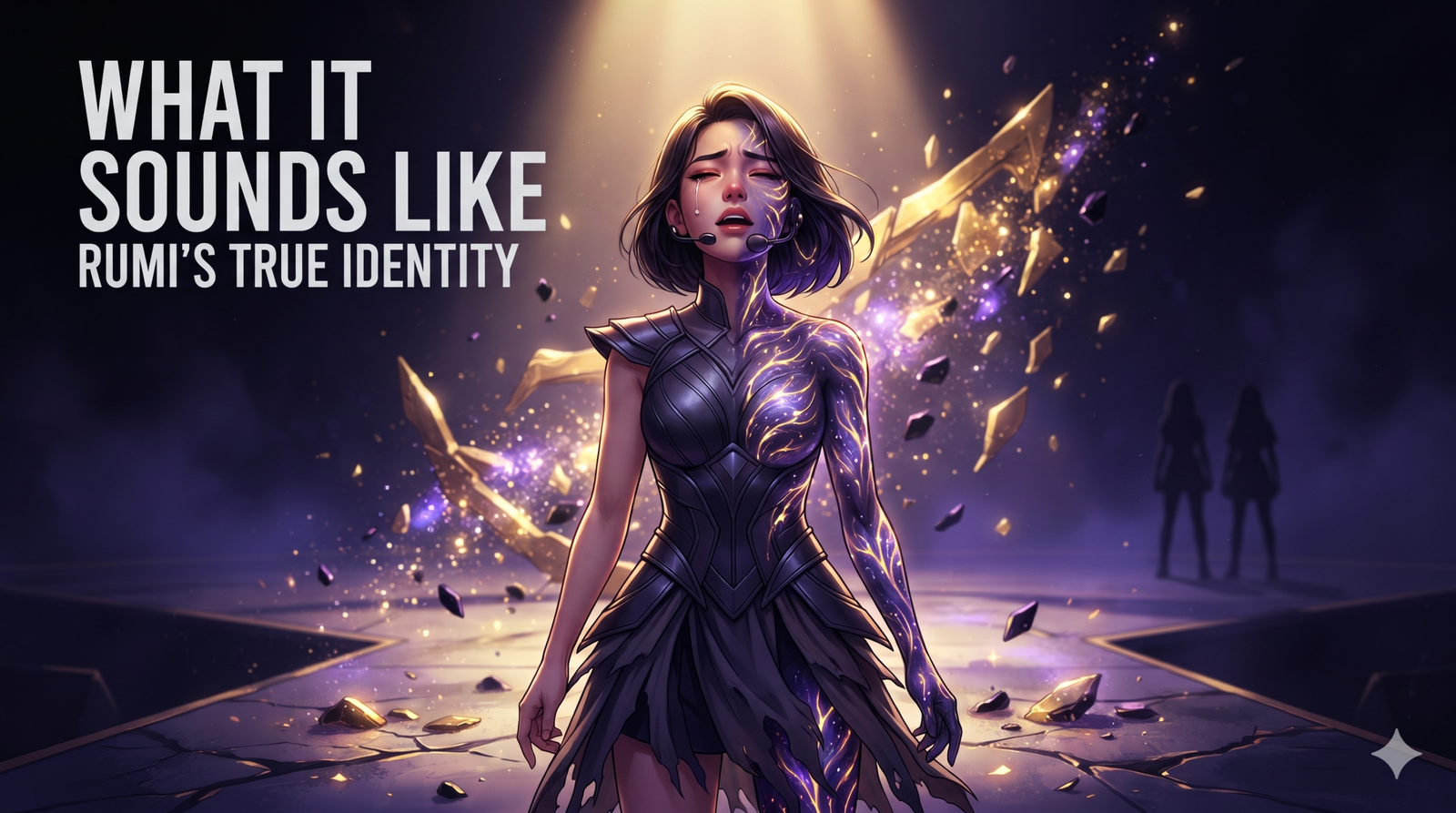
“What It Sounds Like” arrives when Rumi has almost nothing left to protect.
Her secret has been exposed. HUNTR/X has fallen apart. Her relationship with Jinu has been shattered by betrayal and sacrifice. And the Golden Honmoon, which she once believed would solve everything, no longer represents the simple salvation she imagined.
Then she sings.
The important thing is not merely that Rumi finally accepts her demon heritage.
It is that she stops trying to become someone who deserves acceptance.
That distinction changes how we should understand the entire movie.
1. “Golden” and “What It Sounds Like” Represent Two Different Kinds of Victory
At first, “Golden” appears to express the central dream of KPop Demon Hunters.
Rumi wants to become successful, protect the human world, strengthen the Honmoon, and finally eliminate the demon patterns that make her feel different.
The song captures the emotional appeal of that ambition.
It is bright, confident, and forward-looking. Its energy comes from the belief that the right achievement can finally make everything fall into place.
But there is a problem hidden inside Rumi’s dream.
She does not simply want to become a better hunter.
She wants to become someone without the part of herself she considers unacceptable.
That makes her ambition psychologically complicated.
The Golden Honmoon is not only a symbol of protection. In Rumi’s mind, it also becomes a possible escape from her own identity.
“What It Sounds Like” reverses that emotional direction.
Instead of imagining a future in which her differences disappear, Rumi begins to understand that she cannot build a meaningful life by treating part of herself as an enemy.
The contrast between the two songs is therefore more important than their musical differences.
“Golden” represents the desire to become worthy of acceptance.
“What It Sounds Like” represents the realization that acceptance cannot depend on becoming someone else.
One song looks toward an ideal future.
The other confronts the truth of the present.
2. Rumi’s Real Enemy Was Not Her Demon Heritage
The movie initially encourages viewers to interpret Rumi’s demon identity as the central problem.
Her markings are dangerous because they threaten her position within HUNTR/X and challenge the beliefs that have shaped her life.
She has learned that demon hunters protect humanity by defeating demons.
Yet she carries the very identity that her profession is supposed to reject.
This creates a contradiction that cannot be solved through ordinary heroism.
Rumi cannot simply become a more powerful hunter and expect the problem to disappear.
Her struggle is internal.
She has accepted a definition of goodness that requires her to reject part of herself.
That is why hiding becomes so exhausting.
Every successful performance requires her to maintain an image. Every moment of public confidence exists alongside a private fear that someone will discover the truth.
Her problem is not simply that other people might reject her.
It is that she has already begun rejecting herself.
This is an important distinction because it changes the meaning of her final transformation.
She does not become a hero by destroying her demon side.
She becomes more complete by refusing to treat her own existence as something that must be erased.
3. The Difference Between a Perfect Voice and an Honest Voice
The title “What It Sounds Like” invites a particularly interesting interpretation.
Throughout the film, Rumi is a performer.
Her voice is part of her professional identity. It is also part of the public image that HUNTR/X presents to its audience.
A successful idol is expected to deliver something controlled: the right performance, the right expression, the right emotional atmosphere.
But Rumi’s personal struggle makes that expectation more complicated.
How can she perform confidently while believing that her real identity is unacceptable?
This creates a divide between the person who appears onstage and the person who exists when the performance ends.
“What It Sounds Like” challenges that divide.
Rumi’s voice becomes meaningful not because it is flawless, but because she finally allows it to express something she had been trying to conceal.
This is where the song moves beyond the familiar message of believing in yourself.
Self-confidence can sometimes mean becoming better at presenting the version of yourself that other people admire.
Self-acceptance is different.
It means allowing the parts of yourself that do not fit the expected image to exist without constantly apologizing for them.
Rumi’s final performance is powerful because it no longer depends on pretending that she is someone else.
Her voice becomes an expression of identity rather than a tool for hiding it.
4. HUNTR/X’s Collapse Reveals the Weakness of a Relationship Built on Secrets
Rumi’s personal crisis also destroys the stability of HUNTR/X.
The group is more than a musical partnership. Its members depend on one another as friends, performers, and demon hunters.
Their shared mission creates a strong bond.
But that bond has a limitation.
Rumi’s secret means that the group does not fully know the person it is protecting and working beside.
This does not automatically make Rumi dishonest in every aspect of her relationship with Mira and Zoey. Her fear is understandable, especially in a world where demons are treated as enemies.
Nevertheless, the secret creates an unequal relationship.
Her teammates believe they understand the danger they are facing, but they do not know that the conflict also exists inside their closest friend.
When the truth emerges, the damage is not limited to the revelation itself.
The group must reconsider what its friendship was built on.
This is why the breakdown of HUNTR/X matters thematically.
A team can perform together, fight together, and even share the same goal without fully understanding one another.
Real unity requires something more difficult than cooperation.
It requires the ability to confront uncomfortable truths without immediately reducing a person to the worst thing they fear about themselves.
5. Jinu’s Sacrifice Complicates the Movie’s Definition of Good and Evil
Jinu is essential to understanding the meaning of Rumi’s final song.
He is a demon, but his choices cannot be explained by the simple assumption that every demon is defined by evil.
His relationship with Rumi exposes the weakness of a world organized around absolute categories.
Rumi is supposed to represent the human side.
Jinu is supposed to represent the demonic side.
But their emotional experiences complicate those labels.
Both characters carry shame. Both have reasons to hide parts of their identities. Both struggle with the consequences of choices made under pressure.
Jinu’s eventual decision to save Rumi is particularly important because it forces the audience to evaluate him through his actions rather than his classification.
He does not become meaningful because his identity changes.
He becomes meaningful because he makes a choice that contradicts the role assigned to him.
That is the same principle Rumi eventually discovers about herself.
A person’s identity may explain where they come from, but it does not completely determine what they are capable of choosing.
This does not mean the movie argues that every demon is harmless or that moral responsibility disappears.
It means that origin and behavior are not interchangeable.
The film’s emotional conflict becomes more interesting when we stop asking only which side a character belongs to and start asking what that character actually chooses to do.
6. The Honmoon Represents More Than a Barrier Between Worlds
The Honmoon is central to the movie’s fantasy mythology.
It protects the human world by keeping demonic forces at a distance.
For much of the story, its strength appears to be the ultimate measure of success.
A stronger Honmoon means greater protection. Its completion promises an end to the danger that has shaped the hunters’ lives.
But Rumi’s transformation introduces a deeper question.
What happens when the boundary itself becomes part of the problem?
Rumi cannot be comfortably placed on either side of the division.
She is not simply human, and she is not simply a demon.
Her existence challenges the assumptions behind the conflict.
The Honmoon can be understood as a physical representation of a psychological boundary: the division between what society considers acceptable and what it rejects.
The movie does not need to suggest that every boundary should disappear.
Some boundaries protect people from genuine harm.
But a boundary becomes destructive when it prevents us from recognizing individual differences or judging people by their actual choices.
Rumi’s final realization is therefore not simply that the enemy should be forgiven.
It is that the old system of understanding the enemy is incomplete.
7. What Makes “What It Sounds Like” Different From a Typical Redemption Song?
Many animated films use a final musical number to resolve the protagonist’s emotional conflict.
The hero discovers an inner strength, declares a new belief, and emerges ready to face the world.
“What It Sounds Like” follows part of that tradition, but its emotional foundation is more complicated.
Rumi does not simply discover that she was special all along.
She has to confront the damage caused by her fear, her secrecy, and her desire to become someone who could never be rejected.
That makes her transformation less like a sudden achievement and more like a change in how she understands herself.
There is an important difference between being proud of your identity and pretending that your identity has never caused pain.
The film does not erase the consequences of Rumi’s choices.
Her relationships have been damaged. Jinu’s sacrifice cannot simply be undone. The world she inhabits still contains real danger.
Acceptance does not magically repair everything.
Instead, it gives her a different foundation from which to move forward.
That is what makes the song emotionally meaningful.
It does not promise that being honest will make life easy.
It suggests that continuing to hide would make genuine connection impossible.
8. Could This Be the Blueprint for KPop Demon Hunters 2?
The ending naturally invites speculation about a sequel.
If Rumi has accepted her demon heritage, the next story cannot simply repeat the same conflict in which she tries to hide her identity.
That emotional journey has already reached a turning point.
A sequel would have several more interesting possibilities.
It could explore what happens when Rumi must live openly with an identity that challenges the traditional role of a demon hunter.
It could examine whether the Honmoon can evolve beyond its original purpose.
It could introduce demons whose choices complicate the old distinction between enemies and allies.
Most importantly, it could explore whether HUNTR/X can rebuild its relationship around honesty rather than the image of a perfectly united team.
However, these are narrative possibilities, not confirmed details about the sequel.
The ending of the first film does not provide a complete blueprint for the next installment.
What it does provide is a thematic direction.
If the first movie asks whether Rumi can accept herself, a sequel could ask whether the world around her is capable of accepting what she has become.
That is a much larger conflict.
Final Verdict: The Song Is Not About Becoming Someone New
“Golden” shows the future Rumi believes she needs.
“What It Sounds Like” reveals why that future was never going to be enough.
The difference is not simply between ambition and acceptance.
It is between trying to eliminate everything that makes you different and learning to live without treating those differences as evidence of failure.
Rumi’s final transformation does not erase her past, her mistakes, or the pain she has experienced.
It changes the meaning she gives them.
That is why “What It Sounds Like” may be the most important song in KPop Demon Hunters.
The movie begins with a world that divides people into hunters and demons, good and evil, acceptable and unacceptable.
Its final emotional statement comes from a character who can no longer fit inside those categories.
And perhaps the deepest message is this:
You do not become whole by destroying the parts of yourself that others cannot understand. You become whole when you finally stop treating those parts as something that must disappear.