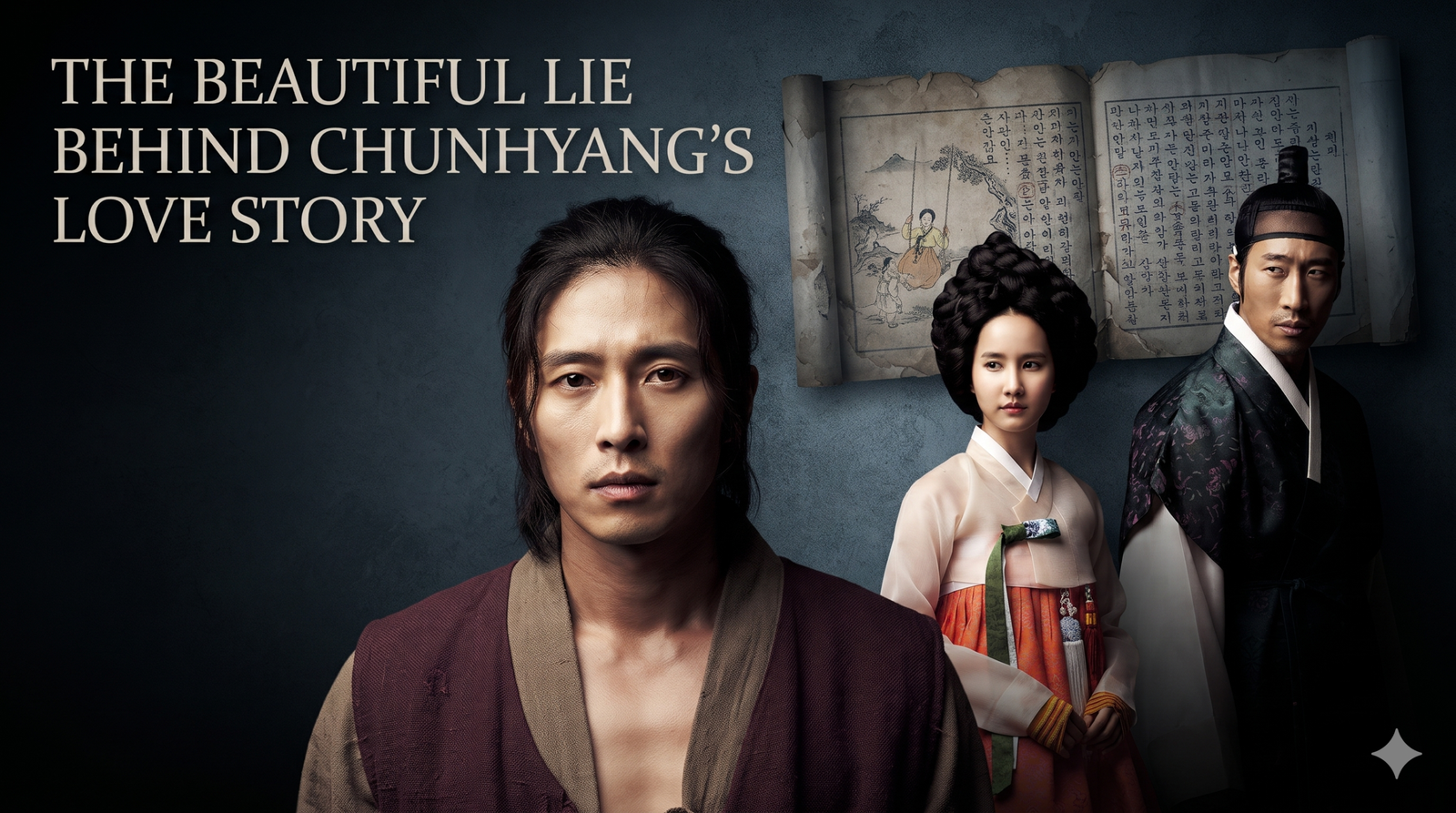
The Hidden Truth Behind Chunhyang’s Story, Class, Desire, Power, and a Devastating Ending
What if one of Korea’s most beloved love stories was never the complete truth?
For generations, the story of Chunhyang has been remembered as a romance about loyalty, courage, and love powerful enough to overcome social boundaries. Lee Mong-ryong returns, Chunhyang remains faithful, and justice eventually triumphs.
But Kim Dae-woo’s 2010 film The Servant asks us to look at this familiar story from an entirely different position.
What if the man standing behind the noble hero was actually the person who loved Chunhyang most deeply? What if the supposedly virtuous Mong-ryong was not the romantic hero we remembered? And what if Chunhyang’s choices were far more complicated than the traditional image of a faithful woman suggests?
By placing Bang-ja, Mong-ryong’s servant, at the center of the narrative, the film transforms a familiar folk tale into a story about class, ambition, sexual desire, manipulation, and the power to decide which version of history survives.
Its most disturbing idea, however, appears at the very end.
Bang-ja knows what really happened. Yet he asks a writer to preserve a beautiful version of the story that he knows is false.
Why?
The answer may reveal more about love than the romantic ending of the original legend ever could.
1. The Servant Changes the Most Important Question in Chunhyang’s Story
In the traditional Tale of Chunhyang, the central question is whether love can survive the barriers imposed by social class.
Chunhyang is the daughter of a former courtesan, while Mong-ryong belongs to the yangban aristocracy. Their relationship challenges the rigid social structure of Joseon society.
The familiar story eventually rewards Chunhyang’s loyalty. Mong-ryong returns with authority, exposes corruption, and reunites with her.
But The Servant changes the perspective.
Instead of following the nobleman, the film follows Bang-ja, the servant who has always existed at the edge of the familiar story.
This is not merely a change of protagonist. It changes the moral structure of the entire narrative.
When the servant becomes the central character, the traditional hero must become someone whose behavior can be questioned. The woman traditionally remembered for her faithfulness becomes a person with competing desires. And the supposedly secondary character becomes the person whose emotional experience determines the meaning of the story.
The film is effectively asking:
What would happen if the person who witnessed the famous love story were finally allowed to tell his own version?
2. Bang-ja’s Social Position Is More Important Than His Romantic Rivalry
At first glance, Bang-ja appears to be competing with Mong-ryong for Chunhyang’s affection.
But the competition is unequal from the beginning.
Mong-ryong possesses a social identity that Bang-ja does not. He belongs to the privileged class and can imagine a future in which education, official appointments, and political authority are available to him.
Bang-ja begins as a servant.
His intelligence, appearance, and personal qualities do not automatically give him the freedom to determine his own future.
This distinction matters because the film does not present love as a completely private experience. Love takes place inside a society where status determines what people can openly pursue.
Bang-ja may be more attractive and emotionally sincere, but those qualities do not erase the social structure surrounding him.
The film therefore introduces an uncomfortable contradiction:
A person may be worthy of love without possessing the social power needed to secure it.
That is the foundation of Bang-ja’s tragedy.
3. Mong-ryong Is Not the Hero We Were Taught to Admire
The most provocative decision in the film is its reconstruction of Lee Mong-ryong.
In the familiar legend, Mong-ryong represents justice, education, and the restoration of moral order.
In The Servant, however, he is also a jealous man who is deeply conscious of his position and threatened by the possibility that his servant might possess something he cannot obtain.
This transformation is important.
Mong-ryong’s greatest advantage is not necessarily his intelligence or emotional maturity. It is his social position.
He has the privilege of being regarded as a potential hero before he has demonstrated that he deserves the title.
The film exposes the difference between possessing authority and possessing moral integrity.
Mong-ryong can use the institutions of his society in ways that Bang-ja cannot. Yet his access to power does not make him a better person.
The traditional story gives him a heroic ending. The film asks whether that ending was ever an honest reflection of his character.
4. Chunhyang Is Not Simply a Faithful Woman or a Manipulative Femme Fatale
Chunhyang is perhaps the most complicated character in the film.
She is frequently interpreted through two opposing images: the devoted woman who loves Bang-ja and the ambitious woman who wants to improve her social position through Mong-ryong.
Both interpretations contain part of the truth, but neither fully explains her.
Chunhyang understands that love and social status are not separate matters in her world.
Her background limits her choices. Her mother’s social position influences how others perceive her, and marriage to a nobleman offers a possibility of changing the conditions under which she lives.
Her ambition is therefore not simply a personal weakness.
It is also a response to a society in which a woman’s future can depend heavily on the identity and status of the man she marries.
Yet the film does not allow her to become an entirely innocent symbol of resistance. She makes calculated decisions, hides parts of her intentions, and sometimes treats the feelings of others as instruments.
This is what makes her interesting.
Chunhyang wants love, but she also wants security and status. The tragedy is that these desires do not always point in the same direction.
5. Why Does Chunhyang Love Bang-ja but Still Want Mong-ryong?
This is one of the film’s most revealing contradictions.
Bang-ja offers Chunhyang something that Mong-ryong cannot necessarily provide: a genuine emotional connection.
Yet Mong-ryong represents a different kind of future.
He offers the possibility of entering a higher social world.
To understand Chunhyang, we must distinguish between the person she desires and the future she wants.
Bang-ja may be the person she loves, while Mong-ryong represents the social security she believes she needs.
This does not make her choices morally uncomplicated. It does, however, make them understandable within the world the film constructs.
The film refuses to pretend that romantic love automatically solves economic insecurity.
That is a particularly interesting departure from traditional romance.
In many love stories, choosing the person one loves is presented as the ultimate solution. The Servant asks what happens when that choice also means accepting a life with fewer opportunities and less social protection.
Chunhyang’s dilemma is not simply between two men.
It is between two possible lives.
6. The Most Important Character May Be Elder Ma
Elder Ma, played by Oh Dal-su, initially appears to provide much of the film’s comic energy.
He teaches Bang-ja the techniques of seduction and offers practical advice about relationships.
But his role is more significant than that.
Elder Ma understands that romantic relationships are often shaped by power, timing, appearances, and competing interests.
He does not approach love as a purely spiritual experience.
He treats it as something people must navigate using knowledge of human behavior.
This makes him a strange kind of teacher.
Bang-ja learns how to attract Chunhyang, but he does not necessarily learn how to understand the larger social and emotional forces governing their relationship.
There is a difference between learning how to win someone’s affection and learning how to build a life with that person.
The film gradually reveals that distinction.
Bang-ja becomes more capable of pursuing love, but his growing confidence cannot protect him from the ambitions and insecurities of the people around him.
7. Desire Is Not the Same as Freedom
The film contains sexual material that can easily attract attention, but reducing it to erotic comedy would miss an important part of its construction.
The characters are sexually active, but they are not equally free.
Bang-ja is socially subordinate. Chunhyang faces the restrictions associated with her birth and gender. Mong-ryong enjoys privileges that allow him to pursue his ambitions through institutions unavailable to the others.
Their desires exist within unequal circumstances.
This distinction matters because the ability to express desire is not identical to having the freedom to determine one’s future.
Chunhyang can desire Bang-ja, but that does not mean society will accept their relationship.
Bang-ja can love Chunhyang, but that does not mean he can openly claim the future he wants.
Mong-ryong can pursue status and authority, but his own jealousy exposes the insecurity beneath his privileged position.
The film’s romantic triangle is therefore also a triangle of unequal freedom.
8. The Film’s Real Conflict Is About Who Controls the Future
At first, the story appears to concern which man will win Chunhyang.
But the deeper conflict is about who has the power to decide what happens next.
Mong-ryong has social privilege.
Chunhyang has beauty, intelligence, and an understanding of how social relationships can be used.
Bang-ja has emotional attachment and a growing ability to act independently.
Each character possesses a different form of power, but none possesses everything.
This is why the relationship becomes increasingly unstable.
Love does not remove the competition between them. It intensifies it.
The film suggests that when affection becomes entangled with social advancement, personal insecurity, and control, even genuine feelings can become part of a struggle for power.
The question is no longer simply who loves whom.
It becomes who can determine the conditions under which the others must live.
9. The Original Chunhyang Story Depends on a Particular Kind of Hero
The traditional story needs Mong-ryong to return as a figure of justice.
His authority resolves the conflict, punishes the corrupt official, and restores the moral order.
That structure works because the audience is encouraged to believe that the powerful man is also the righteous man.
The Servant deliberately separates those two ideas.
Mong-ryong’s social position does not guarantee his moral superiority.
Bang-ja’s low position does not make him emotionally or ethically inferior.
This reversal is more than a provocative retelling. It challenges the way traditional stories distribute moral authority.
Who gets to be called a hero?
Is it the person who possesses the power to resolve a conflict, or the person who bears the consequences of that power?
The film makes the audience reconsider the assumptions behind the original legend.
10. The Story of Chunhyang Is Also a Story About Who Gets Remembered
One of the most original aspects of the film is its framing device.
An older Bang-ja meets a writer who wants to record his experiences.
This means that the story is not presented simply as a sequence of past events. It is also a story about how those events will be remembered.
The writer is not merely collecting information.
He is deciding what kind of narrative can be told to the world.
That distinction is crucial.
The truth of an event and the version of that event remembered by society are not necessarily the same thing.
A powerful person may influence the official account. A popular story may survive because it satisfies the audience’s expectations. A complicated reality may be simplified until it becomes a reassuring legend.
Bang-ja’s position is especially unusual.
He is the person who knows what happened, but he also understands that the story the writer wants to publish may be more powerful than his own testimony.
The film is no longer only questioning the characters.
It is questioning the production of history itself.
11. Why Does the Film Make the Audience Doubt a Familiar Legend?
Audiences often approach traditional stories with established expectations.
We already know who the hero is supposed to be. We know which woman is supposed to remain faithful. We know which ending is supposed to represent justice.
These expectations make stories emotionally comfortable.
But they can also prevent us from asking difficult questions.
What if the hero was not heroic?
What if the faithful woman had ambitions that the traditional story never acknowledged?
What if the servant, who was treated as a secondary figure, had the deepest emotional experience of all?
By changing the perspective, The Servant reveals how much of our understanding depends on the storyteller’s choices.
The film does not simply replace one version of Chunhyang’s story with another.
It demonstrates that every version has someone whose experience is emphasized and someone whose experience is pushed aside.
12. Mong-ryong’s Jealousy Reveals the Fragility of His Status
Mong-ryong’s jealousy toward Bang-ja is not simply the reaction of a man who has lost a romantic competition.
It also reveals a deeper insecurity.
Bang-ja is supposed to be beneath him.
He is a servant who should obey, assist, and remain in the background.
But Bang-ja possesses qualities that challenge Mong-ryong’s assumptions about superiority.
When Chunhyang develops feelings for Bang-ja, the social hierarchy becomes emotionally uncomfortable for Mong-ryong.
The servant is no longer merely a subordinate.
He becomes a rival.
This exposes a weakness in Mong-ryong’s understanding of status. He expects his position to guarantee a certain level of respect and desirability.
But human affection does not always follow social rankings.
The film suggests that a privileged man can become particularly dangerous when he discovers that his authority cannot control another person’s feelings.
13. Bang-ja’s Greatest Misfortune Is That Love Cannot Protect Him
Bang-ja eventually becomes more independent and develops a relationship with Chunhyang.
For a time, it seems possible that the two can build a life together.
But their relationship remains vulnerable to the power struggle involving Mong-ryong.
Bang-ja’s love cannot erase the social world surrounding them.
Nor can his personal courage guarantee that Chunhyang will remain safe.
This is where the film moves away from the expectations of a conventional romance.
In a traditional love story, emotional sincerity often becomes a source of strength.
In The Servant, sincerity can also become a vulnerability.
Bang-ja loves Chunhyang, but his love gives him something to lose.
The more deeply he becomes attached to her, the more painful the consequences of the conflict become.
The film does not suggest that love is worthless.
It suggests that love alone cannot overcome every form of power.
14. The Waterfall Scene Destroys the Possibility of a Conventional Happy Ending
The final confrontation at the waterfall is one of the most important turning points.
Mong-ryong pushes Chunhyang into the water, and Bang-ja jumps in to save her.
The familiar romantic structure collapses.
The nobleman who should have been the returning hero becomes the source of danger. The servant who was supposed to remain in the background becomes the person who risks everything to save Chunhyang.
But survival does not mean that the tragedy has been undone.
Chunhyang survives, yet the consequences leave her severely impaired.
This detail changes the emotional meaning of the rescue.
Bang-ja succeeds in saving her life, but he cannot restore the future they might have shared.
The film makes a painful distinction between preventing death and recovering happiness.
Sometimes a person can be saved physically while losing the life they once knew.
15. Chunhyang’s Final Condition Changes the Meaning of Bang-ja’s Love
After the events at the waterfall, the older Bang-ja reveals that Chunhyang is alive but has become childlike because of her injuries.
This is a devastating development.
The woman who once possessed ambition, intelligence, desire, and the ability to make complicated decisions is no longer able to live in the same way.
Bang-ja has not simply lost a romantic partner.
He has lost the possibility of sharing an equal future with the person he loved.
Their relationship cannot return to the way it was.
This also makes the ending more complicated than a simple story of devotion.
Bang-ja’s care for Chunhyang may be genuine, but the film leaves us facing a difficult question:
What does love become when the person you love can no longer participate in the relationship as before?
The answer cannot be reduced to a beautiful romantic image.
It involves grief, responsibility, memory, and the painful recognition that love cannot reverse everything that has happened.
16. Why Does Bang-ja Ask the Writer to Tell a False Story?
This is the film’s most important question.
The writer wants to create a story about a servant whose love eventually becomes heroic.
But Bang-ja does not ask him to tell the complete truth.
Instead, he insists that the story should preserve the familiar version: Chunhyang remains faithful, Mong-ryong returns, and the lovers receive the happy ending that audiences expect.
Why would Bang-ja do this?
One interpretation is that he wants to protect Chunhyang from a world that would judge her.
The truth of her relationship with Bang-ja, her ambitions, and the final events would destroy the idealized image associated with the traditional heroine.
Another interpretation is more personal.
Bang-ja may understand that the beautiful version of the story is the only remaining future he can offer Chunhyang.
She cannot return to the life they once imagined. But he can preserve a version of that life in the story people will remember.
The lie becomes a form of emotional protection.
Yet it is also a sacrifice of truth.
Bang-ja allows the world to remember a romance that never happened in the way the legend describes.
The man who loved Chunhyang most deeply chooses not to be recognized as the man who actually loved her.
17. Is Bang-ja’s Final Decision Noble or Tragic?
It is tempting to describe Bang-ja’s decision as the purest expression of love.
But that interpretation may be too simple.
His choice is moving precisely because it is not entirely free of pain or contradiction.
By accepting the fictional version, Bang-ja gives up the possibility of having his experience publicly recognized.
He allows Mong-ryong to remain part of a beautiful legend, despite knowing what happened.
He also allows Chunhyang to remain the heroine of a story in which she receives the happiness she never truly experienced.
But does this protect her, or does it erase her?
The answer is uncomfortable.
Bang-ja’s decision can be understood as an act of compassion, but it also continues the process of turning Chunhyang into a character in someone else’s story.
In the traditional legend, her identity is shaped by the expectations of society.
At the end of the film, her identity is preserved through Bang-ja’s chosen fiction.
Even his act of love cannot completely escape the problem of representation.
This is why the ending is more complicated than a simple declaration that love means sacrifice.
18. The Film’s Most Radical Idea: A Beautiful Story Can Be Built on an Uncomfortable Truth
The traditional ending of Chunhyang’s story provides emotional satisfaction.
The lovers are reunited, justice is restored, and the social world appears to have corrected itself.
But The Servant asks us to consider what may have been excluded to create that satisfaction.
Whose feelings were ignored?
Whose actions were rewritten?
Whose suffering was made invisible?
The film suggests that a beautiful story can sometimes survive because it refuses to acknowledge the people and events that would make its ending uncomfortable.
This is not limited to historical legends.
Modern societies also create simplified stories about successful people, heroic leaders, perfect relationships, and happy families.
The stories people remember are not always the stories that actually happened.
Sometimes the most important truth is the one that never becomes part of the public narrative.
19. Why The Servant Still Deserves a Different Kind of Discussion
The film is often approached through its erotic elements, provocative reinterpretation of a familiar folk tale, and unusual love triangle.
Those elements are part of its identity, but they are not the only reasons the film deserves attention.
Its deeper subject is the relationship between personal experience and public memory.
It asks whether social status determines who gets to be a hero, whether love can exist independently of ambition, and whether a person can protect someone by allowing the world to believe something untrue.
There are also limitations worth acknowledging.
Some of the film’s sexual comedy and provocative characterization can feel more interested in shock and entertainment than in fully exploring the social conditions it introduces. The Korea Times review, for example, praised the creative premise but questioned whether the narrative maintained its dramatic grip.
That criticism is worth considering.
Nevertheless, the film’s central narrative idea remains compelling: the familiar story of Chunhyang may look different when told by the person who was never supposed to be its hero.
20. The Final Question: Did Bang-ja Save Chunhyang, or Did He Save Her Story?
At the end, Bang-ja carries Chunhyang on his back, recalling the intimacy of their earlier relationship.
The image is tender, but it is also heartbreaking.
The woman he once loved as an independent person can no longer share the same life with him.
He cannot restore their past.
He cannot give her back the future that was taken away.
And he cannot make the world understand what truly happened without destroying the beautiful story he has chosen to preserve.
So he does something else.
He gives the writer a different ending.
The world will remember Chunhyang and Mong-ryong as the lovers who overcame every obstacle. Bang-ja will remain a servant in the background of that familiar legend.
But privately, he knows another story.
Perhaps that is the final irony of The Servant.
The person who was excluded from the traditional love story becomes the only person who truly understands its cost.
Bang-ja does not defeat the social order. He does not receive public recognition. He does not even obtain the happy ending that a conventional romance would promise.
Instead, he chooses what the world will remember.
And that choice leaves us with a question that is much harder than deciding who truly loved Chunhyang:
If the only way to preserve someone’s happiness is to hide the truth, is that an act of love—or the final surrender to a world that never allowed the truth to be told?
Perhaps the most tragic part of The Servant is not that Bang-ja loses Chunhyang.
It is that he must become the keeper of a beautiful story that conceals the very love that made it possible.
Final Thought
The Servant is not simply a story about a servant who falls in love with his master’s woman. It is a film about how power shapes relationships, how society chooses its heroes, and how the truth can disappear behind a story that everyone prefers to believe.
The traditional Tale of Chunhyang gives us a happy ending.
The Servant asks us who had to disappear to make that ending possible.