What happens when an ordinary person becomes a political symbol without ever choosing to participate in politics?
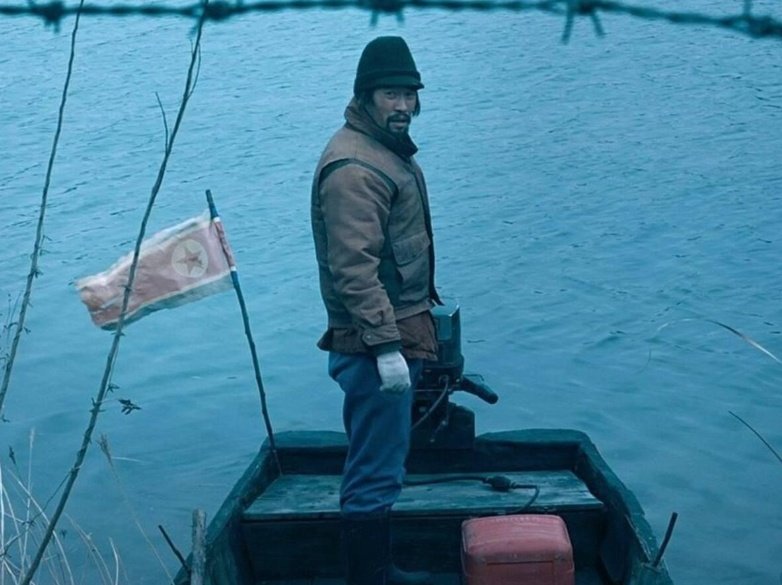
Kim Ki-duk’s The Net (2016) begins with a simple accident. Nam Chul-woo, a North Korean fisherman, experiences a mechanical problem while fishing and drifts across the maritime boundary into South Korean waters. What should have been a temporary mistake becomes a political crisis.
South Korean authorities suspect him of being a possible spy. They investigate him, question his loyalty, and attempt to persuade him that life in the South offers a better future. But Chul-woo wants none of it. He wants to return to his wife, daughter, and familiar life in the North.
When he eventually returns, he discovers that his homecoming does not guarantee freedom either. His experiences in the South become grounds for suspicion, interrogation, and further control.
Starring Ryoo Seung-bum, Lee Won-geun, Kim Young-min, and Choi Gwi-hwa, The Net is not simply a film about the differences between North and South Korea. It is a disturbing examination of what happens when political systems claim authority over an individual’s identity, beliefs, and future.
The film’s most provocative question is not which side wins the ideological argument.
It is whether an ordinary person can remain an individual when both sides insist on deciding what he represents.
1. The Fisherman Who Never Wanted to Defect
Nam Chul-woo is not introduced as a political activist, an intelligence operative, or a man searching for a new ideology.
He is a fisherman.
His daily life revolves around his boat, his work, and his family. His ambitions are limited in the most ordinary sense: he wants to earn a living and return home safely.
This characterization is essential because it separates him from the political expectations placed upon him later.
When he crosses into South Korean waters, the authorities do not initially see an ordinary fisherman who has suffered an accident. They see a potential security threat.
His identity changes immediately.
He becomes someone who must be investigated, interpreted, and classified.
The tragedy begins when the institutions around him stop responding to the person he actually is and begin responding to what they fear he might represent.
Chul-woo does not choose to become a symbol of division.
The political system creates that role for him.
His ordinary desires become almost invisible because everyone around him wants an answer to a much larger political question.
2. Nam Chul-woo: A Man Defined by His Family
Chul-woo’s strongest attachment is not to a political doctrine but to his family.
His wife and daughter represent continuity. They are the people who give his life meaning beyond the repetitive demands of work and survival.
This explains why his refusal to defect is so important.
From the perspective of the South Korean authorities, remaining in the South could appear to offer him better material opportunities. But Chul-woo does not measure his future through economic comparison alone.
He measures it through the possibility of returning to the people he loves.
This creates a fundamental conflict between institutional reasoning and personal reasoning.
The authorities ask what kind of life he could have in South Korea.
Chul-woo asks whether that life would still be his life if his family were left behind.
The difference is significant.
Freedom cannot be reduced to the availability of choices when the consequences of those choices include losing the relationships that define a person’s existence.
Chul-woo’s family is therefore not merely an emotional subplot.
It is the foundation of his identity and the reason he resists becoming the political trophy that either side wants him to be.
3. The Broken Boat: How an Accident Becomes a Political Crisis
The boat is the starting point of the entire tragedy.
Its mechanical failure is an ordinary problem. A fisherman depends on his vessel in the same way that a farmer depends on his tools or a shopkeeper depends on a working store.
But in the waters between North and South Korea, an ordinary mechanical failure can have extraordinary political consequences.
The boat crosses a boundary that is more than a geographical line.
It enters a space shaped by military tension, surveillance, and competing national claims.
This transformation is one of the film’s most effective ideas.
The boat does not carry a political message. Chul-woo does not intentionally cross the border to make a statement. Yet the consequences of his movement are interpreted through the political system.
The accident exposes the absurdity of living in a divided territory where geography can suddenly determine a person’s identity.
A fisherman who loses control of his boat becomes a suspected infiltrator.
A simple problem at sea becomes a question of national security.
The film uses this small event to reveal how political systems can turn everyday life into a matter of ideological interpretation.
4. The First Net: South Korea’s Desire to Rescue Him
When Chul-woo arrives in South Korea, the authorities approach him through the language of security and political opportunity.
They want to understand who he is, whether he has intelligence value, and whether he might be persuaded to remain in the South.
Some officials genuinely believe that South Korea can offer him a better life.
Others are more concerned with institutional procedures, political symbolism, or the possibility that he may be concealing information.
The important point is that these different motivations exist within the same system.
South Korea is not represented through one single personality or one uniform attitude.
However, even the officials who believe they are helping Chul-woo operate within a structure that gives them power over his movements and decisions.
Their idea of rescue does not necessarily match his understanding of freedom.
This creates the first version of the film’s central metaphor.
The net is not only the physical fishing equipment that brought Chul-woo across the border.
It is also the network of questions, expectations, and institutional decisions that gradually restricts his ability to act for himself.
The authorities may offer him a new life, but they do not initially accept that he has the right to reject it.
5. The Closed Eyes: Why He Refuses to See Seoul
One of the film’s most revealing images is Chul-woo’s attempt to avoid seeing the world around him.
In Seoul, he is confronted with the material differences between the two Korean societies.
The authorities expect him to recognize the advantages of the South. They want the city itself to become evidence in their ideological argument.
But Chul-woo closes his eyes.
This gesture can be interpreted in several ways.
First, it is an act of fear. He understands that what he sees may become dangerous information when he returns to the North.
Second, it is a form of resistance. He refuses to participate in the performance that the authorities expect from him.
Third, it reveals the psychological cost of being forced to choose between political systems.
For Chul-woo, looking at Seoul is not a neutral experience. Every observation could later become a question about loyalty.
The authorities want him to see a better society.
He wants to avoid acquiring knowledge that might destroy his ability to return home.
His closed eyes therefore become one of the film’s strongest symbols.
They represent a person attempting to protect himself from information that powerful institutions have already turned into a political weapon.
6. The Teddy Bear: When an Ordinary Object Becomes Propaganda
The teddy bear is an especially interesting detail because it represents something very different from the political language surrounding Chul-woo.
A teddy bear is an ordinary object associated with childhood, comfort, and consumer culture.
In the film, such objects can be used to communicate the material abundance of South Korean society.
The contrast is deliberate.
The authorities want Chul-woo to notice the products, buildings, and consumer goods that distinguish the South from the North.
The teddy bear becomes more than a toy.
It becomes evidence in an ideological argument.
But the scene also exposes the limitations of that argument.
Material abundance cannot automatically answer questions about personal freedom, emotional belonging, or the right to return home.
A person may recognize that another society has more consumer goods and still refuse to make that society his permanent home.
The problem is not whether the teddy bear is attractive.
The problem is that an ordinary object is being used to simplify a human decision.
Chul-woo’s life cannot be evaluated through a shopping display.
His family, memories, fears, and personal attachments are not visible in the objects presented to him.
The scene challenges the assumption that material prosperity alone determines where a person belongs.
7. The Intelligence Officers: Three Different Ways of Understanding a Human Being
The South Korean officials are not interchangeable figures.
Their different attitudes toward Chul-woo create an important contrast within the film.
Some view him through the language of national security. They suspect that his apparent innocence may conceal a larger operation.
Others see him as a possible example of the superiority of the South Korean system.
Still others recognize that he is a frightened individual who wants to return to his family.
These different positions reveal that institutions are made up of people with different motivations.
However, individual sympathy does not necessarily change the structure of power.
An officer may personally understand Chul-woo’s suffering while still participating in an investigation that deprives him of control over his life.
This is one of the film’s more subtle criticisms.
Good intentions do not automatically produce humane outcomes.
An institution can contain compassionate individuals and still operate through procedures that treat people as objects of investigation.
Chul-woo’s experience demonstrates the distance between personal empathy and institutional freedom.
8. Ryoo Seung-bum: The Power of an Ordinary Man’s Fear
Ryoo Seung-bum’s performance is central to the film’s effectiveness.
Chul-woo is not written as a heroic figure who delivers powerful speeches about freedom. His resistance is often expressed through confusion, anxiety, and an almost desperate desire to return to familiar surroundings.
This is a demanding role because the character’s emotional life is largely built around ordinary reactions.
He does not possess the language of political theory.
He does not attempt to defeat the intelligence officers through clever arguments.
Instead, he repeatedly insists on the simple truth that he wants to go home.
Ryoo’s physical performance helps communicate the pressure placed on the character.
His expressions and restrained reactions convey a man who is increasingly aware that his words may be interpreted against him.
The performance also avoids turning Chul-woo into an uncomplicated symbol of innocence.
He is frightened, confused, and sometimes unable to understand the logic of the people questioning him.
That vulnerability makes him believable.
The film’s political argument becomes more effective because the central character does not behave like a political spokesperson.
He behaves like someone who has suddenly lost control of his own life.
9. The Second Net: Returning Home Does Not Mean Returning to Freedom
The second half of the film changes the emotional direction of the story.
Chul-woo finally returns to North Korea, believing that his ordeal in the South may be over.
But his return does not restore his previous life.
Instead, his experiences become the basis for further suspicion.
He has been exposed to South Korean society. He has been questioned by its authorities. He has encountered people and objects that his own government may consider politically dangerous.
The same person who was treated as a potential defector in the South is now treated as a potential security problem in the North.
This reversal is crucial.
It demonstrates that the film’s metaphorical net has no single geographical location.
The first net is formed by suspicion in the South.
The second is formed by surveillance and ideological control in the North.
The details of the two systems are not identical, and the film should not be read as claiming that their political structures are interchangeable.
But both become instruments through which Chul-woo loses control over his own identity.
He has crossed the border twice, yet he has not escaped the political consequences of crossing it.
10. Family as His Last Remaining Identity
As the political pressure increases, Chul-woo’s relationship with his family becomes even more important.
His family is the one part of his life that existed before the political crisis and that he hopes will remain afterward.
The film repeatedly contrasts this personal world with the institutions surrounding him.
The authorities ask questions about loyalty, ideology, and national security.
Chul-woo thinks about his wife and daughter.
The difference reveals how much the political crisis has distorted the priorities of ordinary life.
A family should be a place where a person can exist without constantly proving political loyalty.
But in Chul-woo’s situation, even family relationships become vulnerable to suspicion.
His experiences create a problem that extends beyond his own safety.
The people closest to him may also become affected by the information he has encountered and the suspicions attached to his return.
The tragedy is therefore not limited to one individual.
Political control reaches into private relationships and changes the conditions under which people can trust one another.
The film’s emotional power comes from this contrast between the enormous language of ideology and the small, fragile world of a family trying to remain together.
11. Capitalism and Communism: Two Systems, Different Forms of Control
One of the most controversial aspects of The Net is its comparison of the two Korean societies.
The film presents South Korea as materially prosperous but capable of using political institutions to pressure an individual into accepting a preferred ideological conclusion.
North Korea is portrayed through a different structure of surveillance, suspicion, and ideological enforcement.
These representations should not be interpreted as a claim that both systems are historically or politically identical.
Their institutions, economies, political freedoms, and levels of state control differ substantially.
The film’s central comparison operates at a more specific level.
It examines what happens when an individual becomes an object through which a state attempts to defend its own political legitimacy.
In South Korea, Chul-woo is potentially useful as evidence that the North Korean system has failed its citizens.
In North Korea, his experience in the South becomes a reason to question his loyalty.
In both cases, the authorities have an interest in defining what his experience means.
The individual is no longer allowed to describe his own life without interference.
This is the film’s most provocative political argument.
The problem is not that every political system behaves in exactly the same way.
It is that state power can become dangerous when it refuses to recognize the individual’s right to define his own experience.
12. Kim Ki-duk’s Political Vision: The Individual Against the System
Director Kim Ki-duk frequently explored characters who exist outside the comfortable boundaries of society.
His films often examine isolation, violence, social exclusion, and the unequal relationship between individuals and powerful institutions.
The Net continues this interest, but it places the conflict within the political division of the Korean peninsula.
The central character is not an extraordinary person.
He is deliberately ordinary.
This choice makes the political setting more disturbing because the audience sees how little is required for an ordinary life to collapse.
Chul-woo does not need to organize a political movement or commit an ideological crime.
He only needs to lose control of his boat.
The director uses this simple premise to expose the distance between individual experience and political interpretation.
The film also relies on repetition.
Chul-woo repeatedly explains that he wants to return home, but the people around him continue to interpret his words through their own institutional assumptions.
The repetition creates frustration.
The audience begins to understand that the problem is not a lack of information.
The problem is that the authorities are not necessarily listening to the person in front of them.
13. What International Viewers Appreciated — and Criticized
International discussion of The Net has been relatively limited, so it would be misleading to claim that the film generated a large and consistent Reddit consensus.
A r/Koreanfilm recommendation thread introduced the film to viewers, while audience reviews and international coverage provide additional perspectives.
Some viewers appreciate the film’s willingness to criticize both political systems through the experience of one ordinary person.
Others respond positively to Ryoo Seung-bum’s portrayal of a man whose fear is more powerful than conventional heroic behavior.
However, the film also receives criticism.
Its political message can be direct, sometimes leaving limited room for ambiguity. Some viewers may find that the characters are used primarily to communicate the director’s argument rather than developed as fully independent personalities.
The story can also feel deliberately uncomfortable because it refuses to provide a satisfying political victory.
These reactions reveal an important distinction.
A film can have a strong central idea without executing every part of that idea equally well.
The value of The Net is not that it offers a perfect representation of the Korean peninsula.
It is that it creates a disturbing framework for examining how political identity can overpower personal identity.
14. The Film’s Weakness: When Political Symbolism Overshadows Human Complexity
The strongest feature of The Net is also one of its limitations.
Chul-woo’s ordinary nature allows the film to examine political power through an accessible human story.
But because he functions as a symbol of the individual trapped between two systems, some supporting characters are less fully developed.
Certain officials represent particular attitudes toward national security or ideology more than they exist as complicated people with independent lives.
This can make the film’s political argument feel predetermined.
The audience is often encouraged to recognize the director’s criticism rather than discover every aspect of the conflict through character development.
There is also a risk in interpreting the film’s comparison too broadly.
North Korea and South Korea should not be reduced to interchangeable political environments simply because both can exert pressure on the central character.
The differences between their institutions and political conditions matter.
A careful interpretation must acknowledge those differences while still examining the film’s shared concern: the individual’s vulnerability when confronted by state power.
The film is therefore most persuasive when it focuses on Chul-woo’s personal experience.
Its political symbolism is strongest when it grows naturally out of his fear, family attachments, and desire to return home.
15. The Final Question: Can an Individual Remain Free When Every Side Claims to Save Him?
The most disturbing aspect of The Net is that Chul-woo never asks to become an example of political superiority.
He does not want to prove that capitalism is better than communism.
He does not want to demonstrate that one government is more legitimate than another.
He wants to continue his ordinary life.
Yet the moment he crosses the maritime boundary, his personal wishes become secondary to political interpretations.
South Korea sees a possible defector.
North Korea sees a potential security risk.
Both sides have reasons to examine him, question him, and define what his experiences mean.
But Chul-woo remains the person who must live with the consequences.
This is why the film’s title is so effective.
A net is designed to capture something.
It does not need to understand what it has caught.
It simply holds its target within a structure that determines where movement is possible and where escape becomes difficult.
Chul-woo is caught in a political net that extends beyond the sea, beyond the border, and beyond any single interrogation room.
His experience suggests that the loss of freedom does not always begin with imprisonment.
Sometimes it begins when other people claim the right to decide who you are.
The Final Question: Is a Person Truly Free If They Cannot Choose Their Own Life?
The Net is not a complete historical or political explanation of the Korean division.
It does not offer a comprehensive account of the different political systems, and its symbolic approach sometimes simplifies the complexity of the peninsula.
But its central human question remains powerful.
What happens when governments become more interested in what a person represents than in what that person actually wants?
Chul-woo’s tragedy is not simply that he crosses the wrong border.
It is that neither side fully accepts his right to remain an ordinary person.
He is caught between competing definitions of freedom, each presented by people who believe they understand what is best for him.
The film leaves viewers with a difficult distinction.
A government may claim to protect an individual. An institution may claim to offer a better future. A political system may insist that its ideology represents the highest form of human freedom.
But none of those claims can replace the individual’s right to make decisions about his own life.
The most meaningful freedom is not simply the freedom to live under a different system.
It is the freedom to decide what kind of life is worth living.
TTK Original — Beyond the Headlines