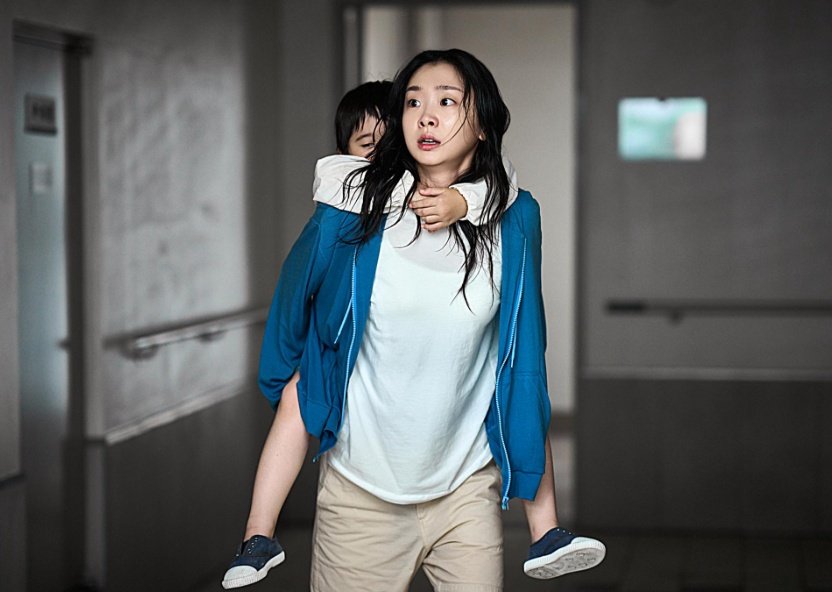
At first, The Great Flood looks like a conventional disaster film. An enormous flood engulfs Seoul, an apartment building becomes a death trap, and a mother desperately searches for her missing child.
But the deeper the story goes, the less certain its reality becomes.
Directed by Kim Byung-woo and starring Kim Da-mi and Park Hae-soo, the Netflix film gradually transforms its survival narrative into a science-fiction experiment about artificial intelligence, memory, and human emotion.
The revelation is not simply that An-na has been trapped in a simulation. The more disturbing possibility is that the future of humanity depends on teaching artificial beings something that technology cannot easily reproduce: the emotional connection between a mother and her child.
The film leaves us with a question that is much larger than its flood.
If artificial intelligence can reproduce human memories, feelings, and relationships, does that mean humanity has survived? Or has something entirely different taken its place?
1. A Disaster Film That Conceals a Different Story
The opening establishes a familiar survival scenario.
A catastrophic flood overwhelms Seoul. Water rises through apartment corridors, elevators become dangerous traps, and residents struggle to reach higher floors.
Gu An-na is not thinking about the fate of civilization. Her immediate concern is Ja-in, the young boy she considers her son.
Her decisions are driven by urgency. Every floor she climbs creates another obstacle, and every delay increases the danger.
The film deliberately encourages the audience to identify with this simple objective: a mother must find her child.
That emotional clarity is important because the story later becomes much more complicated.
When the science-fiction elements emerge, the audience is forced to reconsider the events it has already witnessed. The disaster was not merely a spectacle designed to create suspense. It was the foundation of an experiment intended to reproduce human emotions.
The film’s first major trick is therefore structural. It makes us experience the emotional problem before revealing the scientific question behind it.
2. The Flood Was Real, but the Repeated Disaster Was Not
One of the most important distinctions in understanding the ending is the difference between the original disaster and the later simulations.
The asteroid impact and the resulting global catastrophe belong to the original timeline. The world is genuinely facing extinction.
An-na is rescued from the flooded apartment, but her journey does not end safely. The spacecraft transporting her toward the research facility is struck by debris, and the original An-na dies.
Before her death, she agrees to have her emotional experiences used for the development of artificial humans.
The repeated apartment disaster that occupies much of the film’s later narrative is different.
It is a virtual simulation designed to develop the Emotion Engine.
This distinction explains why the same locations, dangers, and encounters keep returning. The film is no longer showing one continuous escape attempt. It is showing repeated attempts to reproduce a specific emotional response.
The disaster becomes a laboratory.
What appears to be a physical struggle for survival is also a psychological experiment.
3. Ja-in Was Never an Ordinary Human Child
The revelation about Ja-in changes the meaning of An-na’s relationship with him.
He is a synthetic child created as part of the Emotion Engine project.
An-na is assigned the responsibility of raising him, allowing the researchers to observe whether an artificial child can develop emotional responses through experience and human interaction.
Over approximately five years, she raises Ja-in as her own son.
This arrangement creates an uncomfortable question.
If a child is artificially created, does that make the relationship between the child and the person raising him less genuine?
The film’s answer is surprisingly direct.
An-na’s feelings are real even if Ja-in’s origins are artificial.
She does not treat him as an experimental object in her everyday life. She feeds him, protects him, worries about him, and develops the emotional attachment associated with motherhood.
The relationship gradually becomes more important than the scientific purpose that originally created it.
That is the central contradiction of the Emotion Engine.
The researchers want to manufacture emotion through technology, but the experiment depends on a relationship that cannot simply be reduced to a technical instruction.
4. The Emotion Engine Is Searching for Something Beyond Intelligence
Artificial intelligence can process information, identify patterns, and make decisions based on available data.
But The Great Flood imagines a different problem.
The researchers have developed synthetic bodies capable of supporting intelligence and potentially continuing human reproduction. What they still lack is the emotional dimension required to make those beings meaningfully human.
This is where the Emotion Engine becomes essential.
The project is not simply about making artificial beings smarter. It is about developing emotional responses that can influence decisions.
An-na’s experience as a mother becomes the basis of that research.
The film places particular emphasis on the relationship between a mother and a child because it involves competing priorities.
A mother must respond to danger, recognize vulnerability, make sacrifices, and sometimes place another person’s survival above her own.
These decisions are not always logical in the narrow sense of personal survival.
The researchers need to understand how such behavior develops and whether it can be reproduced in an artificial being.
The film’s most provocative idea is that intelligence alone may not be enough to rebuild civilization.
A society can possess extraordinary technology and still lack the emotional foundation necessary for meaningful human relationships.
5. Why Does An-na Keep Waking Up in the Same Building?
The repeated flood scenarios are the clearest visual evidence that An-na is no longer experiencing an ordinary sequence of events.
She wakes up in familiar circumstances, encounters recurring dangers, and repeatedly tries to locate Ja-in.
At first, she does not fully understand what is happening.
But small inconsistencies begin to accumulate.
Conversations repeat. Characters appear in familiar situations. Details change slightly, and An-na’s clothing becomes an increasingly important clue.
The large number printed on her T-shirt is especially significant.
It indicates the repeated iterations of the simulation. As the experiment continues, the number increases, eventually reaching 21,499.
The number is not merely a decorative science-fiction detail.
It represents the enormous amount of repeated experience required to complete the emotional experiment.
The audience is also forced to reconsider the meaning of repetition.
For An-na, each cycle is another attempt to find Ja-in. For the researchers, each cycle provides another opportunity to refine an artificial emotional system.
The same event has two completely different meanings depending on who is observing it.
6. Why Does the Experiment Need So Many Repetitions?
The experiment is not simply testing whether An-na can reach Ja-in.
It is examining the emotional decisions she makes while trying to reach him.
The simulation repeatedly places her in situations where helping others, protecting herself, and searching for her child compete for her attention.
The trapped girl in the elevator and the woman giving birth are important examples.
These situations force An-na to confront people whose survival is not directly connected to her immediate objective.
A purely self-preserving response would prioritize her own escape.
But the emotional engine needs to understand something more complex: why a person might risk personal safety to help someone else.
The repeated cycles allow the system to collect variations in behavior.
However, there is a fundamental limitation to this method.
A computer can record what a person does. It can compare decisions and identify patterns. But does repeating a decision necessarily reveal why that decision matters emotionally?
The film does not provide a scientific answer.
Instead, it uses the experiment to ask whether human emotions can be learned through experience rather than simply programmed as rules.
7. The Shirt Number Is More Than a Time-Loop Clue
The number on An-na’s clothing is one of the film’s most effective storytelling devices.
It gives the audience a visual indication that the same scenario has been repeated far more times than initially imagined.
The Reddit discussion in r/Koreanfilm offered a particularly useful interpretation: the number can be understood as a training iteration, similar to the repeated cycles used when refining an artificial intelligence model.
That explanation helps clarify the film’s structure.
But the number also has an emotional meaning.
Imagine experiencing the same desperate day thousands of times.
Every attempt begins with the possibility of finding Ja-in. Every failure reinforces the loss. The experience is repeated until the distinction between memory, instinct, and learned behavior becomes increasingly difficult to separate.
The experiment may be collecting data, but the person inside it is experiencing something that resembles decades of grief and determination.
The figure of 21,499 days makes this especially disturbing.
An-na is not simply completing a test. She is enduring a lifetime of repeated emotional failure.
The film therefore turns a technical measurement into a symbol of suffering.
8. Hee-jo Is More Than a Security Officer
Son Hee-jo initially appears to be a practical character whose purpose is to help An-na reach safety.
He represents the outside authority trying to move her toward the rescue operation.
As the story develops, however, his role becomes increasingly complicated.
He knows more about the mission than An-na does, but he does not necessarily understand the entire purpose behind it.
Within the simulation, his behavior becomes part of the repeated environment that An-na must navigate.
As she begins to recognize recurring patterns, she also becomes better able to anticipate his actions.
This changes their relationship.
He is no longer simply a man guiding her through a dangerous building. He becomes a partner whose decisions can affect whether she reaches Ja-in.
The character also introduces another important issue.
The experiment is centered on maternal emotion, but An-na does not complete her journey entirely alone. Cooperation, trust, and sacrifice from other people become part of the process.
This suggests that human emotion cannot be understood through motherhood in isolation.
The ability to care for one child exists within a wider network of relationships and moral decisions.
9. An-na’s Biggest Obstacle Is Not the Water
The rising water creates the film’s immediate tension, but the deeper obstacle is An-na’s inability to recover the full meaning of her past.
She knows she must find Ja-in, yet she does not initially understand why certain memories feel so important.
The simulation gradually exposes fragments of her previous experiences.
The audience discovers that the repeated disaster is connected to a real moment of separation between An-na and Ja-in.
In the original timeline, she was forced to leave him behind during the evacuation.
That moment becomes the emotional center of the experiment.
Her promise to return for him remains unfinished.
The simulation repeatedly places her in a situation where she must confront the consequences of that separation.
This changes the meaning of her determination.
She is not simply trying to save a child from a flood. She is attempting to fulfill a promise that she could not keep in the original reality.
The water is the visible threat.
Her unresolved emotional experience is the deeper conflict.
10. The Final Search for Ja-in Changes the Meaning of Motherhood
The final successful attempt depends on An-na remembering where Ja-in is hiding.
He is in a closet on the 30th floor.
Earlier, she had told him to wait there and promised that she would return.
The memory becomes the key to completing the final scenario.
This moment is important because the solution does not come from discovering a new escape route or defeating the disaster through physical strength.
It comes from recovering the emotional meaning of a promise.
An-na finally understands what she has been trying to do throughout the repeated scenarios.
She must return for Ja-in.
The scene transforms the experiment from a technical challenge into an emotional resolution.
Her success is not simply that she finds the child.
It is that she completes the commitment that defined their relationship.
The film suggests that motherhood is not measured only by biological connection or the ability to protect someone physically.
It is also shaped by responsibility, memory, and the decision to remain connected when separation becomes unavoidable.
11. Did An-na Really Learn to Love, or Was Love Already Inside Her?
This is one of the film’s most interesting philosophical problems.
The Emotion Engine is designed to reproduce genuine human emotion.
But An-na’s experience complicates the purpose of the experiment.
She was already emotionally attached to Ja-in before the repeated simulations began.
Her grief, memories, and desire to return for him are not necessarily artificial inventions created by the training process.
They originate in her lived experience.
So what exactly is being learned?
One interpretation is that the system is not creating love from nothing. It is learning how to reproduce the emotional patterns and decisions associated with a relationship that already existed.
Another possibility is that the simulation is transforming An-na’s memories into a model capable of generating similar emotional responses in synthetic beings.
These are not identical processes.
Copying a memory is not the same as experiencing an emotion. Reproducing a behavior is not necessarily the same as understanding why it matters.
The film deliberately leaves this distinction unresolved.
That uncertainty is more interesting than a simple explanation in which the AI suddenly becomes human after completing a test.
12. The Ending: Did Humanity Actually Survive?
The final scenes show An-na and Ja-in traveling back toward Earth in a spacecraft.
At first glance, this appears to be a hopeful conclusion.
The experiment has succeeded. The emotional engine has reached its objective, and the two characters are able to return to a planet that may eventually support a new civilization.
But the ending is more complicated than a conventional survival story.
The original An-na died. Ja-in was a synthetic child. The beings we see at the end are connected to the artificial-human project.
The film does not fully settle whether the final An-na should be understood as the original woman restored through transferred memories or as a synthetic being carrying the emotional data developed by the experiment.
This uncertainty changes the meaning of the reunion.
If the final An-na is an artificial reconstruction, then the original woman did not physically survive.
What survived was a combination of memories, emotional experience, and identity.
The distinction matters.
Humanity may continue through artificial bodies, but that does not automatically mean the original human population has been saved.
The film offers a future for human-like life, not a simple restoration of the world that existed before the catastrophe.
13. The Ship of Theseus: If Every Part Changes, Is It Still the Same Person?
The ending raises a philosophical question often associated with the Ship of Theseus.
If a ship has every part replaced over time, is it still the original ship?
The same question can be applied to An-na.
If her biological body dies but her memories and emotional experiences are transferred into an artificial body, is the resulting being still An-na?
There are several possible answers.
One view is that personal identity depends primarily on memory. If the new being remembers the same experiences and maintains the same emotional connections, it may reasonably be considered the continuation of the original person.
Another view is that consciousness cannot be reduced to information. A perfect copy of someone’s memories might still be a new individual rather than the original person.
A third possibility is that identity is not a single unchanging substance. It is something maintained through relationships, experiences, and the continuity of one’s choices.
The film does not choose one answer.
Instead, it uses the final image of An-na and Ja-in looking toward Earth to make the audience confront the problem.
If the new An-na loves Ja-in exactly as the original did, does it matter that her body is artificial?
Or does the fact that she is a copy change everything?
14. The Film’s Greatest Contradiction: Can Human Emotion Be Manufactured?
The most provocative idea in The Great Flood is also its biggest unresolved problem.
The researchers want to create artificial humans capable of continuing civilization.
They have the technology to build bodies and develop intelligence, but they still need an emotional system.
The experiment suggests that maternal love can provide a foundation for that system.
Yet the film also demonstrates how difficult it is to define love.
An-na’s attachment to Ja-in includes affection, responsibility, fear, regret, sacrifice, and the memory of separation.
It is not a single emotion that can be isolated and reproduced.
Even her final success depends on a complicated history of failure and learning.
The film therefore exposes a contradiction in the idea of manufacturing emotion.
If an artificial being is given memories and emotional responses, does it truly feel, or does it simply behave as though it feels?
And if the behavior is indistinguishable from genuine emotion, is the distinction still meaningful?
There is no easy answer.
The film’s strength lies in making this question emotionally tangible rather than presenting it as an abstract discussion about technology.
We do not watch a machine learn an equation.
We watch a mother repeatedly lose a child and struggle to return to him.
15. Did Humanity Survive, or Did Something New Take Its Place?
The title The Great Flood initially suggests a story about nature destroying human civilization.
But the final meaning is more unsettling.
The catastrophe destroys the world as people knew it. The survival project does not simply restore the old human population. It attempts to create a new form of human-like life through artificial bodies, intelligence, memories, and emotional learning.
That means the central question is not whether the flood can be stopped.
It is whether the qualities that make human life meaningful can survive after humanity itself disappears.
An-na’s relationship with Ja-in provides the film’s answer, but not a complete one.
Love, responsibility, and sacrifice may be transferable through experience. Yet the film cannot prove that an artificial reconstruction possesses the same inner life as the person it resembles.
Perhaps that uncertainty is intentional.
The final An-na and Ja-in may be the beginning of a new civilization, but they are also evidence that survival and continuity are not necessarily the same thing.
The human race might continue in a different form.
But whether that new existence should be called humanity is a question the film leaves to us.
Final Thought
The Great Flood is more than a disaster film with an unexpected AI twist.
It is a story about the limits of technology and the difficulty of defining what makes us human.
An-na’s repeated attempts to find Ja-in transform motherhood into the central test of an artificial future. Her final success gives the film an emotional conclusion, but it does not completely resolve the philosophical problem.
If a machine can remember, protect, grieve, and love as a human does, perhaps the difference between artificial and natural life becomes less obvious.
But there is still one question that technology cannot answer for us:
If humanity survives only as an artificial reproduction of its memories and emotions, have we saved the human race—or merely created something that remembers what being human once meant?