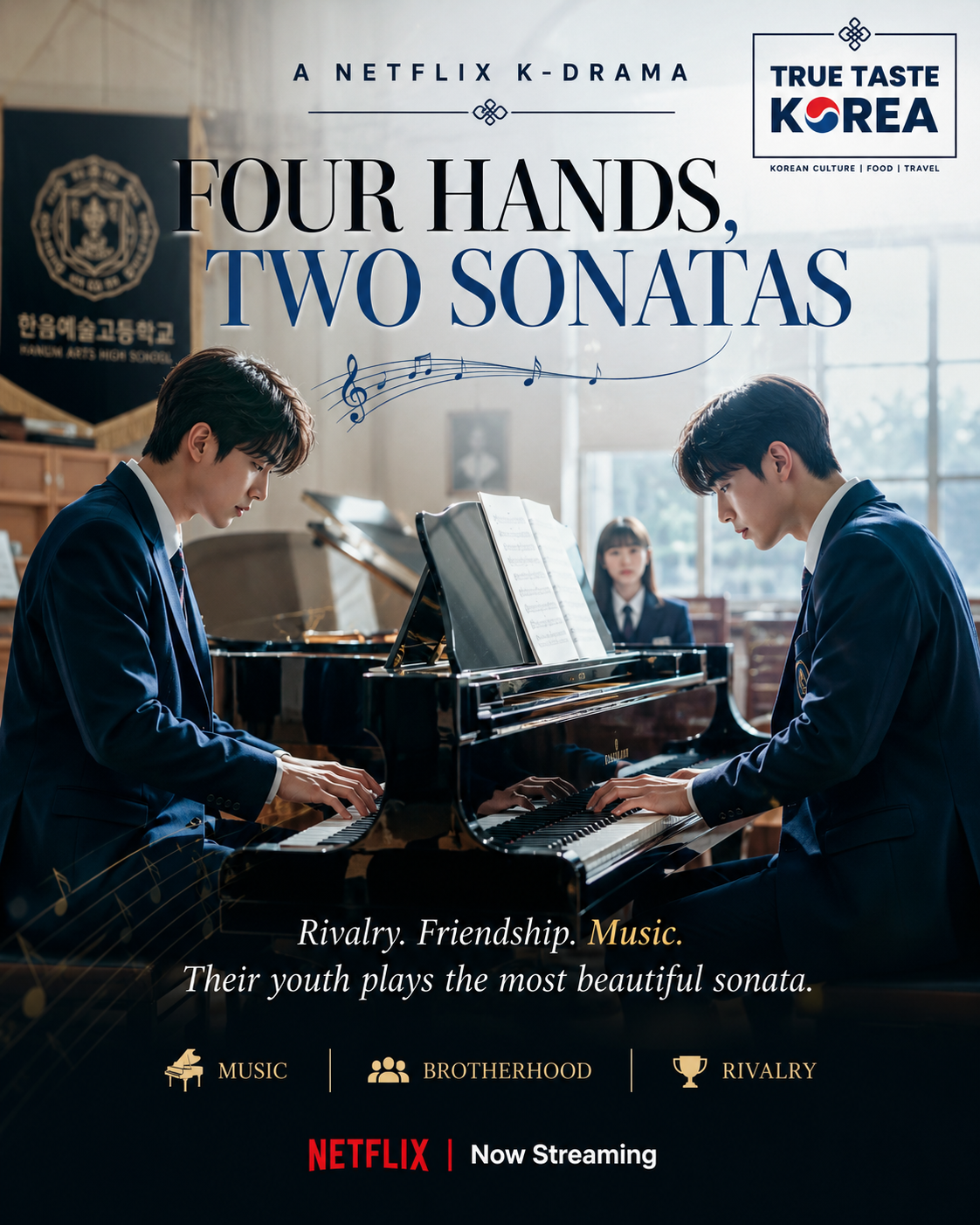
Korean dramas have captured international attention with zombies, revenge, crime, survival competitions, and high-stakes thrillers.
But what if one of the most interesting Korean dramas of 2026 begins with something much quieter?
Two young pianists sharing a single piano.
Netflix’s Four Hands, Two Sonatas takes a different approach from the intense genre dramas that have helped Korean entertainment reach audiences around the world.
Starring Song Kang, Lee Jun-young, and Jang Gyu-ri, the series is set in an elite Korean arts high school. Its story follows young musicians whose lives become connected through music, friendship, rivalry, and the pressure to prove their talent.
At first glance, a classical music drama might seem like an unusual choice for international audiences. It does not rely on a dangerous survival game or a complicated criminal mystery to create tension.
Instead, it explores something much more familiar: what happens when someone who shares your dream also becomes your biggest competitor?
That is one reason Four Hands, Two Sonatas deserves attention beyond its musical setting.
Its greatest strength may be its ability to turn a specifically Korean school environment into a story about emotions that viewers everywhere can understand.
1. What Is Four Hands, Two Sonatas About?
The drama centers on two young piano students who come from very different backgrounds.
Kang Pi-o, played by Song Kang, has grown up in a privileged musical environment. He has received structured training, developed strong technical skills, and learned to pursue excellence through discipline.
His life appears to follow a clear path toward success. But behind his polished performance is the pressure of constantly meeting expectations.
Then he encounters Choi Jeong-yo, played by Lee Jun-young.
Jeong-yo has experienced a much more difficult childhood and has spent time away from the piano. Unlike Pi-o, he has not followed a conventional path through elite musical education.
Yet he possesses a natural musical sensitivity that makes him difficult to ignore.
The two young pianists approach music in very different ways.
Pi-o represents discipline, preparation, and technical perfection. Jeong-yo brings a more instinctive and emotionally expressive approach.
Their meeting creates a conflict that goes beyond a simple competition to determine who is the better pianist.
Each begins to discover something in the other that challenges his understanding of music and himself.
2. Why the Title Four Hands Matters
The title is more than a reference to classical music.
In piano terminology, four hands describes a duet in which two performers play the same piano together.
Two musicians share one instrument, coordinating their movements and combining their individual parts into a single performance.
It sounds simple, but successful four-hand playing requires a great deal of cooperation.
Both performers must listen carefully. They need to adjust their timing, respect the other person’s part, and understand how their individual contributions fit into the larger piece.
One pianist cannot simply dominate the keyboard.
This makes the musical concept a powerful metaphor for Pi-o and Jeong-yo.
At first, they see each other as competitors. Each has a different understanding of what makes a great pianist, and neither is immediately comfortable with the other’s approach.
But music performed by two people requires something more than individual talent.
It requires listening.
It requires compromise.
And it requires recognizing that another person’s strengths do not automatically make your own abilities less valuable.
The title suggests the central question of the drama: can two people who compete with each other learn to create something together?
3. Song Kang: The Pressure Behind a Perfect Pianist
Song Kang plays Kang Pi-o, a gifted young pianist whose life has been shaped by musical discipline and high expectations.
He has the training, ability, and background that many aspiring musicians would envy.
But being talented does not necessarily make life easier.
For Pi-o, success comes with an expectation that he must continue performing at the highest level.
A mistake is not simply a mistake. It can feel like a threat to the identity he has spent years building.
This is an interesting direction for Song Kang because Pi-o’s conflict is largely internal.
His greatest challenge is not necessarily a lack of ability. It is the pressure of believing that he must always be exceptional.
When Jeong-yo enters his world, Pi-o faces a different kind of threat.
He encounters someone whose musical instincts cannot easily be explained by the rules and training he has relied on.
That experience forces him to question whether technical perfection is enough to make someone a great musician.
For international viewers familiar with Song Kang through Sweet Home and Love Alarm, the role offers a different kind of character to explore.
Instead of focusing on physical danger or a dramatic external threat, the story places him in a world where insecurity, ambition, and artistic identity become the main sources of tension.
4. Lee Jun-young: A Natural Talent With a Difficult Past
Lee Jun-young plays Choi Jeong-yo, a young pianist whose path has been very different from Pi-o’s.
Jeong-yo has faced difficult personal circumstances and has experienced a period away from music.
His talent, however, has not disappeared.
He approaches the piano with a sense of freedom and instinct that contrasts with Pi-o’s disciplined style.
This does not mean that Jeong-yo has an easy path simply because he is naturally gifted.
Talent alone cannot guarantee opportunity, stability, or success.
A young musician also needs the right environment, the confidence to keep going, and the determination to develop an ability that may have been neglected.
That is what makes Jeong-yo an interesting counterpart to Pi-o.
One has been trained to meet expectations. The other must find a way to believe in his own potential again.
Their differences create tension, but they also create opportunities for growth.
For viewers who know Lee Jun-young from Weak Hero Class 2 and When Life Gives You Tangerines, this drama offers another opportunity to see him in a very different role.
5. Jang Gyu-ri Adds Another Musical Perspective
The story is not limited to the relationship between two male pianists.
Jang Gyu-ri plays Hong Jae-in, a viola student and a longtime friend of Pi-o.
Her musical background is important because she is not a piano major.
The viola gives her a different perspective on music and performance. Rather than being involved only in the rivalry between Pi-o and Jeong-yo, she brings another artistic viewpoint into their world.
Jae-in’s relationships with the two young men also add emotional complexity to the story.
Friendship, affection, competition, and personal ambition can become difficult to separate when people spend their formative years together.
Jang Gyu-ri, previously known as a member of the K-pop group fromis_9, brings an additional point of interest for viewers familiar with the connection between Korean music and television.
Her character helps the drama move beyond a straightforward contest between two talented pianists.
6. Why a Korean Arts High School Is Such an Interesting Setting
For international viewers, the school environment itself may be one of the drama’s most distinctive features.
An elite arts high school is very different from the ordinary school setting seen in many coming-of-age dramas.
Students are not only trying to achieve good grades. They are also developing specialized artistic abilities and competing with classmates who may be exceptionally talented.
For a young pianist, a practice room can become a place of both ambition and anxiety.
An audition can feel like a judgment of years of hard work.
A classmate’s successful performance can inspire admiration, but it can also create jealousy and self-doubt.
This is particularly interesting because the characters are still teenagers.
They may have extraordinary musical abilities, but they are still learning how to handle friendship, attraction, disappointment, and the pressure of growing up.
The arts-school setting brings these two worlds together.
It shows how a person’s talent can become part of their identity long before they have fully understood who they want to become.
7. The Real Conflict: Natural Talent Versus Years of Training
One of the most familiar questions in any competitive field is whether natural talent can overcome hard work.
Four Hands, Two Sonatas uses music to explore this question through Pi-o and Jeong-yo.
Pi-o has spent years developing his technique. His approach is built around preparation, discipline, and control.
Jeong-yo, on the other hand, has a more instinctive relationship with the piano.
It would be easy to turn this into a simple contest between the disciplined student and the naturally gifted newcomer.
But that would miss the more interesting possibility.
Technical skill and emotional expression are not necessarily enemies.
A technically brilliant performance can still feel emotionally distant. A deeply expressive performance may also need discipline and control to reach its full potential.
The two approaches can complement each other.
Pi-o may need to understand that music is not only about playing every note correctly. Jeong-yo may need to recognize that natural ability must be developed if it is going to last.
Their relationship raises a more meaningful question:
Can people with different strengths become better by learning from each other instead of constantly trying to prove who is superior?
That is a theme that extends far beyond classical music.
8. Why This Drama Feels Different From Many International K-Drama Hits
Korean dramas have become internationally recognized for their ability to create intense entertainment.
Survival competitions, revenge stories, crime investigations, and supernatural threats can immediately capture a viewer’s attention.
Four Hands, Two Sonatas takes a quieter route.
Its central conflict is not about defeating an enemy or escaping a dangerous situation.
It is about understanding one’s own ability and learning how to live with people who challenge it.
That does not mean the story lacks tension.
A musical competition can carry enormous emotional weight when the characters have invested their identities and futures in their performances.
A single performance may change how a student sees himself. Another person’s success may create doubts that were never there before.
The drama finds its tension in these personal consequences.
For viewers who enjoy character-driven stories, this can be just as compelling as a conventional thriller.
The difference is that the suspense comes from emotional development rather than physical danger.
9. Why Music Gives the Story International Potential
One of the strongest advantages of a music-centered drama is that its central subject can cross language barriers.
A viewer does not need to understand every line of Korean dialogue to recognize the tension between two performers.
The difference between a controlled performance and an emotionally expressive one can be heard.
The anxiety before an important performance can be understood without subtitles.
And the feeling of being outperformed by someone you admire is familiar in almost every culture.
Think about the experiences of an athlete, a student, or a young artist.
They may all face the same difficult situation: meeting someone who is more talented in an area they care deeply about.
That person can become a rival.
They can also become a source of inspiration.
Sometimes, they are both at the same time.
This is where Four Hands, Two Sonatas has an opportunity to connect with international audiences.
Its setting is specifically Korean, but its emotional questions are universal.
10. The Netflix Connection: Familiar Actors, a Different Genre
The casting gives the drama another potential advantage.
Song Kang already has international recognition through Netflix titles such as Sweet Home and Love Alarm.
Lee Jun-young has also appeared in productions that have reached audiences outside Korea, including Weak Hero Class 2 and When Life Gives You Tangerines.
For viewers who discovered these actors through Netflix, Four Hands, Two Sonatas offers a reason to explore a different kind of Korean drama.
The contrast is particularly interesting.
Audiences who associate Song Kang with supernatural action or Lee Jun-young with other dramatic roles now see them in a story built around classical music and artistic competition.
Familiar actors can help attract initial attention.
But the drama still needs to offer something beyond the cast to hold viewers’ interest.
Its strongest opportunity lies in the relationship between its two leads and the musical world they inhabit.
11. Could Four Hands, Two Sonatas Become a Global Hit?
It is too early to assume that a distinctive premise automatically guarantees international success.
Global popularity depends on many factors, including regional availability, promotion, audience response, viewing habits, and word of mouth.
However, the drama has several qualities that could help it reach viewers beyond Korea.
First, its central theme is easy to understand. Competition, friendship, insecurity, and personal growth are familiar experiences across cultures.
Second, its musical setting gives it a recognizable identity. It does not look or feel like another conventional revenge thriller.
Third, the leading actors already have connections with international Netflix audiences.
Most importantly, the story has the potential to appeal to viewers who want emotional investment rather than constant shock.
There is also a challenge.
Classical music may not be an immediate attraction for every viewer, especially those who usually prefer fast-paced thrillers.
The series therefore needs to make its characters compelling enough that viewers become interested in their lives, even if they have little knowledge of piano music.
That is ultimately what will determine whether its appeal extends beyond a specialized audience.
12. The Most Interesting Idea: Learning to Listen to Someone Else
There is a deeper message in the idea of four hands sharing one piano.
When two people perform together, neither can focus entirely on themselves.
They have to listen to the other person.
They have to recognize when to lead and when to follow.
They have to understand that a successful performance is not simply the result of one person’s brilliance.
This is also a useful way to understand the relationship between Pi-o and Jeong-yo.
At first, they may see each other as obstacles.
But a rival can reveal weaknesses that no teacher or friend has ever exposed.
A person who approaches music differently can make you question habits you have never thought to challenge.
And sometimes, the person you most want to defeat is also the person who helps you become better.
That idea gives the drama a meaning beyond its musical setting.
It is about the difficult process of recognizing another person’s strengths without losing confidence in your own.
Final Thoughts: A Different Kind of K-Drama With Global Appeal
Four Hands, Two Sonatas may not follow the formula of the most explosive Korean dramas.
It does not need monsters, elaborate revenge plans, or a dangerous survival game to establish its identity.
Instead, it builds its story around two young musicians, one piano, and the complicated emotions that emerge when talent meets competition.
Song Kang’s disciplined pianist and Lee Jun-young’s more instinctive musician create a contrast that gives the story its central energy.
Jang Gyu-ri adds another musical perspective, while the arts high school setting creates a believable environment for ambition, friendship, and personal growth.
Whether the series becomes a major international hit will depend on how strongly viewers connect with its characters.
But its central idea already has something valuable: it speaks to people who have ever competed with someone they admired, struggled with expectations, or wondered whether they were good enough.
Two pianists. One piano. Four hands. Two different lives.
Perhaps the most meaningful music begins when neither person tries to play alone.
That is the possibility at the heart of Four Hands, Two Sonatas—and the reason this Korean drama deserves attention from viewers around the world.
Where to Watch Four Hands, Two Sonatas
Four Hands, Two Sonatas premiered on August 29, 2026. Check the official Netflix page for current availability in your region.
Netflix Official Page:
https://www.netflix.com/title/82682404
Netflix Official Introduction:
https://about.netflix.com/en/news/four-hands-two-sonatas-teaser
Soompi – Cast and Character Guide:
https://www.soompi.com/article/1859522wpp/song-kang-lee-jun-young-and-jang-gyuri-form-a-special-bond-through-music-in-new-drama-four-hands-two-sonatas
True Taste Korea
Exploring Korean dramas, food, travel, music, and culture from inside Korea—and sharing the stories behind them with the world.