Netflix K-Drama

  • Is Netflix’s The Scandal Based on Cruel Intentions? The Dangerous Liaisons Connection Explained

    If you watched the trailer for Netflix’s The Scandal and immediately thought of Cruel Intentions, you are not alone.

    A wealthy and privileged world. A dangerous seduction game. A man challenged to pursue a woman. Desire turning into manipulation — and manipulation threatening to become something real.

    The similarities are easy to notice.

    So, is Netflix’s Korean drama The Scandal actually based on Cruel Intentions?

    No — not directly.

    The connection goes much further back.

    Both stories belong to the same family of adaptations that began with the 1782 French novel Les Liaisons dangereuses, commonly known in English as Dangerous Liaisons.

    Understanding that connection may also tell us something important about what Netflix’s new Korean adaptation is trying to do differently.

    Is The Scandal a Korean Version of Cruel Intentions?

    Not exactly.

    Netflix’s The Scandal is not a remake of the 1999 American movie Cruel Intentions.

    Instead, both works trace their roots to Dangerous Liaisons, the famous French novel by Pierre Choderlos de Laclos.

    The novel revolves around aristocrats who use seduction, sex and emotional manipulation as weapons in games of power and revenge.

    That basic idea has been adapted many times.

    Cruel Intentions took the premise and transformed it into a story about wealthy young people in modern America.

    Korea previously reinterpreted it through the 2003 film Untold Scandal, which moved the story into Joseon society.

    Netflix’s The Scandal now returns to Joseon — but with a new cast, an eight-episode format and newly written character relationships.

    So the family tree is closer to this:

    Dangerous Liaisons (1782)
    ↓
    Many international adaptations
    ↓
    Cruel Intentions (1999) — modern American reinterpretation
    Untold Scandal (2003) — Korean Joseon reinterpretation
    The Scandal (2026) — new Netflix Korean reinterpretation

    That is why Cruel Intentions fans may immediately recognize the DNA of the story even though the Netflix series is not directly based on that movie.

    Why Does The Scandal Feel So Much Like Cruel Intentions?

    The strongest similarity is not the historical period, characters or setting.

    It is the game.

    Netflix introduces Lady Cho, played by Son Ye-jin, and Cho Won, played by Ji Chang-wook, as the central figures in a dangerous wager involving Hui-yeon, played by NANA.

    Seduction is therefore not simply the beginning of a romance.

    It is part of a contest.

    And that is one of the defining ideas audiences associate with Dangerous Liaisons and its adaptations.

    Someone believes they are controlling the game.

    Someone else becomes the target.

    Then feelings, jealousy, pride and desire begin interfering with the original plan.

    The most interesting question is what happens when the players can no longer control the game they created.

    Who Corresponds to Whom?

    Viewers familiar with Dangerous Liaisons or Cruel Intentions will naturally try to match the characters.

    Lady Cho appears to occupy the position of the powerful woman who helps drive the manipulation.

    Cho Won appears to be the charismatic seducer.

    Hui-yeon appears to be the woman drawn into their dangerous wager.

    But there is a reason to be careful with direct one-to-one comparisons.

    Director Jung Ji-woo has said that the Netflix series is very different from the 2003 Korean film and that the characters and their relationships were rewritten after returning to the original French novel.

    That means knowing Cruel Intentions, Dangerous Liaisons or Untold Scandal may help viewers recognize the structure without necessarily telling them exactly what these characters will do.

    And that could be where the new series becomes interesting.

    Lady Cho May Be More Than the Familiar Manipulator

    Lady Cho is particularly important.

    Netflix describes her as a talented woman constrained by the limits Joseon society places on women.

    That gives the character another dimension beyond simply being someone who manipulates romantic relationships for amusement or revenge.

    In a society where power is overwhelmingly controlled by men, what does an intelligent woman do when she possesses ability but lacks formal authority?

    Manipulation may become more than entertainment.

    It could become a form of power.

    If the series explores that idea seriously, Lady Cho’s motivations could feel substantially different from similar characters in previous adaptations.

    And with Son Ye-jin in the role, Lady Cho may become the character through whom this adaptation establishes its own identity.

    Cho Won Is More Than Just a Joseon Playboy

    Ji Chang-wook plays Cho Won, described as the most notorious playboy of his era.

    On the surface, the role seems familiar.

    He is attractive, confident and experienced in seduction — exactly the kind of person needed for a dangerous romantic wager.

    But an eight-episode drama has much more time than a feature film to ask a harder question:

    What happens when a man who treats love as a game encounters an emotion he cannot control?

    That conflict is fundamental to the Dangerous Liaisons tradition.

    The difference will depend on how Netflix develops Cho Won’s motivations and whether the series allows him to make choices viewers familiar with previous adaptations do not expect.

    And What About Hui-yeon?

    Hui-yeon may be the biggest unknown before release.

    At first glance, she appears to be the person caught inside Lady Cho and Cho Won’s game.

    But viewers should probably avoid assuming that this automatically makes her a passive victim.

    The director has specifically emphasized rewritten relationships.

    An eight-part adaptation also has enough time to give Hui-yeon considerably more agency than a shorter version of the story might allow.

    Could she discover the game earlier than expected?

    Could she have motivations the other characters misunderstand?

    Could the apparent target eventually change the balance of power?

    Those are only pre-release possibilities, not confirmed plot points.

    But if Netflix wants to make a centuries-old story feel fresh, Hui-yeon is one obvious character through whom it could surprise viewers.

    How Is This Different From Untold Scandal?

    Korean cinema already created a celebrated Joseon adaptation of Dangerous Liaisons in 2003.

    Untold Scandal, starring Bae Yong-joon, Lee Mi-sook and Jeon Do-yeon, also transplanted the French story into Korean history.

    That naturally raises another question:

    Why make it again?

    The answer will ultimately depend on how much Netflix changes.

    The new The Scandal has the advantage of an eight-episode format, allowing much more space for character motivations, changing relationships and the social restrictions surrounding desire in Joseon.

    Jung Ji-woo has also made clear that this is not intended simply as an extended recreation of the 2003 movie.

    For a detailed comparison between the two Korean adaptations, see our separate guide:

    Is Netflix’s The Scandal a Remake of Untold Scandal? What’s Different From the 2003 Movie

    Could The Scandal Change the Original Story?

    This is where things become especially interesting for viewers who already know Dangerous Liaisons.

    A familiar story creates a unique opportunity.

    The audience thinks it knows what happens next.

    That means even a relatively small change can become a major surprise.

    Netflix does not need to discard the entire structure of Dangerous Liaisons to make The Scandal unpredictable.

    Changing a character’s true motivation, revealing a hidden relationship, reversing who is manipulating whom or altering one crucial decision could change the meaning of everything that follows.

    The strongest adaptation would not simply surprise viewers who have never encountered the story.

    It would surprise the people who believe they already know it.

    Does Knowing Cruel Intentions Spoil The Scandal?

    Probably not.

    Knowing Cruel Intentions or another version of Dangerous Liaisons may help you recognize the basic game of seduction and manipulation.

    But it should not be treated as a spoiler guide for Netflix’s series.

    The historical setting is different.

    The social rules are different.

    The characters have been rewritten.

    The relationships have reportedly been changed.

    And the longer format gives the story room to travel in directions previous film adaptations could not.

    In fact, viewers familiar with earlier versions may have an additional reason to watch:

    How long will Netflix allow us to believe we know what happens next?

    The Real Connection Between The Scandal and Cruel Intentions

    So, is The Scandal based on Cruel Intentions?

    No.

    But if the trailer reminded you of Cruel Intentions, your instinct was not wrong.

    They share the same literary ancestor: Dangerous Liaisons.

    Cruel Intentions transformed that story for late-1990s America.

    Untold Scandal transformed it for Joseon Korea in 2003.

    And now Netflix’s The Scandal is attempting another transformation for a global streaming audience in 2026.

    The basic game may be centuries old.

    The real test is whether this version can make us uncertain about who is actually winning it.

    The Scandal premieres globally on Netflix on September 18, 2026.

    This article was written before the premiere. It will be updated after release once the series confirms how far its characters, relationships and story depart from previous versions of Dangerous Liaisons.
  • Is Netflix’s The Scandal a Remake of Untold Scandal? What’s Different From the 2003 Movie

    Netflix’s upcoming Korean series The Scandal may look familiar to longtime K-drama and Korean film fans.

    A dangerous wager.
    A notorious seducer.
    A powerful woman manipulating the game from behind the scenes.
    And an innocent woman who becomes caught between them.

    If that reminds you of the 2003 Korean film Untold Scandal, starring Bae Yong-joon, Lee Mi-sook and Jeon Do-yeon, you are not imagining the connection.

    But there is an important reason not to assume Netflix’s The Scandal will simply retell the same story.

    Director Jung Ji-woo has already said the new series is “very different” from the 2003 film, explaining that the production went back to the original French novel and rewrote its characters and relationships.

    So what exactly is the connection between The Scandal, Untold Scandal and Dangerous Liaisons?

    And how different could Netflix’s version actually be?

    Is The Scandal a Remake of the 2003 Korean Movie?

    Yes — but “remake” does not tell the whole story.

    The 2003 film Untold Scandal was itself an adaptation of Pierre Choderlos de Laclos’s famous 1782 French novel Les Liaisons dangereuses, better known in English as Dangerous Liaisons.

    The Korean film moved the story from pre-Revolutionary France to late-18th-century Joseon Korea.

    Netflix’s 2026 The Scandal returns to this world of aristocratic desire, manipulation and seduction, once again placing the story in Joseon.

    The new series stars:

    • Son Ye-jin as Lady Cho
    • Ji Chang-wook as Cho Won
    • NANA as Hui-yeon

    At the center of the story is a dangerous wager involving Lady Cho and Cho Won, with Hui-yeon becoming entangled in their game.

    That basic setup will sound very familiar to viewers of the 2003 film.

    But the similarities may become much less straightforward once the story begins.

    The Director Says the New Scandal Is “Very Different”

    This may be the most important thing to know before watching the Netflix series.

    At a press conference ahead of the September 18 premiere, director Jung Ji-woo said the new version is very different from the 2003 movie.

    Rather than simply expanding the old film into a longer Netflix series, Jung said the production returned to the French novel and rewrote the characters and their relationships.

    That distinction matters.

    It suggests that Netflix’s The Scandal should not be approached as an eight-episode recreation of scenes audiences already saw in 2003.

    The basic DNA may remain the same.

    The relationships, motivations and path to the ending may not.

    The Same Three-Person Game — But Possibly Different Players

    Netflix describes Lady Cho as a gifted woman whose abilities cannot be contained by the restrictions placed on women in Joseon society.

    Cho Won is the most famous playboy of his time.

    Hui-yeon is the woman who becomes caught in their dangerous wager.

    On the surface, this preserves the central triangle familiar from earlier versions of Dangerous Liaisons.

    But Netflix’s promotional material already hints that Lady Cho may have motivations that are not immediately visible.

    That could become one of the most important differences in the new adaptation.

    If the characters have been substantially rewritten, the real question may not be:

    “Will the Netflix series follow the 2003 movie?”

    It may instead be:

    “Which character do we think we already understand — but actually don’t?”

    Why Hui-yeon Could Be Especially Important

    Hui-yeon, played by NANA, initially appears to occupy the position of the woman drawn unwillingly into Lady Cho and Cho Won’s dangerous game.

    But this is one character worth watching carefully.

    A modern adaptation has much more room than a two-hour film to develop the supposedly innocent person caught inside the scheme.

    That creates several possibilities.

    Could Hui-yeon have greater agency than viewers expect?

    Could her relationship with Lady Cho become more important?

    Could the person who appears to be a pawn eventually influence the game itself?

    Before release, those questions cannot be answered definitively.

    But the director’s statement that the characters and relationships have been rewritten makes them worth asking.

    Why an Eight-Episode Series Changes the Story

    The 2003 Untold Scandal had to tell its story within the limits of a feature film.

    Netflix’s The Scandal is an eight-part series.

    That extra time gives the writers room to do something potentially much more interesting than simply recreate the original plot.

    They can expand:

    • hidden character motivations,
    • relationships outside the central seduction game,
    • political and social pressures of Joseon,
    • the consequences of female desire in a restrictive society,
    • changes in loyalty,
    • and potentially new twists before the ending.

    The format itself therefore makes substantial adaptation almost inevitable.

    The important question is whether those changes make this familiar story feel genuinely new.

    What About Dangerous Liaisons and Cruel Intentions?

    Some viewers encountering The Scandal may also recognize similarities to Dangerous Liaisons or even Cruel Intentions.

    That is because these stories belong to the same adaptation family.

    The starting point is Laclos’s Les Liaisons dangereuses, published in 1782.

    Its central idea — privileged people turning seduction into a game of power, revenge and manipulation — has inspired numerous adaptations around the world.

    The 2003 Korean Untold Scandal transformed that premise by placing it inside Joseon society.

    Netflix is now reinterpreting it again for a modern global television audience.

    So The Scandal is not simply copying a 2003 Korean movie.

    It is the latest reinterpretation of a story that has been repeatedly reinvented for different eras and cultures.

    Will Netflix Change the Ending?

    This is probably one of the biggest questions for viewers familiar with the previous versions.

    For now, Netflix has not revealed enough to answer it.

    And that uncertainty may be exactly what makes the new adaptation interesting.

    If the characters and relationships really have been rewritten as significantly as the director suggests, assuming that every character will make the same choices — or reach the same destination — could be a mistake.

    The series does not necessarily need to abandon the basic structure of Dangerous Liaisons to surprise viewers.

    A changed motivation, a hidden relationship, an unexpected betrayal or a different decision at a crucial moment could completely alter how we interpret the ending.

    That may ultimately determine whether The Scandal feels like a fresh adaptation or merely another version of a very familiar story.

    The Real Question: How Much Has The Scandal Changed?

    For viewers who have never seen Untold Scandal, Netflix’s series can be watched as a new Joseon romance about desire, manipulation and forbidden relationships.

    For viewers who already know the 2003 movie or Dangerous Liaisons, however, there is another layer of suspense.

    We already know the game.

    We think we know the players.

    We may even think we know where the story is heading.

    And that gives the new series an opportunity to use our expectations against us.

    Director Jung Ji-woo has already warned us that this version is very different.

    Now the question is whether The Scandal can make a centuries-old story unpredictable again.

    The Scandal premieres globally on Netflix on September 18, 2026.

    This article was written before the series premiere and will be updated after release with confirmed differences between the Netflix series, the 2003 film Untold Scandal and the original Dangerous Liaisons story.

  • Mousetrap: 7 Clues You Missed Before the Ending Twist

    Warning: Major spoilers for all 10 episodes of Netflix’s Mousetrap (들쥐) follow.

    If you finished Mousetrap and immediately thought, “Wait — were the clues there all along?”, the answer is yes.

    The finale reveals that Yu-min is behind the present-day theft of Je Moon-jae’s identity. But that is only half of the twist.

    Moon-jae, the man we spent most of the series treating as the victim, had already taken Yu-min’s writing and built part of his own identity and career around something that was never truly his.

    Once you know the ending, several earlier details suddenly look very different.

    Here are 7 clues that make more sense after the Mousetrap ending.

    1. Moon-jae’s identity starts collapsing before he understands why

    At first, the premise seems simple.

    Moon-jae discovers that another person has his face, his name and access to his life.

    Naturally, we assume Moon-jae is the original and the other man is the impostor.

    But Mousetrap deliberately makes us accept Moon-jae’s version of himself before proving that his own identity was already built on appropriation.

    The first trick wasn’t simply hiding the Rat.

    It was making us trust the supposed victim.

    2. Moon-jae is strangely disconnected from his own past

    As the mystery develops, Moon-jae’s past becomes increasingly important.

    The finale eventually reveals why.

    Yu-min isn’t a random stranger who selected a successful novelist to impersonate.

    Their histories are connected.

    Moon-jae had taken Yu-min’s writing and used it in building his career, turning the present-day identity theft into a deliberate mirror of what happened years earlier.

    Yu-min doesn’t merely want Moon-jae’s money.

    He wants him to experience what it feels like when someone else takes ownership of your life.

    3. The real mystery was never just “Who has Moon-jae’s face?”

    This is one of the smartest pieces of misdirection in the drama.

    For much of Mousetrap, we ask:

    Which man is the real Je Moon-jae?

    But the finale changes the question to something much more uncomfortable:

    How much of Moon-jae’s life was actually his to begin with?

    His face and legal name may belong to him.

    But his reputation as a writer is tied to work taken from Yu-min.

    That is why the identity theme works beyond the literal doppelgänger mystery.

    4. Yu-min’s revenge copies Moon-jae’s original crime

    Yu-min could have exposed Moon-jae immediately.

    Instead, his revenge is far more personal.

    He takes Moon-jae’s identity.

    That structure is the clue.

    Moon-jae took Yu-min’s writing and benefited from another man’s talent.

    Years later, Yu-min takes the identity Moon-jae constructed from that success.

    The punishment is designed to resemble the original wrongdoing.

    You took my life. Now watch me take yours.

    The finale therefore makes victim and perpetrator much harder to separate neatly.

    5. The biggest clue comes after Moon-jae gets his identity back

    This may actually be the most important clue in the entire drama.

    Moon-jae survives.

    He returns home.

    His legal identity is effectively his again.

    So the identity-theft thriller should be over.

    Except Moon-jae now faces something much worse:

    he has to write.

    Yu-min leaves behind material connected to The Rat Vol. 2, and Moon-jae tries to produce his own version.

    He struggles to do it.

    The scene brutally exposes the weakness underneath the identity he has spent years protecting: the successful novelist may have reclaimed his name, but he cannot simply reclaim the talent on which that identity depended.

    6. The title “Mousetrap” has been pointing at two Rats

    For most of the series, Yu-min appears to be the Rat.

    And literally, he is the man stealing Moon-jae’s identity in the present.

    But symbolically, the ending turns the label back toward Moon-jae.

    Moon-jae took another person’s writing and incorporated it into his own success.

    So the finale leaves us with two different kinds of theft:

    Yu-min steals Moon-jae’s identity.

    Moon-jae had already stolen pieces of Yu-min’s life.

    That is why asking “Who is the Rat?” has no completely comfortable answer.

    7. The final door scene proves Moon-jae never really escaped

    The ending gives Moon-jae almost everything he thought he wanted.

    His name.

    His home.

    His life.

    And then someone pounds on his door.

    Seung-gyu has returned because of the unresolved money problem, while Moon-jae sees Yu-min when he looks outside.

    The scene does not clearly establish that Yu-min physically survived. A strong reading is that Yu-min has become part of Moon-jae’s guilt and paranoia.

    And that is the real trap.

    Moon-jae can recover his legal identity.

    He can remove the man who stole his face.

    But he cannot return to believing the story he once told himself about who he was.

    The Mousetrap Twist Was Hiding in Plain Sight

    Mousetrap initially looks like a thriller about a man desperately trying to prove:

    “I am the real Je Moon-jae.”

    By the finale, that question almost feels irrelevant.

    The more interesting question becomes:

    What makes an identity truly yours?

    Your face?

    Your legal name?

    Your memories?

    Your talent?

    Or the life you actually created yourself?

    Yu-min steals Moon-jae’s identity in the most literal way possible.

    But Moon-jae’s past makes the audience realize that identity theft began long before another man appeared wearing his face.

    That is why the ending works so well on a second look.

    The Rat wasn’t simply hiding from Moon-jae.

    Moon-jae was living inside the trap all along.

    The seven clues hidden throughout Mousetrap reveal how carefully the drama prepares viewers for its final twist. Yet the biggest clue may be hiding in the title itself. Explore what Mousetrap really means and who the mouse is at the end to discover how the story’s central metaphor gives these clues an even deeper meaning.

  • Four Hands: Why Is Pi-o Falling Apart Because of Jeong-yo?

    At first, the rivalry between Kang Pi-o and Choi Jeong-yo in Four Hands, Two Sonatas looks familiar.

    Two gifted young pianists meet.

    One has spent his life training for perfection.

    The other possesses extraordinary natural talent.

    Competition begins.

    Jealousy follows.

    But after watching Pi-o more closely, I don’t think jealousy alone explains what is happening to him.

    In fact, the most painful part of their relationship may be the opposite.

    Pi-o knows that Jeong-yo is talented.

    He hears it.

    He sees it.

    And perhaps more importantly, he helps bring that talent out.

    That is what makes Jeong-yo so dangerous to him.

    Jeong-yo is not simply Pi-o’s rival.

    He is becoming the person who forces Pi-o to confront a question he has avoided for most of his life:

    Who am I if being the perfect pianist is no longer enough?

    Pi-o Has Spent His Life Being “The Talented Child”

    Pi-o did not suddenly become competitive after meeting Jeong-yo.

    Competition was already built into his life.

    From childhood, piano was connected to expectations, evaluations and results.

    His mother recognized his talent early and invested herself deeply in his success.

    His grandfather, Kang Seung-woon, is a legendary conductor whose approval carries enormous weight for Pi-o.

    So Pi-o learned something very early:

    Playing well is not enough.

    He has to prove himself.

    Again.

    And again.

    And again.

    Eventually, piano becomes inseparable from recognition.

    A competition result tells him whether he is succeeding.

    A teacher’s judgment tells him whether he is good enough.

    And his grandfather’s approval becomes something almost impossible to obtain.

    That is why one of Pi-o’s most revealing moments comes when he describes himself as having lived like a “competition machine.”

    That phrase explains much more than his career.

    It explains his identity.

    Then Jeong-yo Appears

    Jeong-yo comes from almost the opposite world.

    He does not have Pi-o’s carefully constructed path.

    His life has been unstable.

    His training has not followed the same elite route.

    Yet when he plays, something appears that cannot easily be taught.

    Instinct.

    Emotion.

    Musical intuition.

    Raw talent.

    And Pi-o notices it almost immediately.

    This is important.

    If Pi-o simply believed Jeong-yo was terrible, there would be no real psychological crisis.

    He could dismiss him.

    He could laugh at him.

    He could walk away.

    But Pi-o cannot do that.

    Because he knows.

    Jeong-yo is special.

    The Cruelest Part Is That Pi-o Helps Him

    This may be the most fascinating part of their relationship.

    Pi-o does not merely watch Jeong-yo improve.

    He helps him improve.

    He teaches him.

    He listens to him.

    He points things out.

    He gives Jeong-yo access to knowledge accumulated through years of Pi-o’s own training.

    And Jeong-yo absorbs it.

    That creates an almost unbearable contradiction.

    Pi-o wants his friend to succeed.

    But every step forward Jeong-yo takes also makes him more dangerous as a rival.

    Imagine spending your entire childhood building something brick by brick.

    Then someone arrives with an instinctive understanding of the thing you have spent years trying to master.

    Worse still, you like him.

    And you are helping him.

    That is not simple jealousy.

    That is emotional torture.

    Pi-o Doesn’t Hate Jeong-yo

    This is why I hesitate whenever Pi-o’s behavior is reduced to jealousy.

    There is jealousy, certainly.

    There is competitiveness.

    There is insecurity.

    But there is also affection.

    Pi-o and Jeong-yo genuinely connect through music.

    Pi-o sees something in Jeong-yo that the adults around them may not fully understand.

    And Jeong-yo, in turn, recognizes Pi-o’s importance.

    That makes the conflict much more painful.

    It is easy to compete against someone you hate.

    It is much harder to compete against someone you care about.

    Because every victory has a cost.

    If Jeong-yo fails, Pi-o loses someone important to him.

    If Jeong-yo succeeds, Pi-o feels himself disappearing.

    Grandpa Makes Pi-o’s Fear Real

    Then comes the moment that changes everything.

    Pi-o’s grandfather recognizes Jeong-yo.

    For Pi-o, this is devastating.

    Not simply because Jeong-yo receives an opportunity.

    It is because the person Pi-o most desperately wants recognition from sees something extraordinary in Jeong-yo.

    Suddenly Pi-o’s private fear becomes external reality.

    Until then, he could tell himself:

    Maybe I’m imagining it.

    Maybe Jeong-yo isn’t really better.

    Maybe my insecurity is irrational.

    But when Seung-woon chooses Jeong-yo, Pi-o can no longer hide from the comparison.

    His grandfather has made it real.

    “Who Will Be Left in Ruins?”

    One of Seung-woon’s most brutal observations concerns the relationship between the two young pianists.

    He essentially warns Pi-o to think about which of them will eventually be left emotionally devastated by their rivalry.

    It sounds cruel.

    And it is cruel.

    But it also reveals something Seung-woon has already recognized.

    Jeong-yo and Pi-o are not entering this relationship with the same psychological burden.

    Jeong-yo has many wounds of his own.

    But Pi-o has attached his self-worth to musical recognition.

    That makes every comparison dangerous.

    If Jeong-yo plays better, Pi-o doesn’t simply think:

    “He played better today.”

    Pi-o risks hearing something much more destructive:

    “Maybe I’m not who I thought I was.”

    That is why Pi-o is the one in danger of falling apart.

    Jeong-yo Threatens Pi-o’s Identity, Not Just His Career

    This distinction matters.

    If Jeong-yo were merely threatening Pi-o’s chance to win a competition, the problem would be relatively simple.

    Win the next competition.

    Practice harder.

    Try again.

    But Jeong-yo threatens something deeper.

    Pi-o has spent years constructing an identity around being exceptional.

    Then he meets someone whose talent challenges the meaning of everything he sacrificed.

    If Jeong-yo can reach people through music in a way Pi-o struggles to do, what were all those years of competitions for?

    If his grandfather sees something in Jeong-yo that he does not see in Pi-o, what does that say about Pi-o?

    And if Pi-o himself can hear what makes Jeong-yo special…

    where can he hide?

    He cannot even lie to himself.

    His Mother Makes the Pressure Worse

    Pi-o’s mother, Ji-hye, adds another layer.

    She has invested enormous emotional energy in her son’s success.

    That means Pi-o’s musical life is not entirely his own.

    His achievements carry his mother’s hopes.

    His failures threaten those hopes.

    And Jeong-yo becomes dangerous not only to Pi-o, but to the future Ji-hye has imagined for her son.

    This creates a painful trap.

    Pi-o is beginning to question whether he even wants the life that has been planned for him.

    But at exactly that moment, Jeong-yo appears and begins succeeding in the world Pi-o is considering leaving.

    So Pi-o cannot simply walk away.

    If he leaves, does that mean Jeong-yo won?

    If he stays, is he playing because he loves music?

    Or because he cannot bear to lose?

    That may be the real prison surrounding Pi-o.

    The Great Irony: Jeong-yo May Be Exactly What Pi-o Needs

    This is where I think Four Hands becomes much more interesting than a conventional rivalry drama.

    Jeong-yo may destroy the Pi-o we first meet.

    But perhaps that Pi-o needs to be destroyed.

    The “competition machine.”

    The grandson seeking approval.

    The son carrying his mother’s ambition.

    The technically excellent pianist who cannot explain why he is playing.

    Maybe that identity has to collapse before Pi-o can build another one.

    And strangely, Jeong-yo may be the person who makes that possible.

    Because for the first time, Pi-o is encountering music that cannot be reduced to rankings.

    He is encountering someone who forces him to listen differently.

    And through Jeong-yo, he may eventually be forced to ask:

    What does my own music sound like?

    Not his mother’s music.

    Not his grandfather’s standard.

    Not the judges’ scores.

    His.

    Maybe “Being Ruined” Isn’t the Ending

    That is why Seung-woon’s warning interests me so much.

    What if Pi-o really does end up emotionally shattered?

    The drama may initially make that sound like tragedy.

    But losing an identity is not always the same as losing yourself.

    Sometimes the identity that collapses was never truly yours.

    Pi-o may lose competitions.

    He may lose his grandfather’s approval.

    He may even temporarily lose confidence in his own talent.

    But if that destruction eventually allows him to play because he genuinely wants to play, then Jeong-yo will have done something no teacher, parent or competition could do.

    He will have forced Pi-o to become his own person.

    This Is Why Their Friendship Is More Interesting Than Their Rivalry

    The title Four Hands, Two Sonatas itself suggests that this story is not ultimately about one pianist eliminating the other.

    Four hands require two people.

    Two different players.

    Two different musical identities.

    That makes the emotional direction of the story fascinating.

    Perhaps the question is not:

    Who is better, Pi-o or Jeong-yo?

    Perhaps the real question is:

    Can Pi-o stop needing to be better than Jeong-yo?

    If he can, their rivalry may become something completely different.

    Jeong-yo could stop being proof of Pi-o’s inadequacy.

    He could become the musician who helps Pi-o discover what makes Pi-o unique.

    My Take

    I don’t think Pi-o is falling apart because he hates Jeong-yo.

    I think he is falling apart because he cannot dismiss him.

    He knows Jeong-yo is gifted.

    He cares about him.

    He helps him.

    And then he watches the person whose recognition he has wanted for years recognize Jeong-yo too.

    That combination attacks the very foundation of Pi-o’s identity.

    So when Pi-o becomes jealous, angry or irrational, I don’t see only a spoiled young pianist who cannot tolerate competition.

    I see someone realizing that the identity he spent his entire childhood building may not actually belong to him.

    And that is why Jeong-yo is simultaneously the most dangerous and perhaps the most important person Pi-o has ever met.

    Jeong-yo may be the person who breaks Pi-o.

    But he may also be the person who finally sets him free.

  • Four Hands: Was Grandpa Wrong to Choose Jeong-yo Over Pi-o?

    One of the most painful moments in Four Hands, Two Sonatas comes when Kang Pi-o realizes that his grandfather, legendary conductor Kang Seung-woon, has chosen Choi Jeong-yo instead of him for a major audition opportunity.

    Pi-o cannot understand it.

    Why Jeong-yo?

    Why not his own grandson?

    For Pi-o, this is much more than losing a musical opportunity. It feels like confirmation of the fear he has carried for years: no matter how hard he works, he may never receive the recognition he desperately wants from his grandfather.

    After Episode 4, many Korean viewers criticized the adults surrounding these two young pianists, particularly Pi-o’s grandfather and mother.

    But there is another way to look at Seung-woon’s decision.

    What if choosing Jeong-yo was actually the fair thing to do?

    Why Pi-o Is So Hurt by His Grandfather’s Decision

    Pi-o has spent much of his life trying to become the pianist other people expect him to be.

    His mother, Kang Ji-hye, recognized his talent early and pushed him relentlessly toward competitions and success. His grandfather, meanwhile, is a world-renowned conductor and an uncompromising perfectionist.

    Before the drama even premiered, the character description for Seung-woon emphasized that he does not soften his musical judgment even for family.

    That coldness has left Pi-o with an enormous desire to earn his grandfather’s approval.

    By Episode 4, Pi-o finally begins questioning the life he has been living. He tells his mother that he feels like he has been a “competition machine” since childhood and admits that he does not even understand why people say his music lacks soul.

    Then Jeong-yo enters his life.

    And everything becomes more complicated.

    Jeong-yo Has Something Pi-o Cannot Ignore

    Pi-o is not simply jealous of Jeong-yo.

    He recognizes his talent.

    While helping Jeong-yo practice, Pi-o repeatedly discovers just how extraordinary his friend’s natural musical ability is. That realization creates a painful contradiction.

    Pi-o likes Jeong-yo.

    He wants to help him.

    He even wants to make music with him.

    But every time Jeong-yo shines, Pi-o is forced to confront his own deepest insecurity.

    Netflix itself presents the two characters as contrasting young pianists: Pi-o has followed a path toward technical perfection while carrying tremendous anxiety and pressure, whereas Jeong-yo possesses a raw, instinctive musical brilliance despite his difficult upbringing.

    Their rivalry works precisely because neither young man is simply “better” in every way.

    They possess different kinds of talent.

    Then Grandpa Chooses Jeong-yo

    The emotional explosion finally comes when Pi-o discovers that Seung-woon has encouraged Jeong-yo to audition.

    Pi-o confronts him:

    Why Jeong-yo instead of me?

    It is easy to understand Pi-o’s pain.

    This is his grandfather.

    This is the man whose recognition he has wanted for years.

    And now that man appears to see something extraordinary in the boy Pi-o has only recently brought into his world.

    For Pi-o, the decision does not feel like an objective musical judgment.

    It feels personal.

    But should Seung-woon have chosen Pi-o simply because Pi-o is his grandson?

    What If Grandpa Had Chosen Pi-o Because He Was Family?

    This is where my interpretation differs from some of the criticism I have seen from Korean viewers.

    Imagine the opposite situation.

    Suppose Seung-woon genuinely believed Jeong-yo was the more suitable or exceptional musician for the opportunity, but chose Pi-o anyway for one reason:

    Pi-o is my grandson.

    Would that really have been the more responsible decision?

    I don’t think so.

    Seung-woon is not only Pi-o’s grandfather. He is also one of the most respected musicians in the story.

    If he is making a professional musical decision, blood should not automatically outweigh talent.

    Choosing Pi-o simply because he is family would be favoritism.

    And it would be unfair to Jeong-yo, a young musician who has already had far fewer opportunities because of his background.

    Ironically, it might also hurt Pi-o in a different way.

    If Pi-o eventually realized that he had been chosen because he was Seung-woon’s grandson rather than because of his music, would that really heal his insecurity?

    Or would it create a new one?

    He might begin wondering:

    “Did I earn this, or was it given to me because of my family?”

    Choosing Jeong-yo Wasn’t Necessarily the Problem

    This is why I think two questions need to be separated.

    Was Seung-woon wrong to choose Jeong-yo?

    And:

    Was Seung-woon right in the way he treated Pi-o afterward?

    Those are not the same question.

    Choosing Jeong-yo on musical grounds can be defended.

    But recognizing the better musician in a particular moment does not give an adult permission to humiliate the other young musician.

    And this is where Seung-woon’s behavior becomes much harder to defend.

    When Pi-o confronts him, Seung-woon does more than explain his musical judgment.

    He compares the two boys in a way that strikes directly at Pi-o’s deepest insecurity.

    Even when Jeong-yo defends Pi-o and insists that Pi-o was the person who guided him, Seung-woon warns about which of the two will ultimately be emotionally destroyed by their relationship.

    That is a very different matter from simply choosing the musician he believes deserves an opportunity.

    An Adult Can Make the Right Decision in the Wrong Way

    This may be one of the most interesting ideas in Four Hands.

    Seung-woon may be right about music and still be wrong about people.

    He may accurately recognize Jeong-yo’s extraordinary talent.

    He may also recognize Pi-o’s weaknesses.

    But Pi-o is not merely a pianist being evaluated by a conductor.

    He is also a young man desperately seeking recognition from his grandfather.

    Seung-woon knows that.

    And that creates a responsibility beyond musical judgment.

    Choosing Jeong-yo was not necessarily wrong.

    But making the correct professional decision does not remove an adult’s responsibility to care for the young person hurt by that decision.

    That distinction matters.

    Pi-o’s Mother Makes the Situation Even More Complicated

    Pi-o’s mother, Ji-hye, represents almost the opposite problem.

    While Seung-woon can be brutally detached, Ji-hye is intensely invested in her son’s success.

    When Pi-o says he no longer wants to compete and describes himself as having lived like a competition machine, she does not truly engage with what he is telling her.

    Instead, his refusal threatens the future she has imagined for him.

    Her hostility toward Jeong-yo also grows as he becomes a genuine rival to her son.

    So Pi-o is trapped between two adults.

    One seems to measure him too coldly.

    The other may love him so fiercely that she cannot separate his happiness from his achievement.

    And between them stands Pi-o, asking a much more basic question:

    What kind of musician do I actually want to become?

    This Is Why Jeong-yo Is So Dangerous to Pi-o — and So Important

    Jeong-yo threatens Pi-o precisely because he represents something Pi-o has never been allowed to possess freely.

    Jeong-yo’s life is chaotic and painful, but his relationship with music feels instinctive.

    Pi-o has training, technique and privilege.

    Yet he struggles to understand why he plays.

    That makes their relationship much more interesting than a simple rivalry between two piano prodigies.

    Jeong-yo may become the person who destroys Pi-o’s old identity.

    But he may also be the person who finally helps Pi-o discover his own music.

    That is why the grandfather’s warning is so fascinating.

    Perhaps one of them really will be devastated by this relationship.

    But being devastated is not always the same thing as being destroyed.

    Sometimes the identity that needs to collapse is the one other people built for you.

    My Take

    I understand why many Korean viewers are angry with the adults in Four Hands.

    Pi-o and Jeong-yo are young people carrying emotional burdens that the adults around them helped create.

    But I would not criticize Seung-woon simply for choosing Jeong-yo.

    If he believed Jeong-yo deserved the opportunity, choosing his grandson instead because of blood would have created another kind of injustice.

    For me, the real issue is what happened after the choice.

    A fair decision can still be delivered cruelly.

    And an adult who makes the right decision still has a responsibility toward the child who is wounded by it.

    That may ultimately be one of the most important conflicts in Four Hands:

    Not simply who is the better pianist.

    But whether these young musicians can discover who they are before the expectations, failures and unresolved wounds of the adults around them decide it for them.

  • Who Will Replace Ha Young in The Trauma Code Season 2? Cheon Jang-mi’s Future Explained

    Who will replace Ha Young as Cheon Jang-mi in The Trauma Code: Heroes on Call Season 2?

    That question has quickly become one of the biggest mysteries surrounding the Netflix K-drama after it was confirmed that Ha Young will not return for the follow-up.

    Cheon Jang-mi was an important member of Baek Kang-hyuk’s trauma team in Season 1, so her absence creates a problem that the next season will have to address.

    Will Netflix recast Cheon Jang-mi?

    Will the character leave the hospital?

    Or could a completely new character take her place?

    Here is what has actually been confirmed — and what remains speculation.


    Has Ha Young Officially Left The Trauma Code?

    Yes.

    Netflix confirmed on September 1, 2026 that Ha Young will not participate in the follow-up installments of The Trauma Code: Heroes on Call.

    Ha Young played Cheon Jang-mi, a nurse in the trauma center who worked alongside Baek Kang-hyuk, played by Ju Ji-hoon, and Yang Jae-won, played by Choo Young-woo.

    Her departure followed controversy surrounding the pro-Japanese activities of her great-grandfather during Korea’s colonial period.

    Netflix has not said that Ha Young was fired.

    The company said it respected the actor’s position regarding her participation in the follow-up.


    Has Cheon Jang-mi’s New Actress Been Announced?

    No.

    As of now, there has been no official announcement identifying an actress who will replace Ha Young as Cheon Jang-mi.

    This is important because several actress names are already being discussed online.

    Those discussions are currently fan speculation, not confirmed casting news.

    Until Netflix or the production team makes an announcement, reports claiming that a particular actress has already been selected should be treated cautiously.


    Will Netflix Recast Cheon Jang-mi?

    Recasting is one possibility, but it has not been confirmed.

    From a storytelling perspective, keeping Cheon Jang-mi would make sense.

    She was already established as a member of the trauma center and had relationships with the other major characters.

    Replacing Ha Young with another actress would allow the writers to continue Jang-mi’s storyline without explaining why an important member of the team suddenly disappeared.

    But recasting also carries a risk.

    Ha Young’s performance helped define the character in Season 1, and viewers may need time to accept another actress playing the same role.

    That leaves the production with a difficult choice.


    Could Cheon Jang-mi Leave The Story?

    That is another possibility.

    Instead of recasting the character, the writers could explain that Jang-mi transferred to another department or hospital, left the trauma center, or simply moved on before the events of the next installment.

    The series could then introduce a new nurse or medical professional to join Baek Kang-hyuk’s team.

    This approach would avoid a direct recast.

    However, it would also mean losing a character who had already become familiar to viewers.

    At this stage, there is no official information indicating which option the production has chosen.


    Which Actresses Are Fans Talking About?

    K-drama fans have already started discussing possible replacements online.

    Names including actresses such as Pyo Hye-jin, Lee Sung-kyung, Park Ju-hyun and Go Youn-jung have appeared in fan conversations about who could fit into the world of The Trauma Code.

    But there is a crucial warning:

    None of these names should currently be treated as an official replacement for Ha Young.

    They are examples of fan casting and online discussion.

    There is currently no confirmed report that Netflix has cast any of them as Cheon Jang-mi.


    Why Is Replacing Cheon Jang-mi So Important?

    Jang-mi was more important to Season 1 than her job title might initially suggest.

    The Trauma Code is built around the formation of Baek Kang-hyuk’s unconventional trauma team.

    Each member fills a different role in that group.

    Baek Kang-hyuk is the brilliant and aggressive trauma surgeon.

    Yang Jae-won begins as an inexperienced doctor who is gradually transformed by working with him.

    Cheon Jang-mi provides another essential perspective from inside the trauma center.

    She is practical, capable and able to deal with Baek Kang-hyuk’s unusual personality while keeping the medical team functioning.

    That chemistry is one reason viewers noticed Ha Young’s departure immediately.

    The question therefore isn’t simply:

    “Who replaces the actress?”

    It is also:

    “Who fills Jang-mi’s place inside Baek Kang-hyuk’s team?”


    Could The Trauma Code Introduce a Completely New Character?

    Yes — and this may ultimately be just as important as the recasting possibility.

    A new character would give the writers more freedom.

    Instead of asking viewers to compare a new actress directly with Ha Young, the production could create someone with a completely different personality and relationship with Baek Kang-hyuk.

    That could even change the dynamics of the trauma team in Season 2.

    For example, a new nurse or doctor could initially clash with Baek Kang-hyuk rather than immediately fitting into the existing group.

    But again, this is only a storytelling possibility.

    Netflix has not announced such a character.


    Is The Trauma Code Season 2 Canceled Because Ha Young Left?

    No cancellation has been announced because of Ha Young’s departure.

    Her exit concerns her participation in the follow-up, not an announcement that the entire project has been abandoned.

    That distinction matters because some viewers encountering the casting news may assume that production itself is in trouble.

    For now, the more relevant question is how the production will restructure the ensemble without the actress who played Jang-mi.


    What Should Fans Watch for Next?

    There are three announcements that will tell us what happens next:

    1. An official Cheon Jang-mi recasting announcement

    This would confirm that the character remains in the story.

    2. A new female cast member

    If a new actress joins under a different character name, that could indicate the production has decided not to recast Jang-mi.

    3. Official Season 2 character or production information

    This should eventually reveal whether Jang-mi remains part of Baek Kang-hyuk’s trauma team.

    Until one of those things happens, any supposed “replacement actress” should be considered unconfirmed.


    Final Answer: Who Is Replacing Ha Young?

    For now, the answer is simple:

    No replacement for Ha Young as Cheon Jang-mi has officially been announced.

    Fans are already suggesting several actresses, but those names remain speculation.

    The production now has three realistic storytelling options:

    recast Cheon Jang-mi, remove the character, or introduce someone new.

    And that makes the future of Jang-mi one of the most interesting unanswered questions heading into the next chapter of The Trauma Code: Heroes on Call.

    We will update this article when Netflix or the production team officially announces what will happen to Cheon Jang-mi.

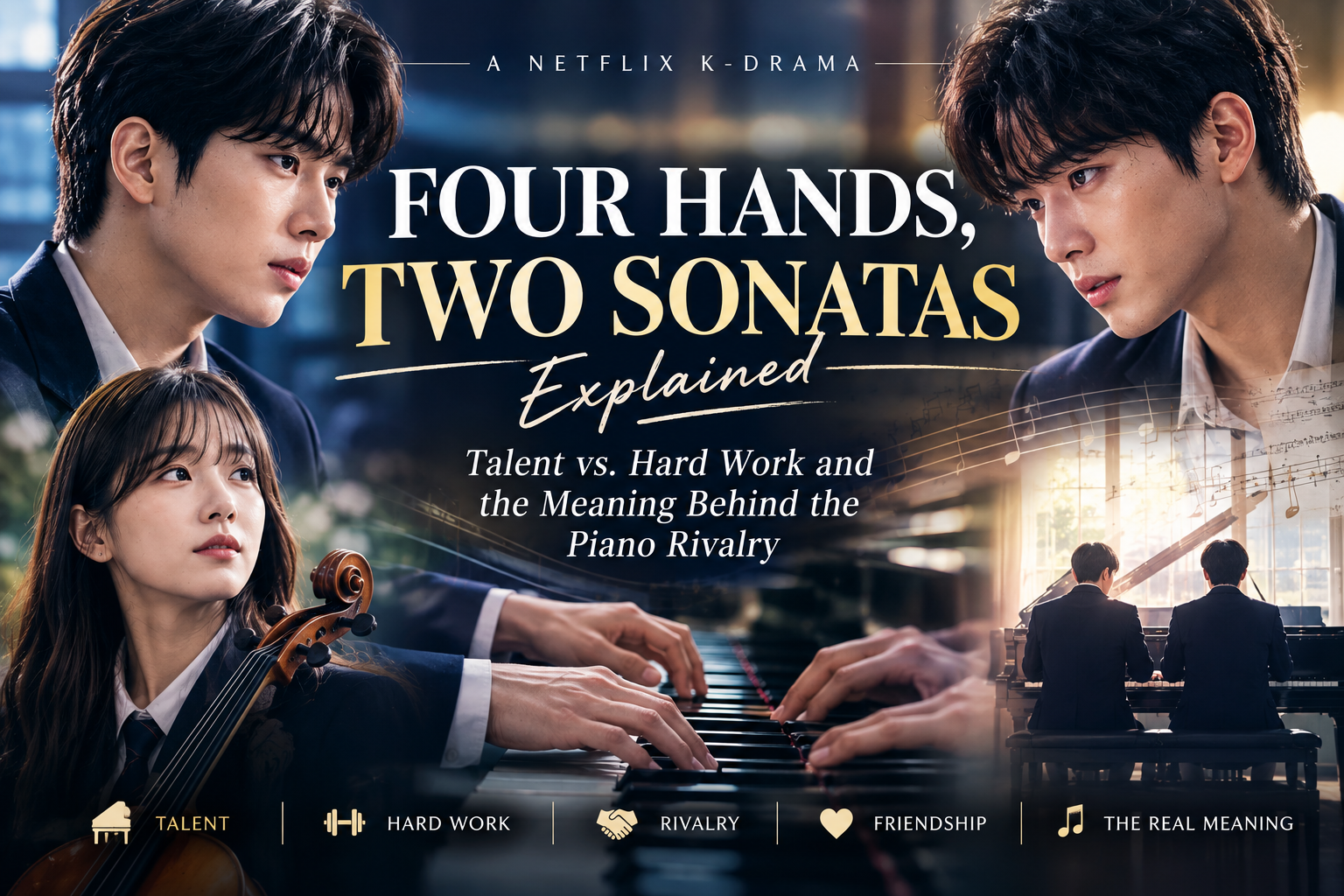
  • Four Hands, Two Sonatas Explained: Talent vs. Hard Work and the Meaning Behind the Piano Rivalry

    Four Hands, Two Sonatas Explained: Talent vs. Hard Work and the Meaning Behind the Piano Rivalry

    When I first wrote about Four Hands, Two Sonatas, I focused on a simple question:

    Why could this Korean drama connect with international viewers?

    But after watching the story more closely, I realized that there is another, much more interesting question.

    What is Four Hands, Two Sonatas actually trying to say?

    On the surface, it is a coming-of-age drama about two gifted young pianists at an elite Korean arts high school.

    Look deeper, however, and the drama becomes a story about something almost everyone has experienced:

    What happens when someone who has worked his entire life to become the best suddenly meets someone who seems to possess naturally what he has spent years trying to perfect?

    That is the conflict between Kang Pi-o, played by Song Kang, and Choi Jeong-yo, played by Lee Jun-young.

    One has discipline, education, technique and an environment built around music.

    The other has lived a far more difficult life and has been forced away from the piano, yet possesses an instinctive musical talent that cannot easily be taught.

    One represents perfection.

    The other represents freedom.

    And somewhere between them lies the real meaning of Four Hands, Two Sonatas.

    This is not simply a drama about deciding which pianist is better.

    It is a story about why neither of them may be complete without the other.

    Two Geniuses — But Two Completely Different Kinds of Genius

    One of the smartest decisions in Four Hands, Two Sonatas is that it does not create a simple relationship between a genius and an ordinary rival.

    Both young men are gifted.

    That makes their conflict much more interesting.

    Kang Pi-o has been walking toward musical excellence for most of his life.

    Choi Jeong-yo, meanwhile, possesses extraordinary talent but has spent much of his life unable—or unwilling—to pursue it.

    Netflix describes Pi-o as an elite pianist who has followed a steady path toward perfection, while Jeong-yo is portrayed as a late-blooming, raw and free-spirited talent whose difficult childhood interrupted his musical journey.

    That difference creates the central question of the drama:

    What exactly makes a great musician?

    Is it thousands of hours of disciplined practice?

    Is it perfect technique?

    Is it natural talent?

    Is it emotion?

    Or does true greatness require all of them?

    Pi-o and Jeong-yo appear to represent different answers.

    But I don’t think the drama ultimately wants us to choose only one.


    Kang Pi-o: The Genius Who Has Spent His Life Proving Himself

    At first glance, Kang Pi-o seems to have everything.

    He comes from an influential musical family.

    He receives elite training.

    He excels academically.

    He wins competitions.

    His piano technique is exceptional.

    He is exactly the kind of student people imagine when they hear the words “Korean elite education.”

    Yet Pi-o may actually be one of the least free characters in the story.

    Why?

    Because almost everything he does carries an invisible question:

    “Am I good enough?”

    Song Kang himself described piano as both Pi-o’s way of communicating with the world and something through which he constantly has to prove himself.

    That distinction matters.

    For some people, music is freedom.

    For Pi-o, music has also become judgment.

    Every performance can become a test.

    Every competition produces another ranking.

    Every mistake becomes evidence that perfection has not yet been reached.

    And every success simply creates the expectation that he must succeed again.


    The Problem With Being Number One

    Being first sounds like the safest position.

    In reality, it can be the most frightening.

    If you are second, you can chase first place.

    If you are first, there is only one direction you can fall.

    Pi-o has built much of his identity around excellence.

    That means Jeong-yo’s arrival threatens more than his position at school.

    It threatens Pi-o’s understanding of himself.

    Imagine spending years practicing, sacrificing and refining every detail of your technique.

    Then someone enters your world who has not followed the same path.

    His technique may be less polished.

    His education may be incomplete.

    Yet when he plays, people stop and listen.

    How would that feel?

    This is where Four Hands, Two Sonatas becomes more than a school rivalry drama.

    Jeong-yo represents a question Pi-o cannot solve simply by practicing longer.


    The Grandfather Behind Pi-o’s Perfectionism

    Pi-o’s pressure does not come only from school.

    It is deeply connected to his family.

    His grandfather, Kang Seung-woon, is a world-renowned conductor and an uncompromising perfectionist.

    Official character material describes him as someone who demands absolute excellence even from his own family. His attitude leaves Pi-o longing for his recognition.

    This helps explain something important about Pi-o.

    His obsession with becoming better is not merely ambition.

    Part of it is emotional.

    Winning becomes connected to recognition.

    Technique becomes connected to approval.

    Music becomes connected to love.

    That is a dangerous combination.

    Because if your value depends on being exceptional, what happens when another exceptional person appears?

    Jeong-yo doesn’t simply challenge Pi-o musically.

    He touches the deepest insecurity Pi-o has carried for years.


    Choi Jeong-yo: The Genius Who Was Forced Away From His Gift

    Jeong-yo’s story is almost the reverse.

    If Pi-o grew up surrounded by music, Jeong-yo grew up surrounded by problems that made music difficult to pursue.

    According to Lee Jun-young’s character interview, Jeong-yo lost his mother at a young age and had to care for his alcoholic father, becoming the family’s breadwinner while still young.

    He loved the piano, but reality forced him to keep his dream at a distance.

    This creates a very different relationship with music.

    For Pi-o, piano can feel like an obligation.

    For Jeong-yo, piano is something he has lost.

    That difference is enormous.

    Pi-o sometimes needs freedom from the piano.

    Jeong-yo needs the freedom to return to it.


    Why “Freedom” Is the Perfect Word for Jeong-yo

    Lee Jun-young chose one word to describe Jeong-yo:

    Freedom.

    He explained that Jeong-yo does not naturally want to live inside a predetermined mold.

    That personality is reflected in his music.

    Jeong-yo has not been shaped by the same institutional system as Pi-o.

    He therefore lacks some of Pi-o’s polish—but he also lacks some of his restraints.

    He can play from instinct.

    From emotion.

    From memory.

    From pain.

    And perhaps that is precisely why Pi-o finds him so disturbing.

    Jeong-yo represents something Pi-o cannot easily acquire through another thousand hours of practice:

    freedom of expression.


    Talent vs. Hard Work Is Actually the Wrong Question

    Many viewers will naturally ask:

    Who is the real genius—Pi-o or Jeong-yo?

    But I think that question misses the point.

    Pi-o is talented too.

    Jeong-yo must work too.

    The drama isn’t really saying:

    One succeeds through effort while the other succeeds through talent.

    The more interesting contrast is this:

    Pi-o has learned how to control music.

    Jeong-yo has learned how to feel it.

    Pi-o needs some of Jeong-yo’s freedom.

    Jeong-yo needs some of Pi-o’s discipline.

    And that is why their rivalry is necessary.

    Each man possesses something the other lacks.


    Jeong-yo Is Not Simply Pi-o’s Enemy

    This is where I think Four Hands, Two Sonatas becomes particularly interesting.

    In an ordinary rivalry story, Jeong-yo would exist to defeat Pi-o.

    But here, his greater role may be to change Pi-o.

    And Pi-o may ultimately do the same for him.

    Jeong-yo forces Pi-o to hear music differently.

    Pi-o forces Jeong-yo to confront the talent and dream he tried to abandon.

    They threaten each other.

    But they also awaken each other.

    That is a much more interesting relationship than simply asking who wins a competition.


    Why the Title “Four Hands” Is the Key to Understanding the Drama

    The title practically tells us what the drama is about.

    In piano terminology, four hands means two pianists playing one piano together.

    Two people.

    One instrument.

    Four hands.

    But think about what that requires.

    You cannot simply play whatever you want.

    You have to listen to the other person.

    You have to understand their timing.

    You have to control your own ego.

    Sometimes you lead.

    Sometimes you follow.

    Sometimes you must create space for the other musician.

    The goal is no longer:

    “I must sound better than you.”

    The goal becomes:

    “We must create one piece of music together.”

    That is why the title is so clever.


    From Competition to Cooperation

    Director Park Hyun-suk explained that the title relates to the journey of two friends moving together toward musical completion.

    That changes how we should view the rivalry.

    The rivalry isn’t necessarily the destination.

    It is the beginning.

    At first, the two musicians compare themselves.

    Who is better?

    Who has more talent?

    Who deserves recognition?

    But four-hands performance demands an entirely different question:

    Can I understand the person sitting beside me?

    And perhaps that is the deeper coming-of-age story.

    Growing up means discovering that life isn’t always a solo performance.


    Two Sonatas May Also Describe Two Lives

    The English title adds another interesting phrase:

    Two Sonatas.

    I read this less literally and more symbolically.

    Pi-o and Jeong-yo are like two separate musical compositions.

    Each has his own rhythm.

    His own history.

    His own pain.

    His own tempo.

    Their lives do not begin in the same place.

    Yet the drama gradually places those two lives beside each other.

    Four hands.

    Two sonatas.

    One piano.

    It is a beautiful metaphor for friendship.

    You don’t need to become the same person to create harmony with someone else.


    Hong Jae-in Is More Important Than a Typical Love-Triangle Character

    Hong Jae-in, played by Jang Gyuri, could easily have been written simply as the woman positioned between two talented men.

    But her musical identity makes her much more interesting.

    Jae-in is not a pianist.

    She is a violist.

    And official character material confirms something particularly important:

    She has perfect pitch.

    She can accurately distinguish individual notes by ear and is among the first people capable of recognizing the extraordinary talent of both Pi-o and Jeong-yo.

    That makes her role symbolically interesting.

    Pi-o and Jeong-yo are busy competing.

    Jae-in is listening.


    Jae-in Represents the Listener

    Music doesn’t exist only between performer and instrument.

    It also exists between performer and listener.

    Jae-in can hear something in both young men that they may not yet fully understand about themselves.

    She knows Pi-o’s excellence.

    But she can also immediately recognize Jeong-yo’s unusual talent.

    In that sense, she becomes a third perspective on their rivalry.

    Pi-o asks:

    “Am I better?”

    Jeong-yo may ask:

    “Do I even belong in this world?”

    Jae-in can hear that both questions are incomplete.

    Both musicians have something worth hearing.

    Jang Gyuri has described music as essentially Jae-in’s entire life and said that her character sees music as both a dream and a source of comfort.

    That makes her much more than a romantic device.

    She is part of the drama’s argument about what music means.


    The Adults Are Creating the Competition Too

    Another layer becomes visible when we look beyond the three young characters.

    The rivalry doesn’t exist in isolation.

    Adults surround them.

    Parents.

    Grandparents.

    Teachers.

    School administrators.

    People who recognize talent—and people who want to shape it.

    Pi-o’s mother has devoted herself to supporting her son’s career, but official character descriptions indicate that Jeong-yo’s appearance creates anxiety because she wants Pi-o to remain the best.

    Meanwhile, school chairwoman Yoon Sun-joo recognizes Jeong-yo’s potential and supports him, although her motives are not entirely simple.

    And pianist Do Hyun-soo becomes a teacher to both young men.

    His task is fascinating:

    Not to make them identical, but to help two opposite musicians strengthen their weaknesses and discover their own musical identities.

    That may be one of the drama’s most important ideas.

    A good teacher does not manufacture copies.

    A good teacher helps different talents become themselves.


    Four Hands Is Also a Story About Korean Competition

    Watching this drama in Korea, I find another layer difficult to ignore.

    Competition is deeply familiar in Korean society.

    Students compete for universities.

    Workers compete for jobs.

    Athletes compete for limited professional positions.

    Artists compete for auditions and recognition.

    And when someone grows up inside a highly competitive system, success can easily become part of personal identity.

    Pi-o fits naturally into that world.

    He has learned to win.

    But the drama asks a more uncomfortable question:

    What happens after you become number one?

    Does being first automatically make you fulfilled?

    Can someone technically perfect still feel incomplete?

    Those questions extend far beyond piano.


    Why Classical Music Works So Well for This Story

    Classical music might initially seem like a difficult subject for a mainstream K-drama.

    But it is actually ideal.

    There are no lyrics telling us exactly what to feel.

    The same composition can sound different depending on who performs it.

    Jang Gyuri made a similar observation while preparing for her role: because classical music has no lyrics, its expression can change according to the performer’s condition and emotional state. She compared that quality to acting.

    That observation could almost describe the entire drama.

    Pi-o and Jeong-yo can look at the same sheet music.

    The notes are identical.

    But the music is not.

    Because the person playing those notes is different.


    The Actors Had to Learn the Language of Their Characters

    Another reason the musical scenes matter is that the actors did significant preparation.

    Song Kang said he began piano lessons months before filming.

    Lee Jun-young, who did not already play piano, said he memorized entire pieces and relied on detailed direction while preparing his performance scenes.

    Jang Gyuri practiced viola, listened extensively to classical music and attended performances to develop her musical sensitivity.

    That matters because hands are difficult to fake in a music drama.

    A viewer may not be a professional pianist, but awkward movement can immediately break the illusion.

    The actors weren’t simply learning dialogue.

    They had to learn enough of their characters’ physical language to make us believe that music had shaped their lives.


    Pi-o and Jeong-yo Are More Similar Than They First Appear

    This may ultimately be the most important point.

    They look like opposites.

    Rich and poor.

    Structured and free.

    Polished and raw.

    Disciplined and instinctive.

    But underneath those differences, they share something.

    Both have been hurt by circumstances they did not choose.

    Pi-o carries the burden of expectation and approval.

    Jeong-yo carries the burden of hardship and responsibility.

    Pi-o has had access to the piano but struggles to become emotionally free.

    Jeong-yo has emotional freedom in his playing but has struggled to gain access to the life of a pianist.

    Each is trapped in a different way.

    That is why they can eventually understand each other.


    The Rival You Hate May Be the Person You Need Most

    This is perhaps the most universal idea in Four Hands, Two Sonatas.

    Sometimes the person who irritates us most is the person exposing something we lack.

    Pi-o looks at Jeong-yo and sees freedom.

    Jeong-yo looks at Pi-o and sees the life of a musician he might have had.

    That can produce jealousy.

    Anger.

    Competition.

    But it can also produce growth.

    A weak rival merely tries to defeat you.

    A great rival changes you.

    And the best rival may eventually become the person capable of playing beside you.


    So Who Is the Real Genius?

    If you came here looking for my answer, here it is:

    Both of them.

    But neither represents complete musical genius alone.

    Pi-o shows us the power of discipline, technique and relentless work.

    Jeong-yo shows us the power of instinct, emotion and freedom.

    The interesting question isn’t:

    Pi-o vs. Jeong-yo — who wins?

    It is:

    What happens when each begins learning what the other already knows?

    That is the story I want to keep watching.


    The Deeper Meaning of Four Hands, Two Sonatas

    For me, the title can ultimately be reduced to one idea:

    You can become excellent alone. But some forms of greatness require another person.

    Pi-o has spent his life becoming a brilliant soloist.

    Jeong-yo has survived by relying heavily on himself.

    Neither is naturally prepared to surrender space to someone else.

    Yet four hands cannot work without trust.

    You have to listen.

    You have to adjust.

    You have to share the keyboard.

    You have to accept that the final music belongs neither entirely to you nor entirely to the person beside you.

    It belongs to both.

    And perhaps that is why a drama about classical piano can become a drama about growing up.

    Because adulthood also requires learning that the world is not a solo performance.

    Sometimes the person sitting next to you isn’t there to take your place.

    Sometimes that person is there to help you play something you could never play alone.

    That, more than the competitions or rankings, may be the real meaning of Four Hands, Two Sonatas.


    Read My First Four Hands, Two Sonatas Review

    If you’re new to the drama, start with my first article, where I explain the story, introduce the main characters, and discuss why I believe Four Hands, Two Sonatas could connect strongly with international K-drama viewers.

    👉 Four Hands, Two Sonatas: Why This K-Drama Could Be a Global Hit


    Official & Further Reading

    For more information about the drama and its cast, these sources offer useful background:

    Netflix – Four Hands, Two Sonatas
    Watch the series and find official information about the drama on Netflix.

    Song Kang on Playing Kang Pi-o
    Read more about Song Kang’s interpretation of Pi-o and why he chose the music-centered drama.

    Lee Jun-young on Playing Choi Jeong-yo
    Learn more about Jeong-yo’s difficult childhood, relationship with the piano, and Lee Jun-young’s approach to the character.


  • Four Hands, Two Sonatas: Why This K-Drama Could Be a Global Hit

    Four Hands, Two Sonatas: Why This K-Drama Could Be a Global Hit

    K-dramas have conquered global audiences with zombies, revenge, crime, survival games and high-stakes thrillers.

    But what if one of Korea’s next internationally loved dramas begins with something much simpler?

    Two young pianists sitting at one piano.

    Netflix’s Four Hands, Two Sonatas is a coming-of-age music drama starring Song Kang, Lee Jun-young and Jang Gyu-ri. Set at an elite Korean arts high school, it follows young musicians whose friendship, rivalry and lives become intertwined through music.

    I started watching the drama in Korea, and what surprised me was how entertaining it is without depending on the extreme violence or constant shock twists often associated with globally successful Korean series.

    At its heart, this is a story about talent, discipline, friendship, rivalry and growing up.

    And that may be exactly what makes Four Hands, Two Sonatas worth watching.

    What Is Four Hands, Two Sonatas About?

    The story centers on two young pianists who come from almost opposite worlds.

    Kang Pi-o, played by Song Kang, has been raised on the path of an elite pianist.

    He is disciplined, technically accomplished and accustomed to striving for perfection. Behind that polished exterior, however, lies enormous pressure and anxiety.

    Then he encounters Choi Jeong-yo, played by Lee Jun-young.

    Jeong-yo comes from a much more difficult background. His personality and music are freer, rawer and more instinctive.

    He does not simply represent another talented pianist.

    He represents a completely different way of understanding music.

    The two meet at an elite arts high school, and what begins as a collision between two contrasting musicians gradually develops into something more complicated: competition, friendship and mutual growth.

    This contrast is one of the most interesting parts of the drama.

    One pursues perfection through discipline.
    The other seems to find music through instinct and emotion.

    Neither is presented simply as the “right” kind of musician.

    Instead, each begins to discover something missing in himself through the other.

    What Does “Four Hands” Mean?

    The title itself contains one of the drama’s most important ideas.

    In piano terminology, “four hands” refers to two pianists playing one piano together.

    Two people.

    One instrument.

    Four hands.

    It is a beautifully appropriate metaphor for Kang Pi-o and Choi Jeong-yo.

    Their personalities, backgrounds and approaches to music are very different. Yet when two musicians sit at the same piano, neither can simply play without considering the other.

    They must listen.

    They must adjust.

    They must understand the other person’s timing.

    And eventually, they must create one piece of music together.

    That makes “Four Hands” more than a musical term. It becomes a symbol of the relationship at the center of the drama.

    Song Kang: The Pianist Raised for Perfection

    International K-drama viewers will immediately recognize Song Kang.

    He has already built a large global audience through Netflix titles including Sweet Home and Love Alarm.

    In Four Hands, Two Sonatas, he plays Kang Pi-o, a pianist who seems to have everything needed for success.

    Talent. Training. Discipline. Opportunity.

    He has spent his life moving toward musical perfection.

    But perfection comes with a price.

    Pi-o’s character allows the drama to ask an interesting question:

    What happens when someone who has been trained to play perfectly meets someone who makes music feel alive in a completely different way?

    That person is Choi Jeong-yo.

    Lee Jun-young: The Free-Spirited Natural Talent

    Lee Jun-young may also be familiar to Netflix viewers.

    He appeared in the internationally successful Korean series When Life Gives You Tangerines as Park Yeong-beom and has appeared in other Netflix productions including Weak Hero Class 2.

    His character Choi Jeong-yo provides a striking contrast to Pi-o.

    Jeong-yo has experienced a difficult childhood and does not come from Pi-o’s privileged musical environment.

    Yet his piano has something that cannot easily be taught.

    Freedom.

    Emotion.

    Instinct.

    There is something unpredictable about the way he approaches both music and life.

    Putting these two characters together creates the drama’s central tension:

    Natural expression vs. disciplined perfection.

    But Four Hands, Two Sonatas does something more interesting than simply asking which pianist is better.

    It asks what happens when they begin learning from each other.

    Jang Gyu-ri and the Third Side of Their Friendship

    The third important young musician is Hong Jae-in, played by Jang Gyu-ri.

    Jang Gyu-ri originally became known as a member of K-pop group fromis_9 before establishing herself as an actress.

    Jae-in is a viola major and a longtime friend of Pi-o.

    At school, she also becomes connected with Jeong-yo, forming the third side of the relationship among these young musicians.

    Her role matters because the drama is not simply structured around two men fighting to determine who is the superior pianist.

    Their school years involve friendship, affection, competition and the complicated emotions of young people discovering both music and themselves.

    The arts high school becomes more than a backdrop.

    It is the place where their identities begin to form.

    A Korean Arts High School Is a Fascinating Setting

    For international viewers, the setting itself may also be interesting.

    The characters attend an elite Korean arts high school filled with exceptionally talented young musicians.

    Instead of ordinary teenagers worrying only about grades and college entrance exams, these students are already living in a highly competitive artistic world.

    Practice rooms become battlegrounds.

    Auditions and performances matter enormously.

    Friendship can easily turn into competition.

    And a classmate may also be the person standing between you and your dream.

    Yet these are still teenagers.

    They experience jealousy, insecurity, friendship, attraction and fear just like everyone else.

    That combination gives the drama much of its emotional energy.

    Why Four Hands Feels Different From Many Global K-Drama Hits

    Some of the Korean dramas that became enormous international hits were built around very intense concepts.

    Survival.

    Zombies.

    Murder.

    Revenge.

    Violence.

    These genres have produced some extraordinary Korean television.

    But Four Hands, Two Sonatas takes another route.

    Its weapons are pianos.

    Its battlefield is the practice room.

    And much of its tension comes from two talented young people trying to understand music, themselves and each other.

    That might sound quieter.

    It doesn’t mean the drama is boring.

    As someone watching the series in Korea, that has been my biggest surprise.

    I expected a beautiful music drama.

    I did not necessarily expect it to be this entertaining.

    The differences between the characters constantly create tension, and their growing friendship makes you want to know what happens next.

    The music is not simply decoration added to the story.

    Music is the conflict.

    And music is also how these characters communicate when words are not enough.

    Why It Could Connect With International Viewers

    There is another reason I think Four Hands, Two Sonatas has international potential.

    You do not need to understand Korean society to understand what these characters want.

    One young man wants to escape the pressure of perfection.

    Another wants his talent to overcome the circumstances into which he was born.

    Both want to make music.

    Both want recognition.

    And both discover that the person who threatens them most may also be the person who helps them grow.

    Those emotions cross borders easily.

    Classical music also gives the drama an unusually universal language.

    A viewer in Seoul, New York, Paris or Tokyo may not speak the same language.

    But everyone can hear the difference between two people playing the same piano.

    From Sweet Home and When Life Gives You Tangerines to Four Hands

    The casting also gives the drama an immediate bridge to international Netflix viewers.

    Song Kang is strongly associated with Netflix through Sweet Home, Love Alarm and other internationally distributed Korean dramas.

    Lee Jun-young has recently reached another large international audience through When Life Gives You Tangerines and Weak Hero Class 2.

    Now the two actors are placed opposite each other as pianists.

    That makes Four Hands, Two Sonatas especially interesting for viewers who discovered Korean actors through Netflix but have never watched a Korean classical-music drama.

    Is Four Hands, Two Sonatas Worth Watching?

    For me, yes.

    But not because it tries to reproduce the formula of another successful K-drama.

    It does almost the opposite.

    Instead of asking who will survive, it asks who these young musicians will become.

    Instead of guns or monsters, there is a piano.

    Instead of defeating an enemy, two rivals may have to learn how to sit beside each other.

    That is why the title feels increasingly meaningful as you watch.

    Two pianists.
    One piano.
    Four hands.
    Two completely different lives.

    And perhaps the most beautiful music begins when neither one plays alone.

    For international viewers looking for a Korean drama built around music, youth, friendship and rivalry rather than violence, Four Hands, Two Sonatas may be one of 2026’s K-dramas worth discovering.


    Where to Watch Four Hands, Two Sonatas

    Four Hands, Two Sonatas premiered on August 29, 2026 and is available internationally through Netflix.

    Official Netflix page:
    Four Hands, Two Sonatas on Netflix


    True Taste Korea watches Korean culture from inside Korea — from food and travel to the dramas, music and everyday experiences that help explain why Korean culture connects with audiences around the world.

    Official & Further Reading

    Want to learn more about Four Hands, Two Sonatas? Here are a few useful official and English-language sources:

    • Watch Four Hands, Two Sonatas on Netflix
      Visit the official Netflix page to watch the series and check availability in your region.
    • Netflix Official Introduction – Four Hands, Two Sonatas
      Read Netflix’s official introduction to the drama, including its story, characters, and the musical rivalry at the heart of the series.
    • Four Hands, Two Sonatas – Cast and Character Guide
      Learn more about Song Kang, Lee Jun-young, Jang Gyu-ri, and the friendship that develops among the young musicians at their elite arts high school.

    Links

    Netflix: https://www.netflix.com/title/82682404

    Netflix Official Introduction: https://about.netflix.com/en/news/four-hands-two-sonatas-teaser

    Soompi Cast & Character Guide: https://www.soompi.com/article/1859522wpp/song-kang-lee-jun-young-and-jang-gyuri-form-a-special-bond-through-music-in-new-drama-four-hands-two-sonatas

    Discover K-Beauty Favorites from Korea 🇰🇷
    Love K-dramas and Korean culture? Discover trending Korean skincare, makeup, face masks, and more at OLIVE YOUNG Global.

    Shop K-Beauty at OLIVE YOUNG Global