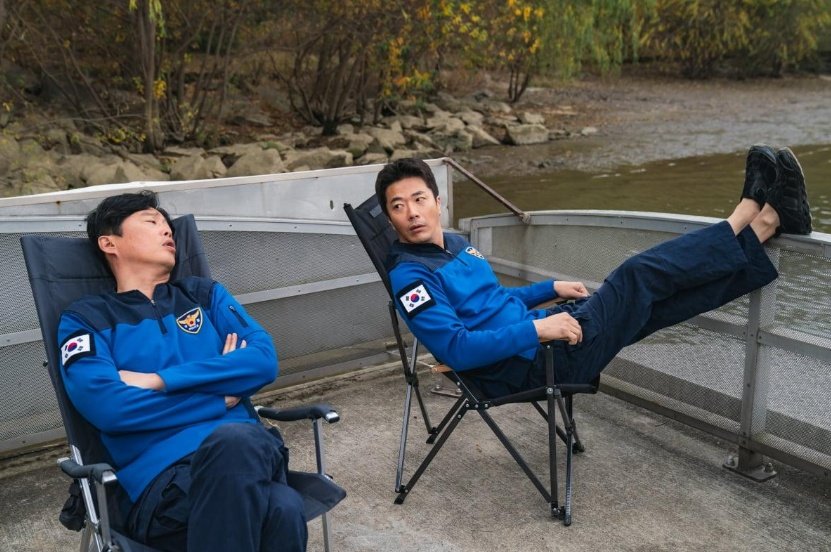
• Han River Police: Why Did a Drama About Protecting the Han River Become Just Another Crime Story?

    Han River Police: Why Did a Drama About Protecting the Han River Become Just Another Crime Story?

    The Han River is one of Seoul’s most recognizable landmarks.

    It is a place where people exercise, relax, meet friends, enjoy the city, and occasionally find themselves in dangerous situations. It is also an enormous public space that requires constant protection.

    That makes the premise of Han River Police immediately interesting.

    What if a television drama followed the officers responsible for protecting this river? What kinds of emergencies would they face? What would happen when an ordinary rescue operation unexpectedly revealed a much larger criminal conspiracy?

    Released on Disney+ in 2023, Han River Police stars Kwon Sang-woo as Han Du-jin, Kim Hee-won as Lee Chun-seok, and Lee Sang-yi as Go Ki-seok.

    The series combines police action, comedy, personal grudges, and a criminal investigation involving the Han River.

    Yet an interesting question emerges after watching it.

    Why does a drama with such a distinctive location and unusual police organization sometimes feel like a familiar crime story?

    The problem is not that the series lacks an interesting premise.

    It is that the premise promises a different kind of police drama, while the narrative repeatedly returns to familiar territory.

    1. The Han River Should Have Been the Main Character

    The most valuable element of Han River Police is not its criminal organization.

    It is the river itself.

    The Han River is more than a scenic background. It is a living part of Seoul, surrounded by parks, bridges, recreational facilities, residential areas, and busy public spaces.

    Every day, thousands of people use the river for different reasons.

    That creates countless possibilities for storytelling.

    A police team assigned to protect such a place could encounter missing people, boating accidents, suspicious packages, environmental violations, dangerous rescue situations, and unexpected criminal activity.

    Each incident could reveal a different side of the city.

    But the series increasingly uses the Han River as the setting for a conventional criminal investigation.

    The location remains visually important, yet its everyday identity receives less attention than the larger crime plot.

    This is the first missed opportunity.

    The river could have shaped the entire identity of the drama instead of simply providing a recognizable place for its action scenes.

    2. Han River Police: A Different Kind of Police Team

    Han Du-jin and Lee Chun-seok belong to a specialized police unit responsible for activities along the Han River.

    This is an unusual professional environment for a television drama.

    Unlike detectives who mainly investigate crimes after they happen, these officers operate in a space where emergencies can develop at any moment.

    Their work involves responding to incidents, protecting people, and dealing with unpredictable situations.

    That difference should influence the way the characters behave.

    A river police officer must understand the environment, recognize danger, make decisions quickly, and sometimes put personal safety aside to rescue someone.

    The job creates opportunities for action that do not depend on guns, gangsters, or complicated criminal conspiracies.

    Unfortunately, the series does not always explore these possibilities as deeply as its premise suggests.

    The result is a drama that introduces an unusual police organization but often relies on the familiar conventions of a standard action-comedy.

    3. Han Du-jin: A Police Officer Driven by More Than Justice

    Kwon Sang-woo plays Han Du-jin, a passionate and sometimes reckless officer.

    At first, he appears to be a familiar television character: the hot-tempered policeman who follows his instincts and refuses to back down.

    But his personality is connected to something more personal.

    His brother’s death has left him with unresolved anger and resentment, particularly toward Baek Chul.

    This history gives his determination a different meaning.

    Du-jin is not simply someone who wants criminals punished.

    He is also someone who has not completely escaped his own past.

    That distinction matters because personal grief can influence how a police officer understands justice.

    A person who has experienced a painful loss may become more determined to protect others.

    But that same pain can also make it difficult to separate professional responsibility from personal revenge.

    Du-jin’s character becomes more interesting when viewed through this conflict.

    He is trying to protect the public while carrying an emotional burden that threatens to influence his decisions.

    4. Lee Chun-seok: The Partner Who Balances Du-jin

    Kim Hee-won plays Lee Chun-seok, Du-jin’s senior colleague and partner.

    Their relationship is built around contrasting personalities.

    Du-jin is impulsive and emotionally driven.

    Chun-seok is generally more restrained, practical, and experienced.

    This familiar contrast provides much of the series’ comedy.

    One character rushes toward danger while the other has to deal with the consequences.

    However, a successful police partnership requires more than contrasting personalities.

    The strongest buddy dramas make the two characters indispensable to each other.

    One notices something the other misses. One compensates for the other’s weaknesses. Their disagreements eventually create better decisions.

    In Han River Police, the relationship has moments of entertainment, but it does not always develop into the kind of emotionally convincing partnership that could carry the entire series.

    The characters are different, but their differences do not consistently produce deeper storytelling.

    That is an important distinction.

    A good comic partnership makes viewers want to spend more time with the characters, even when the central mystery is not particularly complicated.

    5. Go Ki-seok: The Inheritor Who Wants His Own Power

    Lee Sang-yi plays Go Ki-seok, an important figure in the criminal side of the story.

    He is connected to the criminal organization through his uncle, Hwang Man-dae.

    His position creates an interesting psychological conflict.

    Ki-seok wants recognition and authority, but his power is connected to an older generation that already controls the organization.

    He is not simply trying to become successful.

    He wants to establish himself as someone who deserves to control the future.

    This is a familiar problem in stories about criminal families and inherited power.

    The next generation may receive access to money and influence, but it does not automatically receive the respect that comes with those things.

    Ki-seok’s frustration can therefore be understood as a struggle between inherited status and personal ambition.

    The problem is that the series does not always give this conflict enough depth.

    His anger and aggressive behavior sometimes become more prominent than the motivations that could make him a memorable antagonist.

    A stronger exploration of his insecurity might have produced a much more interesting character.

    6. The Criminal Organization: A Familiar Enemy in an Unusual Setting

    The criminal conspiracy provides the central conflict of the series.

    It gives the police officers a larger target and connects several incidents to a common investigation.

    This structure is easy for viewers to understand.

    A police team discovers suspicious activity, follows the clues, encounters dangerous individuals, and gradually uncovers a larger criminal operation.

    There is nothing inherently wrong with this formula.

    Many successful police dramas use it.

    But the problem is that Han River Police has an opportunity to offer something different.

    Its officers work in a distinctive environment with a particular set of responsibilities.

    The criminal investigation could have grown naturally out of those responsibilities.

    Instead, the larger conspiracy sometimes feels like a familiar crime story placed inside a less familiar location.

    The result is an imbalance between the originality of the setting and the familiarity of the plot.

    7. Why the Comedy and Action Do Not Always Work Together

    The series attempts to combine comedy and action.

    This is a difficult balance.

    Comedy often depends on timing, exaggeration, and the characters’ ability to react in unexpected ways.

    Action depends on tension, physical danger, and the audience’s belief that the consequences matter.

    When these two elements work together, they can create a highly entertaining experience.

    But when the transitions are not sufficiently developed, the audience may struggle to understand what kind of emotional response the scene requires.

    Should we laugh at the characters?

    Should we worry about their safety?

    Should we take the criminal investigation seriously?

    The series sometimes moves between these expectations without allowing the characters or situations enough time to develop.

    This is one reason the action and comedy can feel less effective than they might have been.

    The problem is not the combination of genres.

    It is the difficulty of making them serve the same story.

    8. The Most Interesting Question: What Does It Mean to Protect a River?

    A river is a public space, but it is also an environment that can become dangerous.

    People visit the Han River because it offers freedom and relaxation.

    They may not think about the officers who monitor the area or the emergencies that can develop there.

    This creates a valuable narrative opportunity.

    A drama about river police could explore the difference between enjoying a public space and protecting it.

    For example, a seemingly ordinary day could suddenly become a rescue operation.

    A missing person could lead to an unexpected discovery.

    A suspicious incident could reveal a larger problem involving public safety.

    These stories would allow the series to explore the actual identity of its central police unit.

    They could also give the audience a stronger emotional connection to the Han River itself.

    The river would no longer be just a place where the characters chase criminals.

    It would become the reason their work matters.

    9. Rescue Work Could Have Been More Powerful Than Another Criminal Chase

    One of the most promising aspects of the series is the possibility of making rescue operations the emotional center of its storytelling.

    Saving someone from a dangerous situation can create powerful drama without requiring a major villain.

    The danger is immediate.

    The outcome is uncertain.

    The officers must make decisions under pressure.

    And the person being rescued may have a story that changes how the audience understands the incident.

    A police officer pulling someone from the water can produce more emotional tension than another confrontation with a criminal.

    This is especially true because the Han River has a strong connection to ordinary life in Seoul.

    People recognize it.

    They have memories associated with it.

    They understand why someone might visit it and why losing someone there would be devastating.

    A series that explored those human stories more deeply could have developed a distinctive identity.

    10. The Missed Opportunity of Everyday Seoul

    Many Korean dramas use Seoul as a recognizable background.

    But Han River Police has an opportunity to explore a different side of the city.

    Instead of focusing on corporate offices, wealthy neighborhoods, or criminal underworlds, it could show the everyday public spaces that millions of people share.

    The Han River connects different parts of the city.

    It belongs to people with different occupations, incomes, ages, and personal circumstances.

    A story about the officers who protect that space could naturally introduce a wide range of characters.

    A delivery worker. A tourist. A family enjoying a weekend outing. A person exercising alone. Someone who has lost something important.

    Each encounter could reveal a different human story.

    This would make the drama feel more connected to the city itself.

    The series occasionally approaches this possibility, but its central criminal plot often takes priority.

    11. The Emotional Story Behind Han Du-jin’s Anger

    Du-jin’s relationship with the memory of his brother is one of the more meaningful elements of the character.

    His anger toward Baek Chul gives the story a personal dimension.

    However, revenge and justice are not the same thing.

    A person seeking revenge wants to settle a personal emotional debt.

    A police officer seeking justice must consider evidence, responsibility, and the protection of others.

    These goals can overlap, but they can also conflict.

    Du-jin’s character could have been explored through this contradiction.

    Does his anger make him a better officer because he understands the pain of loss?

    Or does it make him more dangerous because he may allow personal emotions to influence professional decisions?

    The series introduces the ingredients for this conflict, even if it does not always explore them as deeply as possible.

    This remains one of the more interesting ways to understand its main character.

    12. What Reddit Viewers Found Disappointing

    Reddit discussions about Han River Police reveal a relatively limited but useful set of reactions.

    Some viewers found the premise interesting but were disappointed by the actual storytelling.

    One discussion included criticism that the series felt boring, with one viewer saying that Do-na-hee’s appearances were among the more entertaining parts.

    Another discussion questioned the excitement generated by the story and criticized its familiar direction.

    The short six-episode format also became part of the discussion.

    These are individual opinions rather than a representative survey of all viewers.

    Nevertheless, they point toward a recurring issue.

    The series has recognizable actors, an unusual professional setting, and an accessible action-comedy premise.

    Yet those elements do not consistently combine into a compelling narrative.

    The criticism is less about one specific performance and more about the gap between what the premise promises and what the story delivers.

    13. Why the Series Feels Less Original Than Its Premise

    The most frustrating thing about Han River Police is that its originality is visible from the beginning.

    A specialized police team.

    A famous public space.

    Water-based rescue operations.

    A city environment that can create unexpected emergencies.

    A partnership between two officers with very different personalities.

    These are strong foundations.

    But the series increasingly relies on familiar crime-drama ingredients.

    A criminal organization.

    Personal revenge.

    A powerful antagonist.

    A conspiracy that connects the main incidents.

    These elements are not necessarily bad.

    The problem is that they become more important than the distinctive world that initially made the drama interesting.

    The series could have used its unusual setting to reinvent the police procedural.

    Instead, it often uses the setting to decorate a more conventional story.

    That is why its central opportunity feels only partially realized.

    14. Could Han River Police Have Become a Better Series?

    The answer is yes, and the solution would not necessarily have required a bigger budget or a more complicated criminal conspiracy.

    It could have focused more strongly on the actual experiences of the river police.

    Each episode could have begun with a different emergency.

    Some incidents could be funny.

    Others could be frightening or emotionally difficult.

    The officers’ relationships could develop through the consequences of their decisions.

    The criminal investigation could emerge gradually from the incidents rather than dominating the story from the beginning.

    This approach would have allowed the series to build its own identity.

    It could still have included action, comedy, and a larger conspiracy.

    But those elements would have grown out of the central idea of protecting the river.

    The audience would have had a reason to care about the police team beyond the fact that they were chasing criminals.

    They would care because the characters were protecting a place that belonged to everyone.

    15. The Real Meaning of the Han River as a Setting

    The Han River is more than a beautiful landscape.

    It represents movement, connection, and the everyday life of Seoul.

    People visit it to escape their routines.

    Some come with friends or family.

    Others come alone.

    For some, it is a place of happiness.

    For others, it may be connected to painful memories.

    A police team responsible for protecting the river stands at the intersection of all these different lives.

    That is a much richer premise than simply placing a crime investigation beside the water.

    The series could have explored the relationship between a city and the people who protect its shared spaces.

    It could have shown that public safety is not always about catching dangerous criminals.

    Sometimes it is about noticing a person in trouble before anyone else does.

    Sometimes it is about arriving at the right place at the right moment.

    And sometimes it is about saving someone whose story would otherwise remain unknown.

    16. Final Verdict: A Good Idea That Never Fully Became Its Own Identity

    Han River Police has several appealing elements.

    Kwon Sang-woo brings energy to Han Du-jin.

    Kim Hee-won provides a contrasting presence through Lee Chun-seok.

    Lee Sang-yi adds another dimension to the criminal conflict as Go Ki-seok.

    The series also benefits from an unusual setting that could have supported a distinctive police drama.

    But its greatest weakness is the gap between its premise and its execution.

    A story about protecting one of Seoul’s most important public spaces gradually becomes a familiar crime narrative.

    The Han River remains visually recognizable, but the drama does not always explore what makes that location unique.

    The police officers have an unusual job, but the story does not consistently make that job the source of its strongest drama.

    This is why the series feels like a missed opportunity rather than a completely unsuccessful idea.

    It had the ingredients for something different.

    It simply did not use all of them.

    Perhaps the most interesting question Han River Police leaves behind is not whether its officers can catch the criminals. It is why a drama about protecting the Han River did not spend more time showing us what makes the river worth protecting.

  • Running Wild (2006): When Justice and Violence Become Impossible to Tell Apart

    Running Wild (2006): When Justice and Violence Become Impossible to Tell Apart

    How a Korean crime thriller exposes the dangerous line between fighting evil and becoming what you hate.

    Spoiler Warning: This analysis discusses the film’s central conflicts and character development.

    What happens when the people responsible for enforcing the law stop believing that the law can deliver justice?

    And what happens when those who still believe in the legal system discover that criminals can manipulate the very institutions designed to punish them?

    Kim Sung-soo’s 2006 Korean crime thriller Running Wild (์•ผ์ˆ˜) begins with a familiar conflict: two men pursue a powerful criminal who appears to be beyond the reach of ordinary justice. One is a detective who has lost faith in the law. The other is a prosecutor who believes that the law is the only legitimate path to justice.

    Their differences initially seem clear. One trusts action; the other trusts procedure. One is driven by anger; the other by professional conviction.

    But the film’s most interesting question is not whether they can defeat their common enemy.

    It is whether their different beliefs can survive the experience of fighting him.

    The central paradox of Running Wild is that two men who begin with opposite ideas about justice are gradually pushed toward the same dangerous conclusion: that violence may be the only language power understands.

    This is more than a story about two determined law-enforcement officers. It is a film about what happens when the pursuit of justice begins to destroy the principles that once made it worth pursuing.

    1. Two Men, Two Definitions of Justice

    The film introduces two protagonists whose personalities and professional philosophies could hardly be more different.

    Jang Do-young, played by Kwon Sang-woo, is a hot-blooded homicide detective. He has little faith in the ability of the legal system to deal effectively with criminals. His instinct is to confront danger directly, often through physical force.

    Oh Jin-woo, played by Yoo Ji-tae, is an elite prosecutor. He believes in evidence, legal procedure, and the authority of the law. For him, justice cannot simply mean punishing someone who deserves punishment. It must also be achieved through a legitimate process.

    Their conflict is therefore philosophical, not merely personal.

    Do-young sees the weaknesses of the system and responds with action. Jin-woo sees the same criminal world but believes that abandoning legal principles would mean surrendering the very foundation of justice.

    At first, Jin-woo’s position appears more reasonable. A society cannot allow individuals to decide for themselves who deserves punishment and how much force should be used.

    Yet Do-young’s frustration is not entirely irrational either.

    What is a person supposed to do when the system repeatedly fails to protect the innocent?

    The film deliberately places these two positions in conflict without offering an easy solution.

    Its deeper question is whether justice can remain meaningful when the institutions responsible for delivering it become vulnerable to manipulation.

    2. The Real Power of a Criminal Is Not His Violence

    Yoo Kang-jin, played by Son Byung-ho, is the criminal figure at the center of the conflict.

    A conventional crime thriller might present such a character as a physically dangerous gangster who must eventually be defeated by a stronger opponent.

    But Kang-jin’s most important advantage is not simply his ability to use violence.

    It is his ability to operate through connections, influence, intimidation, and institutional weaknesses.

    The Korean Film Council’s synopsis describes how Kang-jin responds to the investigation by threatening Do-young’s family and using his influence to have Jin-woo removed from the case. https://www.koreanfilm.or.kr/eng/films/index/filmsView.jsp?movieCd=20050345

    This is a crucial distinction.

    A criminal who relies only on physical strength can be confronted physically. A criminal who can influence the institutions surrounding him presents a much more difficult problem.

    The investigators are not simply fighting one man. They are confronting an environment in which their professional authority may not be enough to protect them.

    Kang-jin understands something that the two protagonists are forced to learn: power does not always need to defeat the law openly. Sometimes it only needs to make the law ineffective.

    That is why he is more than an antagonist in an action film.

    He represents the possibility that the system can continue to exist formally while failing to deliver justice in practice.

    And that creates a particularly uncomfortable dilemma for Jin-woo.

    If the law cannot reach a powerful criminal, should he abandon his principles to achieve the result he wants?

    3. When the Pursuit of Justice Becomes Personal Revenge

    Do-young’s conflict is not simply professional.

    The death of his younger half-brother gives the investigation a deeply personal dimension. His anger is no longer limited to frustration with the criminal justice system.

    He has suffered a loss that cannot be repaired through a court judgment.

    This changes the nature of his pursuit.

    A detective is supposed to investigate a crime, identify the responsible parties, and help bring them before the law. But a grieving brother may want something different: an immediate and emotionally satisfying form of punishment.

    The two desires can exist inside the same person, but they are not identical.

    This is where Do-young becomes an especially interesting character.

    His anger makes him effective in situations where a more cautious person might hesitate. Yet the same anger threatens to distort his judgment.

    When personal pain becomes the driving force behind an investigation, the distinction between finding justice and satisfying revenge becomes increasingly difficult to maintain.

    There is a question that the film encourages viewers to consider:

    If someone has suffered an unbearable injustice, does that suffering give them the right to decide how another person should be punished?

    Most viewers may understand Do-young’s anger. Some may even sympathize with his methods.

    But understanding a character’s emotions is not the same as approving every action those emotions produce.

    That distinction is essential to the film’s moral tension.

    4. The Prosecutor’s Dilemma: Can You Defend the Law Without Trusting Its Results?

    Jin-woo initially represents the opposite answer.

    He believes that justice must be achieved through legal institutions, not personal violence.

    His position is important because it establishes a standard against which the film’s later developments can be measured.

    But his professional confidence is tested when Kang-jin uses his influence to interfere with the investigation.

    This creates a problem that cannot be solved simply by repeating the principle that the law must be respected.

    A legal system is only as effective as its ability to apply its rules independently and consistently.

    If a powerful individual can influence investigations, intimidate witnesses, or interfere with the people pursuing a case, then the formal existence of legal procedures does not guarantee that justice will be achieved.

    Jin-woo must confront the possibility that following the rules may not be enough.

    This is not necessarily an argument that the rules should be abandoned. Rather, it exposes the difference between believing in a principle and living through the conditions that make that principle difficult to uphold.

    It is relatively easy to defend the law when the law works.

    The harder test comes when the law appears powerless against someone who can manipulate it.

    The film places Jin-woo in precisely that uncomfortable position.

    His struggle is not simply against Kang-jin. It is against the temptation to believe that an unjust result can justify abandoning the principles he once defended.

    5. The Most Dangerous Similarity Between the Two Men

    Do-young and Jin-woo begin from opposite positions.

    One distrusts the legal system and relies on force. The other believes that legal procedure must remain the foundation of justice.

    Yet both are increasingly consumed by the pursuit of the same enemy.

    This is where the film’s title becomes particularly meaningful.

    The word beast initially seems to describe the criminal world. Gangsters use violence, intimidation, and fear to maintain their power.

    But the film gradually directs attention toward the people fighting that world.

    What happens when a detective’s anger becomes more important than his judgment?

    What happens when a prosecutor begins to see legal restraint as an obstacle rather than a principle?

    The danger is not that the two men suddenly become identical to Kang-jin. Their motivations and responsibilities remain different.

    The danger is that they begin to accept the same underlying assumption: that force can achieve what legitimate institutions cannot.

    That is a profound moral shift.

    Kang-jin uses power to protect his criminal interests. Do-young and Jin-woo are driven by a desire to stop him. Their purposes are not equivalent.

    But the film asks whether a noble purpose is enough to keep violence morally controlled.

    It is possible to fight an evil person and still make choices that damage the very values one claims to defend.

    That is the uncomfortable territory Running Wild explores.

    6. Why the Film’s Action Is More Than Physical Spectacle

    The film’s action sequences can be appreciated as hard-hitting Korean crime cinema. Its confrontations, physical intensity, and dark atmosphere are central to its identity.

    But there is another way to understand the violence.

    The action is connected to the breakdown of the characters’ confidence in their respective systems.

    For Do-young, physical confrontation is already part of his approach to the world. His body becomes an extension of his anger and his refusal to accept institutional limitations.

    For Jin-woo, violence represents a more fundamental departure from his professional identity.

    The contrast makes their shared conflict more meaningful than a conventional partnership between two men with different personalities.

    The film repeatedly places the audience between two reactions.

    We may feel satisfaction when a powerful criminal finally faces resistance. At the same time, we may recognize that the methods being used are becoming increasingly difficult to justify.

    That tension is important.

    If the audience simply celebrates every act of retaliation, the moral question disappears. If the audience rejects all violence without considering the failures that produced it, the characters’ desperation becomes difficult to understand.

    The film works best when it forces viewers to hold both reactions at once.

    Violence can feel emotionally satisfying while remaining morally dangerous.

    7. The Film’s Limitation Is Also Part of Its Meaning

    Running Wild is not a perfectly balanced psychological drama.

    Its story relies heavily on familiar crime-thriller elements: a powerful gangster, compromised institutions, personal tragedy, and two protagonists driven toward a final confrontation.

    Some of its dialogue and dramatic situations can feel exaggerated. The film’s emotional intensity sometimes takes priority over subtle character development.

    A contemporary review in the Korea JoongAng Daily criticized its reliance on familiar gangster-film conventions and questioned the clarity of some of its dialogue. https://koreajoongangdaily.joins.com/2006/05/02/artsDesign/A-battle-of-gangster-cliches/2732048.html

    That criticism deserves consideration.

    The film does not explore every ethical question with the precision of a legal drama. It is first and foremost a violent crime thriller.

    But its central conflict remains valuable precisely because it gives a familiar genre question a more complicated form.

    The issue is not simply whether criminals should be punished.

    It is what happens to the people who pursue punishment when the institutions they represent fail them.

    That question is larger than the film’s action sequences, and it remains relevant beyond the period in which the film was released.

    Conclusion: If You Defeat a Monster by Becoming One, What Have You Actually Defended?

    Running Wild begins with two men who believe they understand justice in different ways.

    Jang Do-young believes that the law has failed too many people to deserve his trust. Oh Jin-woo believes that abandoning the law would destroy the very foundation of justice.

    Their common enemy forces both men to confront the limits of their beliefs.

    The film does not offer a comfortable answer. It shows how personal grief, institutional weakness, and the desire to punish wrongdoing can push people toward increasingly extreme decisions.

    And that is where its most important question emerges.

    A society needs people who are willing to confront evil. But it also needs limits on the methods those people can use.

    Without those limits, the pursuit of justice risks becoming another struggle for power.

    Kang-jin uses violence to preserve his position. Do-young and Jin-woo fight to destroy that position. Their motivations are different, but the film makes us consider what happens when the means begin to resemble one another.

    Perhaps the most frightening possibility is not that good people can become evil overnight.

    It is that they can gradually convince themselves that every compromise is necessary because their cause is righteous.

    If the only way to defeat a monster is to become one, have you really defended justiceโ€”or have you simply created another kind of monster?

    That is the question that makes Running Wild worth revisiting.


    Film Information

    • Title: Running Wild (2006)
    • Original Korean Title: ์•ผ์ˆ˜ (้‡Ž็ธ)
    • Director: Kim Sung-soo
    • Cast: Kwon Sang-woo, Yoo Ji-tae, Son Byung-ho, Uhm Ji-won
    • Genre: Action, Crime, Noir
    • Runtime: 124 minutes
    • South Korean Release Date: January 12, 2006
    • Country: South Korea

    Sources and Further Reading

    1. Korean Film Council (KOFIC) โ€“ Running Wild
    2. Cine21 โ€“ Running Wild
    3. Korea JoongAng Daily โ€“ A Battle of Gangster Clichรฉs
    4. Apple TV โ€“ Running Wild

    TTK Original Analysis: This article interprets the contrast between the two protagonists as a conflict between justice, institutional legitimacy, and personal vengeance. It is an editorial reading of the film, not a claim that the director explicitly described the story in these terms.

  • The Accidental Detective 2: In Action (2018): Can Two Ordinary Men Really Become Professional Detectives?

    The Accidental Detective 2: In Action (2018): Can Two Ordinary Men Really Become Professional Detectives?

    What happens when two men who once solved a major criminal case decide to turn their unexpected success into a profession?

    In The Accidental Detective 2: In Action, Kang Dae-man and former homicide detective Noh Tae-soo take a risky step. They leave their previous lives behind and open a private detective agency. Dae-man gives up his comic book store, while Tae-soo steps away from the police force.

    They imagine a future filled with important investigations. Reality, however, has other plans.

    Their office receives almost no meaningful work. Instead of solving major crimes, they deal with ordinary problems such as marital suspicions, unpaid debts, and missing pets. Their dream of becoming professional detectives quickly collides with the need to pay everyday expenses.

    Then a woman arrives with a suspicious death case and an attractive financial reward. What initially appears to be a straightforward investigation gradually reveals a disturbing connection between former orphanage residents, mysterious deaths, and a larger criminal operation.

    Directed by Lee Eon-hee and starring Kwon Sang-woo, Sung Dong-il, and Lee Kwang-soo, the 2018 sequel combines buddy comedy with a darker crime mystery.

    But beneath the jokes, the film raises a more interesting question: Is becoming a detective about having exceptional instincts, or about learning to recognize the truth when everyone else has overlooked it?

    1. The Dream of Becoming a Detective Begins After the First Success

    Kang Dae-man is not a conventional detective.

    He is a comic book enthusiast with an unusual interest in criminal investigations. His passion for detective stories has shaped the way he looks at everyday events. He notices details that other people might ignore and enjoys connecting seemingly unrelated clues.

    His previous experience with Tae-soo gives him something even more valuable: confidence.

    For the first time, his hobby seems capable of becoming a real profession.

    This is an important starting point because Dae-man does not simply want another job. He wants to turn the identity he has imagined for himself into something legitimate.

    The problem is that solving one extraordinary case does not automatically make someone capable of running a detective business.

    The sequel begins precisely where that difference becomes visible.

    2. Selling the Comic Book Store: When Passion Becomes a Financial Risk

    Dae-man’s decision to sell his comic book store represents a major change.

    The store is more than a workplace. It reflects his personality and the world he has built around his interests. Leaving it behind means abandoning a familiar identity in exchange for an uncertain future.

    Yet he does not approach the decision with complete financial or personal preparation.

    His wife is not even properly consulted.

    This creates a familiar conflict between individual ambition and family responsibility. Dae-man sees the detective agency as an opportunity to pursue his dream. His wife sees the consequences of a decision that could affect the entire household.

    Neither perspective is entirely unreasonable.

    The film uses this domestic disagreement for comedy, but the underlying problem is serious: pursuing a dream does not remove the responsibility to consider the people who share its risks.

    3. Tae-soo and Dae-man: Two Different Ideas of Professionalism

    The partnership between Dae-man and Tae-soo works because their personalities are fundamentally different.

    Dae-man approaches investigations with curiosity, enthusiasm, and the imagination of someone who has spent years reading detective stories.

    Tae-soo brings professional experience, practical judgment, and the instincts of a former homicide detective.

    One tends to see possibilities everywhere. The other is more likely to question whether those possibilities make sense.

    Their disagreements create much of the film’s comedy.

    But their differences also reveal an important principle of investigation: knowledge and imagination are not interchangeable.

    A person who knows investigative procedures may overlook an unusual possibility. Someone with an unconventional perspective may notice something important but fail to understand its significance.

    The partnership becomes effective when neither man assumes that his own way of thinking is sufficient.

    4. The Detective Agency: The Difference Between a Dream and a Business

    One of the film’s most relatable ideas appears before the central mystery even begins.

    The two men have opened their agency, but customers do not arrive simply because they believe they are talented.

    Their professional identity exists in their minds long before the market recognizes it.

    This is a familiar problem for anyone who starts a small business.

    A person may have the skills, motivation, and confidence to begin. But a business also requires customers, trust, a sustainable operating model, and enough money to survive periods without income.

    The agency’s ordinary assignments are therefore more than comic interruptions.

    They expose the gap between the exciting image of a detective’s life and the repetitive work required to keep a professional service alive.

    The film does not spend much time exploring this economic reality in depth, but it provides a useful foundation for understanding the characters.

    5. The Woman Who Offers $50,000: The Case That Changes Everything

    The arrival of a woman seeking answers about her fiancรฉ’s death changes the direction of the story.

    She offers the detectives a substantial reward, giving them the opportunity they have been waiting for.

    For Dae-man and Tae-soo, the case seems to offer two things at once: a chance to prove their professional abilities and a financial reason to take the investigation seriously.

    But money also introduces a potential weakness.

    When a reward is large enough, investigators may become too focused on the outcome they expect to find.

    The important question is not simply who is willing to pay for an investigation. It is whether the client’s version of events contains the whole truth.

    The film gradually shifts the detectives’ attention away from the apparent circumstances of one man’s death and toward a pattern involving several people.

    6. A Suspicious Death Becomes a Pattern

    The investigation becomes more disturbing when the detectives discover that the deceased man had grown up in an orphanage.

    Other former residents have also died under suspicious circumstances.

    At first, these incidents appear to be separate events: a suicide, a hit-and-run, and a death involving a train.

    But the similarities between the victims suggest that the investigators are looking at something more organized.

    This is where the film moves beyond its initial buddy-comedy formula.

    A single suspicious death can be explained away as an accident. Several deaths involving people connected to the same institution demand a different kind of attention.

    The detectives begin looking for relationships rather than isolated explanations.

    The mystery becomes a question of whether someone has been turning apparently unrelated tragedies into a convenient cover for criminal activity.

    7. The Orphanage: An Institution That Should Have Protected Its Residents

    The orphanage is central to the darker side of the story.

    An institution that exists to care for vulnerable children should represent safety, responsibility, and protection.

    That expectation makes its connection to the suspicious deaths especially disturbing.

    The former residents are not simply strangers who happen to share a background. Their histories create a connection that investigators cannot ignore.

    The film uses this setting to introduce a troubling possibility: an institution’s public reputation can conceal the actions of people who have access to those it is supposed to protect.

    The contrast between appearance and reality is important.

    The detectives cannot rely on an official title or a respectable public image. They must examine what people actually do.

    This is one of the reasons the investigation becomes more serious than the film’s comic tone initially suggests.

    8. The Arrival of Yeochi: A Third Mind Changes the Investigation

    The introduction of Yeochi, played by Lee Kwang-soo, changes the structure of the detective team.

    Yeochi is a Mensa-level genius and an online private investigator with strong technical abilities.

    He is not simply another character added to create jokes.

    His presence introduces a different investigative method.

    Dae-man relies on curiosity and observation. Tae-soo depends on experience and practical judgment. Yeochi brings digital information, technical access, and a different way of connecting evidence.

    The trio therefore represents three different forms of intelligence.

    Their cooperation becomes more important as the case grows complicated.

    A modern investigation may require more than traditional detective instincts. Digital information can reveal connections that are difficult to discover through physical observation alone.

    However, technical ability also has limitations. Data can provide clues, but someone still needs to understand what those clues mean.

    9. The Importance of Small Details

    A major part of the investigation involves examining details that initially appear insignificant.

    The detectives look at the victims’ backgrounds, their connections to the orphanage, the circumstances surrounding their deaths, and the people who appear repeatedly in the available information.

    This is a familiar structure in detective fiction.

    A clue becomes meaningful not because it is impressive on its own, but because it changes the interpretation of other evidence.

    The film’s mystery works through accumulation.

    One incident creates suspicion. Another makes the suspicion harder to dismiss. A third reveals that the apparent accidents may share a common explanation.

    This approach also reflects a real investigative principle: a theory should explain the available evidence rather than forcing every new fact to fit an existing assumption.

    10. Kim Jung-hwan and the Problem of the Convenient Culprit

    As the investigation develops, Kim Jung-hwan becomes an important figure in the chain of suspicious events.

    The evidence appears to point toward him, and the case seems close to reaching a conclusion.

    But the film does not treat an apparent confession or a convenient suspect as the end of the investigation.

    That distinction matters.

    A suspect may be connected to several incidents without being the person who designed the entire operation.

    The detectives must consider whether the explanation they have found accounts for all the evidence.

    The danger of stopping too early is one of the central ideas in detective stories.

    A case can appear solved while the person responsible for the larger crime remains protected.

    11. Insurance Money: Following the Financial Motive

    The investigation eventually moves toward the financial relationships behind the deaths.

    The detectives discover suspicious insurance arrangements involving former workers and people connected to the victims.

    The money trail offers a possible explanation for why several individuals might have been targeted.

    This development changes the meaning of the case.

    The deaths are no longer simply a collection of mysterious incidents. They may be part of a system in which vulnerable people are treated as opportunities for financial gain.

    The film uses insurance fraud as a bridge between individual criminal actions and a broader organization.

    It also reminds viewers that financial motives can hide behind apparently unrelated personal tragedies.

    The important question becomes not only who benefited from a death, but who had the ability to arrange the circumstances that made the death appear accidental.

    12. The Orphanage Director: The Difference Between Authority and Trust

    The investigation ultimately leads back to the orphanage director.

    This is an especially effective reversal because the director occupies a position that should naturally inspire trust.

    The institution’s purpose is to protect children who have limited power and few alternatives.

    But the story reveals how that position can be exploited.

    The director is not simply a person who knows something about the victims. He is connected to the larger criminal operation, and his respectable role helps conceal the truth.

    The film’s central contrast becomes clear here.

    The detectives are outsiders who initially seem unqualified to investigate a complicated case. Yet they are willing to question people whose positions make them appear trustworthy.

    The person who should have been protecting vulnerable individuals becomes the source of their danger.

    This is the darkest idea in the film.

    13. The Final Confrontation: When the Investigation Becomes Personal

    The final confrontation brings the three detectives into direct danger.

    The orphanage director’s criminal operation reaches its decisive moment, and the investigation is no longer about collecting evidence from a safe distance.

    Tae-soo is attacked and incapacitated. Dae-man and Yeochi must work together to reach him and stop the operation.

    The danger becomes especially personal when Dae-man puts himself between Tae-soo and a gunshot.

    This moment gives the partnership a meaning that goes beyond professional cooperation.

    Earlier, the two men argued about methods, responsibilities, and their different personalities. Now Dae-man’s decision demonstrates how much their relationship has changed.

    He is no longer simply a comic-book enthusiast trying to become a detective.

    He is willing to risk his life for the person who has become his partner.

    The final action sequence therefore resolves an emotional question as well as the criminal mystery.

    14. The Ending: From a $50,000 Reward to Another Ordinary Assignment

    After the criminals are exposed, the detectives receive a reward connected to the insurance investigation.

    Tae-soo decides to return the original fee paid by the woman who hired them.

    The decision gives the conclusion a sense of moral resolution.

    Their work was not simply about collecting a large payment. They have uncovered a much more serious crime and helped bring the responsible people to justice.

    But the film does not end by transforming the detectives into glamorous heroes.

    Instead, it returns to the comic contrast between their ambitions and the ordinary demands of their profession.

    They receive another assignment, this time involving a missing cat.

    The contrast is deliberate.

    After dealing with a dangerous criminal operation, they are once again confronted with the kind of small case that their agency originally struggled to attract.

    Their dream continues, but the reality of detective work remains unpredictable.

    15. What Does It Really Mean to Become a Detective?

    The Accidental Detective 2: In Action is not a groundbreaking mystery film.

    Its plot follows familiar buddy-cop conventions, and its comedy sometimes competes with the seriousness of the criminal investigation.

    The Los Angeles Times described the film as a smooth but forgettable ride, while other critics also pointed to its familiar structure and predictable mystery. Rotten Tomatoes lists four critic reviews, with a 67% Tomatometer score. These figures represent a small critical sample, not a broad consensus among all viewers.

    Yet the film has an idea worth examining.

    Dae-man begins with the fantasy of becoming a detective. He imagines important cases, clever deductions, and the satisfaction of proving his talent.

    But the actual profession demands something different.

    It requires patience when there are no customers, discipline when evidence is confusing, cooperation when another person has a better idea, and persistence when the apparent answer turns out to be wrong.

    Tae-soo also learns that professional experience alone is not enough. He needs the curiosity and unconventional thinking that Dae-man and Yeochi bring to the team.

    The three men become more effective not because one of them is perfect, but because each contributes something the others lack.

    Perhaps that is the film’s most appealing message.

    A real detective is not necessarily the person who knows everything. It is the person who keeps asking questions when the easiest answer is no longer convincing.

    And sometimes, the people who look least qualified to solve a mystery are precisely the ones willing to look where everyone else has stopped searching.

  • Running Wild (2006): When Men Fight Monsters, Who Becomes the Real Beast?

    Running Wild (2006): When Men Fight Monsters, Who Becomes the Real Beast?

    Can a person fight evil for so long that he eventually becomes part of it?

    This is the central question behind Running Wild (2006), directed by Kim Sung-soo. Starring Kwon Sang-woo, Yoo Ji-tae, and Son Byung-ho, the film follows two investigators with fundamentally different ideas about justice as they attempt to bring down a powerful criminal boss.

    Jang Do-young, played by Kwon Sang-woo, is a homicide detective who has little faith in the judicial system. He believes that criminals often escape punishment because the law is too slow, too cautious, or too easily manipulated.

    Oh Jin-woo, played by Yoo Ji-tae, is a prosecutor who believes in evidence, procedure, and the authority of the law. He understands that the legal system has weaknesses, but he still believes that justice must be pursued through legitimate institutions.

    Their common target is Yoo Kang-jin, played by Son Byung-ho, a gangster boss whose influence extends beyond the criminal underworld.

    At first, the conflict appears straightforward: two men with different methods join forces to defeat a dangerous criminal.

    But the film gradually exposes a more disturbing possibility.

    What happens when the people who are supposed to defend justice begin abandoning the very principles that distinguish them from criminals?

    The title Running Wild captures this transformation. The characters are not simply chasing an enemy. They are moving toward a point where anger, ambition, fear, and the desire for justice become increasingly difficult to separate.

    1. Three Men, Three Different Definitions of the Beast

    The film’s central characters represent three different relationships with power and justice.

    Jang Do-young believes that justice requires direct action. Oh Jin-woo believes that justice must be established through law. Yoo Kang-jin understands that power can operate through both legal and illegal channels.

    These three positions create the film’s central conflict.

    Do-young is emotionally driven. He sees the criminal world as a place where hesitation can cost lives.

    Jin-woo is institutionally driven. He understands that a conviction requires evidence and that personal anger cannot replace legal judgment.

    Kang-jin is strategically driven. He does not need to prove that he is innocent in a moral sense. He needs to ensure that the system cannot effectively punish him.

    The interesting point is that none of these men is completely free from desire.

    Do-young wants justice, but he also wants personal revenge. Jin-woo wants accountability, but his belief in the law is tested by the limitations of the institution he serves. Kang-jin wants to preserve his power and treats every relationship as a potential instrument.

    The film’s title can therefore be understood as a question directed at all three.

    The beast is not necessarily the person who commits the most obvious violence. It may also be the person who becomes willing to sacrifice everything else in pursuit of a particular goal.

    2. Jang Do-young: A Detective Who Has Lost Faith in the Law

    Jang Do-young is introduced as a detective whose relationship with authority is already damaged.

    He is aggressive, impatient, and willing to use physical force. His colleagues recognize him as a difficult figure, but his behavior is not simply presented as a personality problem.

    He has come to believe that conventional procedures cannot adequately respond to the criminal world he confronts.

    His younger half-brother’s murder makes this belief even more personal.

    The case is no longer only a professional responsibility. It becomes connected to family grief and a desire to punish those responsible.

    This transformation is psychologically important.

    A detective is supposed to investigate a crime without allowing personal feelings to determine the outcome. Do-young increasingly struggles to maintain that distance.

    His anger gives him energy, but it also narrows his judgment.

    He begins to view the law as an obstacle rather than a necessary protection against arbitrary punishment.

    The tragedy is that his determination may be understandable while his methods become increasingly dangerous.

    He wants to defeat criminals, but the more he relies on violence, the more he risks losing the moral distinction between himself and the people he pursues.

    3. Oh Jin-woo: The Prosecutor Who Believes in Evidence

    Oh Jin-woo represents the opposite approach.

    He believes that a criminal must be brought to justice through evidence and legal procedure. His method is slower than Do-young’s, but it is based on the principle that punishment must be justified rather than imposed through personal anger.

    This distinction is fundamental.

    A prosecutor does not simply decide who deserves punishment. The prosecutor must establish what happened, demonstrate responsibility, and work within a system designed to prevent arbitrary decisions.

    Jin-woo’s faith in the law is therefore more than professional discipline.

    It is a belief that justice must remain different from revenge.

    However, the film places this belief under pressure.

    When a powerful criminal can influence witnesses, manipulate circumstances, and exploit institutional weaknesses, legal procedure begins to look painfully inadequate.

    Jin-woo must confront the possibility that the system he trusts can be used by the very people it is supposed to control.

    His dilemma is not whether the law is perfect.

    It is whether an imperfect legal system should be abandoned simply because a powerful criminal knows how to exploit it.

    That question gives his character a deeper significance than the conventional image of a disciplined prosecutor.

    4. Yoo Kang-jin: The Criminal Who Understands Power

    Yoo Kang-jin is the most disturbing figure in the film because his power does not depend entirely on physical violence.

    He is a gangster boss, but his influence extends into relationships and institutions that are supposed to exist outside the criminal world.

    This makes him more dangerous than an ordinary street-level criminal.

    A violent individual may threaten people directly. A powerful criminal organization can also influence the conditions under which people make decisions.

    Kang-jin understands that power is not simply the ability to hurt someone.

    It is the ability to make other people believe that resisting you will cost them more than cooperating.

    He uses intimidation, connections, and strategic calculation to protect his position.

    His relationship with the political and social environment is particularly revealing.

    The boundary between organized crime and legitimate authority becomes less clear when money, influence, and personal connections can shape institutional outcomes.

    Kang-jin does not need to destroy the legal system completely.

    He only needs to understand how to use its weaknesses.

    That is what makes him a powerful antagonist.

    He represents a form of criminality that survives not only through violence but also through the cooperation, fear, and compromises of others.

    5. The Murder That Turns an Investigation into Personal Revenge

    The murder of Do-young’s younger half-brother changes the emotional structure of the story.

    Before this event, the investigation can be understood as a professional attempt to confront organized crime.

    Afterward, the boundary between the detective’s duty and personal suffering becomes increasingly difficult to maintain.

    This is a familiar but important problem in crime fiction.

    When an investigator becomes personally connected to a victim, the desire to discover the truth can become mixed with the desire to punish someone.

    The two motivations may initially point in the same direction.

    But they are not identical.

    An investigation asks what happened and who was responsible.

    Revenge begins with a desire to make someone suffer for what happened.

    The difference matters because revenge can create certainty before the evidence is complete.

    Do-young’s emotional involvement makes him vulnerable to that danger.

    His personal loss gives him a reason to continue when others might stop. It also makes it harder for him to recognize when his actions are no longer serving the investigation.

    The film’s tragedy develops from this collision between professional responsibility and private grief.

    6. When the Legal System Becomes a Weapon

    One of the film’s most interesting ideas is that the law can be weakened without being openly abolished.

    A criminal with sufficient influence may not need to destroy the judicial system. He can exploit delays, manipulate evidence, pressure witnesses, and use relationships to obstruct accountability.

    This is more complicated than the familiar idea that criminals operate outside the law.

    Sometimes they survive precisely because they understand how the law works.

    That creates an uncomfortable contradiction.

    A society may possess courts, prosecutors, police officers, and formal procedures, yet still struggle to protect people when powerful individuals can manipulate the conditions under which justice is delivered.

    Kang-jin’s position exposes this vulnerability.

    The legal system is not necessarily powerless. It is vulnerable to unequal access to influence and resources.

    This is why the film’s conflict extends beyond the question of whether a particular gangster can be arrested.

    It asks whether a society can maintain meaningful equality before the law when some individuals have the power to shape the process itself.

    7. The Alliance Between Two Men Who Do Not Trust Each Other

    Do-young and Jin-woo are forced to cooperate because they share a target.

    But their agreement does not erase their fundamental differences.

    One believes that direct action is necessary when institutions fail. The other believes that abandoning procedure would destroy the very meaning of justice.

    Their partnership creates tension because each man sees the other’s approach as dangerous.

    Do-young may consider Jin-woo too cautious to confront powerful criminals effectively.

    Jin-woo may consider Do-young too reckless to distinguish justice from personal revenge.

    Both positions contain a degree of truth.

    The film’s strongest character dynamic comes from this disagreement.

    It is not simply a buddy-cop relationship in which two contrasting personalities produce entertainment.

    Their conflict represents a larger debate about the limits of law enforcement.

    How much force can be justified in the name of justice?

    And when does the use of force begin to destroy the principles it was supposed to defend?

    Their cooperation is therefore unstable from the beginning.

    They are pursuing the same criminal, but they do not share the same understanding of what defeating him should mean.

    8. The Family as a Target of Criminal Power

    Kang-jin’s influence becomes especially frightening when the conflict moves beyond the investigators themselves and reaches their families.

    This is an important shift.

    A criminal organization does not need to defeat an investigator in a direct confrontation if it can make the investigator’s personal life vulnerable.

    Family members become pressure points.

    The threat is no longer limited to professional reputation or physical safety. It reaches the emotional responsibilities that make people human.

    For Do-young, the possibility of losing someone else intensifies his anger.

    For Jin-woo, the pressure demonstrates how personal relationships can be used to undermine professional independence.

    This is one of the film’s most effective illustrations of unequal power.

    The criminal does not have to be stronger in every confrontation.

    He only needs to identify what the other person cannot afford to lose.

    That is a more sophisticated form of intimidation than simple physical violence.

    It also helps explain why the two investigators become increasingly desperate.

    Their conflict with Kang-jin is no longer confined to the question of criminal punishment. It becomes a struggle to protect the people closest to them.

    9. The Political Dimension: When Criminal Power Resembles Political Power

    Kang-jin’s influence raises a question that extends beyond organized crime.

    What happens when a criminal organization begins to resemble a political structure?

    Both systems can depend on hierarchy, loyalty, territorial control, and the distribution of benefits.

    A criminal boss may control a neighborhood through fear and favors. A political organization may maintain influence through networks, patronage, and access to resources.

    The moral difference between these structures is significant, but their methods of organizing power can sometimes look disturbingly similar.

    The film’s portrayal of Kang-jin suggests that organized crime becomes especially dangerous when it can establish relationships with legitimate institutions.

    At that point, the criminal is no longer simply an outsider attacking society.

    He becomes someone who can influence how society operates.

    This does not mean that all political institutions are equivalent to criminal organizations.

    Rather, the film points toward a more specific danger: when public authority becomes vulnerable to private interests, the distinction between legitimate power and coercive influence begins to weaken.

    Kang-jin’s ambition is therefore not merely to survive as a gangster.

    It is to occupy a position from which other people must consider his interests before making their own decisions.

    10. Violence: The Shortcut That Creates a New Problem

    Do-young’s reliance on violence is central to the film’s moral structure.

    Violence appears to offer an immediate solution.

    A criminal refuses to cooperate, so force can produce a response. An investigation moves too slowly, so intimidation can accelerate it. A powerful opponent avoids punishment, so direct confrontation seems like the only remaining option.

    But this approach contains a serious contradiction.

    If violence becomes the primary method of achieving justice, then the investigator begins to operate according to the same logic as the criminal.

    The difference between them becomes increasingly dependent on their intentions.

    Do-young may believe that he uses force for a good reason. Kang-jin uses force to protect his own power.

    But from the perspective of the person being threatened, the immediate experience may be very similar.

    This does not mean that every use of force by law enforcement is equivalent to criminal violence.

    It means that force requires limits, accountability, and justification.

    Without those limits, the language of justice can become a convenient excuse for personal aggression.

    The film’s bleakness comes from watching those distinctions become harder to maintain.

    11. The Masculinity of Anger and the Cost of Emotional Suppression

    The film belongs to a tradition of Korean crime thrillers in which male characters express suffering primarily through physical confrontation.

    Men are expected to endure pain, protect family members, defeat enemies, and prove their strength through action.

    Emotional vulnerability is often displaced by anger.

    Do-young embodies this pattern.

    His grief does not easily become conversation or reflection. It becomes movement, confrontation, and physical aggression.

    Jin-woo expresses his frustration differently, but he also struggles to reconcile his professional identity with personal pressure.

    Kang-jin represents another version of masculine power: emotional detachment, strategic control, and the ability to dominate others without displaying vulnerability.

    These characters appear different, but all three are trapped by particular expectations of masculine strength.

    The film’s violence can therefore be read as more than an action device.

    It becomes a language through which men communicate feelings they cannot otherwise express.

    The problem is that this language rarely produces understanding.

    It produces injuries, retaliation, and further isolation.

    12. Nietzsche’s Warning: Fighting Monsters Without Becoming One

    The philosophical idea associated with Friedrich Nietzsche provides a useful way to understand the film.

    In Beyond Good and Evil, Nietzsche warns that a person who fights monsters must be careful not to become a monster in the process.

    This idea is often used in discussions of revenge, political struggle, and moral compromise.

    It is especially relevant to Do-young.

    He begins by confronting people whose behavior he considers unacceptable. But as his methods become more extreme, the question changes.

    Is he still defending justice, or has defeating his enemy become more important than the principles that once guided him?

    Jin-woo faces a related challenge.

    His belief in law is tested by an opponent who understands how to exploit legal institutions. If Jin-woo abandons his principles completely, he risks becoming another person who believes that the ends justify any means.

    Kang-jin, meanwhile, demonstrates what happens when power is pursued without meaningful moral limits.

    The film does not present a simple philosophical lesson in which one character remains pure and the others become corrupted.

    Instead, it shows how difficult it is to maintain a moral position when the surrounding world constantly rewards compromise and aggression.

    The monster is not only the person standing on the other side.

    It is also the possibility within each person that begins to emerge under pressure.

    13. Why the Film’s Bleakness Is Both Its Strength and Its Weakness

    Running Wild maintains a dark and increasingly pessimistic atmosphere.

    Its characters begin in difficult personal circumstances, and the story rarely offers the emotional relief associated with more conventional action films.

    This bleakness supports the film’s subject.

    A story about institutional corruption and the moral cost of revenge should not necessarily provide a comfortable resolution.

    The atmosphere makes the characters’ choices feel increasingly desperate.

    However, the same approach can also become a weakness.

    A film that maintains an intense level of anger and violence for too long risks reducing its emotional range.

    When every character is trapped in bitterness, the audience may begin to feel that the story is moving toward a predetermined tragedy rather than allowing its conflicts to develop naturally.

    A contemporary Korean film review criticized the movie for relying heavily on familiar gangster-film conventions and excessive masculine sentimentality. Other international commentary praised its dark atmosphere and its questions about justice while acknowledging that it does not fundamentally reinvent the genre.

    These different responses reveal the film’s central tension.

    Its ideas are more ambitious than a conventional action thriller, but its dramatic language sometimes relies on the familiar conventions of that genre.

    Its value lies less in originality of plot than in the uncomfortable questions it raises about the relationship between violence and justice.

    14. The Final Question: Who Is the Real Beast?

    The title Running Wild can be interpreted as the process through which people lose control of the principles that once defined them.

    Do-young wants justice but becomes increasingly vulnerable to revenge.

    Jin-woo believes in the law but discovers how difficult it is to defend legal principles against people who can manipulate the system.

    Kang-jin understands power and uses it without accepting the moral responsibilities that should accompany it.

    These three men are not identical.

    Their motives, responsibilities, and actions must be judged differently.

    But the film places them in a world where the distinction between justice and power is constantly under pressure.

    The most important question is not whether Do-young and Jin-woo can defeat Kang-jin.

    It is whether they can do so without destroying the very principles that make their struggle meaningful.

    If justice requires the complete abandonment of restraint, what remains different about it?

    If the law can be manipulated by the powerful, how can it recover public trust?

    And if a person becomes consumed by the desire to punish evil, how long can that person remain separate from the evil being pursued?

    Running Wild does not offer an easy answer.

    Its most enduring idea is that the fight against corruption is not only a struggle against external enemies.

    It is also a struggle to preserve one’s own moral boundaries.

    The real danger begins when a person becomes so certain that the enemy deserves punishment that every action against that enemy starts to seem acceptable.

    That is when the hunter risks becoming another beast.

    And that may be the most disturbing meaning hidden inside the film’s title.


    TTK Original โ€” Beyond the Headlines

    This analysis explores Running Wild (2006) through the conflict between law and revenge, organized crime and institutional power, masculine anger, and the moral danger of becoming what one fights against.

  • Once Upon a Time in High School: Why Was Violence the Only Language Students Understood?

    Once Upon a Time in High School: Why Was Violence the Only Language Students Understood?

    Spoiler Warning: This article discusses major character developments and the film’s ending.

    1. A School Where Strength Determines Your Place

    Released in 2004 and directed by Yoo Ha, Once Upon a Time in High School: The Spirit of Jeet Kune Do takes viewers into the world of a Korean high school during the late 1970s.

    At first glance, the film appears to be a coming-of-age story about a teenager navigating friendships, romance, school pressure, and physical confrontations. Yet its deeper subject is much more unsettling.

    The school operates like a miniature society in which authority, intimidation, and physical strength determine who deserves respect.

    Students are not simply competing academically. They are also negotiating their positions within an informal hierarchy. Those who possess physical power can impose their will, while weaker students are expected to accept humiliation.

    This environment raises an important question: What happens to a teenager when the institution responsible for protecting him becomes another place where he must learn to survive?

    The film’s answer is uncomfortable. Violence becomes a language because the characters see few other ways to establish their existence.

    2. Hyun-soo: A Boy Searching for a Place to Belong

    Kwon Sang-woo plays Hyun-soo, a student who enters a new school environment hoping to find his place.

    He is not introduced as an extraordinary fighter or a naturally dominant personality. Instead, he is an ordinary teenager who wants friendship, affection, and recognition.

    That ordinariness is essential to understanding the character.

    Hyun-soo’s problems are not caused by an unusual desire for violence. They emerge from the pressure of living in an environment where vulnerability can become an invitation for humiliation.

    His experiences gradually challenge his original understanding of school life. Being quiet does not necessarily protect him. Following the rules does not guarantee fairness. Even personal relationships can become complicated by the social hierarchy surrounding him.

    Hyun-soo is therefore not simply learning how to fight. He is trying to discover what kind of person he can become in a world that constantly tells him what kind of person he is allowed to be.

    3. The School as a Small Authoritarian Society

    One of the film’s strongest ideas is its portrayal of school as a reflection of the larger society.

    The late 1970s setting matters because the story unfolds within a period when South Korean society was shaped by authoritarian political structures, rigid social expectations, and strong institutional discipline.

    The film does not need to turn every classroom into a direct political allegory. Its power comes from showing how hierarchical thinking can reproduce itself in everyday relationships.

    Teachers exercise authority over students. Stronger students dominate weaker ones. Social status determines whose complaints receive attention.

    The result is a system in which obedience is valued more consistently than individual dignity.

    This creates an uncomfortable parallel between institutional authority and student violence. Both can depend on the assumption that people lower in the hierarchy should accept the decisions of those above them.

    The school is therefore more than a background. It is the environment that teaches the characters how power works.

    4. Why Physical Strength Becomes a Form of Social Currency

    In an ordinary school environment, students might gain recognition through academic achievement, creativity, humor, or personal relationships.

    In Hyun-soo’s environment, physical strength carries a different kind of value.

    Being able to fight can change how others treat you. It can discourage bullying, establish a reputation, and provide a degree of protection.

    But this apparent solution contains a contradiction.

    If respect depends on the ability to hurt another person, then the person who becomes powerful may eventually reproduce the same behavior that once threatened him.

    Violence becomes a form of social currency, but it is an unstable currency. Someone stronger can always appear.

    The film exposes the weakness of a system in which personal dignity must constantly be defended through physical confrontation.

    A student may win a fight and gain recognition, but that victory does not necessarily create genuine security.

    5. Woo-sik and the Appeal of Physical Confidence

    Lee Jung-jin plays Woo-sik, a character whose physical confidence and social position make him an important presence in Hyun-soo’s school life.

    For Hyun-soo, Woo-sik represents something he does not yet possess: the ability to move through the school environment without appearing vulnerable.

    This relationship is important because admiration and insecurity can exist together.

    Hyun-soo sees the advantages of being strong. He also sees the social recognition that accompanies strength.

    But the film does not present physical dominance as a simple solution to the problems of adolescence.

    The ability to intimidate others may provide immediate advantages, yet it can also trap a person inside the same hierarchy that created the original conflict.

    Woo-sik’s role helps reveal the difference between being feared and being genuinely respected.

    6. The Romance That Complicates Hyun-soo’s Identity

    The romantic storyline adds another dimension to Hyun-soo’s emotional development.

    His attraction to Eun-joo is not merely a conventional teenage love story. It becomes connected to his growing awareness of social status, confidence, and masculinity.

    For a teenager who already feels uncertain about his place in the world, romantic attraction can intensify the desire to become someone different.

    He wants to be noticed. He wants to be accepted. He wants to believe that he can become the kind of person who deserves affection.

    However, these desires are easily confused with the need to prove physical superiority.

    The film captures a familiar emotional problem of adolescence: the difference between wanting to become a better person and wanting to become someone whom nobody dares to challenge.

    Those motivations may look similar from the outside, but they lead to very different outcomes.

    7. Bruce Lee and the Meaning of Jeet Kune Do

    Bruce Lee’s presence is one of the film’s most recognizable cultural references.

    For Hyun-soo, martial arts offer more than a method of physical defense. They represent an alternative identity.

    Bruce Lee was admired not only for his fighting ability but also for his philosophy of movement, adaptability, and personal expression.

    Jeet Kune Do is commonly associated with the idea of avoiding unnecessary limitations and responding directly to the situation rather than blindly following fixed forms.

    That philosophy creates an interesting contrast with the school environment.

    The school expects students to obey established rules and accept predetermined positions. Martial arts, as Hyun-soo encounters them, suggest the possibility of developing an independent way of thinking.

    The appeal is therefore psychological as much as physical.

    He is attracted to the possibility of becoming someone who can make his own decisions instead of remaining trapped in a role assigned by others.

    8. Martial Arts as a Search for Personal Control

    There is a major difference between learning to fight because you enjoy violence and learning to fight because you feel powerless.

    Hyun-soo’s interest in martial arts is closely connected to the second motivation.

    He wants to recover a sense of control over his own life.

    In a school where other people can humiliate him, his body becomes one of the few things he believes he can change through personal effort.

    Training offers a sense of progress. Physical improvement provides measurable evidence that he is no longer exactly the same person.

    This is psychologically significant.

    When a teenager feels that his environment is beyond his control, mastering a skill can create a temporary sense of independence.

    Yet the film also leaves room for a more difficult question: Can physical training truly free someone from a violent social structure, or does it simply make him more capable of participating in that structure?

    That tension gives the martial arts theme its deeper meaning.

    9. The Film’s View of Masculinity

    Once Upon a Time in High School is particularly revealing when viewed through the expectations placed on boys and young men.

    The characters live in an environment where admitting fear can be interpreted as weakness.

    Emotional vulnerability is rarely treated as something that deserves understanding. Instead, boys are pushed toward toughness, confrontation, and the ability to defend their reputation.

    This creates a narrow definition of masculinity.

    A boy is expected to endure pain without complaint, respond to humiliation, and demonstrate that he cannot be easily dominated.

    The problem is that these expectations leave little room for emotional maturity.

    The characters are not necessarily incapable of friendship or affection. Rather, they are growing up in an environment that repeatedly teaches them to hide insecurity behind aggression.

    The film’s violence is therefore not only physical. It is also connected to the emotional restrictions imposed on young men.

    10. Why the Violence Feels Different from Conventional Action Movies

    Some viewers remember the film particularly for its final confrontation and physical intensity.

    Discussions on Reddit have included praise for the ending’s fighting sequence and its comparatively raw feeling. Other viewers have recommended the film as a memorable Korean coming-of-age story.

    These reactions are useful because they point toward an important distinction.

    The film’s fights are not simply designed to create spectacular entertainment. They emerge from the social and emotional conflicts established throughout the story.

    A conventional action movie may use a fight to demonstrate that the hero has become stronger.

    Here, the physical confrontations carry a more complicated meaning. They reveal how much the characters have absorbed the values of their environment.

    A victory can look satisfying while still exposing the failure of the world that made the fight necessary.

    That is why the violence leaves a more complicated impression than a straightforward action sequence.

    11. The 1970s Setting Is More Than Nostalgia

    The late 1970s setting gives the film a distinctive atmosphere, but its purpose goes beyond recreating an earlier period.

    Clothing, hairstyles, school discipline, popular culture, and social expectations help establish a world in which individual freedom is limited by powerful institutions.

    For younger international viewers, some details may initially appear unfamiliar.

    Yet the emotional experience is recognizable.

    Teenagers in different countries and generations have faced bullying, peer pressure, rigid educational systems, and the fear of being excluded.

    The historical setting gives these problems a particular Korean identity without making them exclusively Korean problems.

    This balance is one reason the film can remain meaningful beyond its original cultural context.

    12. The Hidden Conflict Between Obedience and Individuality

    The school environment repeatedly presents obedience as the safest response.

    Students are expected to follow instructions, accept their positions, and avoid challenging the established order.

    But Hyun-soo’s personal development is driven by the desire to escape the limitations of that identity.

    His interest in martial arts becomes part of this conflict.

    The appeal of Jeet Kune Do is not simply that it teaches him how to strike or defend himself. Its philosophical associations suggest that a person does not have to accept every inherited rule without question.

    This creates a subtle contradiction.

    Hyun-soo wants freedom, but the world around him has taught him to understand freedom through physical power.

    He is searching for independence using the very language of dominance that he has learned from his environment.

    That contradiction is central to the film’s emotional structure.

    13. What the Final Confrontation Really Represents

    The film’s final confrontation is often remembered as one of its most powerful moments.

    It is tempting to interpret it simply as the moment when Hyun-soo finally demonstrates his strength.

    But such an interpretation overlooks the larger development of the character.

    The confrontation represents the accumulated pressure of humiliation, frustration, insecurity, and the desire to reclaim personal dignity.

    It is not merely a test of martial arts ability.

    It also raises the question of whether an individual can escape an unjust hierarchy by defeating the people who enforce it.

    Even if a person succeeds in one confrontation, the larger social structure may remain unchanged.

    That is what makes the ending more complicated than a conventional story of revenge.

    The physical result of a fight and the emotional consequences of growing up in a violent environment are not necessarily the same thing.

    14. Why the Film Still Connects with Modern Audiences

    School violence remains a subject that audiences across different countries can recognize.

    The specific social conditions have changed, but the underlying mechanisms are familiar.

    Students still encounter social exclusion, humiliation, group pressure, and informal systems of power.

    Modern discussions of bullying also increasingly recognize that violence is not limited to physical attacks.

    Isolation, public humiliation, intimidation, and the manipulation of group relationships can be equally damaging.

    Looking back at Once Upon a Time in High School, contemporary viewers may notice how early the film identified the relationship between institutional hierarchy and everyday violence.

    Its historical setting may be distant, but the questions it raises remain relevant.

    Why do victims sometimes admire the people who dominate them?

    Why does physical confidence become confused with personal worth?

    And why do institutions sometimes fail to recognize the suffering occurring within their own walls?

    These questions give the film a life beyond nostalgia.

    15. The Real Tragedy: Learning to Survive Is Not the Same as Learning to Live

    The deepest question in Once Upon a Time in High School is not whether Hyun-soo becomes a stronger fighter.

    It is whether he can find a way to preserve his identity in an environment that repeatedly tries to define him through weakness and strength.

    The school teaches him that survival requires toughness.

    His experiences teach him that social recognition can depend on physical power.

    Bruce Lee’s philosophy introduces the possibility of personal independence.

    But none of these elements automatically guarantees emotional freedom.

    A person can become physically stronger while remaining psychologically trapped by the same fears that existed before.

    This is the film’s most lasting contradiction.

    Hyun-soo’s journey is not simply about learning how to fight back. It is about growing up in a world where the distinction between self-respect and retaliation becomes increasingly difficult to maintain.

    That is why Once Upon a Time in High School remains more than a nostalgic school action movie.

    It is a portrait of adolescence shaped by authority, violence, insecurity, and the search for an identity.

    The most important question it leaves behind is not who won the final fight.

    It is why so many young people had to fight in the first place.


    Final Perspective

    Once Upon a Time in High School uses the language of school violence and martial arts to explore a much larger subject: the struggle to maintain personal dignity inside a rigid hierarchy.

    Its lasting value comes from the questions it asks about masculinity, authority, and the difference between being feared and being respected.

    The film may be set in 1970s Korea, but its central conflict remains recognizable wherever young people are forced to prove their worth through power rather than being allowed to develop their own identities.

  • More Than Blue (2009) Explained: Why Did K Give Away the Woman He Loved?

    TTK Original โ€” Beyond the Headlines

    Some feelings cannot be explained by logic. Perhaps only those who have loved someone more than themselves can truly understand them.

    There are films we discover through recommendations. Others we find through actors, trailers, or streaming platforms.

    But I discovered the Korean film More Than Blue (2009) through a song.

    And I still remember the night I first heard it.

    The Night a Song Silenced a PC Cafรฉ

    When I was younger, I failed an examination I had spent a long time preparing for.

    I was devastated.

    I drank heavily that day and eventually found myself in a PC cafรฉ in South Korea.

    Then something unusual happened.

    Another customer began playing a song loudly.

    In a Korean PC cafรฉ, people generally do not appreciate someone blasting music through speakers. Someone would normally complain or ask for the volume to be turned down.

    But that night, nobody complained.

    People simply listened.

    The song was โ€œMore Than Blueโ€ (์Šฌํ””๋ณด๋‹ค ๋” ์Šฌํ”ˆ ์ด์•ผ๊ธฐ), sung by Kim Bum-soo.

    It was the first time I had ever heard it.

    I did not know it was associated with a movie. I knew nothing about the story behind it.

    I only knew that the voice, the melody, and the emotion were impossible to ignore.

    Years have passed, but I have never forgotten that moment.

    Later, I learned that the song belonged to a Korean romantic tragedy called More Than Blue.

    I watched the movie because of the music.

    Usually, a movie introduces us to a song.

    For me, a song introduced me to a movie.

    And what I found was a story about a man who loved someone so deeply that he tried to give her a future without him.

    What Is More Than Blue (2009) About?

    More Than Blue, known in Korean as ์Šฌํ””๋ณด๋‹ค ๋” ์Šฌํ”ˆ ์ด์•ผ๊ธฐ, is a 2009 South Korean romantic drama directed by Won Tae-yeon.

    The film stars Kwon Sang-woo as K, Lee Bo-young as Cream, and Lee Beom-soo as Joo-hwan.

    K and Cream have both experienced profound loss.

    They become one another’s family, closest friends, and emotional home. Their relationship is intimate, yet they struggle to express the love that exists between them.

    Then K discovers that he is terminally ill.

    He knows his time is running out.

    He also knows that Cream’s greatest fear is being abandoned and left alone.

    So he makes an extraordinary decision.

    Rather than confess his feelings and ask her to spend his remaining days with him, he tries to find another man who can care for her after he is gone.

    That man is Joo-hwan, a kind, financially secure dentist.

    K is not trying to stop loving Cream.

    He is trying to make sure that his love does not leave her completely alone.

    And that is where the film becomes heartbreaking.

    Why Did K Push Away the Woman He Loved?

    The simplest answer is that K believes Cream’s future matters more than his own happiness.

    He wants to hold her close.

    But he is afraid that doing so will make her eventual grief even more unbearable.

    His decision is not based on the absence of love. It is based on an overwhelming fear of what his death will do to the person he loves.

    Most romantic films are built around a familiar struggle: two people trying to overcome obstacles so they can remain together.

    More Than Blue reverses that idea.

    K’s struggle is to make himself unnecessary.

    He wants Cream to find someone who can offer the ordinary future he cannot give her: companionship, stability, and years of shared life.

    There is something deeply moving about that desire.

    But there is also something deeply troubling.

    Because K makes a decision about Cream’s future without giving her the full truth.

    He believes he knows what will make her happy.

    Does he?

    That question is central to understanding the film.

    Is Letting Someone Go the Greatest Act of Love โ€” or the Cruelest?

    Imagine loving someone more than you love your own happiness.

    Imagine knowing that you are going to die and that the person you love will have to continue living without you.

    Would you hold on to them for as long as possible?

    Or would you try to help them build a life with someone else?

    It is easy to answer such questions from a distance.

    We can argue that honesty is essential in love. We can say that Cream deserves the right to decide for herself. We can criticize K for hiding the truth and arranging a future she did not explicitly choose.

    Those arguments are reasonable.

    Yet love is not always experienced as a reasonable argument.

    Sometimes the desire to protect another person becomes stronger than the desire to be understood.

    Sometimes the thought of their future suffering hurts more than the thought of our own loss.

    Perhaps only those who have loved someone more than themselves can understand why K makes this choice.

    That does not necessarily make his decision right.

    It makes his decision human.

    And that distinction matters.

    The film is not asking us to accept every sacrifice as noble. It is asking us to confront the painful possibility that love can inspire both extraordinary generosity and devastating mistakes.

    The Ending Explained: Cream Was Making a Sacrifice Too

    Major spoilers ahead.

    For much of the film, we experience the story through K’s understanding of events.

    He believes he is secretly arranging a better future for Cream.

    But the later revelations transform the meaning of everything we have seen.

    Cream already knows about K’s illness.

    Her apparent willingness to build a future with Joo-hwan is not simply the result of moving on from K.

    She is also trying to protect the man she loves.

    K wants to believe that Cream will be safe and happy after his death.

    Cream wants K to have that peace of mind.

    Both are hiding painful truths.

    Both believe they are making a sacrifice for the other.

    And both are participating in a heartbreaking misunderstanding.

    This is the film’s most powerful reversal.

    At first, we see a man giving up the woman he loves.

    Then we discover that the woman has been giving up something just as precious: the chance to tell him openly that she knows, that she loves him, and that she understands what he is trying to do.

    Their tragedy is not simply that death separates them.

    It is that their love becomes a series of secrets intended to spare each other pain.

    What Happens to Cream at the End?

    The final part of the film strongly implies that Cream does not survive K for long.

    Her fate is presented through the story’s aftermath rather than a prolonged, explicit depiction of her death.

    This ending is devastating, but it also complicates the idea that K’s sacrifice succeeded.

    He wanted to ensure that Cream would not be left alone.

    Yet his carefully arranged plan could not remove the depth of her attachment to him.

    He could organize the circumstances of her future.

    He could not control her heart.

    And perhaps that is the most painful truth in More Than Blue:

    Love cannot always protect the person we love from suffering, no matter how much of ourselves we are willing to sacrifice.

    Kim Bum-soo: The Voice That Led Me to This Film

    For international readers unfamiliar with Korean ballads, Kim Bum-soo is an important artist to discover.

    In South Korea, he is widely respected for his vocal ability, emotional delivery, and command of demanding ballad melodies.

    His singing is not simply about reaching powerful high notes.

    What makes a performance memorable is how he moves between restraint and emotional intensity.

    A quiet phrase can sound almost conversational.

    Then the voice opens up, carrying the weight of feelings that ordinary speech cannot express.

    That is what I remember about hearing โ€œMore Than Blueโ€ for the first time.

    I did not need to know the film’s plot to feel the song’s sadness.

    Later, after watching K’s story, the music acquired another meaning.

    The voice I had heard in a PC cafรฉ on a difficult night now seemed connected to a man trying to say goodbye without admitting that he was leaving.

    The song had already moved me.

    The film helped me understand another dimension of its emotion.

    Lee Seung-chul’s โ€œNo One Elseโ€: Another Unforgettable Voice

    The film is also associated with Lee Seung-chul’s ballad โ€œNo One Elseโ€ (๊ทธ๋Ÿฐ ์‚ฌ๋žŒ ๋˜ ์—†์Šต๋‹ˆ๋‹ค).

    Lee Seung-chul is another major voice in Korean popular music, known for expressive performances that have resonated with listeners across generations.

    Where Kim Bum-soo’s song feels like an emotional wound opening, โ€œNo One Elseโ€ carries the tenderness of recognizing someone who cannot be replaced.

    The two songs approach loss from different emotional directions.

    One expresses the overwhelming pain of love.

    The other evokes the extraordinary value of the person being loved.

    Together, they illuminate the central question of More Than Blue.

    What happens when the person you love most is also the person you know you must lose?

    For international listeners who primarily associate Korean popular music with contemporary idol groups, these songs offer a different introduction to Korea’s musical culture.

    Korean ballads often make room for longing, regret, separation, and the emotions people struggle to say aloud.

    Their power is not limited to understanding every Korean word.

    Sometimes the voice tells you enough.

    Why the Songs Still Matter Years Later

    One of the most revealing things about Kim Bum-soo’s song is the way listeners continue to respond to it.

    In the YouTube comments shared for this article, people describe memories of parents, partners, children, and old relationships.

    Some have discovered the original after hearing a performance by Forestella.

    Others return to the song because it reminds them of someone they miss.

    A few international listeners describe being moved by the singing even without fully understanding Korean.

    These comments are not a scientific measure of the song’s popularity. They are personal testimonies from one online audience.

    But together they reveal something meaningful.

    People do not always return to a sad song because they want to feel sad.

    Sometimes they return because the song gives shape to feelings they have carried silently for years.

    A piece of music can become a place where memory survives.

    For me, this song still carries the memory of a difficult night in a PC cafรฉ.

    For someone else, it may carry the memory of a loved one who is no longer here.

    The circumstances are different.

    The emotional connection is real.

    Why More Than Blue Is Still Worth Watching

    More Than Blue is not a film for viewers looking for a realistic guide to relationships.

    Its characters make choices that can be questioned. Its emotional world is heightened, and its story deliberately pushes love toward tragedy.

    Some viewers will find K’s sacrifice beautiful.

    Others will see a failure of honesty and communication.

    Both responses deserve consideration.

    But I think the film remains worth watching because it captures something that is difficult to explain in ordinary language.

    There are moments when loving someone does not feel like wanting something from them.

    It feels like wanting the best for them, even when that future seems to exclude you.

    That emotion can become selfless.

    It can also become destructive when one person decides what is best for another.

    More Than Blue lives in the uncomfortable space between those two possibilities.

    And its music makes that space impossible to forget.

    Final Thoughts: Some Feelings Cannot Be Explained by Logic

    I first heard Kim Bum-soo’s song after failing an exam, drinking too much, and walking into a PC cafรฉ.

    Someone was playing it loudly.

    Nobody complained.

    I had no idea that years later I would still remember that moment, or that the song would lead me to a film about a man who tries to surrender the person he loves most.

    Looking back, what stays with me is not only the tragedy of K and Cream.

    It is the question their story leaves behind.

    Can we ever truly know what is best for someone we love?

    And what happens when our desire to protect them becomes stronger than our willingness to tell them the truth?

    I do not think More Than Blue offers an easy answer.

    Perhaps it should not.

    Some feelings cannot be explained by logic. Perhaps only those who have loved someone more than themselves can truly understand them.


    Listen to the Songs from More Than Blue

    Before or after watching the film, I recommend listening to these two Korean ballads.

    1. Kim Bum-soo โ€” โ€œMore Than Blueโ€ (์Šฌํ””๋ณด๋‹ค ๋” ์Šฌํ”ˆ ์ด์•ผ๊ธฐ)

    This is the song that led me to the movie. Listen to the emotional progression of Kim Bum-soo’s voice, even if you do not understand Korean.

    YouTube: https://www.youtube.com/watch?v=nLeo1hmdfKg

    2. Lee Seung-chul โ€” โ€œNo One Elseโ€ (๊ทธ๋Ÿฐ ์‚ฌ๋žŒ ๋˜ ์—†์Šต๋‹ˆ๋‹ค)

    Another deeply moving song associated with the film, performed by one of Korea’s most recognizable ballad voices.

    YouTube: https://www.youtube.com/watch?v=vKjCDsy1Rrk

    The videos are linked for listening. Availability may vary by region.


    Explore More Korean Films on True Taste Korea

    If More Than Blue moved you, explore more Korean films through True Taste Korea’s coverage of:

    • Train to Busan โ€” love, family, and sacrifice under impossible circumstances
    • Oldboy โ€” obsession, tragedy, and the devastating consequences of hidden truths
    • The Wailing โ€” fear, faith, and the limits of what people can understand

    Search for these titles on True Taste Korea to find the related articles.


    What do you think?

    Was K’s decision an extraordinary act of love, or should he have trusted Cream enough to tell her the truth?

    And has a song ever led you to a movie you might otherwise never have watched?