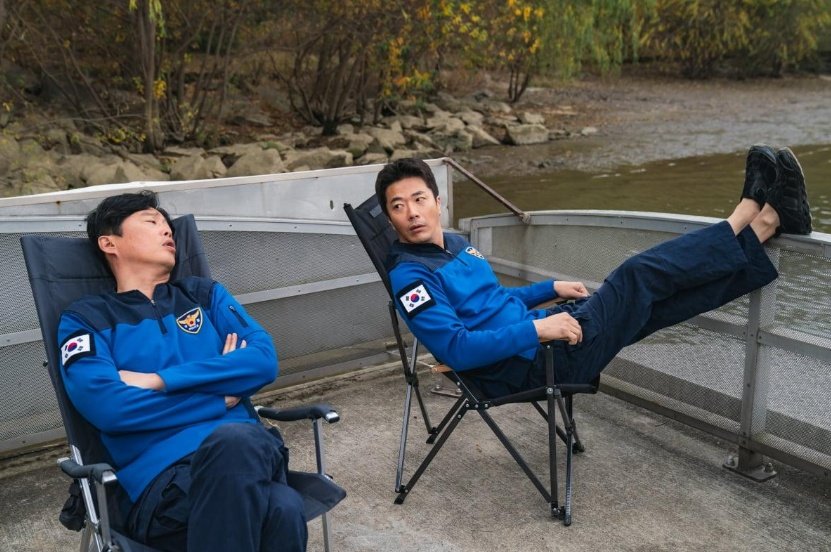
The Han River is one of Seoul’s most recognizable landmarks.
It is a place where people exercise, relax, meet friends, enjoy the city, and occasionally find themselves in dangerous situations. It is also an enormous public space that requires constant protection.
That makes the premise of Han River Police immediately interesting.
What if a television drama followed the officers responsible for protecting this river? What kinds of emergencies would they face? What would happen when an ordinary rescue operation unexpectedly revealed a much larger criminal conspiracy?
Released on Disney+ in 2023, Han River Police stars Kwon Sang-woo as Han Du-jin, Kim Hee-won as Lee Chun-seok, and Lee Sang-yi as Go Ki-seok.
The series combines police action, comedy, personal grudges, and a criminal investigation involving the Han River.
Yet an interesting question emerges after watching it.
Why does a drama with such a distinctive location and unusual police organization sometimes feel like a familiar crime story?
The problem is not that the series lacks an interesting premise.
It is that the premise promises a different kind of police drama, while the narrative repeatedly returns to familiar territory.
1. The Han River Should Have Been the Main Character
The most valuable element of Han River Police is not its criminal organization.
It is the river itself.
The Han River is more than a scenic background. It is a living part of Seoul, surrounded by parks, bridges, recreational facilities, residential areas, and busy public spaces.
Every day, thousands of people use the river for different reasons.
That creates countless possibilities for storytelling.
A police team assigned to protect such a place could encounter missing people, boating accidents, suspicious packages, environmental violations, dangerous rescue situations, and unexpected criminal activity.
Each incident could reveal a different side of the city.
But the series increasingly uses the Han River as the setting for a conventional criminal investigation.
The location remains visually important, yet its everyday identity receives less attention than the larger crime plot.
This is the first missed opportunity.
The river could have shaped the entire identity of the drama instead of simply providing a recognizable place for its action scenes.
2. Han River Police: A Different Kind of Police Team
Han Du-jin and Lee Chun-seok belong to a specialized police unit responsible for activities along the Han River.
This is an unusual professional environment for a television drama.
Unlike detectives who mainly investigate crimes after they happen, these officers operate in a space where emergencies can develop at any moment.
Their work involves responding to incidents, protecting people, and dealing with unpredictable situations.
That difference should influence the way the characters behave.
A river police officer must understand the environment, recognize danger, make decisions quickly, and sometimes put personal safety aside to rescue someone.
The job creates opportunities for action that do not depend on guns, gangsters, or complicated criminal conspiracies.
Unfortunately, the series does not always explore these possibilities as deeply as its premise suggests.
The result is a drama that introduces an unusual police organization but often relies on the familiar conventions of a standard action-comedy.
3. Han Du-jin: A Police Officer Driven by More Than Justice
Kwon Sang-woo plays Han Du-jin, a passionate and sometimes reckless officer.
At first, he appears to be a familiar television character: the hot-tempered policeman who follows his instincts and refuses to back down.
But his personality is connected to something more personal.
His brother’s death has left him with unresolved anger and resentment, particularly toward Baek Chul.
This history gives his determination a different meaning.
Du-jin is not simply someone who wants criminals punished.
He is also someone who has not completely escaped his own past.
That distinction matters because personal grief can influence how a police officer understands justice.
A person who has experienced a painful loss may become more determined to protect others.
But that same pain can also make it difficult to separate professional responsibility from personal revenge.
Du-jin’s character becomes more interesting when viewed through this conflict.
He is trying to protect the public while carrying an emotional burden that threatens to influence his decisions.
4. Lee Chun-seok: The Partner Who Balances Du-jin
Kim Hee-won plays Lee Chun-seok, Du-jin’s senior colleague and partner.
Their relationship is built around contrasting personalities.
Du-jin is impulsive and emotionally driven.
Chun-seok is generally more restrained, practical, and experienced.
This familiar contrast provides much of the series’ comedy.
One character rushes toward danger while the other has to deal with the consequences.
However, a successful police partnership requires more than contrasting personalities.
The strongest buddy dramas make the two characters indispensable to each other.
One notices something the other misses. One compensates for the other’s weaknesses. Their disagreements eventually create better decisions.
In Han River Police, the relationship has moments of entertainment, but it does not always develop into the kind of emotionally convincing partnership that could carry the entire series.
The characters are different, but their differences do not consistently produce deeper storytelling.
That is an important distinction.
A good comic partnership makes viewers want to spend more time with the characters, even when the central mystery is not particularly complicated.
5. Go Ki-seok: The Inheritor Who Wants His Own Power
Lee Sang-yi plays Go Ki-seok, an important figure in the criminal side of the story.
He is connected to the criminal organization through his uncle, Hwang Man-dae.
His position creates an interesting psychological conflict.
Ki-seok wants recognition and authority, but his power is connected to an older generation that already controls the organization.
He is not simply trying to become successful.
He wants to establish himself as someone who deserves to control the future.
This is a familiar problem in stories about criminal families and inherited power.
The next generation may receive access to money and influence, but it does not automatically receive the respect that comes with those things.
Ki-seok’s frustration can therefore be understood as a struggle between inherited status and personal ambition.
The problem is that the series does not always give this conflict enough depth.
His anger and aggressive behavior sometimes become more prominent than the motivations that could make him a memorable antagonist.
A stronger exploration of his insecurity might have produced a much more interesting character.
6. The Criminal Organization: A Familiar Enemy in an Unusual Setting
The criminal conspiracy provides the central conflict of the series.
It gives the police officers a larger target and connects several incidents to a common investigation.
This structure is easy for viewers to understand.
A police team discovers suspicious activity, follows the clues, encounters dangerous individuals, and gradually uncovers a larger criminal operation.
There is nothing inherently wrong with this formula.
Many successful police dramas use it.
But the problem is that Han River Police has an opportunity to offer something different.
Its officers work in a distinctive environment with a particular set of responsibilities.
The criminal investigation could have grown naturally out of those responsibilities.
Instead, the larger conspiracy sometimes feels like a familiar crime story placed inside a less familiar location.
The result is an imbalance between the originality of the setting and the familiarity of the plot.
7. Why the Comedy and Action Do Not Always Work Together
The series attempts to combine comedy and action.
This is a difficult balance.
Comedy often depends on timing, exaggeration, and the characters’ ability to react in unexpected ways.
Action depends on tension, physical danger, and the audience’s belief that the consequences matter.
When these two elements work together, they can create a highly entertaining experience.
But when the transitions are not sufficiently developed, the audience may struggle to understand what kind of emotional response the scene requires.
Should we laugh at the characters?
Should we worry about their safety?
Should we take the criminal investigation seriously?
The series sometimes moves between these expectations without allowing the characters or situations enough time to develop.
This is one reason the action and comedy can feel less effective than they might have been.
The problem is not the combination of genres.
It is the difficulty of making them serve the same story.
8. The Most Interesting Question: What Does It Mean to Protect a River?
A river is a public space, but it is also an environment that can become dangerous.
People visit the Han River because it offers freedom and relaxation.
They may not think about the officers who monitor the area or the emergencies that can develop there.
This creates a valuable narrative opportunity.
A drama about river police could explore the difference between enjoying a public space and protecting it.
For example, a seemingly ordinary day could suddenly become a rescue operation.
A missing person could lead to an unexpected discovery.
A suspicious incident could reveal a larger problem involving public safety.
These stories would allow the series to explore the actual identity of its central police unit.
They could also give the audience a stronger emotional connection to the Han River itself.
The river would no longer be just a place where the characters chase criminals.
It would become the reason their work matters.
9. Rescue Work Could Have Been More Powerful Than Another Criminal Chase
One of the most promising aspects of the series is the possibility of making rescue operations the emotional center of its storytelling.
Saving someone from a dangerous situation can create powerful drama without requiring a major villain.
The danger is immediate.
The outcome is uncertain.
The officers must make decisions under pressure.
And the person being rescued may have a story that changes how the audience understands the incident.
A police officer pulling someone from the water can produce more emotional tension than another confrontation with a criminal.
This is especially true because the Han River has a strong connection to ordinary life in Seoul.
People recognize it.
They have memories associated with it.
They understand why someone might visit it and why losing someone there would be devastating.
A series that explored those human stories more deeply could have developed a distinctive identity.
10. The Missed Opportunity of Everyday Seoul
Many Korean dramas use Seoul as a recognizable background.
But Han River Police has an opportunity to explore a different side of the city.
Instead of focusing on corporate offices, wealthy neighborhoods, or criminal underworlds, it could show the everyday public spaces that millions of people share.
The Han River connects different parts of the city.
It belongs to people with different occupations, incomes, ages, and personal circumstances.
A story about the officers who protect that space could naturally introduce a wide range of characters.
A delivery worker. A tourist. A family enjoying a weekend outing. A person exercising alone. Someone who has lost something important.
Each encounter could reveal a different human story.
This would make the drama feel more connected to the city itself.
The series occasionally approaches this possibility, but its central criminal plot often takes priority.
11. The Emotional Story Behind Han Du-jin’s Anger
Du-jin’s relationship with the memory of his brother is one of the more meaningful elements of the character.
His anger toward Baek Chul gives the story a personal dimension.
However, revenge and justice are not the same thing.
A person seeking revenge wants to settle a personal emotional debt.
A police officer seeking justice must consider evidence, responsibility, and the protection of others.
These goals can overlap, but they can also conflict.
Du-jin’s character could have been explored through this contradiction.
Does his anger make him a better officer because he understands the pain of loss?
Or does it make him more dangerous because he may allow personal emotions to influence professional decisions?
The series introduces the ingredients for this conflict, even if it does not always explore them as deeply as possible.
This remains one of the more interesting ways to understand its main character.
12. What Reddit Viewers Found Disappointing
Reddit discussions about Han River Police reveal a relatively limited but useful set of reactions.
Some viewers found the premise interesting but were disappointed by the actual storytelling.
One discussion included criticism that the series felt boring, with one viewer saying that Do-na-hee’s appearances were among the more entertaining parts.
Another discussion questioned the excitement generated by the story and criticized its familiar direction.
The short six-episode format also became part of the discussion.
These are individual opinions rather than a representative survey of all viewers.
Nevertheless, they point toward a recurring issue.
The series has recognizable actors, an unusual professional setting, and an accessible action-comedy premise.
Yet those elements do not consistently combine into a compelling narrative.
The criticism is less about one specific performance and more about the gap between what the premise promises and what the story delivers.
13. Why the Series Feels Less Original Than Its Premise
The most frustrating thing about Han River Police is that its originality is visible from the beginning.
A specialized police team.
A famous public space.
Water-based rescue operations.
A city environment that can create unexpected emergencies.
A partnership between two officers with very different personalities.
These are strong foundations.
But the series increasingly relies on familiar crime-drama ingredients.
A criminal organization.
Personal revenge.
A powerful antagonist.
A conspiracy that connects the main incidents.
These elements are not necessarily bad.
The problem is that they become more important than the distinctive world that initially made the drama interesting.
The series could have used its unusual setting to reinvent the police procedural.
Instead, it often uses the setting to decorate a more conventional story.
That is why its central opportunity feels only partially realized.
14. Could Han River Police Have Become a Better Series?
The answer is yes, and the solution would not necessarily have required a bigger budget or a more complicated criminal conspiracy.
It could have focused more strongly on the actual experiences of the river police.
Each episode could have begun with a different emergency.
Some incidents could be funny.
Others could be frightening or emotionally difficult.
The officers’ relationships could develop through the consequences of their decisions.
The criminal investigation could emerge gradually from the incidents rather than dominating the story from the beginning.
This approach would have allowed the series to build its own identity.
It could still have included action, comedy, and a larger conspiracy.
But those elements would have grown out of the central idea of protecting the river.
The audience would have had a reason to care about the police team beyond the fact that they were chasing criminals.
They would care because the characters were protecting a place that belonged to everyone.
15. The Real Meaning of the Han River as a Setting
The Han River is more than a beautiful landscape.
It represents movement, connection, and the everyday life of Seoul.
People visit it to escape their routines.
Some come with friends or family.
Others come alone.
For some, it is a place of happiness.
For others, it may be connected to painful memories.
A police team responsible for protecting the river stands at the intersection of all these different lives.
That is a much richer premise than simply placing a crime investigation beside the water.
The series could have explored the relationship between a city and the people who protect its shared spaces.
It could have shown that public safety is not always about catching dangerous criminals.
Sometimes it is about noticing a person in trouble before anyone else does.
Sometimes it is about arriving at the right place at the right moment.
And sometimes it is about saving someone whose story would otherwise remain unknown.
16. Final Verdict: A Good Idea That Never Fully Became Its Own Identity
Han River Police has several appealing elements.
Kwon Sang-woo brings energy to Han Du-jin.
Kim Hee-won provides a contrasting presence through Lee Chun-seok.
Lee Sang-yi adds another dimension to the criminal conflict as Go Ki-seok.
The series also benefits from an unusual setting that could have supported a distinctive police drama.
But its greatest weakness is the gap between its premise and its execution.
A story about protecting one of Seoul’s most important public spaces gradually becomes a familiar crime narrative.
The Han River remains visually recognizable, but the drama does not always explore what makes that location unique.
The police officers have an unusual job, but the story does not consistently make that job the source of its strongest drama.
This is why the series feels like a missed opportunity rather than a completely unsuccessful idea.
It had the ingredients for something different.
It simply did not use all of them.
Perhaps the most interesting question Han River Police leaves behind is not whether its officers can catch the criminals. It is why a drama about protecting the Han River did not spend more time showing us what makes the river worth protecting.