After a long day, sometimes you don’t want another burger.
You don’t want fried chicken.
You don’t want pizza covered in cheese.
You don’t even want something exciting.
You just want something warm.
That may help explain why some Americans are discovering one of Korea’s least flashy but most comforting foods:
Seolleongtang (설렁탕).
In places like Los Angeles, people can drive across town to Koreatown for a steaming bowl of Korean beef soup.
Some restaurants specializing in Korean soups have traditionally served late-night diners, and seolleongtang has long been associated with breakfast, hangovers, cold weather and those days when your body simply doesn’t feel right.
Eater Los Angeles, for example, recommends seolleongtang as a Korean breakfast and describes it as especially restorative for people recovering from a hangover or nursing a cold.
But to understand why this simple-looking soup can inspire such loyalty, you have to understand what seolleongtang means in Korea.
Because for many Koreans, it isn’t merely soup.
It is the kind of food you eat when your body needs a little help getting through the day.
What Is Korean Seolleongtang?
Seolleongtang is a traditional Korean soup made by slowly simmering beef bones and meat.
The long cooking process extracts flavor and richness from the bones and beef, often creating the pale, cloudy broth many people associate with the dish.
But not every seolleongtang looks exactly the same.
Some restaurants prefer a milky-white broth with a stronger bone flavor.
Others produce a clearer broth with more emphasis on the clean flavor of beef.
MICHELIN describes seolleongtang as one of Korea’s quintessential soul foods and notes that preparation varies considerably from restaurant to restaurant.
The bowl itself can look surprisingly plain.
Beef.
Broth.
Rice.
Sometimes thin noodles.
Green onions.
Salt and pepper.
That’s about it.
And that’s exactly why making truly great seolleongtang is harder than it looks.
In Korea, Seolleongtang Feels Like an Early Morning
Ask a Korean what image comes to mind when thinking about seolleongtang, and many answers will have less to do with fine dining than with everyday life.
For me, one of the strongest images is early morning.
It is still cold outside.
The city hasn’t completely woken up.
Someone who has to start work early pushes open the door of a small restaurant.
He is hungry.
A long day is waiting for him.
Then a black earthenware bowl arrives at the table.
The broth is still bubbling.
Steam rises toward his face.
He adds some chopped green onions, a little salt and perhaps some black pepper.
Then he puts rice into the soup.
One spoonful.
Then another.
Gradually, the cold disappears.
The stomach becomes full.
And somehow the day feels a little more manageable.
That is the emotional image of seolleongtang that is difficult to explain with the English words “beef bone soup.”
Technically, that description may be useful.
Emotionally, it doesn’t come close.
A Food Koreans Turn to When They Don’t Feel Well
Seolleongtang also has a strong reputation in Korea as nourishing food.
When someone feels weak, catches a cold or simply feels exhausted, a hot bowl of soup is often appealing.
That doesn’t mean seolleongtang should be considered medicine.
It isn’t.
But culturally, it occupies a similar emotional space to chicken soup in parts of the United States.
Warm. Familiar. Gentle. Restorative.
And something interesting is happening in America.
People are beginning to experience it in much the same way.
Eater Los Angeles recently featured a bowl of seolleongtang eaten just before the writer came down with a summer cold, describing the soup’s warmth and rich texture as deeply soothing.
That’s fascinating to me.
The person eating the soup may have changed.
The country has changed.
But the emotional purpose of the food remains remarkably similar.
The Secret Partner Isn’t Another Meat Dish
If you order seolleongtang for the first time, there is one thing you shouldn’t ignore.
Kkakdugi (깍두기).
Kkakdugi is Korean radish kimchi, usually cut into cubes and fermented with chili pepper, garlic and other seasonings.
A spoonful of rich, mild broth followed by a crunchy, slightly sour and spicy piece of kkakdugi creates one of those combinations that makes much more sense after you taste it.
The broth calms the kimchi.
The kimchi wakes up the broth.
This isn’t a side dish placed on the table merely because Korean restaurants serve lots of side dishes.
Kkakdugi is part of the seolleongtang experience.
MICHELIN’s discussion of the dish makes the same point: kimchi, especially kkakdugi, cuts through the richness of the beef broth, and famous seolleongtang restaurants often take their kimchi extremely seriously.
Some Koreans even add a little kkakdugi juice to their soup.
For someone tasting seolleongtang for the first time, that may sound strange.
Try the original broth first.
Then try it with kkakdugi.
You’ll understand.
The Best Way to Eat Seolleongtang
There isn’t one mandatory method.
But this is how I would introduce it to someone eating Korean seolleongtang for the first time.
First, taste the broth before seasoning it.
Good seolleongtang is often intentionally served lightly seasoned so each diner can adjust it.
Then add a little salt.
Add black pepper if you like it.
Add plenty of chopped green onions.
Taste again.
Now take a bite of beef.
Then kkakdugi.
Once you’ve tasted the broth on its own, add some rice.
Don’t necessarily throw everything in immediately.
Add a little rice at a time and see how the texture changes.
Soon you are no longer eating soup and rice separately.
You are eating gukbap (국밥) — one of the most comforting forms of Korean everyday food.
And Then Comes Dolsotbap
There is an even better combination found at some Korean restaurants:
Seolleongtang with dolsotbap (돌솥밥).
Dolsotbap means rice cooked and served in a hot stone pot.
When the lid is opened, steam rises from freshly cooked rice.
The rice is hot, glossy and fragrant.
You scoop it out.
Then put some into your seolleongtang.
Hot rice.
Hot beef broth.
Tender beef.
And one crunchy piece of kkakdugi.
But here is the part many first-time visitors don’t expect.
Don’t take away the empty stone pot.
The meal isn’t finished.
Wait — Why Are Koreans Pouring Hot Water Into the Rice Pot?
After the rice is removed, a thin layer remains stuck to the scorching-hot bottom of the stone pot.
This is nurungji (누룽지) — toasted, scorched rice.
Pour hot water into the pot.
Put the lid back on.
Then continue eating your seolleongtang.
By the time you finish the soup, return to the stone pot.
The toasted rice has softened and infused the water with a subtle roasted-rice flavor.
Depending on how it is prepared and described, this final rice-water experience is closely associated with sungnyung (숭늉).
Now you have one last warm, clean-tasting finish to the meal.
So a meal that initially looked like nothing more than beef soup has become:
That’s one reason Korean food can be difficult to understand from a menu photograph.
Sometimes the experience isn’t one dish.
It’s the sequence in which you eat it.
Seolleongtang Looks Easy. It Isn’t.
This may be the most important thing to understand about seolleongtang.
It looks simple.
And simple food can be incredibly difficult to make well.
A spicy sauce can sometimes hide imperfections.
Strong seasoning can dominate other flavors.
Seolleongtang has nowhere to hide.
The quality of the bones and meat matters.
How the broth is simmered matters.
How fat is managed matters.
How the meat is cooked matters.
And above all:
time matters.
One of Seoul’s oldest famous seolleongtang restaurants, Imun Seolnongtang, has historically simmered its broth for more than 17 hours, according to MICHELIN’s feature on the dish.
Mapo Ok, another long-running Seoul specialist, is described by MICHELIN as slowly boiling beef and ox bones to produce its signature broth. The restaurant dates to 1949.
There is no dramatic moment when the dish suddenly becomes great.
It happens slowly.
Hour after hour.
Perhaps that’s part of its character.
Why Seolleongtang Works So Well in America
American food culture isn’t lacking in soup.
Chicken noodle soup already plays an important comfort-food role.
There are regional stews, chowders and countless immigrant soup traditions.
So why might seolleongtang connect with American diners?
I think the answer is surprisingly simple.
You don’t need to understand Korean culture to understand being tired.
You don’t need to speak Korean to know what it feels like to come home after a terrible day.
You don’t need to know the history of gukbap to appreciate holding a spoon over a steaming bowl on a cold morning.
And you don’t need to grow up eating kkakdugi to discover that its sharp fermented flavor is wonderful with a mild beef broth.
That universality may be one of seolleongtang’s greatest strengths.
It doesn’t demand attention.
It doesn’t explode with spice.
It doesn’t need melted cheese, an enormous portion or a dramatic tableside presentation to impress you.
It simply makes you feel better.
From Seoul Before Sunrise to Los Angeles After Midnight
There is something beautiful about how food travels.
In Seoul, I think of a worker eating seolleongtang early in the morning before starting a long day.
In Los Angeles, someone may seek out the same soup after a long day, during a cold, or when they simply want something warm and familiar.
Koreatown’s long-running Han Bat has become particularly associated with seolleongtang, with Eater describing generations of the same family slowly simmering ox bones for the restaurant’s broth.
Different city.
Different customers.
Different lives.
But perhaps the reason they lift that first spoonful isn’t so different.
The Korean Comfort Food That Doesn’t Need to Shout
Korean food has become famous around the world for powerful flavors.
Korean fried chicken.
Tteokbokki.
Buldak.
Korean barbecue.
They are exciting, colorful and easy to show in a short video.
Seolleongtang is almost the opposite.
White broth.
White rice.
A few pieces of beef.
Green onions.
Kkakdugi on the side.
It isn’t particularly Instagrammable.
But perhaps that is exactly the point.
Seolleongtang isn’t food that asks you to look at it.
It’s food that asks you to sit down.
To warm your hands.
To add some rice.
To eat a piece of kkakdugi.
And to forget, for twenty minutes, how tiring the day has been.
Sometimes We Don’t Need Exciting Food
Seolleongtang looks simple.
But simple Korean food is often the hardest to make.
There is nowhere for bad ingredients to hide.
No powerful sauce needs to cover the broth.
What creates its depth isn’t a secret seasoning.
It is time.
Maybe that’s also why a bowl of seolleongtang can feel so comforting after a long day.
The person eating it might be in Seoul before sunrise.
Or driving across Los Angeles looking for Korean soup late at night.
The place has changed.
The language has changed.
But the reason for eating it may not have changed very much.
Sometimes, after a difficult day, what we want most isn’t exciting food.
We just want something warm.
And sometimes, that’s enough.
What About You?
Have you ever tried seolleongtang?
Would you choose a mild Korean beef soup over spicy Korean food after a long, exhausting day?
Among all the monsters, explosions and spectacular images in Na Hong-jin’s HOPE, something much simpler has caught the attention of some viewers:
The food.
In particular, two very Korean foods appearing in the movie have made viewers curious:
Jumeokbap (주먹밥) and chonggak kimchi (총각김치).
To a Korean viewer, these foods may look completely ordinary.
But they tell a surprisingly interesting story about Korean food culture.
One carries memories of hardship and has evolved into a popular modern comfort food.
The other has one of the most unusual names in Korean cuisine.
So, what exactly are they?
What Is Jumeokbap?
The literal translation of jumeokbap is surprisingly simple.
Jumeok (주먹) means “fist.”
Bap (밥) means “cooked rice” or simply “a meal.”
Put them together and you get:
“Fist rice.”
That sounds strange in English, but the name makes perfect sense when you see it.
Jumeokbap is rice seasoned and pressed together by hand into a compact ball roughly small enough to hold in your fist.
The basic idea could hardly be simpler.
Rice.
A little seasoning.
Your hands.
And you have something filling that can be carried and eaten easily.
A Simple Food Connected to Korea’s Harder Past
For older generations of Koreans, the image of simple rice balls can carry a very different meaning from the colorful jumeokbap served in restaurants today.
Jumeokbap is strongly associated in Korean cultural memory with periods of hardship, including war.
During difficult times, rice seasoned simply and pressed together by hand provided a practical way to turn limited ingredients into portable food.
That does not mean jumeokbap was “invented” during the Korean War.
Rice has obviously been shaped and eaten in many forms for much longer than that.
But in modern Korean memory, the humble rice ball became closely connected with survival, scarcity and war.
That history gives this extremely simple food an emotional meaning that may not be obvious to an international viewer.
Modern Jumeokbap Is Completely Different
Walk into a Korean restaurant today and jumeokbap can look very different from that austere image.
Modern versions may contain:
roasted seaweed flakes
sesame oil
sesame seeds
tuna
mayonnaise
chopped kimchi
beef
vegetables
flying fish roe
cheese
Sometimes the restaurant brings a bowl of rice and ingredients directly to the table.
You mix everything yourself.
Then you use your hands — usually wearing disposable gloves — to roll the mixture into small rice balls.
It is simple, interactive and surprisingly addictive.
What was once associated with making the most of very little has evolved into something playful and highly customizable.
Why Koreans Eat Jumeokbap With Spicy Food
There is another side of jumeokbap that foreign visitors to Korea quickly discover.
Order an intensely spicy Korean dish and there is a good chance that jumeokbap will appear somewhere on the menu.
One of the classic combinations is:
Spicy chicken feet — dakbal (닭발) — and jumeokbap.
For many Koreans, the combination feels almost inseparable.
Dakbal can be extremely spicy.
After several bites, your mouth is burning.
Then you eat a mild, savory rice ball containing seaweed and sesame oil.
The rice softens the intensity of the chili while the sesame oil and seaweed provide a completely different flavor.
Then you go back to the spicy food.
Spicy.
Rice.
Spicy.
Rice.
That rhythm is part of the pleasure.
This is why jumeokbap is more than just a side dish in modern Korean drinking and late-night food culture.
Sometimes it is the food that allows you to keep eating the spicy main dish.
And What Is Chonggak Kimchi?
The second food is even more interesting linguistically.
Chonggak kimchi (총각김치) is a type of kimchi made from small, firm radishes with their leafy green tops still attached.
Unlike the large Korean radish commonly cut into cubes to make kkakdugi, the radish used for traditional chonggak kimchi is smaller and is often fermented largely intact.
The entire vegetable — radish and greens — becomes part of the kimchi.
And that produces its most important characteristic:
texture.
A properly fermented chonggak radish has an exceptionally satisfying crunch.
Does “Chonggak” Really Mean Bachelor?
Here is where the name becomes fun.
In modern Korean, chonggak (총각) is commonly understood to mean an unmarried young man — essentially, a “bachelor.”
That is why chonggak kimchi is sometimes translated into English as:
“Bachelor kimchi.”
But the history behind the word goes deeper than simply naming a kimchi after unmarried men.
The term chonggak originally referred to an old hairstyle in which the hair of a young person was gathered or tied into horn-like shapes.
The small radish with its long leafy greens was thought to resemble this traditional hairstyle.
The radish became known as chonggakmu — chonggak radish.
And kimchi made from that radish became:
chonggak kimchi.
So the English translation “bachelor kimchi” is memorable, but it does not tell the whole story.
Hidden inside the name is a piece of old Korean culture.
Chonggak Kimchi vs. Kkakdugi: What Is the Difference?
Foreign visitors sometimes confuse chonggak kimchi with kkakdugi (깍두기) because both are radish kimchi.
But eating them is a completely different experience.
Kkakdugi is usually made by cutting a larger Korean radish into cubes before seasoning and fermentation.
Chonggak kimchi traditionally uses smaller, denser radishes, often with their leafy tops attached.
That changes both the appearance and the texture.
Kkakdugi gives you a neat cube of fermented radish.
Chonggak kimchi gives you something much more dramatic.
A Korean diner may pick up a well-fermented piece by its leafy stem and bite directly into the crunchy radish.
Crunch.
The fermented seasoning has penetrated the radish, but the inside can remain wonderfully firm.
That combination of sourness, spice and crunch is the real pleasure of chonggak kimchi.
Why Chonggak Kimchi Needs Time
Chonggak kimchi also behaves differently during fermentation.
Because the radishes are relatively small but dense and may be fermented whole or in large pieces, they generally take longer to mature than cubed kkakdugi.
Fresh chonggak kimchi can retain a sharp, peppery radish flavor.
As fermentation progresses, that harshness softens.
The seasoning penetrates more deeply.
Sourness develops.
But the radish can retain its distinctive crunch.
Many Koreans especially enjoy it at the point where it has developed a noticeable fermented sourness without losing that firm texture.
Why These Two Foods Feel So Korean
Jumeokbap and chonggak kimchi are very different foods.
One is rice.
The other is fermented radish.
But together they reveal something interesting about Korean food.
Neither requires luxury ingredients.
Both transform ordinary ingredients through technique, seasoning and time.
And both are foods where texture matters almost as much as flavor.
Jumeokbap is soft, warm and comforting.
Chonggak kimchi is cold, spicy, sour and crunchy.
Eat them together and the contrast does the work.
Soft rice.
Crunchy radish.
Mild sesame.
Fermented chili.
That is a very Korean way of building a meal — not around one flavor, but around contrasts.
From HOPE to the Korean Table
That is why a small food scene in a huge science-fiction movie can be interesting.
International audiences may watch HOPE for Na Hong-jin, Hwang Jung-min, Zo In-sung, Hoyeon, Michael Fassbender or its enormous science-fiction spectacle.
But sometimes the smallest details reveal the most about the country where a movie was made.
Jumeokbap carries memories of a poorer and more difficult Korea, while its modern versions show how Korean food continues to change.
Chonggak kimchi carries an old Korean word and hairstyle inside its name, while remaining something Koreans still happily bite into today.
Neither food needs an expensive restaurant.
Neither is particularly glamorous.
They are simply part of Korean life.
And perhaps that is exactly why seeing them inside a movie as enormous and strange as HOPE feels so natural.
If watching the movie made you wonder what those Korean rice balls and crunchy radishes tasted like, now you know what to ask for:
Jumeokbap and chonggak kimchi.
And if you ever visit Korea, try the jumeokbap with something seriously spicy.
You will understand very quickly why Koreans put the two together.
Maybe BLACKPINK, Stray Kids, SEVENTEEN, aespa, IVE or another artist you’ve followed from thousands of miles away.
The concert may last only a few hours.
But if you are flying all the way to South Korea, don’t make the concert your entire trip.
Make it the beginning.
K-pop fans are increasingly traveling to Korea not only to see their favorite artists, but to experience the country behind the music.
And for a first visit, there is one itinerary I recommend more than almost any other:
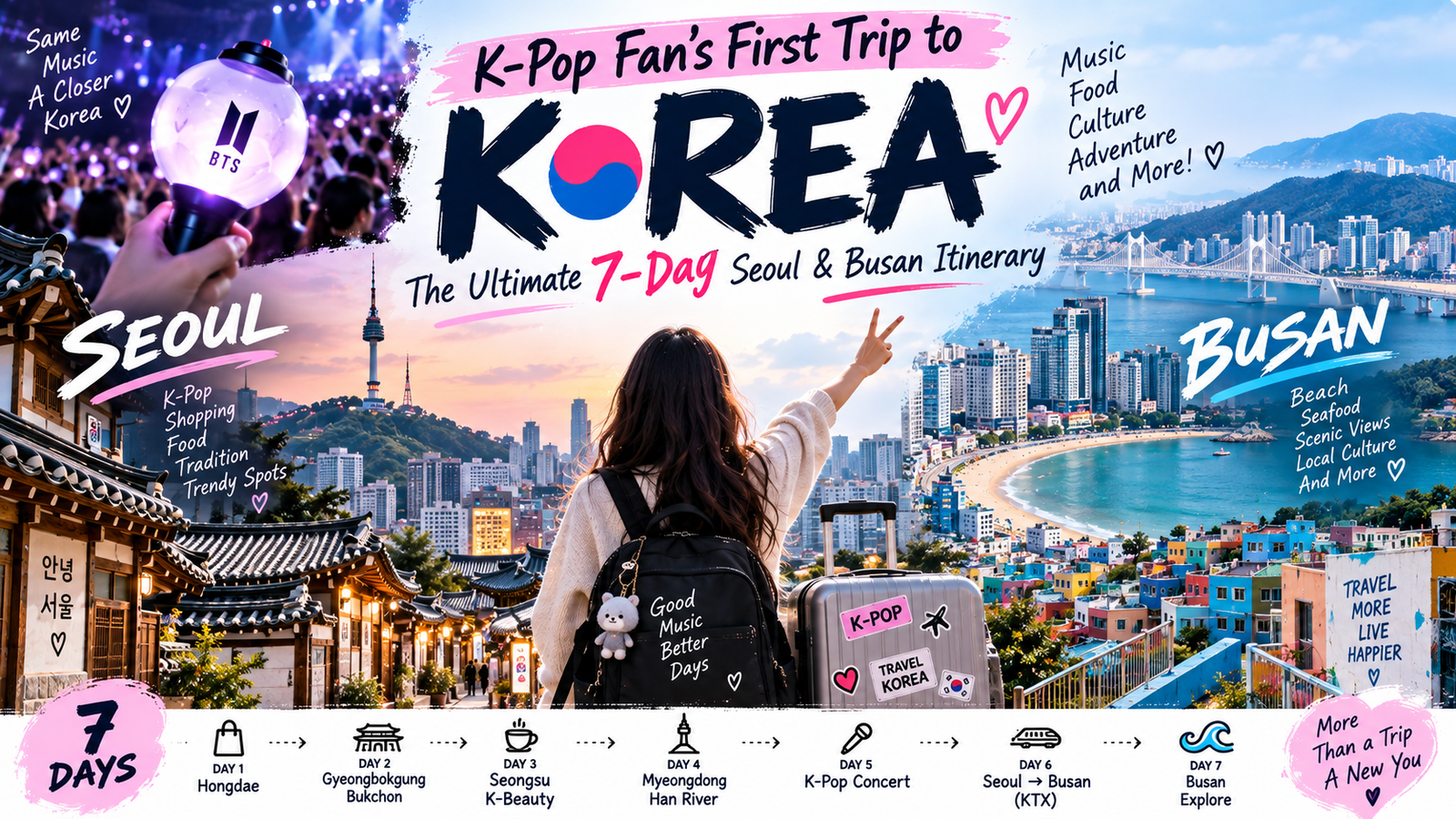
5 Days in Seoul + 2 Days in Busan
Seven days is long enough to experience modern Seoul, traditional Korea, K-pop culture, Korean food, K-beauty and the country’s most famous coastal city — without turning your vacation into an exhausting race between tourist attractions.
This itinerary is designed especially for a first-time international visitor to South Korea who loves K-pop.
You don’t need to spend seven days visiting idol-related locations.
Instead, we’ll use K-pop as the doorway and experience the Korea that exists beyond the concert.
Why 7 Days Is a Great First Korea Trip
You can technically visit Seoul in three or four days.
But if you are flying from North America, Europe or another long-distance destination, that can feel painfully short.
Seven days gives you time for:
K-pop
Korean food
K-beauty
traditional Korea
modern Seoul
shopping
the Han River
and
Busan
without changing hotels every night.
There is another advantage.
If your main reason for visiting Korea is a concert, arriving several days early gives you protection against flight delays.
Never schedule an international arrival only hours before a concert you spent months trying to attend.
For this itinerary, I would ideally place the concert around Day 4 or Day 5.
Before You Arrive: The Three Things You Need
Before discussing the itinerary, prepare three things.
1. A Transportation Card
Seoul’s subway and bus network makes traveling around the city relatively easy.
A rechargeable transportation card can be used across much of Korea’s public transit system.
You’ll use public transportation constantly, so this should be one of the first things you organize after arriving.
2. Korean Map Apps
One surprise for many international travelers is that Google Maps is not always the best navigation option in South Korea.
Install at least one Korean navigation app before your trip.
Naver Map and KakaoMap are widely used for navigating Korean cities.
Save your hotel and important destinations in advance.
This will make your first day considerably easier.
3. Comfortable Shoes
This sounds trivial.
It isn’t.
You are going to walk.
A lot.
Subway stations can be large, neighborhoods are best explored on foot, and several attractions involve hills or long walking routes.
Your fashionable concert shoes and your sightseeing shoes do not necessarily need to be the same pair.
Your feet will thank you by Day 5.
DAY 1 — Arrive in Seoul, Hongdae and Your First Korean Night
Don’t plan too much for your first day.
After immigration, baggage collection and transportation from the airport, you may already be tired.
Check into your hotel, take a short break and begin with one of Seoul’s easiest neighborhoods for younger international visitors.
Hongdae
Hongdae is an excellent introduction to modern Seoul.
The neighborhood is filled with:
cafés,
restaurants,
fashion shops,
street performers,
music,
beauty stores
and nightlife.
If K-pop was your introduction to Korea, Hongdae will probably feel surprisingly familiar and completely new at the same time.
Don’t spend your first evening checking boxes on a sightseeing list.
Walk.
Explore.
Eat.
Watch the city.
What Should You Eat on Your First Night?
For your first Korean meal, keep it fun.
Try:
samgyeopsal — Korean grilled pork belly
or
Korean fried chicken
If you are traveling with friends, Korean barbecue is particularly good because eating together around the grill is part of the experience.
And if you still have energy afterward?
Find a Korean convenience store.
Buy a drink and some snacks.
Congratulations.
Your Korea trip has officially started.
DAY 2 — Traditional Korea: Gyeongbokgung, Bukchon and Insadong
Yesterday was modern Korea.
Today, go backwards in time.
Start at:
Gyeongbokgung Palace
Built during the Joseon Dynasty, Gyeongbokgung is one of Seoul’s most important historical landmarks.
If this is your first visit to Korea, don’t skip it simply because it appears on every tourist itinerary.
There is a reason it does.
The contrast between the palace architecture and modern Seoul surrounding it is one of the city’s defining experiences.
Many visitors also rent hanbok, traditional Korean clothing, near the palace.
If that interests you, allow extra time.
Walk Toward Bukchon
After the palace, explore the traditional streets around Bukchon Hanok Village.
But remember something important:
Bukchon is not a theme park.
People actually live there.
Keep your voice down, respect restricted areas and avoid blocking residential entrances while taking photographs.
That small amount of consideration makes tourism better for everyone.
Lunch: Try a Traditional Korean Meal
This is a good day to move beyond the most internationally famous Korean foods.
Consider:
bibimbap
bulgogi
mandu
samgyetang
or a Korean set meal with multiple side dishes.
One of the best parts of traveling in Korea is discovering that Korean food is much larger than barbecue and kimchi.
Finish the Day in Insadong
Insadong is an easy continuation from the palace area.
You’ll find:
traditional crafts,
tea houses,
souvenirs,
galleries
and smaller streets worth exploring.
If Day 1 showed you the Korea of K-pop, Day 2 shows you part of the cultural foundation underneath modern Korea.
DAY 3 — Seongsu, K-Beauty and Contemporary Seoul
Today is about the Korea that is changing right now.
Head to:
Seongsu
Seongsu has become one of Seoul’s most interesting neighborhoods for fashion, beauty, cafés and pop-up culture.
This is particularly relevant for K-pop fans.
K-pop does not exist separately from Korean:
fashion,
beauty,
design,
brands
and youth culture.
They constantly influence one another.
And Seongsu is one of the easiest places to see those worlds overlap.
Don’t Overplan Seongsu
This is important because pop-ups change constantly.
A store that everyone was posting about three months ago may already be gone.
Instead of building your entire itinerary around one old viral TikTok, check what events and pop-ups are operating shortly before your trip.
Then spend time simply exploring the neighborhood.
Sometimes the most interesting place will be something that did not exist when you booked your flight.
K-Beauty Shopping
If you’ve wanted to try Korean skincare or makeup, today is a good day.
But don’t feel that you need to buy everything immediately.
Korean beauty stores are everywhere in Seoul.
Compare products.
Check what actually suits your skin.
And remember that a giant shopping bag becomes much less exciting after carrying it around for six hours.
DAY 4 — Myeongdong, Namsan and the Han River
Start with one of Korea’s most famous shopping districts.
Myeongdong
Myeongdong is touristy.
And that’s perfectly fine.
For a first-time visitor, it is convenient.
You can find:
K-beauty,
fashion,
restaurants,
cafés,
street food,
currency exchange
and easy transportation.
It is also a good place to buy gifts for people back home.
Try Korean Street Food
Depending on what is available, look for foods such as:
tteokbokki
hotteok
eomuk
dakgangjeong
and various grilled snacks.
Don’t worry about eating every famous Korean dish in one afternoon.
You have seven days.
N Seoul Tower and Namsan
From Myeongdong, you can continue toward Namsan.
Whether you actually go to the top of N Seoul Tower is up to you.
The more important experience is seeing Seoul from above and understanding just how enormous the city really is.
Evening: Do Something Very Korean — Nothing
After several busy days, slow down.
Go to the:
Han River
Buy food.
Get a drink.
Sit.
Talk.
Watch bicycles pass.
Look at Seoul’s skyline.
If you’ve watched Korean dramas, variety shows or idol content, you’ve probably seen people spending time beside the Han River.
It may not sound as exciting as a palace or concert.
But ordinary experiences are often what travelers remember most.
DAY 5 — K-Pop Day and Concert Night
This is the day you came for.
But don’t ruin it by exhausting yourself beforehand.
Keep the daytime schedule light.
Sleep a little longer.
Eat properly.
Charge your phone.
Check your ticket.
Check the venue’s official rules.
Check transportation.
Check prohibited items.
And most importantly:
Follow the organizer’s official instructions rather than random social-media posts.
Concert procedures can change.
What to Do Before a K-Pop Concert
If official merchandise is being sold, queues can be long.
There may also be:
fan events,
pop-up stores,
photo zones,
special cafés,
album events
or citywide promotions.
Plan those around your concert rather than trying to squeeze them into the final hour.
If the venue is outside central Seoul — for example, Goyang or Incheon — allow significantly more transportation time than the map initially seems to suggest.
Thousands of other people may be traveling to the same place.
The Most Important Concert Tip: Plan the Trip Home
Everyone plans how to reach the concert.
Fewer people think carefully about what happens when tens of thousands of fans leave simultaneously.
Before entering the venue, know:
your subway route,
the last train time,
alternative routes,
taxi possibilities,
and where you will meet friends if your phones stop working.
Your concert ends when you are safely back at your hotel.
Not when the encore ends.
DAY 6 — Take the KTX to Busan
Now we change cities.
And this is where your first Korea trip becomes much more interesting.
Take the KTX high-speed train from Seoul to Busan.
The journey is roughly 2.5 to 3 hours depending on the service.
For many international visitors, the train ride itself becomes part of the experience.
You leave the enormous capital behind and begin seeing a different side of Korea.
First Stop in Busan: The Sea
Seoul is one of the world’s great metropolitan cities.
Busan feels different almost immediately.
It is Korea’s largest port city, surrounded by mountains and the sea.
For a short first visit, I would focus on a few major areas rather than trying to see everything.
Haeundae Beach
Haeundae is one of Korea’s most famous beaches.
Walk along the coast, explore nearby restaurants and enjoy the slower atmosphere.
If your Seoul days have been packed with subway transfers and shopping streets, the contrast feels wonderful.
Gwangalli at Night
If you can choose only one Busan night view, Gwangalli is hard to beat.
The illuminated Gwangan Bridge stretches across the water in front of you.
Find somewhere to eat nearby or simply walk along the beach.
This is one of those moments when you’ll realize:
Korea is much more than Seoul.
What to Eat in Busan
Busan has its own strong food identity.
Depending on your preferences, consider trying:
dwaeji gukbap — pork soup with rice
milmyeon — wheat noodles
eomuk — Busan-style fish cake
and, if you enjoy seafood, visit one of the city’s seafood districts.
This is exactly why adding Busan to a K-pop trip is worthwhile.
The music may be the same.
But the Korea around you has changed.
DAY 7 — Gamcheon, Jagalchi and Goodbye to Korea
Your final day should combine one more memorable neighborhood with food and a little shopping.
Start with:
Gamcheon Culture Village
Gamcheon is famous for its colorful hillside houses and narrow streets.
It has become one of Busan’s most recognizable destinations.
Take your time.
The neighborhood is hilly.
Again: comfortable shoes.
Jagalchi Market
Then experience another side of Busan at Jagalchi Market, one of Korea’s best-known seafood markets.
Even if you don’t eat seafood, the area around the market offers an interesting look at Busan’s identity as a port city.
Nearby streets are also good for exploring traditional markets and local food.
One Last Korean Meal
Your final meal does not need to be expensive.
In fact, one of the joys of Korea is that memorable meals can come from very ordinary places.
A small gukbap restaurant.
A noodle shop.
A gimbap restaurant.
A market stall.
A neighborhood barbecue restaurant.
By Day 7, you’ll probably already have your own opinion about which Korean food deserves one final meal.
That’s when you know you’ve actually traveled.
The Complete 7-Day Korea Itinerary
Here is the entire route in one place:
Day
Destination
Main Experience
Day 1
Hongdae
Arrival, modern Seoul, Korean food
Day 2
Gyeongbokgung–Bukchon–Insadong
Traditional Korean culture
Day 3
Seongsu
K-pop culture, cafés, K-beauty, pop-ups
Day 4
Myeongdong–Namsan–Han River
Shopping, street food, Seoul lifestyle
Day 5
Concert Day
K-pop concert and fan experiences
Day 6
Seoul → Busan
KTX, Haeundae, Gwangalli
Day 7
Busan
Gamcheon, Jagalchi, local food
Where Should a First-Time Visitor Stay in Seoul?
For this particular itinerary, three areas stand out.
Hongdae
Best if you want:
youthful atmosphere,
nightlife,
cafés,
easy airport access
and lots of restaurants.
Excellent for younger travelers and K-pop fans.
Myeongdong
Best if you want:
central location,
shopping,
K-beauty,
tourist convenience
and relatively easy access to major attractions.
For a first visit to Korea, Myeongdong is difficult to beat for convenience.
Seoul Station Area
Best if you plan to take the KTX to Busan and value transportation convenience.
It is not necessarily the neighborhood I would choose purely for atmosphere, but it makes moving around Korea easier.
How Much Money Should You Budget?
There is no single answer because Korea can accommodate very different travel styles.
Your biggest expenses are likely to be:
international airfare,
hotel,
concert ticket,
and shopping.
Public transportation and everyday Korean food can be relatively affordable compared with many major global cities.
A budget traveler can use:
guesthouses,
subways,
local restaurants
and convenience stores.
A higher-budget traveler can easily spend much more on:
hotels,
fine dining,
beauty treatments,
taxis,
shopping
and premium concert experiences.
The important thing is to separate your concert budget from your daily travel budget.
K-pop merchandise has a mysterious ability to make carefully planned budgets disappear.
Should You Visit Only K-Pop Locations?
I wouldn’t.
And I’m saying that in a guide specifically written for K-pop fans.
If BTS, BLACKPINK, Stray Kids or another artist made you curious about Korea, that’s wonderful.
Visit the places connected to them.
Go to the concert.
Buy the album.
Take the photos.
But don’t leave Korea having experienced only your fandom.
Spend one day learning about Korean history.
Eat food you’ve never seen your favorite idol eat.
Visit a neighborhood you discovered by accident.
Talk to people.
Take the train to another city.
Sit beside the Han River without doing anything.
Let K-pop bring you to Korea.
Then let Korea surprise you.
Why This Trip Is Bigger Than K-Pop
Recent tourism data shows that K-pop concerts can have a remarkable effect on international travel to Korea.
Foreign accommodation bookings during selected major K-pop concert weeks rose dramatically compared with non-concert periods, while government research around BTS performances found international concertgoers staying longer and spending more than the average foreign visitor.
That’s the phenomenon I explored in our previous article:
The BTS Effect: Why K-Pop Concerts Are Transforming Tourism in South Korea
But statistics only tell half the story.
The other half begins when the fan walks out of the stadium.
What happens next?
They eat tteokbokki.
They discover Seongsu.
They walk beside the Han River.
They shop in Myeongdong.
They ride the KTX.
They see Busan.
And suddenly the concert they flew across the world to attend becomes only one chapter of a much bigger memory.
A Few Mistakes First-Time Korea Travelers Should Avoid
Don’t schedule your flight too close to the concert.
Don’t rely entirely on one navigation app without preparing alternatives.
Don’t carry your passport, wallet and every valuable item carelessly in one place.
Don’t try to visit ten Seoul neighborhoods in one day.
Don’t assume every viral restaurant is worth waiting two hours for.
Don’t forget that residential areas such as parts of Bukchon require respectful behavior.
And don’t spend your entire vacation looking through your phone camera.
You traveled a long way.
Look at Korea with your own eyes too.
What If You Have More Than 7 Days?
Excellent.
Then I would not add more Seoul.
I would add more Korea.
With 9–10 days, consider:
Seoul → Gyeongju → Busan
Gyeongju offers a completely different experience from both Seoul and Busan.
It was the capital of the ancient Silla kingdom and is filled with archaeological and historical sites.
With 10–12 days, you could consider adding Jeju Island.
That gives you four dramatically different versions of Korea:
Seoul — modern metropolis
Gyeongju — history
Busan — coastal city
Jeju — nature
That’s a far richer introduction to Korea than spending the entire trip in one city.
Final Thoughts: Come for the Concert, Stay for Korea
Maybe your journey starts with a notification.
“World Tour Announced.”
Then comes the ticket battle.
The flight search.
The hotel reservation.
The countdown.
Finally, you arrive in Korea.
And for one night, thousands of people inside a stadium sing the same songs together.
That may be the reason you came.
But years later, you might remember something else just as clearly.
The smell of Korean barbecue on your first night.
The rooflines of Gyeongbokgung.
A random café in Seongsu.
Convenience-store ramyeon beside the Han River.
The KTX pulling out of Seoul Station.
The lights of Gwangan Bridge reflecting on the sea.
That is the wonderful thing about traveling because of music.
K-pop may give you the ticket to Korea.
But Korea gives you the journey.
So if you’re traveling thousands of miles for a concert, don’t simply attend the show and fly home.
For rail schedules and KTX reservations, use KORAIL. Because schedules, fares, concert rules, pop-ups and opening hours can change, verify these details shortly before traveling.
K-Beauty Shopping
If you want to explore Korean skincare, cosmetics and beauty products before or after your trip, you can browse OLIVE YOUNG Global.
For many Koreans, japchae is more than a noodle dish.
It is a food connected to happy memories.
Growing up in Korea, when there was something to celebrate or good news in the family, mothers would often prepare a large plate of japchae filled with beef and colorful vegetables.
Birthdays, holidays, family gatherings, and other special occasions often meant one thing: the familiar smell of sesame oil, soy sauce, stir-fried vegetables, and freshly cooked japchae coming from the kitchen.
That is why japchae can bring back memories of family, celebration, and a mother’s home cooking.
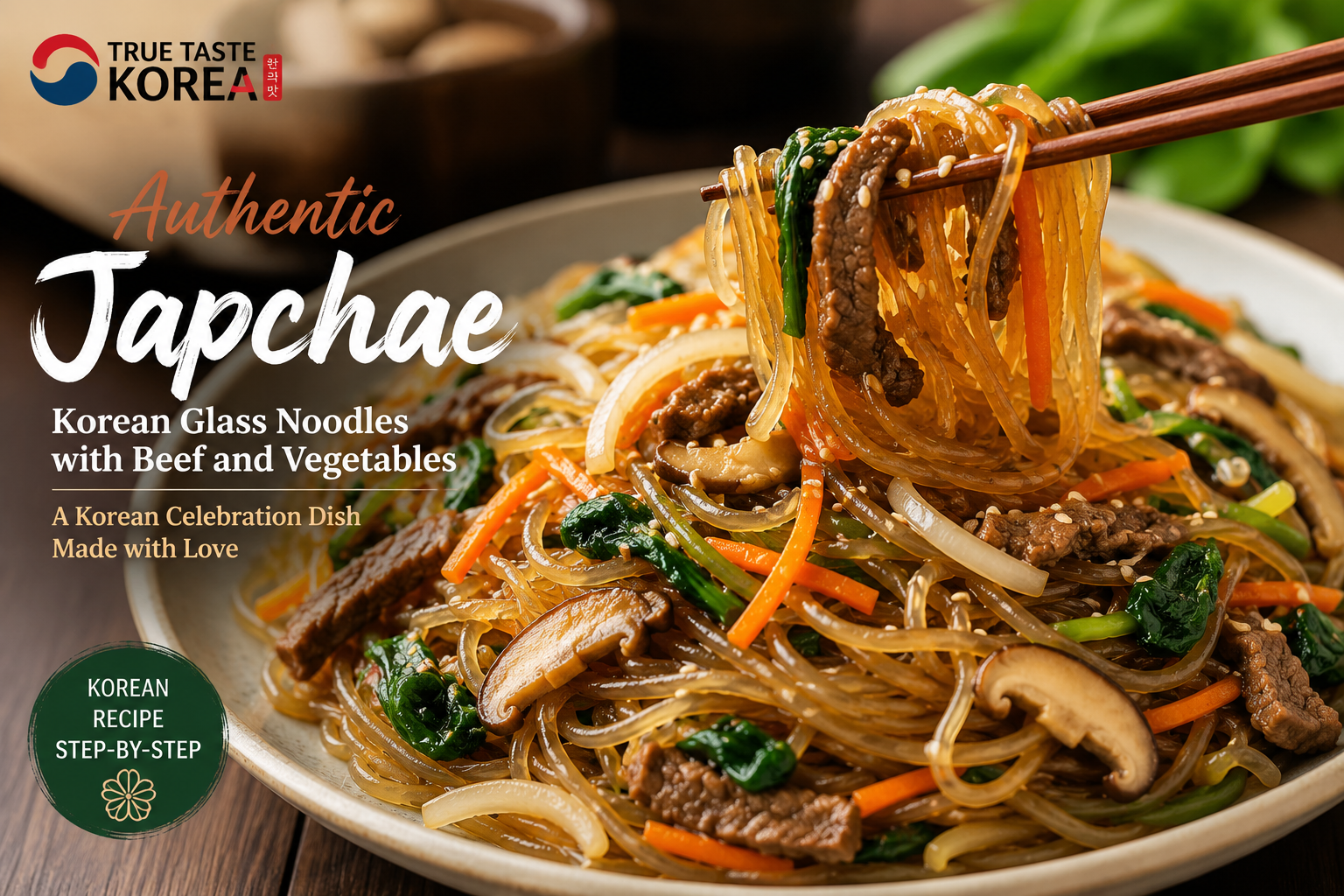
Today, let’s make an authentic Korean-style japchae with chewy glass noodles, beef, mushrooms, spinach, carrots, and onions.
What Is Japchae?
Japchae (잡채) is one of Korea’s best-known noodle dishes.
Modern japchae is typically made with dangmyeon, Korean glass noodles traditionally made from sweet potato starch.
The noodles are cooked and seasoned with soy sauce, sesame oil, and a touch of sweetness, then combined with beef and a variety of vegetables.
The result is a dish that is simultaneously:
chewy
savory
slightly sweet
nutty from sesame oil
colorful
surprisingly filling
Although japchae is often served as banchan (Korean side dish), it can easily become the centerpiece of a meal.
Why Is Japchae a Celebration Food in Korea?
For many Korean families, japchae traditionally appears when there is something worth celebrating.
You may see a large plate of japchae at a birthday table, holiday gathering, family celebration, or special meal for guests.
For many Koreans who grew up eating homemade japchae, the memory is particularly associated with mothers preparing it in the kitchen.
And when it was a special occasion, there would often be beef in the japchae, making an already colorful dish feel even more generous.
It wasn’t simply something you ate because you were hungry.
Japchae was something your mother made when something good happened.
That emotional connection is one reason japchae remains such a familiar celebration food in Korean homes.
Japchae Wasn’t Originally a Glass Noodle Dish
Here is something many international fans of Korean food may not know.
The earliest form of japchae did not contain the glass noodles that define the dish today.
The dish has a history stretching back to Korea’s Joseon period, while sweet potato starch noodles became part of modern japchae much later.
Over time, dangmyeon became the defining ingredient, transforming japchae into the dish most Koreans recognize today.
The name itself is interesting:
Jap (잡) can refer to mixed or assorted ingredients, while chae (채) refers to vegetables.
That history makes sense when you look at a plate of japchae. Rather than being about one ingredient, the dish is about bringing many different ingredients together.
Why Japchae Is So Satisfying
One of japchae’s greatest strengths is how much goes into a single dish.
The noodles provide their characteristic chewy texture. Beef adds richness and protein. Mushrooms add umami. Spinach, carrots, and onions add different flavors, textures, and colors.
This is why japchae is one of the more satisfying side dishes on a Korean table.
Some Koreans will even eat a generous serving of japchae without a separate bowl of rice, particularly when they want a lighter-feeling meal.
However, don’t mistake that for meaning japchae is automatically a low-calorie diet food.
Dangmyeon is primarily a source of carbohydrates, and traditional japchae also contains sesame oil and some sugar. Portion size and the balance of noodles, meat, and vegetables still matter.
Authentic Korean Beef Japchae Recipe
Servings
4–5
Preparation Time
About 25 minutes
Cooking Time
About 25 minutes
Ingredients
Main Ingredients
250 g Korean sweet potato glass noodles (dangmyeon)
150 g beef, thinly sliced
150 g spinach
1 medium carrot
1 medium onion
100 g shiitake mushrooms or other mushrooms
2 green onions
1 tablespoon cooking oil
Sesame seeds for garnish
Beef Marinade
1 tablespoon soy sauce
1 teaspoon sugar
1 teaspoon sesame oil
1 teaspoon minced garlic
Black pepper to taste
Japchae Seasoning
4 tablespoons soy sauce
2 tablespoons sugar
2 tablespoons sesame oil
1 tablespoon minced garlic
You can adjust the sweetness and saltiness slightly according to taste.
Step 1. Prepare the Beef
Thinly slice the beef.
Mix it with soy sauce, sugar, sesame oil, minced garlic, and a little black pepper.
Let it marinate for about 15–20 minutes while preparing the other ingredients.
Thinly sliced beef cooks quickly and mixes more naturally with the noodles and vegetables.
Step 2. Prepare the Vegetables
Slice the carrot, onion, and mushrooms into thin strips.
Keeping the vegetables relatively similar in size makes the finished japchae easier to eat and gives it the colorful appearance associated with traditional Korean japchae.
Wash the spinach thoroughly.
Blanch it briefly in boiling water, then immediately cool it in cold water.
Gently squeeze out excess moisture.
Season lightly with a little salt and sesame oil.
Step 3. Cook the Vegetables Separately
This is one of the secrets to really good japchae.
Instead of throwing every vegetable into the pan at once, cook the ingredients separately or in small groups.
Lightly stir-fry the onions.
Remove them.
Stir-fry the carrots until just tender.
Remove them.
Then cook the mushrooms.
Finally, stir-fry the marinated beef until cooked through.
Why bother?
Because every ingredient has a different cooking time.
Cooking them separately helps preserve their individual texture, color, and flavor.
This extra step is one of the differences between ordinary japchae and really good homemade japchae.
Step 4. Cook the Dangmyeon
Bring a large pot of water to a boil.
Add the sweet potato glass noodles and cook according to the package directions. Cooking times can vary depending on the brand and thickness of the noodles.
Drain thoroughly.
If the noodles are extremely long, cut them a few times with kitchen scissors so the finished japchae is easier to eat.
Do not overcook the noodles.
Good japchae should have a pleasantly chewy and springy texture, rather than becoming overly soft or mushy.
Step 5. Season the Noodles
While the noodles are still warm, add the japchae seasoning:
soy sauce
sugar
sesame oil
minced garlic
Mix thoroughly so the noodles absorb the seasoning evenly.
The warm noodles take on the flavor particularly well.
Step 6. Combine Everything
Now comes the best part.
Place the seasoned noodles in a large bowl or pan.
Add the cooked beef, onions, carrots, mushrooms, spinach, and green onions.
Gently toss everything together.
Taste and adjust with a little additional soy sauce or sesame oil if necessary.
Finish with sesame seeds.
You should now have a glossy, colorful plate of authentic Korean japchae.
The Secret to Better Japchae
There are several small details that make a big difference.
Don’t use too many noodles.
A common mistake is making japchae mostly noodles with a few vegetables scattered throughout.
Good Korean homemade japchae should feel generous.
There should be plenty of beef, mushrooms, spinach, carrots, and onions mixed throughout the noodles.
Don’t overcook the dangmyeon.
The chewy texture of sweet potato noodles is one of the pleasures of japchae.
Sesame oil goes a long way.
Sesame oil gives japchae its unmistakable aroma, but adding too much can overpower the other ingredients.
Cook vegetables according to their needs.
Cooking everything together may be faster, but separately cooked vegetables generally give japchae better color and texture.
Can You Make Japchae Without Beef?
Absolutely.
Beef is common in celebratory Korean-style japchae, but it isn’t essential.
You can leave it out and increase the amount of mushrooms and vegetables for a vegetarian version.
For a fully vegan japchae, make sure all sauces and seasonings you use are vegan-friendly.
Mushrooms are particularly useful because they provide additional savory flavor.
Can Japchae Be a Complete Meal?
It can.
In Korea, japchae is commonly served as banchan alongside rice and other dishes.
But because it contains noodles, vegetables, and often meat, a generous plate can be filling enough that some people eat it without rice.
If you want to make it more meal-like, increase the proportion of vegetables and protein rather than simply adding more noodles.
How to Store Leftover Japchae
Japchae can be refrigerated in an airtight container.
For the best texture, try to eat leftovers within a few days.
The noodles become firmer when refrigerated, so cold japchae doesn’t have quite the same texture as freshly prepared japchae.
Fortunately, it reheats well.
The Best Way to Reheat Japchae
Put the japchae into a frying pan over medium-low heat.
Add a very small amount of water if the noodles have become dry and gently stir-fry until they become soft and glossy again.
You can finish with a tiny amount of sesame oil.
This usually restores the texture better than eating it straight from the refrigerator.
Frequently Asked Questions About Japchae
What are japchae noodles made from?
Traditional Korean dangmyeon used for japchae are generally made from sweet potato starch.
This gives them their translucent appearance and characteristic chewy texture.
Is japchae spicy?
Usually not.
Traditional japchae is savory and slightly sweet rather than spicy, making it one of the more approachable Korean dishes for people who aren’t comfortable with spicy food.
Is japchae gluten-free?
The noodles themselves are typically made from sweet potato starch, but regular soy sauce commonly contains wheat.
Anyone who needs a gluten-free dish should check every ingredient carefully and use an appropriate gluten-free soy sauce.
Can I make japchae ahead of time?
Yes.
That’s another reason japchae works well for parties and family gatherings.
Prepare it ahead, refrigerate it, and gently reheat it before serving.
More Than Korean Glass Noodles
Calling japchae simply “Korean glass noodles” doesn’t quite explain what the dish means in Korea.
For many Koreans, japchae brings back a particular kind of memory.
A birthday.
A holiday.
Relatives gathering around the table.
Good news in the family.
And a mother in the kitchen preparing a large plate of japchae with beef and colorful vegetables.
The combination of chewy dangmyeon, savory beef, colorful vegetables, soy sauce, and fragrant sesame oil makes it delicious.
But the memories surrounding it are what make japchae special.
Sometimes food isn’t just about what is on the plate. It is about remembering who prepared it, and why everyone was gathered around the table in the first place.