BTS Jin has long been associated with a Korean noodle dish that does the exact opposite.
Naengmyeon (냉면).
These thin, chewy noodles are served in an icy-cold broth—sometimes with actual ice floating in the bowl.
For anyone discovering Korean food for the first time, that can raise an obvious question:
Why would you want your noodles freezing cold?
What Is Naengmyeon?
Naengmyeon literally means “cold noodles.”
One of the best-known versions, mul-naengmyeon, combines chewy noodles with chilled broth traditionally made with ingredients such as beef and dongchimi, a Korean radish water kimchi.
Typical toppings include sliced beef, cucumber, radish, pear and boiled egg.
Korea Tourism Organization describes cold buckwheat noodles as noodles served in chilled beef broth and notes that they are especially popular during Korea’s hot summer months.
There is also bibim-naengmyeon, which skips most or all of the broth and coats the noodles in a spicy red sauce.
Same idea.
Completely different experience.
Jin and Naengmyeon Go Back Years
Jin’s connection with naengmyeon isn’t difficult to understand if you’ve followed his food appearances.
In a 2017 television appearance, Jin recalled going out for samgyeopsal with actor Lee Won-geun. The two ate 12 servings of pork belly and six bowls of rice.
And what did they have for dessert?
Naengmyeon.
Yes—in Korea, cold noodles can come after Korean barbecue.
That’s one of the first things international visitors may find surprising.
Why Eat Cold Noodles After Hot Korean BBQ?
Imagine you’ve just spent an hour eating fatty pork or beef straight from a hot grill.
Then a bowl arrives filled with cold, refreshing broth and chewy noodles.
The contrast works.
In fact, the Korea Tourism Organization notes that eating naengmyeon instead of rice at the end of a galbi meal has become a common way to finish with something refreshing.
So naengmyeon isn’t simply another noodle dish.
It can also be the Korean answer to:
“What should we eat after all that meat?”
But Naengmyeon Wasn’t Originally a Summer Food
Here’s the surprising part.
Today, Koreans strongly associate naengmyeon with summer.
Historically, however, it was also a winter food.
Korea’s official government site explains that naengmyeon was traditionally enjoyed during winter, when dongchimi was available, and historical records describe people eating it around the winter solstice.
Imagine sitting on a warm ondol floor during a freezing Korean winter while eating a bowl of cold noodles.
That sounds strange today.
Historically, it made perfect sense.
What Does Naengmyeon Taste Like?
Don’t expect the explosive flavor of tteokbokki or spicy ramyeon.
Especially with Pyeongyang-style naengmyeon, the broth can be surprisingly delicate.
Korea Tourism Organization describes its clear broth as subtle but addictive and notes that cold noodles may be unfamiliar to international visitors accustomed to hot noodle soups.
That’s part of the appeal.
The first bite might make you wonder:
“Is that it?”
Then you take another.
And another.
Suddenly the bowl is empty.
Want to Eat Like Jin?
If you’re already planning to try Korean barbecue in Korea, there’s an easy way.
After the meat, don’t immediately ask for the bill.
Look for 냉면 (naengmyeon) on the menu.
Order a bowl.
And when freezing-cold noodles arrive after a sizzling-hot barbecue dinner, you’ll understand one of the more unusual combinations in Korean food culture.
When Jay Park was asked which Korean food he missed while living in the United States, his answer was surprisingly simple.
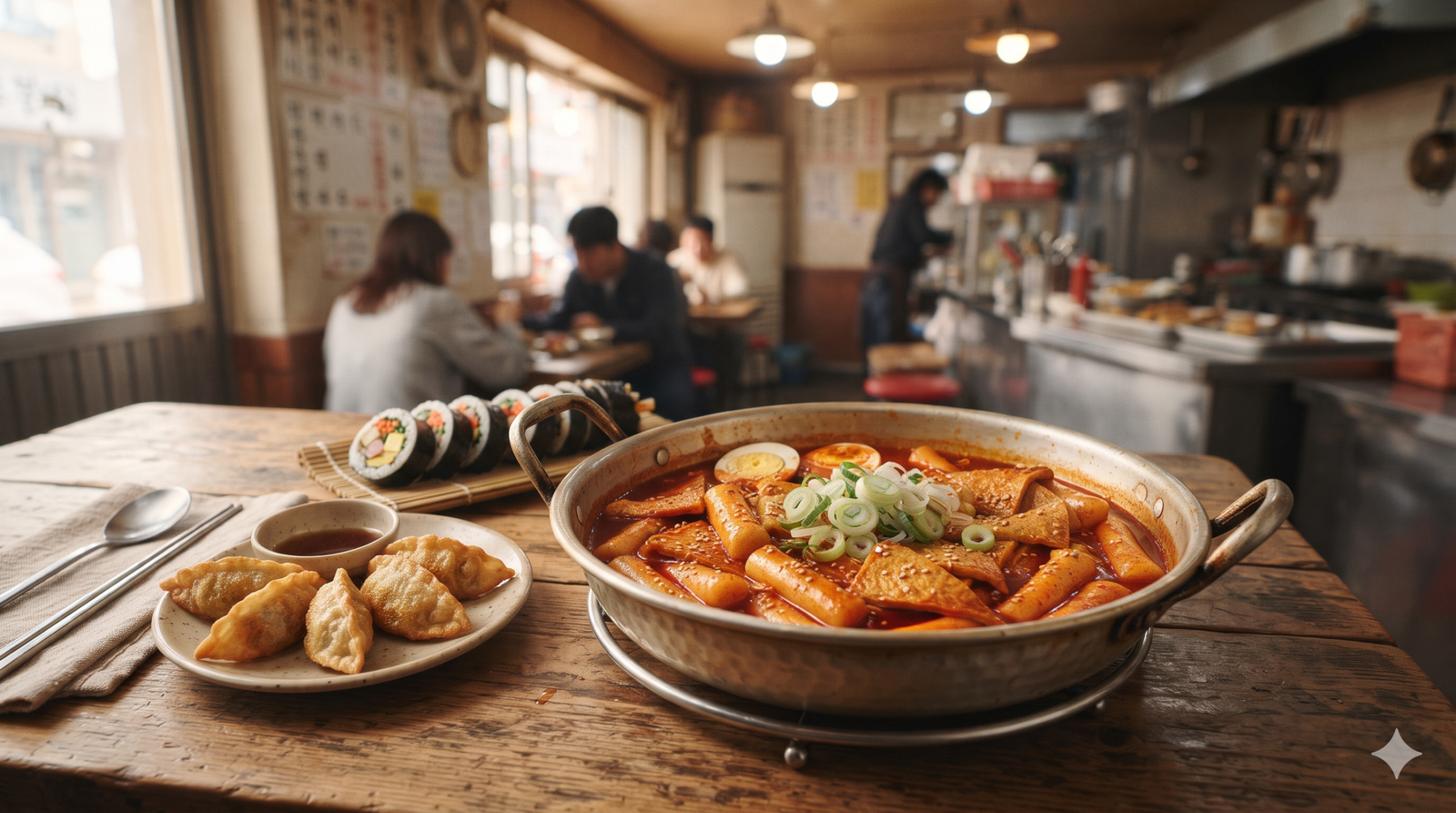
Tteokbokki.
In an interview with Soompi, the Korean-American artist explained that he missed Mexican food when he was in Korea, but when he was in the United States, he missed tteokbokki.
He did not choose an expensive Korean barbecue restaurant or a traditional meal.
He chose a bowl of chewy rice cakes covered in a sweet and spicy red sauce.
That answer reveals something interesting about Korean food culture.
People do not always miss the most sophisticated food when they are far from home. Sometimes they miss something inexpensive, familiar and connected to everyday memories.
But tteokbokki has another story worth discovering.
The red street food that millions of people recognize today was not originally red, spicy or even an ordinary street snack.
Its transformation from a dish associated with the royal court into one of Korea’s most familiar comfort foods is part of what makes it so fascinating.
1. Jay Park’s Choice Reveals the Power of Familiar Food
Jay Park’s answer appeared in a Soompi interview in which he was asked about American and Korean foods he missed when traveling between the two countries.
He mentioned Mexican food such as guacamole, hot sauce and burritos when he was in Korea.
But when he was in the United States, he singled out tteokbokki.
The answer is revealing because tteokbokki is not necessarily the first dish an international visitor would associate with Korean dining.
Korean barbecue, bibimbap and kimchi jjigae may be more familiar to many overseas audiences.
Tteokbokki is different.
It is often eaten casually, sometimes standing at a street stall or sitting in a small neighborhood snack shop.
It does not require a special occasion.
That everyday quality may be exactly what makes it memorable.
For someone who has spent a significant part of his life moving between Korea and the United States, the foods associated with ordinary moments can become especially meaningful.
2. The Original Tteokbokki Was Not Spicy
Here is the first surprise.
The tteokbokki most people recognize today is made with gochujang, or Korean red chili paste.
But historical Korean food records describe an earlier version that was quite different.
Late Joseon-era recipes included rice cakes stir-fried with ingredients such as beef, mushrooms, vegetables, sesame oil and soy sauce.
This version is commonly known today as gungjung tteokbokki, or royal court tteokbokki.
It was not the bright-red street food found in modern Korean snack shops.
Its flavor was savory rather than fiery, and its ingredients reflected a more elaborate style of cooking.
The late nineteenth-century cookbook Siuijeonseo is among the important historical sources documenting this older preparation.
In other words, the dish existed long before the familiar red sauce became popular.
The transformation is a reminder that traditional Korean foods are not always fixed recipes that have remained unchanged for centuries.
Sometimes, the version that becomes internationally famous is actually a relatively modern reinvention.
3. How Did Tteokbokki Become Red?
The familiar spicy version emerged in the decades following the Korean War.
One of the most famous accounts centers on Ma Bok-rim, a food vendor associated with Sindang-dong in Seoul.
According to the widely repeated story, Ma discovered an appealing combination involving rice cake and Chinese black bean sauce, then experimented with gochujang and other seasonings.
She began selling her version in Sindang-dong in 1953.
The resulting dish eventually became closely associated with the neighborhood.
But the story should not be reduced to one accidental discovery.
A 2026 academic study examining the commercial development of tteokbokki in Seoul found that its transformation involved much broader changes.
Government food policies, the availability of ingredients, the expansion of flour-based foods, affordable prices and changing eating habits all contributed to its development.
The red tteokbokki we know today was not simply invented and immediately adopted by the entire country.
It developed through a changing food economy.
4. Why Flour Became Important to the Story
Today, many people assume that tteokbokki must be made with rice cakes.
But flour-based garaetteok played an important role in the expansion of modern street tteokbokki.
After the Korean War, South Korea faced serious food shortages and economic difficulties.
Rice was an important resource, and policies encouraged the consumption of alternative grains and flour-based foods.
Wheat flour became increasingly important in everyday Korean eating.
This helped create favorable conditions for inexpensive flour-based snacks, including the tteokbokki sold around schools and busy neighborhoods.
The connection is important.
Tteokbokki did not become a mass-market favorite simply because Koreans suddenly developed a taste for spicy food.
Its growth was also connected to what ingredients were available, what families could afford and where young people gathered to eat.
A food that was practical and inexpensive could spread much more easily than an elaborate dish requiring expensive ingredients.
5. The School Snack Shop Created a Generation of Tteokbokki Memories
Ask many Koreans about tteokbokki and the conversation may quickly turn to childhood.
They may remember stopping at a small bunsik shop after school, sharing a plate with classmates or spending their limited pocket money on snacks.
Bunsik refers broadly to inexpensive Korean snack foods, many of which became popular in small neighborhood shops.
Tteokbokki often appeared alongside gimbap, sundae, fried foods and fish cakes.
The atmosphere was informal.
Nobody needed to make a reservation or dress up.
Students could enter, order something inexpensive and spend time talking with friends.
Research published in 2026 traces the expansion of bunsik shops around schools during the 1970s and 1980s, when tteokbokki became an increasingly familiar student snack.
This helps explain why the dish carries such strong nostalgic associations.
For many Koreans, its taste is connected to a specific period of life rather than just a particular recipe.
That is a powerful kind of food memory.
6. What Actually Makes Tteokbokki So Addictive?
The answer is not simply that it is spicy.
Tteokbokki combines several different sensations.
First, there is the texture.
Garaetteok is made from rice or, in some versions, wheat-based ingredients. Its distinctive chewiness gives the dish a satisfying physical quality.
Unlike noodles that can be swallowed quickly, rice cakes require repeated chewing.
Second, there is the balance of flavors.
Gochujang provides a fermented chili flavor, while sugar or other sweeteners create the familiar sweet-and-spicy combination.
Garlic, fish cake and other ingredients add savory depth.
Third, there is the sauce.
The thick sauce coats the rice cakes and other ingredients rather than simply sitting at the bottom of the bowl.
Every bite carries a combination of flavor and texture.
The result is more complex than the simple description of spicy rice cakes suggests.
It is also important not to confuse the word addictive with a medical claim. The appeal comes from the combination of taste, texture, familiarity and the pleasure of eating a satisfying snack.
7. The Best Part May Be What You Eat Alongside It
Tteokbokki is rarely experienced in isolation in a traditional Korean bunsik setting.
A familiar combination includes:
Twigim: Korean-style fried foods, such as vegetables, squid or dumplings.
Sundae: Korean blood sausage, commonly served with salt or other dipping seasonings.
Gimbap: Rice and fillings wrapped in seaweed.
Eomuk: Fish cake, often served on skewers in warm broth.
There is also a practical reason these foods work well together.
The thick tteokbokki sauce can be used as a dip for fried food.
The contrast between crispy fried ingredients and chewy rice cakes makes the meal more interesting.
Some people also enjoy eating gimbap with the sauce, while others prefer to alternate between spicy tteokbokki and warm fish-cake broth.
The experience is not just about one dish.
It is about combining several inexpensive foods into a satisfying meal.
8. Tteokbokki Has Changed With Every Generation
The traditional red version remains popular, but modern Korean tteokbokki is no longer limited to one recipe.
Different styles have developed to suit changing tastes.
Gungjung tteokbokki offers a savory alternative based on soy sauce.
Jjajang tteokbokki incorporates black bean sauce.
Cheese tteokbokki adds a creamy, rich contrast to the spicy sauce.
Rosé tteokbokki combines a creamy sauce with Korean-style seasoning, creating a milder flavor profile.
Instant tteokbokki is often prepared at the table with ingredients such as ramen noodles, vegetables and dumplings.
This variety shows how a traditional food can remain recognizable while adapting to modern preferences.
The rice cake remains central, but the sauce, ingredients and cooking methods continue to change.
9. Why Does Tteokbokki Feel Different When You Eat It Abroad?
For international fans, tteokbokki may initially be a new food discovered through Korean entertainment or social media.
For Koreans living overseas, it can mean something else.
A familiar flavor can bring back memories of places and people.
The smell of the sauce may remind someone of a school neighborhood. The texture may recall a snack shop visited with friends. Even the simple act of dipping fried food into the remaining sauce can feel familiar.
That is why finding tteokbokki abroad can be emotionally satisfying even when the restaurant cannot perfectly reproduce the Korean experience.
The food is still recognizable, but the surroundings may be different.
The small snack shop, the after-school atmosphere and the familiar combination of foods are not always easy to recreate.
This is a useful way to understand Jay Park’s answer.
He did not need to explain the history of tteokbokki or describe its ingredients.
He simply said he missed it.
Sometimes, food nostalgia is more powerful than a detailed explanation.
10. Where Should First-Time Visitors Try Tteokbokki in Seoul?
For visitors who want to understand the dish beyond a restaurant menu, two different experiences are worth considering.
Sindang-dong Tteokbokki Town
This neighborhood is closely associated with the development of modern tteokbokki.
Its restaurants are particularly known for instant tteokbokki, where diners cook rice cakes, vegetables, noodles and other ingredients together in a pot at the table.
It is a different experience from ordering a ready-made plate at a street stall.
A neighborhood bunsik shop
For a more casual introduction, visit a local snack shop.
Order a small serving of tteokbokki and try it with fried food or gimbap.
This is closer to the everyday eating experience that made the dish familiar to generations of Korean students.
If you are sensitive to spicy food, ask about the heat level before ordering. Not every restaurant prepares its sauce with the same intensity.
Final Thoughts: Why Jay Park Misses a Simple Bowl of Tteokbokki
Jay Park’s answer was short, but it points toward something much larger than a favorite snack.
Tteokbokki began as a very different dish from the spicy red version now recognized around the world.
It changed through the social and economic conditions of modern Korea, became popular around schools and neighborhood snack shops, and developed into one of the country’s most recognizable comfort foods.
Its appeal comes from more than chili paste.
It is the combination of chewy rice cakes, sweet and savory sauce, affordable ingredients and the memories attached to eating it with other people.
That is why an elaborate Korean meal is not always the food someone misses most when living abroad.
Sometimes, what they want is simply a familiar bowl of tteokbokki.
The most memorable Korean food is not always the most expensive. Sometimes, it is the food that takes you back home.
When SHINee’s Onew was asked about his favorite Korean side dish in an interview with Soompi, his answer was not bulgogi, kimchi, or Korean fried chicken.
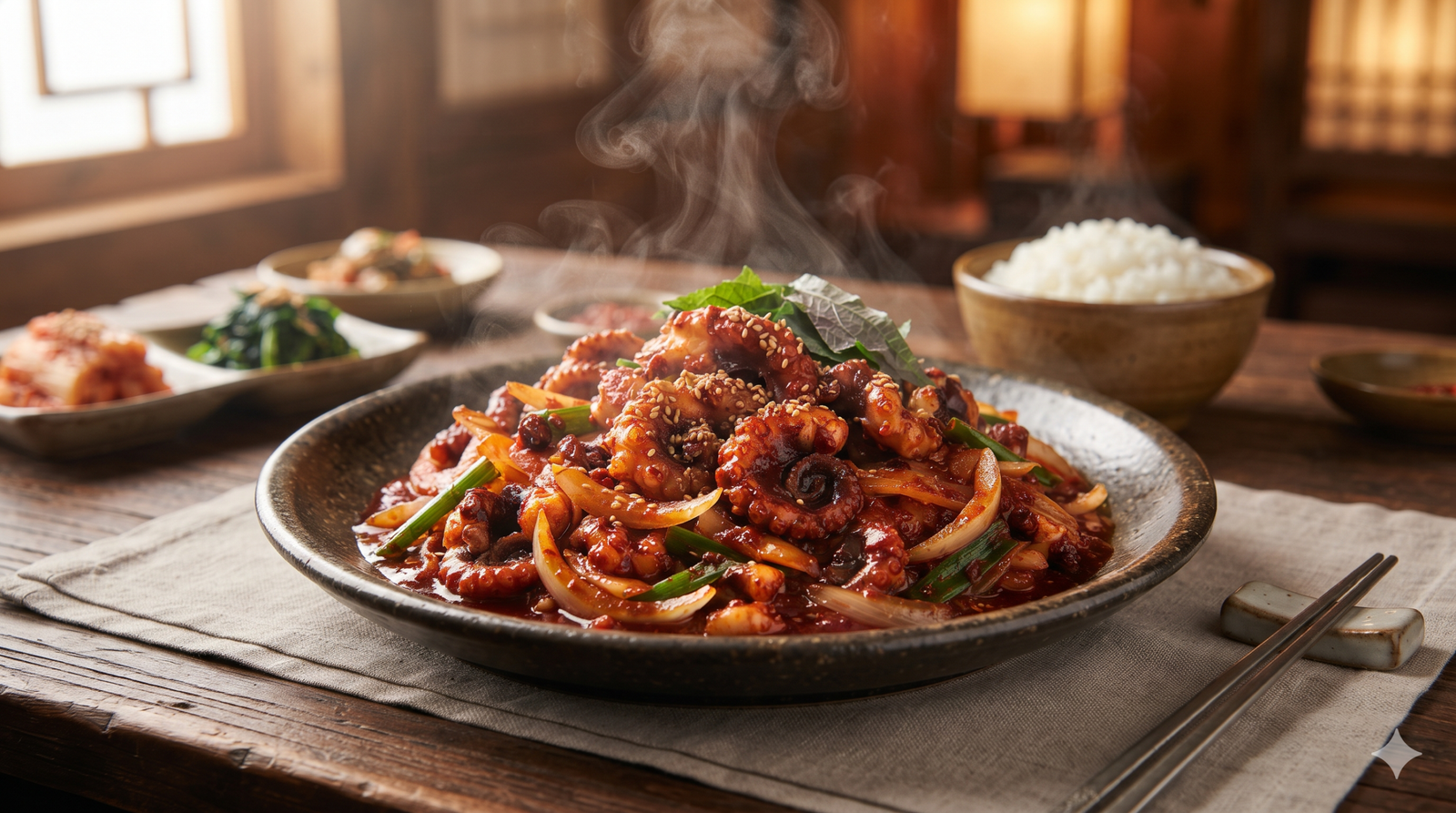
He chose nakji-bokkeum (낙지볶음), Korea’s spicy stir-fried octopus.
And he added a detail that makes the choice even more interesting: he liked it really spicy.
For international fans who have never tried the dish, that might sound like a simple food preference. But nakji-bokkeum is more than octopus covered in red chili sauce. It has a history connected to Seoul’s restaurant culture, a cooking technique that determines whether the seafood stays tender, and a distinctive place in the way Koreans enjoy spicy meals.
The dish also reveals something important about Korean food: heat is only one part of the experience. The texture of the octopus, the balance of the sauce, and the rice served alongside it are just as important.
So how spicy is nakji-bokkeum, what does it actually taste like, and why has it remained a popular Korean seafood dish?
1. What Exactly Is Nakji-bokkeum?
Nakji-bokkeum is a Korean dish made by stir-frying nakji, a small octopus commonly known in English as long-arm octopus, with vegetables and a spicy seasoning sauce.
The word itself explains the cooking method:
Nakji (낙지): A type of small octopus.
Bokkeum (볶음): A Korean cooking method involving stir-frying.
The octopus is cleaned, cut into manageable pieces, and cooked with ingredients such as onion, green onion, garlic, chili powder, and Korean red pepper paste.
The result is a dish with a strong combination of flavors: savory, sweet, smoky, and spicy.
Its texture is equally important. Properly cooked octopus should be pleasantly chewy and tender, not rubbery.
This is one reason nakji-bokkeum is different from simply adding seafood to a spicy sauce. The cooking process has to protect the natural texture of the octopus while allowing the seasoning to coat every piece.
The Korea Tourism Organization describes the dish as a combination of chewy octopus, spicy sauce, and crisp vegetables. It also recommends mixing the finished dish with rice to make nakji-bokkeum bibimbap.
That combination is central to the experience.
2. The Surprising History: How Nakji-bokkeum Became a Seoul Restaurant Favorite
Although octopus has long been part of Korean coastal food culture, the modern restaurant popularity of spicy nakji-bokkeum is closely associated with Seoul’s Mugyo-dong neighborhood.
In the early 1960s, Mugyo-dong was an important nightlife and dining district. Office workers, young professionals, and people looking for an evening out gathered there.
Among the neighborhood’s popular foods were bindaetteok, haejangguk, and nakji-bokkeum.
These dishes offered something different from formal restaurant dining. They were satisfying, strongly flavored, and suited to eating with friends or colleagues.
Nakji-bokkeum gradually became one of the neighborhood’s signature foods.
The Korea JoongAng Daily’s historical account of Mugyo-dong describes how the neighborhood developed its reputation for octopus restaurants during this period. Urban redevelopment later changed the area, but the restaurant tradition survived in nearby streets.
This history helps explain why nakji-bokkeum is often associated with Seoul’s old restaurant culture rather than being understood only as a traditional coastal seafood recipe.
Its story reflects a broader pattern in Korean food history: regional ingredients can become popular urban dishes when restaurants adapt them to the eating habits of city residents.
The octopus itself was not new. What helped make the dish famous was the restaurant culture that turned it into a recognizable menu item.
3. Nakji Is Not the Same as Jukkumi or Squid
One detail that can confuse first-time visitors is the English translation.
Nakji is sometimes described as baby octopus, but it is not simply a young version of every small seafood item found in Korean restaurants.
Three names are especially useful to understand:
Korean name
English description
Typical use
Nakji (낙지)
Long-arm octopus
Nakji-bokkeum, nakji tangtangi
Jukkumi (주꾸미)
Webfoot octopus
Jukkumi-bokkeum
Ojingeo (오징어)
Squid
Ojingeo-bokkeum
Nakji and jukkumi are both octopuses, but they are different animals. Squid belongs to a different group of cephalopods.
The distinction matters because their textures and sizes influence how they are prepared.
Nakji has long, slender arms and a relatively small body. It is used in several Korean dishes, including spicy stir-fries, raw preparations, and soups.
Jukkumi is also popular in spicy stir-fries, often with vegetables and sometimes pork belly.
Squid, meanwhile, has a different body structure and is commonly prepared as ojingeo-bokkeum.
For international visitors, learning these names makes ordering Korean seafood much easier.
If you want the dish Onew mentioned, look specifically for 낙지볶음, not simply a menu item translated as spicy seafood.
4. What Makes the Sauce So Spicy?
The red color of nakji-bokkeum comes mainly from Korean chili ingredients.
Two particularly important components are gochugaru and gochujang.
Gochugaru (고춧가루) is Korean red chili powder or flakes. It contributes chili heat, color, and a distinct dried-pepper flavor.
Gochujang (고추장) is fermented Korean red chili paste. It contributes a thicker texture, savory depth, sweetness, and chili flavor.
Many recipes also include:
Soy sauce for saltiness and umami.
Garlic for a strong aromatic flavor.
Ginger for fragrance and warmth.
Sugar or rice syrup for sweetness.
Onion and green onion for freshness.
Sesame oil for a nutty finish.
The important point is that the sauce is not designed to be hot for the sake of being hot.
A good nakji-bokkeum balances several flavors. If the chili overwhelms everything else, the natural taste of the seafood becomes difficult to appreciate.
The recipe published by Korea.net, prepared in cooperation with the Institute of Traditional Korean Food, uses both gochujang and ground red pepper, together with garlic, ginger, soy sauce, and sesame oil.
This combination helps explain the dish’s characteristic flavor: concentrated chili heat supported by savory and aromatic ingredients.
5. How Spicy Is Nakji-bokkeum Compared with Other Korean Foods?
There is no single official spice level for nakji-bokkeum.
The heat depends on the restaurant’s recipe, the amount and type of chili used, and how the sauce is prepared.
A mild version may emphasize sweetness and seafood flavor. A restaurant specializing in very spicy food may use considerably more chili seasoning.
This is why two plates of nakji-bokkeum can taste surprisingly different.
For someone unfamiliar with Korean spicy food, it is useful to think of the dish as potentially quite hot rather than assuming every restaurant serves the same level.
It is also different from the heat of instant spicy noodles.
With noodles, the seasoning is distributed throughout a soft, starchy food. With nakji-bokkeum, the sauce coats pieces of seafood and vegetables. The chewy texture and concentrated sauce create a different eating experience.
The heat also builds differently depending on how much sauce you eat with each bite.
If you are trying it for the first time, ask the restaurant whether a less spicy version is available.
You do not need to order the hottest version to understand why Koreans enjoy the dish.
6. The Secret Is Not Just the Chili: Why Cooking Time Matters
A good plate of nakji-bokkeum depends on more than the seasoning.
The octopus itself can become tough if it is cooked incorrectly.
Nakji contains a high proportion of muscle tissue, and its texture changes significantly during cooking. Excessive or poorly controlled cooking can make it unpleasantly chewy.
Korean chefs therefore pay attention to preparation and cooking time.
A KBS World recipe prepared with guidance from a professional chef recommends cutting the octopus into relatively large pieces and stir-frying it quickly over high heat. The recipe advises adding the octopus after the onions and sauce have been prepared, then cooking it for approximately one to two minutes.
The same recipe specifically advises against blanching fresh octopus before stir-frying because it can affect the original flavor.
However, not every recipe follows exactly the same method.
Korean food creator Maangchi uses a different preparation process: rubbing the octopus with flour or salt, briefly blanching it, and then stir-frying it with the sauce.
This difference is worth understanding.
There is no single universal cooking technique for nakji-bokkeum. Home cooks and professional kitchens may use different preparation methods depending on the seafood, recipe, and desired texture.
What they share is the goal of keeping the octopus tender while allowing the sauce to develop its flavor.
That is why a well-made plate should not taste like seafood that has simply been boiled in chili paste.
7. Why Koreans Often Eat Nakji-bokkeum with Rice
The combination of spicy seafood and plain rice is one of the most satisfying parts of the meal.
Rice provides a neutral base that allows the strong seasoning to stand out without making every bite feel identical.
It also changes how the dish is experienced.
Instead of eating a few pieces of octopus as a standalone appetizer, you can mix the sauce, vegetables, and seafood with rice to make a complete meal.
This is known as nakji-bokkeum bibimbap.
The Korea Tourism Organization specifically recommends serving the stir-fried octopus with rice and mixing the ingredients together.
Some restaurants also serve noodles alongside the octopus. The combination adds another texture and gives diners a different way to enjoy the sauce.
This style of eating reflects a familiar feature of Korean meals: a strongly seasoned main dish is often balanced by rice and other accompanying foods.
The rice does not remove the chili heat. Instead, it changes the balance of each bite.
For visitors who find the sauce intense, eating it with rice is often a more comfortable introduction than tasting the sauce by itself.
8. Why Is Nakji-bokkeum Associated with Seoul’s Old Restaurant Culture?
The story of Mugyo-dong gives nakji-bokkeum another dimension.
In the early 1960s, Seoul was changing rapidly. New office districts, entertainment areas, and urban dining habits were developing.
Restaurants needed dishes that were distinctive and satisfying for people eating outside the home.
Spicy octopus was a natural fit.
It was strongly flavored, easy to share, and could be served with rice or drinks. It also offered a different experience from the meat-centered dishes that many visitors now associate with Korean dining.
Over time, the dish became part of Seoul’s restaurant identity.
The original Mugyo-dong restaurant scene changed as the city redeveloped, but the name remained associated with spicy octopus restaurants.
This is a useful reminder that Korean food traditions do not always come from royal kitchens or ancient recipes.
Some of the country’s most recognizable dishes became popular through relatively modern restaurant culture.
Nakji-bokkeum is a good example of how an ingredient with a long regional history can acquire a new identity in an urban dining neighborhood.
9. Where Does Nakji Fit into Korea’s Wider Seafood Culture?
Nakji is especially associated with Korea’s western and southwestern coastal regions.
The tidal flats and coastal environments around places such as Mokpo and Muan are important areas for octopus fishing.
The Korea Tourism Organization describes several different ways Koreans enjoy nakji.
These include:
Nakji-bokkeum: Spicy stir-fried octopus.
Nakji-tangtangi: Fresh nakji chopped into small pieces.
Yeonpotang: A clear octopus soup.
Nakji-hoe: Raw sliced octopus.
The differences are not simply about seasoning. They show how one ingredient can become several distinct dishes depending on preparation.
Mokpo, in particular, is closely associated with nakji and other seafood traditions. Local food culture includes preparations that emphasize the natural flavor of the octopus rather than covering it with a strong chili sauce.
That contrast is interesting.
Nakji-bokkeum represents one side of Korean seafood cooking: bold seasoning and intense flavor.
Yeonpotang represents another: a clearer broth that allows the seafood’s flavor to remain central.
For a visitor who enjoys nakji-bokkeum, trying a different octopus dish can reveal how versatile the ingredient is.
10. How to Order Nakji-bokkeum in Korea Without Making a Mistake
If you want to try the dish during a visit to Korea, a few simple expressions can help.
Korean phrase
Meaning
낙지볶음 주세요
One order of nakji-bokkeum, please.
덜 맵게 해주세요
Please make it less spicy.
맵기 조절 가능해요?
Can you adjust the spice level?
밥도 주세요
Please bring rice, too.
낙지볶음 비빔밥 있어요?
Do you have nakji-bokkeum bibimbap?
If you are not used to Korean chili, ask about the spice level before ordering.
Some restaurants may be able to reduce the seasoning, while others prepare the dish according to a fixed recipe.
Also remember that nakji-bokkeum is a seafood dish. Anyone with a shellfish or seafood allergy should check the ingredients and possible cross-contact with the restaurant before eating.
11. What Onew’s Choice Reveals About Korean Food
Onew’s preference is a small detail from an older interview, but it offers a useful entry point into Korean food culture.
He chose a dish that combines seafood, chewy texture, strong seasoning, and a memorable level of heat.
It is not the most obvious choice for an international visitor who is just beginning to explore Korean cuisine.
That is precisely why it is interesting.
Korean food is often introduced abroad through familiar dishes such as bulgogi, bibimbap, kimchi, and Korean fried chicken. These foods are excellent starting points, but they represent only a small part of the country’s dining culture.
Nakji-bokkeum introduces a different side of Korean eating.
It shows how seafood can be prepared with powerful seasoning, how rice balances an intensely flavored dish, and how a modern urban restaurant tradition can turn a local ingredient into a widely recognized menu item.
The dish also reminds us that Korean spicy food is not simply about enduring pain.
The heat is part of a larger combination of flavor, texture, and shared eating.
So the next time you see nakji-bokkeum on a Korean menu, remember Onew’s answer.
You do not have to order the hottest version.
But if you enjoy seafood and are curious about Korean chili flavors, this is one dish worth trying.
Onew may have chosen nakji-bokkeum because he loves it really spicy. The reason to try it yourself is discovering how much more there is beneath that bright-red sauce.
Many K-pop idols talk about their favorite Korean foods.
EXO’s D.O. is a little different.
He doesn’t just enjoy Korean food. He knows how to prepare it.
D.O., whose real name is Doh Kyung-soo, holds a Korean Cooking Certification. During an EXO reality show, he prepared a special rice soup for his fellow members. The dish was later introduced by the Korea Tourism Organization as “D.O. Rice Soup.”
At first glance, it sounds like a simple bowl of rice and broth.
But the ingredients tell a more interesting story.
Dried shrimp, anchovies, kelp, mushrooms, beef, oyster sauce, and even wasabi come together in one bowl.
Why would someone combine seafood stock with beef and wasabi?
And what makes this dish different from the traditional Korean gukbap that millions of people enjoy?
The answer reveals something important about Korean cooking: a memorable bowl of soup does not always need an expensive ingredient or a complicated technique. Sometimes, the secret is knowing how to build layers of flavor.
1. D.O. Is More Than a K-pop Star Who Likes Cooking
Doh Kyung-soo has a reputation for being interested in cooking, and his Korean cooking qualification gives that interest a practical dimension.
His appearance on an EXO reality show became especially memorable because he prepared a dish for the other members rather than simply recommending a restaurant or talking about his favorite food.
According to the Korea Tourism Organization, D.O. made a rich-tasting soup using dried seafood and mushrooms.
His explanation was surprisingly modest. He described it as rice placed in soup, finished with toppings such as green onions and mushrooms.
But the members were impressed. They applauded, gave him thumbs up, and Kai even commented that he wanted to cook instant ramyeon noodles in the broth.
That reaction tells us something about the dish.
Its appeal was not based on an elaborate presentation. It was the depth of the broth and the way the ingredients worked together.
The Korea Tourism Organization later published the ingredients and preparation method, giving international readers a way to recreate the dish at home.
2. What Exactly Is D.O. Rice Soup?
D.O. Rice Soup is a personal variation of Korean gukbap (국밥).
The word is straightforward:
Guk (국): Soup
Bap (밥): Cooked rice
Gukbap generally refers to rice served in soup or eaten together with it.
However, D.O.’s version has a particular structure.
Instead of relying on a heavy meat-bone broth, it begins with a seafood-based stock made from dried shrimp, dried anchovies, kelp, and mushrooms.
Thinly sliced beef is cooked separately and placed over the rice. Green onions, dried seaweed flakes, mushrooms, and wasabi complete the bowl.
Finally, the hot broth is poured over everything.
This creates several layers of flavor:
The seafood stock provides a savory foundation.
The mushrooms add an earthy aroma.
The beef contributes a richer, meaty taste.
The seaweed adds another layer of marine flavor.
Wasabi provides a sharp contrast to the warm broth.
It is a good example of how a relatively simple Korean rice soup can be made more distinctive through the combination of ingredients.
Importantly, D.O. Rice Soup is not an ancient regional gukbap recipe with a fixed traditional formula. It is better understood as a contemporary, celebrity-associated interpretation of a familiar Korean meal.
3. The Actual Ingredients in D.O. Rice Soup
The Korea Tourism Organization published the following ingredient list.
Ingredient
Amount
Water
1 liter
Dried shrimp
1/2 cup
Dried anchovies
1/2 cup
Dried kelp
1 piece
Golden oak mushrooms (shiitake)
2–3
Beef sirloin or tenderloin
100 g
Oyster sauce
1 tablespoon
Chopped green onions
To taste
Dried seaweed flakes
To taste
Salt
A pinch
Black pepper
A pinch
Wasabi
To taste
Cooked rice
For serving
The ingredient combination is more interesting than it first appears.
Many people associate Korean rice soup with beef, pork, or bean sprouts. D.O.’s recipe instead uses dried seafood as the foundation and adds beef as a topping.
That distinction changes the character of the entire dish.
4. Why Dried Seafood and Mushrooms Create Such a Deep Broth
The most important part of D.O. Rice Soup is not the rice.
It is the broth.
Dried shrimp, anchovies, kelp, and mushrooms are common ingredients in Korean cooking because they can create a savory foundation without requiring hours of simmering meat bones.
Each ingredient contributes something different.
4.1 Dried Anchovies: The Savory Foundation
Dried anchovies are one of the most familiar ingredients in Korean home cooking.
They are frequently used to make stock for soups, noodles, and stews.
Their main contribution is a strong savory flavor that helps the broth taste more substantial.
Unlike a meat-bone broth, an anchovy-based stock can remain relatively light while still providing depth.
4.2 Dried Shrimp: A More Concentrated Seafood Aroma
Dried shrimp contribute a distinctive marine aroma and savory intensity.
When simmered in water, they help create a broth that tastes fuller than plain vegetable stock.
They also complement anchovies because the two ingredients contribute different seafood characteristics.
4.3 Kelp: A Natural Source of Umami
Kelp, known as dashima in Korean, is another important ingredient in Korean stock preparation.
It contains glutamate, a compound associated with umami, the savory taste found in foods such as tomatoes, aged cheese, and fermented products.
When combined with the natural glutamates and other flavor compounds in dried seafood, kelp helps create a more rounded broth.
This is one reason anchovy-and-kelp stock is so widely used in Korean kitchens.
4.4 Shiitake Mushrooms: Earthy Flavor and Aroma
Shiitake mushrooms contribute a different kind of savory depth.
Dried shiitake mushrooms are particularly valued because drying concentrates their characteristic aroma and flavor compounds.
In D.O.’s recipe, the mushrooms are not merely decorative toppings. They are also simmered in the broth before being used to finish the rice bowl.
The result is a combination of seafood, mushroom, and meat flavors without depending on a heavy bone stock.
5. Why Does D.O. Add Beef to a Seafood-Based Broth?
This is one of the most interesting decisions in the recipe.
At first, beef and seafood stock might seem like an unusual combination.
But Korean cooking frequently combines different sources of savory flavor.
D.O.’s recipe uses beef as a topping rather than making it the main foundation of the broth.
The thinly sliced beef is seasoned with salt and black pepper, stir-fried separately, and finished with a little oyster sauce.
This separation matters.
The seafood stock remains relatively light, while the beef brings a more concentrated savory taste to the rice.
In each spoonful, the two flavors meet.
It is a useful cooking principle: not every ingredient needs to be cooked in the same pot to become part of the same dish.
Preparing the beef separately also allows the cook to control its texture and avoid making the seafood broth unnecessarily heavy.
6. The Unexpected Ingredient: Why Is Wasabi in Korean Rice Soup?
Perhaps the most surprising ingredient in D.O. Rice Soup is wasabi.
Many people associate wasabi with Japanese sushi and sashimi rather than Korean gukbap.
But its role here is quite understandable.
Wasabi has a sharp, aromatic heat that feels different from the burning sensation of Korean chili pepper.
It can cut through the richness of beef and add contrast to the warm seafood broth.
This does not mean that wasabi is a traditional requirement for Korean gukbap.
It is a distinctive element of D.O.’s particular recipe.
That is what makes the dish interesting: it starts with a familiar Korean comfort-food structure but introduces a flavor combination that feels personal and modern.
For people who are unfamiliar with wasabi in hot soup, it is best to begin with a very small amount.
The goal is to create a gentle contrast, not overpower the broth.
7. How to Make D.O. Rice Soup at Home
The following method follows the recipe published by the Korea Tourism Organization.
Step 1: Prepare the Seafood and Mushroom Broth
Add 1 liter of water to a pot.
Add:
1/2 cup dried shrimp
1/2 cup dried anchovies
1 piece dried kelp
2–3 diced shiitake mushrooms
Simmer over low heat for approximately 20 minutes.
This creates the main broth.
The seafood and mushrooms provide the flavor foundation, so there is no need to add a large number of additional seasonings.
Step 2: Season the Beef
Thinly slice approximately 100 g of beef sirloin or tenderloin.
Season with a little salt and black pepper.
Step 3: Stir-Fry the Beef
Heat a pan and stir-fry the seasoned beef.
Add a small amount of broth if the pan becomes too dry.
Add one tablespoon of oyster sauce and continue cooking until the beef is done.
Step 4: Prepare the Rice Bowl
Place cooked rice in a serving bowl.
Arrange the cooked beef on top.
Add chopped green onions and dried seaweed flakes.
Step 5: Finish with Mushrooms and Broth
Remove the cooked mushrooms from the broth and use them as a topping.
Pour the hot broth over the rice and other ingredients.
Add a small amount of wasabi according to your preference.
Mix gently and enjoy while hot.
D.O.’s Extra Tip
The Korea Tourism Organization also mentions that hot chili peppers can be added to the broth for extra heat.
This gives you another option if you prefer the familiar spicy flavor of Korean soups.
8. What Is the Difference Between D.O. Rice Soup and Traditional Korean Gukbap?
To understand why D.O.’s recipe is distinctive, it helps to look at the wider world of Korean gukbap.
Gukbap is not one specific dish.
It is a broad category of meals in which rice and soup are combined.
Different regions developed their own versions according to local ingredients, food traditions, and economic conditions.
Here are four well-known examples.
8.1 Seolleongtang: A Rich Beef Bone Broth
Seolleongtang is famous for its milky-white broth made by simmering beef bones and meat for an extended period.
It has a deep, comforting flavor and is often seasoned individually with salt, pepper, and green onions.
Compared with seolleongtang, D.O.’s rice soup is lighter and relies on dried seafood rather than beef bones.
8.2 Busan Dwaeji Gukbap: Pork-Based Comfort Food
Busan’s famous pork rice soup uses pork meat and, in some versions, pork bones to create a hearty broth.
It is often served with chives, garlic, kimchi, and salted shrimp.
Its history is closely connected to the development of Busan after the Korean War and the growth of pork production and meat-processing industries.
This is a very different approach from D.O.’s seafood-based soup.
Jeonju is well known for kongnamul gukbap, a rice soup made with soybean sprouts.
The broth is often seasoned with garlic and salted shrimp, and some versions include an egg.
Its flavor is generally lighter and fresher than meat-based gukbap.
8.4 Naju Gomtang: Clear Beef Soup
Naju gomtang is another famous regional rice soup.
It is known for its clear beef broth and sliced beef.
Unlike a heavily simmered, milky bone broth, it offers a cleaner and more delicate meat flavor.
These regional differences show that Korean gukbap is not defined by one particular ingredient.
Its identity comes from the relationship between broth, rice, toppings, and the way people eat them.
D.O.’s version fits naturally into this broad tradition while offering a different combination of flavors.
9. Why Is Gukbap Such an Important Part of Korean Food Culture?
There is a historical reason gukbap became so familiar in Korea.
It was not originally a luxury dish.
Historical records and food research describe gukbap as a practical meal associated with ordinary people, markets, taverns, and travelers.
During the late Joseon period, markets and roadside taverns became important places for trade and travel.
Merchants and peddlers needed meals that were affordable, filling, and quick to serve.
Gukbap answered that need.
A large pot of broth could be prepared in advance, and rice could be served with it quickly.
The meal was warm, convenient, and substantial enough to satisfy people who spent long hours traveling or working.
The Korean Food Promotion Institute’s historical account traces the development of gukbap through these market and tavern cultures.
It also describes how regional versions developed as the dish spread across the country.
This history helps explain why gukbap remains so popular today.
It is not simply because Koreans enjoy hot soup.
It is because gukbap represents an efficient way to turn familiar ingredients into a complete meal.
10. The Korean Secret: Rice and Soup Do Not Always Have to Be Served the Same Way
One detail that foreign visitors may find interesting is that not every Korean rice soup is served in exactly the same way.
Some restaurants place the rice directly into the broth.
Others serve the rice and soup separately.
The second style is called ttaro gukbap.
The word ttaro means separately.
This difference is more important than it might seem.
When rice is already inside the broth, it absorbs some of the liquid and softens as you eat.
When rice is served separately, you can taste the broth first and decide how much rice to add.
Some diners prefer to keep the rice separate because they want to experience the original flavor and texture of the broth before mixing everything together.
D.O.’s recipe uses a flexible approach: rice is placed in the bowl first, and the hot broth is poured over it.
It gives the dish a clear presentation while allowing the rice to absorb the seafood flavor.
This small serving detail reflects how Korean food can be adapted to different preferences without losing its basic character.
11. Why D.O.’s Rice Soup Is an Interesting Example of Modern K-Food
Korean food is often introduced internationally through famous dishes such as Korean barbecue, kimchi, fried chicken, and spicy noodles.
These foods are visually distinctive and easy to promote.
But D.O.’s rice soup introduces a quieter side of Korean cuisine.
It is built around broth, rice, and a few carefully selected ingredients.
Its appeal comes from the balance between them rather than from an elaborate presentation.
There is also something interesting about the way this recipe became known.
A traditional food category was introduced to a new audience through a K-pop idol who prepared his own version for his friends.
The celebrity connection attracts attention, but the dish itself has enough substance to stand independently.
That is an important opportunity for Korean food culture.
International audiences do not need to discover Korean cuisine only through famous restaurants or expensive dishes.
They can also discover it through everyday meals that Korean people have enjoyed for generations.
D.O.’s rice soup offers exactly that kind of introduction.
12. The True Taste Korea Secret: A Great Bowl Begins with the Broth
What makes D.O. Rice Soup special?
It is not an expensive ingredient or a complicated cooking technique.
It is the way different flavors are layered.
Dried anchovies and shrimp create a savory foundation. Kelp adds umami. Mushrooms contribute an earthy aroma. Beef provides richness. Wasabi adds an unexpected contrast.
And then everything comes together with a bowl of rice.
That is the beauty of gukbap.
It can be humble or elaborate, regional or personal, traditional or modern.
D.O. did not simply serve his fellow EXO members a bowl of rice in soup. He showed how a familiar Korean comfort food can become something distinctive through thoughtful ingredient choices.
Perhaps that is one of the most interesting things about Korean cooking.
You do not always need more ingredients to make a better meal. Sometimes, you just need to understand what each ingredient contributes.
And that is a lesson worth taking from D.O.’s kitchen.
On June 8, 2018, MAMAMOO member Hwasa appeared on the Korean reality show I Live Alone. She visited a restaurant alone, ordered grilled beef intestines, and enjoyed her meal with an enthusiasm that viewers immediately noticed.
Within days, gopchang had become one of Korea’s most talked-about foods. Restaurants reported long queues. Some ran out of ingredients. Online searches for the dish surged, and the episode became one of the most memorable examples of celebrity-driven food demand in South Korea.
But the story has a more interesting side than a K-pop star making a traditional dish fashionable.
Gopchang is not an ordinary meat product. It is an edible byproduct of livestock processing, which means its supply cannot easily respond to a sudden increase in consumer demand.
Hwasa’s television appearance therefore created an unusual situation: a sudden cultural phenomenon collided with the practical limits of the meat supply chain.
The result was more than a viral food trend. It became a revealing case study in how entertainment, consumer psychology, and food distribution can interact.
1. What Exactly Is Gopchang?
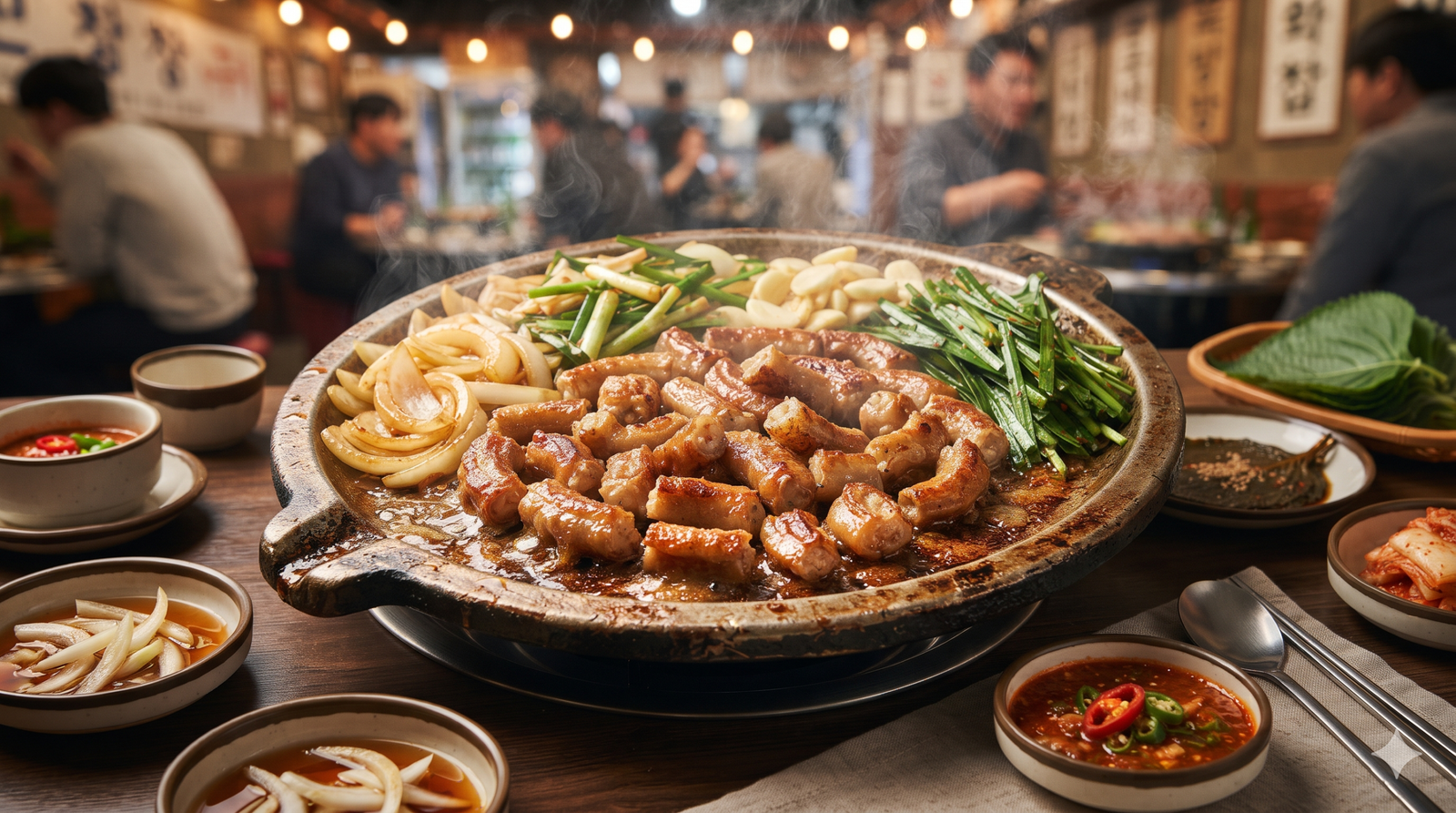
Gopchang (곱창) generally refers to the small intestines of cattle or pigs in Korean cuisine. However, restaurant menus often include several different cuts of animal intestines and other edible organs.
It is important not to confuse every item on a Korean gopchang menu.
Gopchang: Small intestines, commonly beef or pork.
Daechang: Large intestines, especially associated with rich, fatty beef preparations.
Makchang: Another intestinal cut, with the exact animal source and preparation varying by restaurant.
Yeomtong: Heart, often grilled alongside other organ meats.
Beef gopchang is particularly appreciated for its rich flavor and distinctive texture. When grilled properly, the outside develops a browned surface while the interior remains tender and juicy.
It is usually served with vegetables, dipping sauces, and side dishes. At the end of the meal, many restaurants use the remaining grill and seasoning to prepare fried rice.
For someone unfamiliar with Korean food, eating intestines may sound unusual. But in Korea, organ meats have long been part of the country’s broader food culture.
2. Why Was Hwasa’s Meal So Memorable?
Hwasa did not introduce viewers to a newly invented dish. Gopchang restaurants already existed, and the food had an established customer base.
What made the June 8 broadcast different was the way she presented it.
She visited the restaurant alone, in broad daylight, without treating the meal as a special challenge or an unusual culinary experience.
She openly described her fondness for organ meats, including heart, liver, and intestines. She enjoyed grilled gopchang, continued with gopchang hot pot, and finished with fried rice.
The scene felt spontaneous rather than promotional.
That distinction matters.
A traditional advertisement tells viewers that a product is worth buying. A reality-show scene can make viewers feel as if they have discovered something worth trying for themselves.
Hwasa was not simply explaining what gopchang tasted like. She was showing how much she enjoyed it.
In an interview published on June 19, 2018, she said she had not expected her meal to attract so much attention. She also mentioned that a friend had visited a gopchang restaurant after the broadcast and waited for more than two hours.
The episode had already begun changing actual dining decisions.
3. The Hwasa Effect Was About More Than Celebrity Popularity
Celebrity influence is not new. Famous actors and singers have promoted restaurants, cosmetics, clothing, and food for decades.
But Hwasa’s gopchang moment illustrates a particular kind of influence: the transformation of an ordinary personal preference into a widely shared consumer experience.
Three elements helped make the scene powerful.
First, the food was recognizable but not universally familiar.
Gopchang was already popular among many Korean diners, but it was not as internationally recognizable as Korean barbecue or fried chicken. The broadcast gave a traditional restaurant dish unusual national visibility.
Second, the setting felt accessible.
Hwasa was not eating in an expensive restaurant or presenting a carefully designed luxury experience. She was enjoying an ordinary meal at a neighborhood-style restaurant.
Third, viewers could immediately copy the experience.
They did not need to buy concert tickets, travel abroad, or purchase an expensive product. They could simply visit a gopchang restaurant.
That last point is particularly important. The distance between watching the program and acting on it was extremely short.
MBC later described the episode as the beginning of a nationwide gopchang craze. Contemporary reporting also documented restaurant queues and shortages.
The broadcast did not create Korea’s taste for gopchang. It made that existing taste suddenly more visible and urgent.
4. Why Did Restaurants Run Out of Gopchang?
Here is where the story becomes much more interesting.
When demand for an ordinary manufactured product increases, companies may respond by operating additional production shifts, ordering more raw materials, or increasing factory output.
Gopchang is different.
Beef intestines are a byproduct of cattle processing. They are obtained when cattle are slaughtered for meat. A restaurant cannot simply ask a supplier to produce substantially more beef intestines tomorrow without considering how many cattle are being processed.
In other words, the supply of intestines is connected to the wider beef market.
This creates a structural limitation.
Even if thousands of additional customers suddenly want gopchang, the number of available intestines cannot increase at the same speed as consumer interest.
A 2018 report by The Chosun Ilbo described restaurants running out of ingredients and temporarily closing. It also reported that searches for gopchang rose sharply after the broadcast.
The problem was not simply that restaurants had failed to predict a popular television program.
The market was facing a sudden demand shock in a product category with a relatively inflexible short-term supply.
That is the economic mechanism behind the Hwasa gopchang shortage.
5. The Hidden Economics of Eating Every Part of an Animal
There is another cultural dimension worth understanding.
Korean cuisine includes many dishes made from ingredients that some international diners rarely encounter.
Examples include:
Gopchang, made from intestines.
Sundae, a sausage-like dish traditionally prepared using animal intestines as a casing.
Seolleongtang, a beef soup made by simmering bones and other beef ingredients.
Gomtang, a rich soup prepared with beef and, in some versions, internal organs.
These foods reflect a culinary tradition in which different parts of an animal are used in different ways.
This is not unique to Korea. Many food cultures have developed dishes using offal, bones, blood, and other ingredients that might otherwise be discarded.
What is interesting about Korea is how these ingredients became part of everyday restaurant culture.
Gopchang is not simply a way to avoid wasting food. It has developed its own flavor preferences, cooking techniques, restaurant traditions, and social identity.
The Rural Development Administration’s traditional knowledge collection documents a regional preparation of grilled beef tripe and intestines, including cleaning, seasoning, and grilling methods.
The food has a culinary identity of its own, independent of Hwasa’s television appearance.
6. Why Did the Craze Eventually Become a Supply Problem?
A sudden increase in demand can be exciting for restaurant owners, but it can also create operational difficulties.
Gopchang requires preparation and careful handling. Restaurants depend on suppliers who can provide suitable ingredients in consistent quantities.
When demand rises faster than supply, several things can happen:
Existing restaurant inventories are used up more quickly.
Suppliers face pressure to allocate limited quantities among customers.
Restaurants may experience longer periods of ingredient shortages.
Customers may face waiting lists, sold-out menus, or temporary closures.
Prices and purchasing conditions may come under pressure.
Contemporary reports in June 2018 described exactly this kind of disruption.
However, it would be misleading to suggest that every gopchang restaurant in Korea ran out of ingredients. The severity of the shortage varied by location, supplier, and business.
By August 2018, reporting from a visit to restaurants in Seoul’s Sinchon area suggested that supply had become more stable, even though customers were still waiting in line.
This distinction matters: a nationwide media phenomenon does not mean every individual restaurant experiences the same conditions.
7. The Surprising Aftermath: When a Shortage Turns Into a Surplus
Perhaps the most revealing part of the story came later.
A shortage is often treated as proof that a product is extremely popular. But a shortage does not automatically mean that demand will remain high forever.
The gopchang market experienced a dramatic change after the initial craze.
A 2020 report on the aftermath of the Hwasa phenomenon described large quantities of frozen beef byproducts accumulating in storage facilities. Wholesalers and market participants were dealing with a very different situation from the shortage of 2018.
The report explained an important feature of the supply chain: beef intestines are generated alongside cattle slaughter for meat. Their supply does not respond independently to the popularity of gopchang restaurants.
When demand surged in 2018, the available supply struggled to keep up.
But when the initial excitement faded, the market could face the opposite problem. Ingredients purchased or stored in anticipation of continued demand were no longer moving at the same pace.
This is a classic risk in markets affected by sudden consumer trends.
A viral moment can create a temporary demand peak. Businesses that interpret that peak as permanent may make purchasing and inventory decisions that become difficult to reverse.
The Hwasa gopchang craze therefore offers two contrasting market pictures:
2018: Demand surged, and restaurants struggled to secure enough ingredients.
Later years: Reports described accumulated inventories and falling prices in the byproduct market.
The same supply structure that made the shortage difficult to solve also made the market vulnerable when demand cooled.
8. What Does This Tell Us About Korean Food Trends?
The Hwasa episode reveals that food trends are not driven by taste alone.
A dish can become popular because of its flavor, but its popularity can spread much faster when entertainment gives people a reason to talk about it.
Korean television has repeatedly demonstrated this relationship between food and celebrity culture.
A memorable eating scene can turn an ordinary meal into a destination. A celebrity’s personal preference can become a restaurant search term. Viewers may even travel to the location where a particular dish was filmed.
But the gopchang case also reveals the limits of celebrity influence.
A television program can create demand almost instantly. It cannot instantly create more livestock, expand processing capacity, or solve the logistics of storing and distributing perishable food products.
That is the difference between influencing consumer desire and controlling the supply chain.
The entertainment industry can accelerate the first. It cannot guarantee the second.
9. Where Can Visitors Experience the Hwasa Gopchang Story?
For international visitors, the episode offers an interesting way to explore Korean food beyond the dishes most commonly introduced to tourists.
Gopchang restaurants can be found in many parts of South Korea, including specialized food streets and neighborhood dining districts.
One notable example is Daegu’s Anjirang Gopchang Alley. According to Invest Korea, the area’s first gopchang restaurant opened in 1979, and the street developed into a cluster of restaurants specializing in gopchang and makchang.
This is a useful destination for understanding that Korea’s organ-meat culture existed long before the 2018 television craze.
Visitors interested in the original Hwasa episode should also distinguish between the restaurant featured in the broadcast and other restaurants that later became associated with the trend. Restaurant branches and locations can change, so it is worth checking current details before making a special trip.
More importantly, the best way to experience gopchang is not necessarily to recreate a celebrity’s exact meal. It is to understand why this dish already had a place in Korean dining culture.
10. The Real Lesson Behind the Hwasa Effect
Hwasa’s gopchang meal lasted only a short time on television.
Its impact, however, reached beyond the screen.
It showed how a familiar food could suddenly become a national talking point, how celebrity visibility could influence everyday purchasing decisions, and how a traditional ingredient could expose the weaknesses of a modern supply chain.
There is also a deeper lesson for anyone studying the global popularity of Korean culture.
K-pop does not influence the world only through music, fashion, or dance. Its stars can also change what people notice, search for, and want to experience.
But the Hwasa story is not simply about a celebrity making people hungry.
It is about the distance between a moment of cultural excitement and the real-world systems that must respond to it.
A singer can make millions of people want the same meal.
A food market still has to find a way to supply it.
And that is why one afternoon of eating gopchang became much more than a memorable television moment.
If someone in America says “sundae,” you probably imagine ice cream covered with chocolate syrup and whipped cream.
But when SHINee’s Key and Minho talk about Korean sundae (순대), they mean something completely different.
Think sausage, hot broth and rice.
According to the Korea Tourism Organization, Key and Minho have a long connection to sundae-gukbap (순대국밥), a hearty Korean soup they enjoyed from their trainee days.
What Is Korean Sundae?
Korean sundae is not a dessert.
It is a type of Korean blood sausage, traditionally made by stuffing ingredients such as glass noodles into a casing along with other fillings.
It can be eaten on its own, but one of the most comforting ways to enjoy it is in sundae-gukbap.
Gukbap literally combines the Korean words for soup (guk) and rice (bap).
Put them together and you get a hot, filling meal built around broth, rice and sundae.
Key and Minho Ate It During Their Trainee Days
This is what makes their connection to the dish more interesting than a simple celebrity food recommendation.
The Korea Tourism Organization introduces a sundae-gukbap restaurant associated with Key and Minho and describes the dish as a “soul food” they have enjoyed since their trainee days.
That means the story goes back to before the polished performances, world tours and years of SHINee fame.
For two young trainees working toward their debut, a steaming bowl of inexpensive, filling soup would have been a very different kind of meal from the glamorous food people might associate with celebrities today.
What Does Sundae-Gukbap Taste Like?
Don’t let the words “blood sausage” scare you away.
The broth is warm, savory and rich, while the sundae has a soft texture. Depending on the restaurant, the soup may also contain different cuts of pork.
Then comes the fun part.
Korean diners can customize the bowl with ingredients such as salted shrimp, chili seasoning, green onions or perilla powder.
Add rice and suddenly you have the kind of meal that can warm you up on a cold Korean day.
And No, You Won’t Get Ice Cream
This is one Korean word foreign visitors should remember.
Order a sundae in Korea and you won’t receive dessert.
Order sundae-gukbap, and you’ll get something even further from an American ice cream sundae—a steaming bowl of Korean comfort food.
And for SHINee fans, it comes with another story:
It’s a taste connected to Key and Minho’s trainee days.
So if you’re exploring Korea through K-pop, perhaps your next stop shouldn’t be another trendy café.
Try one of Korea’s humble bowls of comfort food instead.
If you had to guess BLACKPINK Lisa’s favorite Korean food, what would you choose?
Korean barbecue? Tteokbokki? Fried chicken?
The answer might surprise you.
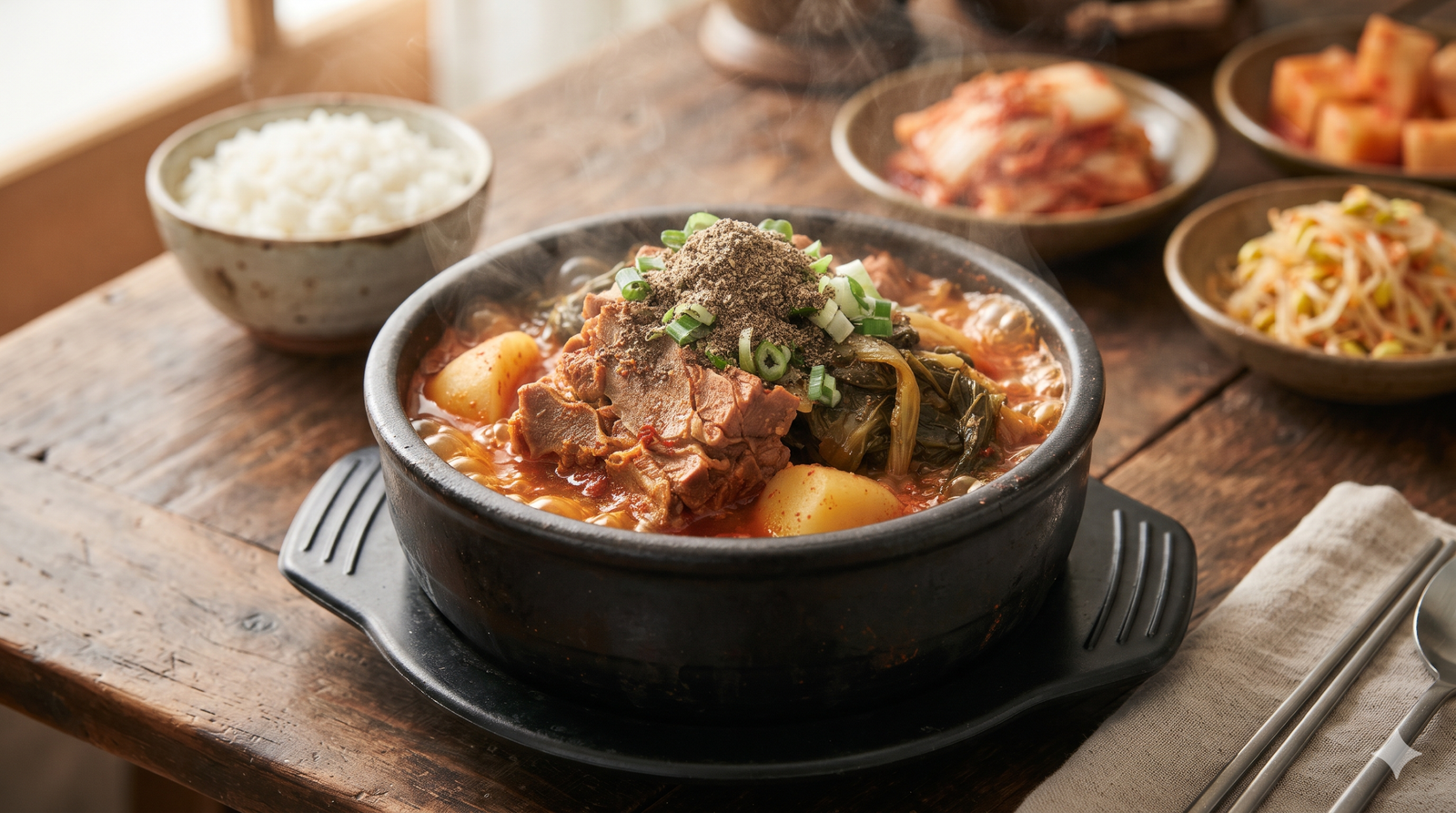
It is gamjatang (감자탕), a hearty Korean pork-bone stew made with pork backbone, potatoes, vegetables, and a deeply savory, spicy broth.
Lisa revealed her favorite Korean dish in a 2016 interview published by YG Life. When asked what Korean food she liked most, she named gamjatang. She explained that she had never encountered the dish in Thailand and first tried it after arriving in Korea.
Her reaction was simple: it was perfect for her taste.
That answer offers an interesting introduction to a dish that is not always included in the usual international image of Korean food. Gamjatang is not a trendy street snack or a glamorous restaurant specialty. It is a traditional, filling meal built around slow-cooked pork bones, vegetables, and a distinctive perilla aroma.
So what exactly makes this Korean stew so special?
1. What Is Gamjatang? Korea’s Hearty Pork-Bone Stew
Gamjatang is a Korean stew made primarily with pork backbone or pork neck bones. The bones are simmered until the attached meat becomes tender and the broth develops a rich, savory flavor.
A traditional pot commonly includes:
Pork backbone or neck bones
Potatoes
Napa cabbage leaves or dried radish greens
Perilla leaves
Perilla seed powder
Garlic and green onions
Korean chili seasoning
The exact ingredients and proportions vary by restaurant and region.
The defining feature is not simply the pork. It is the way the ingredients work together.
The pork bones provide a deep, meaty base. Vegetables soften during cooking and absorb the broth. Chili seasoning adds warmth and heat, while perilla seeds contribute a distinctive nutty fragrance.
Unlike a clear soup, gamjatang has a substantial, full-bodied character. It is usually served piping hot, often in a bubbling pot that continues to simmer at the table.
For visitors unfamiliar with Korean food, it is one of the most satisfying ways to experience the country’s tradition of slow-cooked soups and stews.
2. Why Is It Called Gamjatang? The Potato Name Mystery
The Korean word gamja (감자) means potato, while tang (탕) refers to a soup or stew.
That makes the name sound straightforward: potato stew.
But there is an obvious puzzle. The most important ingredient is pork backbone, not potatoes.
Several explanations for the name have circulated.
One theory suggests that gamja once referred to the spinal cord or a particular part of the pork backbone. Another claims that the backbone itself was called gamja in certain regional expressions. A simpler explanation is that potatoes became an important ingredient and gave the dish its familiar name.
However, the historical origin is not conclusively established. The idea that a specific part of the pig was universally called gamja should not be presented as settled fact.
What is clear is that potatoes are now a familiar part of the dish, but they do not define its entire identity.
The name is a good example of how food vocabulary can preserve older expressions even when the meaning most people recognize today is different.
3. Where Did Gamjatang Come From? A Dish With Working-Class Roots
Gamjatang is often associated with the Jeolla region in southwestern Korea.
Historical accounts of the dish describe pork-bone soup as a practical source of nourishment for people who could not regularly afford beef. Cattle were important for agricultural work, making pork a more accessible choice for many households.
The Korean Traditional Knowledge Portal, drawing on regional food records, describes an earlier form of the dish as a pork-bone broth prepared for elderly people and those who were physically weak.
The dish later became associated with the growth of Incheon and the Seoul–Incheon railway.
During the late nineteenth century, workers and migrants moved around the region as transportation and industrial infrastructure expanded. Hearty, relatively affordable meals were important to people doing physically demanding work.
Gamjatang suited that environment.
Pork bones could provide a substantial broth, while vegetables and potatoes made the meal more filling. A large pot could be shared, and the meat attached to the bones made the dish satisfying without requiring expensive cuts.
Over time, it became a familiar restaurant meal across Korea.
This history helps explain why gamjatang feels different from dishes designed primarily for presentation. Its appeal comes from practicality, generous portions, and the flavor developed through long cooking.
4. What Makes Gamjatang Taste So Different?
Gamjatang is not simply ordinary pork soup with chili powder added.
Its flavor comes from several ingredients working together.
Pork bones create the foundation. Long simmering extracts flavor from the bones and softens the meat attached to them. The result is a savory broth with more depth than a quick soup.
Perilla seeds add the signature aroma. Perilla seed powder gives the broth a nutty, earthy fragrance. This is one of the most recognizable characteristics of traditional gamjatang.
Garlic and chili seasoning provide heat. The spice level varies, but garlic and Korean chili seasoning give the stew its warm, robust character.
Vegetables balance the richness. Cabbage, dried radish greens, green onions, and other vegetables add texture and help keep the broth from tasting like pork alone.
Potatoes absorb the broth. As they cook, potatoes become soft and take on the flavors of the stew. For many diners, they are one of the best parts of the meal.
The overall taste is savory, spicy, nutty, and deeply comforting.
It is also a dish that changes as it cooks. The broth becomes more concentrated as the pot simmers, and the ingredients gradually exchange flavors.
5. How Do Koreans Eat Gamjatang?
Gamjatang is commonly served in two formats.
Individual bowl
A smaller serving is prepared for one person. This is convenient for lunch or a quick meal, and the dish is often served in a hot stoneware bowl or individual pot.
Shared pot
A larger pot is placed in the middle of the table for several people. The stew continues to bubble while everyone takes meat, potatoes, and vegetables.
The shared-pot version is particularly associated with group meals and casual gatherings.
Eating gamjatang also involves a little more work than eating an ordinary soup.
The pork is usually served on large bones. Diners use chopsticks to pull the tender meat away from the bone, sometimes holding the pieces with their hands or using small tools provided by the restaurant.
The best approach is to take your time.
Separate the meat, enjoy it with rice, and try the potatoes after they have absorbed the broth.
If the restaurant provides a dipping sauce, you can use a little to add another layer of flavor.
6. Why Is Fried Rice Often the Best Final Course?
One of the pleasures of eating gamjatang at a Korean restaurant is what happens after most of the stew has been eaten.
Some restaurants offer bokkeumbap (볶음밥), or Korean fried rice, as a final course.
Rather than starting with a completely separate dish, the restaurant uses the remaining broth and seasoning as the flavor base. Rice is mixed with ingredients such as seaweed, vegetables, and sesame oil, depending on the restaurant.
The result is very different from the original stew.
The soup is rich and liquid, while the fried rice is more concentrated and savory. The remaining seasoning coats the rice, turning what is left in the pot into another satisfying dish.
Not every restaurant prepares it in exactly the same way, and some may require you to order it separately.
But if you see bokkeumbap on the menu, it is worth considering.
For many Korean diners, finishing a shared pot with fried rice is part of the full gamjatang experience.
7. Is Gamjatang the Same as Haejangguk?
No. They are related, but the names do not mean the same thing.
Haejangguk (해장국) refers broadly to Korean soups traditionally associated with recovering after drinking alcohol. The word is often translated as hangover soup.
There are many types of haejangguk.
Some use beef, bean sprouts, cabbage, or dried vegetables. Others contain pork bones and may look very similar to gamjatang.
Gamjatang, by contrast, refers to a more specific pork-backbone stew.
The distinction is important because gamjatang is not defined by its use as a hangover remedy. It is also eaten as an ordinary lunch or dinner, particularly when people want a substantial, warming meal.
Some restaurants sell both gamjatang and pork-bone haejangguk, with the main difference being the serving size, ingredients, or preparation.
In other words, gamjatang can be enjoyed after a night out, but you do not need a hangover to order it.
8. Why Did Lisa Choose Gamjatang as Her Favorite Korean Food?
Lisa’s 2016 interview is interesting because she did not choose one of the Korean dishes most commonly promoted internationally.
Korean barbecue, fried chicken, and tteokbokki are familiar introductions to Korean food for many international fans.
Gamjatang is a different kind of experience.
It is a traditional restaurant meal, often served in a large pot, and eating it requires pulling meat from bones. Its appeal comes from its rich broth and comforting ingredients rather than visual presentation.
Lisa said she had first encountered the dish after coming to Korea and found that it suited her taste.
Her answer also highlights something important about food and cultural discovery.
People often arrive in another country expecting to try the dishes they have already seen in television shows, music videos, or social media. But the meals that become personal favorites are sometimes the everyday foods that locals eat without much ceremony.
Gamjatang offers exactly that kind of experience.
It is not necessary to treat Lisa’s preference as proof that everyone will love the dish. Spice levels, texture, and the experience of eating meat from bones can be unfamiliar to some visitors.
But her answer provides a memorable reason to look beyond Korea’s best-known international food exports.
9. What Should First-Time Visitors Know Before Ordering Gamjatang?
If you are visiting Korea and want to try gamjatang, a few practical details will make the experience easier.
Check the spice level. Some restaurants serve a strongly seasoned broth, while others offer a milder version. Ask whether the restaurant can adjust the heat if you are sensitive to spicy food.
Expect large bones. The pork is not usually served as neat slices. You will need to separate the meat from the bones.
Do not ignore the vegetables. Cabbage, dried radish greens, and perilla are not just decoration. They contribute much of the stew’s aroma and texture.
Try the potatoes. They absorb the broth and become soft and flavorful.
Order rice. Gamjatang is commonly enjoyed with a bowl of rice. It helps balance the rich broth and makes the meal more filling.
Consider sharing. A large pot is a good choice for two or more people. If you are eating alone, look for restaurants that offer individual portions.
One more point: gamjatang contains pork bones and may be richer than a light soup. If you prefer mild, clear broths, it may not be the first Korean stew you choose. But if you enjoy bold flavors and slow-cooked meat, it is worth trying.
10. Gamjatang vs. Other Popular Korean Soups
Korean food has many soups and stews, and their names can be confusing for first-time visitors. Here is how gamjatang compares with several familiar dishes.
Dish
Main ingredients
Typical flavor
Gamjatang
Pork bones, potatoes, vegetables, perilla
Rich, spicy, nutty
Seolleongtang
Beef bones and meat
Mild, savory, milky
Yukgaejang
Shredded beef, vegetables, chili seasoning
Spicy, deeply seasoned
Kimchi-jjigae
Kimchi, tofu, pork or tuna
Tangy, spicy
Haejangguk
Varies by regional style
Depends on the ingredients
The biggest difference is the pork-bone base and the distinctive perilla flavor.
If you prefer mild soups, seolleongtang may be an easier introduction. If you enjoy spicy food and want something substantial, gamjatang is a stronger choice.
Frequently Asked Questions
Is gamjatang spicy?
Usually, yes. It commonly contains Korean chili seasoning, but the heat level differs between restaurants. Some versions are milder than others.
Does gamjatang contain potatoes?
Yes. Potatoes are a familiar ingredient, although pork backbone is the defining component of the stew.
Is gamjatang made with pork ribs?
Traditional gamjatang is generally made with pork backbone or neck bones rather than ordinary pork ribs. The exact cuts can vary by restaurant.
Can I eat gamjatang by myself?
Yes. Many restaurants offer individual portions, often served in a smaller bowl. You do not have to order a large shared pot.
Is gamjatang a hangover soup?
It is often eaten after drinking, but it is not exclusively a hangover remedy. It is also a regular lunch and dinner dish.
Why is perilla powder important?
Perilla powder gives gamjatang its distinctive nutty aroma and contributes to the broth’s rich character. Without it, the flavor can be noticeably different.
Final Thoughts: A Traditional Korean Stew That Won Over Lisa
Lisa’s favorite Korean food is a reminder that discovering another country’s cuisine often begins with something unexpected.
Gamjatang may not be the first dish that comes to mind when people think of Korean food. But its appeal is easy to understand once you experience the combination of tender pork, soft potatoes, vegetables, and a deeply flavored broth.
Its history also tells a wider story about Korean food culture: how practical ingredients, regional cooking traditions, and the needs of ordinary people helped shape dishes that remain popular today.
What began as a nourishing pork-bone meal became a familiar part of Korean restaurant culture.
And for Lisa, it was a dish she discovered in Korea and immediately loved.
So if you visit Korea, consider looking beyond barbecue and street food. Find a restaurant serving a bubbling pot of gamjatang, order some rice, and save room for fried rice at the end.
You may discover why this traditional stew became one of Lisa’s favorite Korean foods.
BABYMONSTER did not need an entirely new album to show fans a different side of the group. With “MOON,” a B-side from their third mini album CHOOM, they created a visual identity that felt almost like a separate comeback.
The change was immediately noticeable.
Dark smoky makeup, naturally waved hair, mysterious expressions, and a cinematic atmosphere replaced the brighter image associated with “I LIKE IT.” Ahyeon’s transformation became one of the most discussed parts of the visual campaign, while Rora attracted attention for a more restrained and mysterious look.
But the interest did not stop with individual member photos.
The “MOON” music video introduced a vampire-inspired fantasy world filled with coffins, fangs, bats, and a blood-red moon. Its performance video then extended that concept beyond the original music video.
YG had turned one album track into a distinct visual event.
So why did this particular concept attract so much attention? The answer goes beyond makeup or styling. “MOON” demonstrated how BABYMONSTER could create a different artistic identity without abandoning the musical direction of the same album.
1. Why Did a B-Side Like “MOON” Receive Its Own Music Video?
The first detail worth understanding is that “MOON” was not the title track of CHOOM.
BABYMONSTER released their third mini album on May 4, 2026. The four-track record included:
“MOON”
“CHOOM”
“I LIKE IT”
“LOCKED IN”
YG described “MOON” as a Southern trap-style R&B hip-hop track with a dreamy and unusual atmosphere. This already separated it from the title track, “CHOOM,” which was built around a more energetic hip-hop dance sound.
The company subsequently gave “MOON” its own music video, released on August 3.
This was not simply an additional upload for fans who had already heard the song. It created another promotional moment for an existing album and gave the track a visual identity of its own.
There is a strategic difference between releasing a B-side performance clip and developing a complete visual concept.
A performance clip primarily highlights choreography and stage presence. A concept-driven music video can introduce characters, atmosphere, symbolism, and a fictional world.
“MOON” was designed around the second approach.
It gave listeners a reason to return to a song they already knew, while allowing the group to reveal a different side of its artistic range.
2. Why Ahyeon’s Transformation Became a Major Talking Point
Ahyeon was one of the members who attracted immediate attention when the “MOON” visual photos began appearing.
YG released the visual photos in stages, and the July 29 images of Ahyeon and Rora became a particularly noticeable moment in the campaign.
Ahyeon’s styling was markedly different from the brighter image associated with “I LIKE IT.”
Her dark smoky makeup and naturally waved hair created a more dramatic appearance. The styling also worked with the mysterious atmosphere that YG had already described for the upcoming music video.
The reaction on Reddit was enthusiastic.
In the discussion thread dedicated to the two members’ visual photos, one fan wrote, “Ahyeon changed!” Other comments highlighted her curly hair and praised the group’s ability to handle different concepts.
These reactions are useful because they reveal what fans were responding to: not simply a new outfit, but a noticeable contrast with the image they had recently seen.
The interesting point is that Ahyeon did not need an entirely different character or personality to make the transformation effective.
The styling changed the way viewers interpreted her familiar features.
That is one of the strengths of a successful K-pop concept. It can make an artist look new without making the artist feel unrecognizable.
3. Rora’s Visuals Created a Different Kind of Impact
Rora’s contribution to the visual campaign was different from Ahyeon’s, and that contrast helped the two photos work together.
In the official image, Rora looks directly toward the camera with her chin resting on her hand. Her expression is restrained rather than exaggerated.
The result is a quieter kind of intensity.
Ahyeon’s transformation is immediately noticeable because of the dramatic styling. Rora’s image relies more heavily on her gaze, expression, and the atmosphere created by the photograph.
This difference is important.
A group concept does not become visually interesting when every member is styled in exactly the same way. It becomes more memorable when the members express the same world through different visual personalities.
In “MOON,” the dark atmosphere connects the members, but their individual photographs do not feel interchangeable.
That gives fans different details to notice and discuss.
It also makes the visual campaign more effective than a collection of identical portraits with different faces.
4. The Vampire Concept Was More Than Dark Makeup
The full music video, released on August 3, took the mysterious atmosphere much further.
YG presented BABYMONSTER in a horror-fantasy setting. The members awaken inside coffins, display vampire-like fangs, and appear in scenes featuring bats and a blood-red full moon.
These details create a recognizable visual universe.
The distinction matters because a dark concept can easily become superficial. Black clothing, heavy makeup, and dramatic lighting do not automatically create a coherent story.
“MOON” connects its imagery to the song’s mysterious atmosphere.
The vampire references give viewers a visual language they can immediately recognize. The coffins suggest awakening, the fangs reinforce the supernatural identity, and the red moon provides a central image that ties the scenes together.
The result feels closer to a short fantasy film than a conventional idol music video.
YG also described the video as a cinematic interpretation of the song’s mysterious and dreamy mood.
That approach gave the track an identity that could be discussed independently of the album’s title song.
5. Why the Contrast With “I LIKE IT” Was So Effective
One of the most important comparisons is between “MOON” and “I LIKE IT.”
Both tracks belong to the same mini album, but YG presented them through noticeably different moods.
“I LIKE IT” was described as a dance track with bright and refreshing energy.
“MOON,” by contrast, was built around a dreamy and unconventional Southern trap-style R&B hip-hop sound.
The difference is not limited to the music.
The visual presentation follows the same contrast:
Element
“I LIKE IT”
“MOON”
Overall mood
Bright and refreshing
Mysterious and dreamy
Visual direction
Youthful and energetic
Dark and cinematic
Main appeal
Lightness and accessibility
Fantasy and atmosphere
Performance identity
Bright pop energy
Darker, theatrical expression
This contrast gives the album more than one emotional entry point.
A listener who enjoys the brighter side of BABYMONSTER can connect with “I LIKE IT.” Someone who prefers darker imagery and a more theatrical atmosphere may find “MOON” more memorable.
The group does not have to choose one permanent visual identity.
Instead, it can use different musical styles to reveal different aspects of the same group.
6. Fans Had Imagined a Horror-Inspired Concept Before the Video Arrived
The fan discussion surrounding “MOON” did not begin only after the full music video was released.
During the visual-photo rollout, some fans were already speculating about the direction of the concept.
The Reddit discussion included comments about the members’ unusual appearance, possible fantasy elements, and comparisons with earlier dark BABYMONSTER visuals.
This kind of speculation is common during a K-pop teaser campaign, but it becomes especially interesting when the final video delivers a recognizable concept rather than a collection of unrelated images.
The official vampire imagery gave fans something concrete to connect with their earlier expectations.
Still, it is important not to exaggerate the relationship between fan theories and the finished production. There is no evidence that YG developed the video in response to those particular Reddit discussions.
A more reasonable interpretation is that the teaser campaign successfully encouraged viewers to imagine what kind of world the song would introduce.
The finished music video then gave that curiosity a clear visual answer.
7. The Performance Video Extended the “MOON” Identity
The music video was not the final stage of the campaign.
On August 5, YG released a separate performance video for “MOON.”
This mattered because the original music video and the performance video served different purposes.
The music video established the fantasy setting. It introduced the vampire imagery and built the song’s atmosphere.
The performance video placed more emphasis on the members’ movement, choreography, and stage presence.
YG specifically highlighted the point choreography inspired by the lyric “I’m the moon,” along with the group’s synchronized dancing and vampire-inspired styling.
According to the company, the performance video also reached No. 1 on YouTube’s Worldwide Trending chart.
The original music video had already reached the top of the same global trending chart immediately after its release.
Together, these two releases created a second wave of attention around the same song.
The important lesson is that the visual concept was not limited to one carefully edited music video. It could also be carried into a performance-focused format without losing its identity.
8. Why “MOON” Became More Than Another Album Promotion
There is a promotional strategy behind the way YG presented the song.
The company did not rely only on the May 4 album release. It continued releasing content connected to CHOOM, including individual visual photos, music video teasers, the full “MOON” video, and a separate performance video.
The sequence created several opportunities for fans to return to the same track:
Individual member visual photos introduced the concept.
Teaser content built anticipation for the music video.
The full video revealed the vampire-inspired world.
The performance video shifted attention toward choreography.
Making content gave fans another way to engage with the production.
This is more than simply posting multiple videos.
Each format gives viewers a different reason to pay attention.
The individual photos encourage discussion about members. The music video creates a shared visual experience. The performance video allows fans to focus on dance and stage presence.
For an album with only four tracks, that kind of extended content strategy can help individual songs develop their own identities.
It also explains why a B-side can sometimes generate a separate promotional moment rather than remaining in the shadow of the title track.
9. Does the Dark Concept Suit BABYMONSTER Better?
There is no single answer because fans are drawn to different sides of the group.
Some prefer the energetic hip-hop image associated with earlier releases such as “SHEESH.” Others enjoy the brighter atmosphere of “I LIKE IT.” The darker visual direction of “MOON” offers another option.
The interesting question is not necessarily which concept is objectively best.
It is whether BABYMONSTER can move between these styles while maintaining a recognizable group identity.
“MOON” provides a strong example of how that can work.
The song’s musical atmosphere, the individual visual photos, the vampire imagery, and the performance video all support the same general direction.
The concept feels connected rather than assembled from unrelated styling decisions.
That consistency is what allows a visual transformation to become an era that fans remember.
A group does not need to repeat the same image to maintain its identity. It needs to make each change feel intentional.
10. What “MOON” Reveals About BABYMONSTER’s Future Visual Range
The biggest takeaway from “MOON” is not simply that Ahyeon looked different or that Rora received praise.
It is that BABYMONSTER demonstrated how much variety can exist within one album cycle.
The group moved from a brighter concept to a darker fantasy setting without making the transition feel disconnected from the music.
That creates more possibilities for future releases.
A group that can convincingly handle contrasting moods has more room to experiment with music videos, performances, styling, and storytelling.
But there is also a challenge.
If every new concept relies only on a dramatic visual transformation, the novelty may eventually wear off. To keep these changes meaningful, the music and visual storytelling must continue to support each other.
“MOON” worked because the concept was connected to the track’s sound and atmosphere.
The vampire imagery was not just decoration. It gave the song a distinctive visual identity that could continue into the performance video and the broader promotional campaign.
That is a stronger foundation than simply making the members look different for a few teaser photos.
Final Answer: Why Are Fans So Interested in BABYMONSTER’s “MOON” Era?
The appeal of “MOON” comes from the combination of three elements.
First, the individual transformations: Ahyeon’s dark styling attracted immediate attention, while Rora’s restrained expression added another dimension to the visual campaign.
Second, the vampire-inspired world: The coffins, fangs, bats, and blood-red moon turned the song into a recognizable horror-fantasy concept.
Third, the promotional execution: YG extended the track beyond the album through a separate music video and performance video, giving the B-side its own moment.
The result was more than a styling experiment.
“MOON” showed that BABYMONSTER could explore a darker, more cinematic identity without abandoning the group’s musical foundation.
And perhaps that is the most interesting part of this era.
The group did not have to become someone else to surprise its audience.
It simply showed fans a side they had not seen in quite the same way before.
The next challenge is whether BABYMONSTER can keep expanding that range while making every new concept feel just as distinctive.
For fans who had waited years for major group activities, this should have been a simple celebration.
But for some EXO-Ls, it wasn’t.
Because when EXO returned with “Reverxe” in January 2026, three familiar members weren’t there:
Baekhyun. Chen. Xiumin.
The three members of EXO-CBX have remained absent from recent EXO group activities amid their unresolved dispute with SM Entertainment.
And the situation became so emotionally divisive that EXO’s Reddit community created dedicated spaces specifically for fans who felt unable to celebrate the comeback.
So how did one of K-pop’s most anticipated reunions become so complicated?
EXO Returned After Two and a Half Years
On January 19, EXO released its eighth full-length album, “Reverxe.”
It was the group’s first full-length album since Exist in 2023.
Then came something fans had waited even longer for.
A major EXO concert tour.
“EXO Planet #6 – EXhOrizon” began with three concerts at Seoul’s KSPO Dome in April.
Those Seoul concerts were EXO’s first major concert run in the city in more than six years.
The tour then expanded through Asia.
By August, EXO had performed 27 shows in 14 cities, with three encore concerts scheduled at Seoul’s KSPO Dome for November 6–8.
On paper, it looks like the EXO comeback fans had been waiting for.
Except it wasn’t the EXO lineup everyone wanted to see.
Three Members Were Missing
Baekhyun, Chen and Xiumin—collectively known as EXO-CBX—didn’t participate.
The trio had left SM Entertainment for their individual activities following their earlier contract dispute, while remaining officially part of EXO.
But their relationship with SM deteriorated further.
In October 2025, SM announced EXO activities involving six members: Suho, Chanyeol, D.O., Kai, Sehun and Lay.
CBX’s side subsequently said the trio wanted to reach an agreement that would allow them to participate in EXO activities.
SM responded that resolving the legal dispute and participating in EXO group activities were separate issues, arguing that trust needed to be restored first.
Suddenly, EXO had returned.
But three EXO members weren’t participating.
Reddit Needed a Separate Space Just for Fans Who Couldn’t Celebrate
This is where the fan reaction becomes especially interesting.
The EXO subreddit didn’t simply have a few disappointed comments.
Moderators created a dedicated megathread for discussion of EXO, CBX and the upcoming comeback after it became clear that CBX would not participate.
Eventually, another dedicated thread was created specifically for people who were boycotting, feeling bittersweet about, or simply unable to get excited about the comeback because CBX was missing.
The moderators explicitly asked fans who were enjoying the comeback not to use that particular space to promote it.
Think about how unusual that is.
A fandom had waited years for EXO to return.
Then part of that fandom needed its own space to explain why the comeback itself made them sad.
But That Doesn’t Mean EXO-Ls All Felt the Same Way
This distinction matters.
Reddit doesn’t represent the entire EXO fandom, and even within Reddit there was no single consensus.
Some fans supported the members who were actively promoting and wanted to enjoy the new album and concerts.
Others felt that celebrating without Baekhyun, Chen and Xiumin was emotionally difficult.
And some were caught somewhere between those positions.
Recent discussions still show fans hoping that the disputes can eventually be settled and that all nine current EXO members might share a stage again.
That’s why describing this simply as “fans versus EXO” misses the point.
Many of the disappointed fans were upset precisely because they wanted more EXO, not less.
Then the CBX Story Changed Again
And now there’s another twist.
CBX’s dispute isn’t limited to SM.
The trio also became embroiled in a separate conflict with INB100, the agency handling their individual activities.
Baekhyun originally established INB100 in 2023, before it was absorbed into One Hundred Label the following year.
CBX later alleged that they weren’t receiving required signing fees and revenue settlements and sought to terminate their contracts.
Then, on September 15, 2026, the Seoul Central District Court granted CBX’s request to suspend their exclusive contracts with INB100 while the main lawsuit proceeds.
The court cited unpaid settlements and concluded that the basic relationship of trust underlying the contracts had broken down.
So now the situation is even stranger.
CBX has had disputes involving both SM and the company that later managed their individual careers.
Meanwhile, EXO continues touring without them.
EXO Is Still Moving Forward
Despite all of this, EXO hasn’t stopped.
The EXhOrizon tour continued through cities including Nagoya, Osaka, Macau, Hong Kong and Jakarta.
And after completing the tour schedule, EXO is set to return to Seoul for three encore concerts in November.
That’s important because this isn’t a story where the group simply disappeared while the lawyers fought.
EXO is active.
CBX is active.
But right now, they aren’t active together.
And that’s exactly what makes the situation so difficult for longtime fans.
EXO Came Back. But What Does “EXO Comeback” Mean Now?
EXO officially consists of nine members:
Suho, Chanyeol, Kai, D.O., Baekhyun, Sehun, Xiumin, Chen and Lay.
Yet Baekhyun, Chen and Xiumin remain on hold from current EXO activities.
That’s why the 2026 comeback created such conflicting emotions.
For some fans:
EXO finally returned.
For others:
EXO returned—but not the EXO reunion they had been waiting for.
And now that CBX has won an injunction in its separate dispute with INB100, another question is likely to grow louder:
Will Baekhyun, Chen and Xiumin ever stand on an EXO stage again?
Nobody outside the parties involved can answer that yet.
But judging by how long fans have continued discussing it, plenty of EXO-Ls still want to know.
Mark Lee spent almost a decade inside one of K-pop’s biggest systems.
NCT U.
NCT 127.
NCT DREAM.
SM Entertainment.
Then, in April 2026, he walked away.
Fans naturally wondered what would happen next.
Would Mark sign with another major K-pop agency?
Would he join an international label?
Would he build a traditional solo career?
The answer turned out to be much more unexpected.
Mark created his own company.
And he isn’t just its artist.
He’s also a co-CEO.
So What Exactly Is Upper Room?
After leaving SM Entertainment and NCT, Mark founded a company called Upper Room.
Yonhap describes it as a one-person agency that Mark himself calls a “creative company,” built together with longtime collaborators he trusts. Mark currently serves as its co-chief executive.
That’s an important distinction.
Mark didn’t simply change employers.
He helped create the place where his next music would be made.
For someone who spent nearly 10 years inside SM Entertainment’s enormous production system, that’s a dramatic change.
Before:
Mark was one artist inside NCT.
Now:
Mark is helping run the company behind Mark.
Reddit Fans Immediately Asked the Same Question
When Upper Room appeared, Reddit fans quickly noticed that this didn’t look like a normal agency transfer.
A discussion in the NCT DREAM community focused specifically on the discovery that Mark appeared to be Upper Room’s CEO.
But another question appeared almost immediately:
What kind of artist is Mark going to become now?
Fans debated whether he would continue the familiar K-pop cycle of music shows, choreography, photocards and comeback promotions—or move toward a more independent singer-songwriter model.
That uncertainty is exactly what makes Upper Room interesting.
Fans knew NCT’s Mark.
They don’t fully know Upper Room’s Mark yet.
“My Friend” Gave Us the First Answer
On September 10, Mark released “My Friend,” his first new song since leaving NCT and his first release through Upper Room.
And the credits are revealing.
Mark participated in the song’s:
lyrics, composition and arrangement.
The production itself also moved in a different direction.
Instead of an enormous high-concept K-pop production, “My Friend” uses a restrained mid-tempo pop sound built around a nostalgic guitar loop.
The music video followed the same idea.
Director Gus Black minimized CG and artificial staging, putting more attention on Mark, the music and the physical spaces around him.
Upper Room described the direction with a simple phrase:
“Back to Basic.”
For Mark’s first release after leaving one of K-pop’s biggest companies, that’s a pretty interesting choice.
He Also Changed How He Talks to Fans
The independence isn’t only visible in the music.
Mark has been experimenting with more direct fan communication.
He launched “MARK’s Voice Mailbox,” allowing fans to call a number, hear his message and leave their own voice message.
He also joined the fan communication platform Laylo.
According to reports, 42,392 people sent Mark messages and completed email subscriptions within the first hour of its launch.
He has also opened his own official Weverse community.
In other words, Mark isn’t rebuilding only his music.
He’s rebuilding the infrastructure around his fandom.
And “My Friend” Didn’t Start Quietly
Going independent always comes with a question.
Will the audience follow?
Early results suggest plenty of fans did.
“My Friend” reached No. 1 on Bugs’ real-time chart and topped Genie’s latest music chart after release.
Internationally, it reached No. 1 on the iTunes Top Songs chart in Argentina, Indonesia, the Philippines and Thailand.
Those early chart results don’t tell us what Mark’s independent career will ultimately become.
But they answer one important question.
His audience didn’t disappear when he left NCT.
Leaving NCT May Have Been Only Half the Story
When Mark’s departure was first announced, the obvious headline was:
MARK LEAVES NCT.
That’s huge news by itself.
But five months later, the more interesting story may be what happened after he left.
He didn’t disappear.
He didn’t simply move from one giant entertainment company to another.
He built Upper Room.
He became a co-CEO.
He released music with extensive creative involvement.
And he began building new ways to communicate directly with fans.
That makes his departure look less like the end of a K-pop career…
and more like an attempt to redesign one.
From NCT Member to CEO
Mark debuted in NCT in 2016.
Ten years later, he’s sitting on the other side of the entertainment business.
Artist.
Songwriter.
Composer.
And now company executive.
There are still plenty of unanswered questions.
How big does Mark want Upper Room to become?
Will it remain a company built only around him?
Will he eventually work with or sign other artists?
And how closely will his future releases resemble traditional K-pop?
Those answers haven’t been announced.
But that’s exactly why Mark’s next chapter is worth watching.
Because the biggest surprise wasn’t simply that Mark left NCT after 10 years.