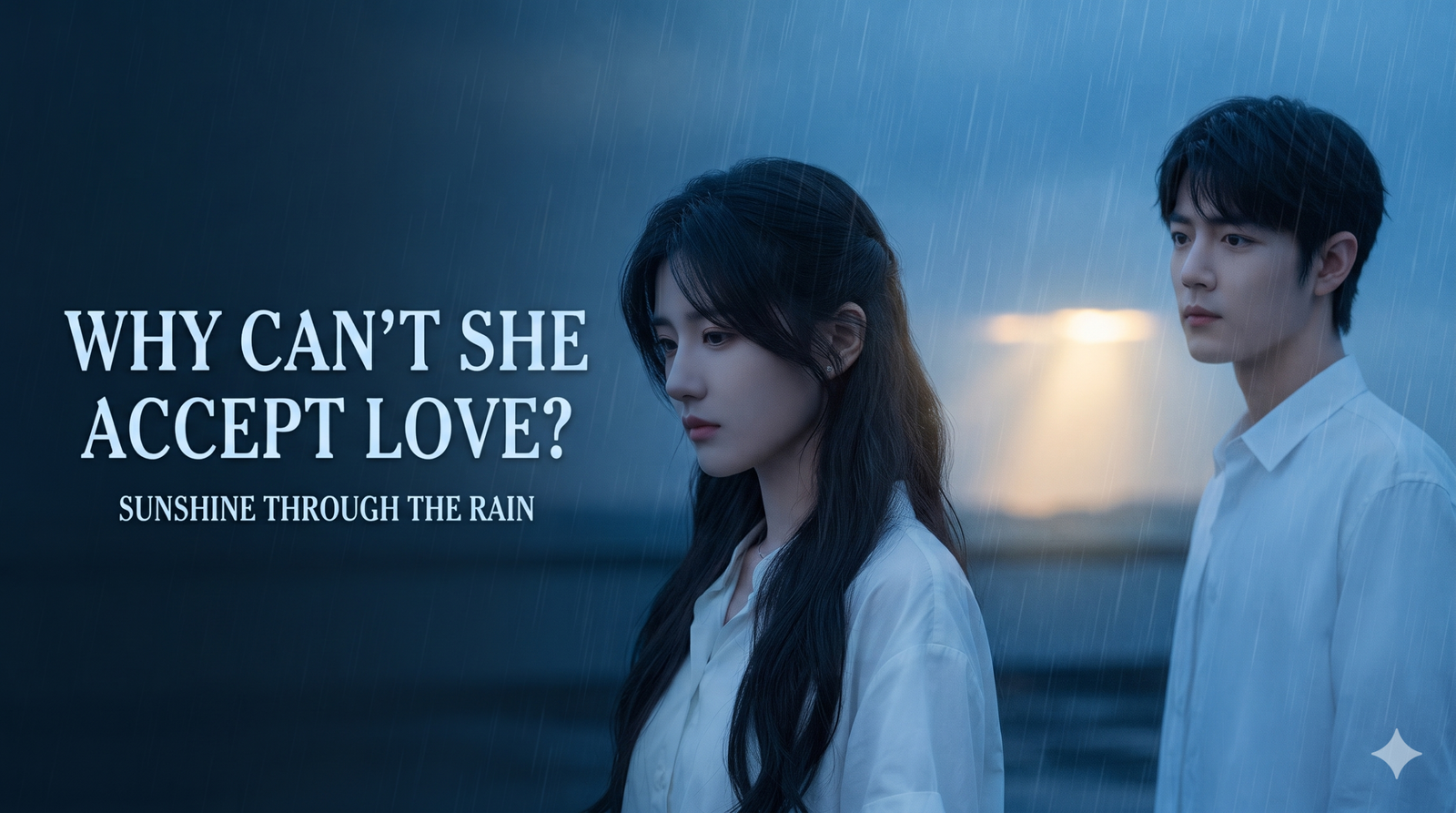
Some people push others away because they do not want to be loved.
Others push people away because they have never learned how to believe that love can be given without a price.
That distinction is at the emotional center of Sunshine Through the Rain (今天是太阳雨), the 2026 Chinese youth drama starring Yang Chaoyue as Zheng Yu and Dong Sicheng, also known as Winwin, as Chen Yanzhou.
At first glance, the series appears to follow a familiar campus-romance structure. Two university students become academic rivals, clash over a scholarship, and gradually develop feelings for each other.
But beneath that familiar framework is a more interesting question:
What happens when survival has taught someone to become independent, but that same independence makes it difficult to accept affection?
Zheng Yu’s struggle is not simply about finding someone who understands her. It is about learning whether she can allow another person to become part of a life she has spent so much energy trying to control.
1. Zheng Yu’s Poverty Is More Than a Financial Problem
Zheng Yu is a biology student carrying serious family responsibilities. Her mother’s medical expenses and the family’s financial difficulties force her to balance academic work with multiple part-time jobs.
A scholarship is therefore not merely an academic achievement.
It represents security, opportunity, and perhaps the possibility of escaping a life in which every unexpected expense can become a crisis.
This changes the meaning of competition.
For a student with financial support, losing a scholarship opportunity might be disappointing. For Zheng Yu, it can threaten the fragile structure holding her life together.
That difference matters because people do not experience competition under equal conditions.
When someone has enough resources, failure can be temporary. When someone is already struggling, failure can feel like a return to the beginning.
Zheng Yu’s determination can therefore be understood as more than ambition. It is a form of protection.
She cannot easily afford to become careless, depend on someone else, or take emotional risks that might interfere with her responsibilities.
The drama’s financial background is important not because poverty automatically makes someone stronger, but because it helps explain why Zheng Yu has so little room to make mistakes.
2. When Independence Becomes a Psychological Defense
Independence is usually presented as a positive quality.
A person who works hard, solves problems alone, and refuses to surrender deserves respect.
But there is a hidden danger when independence becomes the only acceptable way to live.
A person may gradually stop asking for help, even when help is available. They may feel uncomfortable receiving kindness because it creates an obligation they cannot repay.
For someone in Zheng Yu’s position, accepting assistance can produce several uncomfortable questions:
- Will this person expect something in return?
- Will I become a burden?
- What happens if I depend on them and they eventually leave?
- Will accepting help make me appear weak?
These questions are not necessarily conscious decisions. They can become habits developed through repeated experiences of insecurity.
This is where the drama offers an interesting psychological possibility.
Zheng Yu may not be rejecting affection itself. She may be rejecting the uncertainty that comes with allowing another person to influence her life.
There is a meaningful difference between saying, “I do not need anyone,” and believing, “I cannot afford to need anyone.”
The first can be a declaration of confidence.
The second can be a survival strategy.
3. Why Kindness Can Feel Like a Debt
One of the most overlooked aspects of relationships involving financial inequality is the emotional weight of receiving help.
Kindness is often portrayed as something simple. One person offers support, the other accepts it, and their relationship becomes closer.
Real life is not always that straightforward.
When someone has spent years managing difficulties alone, receiving help can create a sense of imbalance.
The person receiving assistance may begin to wonder whether they now owe something emotionally.
They might feel pressure to express gratitude, avoid disappointing the other person, or prove that they are not taking advantage of anyone.
In this situation, even a sincere gesture can become uncomfortable.
This is a particularly useful way to examine Zheng Yu’s relationship with Chen Yanzhou.
Their connection begins within an environment of competition. They are not initially approaching each other as two people freely choosing companionship. They have practical reasons to remain cautious.
That starting point matters.
Competition gives Zheng Yu a clear role: she must perform, improve, and protect her opportunity.
Intimacy is more complicated because it requires her to become vulnerable without knowing exactly what the other person will expect.
The emotional challenge is therefore not simply whether she can fall in love.
It is whether she can receive something without immediately feeling responsible for repaying it.
4. Chen Yanzhou’s Pain Is Different From Zheng Yu’s
Chen Yanzhou is not simply a wealthy or academically gifted rival who enters Zheng Yu’s life to solve her problems.
He carries his own emotional history, particularly the loss of his older brother.
That loss shapes his withdrawal from other people and gives his character a different kind of isolation.
This distinction is important.
Zheng Yu’s insecurity is closely connected to responsibility and financial survival. Chen Yanzhou’s emotional distance is connected to grief and the difficulty of living with an absence that cannot be repaired through hard work.
Their circumstances should not be treated as identical.
Financial insecurity and bereavement are different experiences. One involves the pressure of limited resources and uncertain stability; the other involves the permanent loss of someone important.
Yet both can create a similar outward behavior: emotional withdrawal.
One person may keep others away because dependence feels dangerous.
Another may keep others away because emotional closeness reminds them of what they have lost.
This creates an interesting foundation for their relationship.
They may recognize loneliness in each other without experiencing it in the same way.
That is potentially more meaningful than the familiar idea that two damaged people automatically heal one another.
Understanding someone does not mean having experienced exactly the same pain.
Sometimes it means recognizing that their silence has a reason.
5. Why Their Academic Rivalry Matters to the Romance
The scholarship competition is not just a convenient device for bringing the two leads together.
It establishes a relationship in which both characters have something to lose.
Zheng Yu cannot casually abandon her academic goals. Chen Yanzhou also has to confront the expectations and difficulties surrounding his return to university.
Their initial rivalry gives them a reason to observe each other before they become emotionally close.
That is an important structural choice.
In many romance dramas, attraction arrives before the audience understands why the characters matter to each other.
Here, academic competition creates opportunities for conflict, cooperation, and recognition.
Zheng Yu can see Chen Yanzhou as an obstacle before she begins to see him as a person.
Likewise, Chen Yanzhou has to look beyond her outward determination to understand the pressure behind it.
Their relationship can develop through a gradual change in perception.
The rival becomes a partner. The partner becomes someone whose opinion matters. Eventually, that person may become someone whose presence feels safe.
The progression is emotionally more convincing when each stage changes how the characters understand one another.
6. The Hidden Cost of Always Being Strong
There is a popular idea in television dramas that hardship makes people stronger.
It is an attractive message, but it is incomplete.
Hardship can build determination. It can also create exhaustion, defensiveness, and an inability to relax.
Someone who has been forced to remain strong for a long time may not know what to do when they finally encounter a situation in which they do not have to be strong.
This is one of the most compelling ways to read Zheng Yu.
Her ability to keep moving is admirable, but it should not automatically be interpreted as emotional health.
A person can be capable and overwhelmed at the same time.
A person can be independent and desperately need support.
And someone can sincerely want a relationship while feeling frightened by the vulnerability it requires.
If the drama continues to explore these contradictions rather than turning Zheng Yu’s struggles into a simple inspirational story, her character could become more memorable than the familiar hardworking heroine.
The real test is whether the series allows her to remain complicated even as her circumstances improve.
7. What Viewers Are Responding To — and What May Divide Them
Early online reactions suggest that the drama’s emotional atmosphere is one of its strongest attractions.
In discussions on Reddit, viewers have praised the gradual character development, restrained performances, and the way Zheng Yu slowly builds a circle of support through friendships and relationships. Some have also highlighted the emotional importance of her roommates and the people who begin to stand beside her.
One discussion attracted particularly positive reactions to the show’s storytelling and performances, while other viewers compared its atmosphere with emotionally driven youth dramas such as The First Frost. These are individual community reactions, not proof of universal agreement. <cite>【turn364893reddit4】【turn364893reddit5】【turn364893reddit6】【turn364893reddit12】</cite>
There is also a reasonable criticism.
A slow emotional drama can become repetitive if it keeps showing characters suffering without allowing their decisions to produce meaningful change.
Some viewers have found the pacing too slow, while opinions about the performances and emotional intensity are not entirely uniform. <cite>【turn364893search0】【turn364893reddit7】</cite>
This criticism raises an important question about the series.
Does every quiet scene reveal something new about a character, or does the drama sometimes repeat the same emotional message?
For a story built around gradual healing, patience is necessary. But patience alone does not guarantee depth.
The characters must change in ways that viewers can actually recognize.
8. The Real Meaning of a Sunshower
The title Sunshine Through the Rain suggests a moment when sunlight appears while rain is still falling.
It is a fitting metaphor for the emotional world of the series.
A sunshower does not mean that the rain never existed. It does not mean the weather has completely changed.
It means that light and rain can exist at the same time.
That image offers a useful way to understand Zheng Yu and Chen Yanzhou.
Their connection does not need to erase their financial difficulties, family responsibilities, or grief to become meaningful.
A healthy relationship cannot undo every painful experience.
What it can do is create a different way of facing those experiences.
For Zheng Yu, that may mean discovering that accepting support does not automatically make her indebted or weak.
For Chen Yanzhou, it may mean discovering that emotional closeness does not have to end in another loss.
Neither lesson is simple.
And neither character should be expected to change overnight simply because romance has entered the story.
9. The Question That Makes This Drama More Than a Campus Romance
The most interesting question in Sunshine Through the Rain is not whether Zheng Yu and Chen Yanzhou will become a couple.
It is whether two people who have learned to protect themselves can gradually learn to trust someone else.
That is a more difficult story to tell than a conventional rivals-to-lovers romance.
It requires the drama to understand that love is not only about giving affection. It is also about allowing affection to reach someone who may not know how to receive it.
Zheng Yu’s journey can be especially meaningful if the series recognizes that her independence deserves respect, even when it becomes a barrier to intimacy.
She does not need to become helpless to become lovable.
She does not need someone to rescue her in order to deserve companionship.
And she should not have to abandon her ambition to make room for love.
Perhaps the most meaningful form of growth for her is not learning to depend entirely on another person.
It is learning that she can remain independent without having to face everything alone.
That is the emotional possibility hidden beneath the rain.
Final Thought
Sunshine Through the Rain has the opportunity to explore a question that many romance dramas overlook: why can receiving love sometimes be harder than giving it?
If Zheng Yu’s story continues to examine that question with honesty and restraint, the series may offer something more lasting than a familiar university romance.
Because sometimes the person who needs love most is not the person asking for it.
It is the person who has spent years convincing themselves that they must never need it.