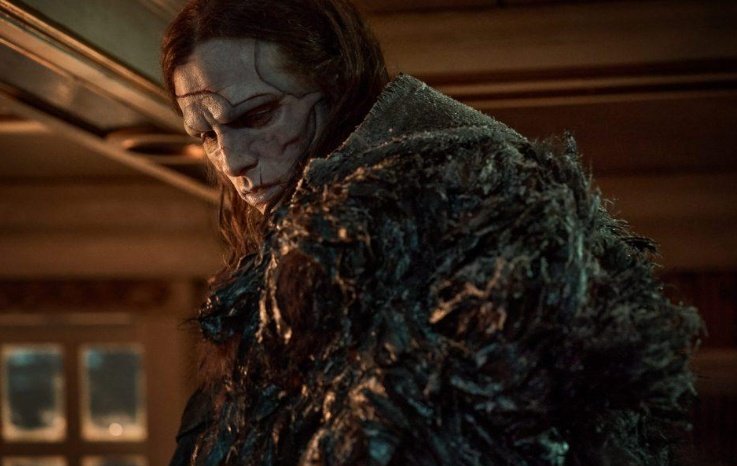
Guillermo del Toro’s Frankenstein is not simply a story about a scientist who creates a monster. It is a story about what happens when someone creates life but refuses to accept responsibility for it. Through Victor Frankenstein and his Creature, the film explores abandonment, inherited trauma, moral responsibility, and the possibility of forgiveness.
1. The Real Horror Begins After Creation
Most versions of Frankenstein focus on the moment Victor Frankenstein succeeds in bringing the dead back to life. It is the spectacular moment when science crosses a boundary that humanity was never supposed to cross.
Guillermo del Toro’s 2025 adaptation approaches the story differently.
The experiment is not the ultimate horror. The real horror begins immediately afterward, when Victor realizes that the living being in front of him is not the perfect achievement he imagined.
He has created life, but he has not considered what that life will need.
The Creature requires protection, understanding, and guidance. Victor instead responds with disappointment and rejection.
This changes the central question of the Frankenstein story. Rather than asking whether human beings should create life, the film asks whether a creator can escape responsibility for what he brings into existence.
Victor’s greatest failure is not that his experiment succeeds. It is that he cannot accept the consequences of its success.
2. Victor Frankenstein: A Man Who Wants the Power of a God
Victor’s ambition is driven by more than scientific curiosity.
His childhood is marked by a difficult relationship with his father and the loss of his mother. These experiences help explain his obsession with death and his determination to overcome the limitations of human existence.
But his desire to defeat death is also deeply personal.
Victor wants to prove that human limitations can be conquered. He wants to become the person who can reverse the one event that made him feel powerless.
The tragedy is that he confuses the ability to create life with the ability to understand it.
He imagines himself as a superior creator, but he has little patience for the ordinary responsibilities that come with caring for another living being.
His ambition is therefore both impressive and deeply immature.
He wants the glory of creation without the burden of parenthood.
3. The Creature Is Born Without Choosing to Exist
One of the film’s most important decisions is to make the Creature’s early experience resemble that of a newborn child.
He does not understand language, social rules, family relationships, or even the world around him.
Everything must be learned.
His body is powerful, but his emotional development is vulnerable. He depends on his creator for explanations and guidance, yet the person who should teach him how to live becomes the first person to reject him.
This creates a fundamental injustice.
The Creature did not choose his appearance, his origins, or the circumstances of his birth. He did not ask Victor to assemble his body from the remains of the dead.
Yet he is immediately expected to bear the consequences of decisions made entirely by someone else.
The film encourages viewers to consider how much of a person’s identity is shaped by the conditions into which they are born.
The Creature begins life without the freedom to choose his existence. His struggle is to discover whether he can choose what that existence will mean.
4. Victor’s Rejection Becomes the Creature’s First Education
Victor’s reaction to his creation is more important than the experiment itself.
Instead of accepting the Creature as a living being who needs help, he treats him as a failed result.
The Creature learns his first lesson about humanity from the person who made him.
That lesson is rejection.
The film’s emotional structure depends on this reversal. Victor believes that the Creature’s appearance and behavior reveal something monstrous about him. But the Creature’s earliest experiences are largely shaped by Victor’s own fear, impatience, and inability to accept imperfection.
This does not mean that Victor is responsible for every action the Creature will eventually take.
It means that the relationship begins with a profound imbalance of power.
One individual controls the conditions of another’s existence and then abandons him when those conditions become inconvenient.
In this sense, Frankenstein becomes a story about the responsibilities of anyone who holds power over a vulnerable being.
5. The Father-Son Relationship Is the Film’s Emotional Foundation
Del Toro places unusual emphasis on the relationship between fathers and sons.
Victor’s own father is demanding and emotionally damaging. Victor grows up with a distorted understanding of affection, authority, and approval.
When he becomes a creator, he repeats part of the pattern that shaped his childhood.
He exercises power without providing the emotional security that a dependent being requires.
The Creature, meanwhile, desperately wants recognition from the person who gave him life.
This is why the conflict feels larger than a scientist confronting a failed experiment.
It resembles a family tragedy in which the child is forced to seek love from the very person who caused his suffering.
Del Toro has described the film as deeply personal, connected to his experiences and reflections as both a father and a son.
That autobiographical dimension helps explain why the film gives so much attention to inherited pain.
The central tragedy is not simply that Victor creates a monster. It is that he reproduces the emotional damage he experienced instead of breaking the cycle.
6. Is the Creature Innocent, or Does His Suffering Make Him Dangerous?
The Creature is sympathetic, but sympathy should not automatically erase moral responsibility.
This is one of the most important distinctions between the film and Mary Shelley’s original novel.
In Shelley’s story, the Creature begins with an extraordinary capacity for kindness and understanding. He observes human beings, learns language, and develops a desire for companionship.
But repeated rejection gradually turns his longing into resentment.
Eventually, he deliberately commits terrible acts, including murder.
Del Toro’s film makes the Creature considerably more sympathetic. His violence is presented more often as a response to rejection, fear, or direct threats.
This changes the audience’s moral relationship with him.
We are encouraged to understand his pain before judging his actions.
However, understanding why someone becomes violent is not the same as declaring that violence acceptable.
The distinction matters because a story about injustice becomes less interesting when it removes every difficult moral question from its central character.
The Creature deserves compassion. But compassion does not require us to pretend that every consequence of his actions is harmless.
7. The Blind Elder: The Kindness Victor Never Offered
The Creature’s encounter with a blind elder provides one of the film’s most important contrasts.
The elder cannot judge him through his appearance.
Instead, he encounters him through his behavior, voice, and developing ability to communicate.
This relationship offers the Creature something Victor never gave him: the opportunity to be understood before being condemned.
The importance of the elder is not simply that he is kind.
He demonstrates that human connection does not require physical perfection or social approval. It requires patience and a willingness to recognize another person’s humanity.
The Creature learns language and develops a deeper understanding of the world through this relationship.
For the first time, he experiences something resembling acceptance.
But this fragile possibility is destroyed when the surrounding human world intervenes.
The film uses this episode to expose the difference between being physically powerful and being socially powerless.
The Creature can overpower many human beings, yet he cannot protect the small relationship that gives his existence meaning.
8. Paradise Lost: Why the Creature Identifies With Adam
The film’s references to John Milton’s Paradise Lost are more than literary decoration.
The Creature encounters a story about creation, innocence, rebellion, and abandonment. He recognizes something of himself in Adam, the first human being created by God.
But there is a crucial difference.
Adam is created within a world that already has meaning and structure. He has a creator who gives him instructions and a place within existence.
The Creature is created by Victor and immediately rejected.
He has no community, no family, and no explanation for why he exists.
This makes the Creature’s identification with Adam deeply tragic.
He wants to understand his place in the world, but the person responsible for creating that place refuses to acknowledge him.
The comparison also raises a difficult question about the relationship between creator and creation.
If a creator brings a being into existence, does that creator owe the being more than simply the fact of existence?
The film suggests that creation without responsibility is an incomplete act.
9. Elizabeth: The Character Who Recognizes What Victor Cannot See
Elizabeth plays an important role because she approaches the Creature without immediately accepting Victor’s judgment of him.
She recognizes that there is an emotional life beneath his frightening appearance.
Her response challenges the assumption that physical difference reveals moral character.
But Elizabeth is more than a symbol of kindness.
Her position in the story exposes Victor’s emotional limitations. She can recognize the Creature’s vulnerability, while Victor remains trapped in his own disappointment and fear.
Her relationship with Victor also complicates the film’s family structure.
She is connected to Victor’s personal world, yet she becomes one of the few people capable of recognizing the humanity of the being he has rejected.
Her fate eventually becomes central to the conflict between creator and creation.
When she dies, the consequences of Victor’s choices can no longer be contained within his laboratory.
The violence he set in motion has entered the lives of the people around him.
10. Why Victor’s Brother Matters
William is important because he represents a different side of Victor’s emotional life.
Victor is not entirely incapable of affection. His relationship with his younger brother demonstrates that he can care about another person.
But his obsession gradually damages even this connection.
William’s presence also helps reveal the difference between the person Victor believes himself to be and the person he becomes.
Victor sees himself as someone pursuing a great achievement for humanity. Yet his behavior increasingly reflects jealousy, insecurity, and a desire for control.
The tragedy is that his ambition does not remain isolated.
It affects his brother, Elizabeth, and ultimately the Creature himself.
This is one of the film’s strongest observations about obsession: a person may believe that a goal is purely personal, while everyone around them gradually pays its price.
Victor’s experiment is conducted in a laboratory, but its consequences are deeply social.
11. The Request for a Companion: A Demand for Recognition
When the Creature asks Victor to create a companion, the story reaches another moral turning point.
His request is understandable.
He has been rejected by almost everyone he encounters. He has no family, no community, and no realistic possibility of being accepted by ordinary society.
He wants someone who will not look at him as an object of fear.
But his request also creates a new problem.
Would creating another being solve the Creature’s loneliness? Would it be fair to bring another life into existence primarily to satisfy the emotional needs of the first?
And would Victor be capable of treating a second creation responsibly when he has failed the first?
The film does not present the request as a simple solution.
It reveals how deeply the Creature has internalized the belief that his only possible future lies in finding someone who resembles him.
Victor’s refusal intensifies the conflict, but the request itself raises a larger ethical question.
No one should be created merely as an instrument for another person’s happiness.
12. The Creature and Victor Become Reflections of Each Other
By the time their conflict reaches its most destructive stage, Victor and the Creature have become disturbingly similar.
Both are driven by obsession.
Both struggle to release the past.
Both believe that the other person is responsible for their suffering.
Victor wants to destroy the being who exposes the failure of his ambition. The Creature wants recognition and accountability from the person who abandoned him.
Their relationship becomes a cycle in which each action produces another act of retaliation.
This is where the film’s title becomes especially meaningful.
Frankenstein is not simply the name of the scientist or the label attached to his creation. It becomes a way of thinking about the connection between them.
The creator and the created cannot be separated from one another.
Victor made the Creature, but the Creature also becomes the living evidence of Victor’s moral failure.
Each is trapped in a relationship that neither knows how to end.
13. The Arctic: A Place Where Revenge Finally Loses Its Purpose
The Arctic setting gives the final confrontation an appropriately isolated atmosphere.
The landscape is vast, cold, and almost empty of human life.
It reflects the emotional condition of both characters.
Victor has pursued the Creature across enormous distances, but the pursuit has not brought him peace. The Creature has spent much of his existence searching for his creator, but revenge has not given him the acceptance he originally wanted.
The Arctic removes the distractions of society and leaves the two central figures with the history they share.
There is no laboratory to hide behind and no ordinary domestic world to return to.
The confrontation becomes less about physical victory and more about whether either character can finally understand what has happened.
The setting also connects the film’s beginning and ending.
The story opens in an environment of ice, danger, and pursuit. It ends by transforming that same environment into a space where the possibility of forgiveness can emerge.
14. The Ending: Does Forgiveness Redeem Victor?
The film’s most controversial decision is its ending.
Victor finally recognizes the damage he has caused and asks the Creature for forgiveness.
The Creature accepts.
This is a powerful emotional moment, but it is also a significant departure from Mary Shelley’s novel.
In the novel, Victor dies without achieving reconciliation with his creation. The Creature, confronted with the death of the only person who connects him to his own existence, expresses profound remorse and announces his intention to end his life.
Del Toro chooses a different direction.
Victor and the Creature finally hear each other’s pain. The relationship that began with rejection ends with an acknowledgment of shared suffering.
The emotional power of the scene is undeniable.
Yet forgiveness raises an uncomfortable question: does Victor’s final recognition erase the consequences of his earlier behavior?
It cannot bring back the dead. It cannot undo the Creature’s suffering. It cannot restore the lives destroyed by the conflict.
The ending is therefore most interesting when forgiveness is understood not as the cancellation of responsibility, but as the possibility of ending an inherited cycle of hatred.
Victor’s apology arrives late. The film does not make that lateness disappear.
15. Why Del Toro Changed Mary Shelley’s Ending
The difference between the novel and the film reveals two distinct moral visions.
Mary Shelley’s Frankenstein is a tragedy of ambition, responsibility, isolation, and destructive revenge.
Her Creature is not simply an innocent victim. He becomes an intelligent and morally complicated individual who deliberately harms others. Victor and his creation become locked in a relationship of mutual destruction.
Del Toro retains the central relationship but changes its emotional destination.
His Creature is more consistently sympathetic, while Victor is presented as a more visibly damaged and irresponsible father figure.
The film’s final act of forgiveness reflects del Toro’s interest in whether inherited pain can be interrupted.
This is not necessarily a more accurate version of Shelley’s novel. It is a different interpretation.
Some viewers may find the ending moving because it offers a possibility that the novel deliberately withholds.
Others may feel that the film makes reconciliation too easy after so much suffering.
Both reactions are reasonable.
The important point is that adaptation is not simply a matter of reproducing events. It is also a decision about which moral questions a new version wants to emphasize.
Shelley leaves us with the consequences of an unresolved tragedy. Del Toro asks whether forgiveness can create a future after that tragedy.
16. The Real Monster: A Creator Who Refuses Responsibility
The most important question in Frankenstein is not whether the Creature looks human.
It is whether the people who consider themselves human are willing to recognize the responsibilities that come with creating, judging, and controlling another life.
Victor wants to overcome death, but he does not know how to care for the life he creates.
The Creature wants to be loved, but his suffering becomes entangled with violence and revenge.
Neither character is completely free from responsibility.
That is what makes their relationship more complicated than a simple story about a good victim and an evil creator.
The Creature is not responsible for being abandoned. But his pain does not automatically justify every action he takes.
Victor is not wrong merely because he pursues scientific knowledge. He is wrong because he treats another living being as a failed experiment rather than accepting the consequences of his own decision.
And forgiveness, however powerful, cannot rewrite the past.
The film ultimately suggests that the real test of creation is not whether someone can bring life into existence.
It is whether that person can remain responsible after the moment of creation has passed.
Victor succeeds in doing something extraordinary.
But he fails at something much more ordinary: being there for the life he has made.
That may be the most frightening idea in Guillermo del Toro’s Frankenstein.
The monster is not simply the being who was assembled from the dead.
Sometimes, the greater monster is the person who creates a life, abandons it, and only recognizes its humanity when it is almost too late.