INDIA

Explore Indian movies, Bollywood, Netflix series, entertainment, and culture through ending explanations, character analysis, hidden meanings, fan theories, and the questions viewers are asking.

  • Shaque: Trust No One — Why Does Anvita Begin to Suspect Everyone Around Her?

    TTK Original — Beyond the Headlines

    What if the people helping you search for your missing child were also the people you could no longer trust?

    That is the disturbing question at the center of Netflix’s Indian mystery thriller Shaque: Trust No One.

    Starring Parineeti Chopra as Anvita, the seven-episode series follows a mother whose newborn daughter disappeared from a hospital nine years earlier. Her search has never ended, but the deeper she investigates, the more uncertain her closest relationships become.

    The real mystery is not simply who took the child. It is why the truth has remained hidden for so long.

    Why the Nine-Year Disappearance Changes Everything

    Nine years is an extraordinary amount of time to live without answers.

    For Anvita, the disappearance is not a tragedy that belongs to the past. It is a continuing presence in her everyday life.

    Netflix’s episode descriptions reveal that Anvita and her husband, Alok, receive disturbing birthday packages connected to their missing daughter. Instead of allowing the family to move forward, these reminders keep the investigation emotionally alive.

    That detail changes the nature of the mystery.

    A disappearance without new information might gradually become a cold case. But repeated reminders suggest that someone knows more than they have revealed.

    The unanswered question becomes increasingly unsettling: who benefits from keeping Anvita searching?

    The birthday packages do not establish the sender’s identity or motive on their own. They do, however, make the passage of time part of the psychological pressure surrounding the family.

    Why Anvita Can No Longer Trust Familiar Faces

    Most crime thrillers introduce an unknown suspect.

    Shaque makes suspicion much more personal.

    As Anvita follows new leads, she begins questioning people who are already part of her life. The series uses relationships, family tensions, and conflicting information to make the audience reconsider its assumptions.

    This is especially important because Anvita is not an independent detective observing strangers.

    She is a mother whose emotions are inseparable from the investigation.

    Every possible clue carries the hope of finding her daughter. Every contradiction threatens to destroy another relationship.

    That creates a cruel dilemma.

    If Anvita trusts everyone, she risks overlooking important information. If she suspects everyone, she risks losing the people who may genuinely want to help her.

    The series’ title, Trust No One, captures that dilemma.

    But it also raises a deeper question: can someone survive emotionally if suspicion becomes their only way of understanding the world?

    Why the Birthday Packages Matter

    One of the story’s most intriguing devices is the annual birthday package.

    A birthday normally represents growth, celebration, and the passing of another year.

    Here, it becomes a reminder of absence.

    The packages turn what should be a family celebration into a recurring confrontation with the unknown.

    Their narrative importance is not limited to whether they contain clues.

    They also suggest that the disappearance has not been forgotten by everyone connected to it.

    For viewers, the crucial distinction is between evidence and interpretation.

    A package may demonstrate that someone is communicating with the family. It does not automatically reveal whether that person is responsible for the disappearance, protecting someone else, or attempting to manipulate the investigation.

    That uncertainty is precisely what gives the detail its power.

    Why Anvita’s Perception Becomes Part of the Mystery

    The Netflix episode summaries also describe Anvita experiencing visions and hallucinations as the investigation intensifies.

    This introduces another layer of uncertainty.

    The audience must consider not only whether other characters are telling the truth, but also how reliably Anvita can interpret what she encounters.

    That does not mean her suspicions are necessarily wrong.

    Nor does it mean that her experiences invalidate her search.

    Instead, the story places viewers inside a difficult psychological situation: a mother is desperately trying to establish facts while living under extraordinary emotional pressure.

    When a thriller challenges a protagonist’s perception, it can force the audience to distinguish three things: what the character experiences, what the character believes, and what the story has actually established.

    Those are not always the same.

    Why the Supporting Characters Are So Important

    The mystery extends beyond Anvita and Alok.

    Characters including Madhu, Apeksha, Shreya, and Inspector Khurana become part of a story involving old photographs, unexpected confessions, threatening messages, and questions surrounding the missing child’s birth.

    Netflix’s official episode summaries indicate that each development complicates the investigation rather than immediately resolving it.

    That structure makes the supporting cast essential.

    A character may appear suspicious because they conceal information. But hiding information is not necessarily the same as being responsible for the original crime.

    Someone might conceal a secret out of fear, loyalty, shame, or self-preservation.

    For a mystery to remain compelling, viewers must resist treating every suspicious action as proof of guilt.

    This is also where Shaque becomes a story about relationships rather than simply a puzzle about a kidnapping.

    Why the Title Is More Than a Warning

    Shaque refers to suspicion or doubt, while its English subtitle gives a direct instruction: Trust No One.

    At first glance, that sounds like ordinary thriller marketing.

    But within Anvita’s story, it carries a painful contradiction.

    Trust is necessary for families to function. It allows people to share responsibility, offer comfort, and face uncertainty together.

    Yet the search for truth sometimes requires questioning precisely those relationships.

    The title therefore describes a condition that cannot be sustained forever.

    If nobody can be trusted, how can anyone establish the truth?

    Evidence must eventually matter more than suspicion.

    Otherwise, every answer can be dismissed as another deception.

    Is Shaque Really About Finding a Child?

    The missing daughter provides the central mystery, but the emotional stakes extend beyond locating her.

    Anvita is also searching for an explanation of the nine years she has lost.

    She wants to understand why her family was forced to live with uncertainty and why apparently familiar people may have hidden important truths.

    That distinction matters.

    Finding a missing person can answer one question while leaving many others unresolved.

    Who knew what happened? When did they know? Why did they remain silent? And what does that silence mean for the relationships that survive?

    These are the questions that give the story its emotional weight.

    The Real Question Behind Shaque: Trust No One

    The series presents a mother who refuses to abandon her search, even as that determination threatens the stability of her closest relationships.

    Its central conflict is therefore not merely between a victim and a hidden criminal.

    It is between the need to trust and the need to question.

    Anvita cannot find answers by accepting every explanation she receives. But she cannot rebuild her life through suspicion alone.

    The most disturbing possibility in Shaque is not simply that a stranger took her child. It is that discovering the truth may permanently change how she sees the people she loves.

    That is what makes this Netflix thriller more than a conventional missing-child mystery.

    TTK Original — Beyond the Headlines. We explore not just what happens in a story, but why it matters.
  • Drishyam 3: Can Vijay Salgaonkar Really Escape His Past?

    TTK Original — Beyond the Headlines

    What happens when a father saves his family by hiding the truth, only to discover that the past refuses to disappear?

    That question has haunted the Drishyam franchise for years. Now, with Drishyam: The Conclusion arriving in Indian theaters on October 2, 2026, Ajay Devgn returns as Vijay Salgaonkar for what is being presented as the final chapter of the Hindi crime-thriller series.

    But the most interesting question is not simply whether Vijay can outsmart the police again.

    It is whether he can ever truly escape the consequences of what he has done.

    Why Vijay Salgaonkar Is Such a Complicated Hero

    Vijay is not a conventional action hero. He does not defeat his enemies through physical strength, political influence, or wealth.

    His greatest weapon is his ability to understand how people think.

    In the earlier films, Vijay constructed an elaborate defense around his family’s involvement in a young man’s death. His knowledge of movies, human behavior, and investigative assumptions helped him create a version of events that authorities struggled to dismantle.

    For viewers, that intelligence made him fascinating.

    But there is a moral contradiction at the center of his character.

    Vijay protects the people he loves by manipulating the truth.

    The audience understands his motivation, yet understanding his motivation is not the same as proving that every decision he makes is right.

    That tension is what makes Drishyam more than an ordinary police thriller.

    Why the Past Still Threatens Vijay

    The first two films established something important: escaping punishment does not necessarily mean escaping consequences.

    Even when an investigation appears to reach a dead end, the people involved continue living with suspicion, grief, and fear.

    Vijay’s family cannot simply return to the innocence they once had.

    Every new question threatens to reopen an old wound.

    In Drishyam: The Conclusion, Meera Deshmukh returns, and the investigation faces a new phase involving another senior crime officer.

    The conflict therefore becomes larger than one clever man trying to defeat the police.

    It becomes a struggle between two families whose lives were permanently changed by the same tragedy.

    For Vijay, the past represents a danger to his family.

    For Meera, that same past represents a truth that cannot be abandoned.

    Neither perspective can be dismissed without ignoring the emotional foundation of the story.

    Is Vijay Protecting His Family or Protecting Himself?

    This is perhaps the most uncomfortable question in the entire franchise.

    At the beginning, Vijay’s choices are driven by an understandable instinct: a father wants to prevent his family from being destroyed.

    But as the deception grows more elaborate, another possibility emerges.

    What happens when protecting your family becomes inseparable from protecting the lies you created?

    Vijay has spent years maintaining control over the narrative surrounding the incident.

    His intelligence has allowed him to anticipate questions, prepare explanations, and identify weaknesses in an investigation.

    Yet the more complicated a deception becomes, the more difficult it is to separate genuine protection from the need to preserve that deception.

    This does not mean Vijay has stopped loving his family.

    It means his love has placed him inside a moral trap.

    He may believe that admitting the truth would destroy everything he has worked to protect.

    But continuing to hide it also prevents his family from fully escaping the past.

    That is the central tragedy of Vijay Salgaonkar.

    Why October 2 Matters So Much

    The release date of Drishyam: The Conclusion is not an arbitrary marketing choice.

    October 2 has special significance within the franchise because it is tied to the carefully constructed timeline of Vijay’s original alibi.

    By releasing the concluding film on October 2, 2026, the filmmakers connect the franchise’s ending to one of its most recognizable story elements.

    The date becomes more than a reference for longtime fans.

    It symbolizes the central idea of Drishyam: how a specific sequence of events can be transformed into a story that other people believe.

    The franchise has always understood that memory is not merely about what happened.

    It is also about what people can be persuaded to remember.

    Why the Hindi and Malayalam Versions Are Taking Different Paths

    There is another reason this third installment deserves attention.

    The Hindi Drishyam films were adapted from the Malayalam franchise led by Mohanlal, whose central character is Georgekutty.

    However, the filmmakers have explained that the third Hindi installment and the third Malayalam installment follow different scripts and treatments.

    This creates an unusual opportunity.

    Two versions of a familiar premise can explore different consequences for their central characters.

    Rather than treating one ending as a simple reproduction of the other, audiences can examine how each version approaches family loyalty, guilt, justice, and survival.

    For TTK readers, this distinction matters because discussions of one version’s ending should not automatically be treated as explanations of the other.

    The two stories must be evaluated on their own terms.

    Why Drishyam Is Really About the Limits of Intelligence

    Many crime thrillers ask whether the police can catch the criminal.

    Drishyam asks something more unsettling.

    Can intelligence become a substitute for accountability?

    Vijay’s greatest advantage has always been his ability to think several steps ahead.

    He knows how investigators build cases. He understands how ordinary details can become convincing evidence. And he recognizes that people often trust a coherent story more readily than an uncomfortable truth.

    But intelligence has limits.

    It can manipulate circumstances, delay consequences, and expose weaknesses in a system.

    It cannot automatically erase grief.

    It cannot restore the innocence of a family.

    And it cannot guarantee that everyone involved will eventually find peace.

    This is why Vijay remains such a compelling protagonist even after multiple films.

    His brilliance solves immediate problems while leaving deeper moral questions unresolved.

    Can Vijay Finally Escape His Past?

    The title The Conclusion suggests that Vijay’s long struggle is approaching a decisive endpoint.

    But a meaningful conclusion does not have to be defined only by whether he is arrested or remains free.

    The more interesting question is what freedom would actually mean for him.

    If Vijay avoids punishment but his family continues living in fear, has he truly won?

    If the truth emerges and destroys the people he tried to protect, can that outcome be called justice without considering its human cost?

    And if the people on opposite sides of the tragedy can never agree on what justice means, is a completely satisfying ending even possible?

    These are interpretive questions, not claims about the film’s final scenes.

    They are also the questions that make the franchise worth discussing beyond its twists and box-office performance.

    The Real Question Behind Drishyam 3

    Drishyam: The Conclusion brings audiences back to a man who has repeatedly demonstrated that he can outthink powerful institutions.

    Yet the defining conflict may never have been Vijay versus the police.

    It has always been Vijay versus the consequences of his own choices.

    The audience can admire his intelligence, sympathize with his family, and still question the morality of the deception that protects them.

    That contradiction is the franchise’s greatest strength.

    Vijay Salgaonkar may be able to escape an investigation. But can anyone truly escape a past that has changed so many lives?

    That is the question Drishyam leaves us confronting.


    TTK Original explores the deeper questions behind movies, television, and global entertainment — not just what happened, but why it matters.

  • Chumbak Netflix Controversy: Why Does a Feel-Good Comedy Make Viewers So Angry?

    TTK Original — Beyond the Headlines

    A Netflix comedy about five neighboring families should be an easy crowd-pleaser. So why are some Indian viewers calling Chumbak a welcome return to family entertainment while others cannot even finish the first episode?

    That contradiction is the most interesting thing about Chumbak.

    Created by Aatish Kapadia and Jamnadas Majethia, the minds behind beloved Indian television comedies such as Sarabhai vs Sarabhai and Khichdi, the series takes viewers into a fictional Mumbai neighborhood where five families share far more than a street.

    They share arguments, secrets, embarrassing situations and almost every detail of one another’s private lives.

    For some viewers, this is exactly the kind of comedy Indian streaming platforms have been missing.

    For others, it is proof that nostalgia cannot rescue outdated writing.

    The disagreement is not simply about whether the jokes are funny.

    It is about what Indian audiences now expect from a family comedy.

    Why Did Chumbak Create Such Divided Reactions?

    Netflix presents Chumbak as a feel-good ensemble sitcom built around the everyday chaos of neighborhood life.

    Its appeal is easy to understand.

    Instead of relying on murder mysteries, political conspiracies or relentless violence, the series returns to ordinary domestic conflicts.

    Rajni and Kuku Merchant struggle with their marriage. Other couples confront their own relationship problems. An affair creates complications, and family disagreements become neighborhood entertainment.

    The characters constantly interfere in one another’s lives.

    This is familiar territory for Indian television comedy.

    But familiarity is also where the controversy begins.

    Some Reddit viewers praise the show for bringing back the atmosphere of classic family sitcoms.

    Others argue that the characters are exaggerated, the jokes feel forced and the writing relies too heavily on situations that worked better decades ago.

    Both groups are responding to the same creative decision.

    Chumbak wants to revive an older style of comedy.

    The question is whether that style still works unchanged.

    The Infidelity Debate: Can a Family Comedy Make Cheating Funny?

    One particularly revealing Reddit discussion criticized the show’s treatment of infidelity.

    The viewer objected not merely to the presence of a cheating storyline, but to the impression that the surrounding characters were too accepting of the behavior.

    This distinction matters.

    A comedy can include morally questionable characters without endorsing their actions.

    Indeed, misunderstandings, lies and affairs have been central to sitcom plots for generations.

    But the framing determines how audiences interpret the joke.

    If a character’s betrayal is treated primarily as a source of comic inconvenience, some viewers may feel the emotional consequences are being ignored.

    Other viewers may see the same storyline as ordinary farce: a flawed character creates a mess, and the audience laughs at the consequences.

    Neither reaction is automatically unreasonable.

    The more interesting question is whether Chumbak gives its characters enough emotional depth for the comedy to work without trivializing their relationships.

    A storyline about cheating is not necessarily an endorsement of cheating. But a comedy still has to decide whose pain becomes the punchline.

    That is where some viewers believe the series falls short.

    Why Are Fans Comparing Chumbak to Sarabhai vs Sarabhai and Khichdi?

    The comparison was inevitable.

    Kapadia and Majethia helped create two of India’s most recognizable television comedies.

    Those shows developed devoted audiences through eccentric characters, memorable dialogue and family conflicts that often exposed class differences or social pretensions.

    Chumbak arrives with much of that creative reputation attached.

    It also features familiar performers, including Neena Gupta, Deven Bhojani, Manasi Parekh and Sumeet Raghavan.

    For longtime fans, the casting and creative team promise a particular kind of entertainment.

    That promise creates a problem.

    A viewer who expects a spiritual successor to Sarabhai vs Sarabhai may judge Chumbak more harshly than someone discovering its style for the first time.

    Reddit reactions reflect this tension.

    Some viewers enjoy the familiar comic rhythm and celebrate the return of ensemble family comedy.

    Others say the older shows had sharper dialogue and more convincing characters.

    In other words, Chumbak is competing not only with today’s Netflix releases.

    It is competing with the audience’s memories.

    And memories are difficult competition.

    Is Chumbak’s Biggest Problem Its Characters or Its Writing?

    One of the most consistent criticisms concerns exaggerated performances and predictable jokes.

    The characters are intentionally broad.

    Their personalities are designed to clash, and their disagreements quickly become collective neighborhood crises.

    That approach can be effective in a sitcom.

    Distinctive characters help viewers recognize the source of a joke before it fully develops.

    But exaggeration becomes a weakness when every conversation feels like a performance rather than a believable exchange.

    Some viewers enjoy the heightened energy.

    Others describe it as exhausting.

    The disagreement reveals a difference in comic taste.

    One audience wants rapid-fire jokes, exaggerated reactions and familiar domestic chaos.

    Another expects more natural dialogue, subtle characterization and situations that feel contemporary.

    Chumbak leans toward the first tradition.

    That choice gives the series a recognizable identity, but it also limits its appeal.

    Why Does Rajni and Kuku’s Marriage Matter?

    Rajni and Kuku’s relationship provides one of the show’s central emotional conflicts.

    Early episodes establish that their marriage is under strain.

    Rajni considers separation, and their disagreement becomes part of the wider neighborhood’s involvement in private matters.

    This storyline matters because it exposes a contradiction at the heart of the series.

    The neighborhood is presented as a place where nobody has to face life’s difficulties alone.

    But the same closeness can make personal decisions harder.

    When everyone knows everyone else’s business, privacy becomes almost impossible.

    For a couple struggling with marriage, that may be comforting—or suffocating.

    The show celebrates neighbors who behave like extended family.

    Yet its relationship conflicts also demonstrate why boundaries matter.

    The people who make a neighborhood feel like home can also make it difficult to live your own life.

    That tension gives Chumbak more thematic potential than its broad comedy might initially suggest.

    Does Nostalgia Explain Why Some Viewers Love It?

    Nostalgia is a powerful part of the show’s appeal.

    For viewers who grew up watching Indian family sitcoms, Chumbak recalls a television world built around recognizable households, eccentric relatives and communal living.

    Its fictional colony offers a version of neighborhood life in which people remain deeply involved in one another’s affairs.

    That world can feel reassuring in an era when entertainment often focuses on isolation, violence and distrust.

    The series offers a different emotional promise.

    Problems may be embarrassing. Families may fight. Neighbors may interfere.

    But nobody remains completely alone.

    For viewers seeking comfort rather than narrative complexity, that promise may be enough.

    And that helps explain why some people genuinely enjoy the same scenes that others dismiss as childish.

    They are not necessarily looking for the same experience.

    Why Did Netflix Release Chumbak in Two Parts?

    The release strategy also matters.

    Netflix launched the first eight episodes in September 2026, followed by eight additional episodes on October 1.

    That gave viewers time to discuss the initial episodes before the second batch arrived.

    It also meant early reactions could shape expectations for the remaining storylines.

    Viewers who enjoyed the first part had a reason to return quickly.

    Those who disliked its humor had little incentive to continue.

    The split release therefore made the divide in audience opinion especially visible.

    But the release strategy itself does not explain the criticism.

    The stronger explanation lies in the show’s creative identity: it deliberately embraces a style that some audiences miss and others have outgrown.

    What Reddit’s Chumbak Debate Really Reveals

    The most revealing aspect of the Reddit discussion is that both supporters and critics often recognize the same qualities.

    They notice the old-fashioned humor.

    They notice the exaggerated personalities.

    They notice the similarities to earlier Indian sitcoms.

    They simply disagree about whether those qualities are strengths.

    Some viewers call the series refreshing because it offers relatively light entertainment without depending on explicit content or relentless darkness.

    Others argue that family-friendly entertainment should still offer modern writing and thoughtful treatment of relationships.

    That is a more substantial disagreement than a simple good-versus-bad review.

    It raises a question about the future of Indian streaming comedy.

    Should creators preserve the rhythms that made older television sitcoms popular?

    Or should they reinvent those rhythms for an audience whose expectations have changed?

    My Interpretation: Chumbak Is Caught Between Two Eras

    I think Chumbak‘s divided reception comes from its attempt to bring an older television sensibility into the modern streaming environment.

    Its greatest strength is also its greatest vulnerability.

    The show believes in the comic possibilities of shared family life, nosy neighbors and characters whose flaws become everybody’s business.

    That belief gives it warmth.

    But warmth alone cannot guarantee that every joke lands or that every relationship storyline feels convincing.

    The infidelity criticism is particularly revealing.

    A viewer can enjoy exaggerated comedy while still expecting the story to recognize when someone’s behavior causes real emotional harm.

    Likewise, nostalgia can make familiar characters comforting, but it cannot automatically make familiar jokes fresh.

    The series does not need to abandon its identity.

    It needs to demonstrate that old-fashioned family comedy can still have something new to say.

    Final Verdict: Why Does Chumbak Make Viewers So Angry?

    Because the very things that make Chumbak comforting to one audience make it frustrating to another.

    Its nostalgia, broad performances and familiar domestic conflicts are not incidental features.

    They are the foundation of the show.

    Some viewers welcome that return to an earlier style of Indian entertainment.

    Others want more contemporary humor, stronger writing and greater sensitivity in how relationships are portrayed.

    The real controversy is not whether Chumbak is funny.

    It is whether a beloved style of comedy can survive on nostalgia alone.

    And perhaps that is the most interesting question the series has raised.


    What do you think? Is Chumbak a refreshing return to classic Indian family comedy, or does its humor feel outdated? And did the infidelity storyline go too far? Share your view in the comments.

  • Romancham Ending Explained: Was Anamika Real, and Why Did Sinu Return?

    TTK Original — Beyond the Headlines

    Spoiler Warning: This article discusses the ending and major supernatural mysteries of the 2023 Malayalam horror-comedy Romancham.

    Seven friends decide to play with a homemade Ouija board. At first, the entire experience seems like an elaborate joke.

    Then the glass starts moving without anyone controlling it.

    Strange accidents follow. A mysterious visitor behaves as though he knows things he should not know. And by the end, a hospital bag becomes the most frightening object in the story.

    But Romancham never gives us the explanation we expect.

    Was Anamika a real ghost, or did the friends create their own nightmare by believing in her?

    The answer may lie in three details: the Ouija board, Sinu’s behavior, and the disturbing final message.

    What Actually Happens at the End of Romancham?

    The film follows Jibin and his friends, who share a house in Bengaluru and begin experimenting with a Ouija board.

    Initially, the supernatural activity is staged. Jibin and Shijappan secretly manipulate the glass to entertain and frighten their friends.

    But the game changes when the glass apparently moves without their intervention.

    The spirit they call Anamika begins giving answers that seem impossible to explain.

    As the friends become increasingly frightened, their ordinary lives start falling apart.

    Rivin repeatedly loses his way home. Karikuttan makes a disastrous mistake at work. Jibin becomes seriously ill and is hospitalized with meningitis.

    In the hospital, Jibin recalls seeing what appeared to be a female spirit entering his bag before he lost consciousness.

    Then comes the final twist.

    Sinu, whose strange behavior had already alarmed the group, returns carrying that same bag.

    And he reveals a message associated with Anamika:

    “We are coming.”

    The film ends without explaining who “we” refers to.

    That single change—from one spirit to an apparent group—transforms a funny supernatural adventure into an unresolved threat.

    Was Anamika Really a Ghost?

    There are two major ways to interpret Anamika.

    The first is straightforward: the friends accidentally contacted a genuine spirit.

    Several events support that reading.

    The glass appears to move independently, the answers become disturbingly accurate, and Sinu seems connected to information the others do not possess.

    The supernatural incidents also continue after the friends decide to stop using the board.

    If Anamika exists, the group’s original prank has unintentionally opened the door to something real.

    But there is another interpretation.

    The film begins with deliberate deception. The friends are encouraged to believe in something that was initially fabricated.

    Once they become frightened, ordinary mistakes and coincidences start looking like evidence of a haunting.

    A wrong turn, a workplace accident or an unexpected sound can become terrifying when everyone expects a ghost to be responsible.

    Under this reading, Romancham is partly about how fear spreads through a group.

    Yet neither explanation accounts perfectly for everything.

    And that uncertainty appears central to the film’s appeal.

    Why Is Sinu So Important to the Ending?

    Sinu is one of the movie’s most unsettling characters because his behavior never fits comfortably into either comedy or conventional horror.

    He stares blankly, behaves unpredictably and appears disconnected from his surroundings.

    At times, the other men treat him as an irritating or bizarre houseguest.

    But his actions gradually suggest that he may have a deeper connection to the supernatural events.

    The most disturbing possibility is that Sinu has been possessed—or is somehow communicating with forces the others cannot perceive.

    This would explain why his behavior seems linked to information about Anamika.

    However, the movie does not definitively establish the mechanics of his condition.

    His strange behavior can also be read as part of the film’s deliberate refusal to distinguish psychological disturbance from supernatural influence.

    That ambiguity makes his return at the hospital especially effective.

    The audience already knows Sinu is unpredictable.

    What it does not know is whether he is carrying a ghost, carrying a warning, or merely carrying a bag.

    What Does “We Are Coming” Actually Mean?

    This is the film’s most important unresolved question.

    Earlier communication appears to involve Anamika as an individual spirit.

    The final message introduces a plural presence.

    Why “we” instead of “I”?

    One possibility is that Anamika was never alone.

    The friends may have contacted multiple spirits without realizing it.

    Another possibility is that Sinu has become connected to a different supernatural presence, one whose intentions are even less clear.

    A third interpretation is that the message deliberately amplifies the group’s existing fear.

    By this point, they are already prepared to believe that something terrible is following them.

    A message suggesting multiple spirits would be enough to destroy whatever confidence they have left.

    The most frightening part is not the number of ghosts. It is the realization that the characters no longer understand what they have invited into their lives.

    The movie offers no definitive answer about the identities behind the message.

    Any specific explanation remains a theory.

    Why Are Dead Rats Appearing Throughout the Film?

    The recurring dead rats are among the movie’s strangest details.

    They can be understood as signs of an unhealthy, chaotic shared house.

    But as the supernatural incidents escalate, viewers begin connecting the rats to Anamika.

    One interpretation is that the animals are responding to an unseen presence.

    Another is that their deaths are ordinary events given sinister meaning by the frightened housemates.

    Some Reddit viewers have proposed more imaginative theories, including the possibility that the rats themselves are connected to the supernatural mystery.

    The film never confirms such an explanation.

    What matters dramatically is how a disgusting but mundane household problem becomes part of a larger pattern of fear.

    Once the men believe they are haunted, even dead rats become possible evidence.

    Why Does Jibin’s Hospital Bag Matter?

    The bag is the final scene’s most carefully placed object.

    Jibin believes he saw a woman’s spirit entering it shortly before he became unconscious.

    Later, Sinu appears with the same bag.

    If Jibin’s vision was real, the bag may have become a vessel for a supernatural presence.

    That interpretation makes Sinu’s arrival extremely ominous.

    But Jibin was also suffering from a severe illness and high fever.

    His vision could have been a hallucination.

    The film deliberately places these explanations side by side.

    The bag may contain something terrifying.

    Or it may be an ordinary object onto which Jibin has projected his fear.

    The audience cannot inspect it, and the film refuses to resolve the uncertainty.

    That is why the final scene works without showing a monster.

    The possibility is more frightening than confirmation.

    What Are Reddit Viewers Arguing About?

    The unanswered ending has generated competing interpretations among Malayalam cinema fans.

    In discussions on r/MalayalamMovies, viewers have questioned the meaning of the dead rats, whether Sinu was possessed, and how he appeared to know details about Anamika.

    Others have suggested that the entire film is a commentary on belief: a fabricated supernatural experience becomes increasingly convincing until the characters can no longer distinguish fear from reality.

    There is also disagreement over the cliffhanger itself.

    Some viewers want a sequel that explains Anamika’s history and the final message.

    Others argue that explaining the ghost would weaken the very uncertainty that makes the film memorable.

    That disagreement is more interesting than a simple debate about whether the movie is scary.

    It asks what a supernatural comedy should ultimately provide: an answer or an experience.

    My Interpretation: The Real Ghost Is the Fear They Created

    My reading is that Romancham works best when the supernatural question remains unresolved.

    The friends begin by manufacturing evidence of a ghost.

    But once the group accepts that a spirit is present, every unexplained event reinforces the belief.

    Their fear becomes self-sustaining.

    That does not prove Anamika is imaginary.

    The film includes enough unexplained incidents to preserve the possibility of a genuine haunting.

    Instead, the story shows how belief changes the way people experience reality.

    A harmless prank becomes an obsession.

    An unusual guest becomes a possible medium.

    An ordinary bag becomes a supernatural threat.

    And a short message becomes terrifying because the characters are already expecting disaster.

    The cleverest part of the ending is that viewers experience the same uncertainty as the characters.

    We also begin searching for patterns, connecting unrelated clues and imagining the worst.

    The movie turns its audience into another group of people sitting around the Ouija board.

    Final Verdict: Was Anamika Real?

    Romancham strongly invites a supernatural interpretation, but it does not conclusively explain Anamika, Sinu or the final message.

    The last scene suggests that the haunting may not be over.

    It does not establish exactly who—or what—is coming.

    That ambiguity is the point.

    A conventional horror movie would reveal the ghost and explain its motives.

    Romancham leaves us wondering whether the characters summoned a supernatural force or created a nightmare through their own growing belief.

    And perhaps the most unsettling possibility is that both things happened.

    The friends started the game as a joke.

    By the end, nobody—including the audience—knows where the joke stopped.


    What do you think? Was Anamika a real spirit? Was Sinu possessed? And who was behind the final message, “We are coming”? Share your theory in the comments.

  • Shaque: Trust No One Ending Explained: Was Sakshi a Mother or a Monster?

    TTK Original — Beyond the Headlines

    Spoiler Warning: This article reveals major twists from Netflix’s Shaque: Trust No One (2026).

    A mother spends nine years searching for her kidnapped daughter. Another woman spends those same nine years raising that child as her own.

    When the truth finally emerges, one woman gets her daughter back. The other faces the collapse of the only family life she has known.

    Netflix’s Shaque: Trust No One appears to present a straightforward moral question: who is the victim, and who is the villain?

    But Jennifer Winget’s character, Sakshi, makes that distinction more complicated than it first appears.

    Sakshi commits an unforgivable act. Yet the series also asks us to understand the grief and revenge that drove her to commit it.

    Does understanding her pain make her sympathetic? And can someone genuinely love a child whose life she stole?

    Who Kidnapped Apeksha in Shaque: Trust No One?

    The finale reveals that Sakshi, played by Jennifer Winget, orchestrated the kidnapping of Anvita’s newborn daughter, Apeksha.

    She was assisted by Dr. Bhaskar, whose involvement in illegal medical activities helped make the abduction possible.

    For nine years, Sakshi raised the child under a different name: Rhea.

    Anvita, played by Parineeti Chopra, never stopped looking for her missing daughter. Her search eventually led her to the girl living with Sakshi and Gaurav.

    DNA evidence finally establishes the truth.

    Rhea is Apeksha, Anvita’s biological daughter.

    The revelation resolves the central mystery, but it opens a far more difficult emotional question.

    What happens when a child discovers that the woman she has always called her mother is the person who took her away from her real family?

    Why Did Sakshi Kidnap Anvita’s Daughter?

    Sakshi’s actions are rooted in grief and revenge.

    The story connects her traumatic loss of an unborn child to the actions of Anvita’s husband, Alok.

    Rather than confronting that suffering directly, Sakshi turns her anger toward an innocent family.

    Taking Apeksha allows her to punish Alok while creating the family she has lost.

    That combination makes her motivation particularly disturbing.

    She does not simply want to hurt someone.

    She also wants to fill an emotional absence in her own life.

    But the two desires cannot be separated.

    Her experience of motherhood is built on another mother’s suffering.

    This is the central contradiction of Sakshi’s character.

    She may feel genuine affection for Rhea, but the relationship exists because she deliberately deprived Anvita of her daughter.

    Did Sakshi Really Love Rhea?

    This is the most uncomfortable question in the story.

    For nine years, Sakshi raises Rhea as her child. Whatever her original intentions, the emotional bond that develops during those years is not necessarily imaginary.

    Rhea knows Sakshi as her mother.

    She has memories, routines, affection and a sense of belonging built around that relationship.

    From the child’s perspective, the revelation of her biological identity cannot instantly erase the life she remembers.

    That makes Sakshi more than a conventional thriller villain.

    She is capable of affection while remaining responsible for an act of extraordinary cruelty.

    But love cannot retroactively justify kidnapping.

    The fact that Sakshi cared for Rhea does not give her the right to decide that Anvita should lose her child.

    The series forces us to hold two ideas together.

    Sakshi’s feelings may be real.

    Her actions remain indefensible.

    Why Is Anvita’s Victory Not a Simple Happy Ending?

    Anvita finally discovers that her daughter is alive.

    After years of uncertainty, that should be the happiest possible outcome.

    Yet the reunion is not a return to the past.

    Apeksha has grown up as Rhea.

    She has spent almost her entire childhood in another home, with another identity and another mother figure.

    Anvita can prove that she is Rhea’s biological mother.

    She cannot instantly create nine years of shared memories.

    The girl must now reconcile the family she remembers with the truth about her birth.

    For Anvita, the victory is equally complicated.

    She has found her daughter, but she cannot recover the childhood milestones she missed.

    The search is over.

    The work of becoming a family must begin again.

    Was Alok Also Responsible for the Tragedy?

    Alok did not simply stand outside the story as an innocent bystander.

    His relationship with Shreya and the secrets surrounding his past become important parts of the larger mystery.

    Those revelations complicate the image of the stable family Anvita believed she had.

    However, it is important to distinguish moral responsibility from responsibility for the kidnapping itself.

    Sakshi’s decision to take Apeksha remains her own.

    Alok’s betrayals and the circumstances that contributed to Sakshi’s anger do not excuse that decision.

    Instead, the series shows how secrets can create consequences far beyond the people who initially keep them.

    Anvita suffers not only because her daughter was abducted, but because the people closest to her concealed information that might have helped her understand what happened.

    That is why the title Trust No One becomes more than a thriller slogan.

    It describes the collapse of Anvita’s confidence in the relationships surrounding her.

    Why Does the Final Tarot Card Scene Matter?

    The ending returns to the Sun tarot card that Inspector Khurana previously gave Anvita.

    The card represents hope and the possibility of finding her daughter.

    In the final scene, Anvita watches Apeksha riding a horse-shaped merry-go-round.

    The image echoes the child on horseback depicted in the card.

    This visual connection transforms an earlier symbol of hope into something tangible.

    For years, Anvita lived with photographs, suspicions and incomplete evidence.

    Now her daughter is physically present.

    But the Sun card also points toward a future rather than a restored past.

    The ending does not promise that everything will immediately become normal.

    It suggests that Anvita and her daughters finally have the chance to build a life no longer controlled by uncertainty.

    My Interpretation: Sakshi’s Love Makes Her Crime More Tragic, Not Less Serious

    I do not think Shaque: Trust No One asks viewers to forgive Sakshi.

    It asks something more challenging.

    Can we recognize a person’s suffering without allowing that suffering to excuse the harm they cause?

    Sakshi’s grief helps explain her actions.

    Her attachment to Rhea makes the consequences emotionally complicated.

    But neither changes the fundamental injustice.

    She stole a child to answer a loss of her own.

    And in doing so, she created another mother’s nine-year nightmare.

    What makes the ending powerful is that exposing Sakshi does not instantly repair the damage.

    Rhea’s love for the woman who raised her cannot simply be switched off.

    Anvita’s rightful reunion with her daughter does not erase those memories.

    The truth resolves the mystery while leaving everyone to live with its consequences.

    Final Verdict: Was Sakshi a Mother or a Monster?

    Sakshi was a mother figure to Rhea, but she became one through an act of kidnapping.

    Those facts are not mutually exclusive.

    Her affection makes her psychologically complex.

    Her crime makes her morally accountable.

    And Rhea’s position makes the story far more painful than a simple battle between a good mother and an evil one.

    Ultimately, Shaque: Trust No One is not only about discovering who took Apeksha.

    It is about what happens when love, grief and revenge become so entangled that a child is forced to carry the consequences.

    The mystery ends when Anvita finds her daughter.

    The emotional story continues long after that discovery.


    What do you think? Can Sakshi’s love for Rhea be considered genuine, or was it always inseparable from her desire for revenge? Share your interpretation in the comments.

  • Kohrra Season 2 Ending Explained: Why Did Justice Feel So Incomplete?

    TTK Original — Beyond the Headlines

    Spoiler Warning: This article reveals the identity of Preet Bajwa’s killer and major events from Netflix’s Kohrra Season 2.

    The police solve the murder. The truth finally comes out. The mystery that has driven six episodes reaches its conclusion.

    So why does the ending of Kohrra Season 2 still feel so unsettling?

    For some viewers, the finale is a devastating achievement. For others, it is an underwhelming conclusion to an otherwise gripping investigation.

    The disagreement reveals something important about the series.

    Kohrra is not simply asking who killed Preet Bajwa. It is asking who created the circumstances that made her death possible.

    And those are two very different questions.

    Who Actually Killed Preet Bajwa?

    The investigation led by Dhanwant Kaur (Mona Singh) and Amarpal Garundi (Barun Sobti) eventually reveals that Rakesh Kumar was directly responsible for Preet’s death.

    But the circumstances are far removed from a conventional murder mystery.

    Rakesh had endured years of exploitation and confinement as a bonded laborer on property connected to Preet’s family.

    Even after being freed, he remained psychologically trapped by the experience.

    When Preet encountered him at the property, she tried to persuade him to remove the chains and leave. Instead, the encounter turned violent. Rakesh strangled and pushed her, causing her to fall onto agricultural equipment.

    Her death was the immediate result of that encounter.

    Yet describing Rakesh simply as the villain would erase the suffering that brought him there.

    That is where the finale becomes more disturbing than an ordinary whodunit.

    Why Does the Killer’s Identity Feel Like an Anti-Climax?

    A traditional murder mystery usually builds toward a satisfying confrontation.

    The audience expects the detectives to expose a calculating murderer, uncover a carefully hidden motive and restore some sense of order.

    Kohrra Season 2 takes a different route.

    The truth does not reveal a criminal mastermind.

    It reveals a damaged man whose life has been shaped by prolonged exploitation.

    The murder is solved, but the explanation offers little emotional relief.

    Some viewers may find that dramatically unsatisfying. After so many suspects, secrets and dangerous confrontations, they expect a more forceful payoff.

    Others may see the refusal to deliver a neat resolution as the series’ greatest strength.

    The uncomfortable possibility is that both reactions are reasonable.

    The ending provides an answer to the mystery without providing an answer to the suffering surrounding it.

    Was Preet’s Family More Responsible Than Rakesh?

    Legally and factually, the person who caused Preet’s death matters.

    But moral responsibility is the larger question.

    Preet’s brother Baljinder is connected to the exploitation of migrant workers, including the brutal conditions under which Rakesh lived.

    Meanwhile, the family property dispute exposes how inheritance, entitlement and financial self-interest shape the behavior of those around Preet.

    Twinkle’s involvement in a separate plan to have Preet killed makes the situation even darker. The investigation reveals that Preet had already died before that planned attack could be carried out.

    This distinction is essential.

    The person who intended to arrange Preet’s murder was not necessarily the person who actually caused her death.

    The competing motives and actions expose a family environment in which Preet’s rights and safety were repeatedly subordinated to property and power.

    Rakesh’s actions caused her death. But the family’s exploitation helped create the conditions in which that tragedy occurred.

    The series invites viewers to consider responsibility beyond the final act of violence.

    The Most Disturbing Clue Was Not About the Murder

    One of the season’s most haunting images is Rakesh returning to the place where he had been imprisoned and chaining himself again.

    He has been released physically, but he cannot escape the psychological world built around his captivity.

    This is not merely another clue in a police investigation.

    It is the visual expression of the show’s central tragedy.

    A person can be declared free while remaining trapped by what has been done to him.

    The image also changes the meaning of the murder.

    Preet tries to help a man who has been brutalized by the very social and economic system surrounding her family.

    The resulting violence is horrifying precisely because it cannot be reduced to a simple struggle between innocence and evil.

    It is the final consequence of a much longer history of abuse.

    Why Did the Migrant Workers’ Story Matter So Much?

    At first, the investigation into migrant labor exploitation can appear to be a separate storyline.

    But it gradually becomes essential to understanding the murder.

    The workers’ treatment exposes a system in which vulnerable people are deprived of autonomy and treated as disposable.

    The deaths connected to the poultry farm deepen that portrait of exploitation.

    The mystery therefore expands from a single dead woman to a broader question about whose lives are protected and whose suffering remains invisible.

    This is also why the title Kohrra, meaning fog, feels appropriate.

    The investigation clears away the immediate uncertainty surrounding Preet’s death.

    But the larger moral landscape remains obscured by class, power, silence and prejudice.

    The fog lifts from the crime. It does not entirely lift from society.

    Why Are Reddit Viewers Divided About the Finale?

    Reddit discussions show two noticeably different responses.

    Some viewers praise the season’s atmosphere, performances and emotional depth. They argue that the series is fundamentally about grief, complicated relationships and morally damaged people rather than a spectacular murder reveal.

    Others question the plausibility of certain investigative scenes, the handling of suspects and the way the final explanation is delivered.

    One recurring criticism is that the season builds considerable suspense only to resolve important questions through explanations that feel less dramatic than the setup.

    That criticism should not simply be dismissed.

    A mystery still needs its plot mechanics to feel convincing, even when it has larger social ambitions.

    But the opposite view also deserves attention.

    If the finale had ended with a straightforward villain confession and an uncomplicated triumph for the police, it might have undermined the story’s central message.

    The disagreement is not merely about whether the ending is good or bad.

    It is about what viewers believe a crime thriller owes its audience.

    Dhanwant Kaur’s Grief Changes the Meaning of Justice

    Dhanwant is not an emotionally detached investigator.

    Her personal life is marked by the death of her son and the damage that grief has inflicted on her marriage.

    That history matters because she is investigating a case in which suffering cannot be undone by identifying a culprit.

    Her professional duty requires her to establish what happened.

    Her personal experience tells her that knowing what happened does not necessarily make the pain disappear.

    Mona Singh’s restrained performance reinforces that contradiction.

    Dhanwant can move an investigation forward without being able to repair everything that has been broken.

    Her story mirrors the murder case itself.

    A factual answer is not the same thing as emotional closure.

    Does Garundi Get a Happy Ending?

    Garundi’s personal storyline also complicates the idea of resolution.

    The consequences of his past relationship with his sister-in-law threaten his marriage and destabilize his family.

    By the finale, the characters begin moving toward a fragile form of reconciliation.

    But the damage does not vanish.

    Forgiveness is presented as a difficult choice rather than a magical solution.

    This parallel matters.

    In both the police investigation and the detectives’ private lives, Kohrra Season 2 repeatedly separates resolution from restoration.

    An argument can end without trust being fully repaired.

    A crime can be solved without justice feeling complete.

    A family can remain together without becoming what it once was.

    My Interpretation: The Ending Is Supposed to Leave Us Uncomfortable

    I understand why some viewers found the finale underwhelming.

    The investigation creates expectations of a dramatic revelation, and certain plot developments invite legitimate questions about plausibility.

    But I do not think the emotional discomfort of the ending is necessarily a storytelling failure.

    The central distinction is between solving a murder and confronting the conditions behind it.

    Rakesh’s identity resolves the first question.

    The history of exploitation, the family’s property interests and the treatment of migrant workers make the second question much harder.

    There is no single arrest that can undo those circumstances.

    And there is no final conversation that can bring Preet back.

    The season’s most unsettling idea is that justice can arrive too late to feel like justice.

    Final Verdict: Why Does Kohrra Season 2 End This Way?

    Preet Bajwa’s death is explained, but the wider injustice remains unresolved.

    That is why the finale can feel both complete and incomplete.

    As a murder mystery, it delivers an answer.

    As a story about exploitation, family power and grief, it refuses to pretend that one answer is enough.

    Whether that makes the ending brilliant or disappointing depends on what viewers wanted from the series.

    But perhaps its most important achievement is forcing us to ask a question that survives the final episode:

    If the police identify the person who caused a death, have they really uncovered everyone responsible?


    What do you think? Was the Kohrra Season 2 finale emotionally powerful, or did the murder mystery deserve a more convincing payoff? Share your interpretation in the comments.

  • Lust Stories 3 Ending Explained: Did Sailee and Varun Stay Together?

    TTK Original — Beyond the Headlines

    Spoiler Warning: This article discusses the ending of Shakun Batra’s segment in Netflix’s Lust Stories 3 (2026).

    Two people walk into a courthouse holding hands.

    Normally, that would look like a romantic reconciliation. But in Lust Stories 3, Sailee and Varun are heading toward the final stage of their divorce.

    So what does that last gesture mean? Have they decided to save their marriage, or have they finally learned how to end it?

    The answer is more complicated than a simple yes or no.

    Did Sailee and Varun Actually Get Back Together?

    The film never explicitly confirms that Sailee and Varun cancel their divorce.

    In the final sequence, they approach the court together, holding hands. Their relationship is visibly different from the bitter, combative marriage we have watched unravel.

    But the scene does not establish that they have chosen to remain husband and wife.

    There are two plausible interpretations.

    The romantic reading is that they have rediscovered their affection and might be ready to start again.

    The more bittersweet reading is that they have finally made peace with separating.

    I lean toward the second interpretation.

    Their final gesture does not necessarily mean they are choosing marriage. It may mean they are choosing kindness.

    Why Were Sailee and Varun Divorcing in the First Place?

    When we meet Sailee, played by Radhika Madan, and Varun, played by Ali Fazal, their marriage has deteriorated so badly that divorce seems inevitable.

    They cannot discuss ordinary matters without reopening old wounds.

    Yet their physical attraction has not disappeared.

    In fact, their intimacy becomes particularly intense during the court-mandated waiting period before their divorce.

    That contradiction is the central irony of Shakun Batra’s story.

    The couple’s problem is not simply that they have stopped desiring each other. It is that desire has become easier than communication.

    Physical closeness allows them to escape their arguments temporarily, but it does not resolve the reasons they are separating.

    They know how to reach each other physically. They no longer know how to live together.

    Was Varun’s Mother the Real Reason Their Marriage Failed?

    Family interference is one of the clearest sources of conflict.

    Varun’s mother remains deeply involved in his life, while Sailee struggles with the lack of privacy and independence within their marriage.

    The issue is not merely whether Varun loves his mother too much.

    It is whether he can establish boundaries that allow his marriage to exist as a relationship between two adults.

    At one revealing moment, Varun admits that when Sailee wanted to leave, his first concern was not their relationship itself. He worried about what his parents would think.

    That admission changes how we understand the marriage.

    Varun has spent so much energy protecting the appearance of a successful marriage that he has failed to protect the people inside it.

    But blaming his mother alone would oversimplify the story.

    Sailee and Varun also struggle to express their needs without accusation, defensiveness or resentment.

    Their marriage is damaged by family pressure, but it is sustained in that damaged state by their inability to talk honestly.

    Why Does Their Final Conversation Matter More Than Their Physical Chemistry?

    Throughout the segment, physical intimacy repeatedly interrupts emotional conflict.

    It offers relief without resolution.

    Eventually, their conversations begin to change.

    Instead of trying to win every argument, Sailee and Varun acknowledge their disappointments and the expectations they brought into their marriage.

    This is the real turning point.

    Their breakthrough is not that they suddenly become passionate again. Passion was never entirely absent.

    Their breakthrough is that they begin listening.

    For perhaps the first time in years, they can recognize each other as individuals rather than opponents.

    That does not automatically make them compatible.

    Sometimes understanding another person helps repair a relationship. Sometimes it helps explain why the relationship should end.

    The Meaning of “I Like You” Instead of “I Love You”

    One of the most revealing moments comes when the couple discovers that saying they like each other feels more meaningful than declaring their love.

    Why would a smaller expression carry greater emotional weight?

    Because, in their marriage, love has become entangled with obligation.

    It comes with expectations about sacrifice, family, loyalty and what a successful marriage should look like.

    Liking someone is different.

    It suggests that beneath years of conflict, Sailee and Varun can still appreciate each other without demanding that the other person fulfill an idealized role.

    This distinction is crucial to the ending.

    Their affection is real.

    But affection alone does not answer whether they should remain married.

    Why Are Viewers Divided Over the Final Scene?

    The disagreement is visible in Reddit discussions of the film.

    Some viewers interpret the hand-holding as evidence that Sailee and Varun have reconciled.

    Others argue that they are entering the courthouse to complete their divorce peacefully.

    Both readings respond to something the film deliberately preserves: emotional intimacy without an explicit declaration of reconciliation.

    The final scene gives us a gesture, not a legal outcome.

    That ambiguity matters because audiences often expect romantic stories to reward emotional growth with reunion.

    But Lust Stories 3 raises a more uncomfortable possibility.

    What if emotional growth means accepting that a relationship has ended?

    What if two people can still care deeply about each other without being right for each other?

    My Interpretation: They Find Closure, Not Necessarily a Second Chance

    I believe Sailee and Varun are more likely moving toward an amicable divorce than an uncomplicated reunion.

    The strongest clue is not the courthouse itself. It is the emotional transformation that precedes it.

    Earlier, they repeatedly confuse physical attraction with the possibility of repairing their marriage.

    By the end, they no longer need that confusion.

    They can be affectionate without pretending their problems never existed.

    Holding hands can therefore represent mutual respect rather than a renewed commitment.

    That reading also makes the ending more powerful.

    A conventional romance would tell us that love conquers everything.

    Shakun Batra’s story suggests something harder: sometimes the kindest thing two people can do is stop hurting each other, even if they still care.

    Final Verdict: Did They Stay Together?

    There is no definitive on-screen confirmation that Sailee and Varun stay married.

    Their hand-holding leaves room for reconciliation, but their honest conversations and the courthouse setting also support the interpretation that they are parting on better terms.

    My reading is that they have found closure.

    The film’s final question is not simply whether they love each other.

    It is whether love, without compatibility and communication, is enough to sustain a marriage.

    And Lust Stories 3 is brave enough to leave that answer unresolved.


    What do you think? Did Sailee and Varun walk into court to cancel their divorce, or to end their marriage as friends? Share your interpretation in the comments.

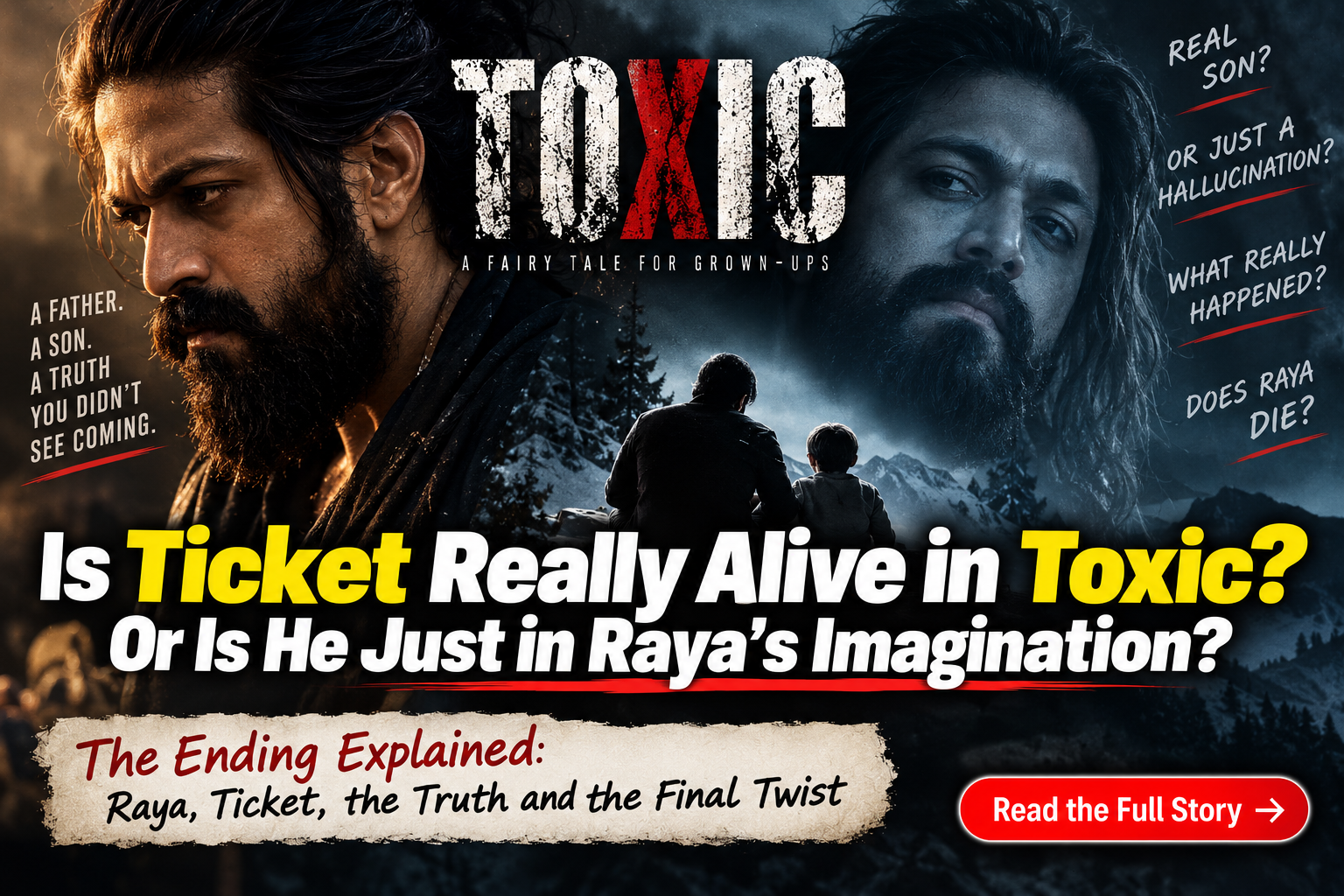
  • Is Ticket Really Alive in Toxic? Or Is He Just in Raya’s Imagination?

    Is Ticket Really Alive in Toxic? Or Is He Just in Raya’s Imagination?

    Major Spoiler Warning: This article reveals the ending and biggest twist of Toxic: A Fairy Tale for Grown-Ups.

    If you just walked out of Toxic thinking:

    Wait… was Ticket even real?

    You’re asking exactly the question the ending wants you to ask.

    For much of the movie, Ticket appears to be Raya’s grown-up son.

    He narrates the story.

    He confronts his father.

    He attacks the empire Raya spent years building.

    He even appears to threaten Raya’s other son, Adam.

    So naturally, we assume:

    Ticket survived childhood and came back for revenge.

    Then the ending changes everything.

    No — the adult Ticket is not actually alive.

    The climax reveals that the real Ticket died years earlier.

    The adult Ticket we’ve been watching is a manifestation of Raya’s guilt, grief and fractured state of mind.

    And once you understand that twist, a huge part of Toxic suddenly looks different.


    What Really Happened to Ticket in Toxic?

    Ticket is Raya and Nadia’s son.

    The film initially encourages us to believe that Ticket survived his traumatic childhood and eventually grew into the adult man played by Yash.

    But that’s not what really happened.

    Raya had tried to kill Ticket when he was a child.

    He later changed his mind.

    But by then, according to the film’s final reveal, it was too late.

    Ticket died.

    Raya couldn’t save him.

    That truth becomes one of the defining psychological wounds of Raya’s life.

    Instead of fully processing what he did, Raya’s mind eventually creates something else:

    an adult version of the son who never got to grow up.

    That is the Ticket we spend so much time watching.


    Then Who Is the Adult Ticket?

    The simplest explanation is:

    Ticket is Raya’s guilt given a human form.

    He’s the son Raya lost.

    He’s also the consequence Raya cannot escape.

    Ticket grows up in Raya’s mind because the real child never had the opportunity to.

    That makes the casting particularly important.

    Yash plays both Raya and Ticket.

    At first, that looks like a conventional dual role.

    By the ending, it means something completely different.

    The apparent father-versus-son conflict has also been:

    Raya versus Raya.

    India Today describes Ticket as part of Raya’s imagination, created by a mind unable to cope with the guilt and trauma of the child’s death.


    Why Does Raya Imagine Ticket?

    Because Raya cannot escape what he did.

    His criminal empire gives him power.

    It doesn’t give him peace.

    Over the course of the story, he also suffers devastating losses, including Ganga and Nadia.

    As those losses accumulate, his psychological state deteriorates.

    Ticket becomes the physical representation of something Raya has spent years suppressing:

    his guilt over his son.

    That’s why Ticket is much more than an imaginary friend.

    He’s almost Raya’s punishment.

    Every time Ticket threatens Raya’s family, power or empire, the movie can be read as showing Raya’s unresolved trauma destroying the life he built.


    Why Does Ticket Want Revenge on Raya?

    Before the twist, the answer seems obvious.

    Ticket believes his father tried to kill him.

    So he grows up.

    Returns.

    And wants revenge.

    But after the reveal, Ticket’s behavior becomes much stranger.

    He says he hates Raya.

    Yet he doesn’t simply kill him when he gets the opportunity.

    At another point, he even saves Raya.

    Why?

    Because Ticket isn’t an independent revenge-seeking son.

    He exists inside Raya’s fractured psychological world.

    So Ticket’s contradictory behavior reflects Raya’s own conflict with himself.

    Part of Raya wants punishment.

    Part wants forgiveness.

    Part wants to forget.

    And another part desperately wants the son he lost to still exist.

    Ticket embodies all of those contradictions.


    Wait — If Ticket Isn’t Real, Who Has Been Narrating Toxic?

    Now we’ve reached the really clever part.

    Ticket.

    The imaginary character.

    Ticket narrates much of the story.

    That means Toxic gives us an unreliable narrator.

    Once the movie reveals that the person telling us the story doesn’t physically exist in the present timeline, we’re forced to reconsider everything we’ve watched.

    And that’s why the ending isn’t simply:

    “Surprise! Ticket was imaginary.”

    The bigger question becomes:

    How much of Toxic actually happened exactly the way we saw it?

    India Today explicitly raises this problem: if Ticket exists inside Raya’s fractured psyche, some events may be real, some distorted by memory and guilt, and some potentially internal to Raya’s mind.

    The film doesn’t neatly label every scene for us.

    That’s deliberate.


    Was Everything in Toxic Just Raya’s Imagination?

    No — that’s going too far.

    The reveal does not necessarily mean:

    “None of the movie happened.”

    The criminal world exists.

    Raya exists.

    His relationships and losses exist within the story.

    What becomes uncertain is our perception of events involving Ticket and how accurately Raya’s fractured mind has presented parts of the story.

    So a better interpretation is:

    The movie happened, but we cannot completely trust the version of reality we were shown.

    That’s very different from saying:

    “It was all a dream.”


    Did Ticket Really Kidnap Adam?

    This becomes one of the most interesting questions after the reveal.

    Before we know the truth, Ticket appears to kidnap Adam and attempt to recreate the violence Raya once inflicted on him.

    But Ticket doesn’t physically exist as the independent adult man we thought he was.

    So who is really responsible?

    The ending pushes us toward a darker interpretation:

    Raya himself is the danger.

    The imaginary Ticket is the form through which Raya’s collapsing mind expresses that danger.

    People around Raya also appear to recognize that something is seriously wrong with him.

    This makes the second half considerably darker on a rewatch.

    Raya isn’t fighting an enemy coming to destroy his family.

    His own unresolved trauma is destroying it.


    Why Are Raya and Ticket Both Played by Yash?

    Before the ending, it’s a star-driven dual role.

    After the ending, the casting becomes part of the clue.

    Raya sees his son as an adult.

    But the adult Ticket is also an extension of Raya himself.

    Having Yash play both characters visually reinforces that idea.

    Father and son appear to be fighting each other.

    Psychologically, Raya is fighting himself.

    The movie therefore disguises an internal conflict as an external gangster rivalry for much of its runtime.

    That’s why the final reveal changes the meaning of earlier scenes rather than merely adding one last surprise.


    What Does Ticket Symbolize?

    Ticket can be interpreted as several things simultaneously.

    He represents:

    Raya’s dead son

    Raya’s guilt

    Raya’s grief

    the consequences of his violence

    and ultimately

    the part of Raya he cannot suppress anymore.

    The criminal empire may have survived enemies, betrayals and attacks.

    But Raya cannot defeat his own memory.

    That’s arguably the central idea behind the title’s psychological ending.

    The most dangerous thing in Raya’s life isn’t another gangster.

    It’s Raya himself.


    Why Does Ticket Save Raya If He Hates Him?

    This makes far more sense after the twist.

    If Ticket were simply a real son seeking revenge, his inconsistent behavior might seem strange.

    He wants to punish Raya.

    But he repeatedly stops short of completely destroying him.

    And he even saves him.

    After the reveal, the contradiction becomes meaningful.

    Ticket isn’t operating with his own independent psychology.

    He’s part of Raya.

    Raya simultaneously hates himself and wants to survive.

    He wants punishment and forgiveness.

    He wants Ticket gone and wants Ticket alive.

    That contradiction is exactly what the imaginary Ticket represents.


    What Happens in Toxic’s Final Avalanche Scene?

    The movie’s final moments move away from conventional gangster logic.

    An avalanche approaches Raya.

    Instead of giving viewers a straightforward victory or defeat, the scene becomes psychological.

    Raya finally embraces Ticket.

    But now we know what Ticket actually represents.

    Raya isn’t simply embracing his grown son.

    He’s finally embracing the child he failed.

    And, metaphorically, he’s accepting the guilt and trauma he spent years trying to escape.

    Then the film cuts to black.

    Which creates another major question.


    Does Raya Die at the End of Toxic?

    The film deliberately makes this less certain than Ticket’s fate.

    Ticket’s truth is revealed:

    the real Ticket died years earlier.

    Raya’s final fate is more ambiguous.

    The avalanche approaches.

    Raya doesn’t receive the kind of clean, conventional death scene that would remove all doubt before the cut to black.

    Some coverage interprets the climax as Raya’s death, while other explanations emphasize that the film leaves his literal survival unresolved.

    That distinction matters.

    So the safest answer is:

    Toxic clearly resolves who Ticket is, but leaves more room to interpret exactly what happens to Raya.

    And that is likely another reason viewers leave the theatre arguing about the ending.


    Why Does Raya Stop Running?

    Because by this point, physical survival isn’t really the center of the scene anymore.

    Earlier, Raya tried to control everything.

    His empire.

    His enemies.

    His family.

    His future.

    But the one thing he couldn’t control was the past.

    By embracing Ticket as the avalanche approaches, Raya finally stops fighting the memory of his son.

    On a psychological level:

    he accepts Ticket.

    he accepts what he did.

    and he accepts what he has become.

    Whether that acceptance arrives too late is part of the tragedy.


    Is Ticket Raya’s Split Personality?

    You’ll probably see this phrase used online.

    But it’s better to be careful.

    The movie presents Ticket as a manifestation or figment of Raya’s fractured mind. Entertainment coverage also uses terms such as hallucination, imagination and unreliable narrator.

    That doesn’t automatically justify diagnosing Raya with a specific real-world psychiatric disorder.

    For understanding the movie, you don’t need a medical label.

    The important storytelling point is simply:

    Adult Ticket exists inside Raya’s psychological reality rather than as the living adult son we initially believed him to be.


    Why Is the Ending Called Ambiguous If Ticket’s Death Is Revealed?

    Because there are actually two mysteries, not one.

    Mystery 1: Is Ticket alive?

    This receives a fairly clear answer.

    No.

    The real Ticket died as a child.

    Mystery 2: How much of what we watched can we trust?

    This remains much less certain.

    Because Ticket narrated the story and exists inside Raya’s fractured perspective, the film deliberately destabilizes our understanding of earlier events.

    That’s the clever part.

    The movie answers one question and creates a much bigger one.


    So Was Ticket Ever Real?

    Yes.

    And this distinction is important.

    Ticket was a real child.

    He was Raya and Nadia’s son.

    What isn’t real in the present-day story is the adult Ticket who appears to have survived, grown up and returned to confront Raya.

    The real child died.

    Raya’s mind created the adult he might have become.

    So saying:

    “Ticket never existed”

    would be wrong.

    The better answer is:

    Ticket existed, but the adult Ticket we follow later does not exist independently of Raya’s mind.


    The Simple Answer: Is Ticket Alive in Toxic?

    If you came here because the ending confused you, here’s the shortest possible explanation.

    No. The adult Ticket isn’t really alive.

    The real Ticket died when he was young after Raya tried to kill him and later failed to save him.

    Unable to live with that guilt, Raya’s fractured mind creates an adult version of Ticket.

    That’s why Ticket can:

    return

    confront Raya

    attack his empire

    threaten Adam

    and ultimately

    stand face-to-face with his father.

    Ticket is Raya’s dead son transformed into a manifestation of guilt and trauma.

    And that’s why the final embrace matters.

    For most of the movie, Raya appears to be fighting Ticket.

    By the end, we understand:

    Raya has been fighting himself.

    The gangster who spent his life defeating enemies finally meets the one enemy he can’t kill—

    his own past.

  • Who Was Shot at the End of Mirzapur: The Movie? The Post-Credit Scene Explained

    Who Was Shot at the End of Mirzapur: The Movie? The Post-Credit Scene Explained

    Spoiler Warning: This article contains major spoilers for the movie.

    You stayed through the credits.

    Guddu, Munna and Bablu are sitting in a salon.

    At first, the scene almost feels strangely peaceful for Mirzapur.

    Then Guddu and Munna start talking.

    They realize something.

    The woman Guddu loves and the woman Munna loves are the same person: Sweety.

    The mood changes.

    The confrontation escalates.

    And then—

    Gunshots.

    The screen doesn’t give us a clear answer about what happens immediately afterward.

    So the obvious question is:

    Who was shot?

    Was it Guddu?

    Munna?

    Someone else?

    And does this mean Mirzapur: The Movie 2 is coming?

    Here’s what the ending actually tells us — and what it deliberately doesn’t.

    Does Mirzapur: The Movie Have a Post-Credit Scene?

    Yes. Mirzapur: The Movie has a post-credit scene, and it is worth staying for.

    The scene features Guddu Pandit, Munna Bhaiya and Bablu Pandit together at a salon.

    What begins as a surprisingly casual conversation quickly turns into one of the movie’s biggest cliffhangers when Guddu and Munna discover that they are both talking about the same woman:

    Sweety.

    The confrontation escalates, gunshots are heard, and the movie ends without clearly revealing who — if anyone — was hit.

    So if you’re wondering whether you should stay after the credits:

    Yes.

    The post-credit scene is not just a joke or a small bonus moment. It introduces an unresolved conflict that could become important to the next Mirzapur movie.

    But what exactly happens in that scene?

    Let’s break it down.


    What Happens in the Mirzapur Movie Post-Credit Scene?

    Let’s reconstruct the scene first.

    Guddu Pandit, Munna Bhaiya and Bablu Pandit are at a salon.

    Guddu and Munna are getting facials.

    Bablu is sitting nearby, using his phone and messaging Golu.

    Munna notices and starts teasing him about whether he’s talking to a girlfriend.

    That leads the conversation toward relationships.

    Guddu and Munna eventually reveal that they are both in love.

    Then comes the crucial moment.

    They say the woman’s name.

    And both are talking about:

    Sweety.

    Guddu refers to her as Swaranjali, while Munna calls her Sweety.

    They realize they’re in love with the same woman.

    The atmosphere immediately changes.

    The confrontation escalates.

    Then gunshots are heard.

    And the film cuts away without clearly showing the immediate outcome.

    That’s not a small extra scene.

    It’s effectively another cliffhanger.


    So Who Was Shot?

    Here’s the important answer:

    The movie does not clearly reveal it.

    At least based on what the released post-credit scene actually shows, we cannot honestly say:

    “Guddu was shot.”

    or

    “Munna was shot.”

    The ambiguity is intentional.

    The Economic Times describes the scene as ending with gunshots without revealing what happens immediately afterward, leaving Guddu and Munna’s fate unresolved.

    So if you’ve seen someone confidently claiming:

    “This person definitely gets shot.”

    be careful.

    Unless later official material confirms it, that’s a theory, not something the post-credit scene itself establishes.


    But We Already Know Guddu and Munna’s Future, Right?

    And this is where the movie becomes really interesting.

    If you’ve watched the original Mirzapur series, you already know what happens later to these characters.

    That creates an unusual problem.

    How can the movie give us a dramatic gunshot cliffhanger when we already know the future?

    The answer lies in the timeline.

    As we explained in our previous article, Mirzapur: The Movie is positioned within the Season 1-era story, rather than after Season 3. Reporting around the release places it between Episodes 6 and 7 of Season 1.

    So the post-credit scene isn’t asking:

    What happens after Season 3?

    It’s asking:

    What happened during this missing part of Season 1?

    That’s a very different mystery.


    Does That Mean Guddu Can’t Die?

    If the movie remains consistent with the established series timeline, Guddu obviously needs to survive long enough to participate in the events we’ve already seen later.

    The same basic logic applies to other characters whose later-series stories are already known.

    That gives viewers clues.

    But it still doesn’t tell us exactly what happened after those gunshots.

    Someone could be injured.

    Someone could fire without hitting anyone.

    Another person could become involved.

    Or the confrontation could resolve in some other way.

    Those possibilities are speculation.

    The film itself deliberately stops before giving the answer.


    Why Is Sweety So Important?

    Because Sweety is not just a random woman introduced for the movie.

    She is central to the rivalry between Guddu and Munna.

    In the original series, Guddu and Sweety are romantically involved, while Munna also wants her.

    Sweety does not reciprocate Munna’s feelings.

    So when the movie puts Guddu and Munna in a room and lets them discover that they’re talking about the same woman, the audience already understands how dangerous that information is.

    The post-credit scene effectively takes something viewers know from the wider Mirzapur story and turns it into a new confrontation.


    Why Didn’t Guddu and Munna Know They Loved the Same Woman?

    Remember where we are in the timeline.

    This isn’t the Guddu and Munna who have already lived through everything viewers saw in Seasons 2 and 3.

    These are earlier versions of the characters.

    That’s the key to understanding the entire movie.

    The filmmakers are revisiting a period when relationships and rivalries were still developing.

    So information that feels obvious to us as viewers isn’t necessarily obvious to the characters yet.

    That’s exactly why the reveal works.

    We know what’s coming.

    They don’t.


    Is the Post-Credit Scene Different From the Main Ending?

    Yes, and that’s worth separating.

    The main story of Mirzapur: The Movie revolves around the struggle for power surrounding Kaleen Bhaiya and the new threat posed by Babban Yadav.

    Babban wants control of Mirzapur and develops a plan involving Kaleen Bhaiya.

    But Guddu, Bablu and Munna become involved in defending the Tripathi empire.

    Then the post-credit scene shifts the focus.

    Instead of another large battle over the Mirzapur throne, it returns to something much more personal:

    Guddu vs. Munna.

    And the trigger is Sweety.

    That suggests the next movie chapter could explore not only the criminal power struggle but also the personal rivalry that fans already know becomes enormously important.


    Does Kaleen Bhaiya Die in Mirzapur: The Movie?

    This is another question appearing around the ending.

    Babban’s plan involves targeting Kaleen Bhaiya and trying to take over his power.

    But the attempt does not simply result in Babban replacing Kaleen Bhaiya as ruler of Mirzapur.

    Guddu, Bablu and Munna are all involved in protecting the Tripathi empire during this point in the timeline.

    Again, the established series itself provides an important clue.

    Because the movie occurs during Season 1, major characters who appear later in the original series cannot simply disappear without some explanation.

    That’s why knowing the timeline makes the ending much easier to understand.


    Why End the Movie With Gunshots?

    Because it’s almost a perfect sequel hook.

    Think about what the scene accomplishes.

    In only a few minutes it:

    reconnects Guddu and Munna’s rivalry

    brings Sweety directly into the conflict

    uses Bablu and Golu’s relationship

    creates an unanswered shooting

    and

    gives viewers a reason to wait for another movie.

    The Economic Times reports that a sequel to Mirzapur: The Movie has been reported as confirmed.

    So those gunshots may not be intended as an ending at all.

    They may be the beginning of the next movie.


    Is Mirzapur: The Movie 2 Confirmed?

    This needs careful wording.

    Current entertainment reporting says a sequel has reportedly been confirmed, with the Economic Times citing reporting from Times Now.

    That’s different from inventing a release date.

    At this point, you should be skeptical of any precise date circulating online unless the filmmakers or studio officially announce it.

    What we can say with much greater confidence is that the post-credit scene is clearly constructed to leave room for another chapter.

    And there is plenty left unresolved.

    Most obviously:

    What happened after the gunshots?


    Could Mirzapur: The Movie 2 Change the Original Timeline?

    Possibly — but we should not assume that yet.

    This is where fan theories can easily turn into false facts.

    The movie revisits an existing period of Mirzapur history while telling a new story.

    That creates two possibilities.

    The filmmakers could keep everything compatible with the series.

    Or they could eventually create differences significant enough that viewers begin treating the films as an alternate version of events.

    Some reviews have already described the film as effectively resetting or revisiting the franchise’s earlier world, but that is critical interpretation rather than proof that the official continuity has been replaced.

    Until the filmmakers clarify otherwise, the safest approach is:

    Don’t assume the original series has been erased.


    Why Does the Ending Feel So Confusing?

    Because the audience has more information than the characters.

    That’s unusual.

    In most mysteries:

    Characters know something → audience tries to discover it.

    Here, it’s almost reversed:

    Audience knows the future → characters haven’t reached it yet.

    We know where many of these relationships eventually go.

    But now we’re watching an additional story inserted into their past.

    That means every new event creates another question:

    How does this fit with what we’ve already seen?

    The gunshots are particularly effective because viewers know Guddu and Munna still have major roles ahead of them.

    So the mystery isn’t necessarily:

    “Does the entire Mirzapur story suddenly change?”

    It’s:

    “What happened here that still allows the story we know to happen later?”


    Could Nobody Have Been Shot?

    Yes.

    That’s one possibility.

    But it is only a possibility.

    Hearing gunshots does not automatically tell us:

    who fired

    how many people fired

    whether anyone was hit

    or

    how seriously anyone was injured.

    The released scene intentionally withholds that information.

    Therefore:

    “Nobody was shot”

    is not yet the answer either.

    It’s simply one theory.

    This distinction is important because search articles often turn theories into facts just to make a stronger headline.

    We shouldn’t.


    Could Munna Have Been Shot?

    Also possible.

    But again, we don’t know.

    Because Munna’s later story exists in the original series, any serious injury would need to be reconciled with what happens afterward.

    The same applies to Guddu.

    That makes the question more interesting than a normal “Who died?” cliffhanger.

    We already know both men have a future.

    What we don’t know is:

    what happened between the gunshots and that future.


    Does Sweety Survive the Movie?

    The post-credit scene is centered around Guddu and Munna discovering their shared feelings for Sweety.

    But the scene itself should not be interpreted as rewriting everything viewers know about Sweety’s later fate.

    Again:

    The movie happens earlier.

    This is the same reason Munna can appear alive in the movie despite viewers knowing what happens to him later.

    The film is filling in an earlier period rather than simply continuing beyond Season 3.


    What Should You Watch After Mirzapur: The Movie?

    If you’re a newcomer who watched the movie first and now wants to follow the story chronologically, the most useful thing to understand is where the movie sits.

    The film has been reported as fitting between Season 1 Episodes 6 and 7.

    So the rough chronological route is:

    Season 1 Episodes 1–6

    ↓

    Mirzapur: The Movie

    ↓

    Season 1 Episodes 7–9

    ↓

    Season 2

    ↓

    Season 3

    That explains both:

    why Munna is alive

    and

    why the post-credit conflict can happen.


    So Who Was Shot at the End of Mirzapur: The Movie?

    For anyone who came here wanting one simple answer:

    We don’t know yet.

    The post-credit scene intentionally ends after Guddu and Munna realize they both love Sweety and their confrontation escalates into gunshots.

    It does not clearly reveal who was hit or what happens immediately afterward.

    That’s the point of the cliffhanger.

    So right now:

    Guddu being shot = theory.

    Munna being shot = theory.

    Nobody being shot = theory.

    The only confirmed part is the confrontation and the gunshots.

    And because another movie has reportedly been confirmed, the unanswered question may be exactly where the next chapter begins.

    Until then, the most accurate answer isn’t the most exciting one.

    It’s simply:

    Mirzapur hasn’t told us yet.

  • Why Is Munna Bhaiya Alive in Mirzapur: The Movie If He Died in Season 2?

    Why Is Munna Bhaiya Alive in Mirzapur: The Movie If He Died in Season 2?

    If you watched Mirzapur Season 2, seeing Munna Bhaiya in Mirzapur: The Movie can be confusing.

    Wait.

    Didn’t Munna die?

    So why is Divyenndu suddenly back as Munna Tripathi?

    Did the filmmakers bring him back from the dead?

    Did he somehow survive?

    Is the movie ignoring Season 2?

    Or is Mirzapur: The Movie happening in a completely different timeline?

    The answer is actually much simpler.

    Munna Bhaiya did not come back to life.

    Mirzapur: The Movie takes place in the past.

    The movie is set between Episode 6 and Episode 7 of Mirzapur Season 1.

    That means the events of the movie happen long before Munna’s fate in Season 2.

    So yes:

    Munna is supposed to be alive.

    Let’s put the timeline in the right order.


    Where Does Mirzapur: The Movie Fit in the Timeline?

    This is the most important thing to understand.

    If you watch the story chronologically, the order is:

    Mirzapur Season 1 — Episodes 1–6

    ↓

    Mirzapur: The Movie

    ↓

    Mirzapur Season 1 — Episodes 7–9

    ↓

    Mirzapur Season 2

    ↓

    Mirzapur Season 3

    A viewer who had just watched the movie posted essentially this same sequence after seeing it:

    S1 E6 → Movie → E7, E8, E9 → S2 → S3.

    That’s the trick.

    The movie was released after three seasons of Mirzapur.

    But it doesn’t take place after Season 3.

    It jumps all the way back to Season 1-era Mirzapur.


    So Did Munna Bhaiya Really Die in Mirzapur?

    Yes.

    The movie does not erase what happened later in the series.

    And it doesn’t require Munna to have secretly survived.

    Think about it like this.

    Suppose a character dies in Chapter 20 of a book.

    Then the author publishes a new story set between Chapters 5 and 6.

    That character can obviously appear in the new story.

    Not because he came back from the dead.

    But because:

    He hasn’t died yet.

    That’s essentially what Mirzapur: The Movie is doing with Munna.


    When Does Munna Bhaiya Die in Mirzapur?

    This is another question viewers frequently ask after seeing Munna alive again in the movie.

    Munna’s death comes in Mirzapur Season 2, after the period in which the movie takes place.

    That distinction is important.

    The chronological order is not:

    Season 1 → Season 2 → Season 3 → Movie.

    Instead, the movie has been inserted back into the Season 1 timeline.

    So when you see Munna alive in the movie, you are watching a younger Munna who has not yet reached the events that lead to his death.

    Nothing about the movie requires his Season 2 fate to be reversed.


    Is Munna Bhaiya Alive in Mirzapur Season 3?

    This is where the movie’s unusual timeline creates the most confusion.

    Munna’s appearance in Mirzapur: The Movie does not mean that he survived into the main Season 3 timeline.

    Remember the order:

    Movie Munna = Season 1-era Munna.

    By the time the main story reaches Season 3, the events surrounding Munna’s fate in Season 2 have already happened.

    So if you’re asking:

    Is Munna Bhaiya secretly alive in Mirzapur Season 3?

    The movie itself does not establish that.

    It simply allows viewers to see Munna again by returning to a period when he was still alive.

    This is why two statements can both be true:

    Munna died in the series timeline.

    And:

    Munna is alive in Mirzapur: The Movie.

    They happen at different points in the story.


    Why Did Mirzapur Bring Munna Back?

    Now we get to the more interesting question.

    Why would the filmmakers deliberately move the story backward?

    One obvious advantage is that it allows several beloved characters from early Mirzapur to exist together again.

    India Today reported before release that Divyenndu was returning as Munna alongside Ali Fazal as Guddu Pandit and Pankaj Tripathi as Kaleen Bhaiya.

    And Munna isn’t the only clue that we’re going backward.

    Shweta Tripathi said returning to the Season 1 version of Golu was actually challenging because she had spent years playing the later, revenge-driven version of the character.

    For the movie, she had to mentally return to who Golu was much earlier in the story.

    That’s a pretty strong indication of what the filmmakers are doing.

    They’re not undoing later Mirzapur.

    They’re revisiting an earlier version of it.


    Is Mirzapur: The Movie a Prequel?

    Sort of — but calling it simply a “prequel” can also be misleading.

    It isn’t set before the entire Mirzapur series.

    Instead, it’s better described as an interquel.

    That’s a story inserted between events that have already happened in an existing series.

    In this case:

    Season 1 starts.

    Six episodes happen.

    The movie fits here.

    Then Season 1 continues.

    So if someone asks:

    Is Mirzapur: The Movie a prequel?

    The clearest answer is:

    It is a story set inside the existing Season 1 timeline rather than a sequel to Season 3.


    Is Mirzapur: The Movie Canon?

    This is where things get more interesting.

    The movie clearly uses the established Mirzapur world and characters.

    But it isn’t simply replaying old episodes.

    Pankaj Tripathi described the basic idea before release as:

    the characters are the same, but the story is new.

    He also said existing viewers would find answers to some questions, while people who had never watched the series should still be able to follow the film as a standalone story.

    That tells us something important.

    The filmmakers are trying to do two things at once:

    give existing fans additional Mirzapur story

    while also

    making a theatrical movie understandable to newcomers.

    And that helps explain some of the unusual choices.


    Do I Need to Watch the Mirzapur Series Before the Movie?

    Not necessarily.

    According to Pankaj Tripathi, the film was designed so people who haven’t watched the series can still follow it.

    So technically:

    No, you don’t have to watch all three seasons first.

    But there’s an important difference between:

    understanding the plot

    and

    understanding why fans care so much about these characters.

    Someone who already knows Kaleen Bhaiya, Guddu, Munna and Golu will naturally recognize relationships and references that mean less to a newcomer.

    So if you have never watched Mirzapur, you should still be able to watch the movie.

    But existing fans will see it differently.


    Why Is Golu Different in the Movie Too?

    Because we’re seeing an earlier Golu.

    This detail is easy to miss if you haven’t thought about the timeline.

    The Golu viewers know from later Mirzapur has been transformed by violence, loss and revenge.

    But the movie takes us back before much of that development.

    Shweta Tripathi said returning to that older version of Golu initially felt confusing because she had to undo years of character development in her own mind.

    So if you’re watching the movie and thinking:

    Why isn’t Golu acting like the Golu from Season 3?

    That’s the reason.

    She isn’t Season 3 Golu yet.

    Exactly the same logic explains Munna.


    What About Guddu and Munna?

    This is where the movie’s timeline becomes even more useful.

    By returning to Season 1, the filmmakers can explore relationships that later events permanently changed.

    And Mirzapur: The Movie takes advantage of that.

    The movie’s post-credit scene puts Guddu, Munna and Bablu together.

    Guddu and Munna eventually discover that they’re both talking about the same woman — Sweety — before the scene escalates and ends with gunshots.

    That scene would be impossible to construct in exactly the same way if the story simply continued after Season 3.

    Going backward restores those earlier character dynamics.


    Wait — Does the Movie Change What Happened in the Series?

    This is the question to watch carefully.

    A movie inserted into an existing timeline has a difficult job.

    It needs to tell a new story.

    But it also has to arrive at a point where the original story can continue.

    That’s why viewers are already examining how the film fits between Episodes 6 and 7.

    The simplest way to understand it for now is:

    Don’t treat the movie as “Season 4 in cinemas.”

    Treat it as:

    “A missing Mirzapur story from Season 1.”

    That mental model solves most of the confusion.


    Is Munna Bhaiya Alive in Mirzapur Season 4?

    This is another question the movie naturally creates.

    But again, Munna appearing alive in Mirzapur: The Movie does not automatically mean he is alive in the Season 4 timeline.

    The reason is simple.

    The movie and Season 4 occupy different parts of the Mirzapur chronology.

    The movie returns to the Season 1 era.

    Season 4, by contrast, belongs to the continuing series storyline after the events viewers have already seen.

    So the movie should not be treated as proof that Munna secretly survived and will simply walk back into the present-day story.

    Could Mirzapur eventually find another way to use Munna again?

    The franchise can always surprise viewers.

    But based on the movie’s timeline alone, the answer is clear:

    Movie Munna is alive because we have gone back in time — not because the movie has confirmed that Munna survived into Season 4.


    Why Didn’t They Just Make Mirzapur Season 4?

    Because the movie appears to have a different purpose.

    The creators are taking a franchise built through streaming and turning it into a theatrical event.

    That allows audiences to see familiar characters on the big screen while also reopening an era of the story that contained several fan-favourite characters.

    And that makes Munna particularly valuable.

    For many viewers, Munna became one of the most memorable characters in the entire franchise.

    Moving backward in time allows the filmmakers to use him again without simply saying:

    “Surprise! He wasn’t actually dead.”

    That’s a much cleaner storytelling solution.


    Is Munna Bhaiya Alive After Season 2 Then?

    No — the movie itself is not evidence of that.

    This distinction matters.

    If someone searches:

    Is Munna alive after Season 2?

    the movie does not prove it.

    Why?

    Because the movie happens before Season 2.

    So Munna appearing here tells us nothing new about whether he survived the later events of the series.

    This movie version of Munna hasn’t reached those events yet.


    Why Does Mirzapur: The Movie Feel Like Season 1?

    Because that’s essentially the point.

    The characters are being returned to their earlier relationships and personalities.

    Golu is closer to early Golu.

    Munna is alive.

    Guddu and Bablu’s earlier dynamic can exist again.

    Kaleen Bhaiya is operating inside that earlier Mirzapur power structure.

    The movie isn’t asking viewers:

    “What happened after Season 3?”

    It’s asking something closer to:

    “What else happened during the Mirzapur story we thought we already knew?”

    That’s a completely different kind of franchise expansion.


    What Happens in the Mirzapur Movie Post-Credit Scene?

    Major spoiler from here.

    The post-credit scene is worth staying for because it creates another mystery.

    Guddu, Munna and Bablu are together at a salon.

    Guddu and Munna begin discussing the women they love.

    Then they reveal the names.

    Guddu says Swaranjali.

    Munna says Sweety.

    They realize they’re talking about the same woman.

    The confrontation escalates.

    Then:

    gunshots.

    But the movie doesn’t immediately reveal the outcome.

    And that creates the next obvious Google question:

    Who was shot?

    Which is exactly why the ending is likely to generate another wave of searches.


    Does Mirzapur: The Movie Set Up a Sequel?

    The post-credit cliffhanger certainly gives the filmmakers somewhere to go.

    The Economic Times reports that a sequel has been reported as confirmed, although the precise continuation of the gunshot cliffhanger isn’t revealed in the movie itself.

    So don’t interpret the unresolved ending as an accident.

    It’s a hook.

    And it gives audiences another reason to wonder how this new movie storyline will fit into the established Mirzapur timeline.


    Munna Bhaiya Dead or Alive? The Timeline at a Glance

    Here’s the easiest way to remember it:

    Mirzapur Season 1 Episodes 1–6
    Munna is alive.

    ↓

    Mirzapur: The Movie
    Munna is alive because this story still takes place during the Season 1 era.

    ↓

    Mirzapur Season 1 Episodes 7–9

    ↓

    Mirzapur Season 2
    Munna reaches the events that determine his fate.

    ↓

    Mirzapur Season 3
    The main series continues after those events.

    ↓

    Mirzapur Season 4
    Munna’s appearance in the movie should not by itself be taken as evidence that he survived into this later timeline.


    Munna Bhaiya FAQ

    Did Munna Bhaiya die in Mirzapur?

    Yes. Munna’s fate occurs in Season 2. The movie does not erase those events.

    Is Munna Bhaiya alive in Mirzapur Season 3?

    His appearance in Mirzapur: The Movie does not mean he survived into the Season 3 timeline. The movie takes place much earlier.

    Is Munna Bhaiya alive in Mirzapur: The Movie?

    Yes. He is alive because the movie is set during the Season 1 era, before his later fate.

    How is Munna Bhaiya alive in Mirzapur: The Movie?

    He wasn’t resurrected. The story has moved backward in time to a period when Munna was still alive.

    Is Munna Bhaiya alive in Mirzapur Season 4?

    The movie does not establish that. His movie appearance happens in the Season 1-era timeline and should not be treated as proof that he survived into Season 4.

    Is Munna Bhaiya dead or alive?

    It depends on where you are in the timeline. He is alive during the events of the movie because those events occur before his Season 2 fate.

    Is Mirzapur: The Movie a sequel to Season 3?

    No. It returns to the Season 1 era rather than simply continuing the story after Season 3.

    Is Mirzapur: The Movie canon?

    The film is presented as an additional story involving the established Mirzapur characters inside the earlier timeline rather than as a replacement for what happened in Seasons 2 and 3.


    The Simple Answer: Why Is Munna Bhaiya Alive?

    If you’ve come here looking for the shortest possible explanation, here it is:

    Munna Bhaiya is alive in Mirzapur: The Movie because the movie takes place before his death.

    More specifically:

    Season 1 Episodes 1–6

    → Mirzapur: The Movie

    → Season 1 Episodes 7–9

    → Season 2

    → Season 3.

    So:

    Munna wasn’t resurrected.

    The series wasn’t reset.

    The movie isn’t taking place after Season 3.

    We have simply gone back in time.

    And once you understand that one detail, almost everything else about Mirzapur: The Movie suddenly makes much more sense.