You hear a noise in the kitchen at night.
The next morning, you find a few tiny droppings behind the refrigerator.
So you buy a mouse trap.
Then comes the surprisingly difficult question:
What should you put on it?
Cheese?
Peanut butter?
Chocolate?
Bacon?
Pet food?
Search online and you’ll find dozens of answers.
Search Reddit and things get even more interesting.
One person swears by peanut butter. Another says the mouse licked every bit of peanut butter off the trap without getting caught. Someone else recommends chocolate, pet kibble, jerky, cereal — or combinations that sound more like a snack recipe than pest control.
So what is actually the best mouse trap bait?
The short answer is:
Peanut butter is still one of the best places to start.
But the longer answer is more useful.
Because successful mouse trapping isn’t only about what you put on the trap.
It’s also about how much you use, how securely the bait sits on the trigger, and where you put the trap.
Let’s separate official guidance from internet folklore.
Is Peanut Butter Really the Best Mouse Trap Bait?
There’s a reason peanut butter appears in almost every discussion about catching mice.
It’s aromatic.
It’s calorie-dense.
It’s easy to put on a trap.
And unlike a loose piece of food, it sticks to the trigger.
More importantly, peanut butter isn’t just a Reddit recommendation.
The U.S. Centers for Disease Control and Prevention specifically recommends putting a small amount of bait such as chunky peanut butter on the bait pan of a traditional snap trap.
Older CDC technical guidance has also described a mixture of peanut butter and rolled oats as suitable snap-trap bait.
So if you’re standing in your kitchen wondering what to try first:
Start with peanut butter.
But there is a catch.
The Biggest Peanut Butter Mistake: Using Too Much
This sounds backwards.
If mice like peanut butter, shouldn’t more peanut butter attract them better?
Not necessarily.
Your goal isn’t to feed the mouse.
Your goal is to make the mouse interact with the trap’s trigger.
The CDC recommends only a small amount of bait.
And this matches one of the most common complaints from homeowners online:
“The peanut butter disappeared, but the trap didn’t go off.”
In a popular Reddit discussion asking for the best mouse-trap bait, peanut butter received more than 150 upvotes.
But buried underneath were frustrated replies from people saying mice had managed to remove tiny amounts of peanut butter from multiple traps without triggering them.
That’s the key lesson.
More bait isn’t necessarily better bait.
Use enough to attract the mouse, but not so much that it can enjoy dinner without properly contacting the trigger.
Why Does Peanut Butter Work So Well?
There are several practical advantages.
1. It sticks
A mouse can’t simply pick up a dab of peanut butter and run away with it like a piece of cheese.
2. It has a strong food odor
This makes it useful in places where mice are already traveling.
3. It can be worked into the bait area
That can force the mouse to spend more time interacting with the trigger.
4. It’s inexpensive and easy to find
You probably already have some.
That makes peanut butter a very good first bait.
But “good first bait” isn’t the same as “the only bait that ever works.”
What Does Reddit Say Is the Best Mouse Trap Bait?
This is where things become entertaining.
A long-running r/homestead discussion asked one simple question:
What is the best bait for a mouse trap?
Peanut butter dominated the discussion, but users also reported success with:
- Chocolate
- Chocolate chips
- Pet kibble
- Beef jerky
- Dog treats
- Sweet corn
- Cereal
- Sticky candy
- Nuts
Some commenters described combining a solid food with peanut butter so that the mouse had to chew or pull at the bait rather than simply lick it away.
Another recent r/pestcontrol question came from someone who didn’t have peanut butter or chocolate spread and wondered whether cheese, jam, salami, cereal bars or other foods would work.
Even there, the discussion quickly turned toward a second issue:
How securely is the bait attached to the trigger?
This is useful information.
But remember:
Reddit anecdotes are not controlled scientific experiments.
A bait that caught six mice in someone’s garage isn’t automatically the world’s best mouse bait.
So let’s compare the major options more carefully.
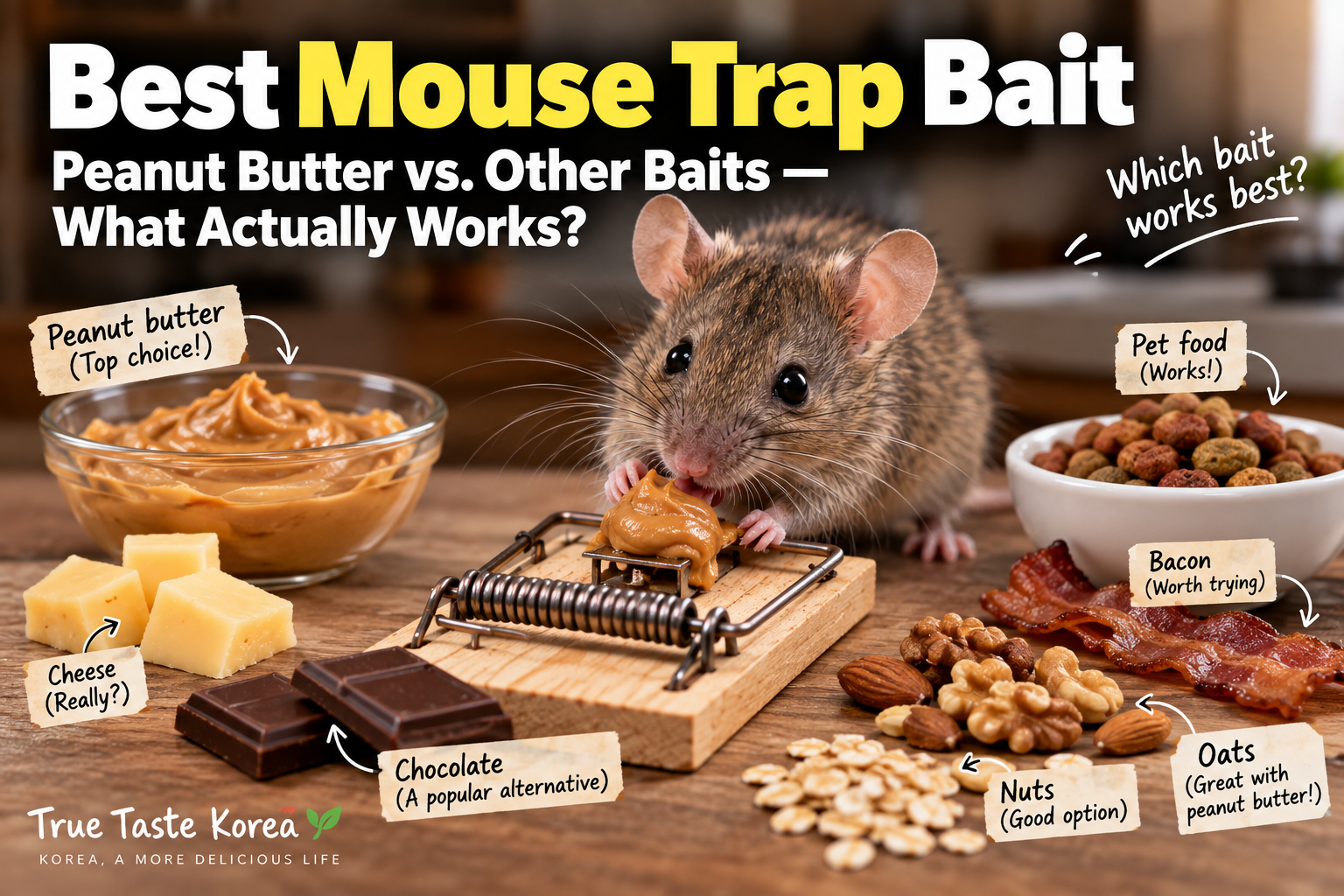
1. Peanut Butter — Best Overall Starting Point
Verdict: ★★★★★
If you have no idea what to use, start here.
CDC guidance specifically recommends a small amount of chunky peanut butter as snap-trap bait.
Advantages
- Strong smell
- Sticky
- Cheap
- Easy to apply
- Officially recommended
- Widely reported to work
Disadvantage
A clever or very small mouse may sometimes lick accessible bait without triggering the trap.
That’s why quantity and placement matter.
2. Peanut Butter + Oats — An Interesting Upgrade
Verdict: ★★★★★
This combination deserves more attention.
CDC technical material has recommended a mixture of peanut butter and rolled oats because the sticky mixture adheres to the trigger.
It also makes intuitive sense.
Instead of a smooth dab that can potentially be licked away, the oats give the bait texture.
For someone repeatedly losing plain peanut butter from a trap, this is one of the first alternatives I would consider.
3. Chocolate — The Reddit Favorite Alternative
Verdict: ★★★★☆
Chocolate appears surprisingly often in Reddit mouse-control discussions.
Several users report success with chocolate chips or chocolate-based candy, particularly when peanut butter hasn’t worked.
Older public pest-management guidance has also listed chocolate candy among foods attractive to rodents.
The problem
A loose chocolate chip can potentially be removed.
If you’re using a solid bait, the way it is secured to the trap becomes important.
Follow the trap manufacturer’s instructions and avoid modifications that interfere with its safe operation.
4. Pet Food — Convenient If You Already Have It
Verdict: ★★★☆☆
Dog and cat kibble appears regularly in homeowner discussions.
And it makes sense.
If mice are already stealing your pet’s food, you have evidence that the food is attractive to the mice in your house.
Public pest-control guidance has also listed dog or cat kibble among foods that can attract rodents.
But there’s a practical drawback.
A dry piece of kibble can be easier to remove than a sticky bait.
That brings us back to the same principle:
Attraction isn’t everything.
The mouse needs to interact with the trigger.
5. Bacon, Sausage and Meat — Do They Work?
Verdict: ★★★☆☆
Forget the cartoon stereotype that mice only want cheese.
Rodents can be attracted to many calorie-rich foods.
Older pest-management guidance lists foods including bacon and sausage among possible rodent baits.
Reddit users also occasionally report success with jerky and meat-based pet treats.
But these foods have disadvantages.
They can spoil.
They can smell.
And they may attract insects.
For a normal household snap trap, I would still start with peanut butter before opening the bacon package.
6. Cheese — Is the Cartoon Actually Right?
Verdict: ★★☆☆☆
Mice can certainly eat cheese.
The problem is that the question isn’t:
“Will a mouse eat this?”
The question is:
“Is this the most practical bait for this trap?”
A loose piece of cheese can potentially be removed.
Some pest-control guidance recommends securing non-sticky bait to the trigger so rodents can’t simply steal it.
So cheese isn’t useless.
It’s just not automatically superior because cartoons have spent a century telling us mice love it.
If peanut butter is available, that’s still where I’d begin.
7. Nuts and Seeds — Worth Trying in the Right Situation
Verdict: ★★★☆☆
Mice naturally consume grains, seeds and other foods.
Nuts and seeds also appear repeatedly in trapping discussions.
Some Reddit users describe pressing nuts into bait mechanisms or combining seeds with peanut butter.
Again, don’t overcomplicate it.
If peanut butter is working, there is no reason to create an elaborate mouse tasting menu.
But if the mice are ignoring your bait and you know they have been eating bird seed, cereal or nuts elsewhere in the house, that information is useful.
8. What About Nesting Material Instead of Food?
Here’s something many homeowners don’t consider.
Food isn’t the only thing a mouse may want.
Some pest-management guidance suggests that nesting material such as cotton can sometimes be attached to a trap trigger instead of food.
This can be especially interesting when food bait isn’t attracting attention.
But for the average homeowner beginning with a normal mouse problem, I’d still keep things simple:
Start with a properly positioned snap trap and a small amount of peanut butter.
The Best Bait May Be the Food Your Mice Are Already Eating
This is one of the smartest practical ideas.
Suppose you discover a cereal package with chew marks.
Or your dog food keeps disappearing overnight.
Or you find evidence that something has been eating bird seed in the garage.
That tells you something.
The mouse has already revealed a food preference.
So instead of searching endlessly for the internet’s universal “best mouse bait,” look at the evidence inside your own home.
What are your mice already stealing?
That can sometimes be more useful than another top-ten list.
The Secret Isn’t Always Better Bait — It’s Better Placement
This is probably the most important section of the article.
You could have the most irresistible mouse bait ever invented.
It won’t help much if the trap is sitting in the middle of a room the mouse never crosses.
The CDC recommends placing snap traps on the floor against a wall, with the baited end beside the wall so the trap forms a T shape with it.
Why?
Rodents tend to travel next to walls and objects for protection.
Look for:
- Droppings
- Gnaw marks
- Damaged food packages
- Nesting material
- Urine evidence
- Activity behind appliances
- Activity beneath sinks
- Activity inside cabinets
The EPA also lists droppings, nesting material, chewed food packaging, holes and stale odors among common signs of rodent infestation.
Find the mouse highway first.
Then put your bait there.
Peanut Butter vs. Chocolate vs. Cheese: Quick Comparison
| Bait | My Rating | Biggest Advantage | Biggest Problem |
|---|---|---|---|
| Peanut butter | ★★★★★ | Sticky, aromatic, CDC-recommended | Can sometimes be licked off |
| Peanut butter + oats | ★★★★★ | Sticky with added texture | Requires mixing |
| Chocolate | ★★★★☆ | Frequently reported by homeowners | Solid pieces can be stolen |
| Pet kibble | ★★★☆☆ | Familiar household food | Easy to carry away |
| Nuts/seeds | ★★★☆☆ | Natural food source | May be removable |
| Meat/jerky | ★★★☆☆ | Strong odor | Can spoil |
| Cheese | ★★☆☆☆ | Mice may eat it | Often less practical than sticky bait |
| Nesting material | Special use | Doesn’t rely on hunger | Situation-dependent |
Important: These ratings are a practical editorial comparison, not a CDC ranking.
What If the Mouse Eats the Bait but Never Gets Caught?
This is exactly the problem we covered in our previous guide.
If bait keeps disappearing:
First, use less.
Then check whether the bait is properly positioned on the trigger.
Next, move the trap onto an actual travel route.
And consider whether you need more than one trap.
If you’re experiencing this exact problem, read:
Mice Keep Stealing the Bait? Why Your Mouse Trap Isn’t Working
That guide explains why mice can sometimes eat the bait without triggering the trap and how trap placement changes the odds.
What If Nothing Touches the Bait?
Different problem.
If the peanut butter remains untouched night after night, consider three possibilities:
The trap is in the wrong place.
The mice have another food source.
There may not currently be mouse activity at that location.
Don’t automatically keep changing foods.
Look for fresh evidence.
The EPA recommends removing accessible food and water sources, keeping garbage tightly contained and eliminating potential nesting sites as part of rodent control.
Your trap shouldn’t have to compete with an open bag of dog food ten feet away.
How Long Should You Keep Trapping?
Don’t stop simply because you caught one mouse.
The CDC recommends continuing to trap until rodent activity has stopped.
If there are no captures and no new signs such as droppings, urine spots or gnawing for a week, that is a useful indication that the rodents may be gone.
But if fresh evidence keeps appearing, trapping alone may not solve the problem.
Which brings us to the part that matters more than any bait.
The Best Mouse Bait Won’t Fix a Hole in Your House
This is where people can waste weeks.
Catch mouse.
Reset trap.
Catch another mouse.
Reset trap.
Catch another.
At some point, you need to ask:
How are they getting inside?
The EPA says some of the most important steps for eliminating and preventing rodent infestations are keeping living areas clean, preventing rodent access and eliminating nesting opportunities.
It specifically recommends sealing holes inside and outside the home and removing food, water and shelter sources.
This is the real long-term solution.
A trap removes the mouse already inside.
Sealing the entry point helps stop the next one.
What About Poison Bait?
Don’t confuse food used on a snap trap with commercial rodenticide bait.
They’re very different things.
If an infestation persists, EPA-registered rodenticide bait stations are another control option, but they must be used exactly according to label instructions.
The EPA emphasizes keeping rodenticides away from children and pets and using the bait station supplied with consumer rodenticide products.
The CDC similarly recommends traditional snap traps first and says poison or bait stations may be considered for persistent infestations.
Don’t improvise with poison.
One More Important Safety Tip
Whatever bait you choose:
Keep traps away from children and pets.
Both CDC and EPA guidance emphasize this.
And if you catch a mouse, don’t handle the rodent casually with bare hands.
The CDC provides specific guidance for disinfecting and disposing of trapped rodents safely.
So, What Is the Best Mouse Trap Bait?
If you want one simple answer:
Start with a small amount of peanut butter.
That’s supported by current CDC guidance.
If that isn’t working, don’t immediately assume the mouse dislikes peanut butter.
Check:
How much bait are you using?
Can the mouse remove it without triggering the trap?
Is the trap actually on the mouse’s travel route?
Is another food source more attractive?
Then experiment.
Peanut butter with oats can be worth trying.
Chocolate, kibble, nuts and other foods have worked for homeowners in different circumstances.
Reddit is full of creative experiments.
But the biggest lesson from both official guidance and homeowner experiences is surprisingly simple:
The best bait on a badly placed trap is still a badly placed trap.
Find where the mouse travels.
Use a small amount of attractive bait.
Set the trap correctly.
Remove other food sources.
And seal the holes that allowed the mice inside.
Because the ultimate goal isn’t finding the perfect mouse snack.
It’s reaching the point where you don’t need a mouse trap at all.
Next Guide in This Series
Where to Place Mouse Traps: 10 Best Spots in Your House
That’s the logical next question.
Because once you’ve chosen the bait, location may matter even more.
K-Beauty Shopping
Interested in Korean skincare and beauty products? You can browse K-Beauty products through OLIVE YOUNG Global.
Shop K-Beauty at OLIVE YOUNG Global
If you purchase through the link above, the site operator may receive a commission at no additional cost to you.