kkneoqkr@gmail.com

  • Why Is Ha Young Leaving The Trauma Code Season 2? Her Great-Grandfather Controversy Explained

    Ha Young will not return as Cheon Jang-mi in the follow-up to Netflix’s hit Korean medical drama The Trauma Code: Heroes on Call.

    For international viewers, the news may be especially confusing.

    Why would an actress leave one of her biggest roles because of a controversy involving her great-grandfather and events that took place during Korea’s Japanese colonial period more than a century ago?

    The answer requires more than a simple celebrity-news explanation.

    It involves Korea’s painful colonial history, the continuing sensitivity surrounding people who collaborated with Imperial Japan, and the way Ha Young originally spoke about her family history before learning more about it.

    Here is what happened — and what it could mean for The Trauma Code Season 2.


    Is Ha Young Leaving The Trauma Code Season 2?

    Yes.

    Netflix confirmed on September 1, 2026 that Ha Young will not appear in the follow-up installments of The Trauma Code: Heroes on Call.

    Ha Young played Cheon Jang-mi, the trauma center nurse who became an important member of Baek Kang-hyuk’s team in Season 1.

    She had been expected to return alongside major cast members including Ju Ji-hoon and Choo Young-woo.

    That is why the announcement immediately raised another question among fans:

    What happened?


    Why Is Ha Young Leaving The Trauma Code?

    Her departure came after a controversy involving her great-grandfather, An Sang-ho, a doctor who lived during Japan’s colonial rule of Korea.

    The controversy began after Ha Young appeared on the Korean television program Problem Child in House.

    While discussing her family background, she explained that medicine had been practiced in her family for four generations and mentioned that her great-grandfather had studied Western medicine in Japan.

    The timing was particularly sensitive.

    Her comments came shortly before August 15, Korea’s National Liberation Day, which commemorates the end of Japanese colonial rule in 1945.

    Korean internet users subsequently began examining historical records concerning her great-grandfather.

    This led to allegations concerning his pro-Japanese activities during the colonial period.


    What Did Ha Young Say About Her Great-Grandfather?

    The controversy became more serious because Ha Young had initially spoken about her family’s medical history with pride.

    Her representatives first rejected the allegations surrounding her great-grandfather as groundless.

    However, Ha Young later said that after personally examining relevant historical records, she learned about her great-grandfather’s pro-Japanese activities.

    She apologized for speaking about her family history without fully understanding that part of Korea’s past.

    She also expressed regret and said she took her ancestor’s wrongdoing seriously.

    This distinction is important.

    The controversy was not simply:

    “An actress has a controversial ancestor.”

    Part of the public reaction came from the fact that the family history had initially been presented positively, followed by an initial denial of the allegations before Ha Young later acknowledged what she had learned from the historical records.


    Why Is This Such a Sensitive Issue in South Korea?

    This is probably the most difficult part for international viewers to understand.

    Korea was under Japanese colonial rule from 1910 to 1945.

    During this period, Koreans experienced political repression, forced assimilation policies, exploitation and other abuses.

    But another issue continued after liberation.

    Many Koreans believe that people who collaborated with the Japanese colonial authorities were never adequately held accountable after 1945.

    Some collaborators and their descendants were perceived as having retained property, wealth or social privilege acquired during the colonial period.

    Because of this history, the Korean term often translated as “pro-Japanese collaborator” carries much heavier historical and emotional meaning than simply describing someone who liked Japan or Japanese culture.

    It refers to collaboration with the colonial system that ruled Korea.

    That distinction is essential for international readers.

    The controversy surrounding Ha Young therefore touched a historical wound that remains sensitive in Korean society today.


    Was Ha Young Fired by Netflix?

    There is an important distinction here.

    Netflix has not publicly said that it fired Ha Young.

    Netflix said it was respecting the actor’s position and confirmed that she would not participate in the follow-up installments.

    Reports also indicate that Ha Young communicated her decision to the production side.

    Therefore, headlines claiming that Netflix simply “fired” her because of her ancestor would go beyond what has officially been confirmed.

    What is confirmed is:

    Ha Young is leaving The Trauma Code follow-up after the controversy, and Netflix has accepted her decision.


    What Happens to Cheon Jang-mi in Season 2?

    This is now the biggest question for The Trauma Code fans.

    Cheon Jang-mi was not just a background nurse in Season 1.

    She became one of the recognizable members of the trauma team and developed strong chemistry with Baek Kang-hyuk, Yang Jae-won and the rest of the hospital staff.

    Her absence therefore creates a real casting and storytelling problem for the next installment.

    There are several possibilities.

    The production could:

    • recast Cheon Jang-mi with another actress,
    • write the character out of the story,
    • or introduce a new character who performs a similar role within the trauma team.

    For now, however, Netflix has not officially announced who will replace Ha Young or how Cheon Jang-mi’s absence will be handled.


    Who Will Replace Ha Young in The Trauma Code Season 2?

    There is currently no confirmed replacement actress.

    Fans online have already begun suggesting actresses they would like to see join the series.

    Reddit discussions, for example, have quickly turned toward possible replacements and whether Cheon Jang-mi should be recast at all.

    But these names should be treated as fan casting only.

    Until Netflix or the production team announces a replacement, claims that a specific actress has been chosen should be treated with caution.


    Is The Trauma Code Season 2 Still Happening?

    Ha Young’s departure does not mean the series itself has been canceled.

    Interest in a follow-up has remained high after the success of the first season, and preparations for the next installment have been reported to be underway.

    The original drama follows genius trauma surgeon Baek Kang-hyuk, played by Ju Ji-hoon, as he attempts to rebuild a struggling trauma center with an unconventional team.

    Season 1 consists of eight episodes and became a significant international Netflix K-drama hit.

    Ha Young’s departure changes an important part of that ensemble, but there has been no announcement that the entire follow-up project has been canceled because of her exit.


    Why International Fans May See This Differently From Korean Viewers

    The reaction to this controversy may look unusual from outside Korea.

    Some international viewers may ask:

    Why should someone today be held responsible for something their great-grandfather did?

    That is a reasonable question.

    At the same time, the Korean reaction cannot be understood simply as people blaming a descendant for an ancestor’s actions.

    The controversy also involved how the family history was publicly presented, the initial response to the allegations, the timing around Liberation Day, and a much larger unresolved historical debate over colonial collaboration.

    Understanding that context does not require every reader to agree with every reaction.

    But it does explain why the story became much larger in Korea than an ordinary celebrity family-history controversy.


    Final Thoughts

    Ha Young’s departure creates one of the biggest changes facing The Trauma Code: Heroes on Call as it prepares for its next chapter.

    Netflix has confirmed that she will not return, meaning viewers should not expect to see Ha Young playing Cheon Jang-mi in the follow-up under the current plan.

    But another mystery remains unresolved:

    What happens to Cheon Jang-mi now?

    Will Netflix recast the character?

    Will Jang-mi disappear from the story?

    Or will a completely new trauma-center nurse join Baek Kang-hyuk’s team?

    For The Trauma Code fans, that may now be the next major announcement to watch.

    This article will be updated if Netflix announces a replacement for Cheon Jang-mi or releases additional information about the next season.
  • 嵐ドキュメンタリー『5 – 嵐という時間 -』いつ配信?是枝裕和監督が撮った“最後の5人”とは

    嵐の5人を追ったドキュメンタリー映画、

    『5 – 嵐という時間 -』

    がPrime Videoで世界独占配信されます。

    しかも総監督を務めるのは、『万引き家族』などで世界的に知られる是枝裕和監督。

    「いつから配信される?」

    「どんな内容?」

    「最後のライブも見られる?」

    そんな疑問を、現在発表されている情報をもとにまとめます。

    『5 – 嵐という時間 -』はいつ配信?

    『5 – 嵐という時間 -』の配信開始日は、

    2026年12月15日(火)

    です。

    Prime Videoで世界独占配信される予定です。

    そして注目したいのが、その6日後。

    12月21日(月)には、嵐の最後のツアーを収録したコンサート映像もPrime Videoで世界独占配信されます。

    つまり12月には、

    12月15日:ドキュメンタリー映画

    12月21日:ラストツアーのコンサート映像

    という二つの大きな配信が予定されています。

    『5 – 嵐という時間 -』はどんな映画?

    この作品は、単なるライブ映像ではありません。

    嵐が活動終了へ向かっていく最後の時間を記録したドキュメンタリーです。

    大野智、櫻井翔、相葉雅紀、二宮和也、松本潤。

    5人が再び集まり、最後のドームツアーへ向かっていく姿をカメラが追います。

    撮影期間は約半年。

    ステージ上の華やかな嵐だけではなく、その裏側で5人が何を考え、どのように“最後”と向き合ったのかが重要なポイントになりそうです。

    なぜ是枝裕和監督なのか?

    今回、特に大きな注目を集めているのが是枝裕和監督です。

    是枝監督といえば、『万引き家族』をはじめ、人間関係や家族、言葉にならない感情を丁寧に描いてきた映画監督として世界的に知られています。

    そんな是枝監督が撮る「嵐の最後」。

    ここが通常のアイドルドキュメンタリーとは少し違うところです。

    豪華なステージだけではなく、

    5人の間に流れる空気。

    長い時間を一緒に過ごしてきたメンバー同士の関係。

    そして活動終了を前にした、それぞれの表情。

    そうした部分まで映し出される作品になるのかが注目されます。

    「なぜ戻ったのか」「なぜ終わるのか」

    この作品で最も気になるのは、5人自身が“嵐”について何を語るのかという点です。

    なぜ再び5人で集まったのか。

    なぜ最後のツアーを行うのか。

    そして、なぜ終わるのか。

    長年、国民的グループとして活動してきた5人にとって、

    「嵐とは何だったのか」

    という問いは、ファンだけでなく本人たちにとっても非常に大きなテーマでしょう。

    『5 – 嵐という時間 -』というタイトルそのものが、そのテーマを象徴しているようにも見えます。

    12月21日には“最後のツアー”も配信

    ドキュメンタリーだけではありません。

    12月21日には、嵐の最後のツアーを収録したコンサート映像もPrime Videoで世界独占配信される予定です。

    ここで面白いのが、

    ドキュメンタリーを見たあとに、最後のコンサートを見ることができる

    という配信順です。

    12月15日に5人が最後の時間をどう過ごしたのかを見る。

    そして6日後の12月21日に、その5人が立った最後のステージを見る。

    この順番によって、同じライブでも感じ方が大きく変わるかもしれません。

    松本潤が最後のライブ映像を編集

    もう一つ注目したいのが松本潤です。

    最後のツアーのコンサート映像は、松本潤自身が編集を手掛けたと発表されています。

    嵐のライブ演出に深く関わってきた松本潤が、

    最後にファンへ何を見せたいのか。

    どの表情を残すのか。

    どの瞬間を選ぶのか。

    単なるライブ記録ではなく、松本潤自身が作る「嵐の最後のステージ」として見ると、さらに興味深い作品になりそうです。

    過去の嵐ライブ作品もPrime Videoで配信へ

    今回の発表は、新作2本だけではありません。

    嵐の過去のライブ作品についてもPrime Videoで順次配信される予定です。

    そのため、最近嵐を知った人でも、

    過去のライブを見る

    ↓

    『5 – 嵐という時間 -』を見る

    ↓

    最後のツアーを見る

    という流れで、嵐の歴史をたどることができます。

    日本だけではなく世界独占配信という点も重要です。

    海外のファンにとっても、嵐の過去と最後をまとめて見る大きな機会になりそうです。

    『5 – 嵐という時間 -』はNetflixで見られる?

    現時点で発表されている配信先はPrime Videoです。

    『5 – 嵐という時間 -』はPrime Videoで世界独占配信されると発表されているため、Netflixでの配信予定は現在発表されていません。

    同様に、12月21日の最後のツアー映像についてもPrime Videoでの世界独占配信が予定されています。

    「どこで見られる?」と探している人は、この点を間違えないようにしたいところです。

    『5 – 嵐という時間 -』を見る前に知っておきたいこと

    この映画は、「嵐の最後のライブを見るための作品」だけではないのかもしれません。

    5人は長い時間を一緒に過ごしてきました。

    その5人が最後にもう一度集まり、

    何を話したのか。

    何を残そうとしたのか。

    そして、どんな気持ちで最後のステージへ向かったのか。

    そこを是枝裕和監督のカメラがどう映したのかが、この作品最大の見どころになりそうです。

    まとめ|嵐の“最後”を2段階で見る12月

    最後に現在発表されている重要な日程を整理します。

    2026年12月15日

    『5 – 嵐という時間 -』
    Prime Video世界独占配信

    2026年12月21日

    嵐の最後のツアーを収録したコンサート映像
    Prime Video世界独占配信

    まず是枝裕和監督が記録した5人の“最後の時間”を見る。

    そのあと、5人が立った最後のステージを見る。

    この二つは別々の映像作品ですが、続けて見ることで一つの大きな物語になるのかもしれません。

    そして最大の注目点は、

    嵐の5人自身が最後に「嵐」をどう語るのか。

    12月15日の配信開始後、この作品で5人が実際に語った内容についても改めて詳しく追っていきます。

  • VIVANT第17話|ジャミーンはなぜ和久井を拒絶した?DV発覚と“人を見抜く力”を考察

    ※この記事には『VIVANT』第17話のネタバレが含まれています。

    『VIVANT』第17話で、意外なほど強烈な印象を残したのがジャミーンと和久井俊作の場面でした。

    ジャミーンは公安関係者の写真を見せられた際、和久井に明らかな拒絶反応を示します。

    なぜジャミーンは、会ったこともないはずの和久井を嫌がったのでしょうか?

    その直後、和久井の自宅を監視したことで衝撃的な事実が明らかになります。

    ジャミーンはなぜ和久井を拒絶した?

    結論から言えば、第17話はジャミーンが和久井の中にある“危険な何か”を感じ取っていたことを示唆しています。

    ジャミーンには以前から、人の善悪を直感的に見抜くような不思議な一面が描かれてきました。

    公安内部への疑惑が深まる中、ジャミーンに関係者の写真を見せると、彼女は二人の男性に強い拒絶反応を示します。

    和久井俊作と鈴木翔です。

    当然、二人に疑いの目が向けられることになります。

    そして和久井を調べると、彼が家庭で見せていた恐ろしい素顔が明らかになりました。

    和久井のDVが発覚

    和久井の自宅を監視していた映像に映っていたのは、公安の人間として働く姿からは想像しにくいものでした。

    妻が用意した卵料理に対して不満をぶつけ、半熟が好きだと言って怒り始める和久井。

    しかし、それだけでは終わりません。

    妻の首に手をかけ、暴力まで振るいます。

    監視映像を見ていた太田梨歩も、その光景に嫌悪感をあらわにします。

    放送後、SNSでも和久井に対して厳しい反応が相次ぎました。

    なぜなら、暴力のきっかけがあまりにも日常的で些細なことだったからです。

    この場面によって、ジャミーンが写真を見ただけで和久井を拒絶した理由が一気につながります。

    ジャミーンは本当に人の善悪が分かる?

    ここが第17話の重要なポイントです。

    ジャミーンは、和久井の家庭で何が起きているのか知りません。

    それにもかかわらず、写真を見た段階で強い拒絶反応を示しました。

    その後、和久井の隠された暴力性が判明します。

    つまり少なくとも今回の描写だけを見ると、

    ジャミーンは他の人には見えない“その人物の本質”を感じ取っていた

    ようにも見えます。

    ただし、『VIVANT』はジャミーンに本当に超能力があると明言しているわけではありません。

    人の表情や雰囲気に極端に敏感なのか。

    それとも本当に善悪を直感的に判断できるのか。

    その答えは、まだはっきりしていません。

    実はジャミーンが拒絶したのは和久井だけではない

    ここで忘れてはいけない人物がいます。

    鈴木翔です。

    ジャミーンは和久井だけでなく、鈴木の写真にも拒絶反応を示していました。

    そして調査が進むにつれ、鈴木については野崎やテント、別班などに関係する会話を監視していたことが判明。

    さらに重要な情報がシンシ側へ流れていたことも明らかになります。

    この二人を比較すると非常に面白いことが分かります。

    和久井から明らかになったのは、家庭内で隠されていた暴力性。

    一方、鈴木から明らかになったのは、物語の中心に関わるさらに大きな疑惑です。

    和久井もシンシのスパイなのか?

    ここは区別して考える必要があります。

    第17話の時点で、和久井がシンシ側のスパイだと確定したわけではありません。

    ジャミーンが拒絶したことと、スパイであることは同じではありません。

    和久井について明確になったのは、家庭内で妻に暴力を振るう人物だったということ。

    一方、シンシとのつながりという意味では鈴木のほうが物語の核心に近づいています。

    だからこそ、ジャミーンの能力は単純な「スパイ発見能力」ではないのかもしれません。

    むしろ、

    “危険な人間”や“悪意を持つ人間”を直感的に察知する力

    と考えたほうが、第17話の描写には合っています。

    なぜ和久井のDVシーンをわざわざ描いたのか?

    『VIVANT』第17話では、もっと大きな事件が動いています。

    野崎の潜入が発覚し、別班メンバーの救出も重大な局面を迎えています。

    そんな中で、なぜ和久井の家庭で起きている出来事に時間を使ったのでしょうか?

    単に「嫌な人物」を登場させるためだけとは考えにくいでしょう。

    この場面には、ジャミーンの判断が信用できることを視聴者にもう一度見せる役割があった可能性があります。

    ジャミーンが和久井を拒絶する。

    その後、和久井の隠された暴力性が明らかになる。

    この順番が重要です。

    視聴者はここで、

    「やっぱりジャミーンには何か分かっているのでは?」

    と考えることになります。

    そして、それはもう一人の人物――鈴木への疑いをさらに強めます。

    第17話で本当に怖いのは“和久井”だけではない

    和久井のDVは非常に衝撃的でした。

    しかし物語全体で考えると、もっと重要なのはジャミーンが二人を拒絶したという事実かもしれません。

    一人は家庭で隠していた暴力性が発覚。

    もう一人はシンシにつながる重大な疑惑が浮上。

    偶然とは考えにくい配置です。

    そして今後、ジャミーンが別の重要人物に同じ反応を示したとしたら――。

    その瞬間は見逃せません。

    まとめ|ジャミーンが和久井を拒絶した本当の意味

    『VIVANT』第17話でジャミーンが和久井を拒絶した理由は、単に「和久井が怪しいから」というだけではなさそうです。

    その後に明らかになったDVによって、和久井には周囲から見えない暴力的な一面があることが分かりました。

    そしてジャミーンは、それが判明する前から彼を拒絶していました。

    さらに鈴木にも同じ反応を示していたことを考えると、第17話はジャミーンの“不思議な直感”を改めて重要な伏線として提示した回だったのかもしれません。

    これから注目したいのは、

    「ジャミーンが次に誰を拒絶するのか?」

    です。

    『VIVANT』では、小さく見えた場面が後になって大きな意味を持つことがあります。

    第17話のジャミーンの反応も、その一つになる可能性があります。

  • Why Does Pi-o’s Mother Hate Jeong-yo in Four Hands, Two Sonatas?

    Spoiler Warning: This article contains spoilers for Four Hands, Two Sonatas through Episode 4.

    Why does Pi-o’s mother seem to hate Choi Jeong-yo so much in Four Hands, Two Sonatas?

    At first, Kang Ji-hye’s reaction can look like the behavior of an overly competitive mother.

    Her son, Kang Pi-o, has been raised as an elite pianist. Then Jeong-yo suddenly appears, reveals extraordinary musical instinct and begins receiving attention from the people around Pi-o.

    But Ji-hye’s hostility toward Jeong-yo appears to be about more than protecting her son from a rival.

    Jeong-yo threatens the future Ji-hye has spent years building around Pi-o — and may also force her to confront her own unresolved relationship with her father, Kang Seung-woon.

    Why Is Pi-o’s Mother So Obsessed With His Success?

    Pi-o has grown up under enormous expectations.

    He is talented, disciplined and highly trained, but his musical life has also been shaped by competition and the need to succeed.

    Ji-hye is a major part of that environment.

    She does not simply want Pi-o to enjoy playing the piano.

    She wants him to win.

    That difference matters.

    For Pi-o, success gradually becomes connected to approval. Being talented is not enough. He has to prove that talent repeatedly.

    This helps explain why Jeong-yo’s arrival becomes so threatening.

    Why Does Jeong-yo Threaten Ji-hye?

    Jeong-yo enters Pi-o’s world from almost the opposite direction.

    He does not have Pi-o’s privileged musical upbringing or the same carefully planned career.

    Yet people quickly notice something unusual in his music.

    Jeong-yo possesses an instinctive musical ability that cannot easily be measured by competition results alone.

    And then Kang Seung-woon notices it too.

    That is where the conflict becomes much more personal.

    Jeong-yo is no longer simply Pi-o’s talented friend.

    He becomes someone capable of receiving the recognition Ji-hye desperately wants for her son.

    Grandpa Kang Seung-woon Is the Key

    To understand Ji-hye, we also need to look at her relationship with her father.

    Kang Seung-woon is not an ordinary grandfather.

    He is an enormously respected musician whose judgment carries tremendous weight inside the family.

    Pi-o wants his approval.

    But Ji-hye’s behavior suggests that she also cares deeply about what her father thinks of Pi-o.

    That means Pi-o’s success may represent more than a mother’s ambition for her child.

    His success can also become a way for Ji-hye to prove something to her own father.

    If Pi-o becomes the musician everyone expects him to become, Ji-hye’s choices are validated.

    But then Jeong-yo appears.

    And Seung-woon sees something special in him.

    Suddenly, the person disrupting Ji-hye’s carefully constructed future is not another elite student.

    It is Jeong-yo.

    Why Grandpa Choosing Jeong-yo Changes Everything

    Pi-o has trained for years.

    Ji-hye has invested enormous emotional energy in his success.

    Then Seung-woon becomes interested in Jeong-yo’s music and chooses to work with him.

    For Pi-o, this feels like rejection.

    For Ji-hye, it may feel like something even bigger.

    The person whose judgment matters most is recognizing another young pianist.

    And worse, Jeong-yo represents a kind of musical talent that cannot simply be defeated by making Pi-o practice harder.

    That may explain why Ji-hye sees Jeong-yo less as Pi-o’s friend and more as a danger.

    Does Pi-o’s Mother Really Hate Jeong-yo?

    “Hate” may actually be too simple a word.

    Ji-hye’s behavior can also be understood as fear.

    She fears what Jeong-yo’s talent could mean for Pi-o.

    She fears Pi-o losing his position.

    She may fear losing control over the future she has planned for him.

    And she may fear her father choosing Jeong-yo over Pi-o.

    This is why Jeong-yo’s presence becomes so disruptive.

    He does not have to attack Pi-o.

    Simply being talented is enough.

    Jeong-yo Is Not the Real Problem

    This is one of the most important distinctions in the drama.

    Jeong-yo did not create Pi-o’s pressure.

    That pressure existed long before he arrived.

    He did not create Pi-o’s need for his grandfather’s approval.

    He did not create Ji-hye’s expectations.

    And he did not create the complicated relationship between Ji-hye and Kang Seung-woon.

    Jeong-yo exposes problems that were already inside the family.

    That is why blaming him is so dangerous.

    If Ji-hye decides that removing Jeong-yo will solve Pi-o’s problems, she may completely misunderstand what is happening to her son.

    Pi-o’s Collapse Makes Ji-hye’s Role Even More Important

    Episode 4 ends with Pi-o unconscious in his room.

    The drama has not yet confirmed a specific medical explanation for his collapse.

    But the scene comes after Pi-o has been placed under extraordinary emotional pressure.

    And importantly, Ji-hye is the person who finds him.

    That creates a crucial question for what comes next.

    Will seeing Pi-o collapse make Ji-hye question the pressure she has placed on him?

    Or will she conclude that Jeong-yo is responsible?

    The answer could determine how much worse the conflict becomes.

    Because if Ji-hye chooses the second explanation, Jeong-yo may become the target for problems that began long before he entered Pi-o’s life.

    Is Ji-hye Repeating the Same Cycle?

    There may also be a larger theme developing here.

    Pi-o desperately wants recognition from his grandfather.

    At the same time, Ji-hye appears deeply affected by her own relationship with Kang Seung-woon.

    That creates the possibility of an emotional cycle passing from one generation to the next.

    A daughter struggles with her father’s expectations and judgment.

    Then she places enormous expectations on her own son.

    The son begins measuring his worth through the approval of the same grandfather.

    And eventually, Pi-o begins breaking under that weight.

    If this interpretation is correct, Jeong-yo is not the cause of the family conflict at all.

    He is the outsider who accidentally reveals it.

    Why Does Pi-o’s Mother Hate Jeong-yo?

    So why is Ji-hye so hostile toward Jeong-yo?

    It is probably not because Jeong-yo has personally done something terrible to her.

    Jeong-yo threatens the system of achievement, approval and control that Ji-hye has built around Pi-o.

    His natural musical instinct attracts Kang Seung-woon.

    His friendship changes Pi-o.

    And his presence forces Ji-hye to face the possibility that years of planning and pressure cannot guarantee the future she wants.

    That is what makes Jeong-yo dangerous to her.

    But Episode 4 leaves us with an even more important question.

    After finding her son unconscious, will Ji-hye finally realize that Pi-o needs something other than another victory?

    Or will her fear of Jeong-yo push Pi-o even further away from the music — and the friend — that once made him happy?

    More Four Hands, Two Sonatas Explained

    Read Why Did Pi-o Collapse in Episode 4? for our explanation of the shocking final scene.

    Read Why Is Pi-o Jealous of Jeong-yo? to understand why Grandpa’s recognition affects Pi-o so deeply.

    And see Pi-o vs Jeong-yo: Who Is the Better Pianist? for our analysis of training, instinct and the musical difference between the two characters.

  • Why Did Pi-o Collapse in Four Hands, Two Sonatas Episode 4? Ending Explained

    Spoiler Warning: This article contains major spoilers for Four Hands, Two Sonatas Episode 4.

    Why did Kang Pi-o collapse at the end of Four Hands, Two Sonatas Episode 4?

    The episode ends with one of the drama’s most alarming scenes so far.

    After pushing Jeong-yo away and shutting himself inside his room, Pi-o stops responding. His mother, Kang Ji-hye, eventually goes inside and finds him lying unconscious.

    But Episode 4 does not clearly reveal a specific medical diagnosis for Pi-o’s collapse.

    Instead, the drama spends the entire episode showing us something else:

    Pi-o has been breaking down emotionally under years of pressure, and Jeong-yo’s arrival finally pushes that pressure to a crisis point.

    What Happened to Pi-o at the End of Episode 4?

    Before Pi-o collapses, several parts of his life begin falling apart at the same time.

    Pi-o has spent years training as an elite pianist while carrying enormous expectations from his family.

    His mother expects him to succeed.

    He desperately wants recognition from his grandfather, Kang Seung-woon.

    And then Choi Jeong-yo enters his life.

    At first, Jeong-yo actually helps Pi-o rediscover something he had almost forgotten:

    the joy of playing music.

    But the same friend soon becomes the person who threatens Pi-o’s entire sense of identity.

    Pi-o Has Been Under Pressure for Years

    To understand the collapse, we need to understand Pi-o’s childhood.

    Pi-o did not begin playing the piano simply because he wanted trophies.

    As a child, music brought him genuine happiness.

    But over time, that relationship changed.

    Practice became connected to competition.

    Competition became connected to expectations.

    And success became connected to approval.

    Pi-o learned that being excellent was not enough.

    He had to keep winning.

    That is especially important because his mother, Ji-hye, has placed enormous expectations on him.

    By Episode 4, Pi-o is no longer simply a perfectionist.

    He looks like someone who has spent years carrying a life designed by the adults around him.

    Why Grandpa Choosing Jeong-yo Hurts Pi-o So Much

    Then comes the emotional blow that Pi-o is least prepared for.

    His grandfather recognizes Jeong-yo’s musical ability.

    For another pianist, this might simply create professional jealousy.

    For Pi-o, it is much more personal.

    Pi-o has spent years wanting his grandfather’s recognition.

    Kang Seung-woon is both his grandfather and the musician whose approval means almost everything to him.

    Then Jeong-yo arrives and receives the attention Pi-o has been chasing.

    That creates a terrifying question inside Pi-o:

    What if all my years of work still cannot give me what Jeong-yo seems to possess naturally?

    This is why Pi-o’s jealousy cannot be explained simply as competition between two talented pianists.

    Jeong-yo threatens the way Pi-o understands his own value.

    Jeong-yo Is Both Pi-o’s Friend and His Greatest Threat

    This is what makes their relationship especially painful.

    Jeong-yo is not someone Pi-o simply hates.

    In fact, Jeong-yo had started becoming one of the few people around whom Pi-o could experience music differently.

    They practiced together.

    They began understanding each other.

    And Pi-o gradually opened himself to Jeong-yo.

    That makes the rivalry worse, not easier.

    If Jeong-yo were merely an enemy, Pi-o could simply try to defeat him.

    Instead, the person who helps Pi-o rediscover the happiness of music becomes the same person who triggers his deepest insecurity.

    Pi-o wants Jeong-yo beside him.

    But he is also terrified of standing next to him.

    Why Does Pi-o Push Jeong-yo Away?

    By the end of Episode 4, Pi-o feels betrayed and overwhelmed.

    Jeong-yo tries to reach him, but Pi-o refuses to listen and pushes him away before going into his room.

    That reaction is important.

    Pi-o is no longer dealing with only one problem.

    His feelings toward Jeong-yo, his grandfather’s judgment, his mother’s expectations, his fear of failure and his uncertainty about music are all colliding at once.

    The drama then cuts to the disturbing final image:

    Pi-o lying unconscious in his room.

    Did Pi-o Collapse Because of Stress?

    Episode 4 does not yet give viewers a confirmed medical explanation.

    So it would be premature to diagnose exactly what happened to him.

    However, the storytelling strongly connects his collapse with the enormous emotional and psychological pressure surrounding him.

    Throughout the episode, Pi-o appears increasingly exhausted and overwhelmed.

    The collapse therefore works not only as a cliffhanger but also as a physical representation of what has been happening internally.

    Pi-o has spent years trying to remain perfect.

    Episode 4 may be the moment when he can no longer maintain that perfection.

    Pi-o’s Mother Is Important to Understanding the Scene

    There is another layer to the ending.

    The person who discovers Pi-o is his mother.

    Ji-hye has spent years pushing her son toward achievement, while her own complicated relationship with Kang Seung-woon appears to influence how she raises Pi-o.

    That makes the ending especially significant.

    The mother who has demanded so much from Pi-o is finally forced to see what that pressure may be doing to him.

    And that could become important in the episodes ahead.

    Will she recognize that Pi-o is suffering?

    Or will she blame Jeong-yo for what happened?

    The ending of Episode 4 leaves that conflict wide open.

    The Collapse Is About More Than Jeong-yo

    It would be easy to say:

    Pi-o collapsed because of Jeong-yo.

    But that would oversimplify the story.

    Jeong-yo did not create Pi-o’s problems.

    He exposed them.

    The pressure was already there.

    The need to be perfect was already there.

    The desperate desire for his grandfather’s approval was already there.

    And his mother’s expectations were already there.

    Jeong-yo simply became the person who forced Pi-o to confront a possibility he had never been prepared to accept:

    Someone else could be extraordinary without following Pi-o’s path.

    What Will Happen to Pi-o in Episode 5?

    Episode 4 does not yet tell us exactly what happens after Pi-o is found unconscious.

    That makes his condition one of the biggest questions heading into Episode 5.

    But the more important question may not be whether Pi-o physically recovers.

    It may be whether anything changes after he does.

    Will his mother continue pushing him?

    Will Pi-o blame Jeong-yo?

    Will his grandfather reconsider the way he treats him?

    And can Pi-o return to the friendship that had briefly helped him enjoy music again?

    The collapse may mark the point where Pi-o and Jeong-yo’s friendship begins turning into the painful rivalry we have already been warned about.

    Four Hands Episode 4 Ending Explained

    So why did Pi-o collapse?

    The drama has not yet confirmed a specific medical cause.

    But Episode 4 deliberately shows Pi-o reaching his emotional limit after years of perfectionism, family expectations, competition and his growing insecurity toward Jeong-yo.

    That distinction matters.

    Jeong-yo may be the immediate trigger for Pi-o’s emotional crisis, but he is not the root cause.

    Pi-o has been carrying this pressure for years.

    And perhaps the most tragic part of Four Hands, Two Sonatas is that the person who helped Pi-o rediscover why he loved music may now become the person Pi-o believes is taking everything away from him.

    More Four Hands, Two Sonatas Explained

    Read Why Is Pi-o Jealous of Jeong-yo? Grandpa’s Choice Explained to understand why Jeong-yo’s talent affects Pi-o so deeply.

    You can also read Pi-o vs Jeong-yo: Who Is the Better Pianist? for our analysis of the drama’s “calculation vs instinct” conflict.

    And read Jeong-yo’s Family Secret Explained for the major Episode 4 revelation about his father.

  • Pi-o vs Jeong-yo: Who Is the Better Pianist in Four Hands, Two Sonatas?

    Spoiler Warning: This article contains spoilers for Four Hands, Two Sonatas through Episode 4.

    Who is actually the better pianist in Four Hands, Two Sonatas — Kang Pi-o or Choi Jeong-yo?

    At first, the answer seems obvious.

    Pi-o has years of elite training, competition experience and polished technique. He knows how to perform at the highest level.

    Then Jeong-yo sits at the piano.

    Suddenly, the question becomes much harder.

    The drama is not simply comparing a talented pianist with a less talented one. It is showing us two completely different ways of understanding music.

    Pi-o represents discipline, control and calculation.

    Jeong-yo represents instinct, freedom and musical intuition.

    And that difference may be the real reason their friendship is becoming such a powerful rivalry.

    Pi-o: The Pianist Built Through Training

    Pi-o has spent much of his life inside the competitive world of classical music.

    He has been trained to perform precisely, prepare thoroughly and meet extremely high expectations.

    Technically, Pi-o has almost everything a young pianist could want.

    But there is a problem.

    The more music becomes about competition and recognition, the further Pi-o seems to move away from the reason he loved the piano in the first place.

    He knows how to play well.

    But he begins to question whether playing well is enough to make him happy.

    That is where Jeong-yo changes everything.

    Jeong-yo: The Pianist Who Plays by Instinct

    Jeong-yo approaches music differently.

    His greatest strength is not simply technique.

    It is his musical instinct.

    He can improvise, experiment and respond naturally to what he hears and feels.

    Instead of always asking how a piece is supposed to be played, Jeong-yo seems capable of discovering what the music could become.

    That ability attracts the attention of people around him.

    Most importantly, it attracts the attention of Pi-o’s grandfather, Kang Seung-woon.

    And for Pi-o, that matters more than almost anything else.

    “Calculation vs Instinct” Explains Their Difference

    One of the best ways to understand Pi-o and Jeong-yo is through the contrast between calculation and instinct.

    Pi-o’s music is built on years of discipline.

    He thinks, prepares and controls.

    Jeong-yo’s music feels more spontaneous.

    He listens, reacts and creates.

    But this does not mean Pi-o has no natural talent.

    And it certainly does not mean Jeong-yo succeeds without effort.

    The contrast is more subtle than that.

    Pi-o has learned how to master music.

    Jeong-yo seems to experience music before trying to master it.

    That difference becomes especially painful when Kang Seung-woon recognizes something special in Jeong-yo.

    Why Does Grandpa Choose Jeong-yo?

    This is where a musical difference becomes an emotional conflict.

    Pi-o has spent years wanting recognition from his grandfather.

    Kang Seung-woon is not simply a family member to him. He is also the great musician whose approval Pi-o desperately wants.

    Then Jeong-yo appears.

    And the grandfather sees something in Jeong-yo’s music that fascinates him.

    For Pi-o, this is devastating.

    It is not simply:

    “Jeong-yo might be better than me.”

    It becomes:

    “Jeong-yo has something I may never be able to create through practice alone.”

    That is a much deeper fear.

    And because Jeong-yo is Pi-o’s friend, the feeling becomes even more complicated.

    So Is Jeong-yo More Talented Than Pi-o?

    Not necessarily.

    That may actually be the wrong question.

    Pi-o possesses things Jeong-yo does not.

    He has extensive training, technical control, competitive experience and an understanding of performance developed over many years.

    Jeong-yo has qualities Pi-o struggles to access naturally: spontaneity, improvisation and an unusually instinctive relationship with music.

    They are not simply two pianists standing on the same ladder with one above the other.

    They are different kinds of musicians.

    And that becomes especially clear when they play together.

    Why Pi-o and Jeong-yo Are Better Together

    This may be one of the most interesting ideas in Four Hands, Two Sonatas.

    When Pi-o and Jeong-yo compare themselves, their differences become weapons.

    Pi-o sees Jeong-yo’s instinct and feels threatened.

    Jeong-yo enters a musical world shaped by standards and expectations that Pi-o understands far better.

    But when they sit at the same piano, those differences can complement each other.

    Pi-o brings structure.

    Jeong-yo brings freedom.

    Pi-o brings control.

    Jeong-yo brings spontaneity.

    One musician can potentially give the other what he is missing.

    And that may help explain the meaning behind the drama’s title.

    What Does “Four Hands” Really Mean?

    In piano music, “four hands” describes two pianists playing together on the same piano.

    But the title Four Hands, Two Sonatas may carry a deeper meaning within the story.

    Pi-o and Jeong-yo do not need to become the same kind of pianist.

    In fact, their differences may be precisely what makes their musical relationship special.

    When they treat each other as rivals, those differences create jealousy and insecurity.

    When they listen to each other, the same differences can create something neither could produce alone.

    That is why the question “Who is better?” may eventually become less important than another question:

    Can Pi-o and Jeong-yo stop competing long enough to understand what they can create together?

    Pi-o vs Jeong-yo: Who Is the Better Pianist?

    If we judge only by formal training, experience and technical preparation, Pi-o has the advantage.

    If we focus on instinct, improvisation and natural musical imagination, Jeong-yo appears extraordinary.

    But Four Hands, Two Sonatas seems interested in something bigger than deciding which young pianist deserves first place.

    Pi-o’s greatest challenge may be learning that another person’s talent does not make his own talent worthless.

    Jeong-yo may eventually discover that instinct alone is not everything either.

    One has spent years learning how to control music.

    The other seems to know how to let music breathe.

    Perhaps the best music will only appear when they learn from each other.

    And that is what makes Pi-o and Jeong-yo much more interesting than a simple story about two pianists competing to see who is better.

    More Four Hands, Two Sonatas Explained

    Want to understand the emotional side of their rivalry? Read our analysis of why Pi-o is jealous of Jeong-yo and why Grandpa chooses Jeong-yo.

    You can also read Jeong-yo’s family secret explained to understand the shocking revelation about his father in Episode 4.

    For a broader look at the drama, see our Four Hands, Two Sonatas explained guide: talent vs hard work, rivalry and the meaning of the piano.

  • Is Jeong-yo His Father’s Biological Son in Four Hands, Two Sonatas? His Family Secret Explained

    Spoiler Warning: This article contains major spoilers for Four Hands, Two Sonatas Episode 4.

    Is Choi Jeong-yo really Choi Gi-taek’s biological son in Four Hands, Two Sonatas?

    Episode 4 finally gives us a clear answer:

    No. Jeong-yo is not Gi-taek’s biological son.

    But the revelation creates an even bigger mystery.

    If Gi-taek is not Jeong-yo’s biological father, who is his real father — and why has Gi-taek treated Jeong-yo so cruelly?

    Is Jeong-yo Gi-taek’s Biological Son?

    No.

    The truth is revealed after Jeong-yo once again becomes trapped in the consequences of Gi-taek’s debt.

    Loan sharks capture Gi-taek and demand 80 million won. Despite everything his father has put him through, Jeong-yo still tries to save him.

    Unable to solve the problem himself, Jeong-yo eventually asks Yun Seon-ju for help.

    She intervenes and helps resolve the immediate crisis.

    But instead of thanking the son who just saved him, Gi-taek reveals the devastating truth:

    Jeong-yo is not his biological son.

    For Jeong-yo, the revelation is heartbreaking.

    Why Does Jeong-yo Still Save His Father?

    This may be more important than the biological mystery itself.

    Jeong-yo has suffered because of Gi-taek’s debts and behavior.

    He had every reason to walk away.

    Yet when Gi-taek’s life was in danger, Jeong-yo still tried to save him.

    Why?

    Because to Jeong-yo, Gi-taek was still his father.

    Biology did not suddenly erase the years they had spent as a family.

    That is what makes the scene so painful.

    Jeong-yo essentially asks why the lack of a biological connection matters now when they once lived together as father and son.

    The tragedy is not simply that Jeong-yo discovers the truth about his birth.

    It is that he realizes the man he still considers his father may not see him the same way.

    Why Does Gi-taek Hate Jeong-yo?

    Episode 4 gives us an important clue, but not the entire answer.

    Gi-taek says that Jeong-yo is not his biological son and indicates that he had been deceived by his wife for years.

    That changes how we can interpret his resentment toward Jeong-yo.

    Until now, it was possible to see Gi-taek simply as a destructive father whose debts repeatedly ruined his son’s life.

    Now the drama suggests that his hostility may also be connected to Jeong-yo’s mother and the painful history surrounding Jeong-yo’s birth.

    However, one distinction is important:

    Jeong-yo did not cause that betrayal.

    Whatever happened between the adults, Jeong-yo was a child.

    That makes Gi-taek’s decision to direct his anger toward Jeong-yo even more tragic.

    Who Is Jeong-yo’s Real Father?

    This is now one of the biggest unanswered questions in Four Hands, Two Sonatas.

    Episode 4 confirms that Gi-taek is not Jeong-yo’s biological father.

    But it does not yet reveal the identity of Jeong-yo’s real father.

    That means viewers should be careful about theories circulating online.

    At this point, we know there is a family secret.

    We do not yet know the complete story behind it.

    And considering how closely family history, music and the relationships between the older characters are connected in this drama, Jeong-yo’s biological father could become important later.

    Jeong-yo’s Mother May Be the Key

    Jeong-yo’s mother was already central to one of his deepest emotional wounds.

    His fear of performing on stage is connected to the trauma surrounding her death.

    Now Episode 4 adds another mystery involving her past.

    If Gi-taek believed for years that Jeong-yo was his son before learning otherwise, then understanding what happened between Jeong-yo’s mother and Gi-taek may eventually explain much more about the family.

    It could also explain why Gi-taek’s relationship with Jeong-yo became so bitter.

    For now, however, the drama has revealed only part of the puzzle.

    The Cruelest Part of Jeong-yo’s Family Secret

    For me, the most painful part of this revelation is not the question of DNA.

    It is Jeong-yo’s reaction.

    This is a young man who has already been carrying burdens created by adults around him.

    Even after everything Gi-taek has done, Jeong-yo still tries to save him.

    Then he discovers that the man he has continued to call his father does not even consider him his son.

    That tells us something important about Jeong-yo.

    His instinct is not only visible in his music.

    It is also visible in the way he forms emotional bonds.

    He continues to care even when logic tells him that he should walk away.

    And that may become both one of his greatest strengths and one of his greatest vulnerabilities.

    What Happens Next?

    Episode 4 answers one question but creates several more:

    Who is Jeong-yo’s biological father?

    What really happened between his mother and Gi-taek?

    When did Gi-taek learn the truth?

    And could Jeong-yo’s real father already be connected to another character in the story?

    For now, only one thing is certain:

    Gi-taek is not Jeong-yo’s biological father.

    Until Four Hands, Two Sonatas reveals more, everything beyond that remains a theory.

    And that makes Jeong-yo’s family secret one of the biggest mysteries to watch in the episodes ahead.

    More Four Hands, Two Sonatas Explained

    If you want to understand why Jeong-yo’s natural musical talent begins to threaten Pi-o, read our analysis of why Pi-o becomes jealous of Jeong-yo and why Grandpa chooses Jeong-yo.

    You can also read our main Four Hands, Two Sonatas explained guide for a deeper look at talent, rivalry, friendship and the meaning of the piano.

  • Why Is Pi-o Jealous of Jeong-yo in Four Hands, Two Sonatas? Grandpa’s Choice Explained

    Spoiler Warning: This article contains major spoilers for Four Hands, Two Sonatas Episode 4.

    Why is Kang Pi-o suddenly so threatened by Choi Jeong-yo in Four Hands, Two Sonatas?

    The simple answer is jealousy.

    But Episode 4 suggests something much deeper.

    Pi-o is not just afraid that Jeong-yo might become a better pianist. Jeong-yo receives the one thing Pi-o has spent much of his life chasing: recognition from his grandfather, Kang Seung-woon.

    That is what makes their growing rivalry so painful.

    Jeong-yo is not a stranger Pi-o wants to defeat. He is the friend who helped Pi-o rediscover the joy of music — and at the same time, the person who exposes everything Pi-o fears he may be missing as a musician.

    Why Does Pi-o Want His Grandfather’s Approval?

    To understand Pi-o’s jealousy, we first have to understand what his grandfather means to him.

    Pi-o has grown up in a world built around elite musical training, competitions and expectations.

    He knows how to practice.

    He knows how to perform.

    And he knows how to compete.

    But beneath all of that is a much more personal desire.

    Pi-o wants Kang Seung-woon to recognize him as a musician.

    His grandfather is not simply another family member whose praise would make him happy. He represents the musical authority Pi-o desperately wants to impress.

    That helps explain why Jeong-yo’s arrival changes everything.

    Pi-o has spent years trying to earn that recognition.

    Jeong-yo seems capable of attracting it simply by playing.

    Why Does Grandpa Choose Jeong-yo?

    Episode 4 makes the contrast between the two young pianists increasingly clear.

    Pi-o has been shaped by formal training and competition.

    Jeong-yo approaches music differently.

    He improvises. He experiments with harmony. He changes what he plays according to what he feels instead of always remaining confined by the score.

    As Pi-o spends more time practicing with him, he begins noticing this difference himself.

    He discovers Jeong-yo’s composition notebook.

    He sees their teacher, Do Hyun-soo, react to Jeong-yo’s improvisation.

    Even Hong Jae-in becomes absorbed in Jeong-yo’s playing.

    Then comes the moment Pi-o fears most.

    Jeong-yo plays in front of Kang Seung-woon.

    His grandfather likes what he hears enough to consider performing with Jeong-yo.

    For Pi-o, this is not merely another musician receiving praise.

    It is Jeong-yo receiving the approval Pi-o wanted for himself.

    Pi-o vs Jeong-yo: Calculation vs Instinct

    This is where the musical conflict at the center of Four Hands, Two Sonatas becomes much more interesting than a simple question of who is the better pianist.

    Pi-o represents control.

    Jeong-yo represents instinct.

    Pi-o has learned to succeed inside the system: training, technique, competitions and disciplined preparation.

    Jeong-yo possesses a more spontaneous relationship with music.

    This does not mean Pi-o has no talent or that Jeong-yo does not work hard.

    The drama is asking a more uncomfortable question:

    What happens when someone who has spent his entire life perfecting music meets someone who seems to understand it naturally?

    For Pi-o, Jeong-yo becomes a mirror.

    And Pi-o does not necessarily like what that mirror shows him.

    Why Their Friendship Makes the Jealousy More Painful

    There is another reason Pi-o’s reaction feels so tragic.

    Jeong-yo was becoming his closest musical friend.

    When Jeong-yo struggled with stage fright, Pi-o helped him return to the piano.

    When Jeong-yo was in danger, Pi-o helped him.

    And after their conflicts, it was Pi-o who suggested that they become practice partners because he wanted to discover how to enjoy music again.

    That detail matters.

    Jeong-yo is not only Pi-o’s rival.

    He is also the person who reminded Pi-o that playing the piano could make him happy.

    That creates a cruel contradiction.

    The person who helps Pi-o rediscover his love of music is also the person who awakens his deepest insecurity.

    Why Does Pi-o Become Jealous of Jeong-yo?

    Pi-o’s jealousy builds gradually rather than appearing from nowhere.

    He sees Jeong-yo’s natural musical sense.

    He notices other musicians reacting to it.

    He hears that people in the industry may prefer Jeong-yo.

    He watches Jae-in become fascinated by Jeong-yo’s playing.

    And finally, he sees his own grandfather recognize Jeong-yo.

    Each moment reinforces the same fear:

    What if everything Pi-o worked for can be surpassed by something Jeong-yo simply possesses naturally?

    That is why calling Pi-o merely “jealous” misses the point.

    His jealousy is connected to identity.

    If being an exceptional pianist has defined Pi-o for most of his life, Jeong-yo’s talent threatens more than his position in a competition.

    It threatens Pi-o’s understanding of who he is.

    What Does Grandpa’s Warning to Pi-o Really Mean?

    After Kang Seung-woon shows interest in performing with Jeong-yo, Pi-o finally confronts his grandfather.

    He wants to know why Jeong-yo was chosen.

    The answer is devastating because it attacks the insecurity Pi-o has already begun developing.

    His grandfather essentially warns him that if this relationship continues as a competition, Pi-o may be the one who ends up emotionally destroyed.

    The warning can be interpreted in two ways.

    On the surface, Kang Seung-woon may simply believe Jeong-yo possesses greater natural musical talent.

    But there is another possibility.

    He may understand Pi-o better than Pi-o realizes.

    Jeong-yo does not appear to define himself by defeating Pi-o.

    Pi-o, however, is beginning to measure his own worth against Jeong-yo.

    That makes the rivalry far more dangerous for Pi-o.

    The greatest threat may not be losing to Jeong-yo.

    It may be becoming so obsessed with beating him that Pi-o loses the happiness he had only just rediscovered.

    Is Pi-o Really Angry at Jeong-yo?

    This may be the most important question after Episode 4.

    Pi-o appears angry at Jeong-yo.

    But much of that anger may actually be directed at himself.

    Jeong-yo did not steal his grandfather.

    He did not deliberately take Pi-o’s opportunities.

    And he did not become Pi-o’s friend in order to defeat him.

    Instead, Jeong-yo unintentionally reveals Pi-o’s deepest wound.

    Pi-o has spent years doing what everyone expected from him, yet he still cannot obtain the recognition he wants most.

    That is why his jealousy feels less like hatred and more like fear.

    Talent vs Hard Work May Not Be the Real Question

    It would be easy to interpret Four Hands, Two Sonatas as another “talent versus hard work” story.

    But the drama appears to be building toward something more complicated.

    Pi-o has what Jeong-yo lacks.

    Jeong-yo has what Pi-o lacks.

    Pi-o gives Jeong-yo structure and discipline.

    Jeong-yo shows Pi-o freedom and musical instinct.

    When they play together, those differences complement each other.

    When they begin comparing themselves, those same differences become weapons.

    That may be the real meaning of the title Four Hands, Two Sonatas.

    Two musicians do not necessarily have to become identical to create something extraordinary together.

    The tragedy begins when one decides he must become better than the other.

    What Happens Next to Pi-o and Jeong-yo?

    Episode 4 appears to mark an important turning point.

    Until now, Pi-o and Jeong-yo have repeatedly rescued each other.

    Now talent, family expectations, money and the adults surrounding them are beginning to turn friendship into competition.

    The most interesting question going forward is therefore not simply:

    Who is the better pianist?

    It is:

    Can Pi-o accept Jeong-yo’s talent without believing that it makes his own music worthless?

    If he cannot, his grandfather’s warning may become a self-fulfilling prophecy.

    And that would make Pi-o and Jeong-yo’s relationship one of the most painful parts of Four Hands, Two Sonatas.


    Related Four Hands, Two Sonatas Guide

    Want a deeper look at the drama’s central themes?

    Read our Four Hands, Two Sonatas Explained: Talent vs Hard Work, Rivalry and the Meaning of the Piano guide for more on Pi-o and Jeong-yo’s contrasting approaches to music.


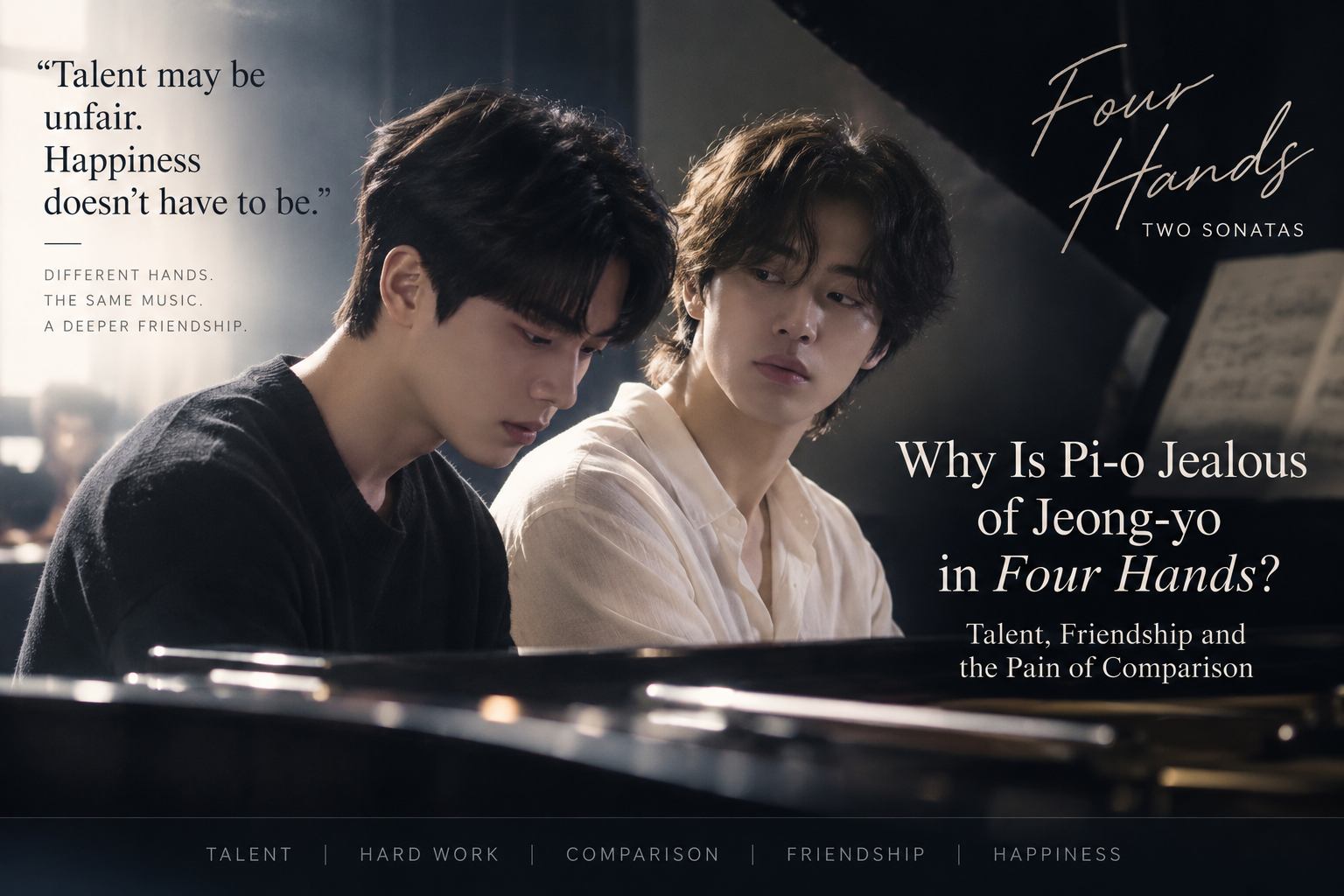
  • Why Pi-o Is Jealous of Jeong-yo in Four Hands — Talent, Friendship and the Pain of Comparison

    Why Pi-o Is Jealous of Jeong-yo in Four Hands — Talent, Friendship and the Pain of Comparison

    There is something painful about watching Pi-o and Jeong-yo in Four Hands, Two Sonatas.

    At first, it looks like a familiar story about two gifted young pianists.

    One is disciplined, polished and relentlessly trained.

    The other seems to possess something that cannot be taught.

    But the more I watched Four Hands, the less I thought this was really a story about piano.

    It is a story about something almost everyone experiences at some point in life:

    What happens when you meet someone who is simply more gifted than you?

    Someone who understands in minutes what takes you hours.

    Someone who reaches naturally for something you spent years trying to master.

    And what if that person isn’t your enemy?

    What if he becomes your friend?

    That may be the most difficult relationship at the heart of Four Hands.


    Pi-o Isn’t Ordinary — That’s What Makes It Hurt

    It would be easy to describe Kang Pi-o as the hardworking pianist and Choi Jeong-yo as the genius.

    But that description misses something important.

    Pi-o is extraordinarily talented too.

    To most people, Pi-o would already look like a prodigy.

    He has spent years training, practicing and pursuing perfection. He has developed the discipline required to turn musical ability into performance.

    Netflix describes Pi-o as an elite pianist who has relentlessly pursued perfection, while Jeong-yo is presented as a rougher, freer figure with remarkable natural musical talent.

    Without Jeong-yo beside him, Pi-o might have spent his entire life being called a genius.

    Then Jeong-yo appears.

    And suddenly Pi-o discovers that there are places he has struggled for years to reach that Jeong-yo seems to understand almost instinctively.

    That is what makes their relationship painful.

    Pi-o isn’t discovering that he is bad at piano.

    He is discovering the limits of being very, very good.


    Sometimes We Discover Our Limits Through Other People

    I think this happens far beyond music.

    Most of us don’t clearly see our own limits when we are alone.

    We work.

    We improve.

    Yesterday’s version of ourselves is our reference point.

    Then someone else appears.

    You practice something ten times.

    They understand it after two.

    You spend years learning how a business works.

    They seem to recognize the opportunity almost immediately.

    You study for hours.

    They remember something after reading it once.

    It happens in sports, art, cooking, mathematics, business, writing and almost every kind of work.

    There are people whose results seem disproportionately large compared with the effort required to produce them.

    Meeting someone like that can be uncomfortable.

    Because suddenly the comparison is no longer theoretical.

    Another person becomes a mirror that shows you your own limits.

    That, to me, is part of what Jeong-yo becomes for Pi-o.


    The Cruelest Comparison Is With Someone Close to You

    A genius who lives thousands of miles away is relatively easy to admire.

    Pi-o doesn’t have to wake up every morning consumed by jealousy because some legendary concert pianist somewhere in the world is better than him.

    That person is distant.

    Jeong-yo isn’t.

    He is right there.

    They practice together.

    They fight.

    They laugh.

    They begin to understand each other’s weaknesses.

    They become friends.

    And that makes comparison much more difficult.

    Imagine spending most of your life developing one ability.

    Then your closest friend begins receiving attention for doing something you have desperately wanted to do better than anyone else.

    As a friend, you want him to succeed.

    As a competitor, his success hurts.

    You can be happy for your friend and threatened by him at the same time.

    Those feelings are not mutually exclusive.

    That contradiction is one of the things Four Hands understands remarkably well.


    Maybe Pi-o Isn’t Really Jealous of Jeong-yo’s Success

    Jealousy is an easy word.

    But I think there is something underneath it that hurts more.

    Futility.

    The painful question may not be:

    Why is everyone paying attention to him?

    It may be:

    I spent so much of my life trying to reach this place. Why does he seem to possess naturally what I had to fight for?

    That question can destroy a person’s confidence.

    Because hard work is something we can control.

    Natural ability isn’t.

    We can practice longer.

    We can study harder.

    We can become more disciplined.

    But eventually, many of us encounter someone whose natural advantages cannot simply be erased by working another hour.

    And that is when comparison becomes dangerous.


    This Isn’t Really a Piano Story

    Piano is simply the stage on which Four Hands explores the problem.

    Replace piano with almost anything else and the story still works.

    Two students.

    Two athletes.

    Two artists.

    Two chefs.

    Two entrepreneurs.

    Two coworkers.

    Two writers.

    One person works incredibly hard and becomes exceptional.

    Then another person arrives who seems to see the same world differently.

    Most people will never experience Pi-o and Jeong-yo’s exact musical situation.

    But many people know the feeling behind it.

    “Why is this so much easier for that person than it is for me?”

    That’s why Pi-o’s struggle can feel surprisingly personal.


    Friendship Makes the Problem Harder, Not Easier

    We often assume that a deep friendship should be stronger and therefore harder to break.

    Sometimes the opposite may be true.

    The deeper the friendship, the deeper the possible wound.

    If someone I barely know succeeds, I can congratulate them and move on.

    But if the person walking beside me suddenly races ahead, I cannot avoid seeing the distance between us.

    And if we share the same dream, the problem becomes even harder.

    Pi-o and Jeong-yo are not merely friends.

    They are also rivals.

    The person who understands you best can therefore become the person most capable of hurting you.

    That’s the paradox at the center of their friendship.

    They can help each other grow precisely because they are different.

    But those same differences can tear them apart.


    Jeong-yo’s Side Isn’t Easy Either

    There is another side to this relationship.

    Jeong-yo didn’t choose his talent.

    Imagine realizing that simply doing what comes naturally to you is hurting someone you care about.

    What should you do?

    Pretend to be worse?

    Stop trying?

    Hide your ability?

    Of course not.

    Jeong-yo shouldn’t have to apologize for being gifted any more than Pi-o should feel ashamed of having worked hard.

    This is why a friendship between people with unequal abilities requires maturity from both sides.

    Pi-o needs the wisdom to accept.

    Jeong-yo needs the wisdom to understand.

    Pi-o must learn to recognize Jeong-yo’s gift without using it as evidence that his own life has less value.

    Jeong-yo must understand that something effortless to him may represent years of sacrifice to someone else.

    Neither lesson is easy.


    When I Was Younger, I Envied People Like Jeong-yo

    This is where Four Hands became more than a drama for me.

    When I was younger, people with extraordinary natural ability were easy to envy.

    If two people put in similar effort and one achieves much more, it can feel unfair.

    You begin thinking:

    “If only I had been born with that talent.”

    Then comparison begins.

    Comparison becomes envy.

    Envy can become frustration.

    Frustration can become resentment.

    And eventually some people simply give up.

    Why continue if someone else can always do it better?

    But as I’ve grown older, I’ve started to see the question differently.


    Someone Else’s Talent Does Not Take Away Your Happiness

    This took me a long time to understand.

    Someone else’s gift does not reduce the amount of happiness available to me.

    A person being a better pianist does not make my music worthless.

    Someone making more money does not automatically make my life poorer.

    Someone learning faster does not mean there is no value in what I learn slowly.

    Yet comparison makes us behave as though happiness were a fixed quantity.

    If that person has more, I must have less.

    Life doesn’t necessarily work that way.

    Talent may be distributed unequally.

    Opportunity may be distributed unequally.

    Even effort and results are often unfairly matched.

    But that does not mean happiness has already been assigned in the same proportions.

    Put simply:

    Talent may be unfair. Happiness doesn’t have to be.

    That is one of the things Pi-o’s struggle makes me think about.


    The Wisest Response to Genius Is Not Envy

    So what should we do when we meet someone far more gifted than ourselves?

    As I’ve grown older, my answer has become simpler.

    Acknowledge it.

    That person is better than me at this.

    That person learns this faster.

    That person has something I don’t.

    Saying those things does not make me smaller.

    Then comes the important part:

    Learn what you can.

    Meeting someone better than you can actually be an extraordinary advantage.

    You may learn in months what would have taken you years to discover alone.

    The tragedy begins when admiration becomes resentment.

    If you become consumed by envy, attack the other person, lose confidence and eventually abandon your own path, then their talent has defeated you.

    Not because they were better.

    Because comparison convinced you that your own journey no longer mattered.


    But Genius Doesn’t Mean Having Everything

    There is another mistake we often make.

    When we see an extraordinary person, we focus entirely on what they possess.

    We see Jeong-yo’s musical intuition and think:

    Imagine being born with that.

    But exceptional ability in one part of life does not guarantee completeness in every other part.

    Someone who understands music more naturally than everyone around them may still struggle with things that seem completely natural to other people.

    Relationships.

    Ordinary emotions.

    Belonging.

    Understanding what another person feels.

    This should not be generalized to every gifted person, of course.

    But Four Hands raises an interesting possibility:

    Sometimes the very thing that makes someone extraordinary can also make it harder for them to feel ordinary.

    And perhaps being ordinary contains gifts we rarely recognize as gifts.


    Maybe Jeong-yo Needs Pi-o Too

    This changes how I see their friendship.

    At first, it can look as though Pi-o has more to learn from Jeong-yo.

    Jeong-yo possesses a musical freedom Pi-o struggles to reach.

    But Jeong-yo is not complete either.

    He carries trauma, struggles with the stage, and needs help entering a world Pi-o already understands.

    Pi-o knows discipline.

    He knows training.

    He knows how to stand before an audience.

    He knows how to transform ability into a life as a musician.

    So perhaps their relationship is not:

    The lesser pianist learning from the greater one.

    It is two incomplete people carrying different strengths.

    Jeong-yo can teach Pi-o something about music.

    Pi-o can teach Jeong-yo something about living with music.

    And perhaps both can teach the other something about being human.


    This Is Why the Title “Four Hands” Feels So Perfect

    “Four hands” refers to two pianists playing the same piano together.

    Think about what that requires.

    Two people do not have to be equally gifted.

    But neither person can simply play however they want.

    You have to listen.

    You have to feel the other person’s timing.

    Sometimes you lead.

    Sometimes you follow.

    Sometimes you wait.

    Sometimes you make room.

    The better pianist cannot simply rush ahead and expect the music to survive.

    And the weaker pianist cannot spend the entire performance resenting the other person’s ability.

    The music only works when two different people learn to hear each other.

    Friendship may work the same way.

    Friendship, like four-hands piano, does not require two people to be equally gifted. It requires them to listen to each other’s tempo.

    That may be the real challenge facing Pi-o and Jeong-yo.


    Pi-o Must Accept. Jeong-yo Must Understand.

    If their friendship is going to survive, both of them have work to do.

    Pi-o must accept Jeong-yo’s talent without diminishing himself.

    Jeong-yo must understand Pi-o’s effort without diminishing it.

    Pi-o must learn acceptance.

    Jeong-yo must learn empathy.

    Neither needs to become the other.

    Pi-o doesn’t need Jeong-yo’s exact gift to have value.

    Jeong-yo doesn’t need to hide his talent to protect Pi-o.

    They simply have to learn that difference does not automatically create hierarchy in every part of life.

    One person can be better at piano without being better at being a person.

    That’s a much harder distinction to live than it is to write.


    The Hardest Four-Hands Performance May Not Happen at the Piano

    At this point, I’m not particularly interested in asking whether Pi-o or Jeong-yo is the better pianist.

    The drama has already made Jeong-yo’s extraordinary natural gift clear.

    The question I find much more interesting is:

    Can they remain friends?

    Can Pi-o admire someone more gifted than himself without losing his own sense of worth?

    Can Jeong-yo fully use his gift while understanding what Pi-o’s years of effort mean?

    Can two people who share the same dream survive when one person’s talent becomes a mirror reflecting the other’s limitations?

    That may be the most difficult four-hands performance in the entire drama.

    Not the piece they play together on a piano.

    But learning how to move through life together without one person’s gift becoming the other person’s wound.


    Talent May Be Unequal. Happiness Doesn’t Have to Be.

    Eventually, all of us meet someone better than ourselves.

    Someone smarter.

    Faster.

    More talented.

    More intuitive.

    Someone who reaches in two steps what takes us ten.

    We can resent them.

    We can allow their ability to become proof of our inadequacy.

    We can give up.

    Or we can acknowledge the difference, learn what we can and continue walking our own path.

    Because another person’s talent does not determine the value of our life.

    And another person’s success does not set the ceiling on our happiness.

    When I was younger, extraordinary talent seemed like one of the greatest gifts a person could receive.

    I’m less certain now.

    There are many ways to live a meaningful life, and many forms of happiness that have nothing to do with being the best.

    Perhaps talent was never distributed fairly.

    But happiness was never promised only to the talented.

    And that may be what Pi-o and Jeong-yo ultimately need to discover about each other.

    They don’t need equal gifts to remain friends.

    They need to hear each other’s tempo.

    Because sometimes the hardest part of playing four hands isn’t knowing your own part.

    It’s continuing to listen when the person beside you can play something you never could.


    FAQ: Pi-o, Jeong-yo and Talent in Four Hands

    Why is Pi-o jealous of Jeong-yo in Four Hands?

    Pi-o has spent years pursuing technical and musical perfection, while Jeong-yo possesses an unusually natural musical instinct. Their closeness makes that difference impossible for Pi-o to ignore, turning admiration, competition and friendship into complicated emotions.

    Is Jeong-yo more talented than Pi-o?

    The drama presents Jeong-yo as possessing extraordinary natural musical talent, while Pi-o represents a highly trained elite pianist shaped by discipline and relentless practice. The more interesting contrast is therefore not simply who is “better,” but what each lacks and can learn from the other.

    Are Pi-o and Jeong-yo friends or rivals?

    They are both. Their friendship and rivalry are intertwined, which is one reason their relationship becomes so emotionally complicated. Netflix itself frames Four Hands, Two Sonatas around friendship, rivalry and growth.

    What does “Four Hands” mean?

    In piano music, four-hands playing involves two pianists performing together on one piano. Within the drama, it also works as a powerful metaphor for Pi-o and Jeong-yo: two different people learning to listen, adjust and make room for each other.

    What is the main message of Pi-o and Jeong-yo’s relationship?

    One possible interpretation is that unequal talent does not make friendship impossible, but it makes friendship more demanding. Pi-o must learn to recognize Jeong-yo’s gift without losing his own self-worth, while Jeong-yo must learn to understand the effort and emotions of the person beside him.

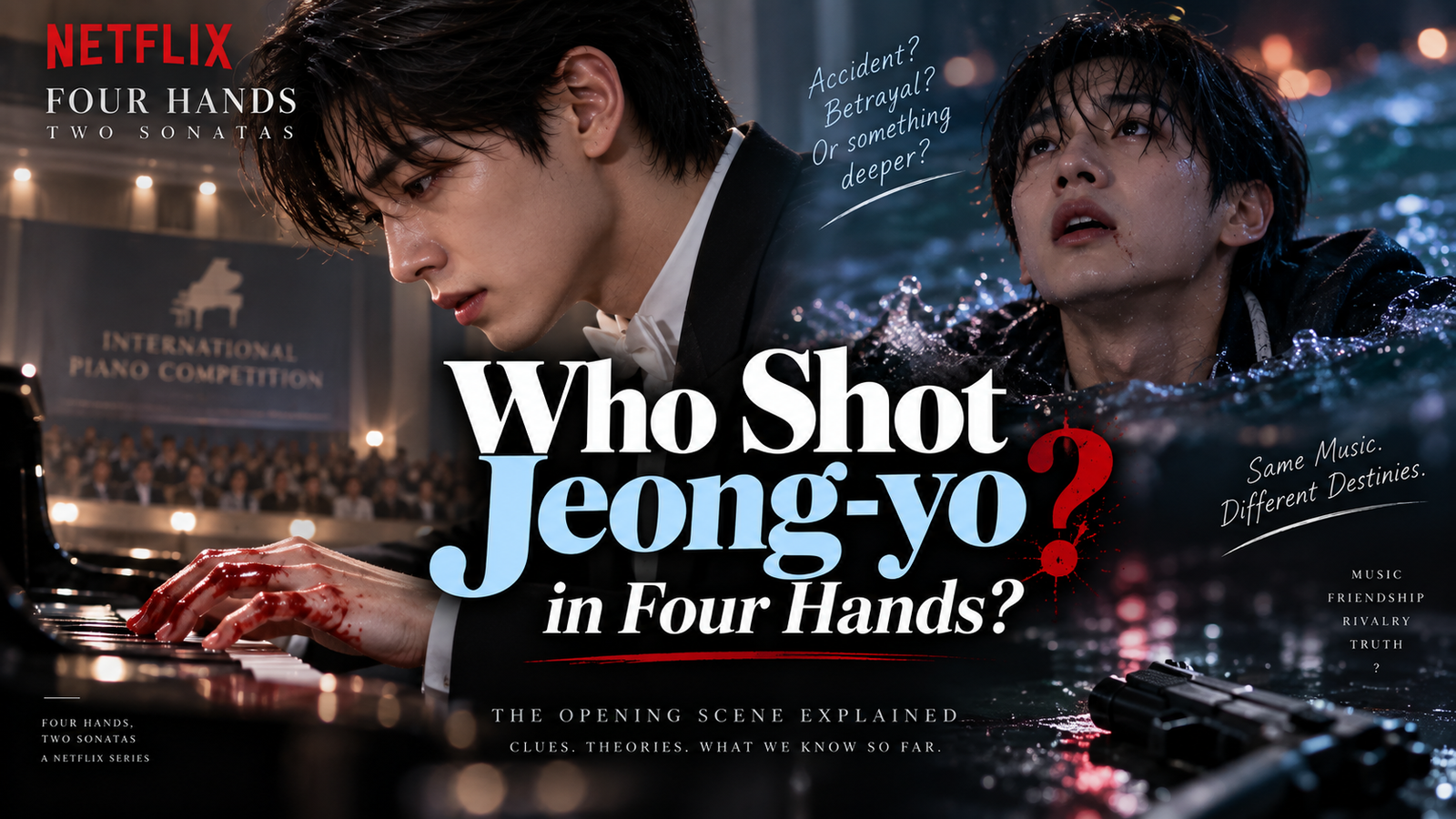
  • Who Shot Jeong-yo in Four Hands? The Opening Shooting Scene Explained

    Who Shot Jeong-yo in Four Hands? The Opening Shooting Scene Explained

    Updated through Episode 3. This article will be updated as new clues are revealed.

    Warning: Spoilers for Four Hands, Two Sonatas.

    If you started watching Four Hands, Two Sonatas expecting a beautiful coming-of-age drama about two young pianists, the opening scene probably made you wonder whether you had clicked on the wrong K-drama.

    A piano competition.

    Blood on the keys.

    Choi Jeong-yo in danger.

    A gunshot.

    And Jeong-yo falling into the water.

    Then the story takes us back to a much younger Kang Pi-o and Choi Jeong-yo, before their friendship, rivalry and musical lives have reached that terrifying moment.

    It immediately creates one of the biggest mysteries in Four Hands:

    Who shot Jeong-yo?

    The most important answer right now is:

    We don’t know yet.

    And that is exactly why the opening scene matters.

    The drama has shown us a possible future before explaining how these two young pianists could ever arrive there. Early reviews have similarly identified the violent flash-forward as one of the central mysteries hanging over the story.

    So rather than pretending we already know the shooter, let’s separate what Four Hands has actually shown us from what we can only speculate about.


    What Happens in the Four Hands Opening Scene?

    The drama begins far away from the warm school friendship that follows.

    Pi-o is playing piano at a major competition.

    But something is terribly wrong.

    His fingers are bloodied as he continues playing.

    Meanwhile, Jeong-yo is caught in a violent situation elsewhere.

    A gun goes off.

    Jeong-yo is hit and falls into the water.

    The contrast is shocking.

    One friend is playing music while the other appears to be fighting for his life.

    A review of Episodes 1 and 2 describes the opening in essentially these terms: Pi-o plays with bloodied fingers while Jeong-yo is shot and falls into water.

    But the drama doesn’t immediately tell us who shot him or how the two boys reached this point.

    Instead, it takes us backward.

    And suddenly we meet two young musicians whose relationship looks very different.


    Why Show Jeong-yo Being Shot Before We Even Know Him?

    This may be the more interesting question.

    The opening doesn’t simply create suspense.

    It changes how we watch everything that follows.

    Netflix officially describes Pi-o and Jeong-yo as two contrasting pianists whose lives become intertwined through friendship, rivalry and growth. Pi-o has followed a disciplined path toward perfection, while Jeong-yo comes from a turbulent childhood and possesses a much rawer natural talent.

    When we watch them begin to understand each other, however, we already know something they don’t.

    Something terrible is coming.

    That knowledge changes even their happiest scenes.

    When they play together, we remember the opening.

    When they become closer, we remember the opening.

    When rivalry begins to appear, we wonder whether it somehow leads to the opening.

    The drama has effectively given the audience the destination while hiding the road.


    The Biggest Question Isn’t Only “Who Shot Jeong-yo?”

    There are actually several mysteries packed into that opening.

    Who shoots Jeong-yo?

    But also:

    Why is Jeong-yo in that situation?

    Why is Pi-o somewhere else playing piano?

    Why are Pi-o’s fingers bleeding?

    Does Pi-o know Jeong-yo is in danger?

    How much time has passed since their school days?

    And perhaps most importantly:

    What happens between these two friends before we return to this moment?

    That last question may ultimately matter more than the identity of the shooter.


    Does Jeong-yo Die in Four Hands?

    This is another question viewers are likely to ask after watching the opening.

    At this stage:

    Jeong-yo’s death has not been confirmed.

    We see an extremely dangerous situation and a fall into the water.

    But showing a character apparently facing death is not the same as confirming that character’s death.

    Until the drama explicitly reveals what happens afterward, it would be misleading to say that Jeong-yo dies.

    So for now:

    Shot? Yes.

    Falls into the water? Yes.

    Confirmed dead? No.

    That distinction is important.


    Is Pi-o Connected to Jeong-yo’s Shooting?

    This is where we have to be particularly careful.

    The editing deliberately connects the two men.

    Jeong-yo is in danger while Pi-o is performing.

    Pi-o’s bloody fingers make his own scene disturbing as well.

    But parallel editing does not prove that Pi-o caused what happened to Jeong-yo.

    There is currently no reason to turn a visual connection into a factual accusation.

    What we can say is that the drama clearly wants us to ask why these two events are happening at the same time.

    And because the series is built around their friendship and rivalry, the answer will almost certainly tell us something important about how their relationship develops.


    Could Their Rivalry Become That Dark?

    At first glance, that’s an obvious theory.

    Pi-o and Jeong-yo are both extraordinary pianists.

    One has spent years being shaped toward perfection.

    The other possesses an instinctive musical gift capable of disrupting that world.

    Netflix itself describes them as characters who repeatedly clash and challenge each other, pushing one another toward new artistic heights.

    So when the opening shows blood and violence, viewers naturally wonder:

    Does their rivalry eventually destroy their friendship?

    Maybe.

    But again, the drama hasn’t established that.

    And based on the episodes we’ve seen so far, reducing their relationship to simple hatred would miss much of what makes Four Hands interesting.

    Their relationship contains competition, but it also contains admiration.

    They challenge each other precisely because each recognizes something extraordinary in the other.

    That makes the eventual journey toward the shooting scene much harder to predict.


    The Opening Makes Every Happy Scene Feel Different

    This is one of the smartest things about the storytelling so far.

    Without the flash-forward, we could simply enjoy the story of two young pianists becoming friends.

    But we can’t completely do that.

    We have already seen the blood.

    We have already heard the gunshot.

    We have already seen Jeong-yo fall.

    So when Pi-o and Jeong-yo laugh together, practice together or begin understanding each other through music, there is an uncomfortable thought sitting underneath the scene:

    How does this become that?

    One early review made the same observation: the flash-forward places tension underneath the drama because viewers know that a darker moment is waiting somewhere ahead.

    That’s an effective narrative trick.

    The drama isn’t only making us care about their friendship.

    It is making us afraid of losing it.


    Pi-o’s Bloody Fingers May Be Just as Important as the Gunshot

    It’s easy to focus entirely on Jeong-yo because a gunshot is obviously more dramatic.

    But look at Pi-o.

    Why is he playing with injured, bloody fingers?

    For a pianist, hands aren’t simply another part of the body.

    They are connected to identity, career and expression.

    And Pi-o keeps playing.

    That image raises its own questions.

    Did something happen before he went on stage?

    Is he forcing himself through an injury?

    Does his condition have any connection to what is happening to Jeong-yo?

    Or are the two scenes connected primarily symbolically rather than literally?

    We don’t know yet.

    But the drama chose to place those images beside each other.

    That makes Pi-o’s hands another clue worth watching.


    Music and Violence Are Deliberately Colliding

    This may ultimately be the most important thing about the opening.

    Everything else about Four Hands teaches us to associate these characters with music.

    Jeong-yo hears music almost everywhere. An official preview even depicts ordinary school noises transforming into music in his mind, emphasizing his instinctive relationship with sound.

    Pi-o has spent his life pursuing perfection at the piano.

    Then the opening takes the thing that defines them—

    music—

    and places it beside blood, fear and violence.

    That contrast feels deliberate.

    The piano may eventually become more than the thing that brings them together.

    It may also become connected to ambition, sacrifice and pain.


    What We Know So Far

    As of Episode 3, here’s the safest way to understand the mystery:

    Confirmed: Jeong-yo is shown being shot and falling into water in the flash-forward.

    Confirmed: Pi-o is shown performing piano with bloodied fingers.

    Confirmed: The main story then moves back to an earlier period in their lives.

    Not confirmed: Who shot Jeong-yo.

    Not confirmed: Why Jeong-yo was shot.

    Not confirmed: Whether Jeong-yo dies.

    Not confirmed: Whether Pi-o has any direct connection to the shooting.

    Not confirmed: What caused Pi-o’s injured fingers.

    That’s where the mystery stands.

    Anything beyond that is currently a theory.


    My Theory: The Shooter May Not Be the Real Mystery

    I suspect the drama wants us to focus on the obvious question:

    “Who pulled the trigger?”

    But I don’t think that will necessarily be the most important revelation.

    Four Hands is fundamentally being presented as a story about two young musicians whose lives become intertwined through friendship, rivalry and growth.

    That suggests the emotional mystery may be bigger than the crime mystery.

    The question may eventually become:

    What happened to Pi-o and Jeong-yo between the day they became friends and the day one was bleeding at a piano while the other was bleeding in the water?

    Who fired the gun will give us one answer.

    How their friendship reached that moment may give us the real story.


    Why the Opening Scene Works So Well

    We already know where the road appears to lead.

    But we don’t know how they get there.

    That means every new friendship becomes a clue.

    Every rivalry becomes a clue.

    Every family conflict becomes a clue.

    Every decision involving their careers becomes a clue.

    Even the music may become a clue.

    The opening turns what initially appears to be a youth music drama into something with an underlying mystery.

    And that’s why the scene stays in your mind even when the story returns to classrooms, competitions and piano practice.


    So Who Shot Jeong-yo?

    For now, the only accurate answer is:

    Four Hands hasn’t revealed it yet.

    And we shouldn’t invent an answer before the drama gives us one.

    What we do know is that the shooting isn’t a random scene added simply for shock.

    The drama deliberately shows us Jeong-yo’s violent future alongside Pi-o’s bloodied performance before asking us to watch their relationship develop from the beginning.

    That makes the real mystery bigger than:

    Who shot Jeong-yo?

    It becomes:

    What happened to these two boys?

    And every episode brings us a little closer to finding out.


    Four Hands Shooting Scene FAQ

    Who shot Choi Jeong-yo in Four Hands?

    As of Episode 3, the identity of the shooter has not been revealed.

    Does Jeong-yo die?

    His death has not been confirmed. The opening shows him being shot and falling into water, but viewers have not yet been shown a definitive outcome.

    Why are Pi-o’s fingers bleeding?

    That has not yet been fully explained. The drama deliberately juxtaposes Pi-o’s bloodied piano performance with Jeong-yo’s violent situation.

    Is Pi-o responsible for Jeong-yo being shot?

    There is currently no confirmed evidence that Pi-o is responsible. The editing connects their situations, but that should not be mistaken for proof.

    When will the shooting scene be explained?

    The series has 12 episodes, but there is currently no confirmed episode in which the full circumstances of the flash-forward will be revealed. The article should therefore be updated as new episodes provide clues. The 12-episode format is reflected in current series listings and discussion information.