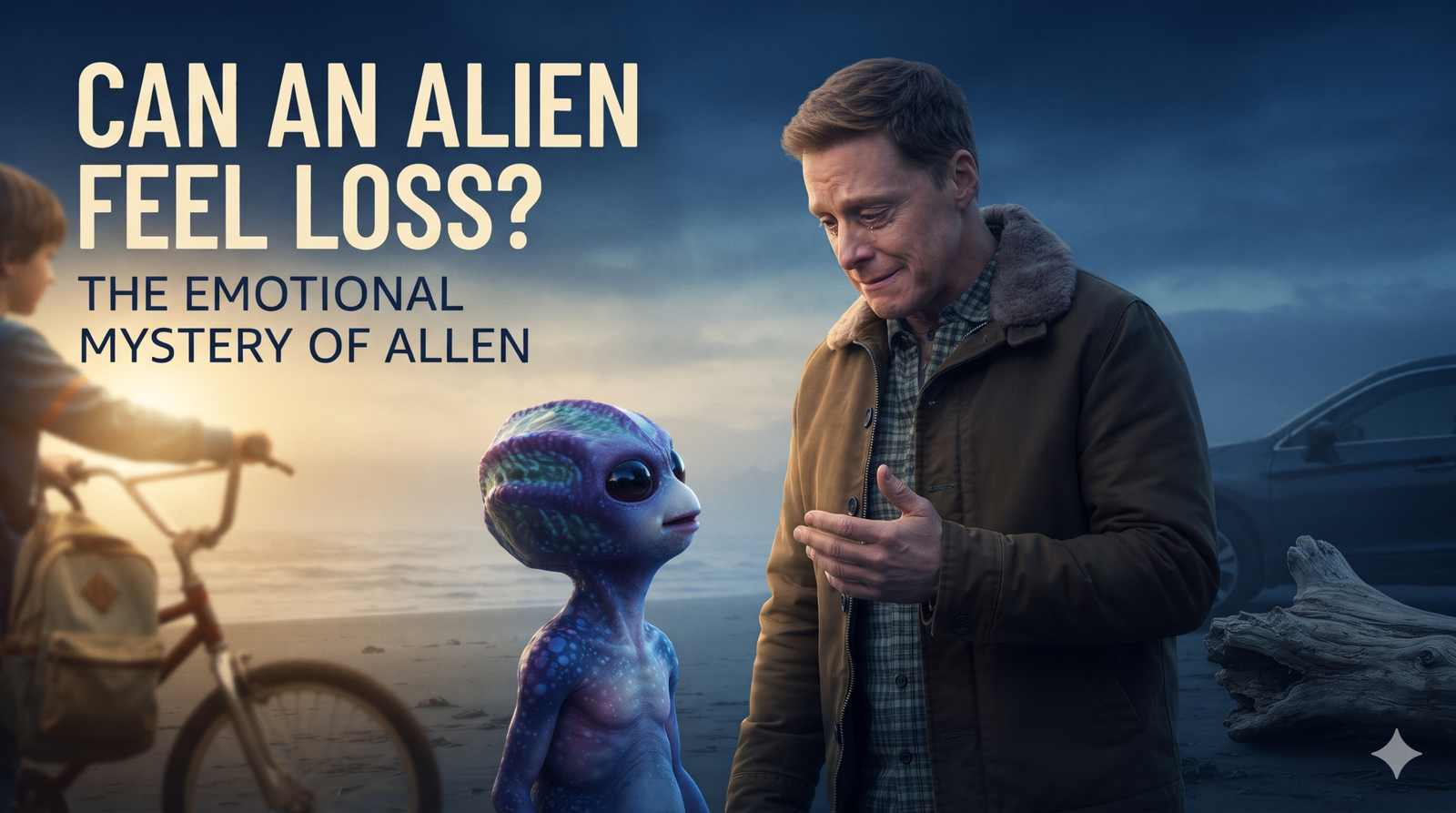
What happens when a human being meets someone from another world, forms an extraordinary friendship, and then loses that friend?
For most people, such an encounter would become an unforgettable childhood memory. But what if the memory never becomes part of the past? What if it continues to control the person’s present, shaping relationships, decisions, and the way they understand the world?
Netflix’s Allen begins with an idea that feels familiar to anyone who remembers E.T. the Extra-Terrestrial. A young boy encounters an alien, develops a deep friendship with it, and experiences a separation he cannot fully understand.
But Allen makes a significant change to that familiar premise.
Instead of ending with the emotional impact of childhood separation, the story follows Petey into adulthood. Twenty years after his encounter with Allen, he still has not moved on. When his extraterrestrial friend finally returns, the reunion becomes more than a science-fiction adventure. It becomes a confrontation with the past Petey has spent years preserving.
This raises a question that goes beyond either film:
If two completely different forms of life can become friends, do they necessarily experience friendship, attachment, and loss in the same way?
Perhaps the most interesting part of an encounter with an alien would not be discovering that another intelligent species exists. It would be discovering that something so different from us can make us feel understood.
And perhaps the most painful part of that encounter would be realizing that the same relationship might not mean exactly the same thing to both sides.
1. E.T. Was More Than an Alien: He Became a Part of Elliott’s Emotional World
In Steven Spielberg’s E.T. the Extra-Terrestrial (1982), Elliott does not simply discover an unusual creature. He discovers a companion who seems capable of understanding emotions that the people around him cannot always recognize.
Their relationship develops without the usual foundations of human friendship.
They do not share the same language, culture, family background, or biological experience. Yet they establish a connection through gestures, curiosity, fear, playfulness, and emotional responses.
That is what makes the relationship powerful.
Human beings often assume that friendship requires similar experiences. We look for people who understand our language, recognize our problems, and respond to the world in familiar ways.
But Elliott’s relationship with E.T. challenges that assumption.
The film suggests that emotional connection might begin before complete understanding. Two beings do not necessarily need to explain everything to each other before they can develop trust.
There is also something important about the timing of their encounter.
Elliott meets E.T. during childhood, a period when identity and emotional expectations are still developing. The friendship becomes part of how he understands himself and the world around him.
When E.T. leaves, Elliott loses more than a companion.
He loses a relationship that helped define a particular period of his life.
That distinction matters because people do not always remember someone simply because that person was important. Sometimes they remember who they were when that person was present.
2. Do Humans and Aliens Have the Same Emotions?
This is where the science-fiction premise becomes a philosophical question.
We do not know whether extraterrestrial life exists in an intelligent form, let alone whether it experiences emotions comparable to human feelings.
If an intelligent alien species were discovered, it would be a mistake to assume that its emotional world would automatically resemble ours.
Human emotions are connected to our biology, nervous systems, social structures, evolutionary history, and experience of time.
Love, fear, attachment, and grief have recognizable patterns in human life, but their expression is also shaped by culture and individual experience.
An alien species could have an entirely different biological foundation.
It might form relationships through chemical signals, collective consciousness, shared memories, or forms of communication that humans cannot easily understand.
It might experience separation differently. It might not perceive time as humans do. It might even understand the concept of an individual relationship in a way that makes little sense to us.
However, there is another possibility.
Different biological systems might produce some comparable emotional experiences.
An alien might not experience love exactly as a human does, but it could still develop a preference for a particular individual, seek that individual’s presence, or react when the relationship disappears.
The important distinction is between having the same emotion and recognizing a similar emotional need.
Two beings may not feel in identical ways, yet both may experience the importance of connection.
That is the imaginative foundation behind the friendship in E.T. and Allen.
The films do not need to prove that humans and aliens have identical emotional systems. They ask us to consider whether meaningful relationships can exist despite profound differences.
3. Why Would Elliott Find It So Difficult to Forget E.T.?
Imagine being a child who discovers that the universe is much larger and stranger than anything adults have told you.
Then imagine that one of the beings you meet in that universe becomes your closest friend.
The experience would challenge your understanding of reality.
For Elliott, E.T. represents several things at once: friendship, discovery, emotional recognition, and the possibility that life exists beyond the world he knows.
That combination makes the encounter unusually powerful.
Most childhood friendships develop within familiar social environments. They are formed through school, family, neighborhoods, and shared activities.
Elliott’s friendship is different because it introduces an entirely new understanding of existence.
He does not merely meet someone new. He discovers that the boundaries of his known world are incomplete.
When E.T. leaves, the loss therefore has two dimensions.
First, Elliott loses a friend.
Second, he loses direct access to a reality that once seemed extraordinary and possible.
This helps explain why a childhood encounter could remain emotionally significant long after the event itself has ended.
A person may eventually accept that a friend has gone away. But accepting the absence does not mean the experience becomes meaningless.
Some memories remain important precisely because they cannot be repeated.
4. Allen Changes the Question: What Happens When the Child Never Moves On?
The most significant difference between E.T. and Allen is not simply the passage of twenty years.
It is what happens to the person who remains behind.
In Allen, Petey’s childhood friendship with an alien becomes something he cannot leave in the past. Twenty years after Allen disappears, Petey is still emotionally attached to the encounter.
This changes the structure of the story.
E.T. focuses on the emotional significance of meeting someone extraordinary and eventually saying goodbye.
Allen asks what happens when someone continues living as if that goodbye has never truly happened.
Petey’s attachment can be understood in several ways.
It may be loyalty to a friend. It may be an attempt to preserve a beautiful childhood experience. It may also be a refusal to accept that an important part of his life has ended.
These explanations are not mutually exclusive.
The problem is not that Petey remembers Allen. Remembering someone is not a failure to grow up.
The problem emerges when the memory becomes more important than the life still waiting to be lived.
This is a much more complicated emotional situation than ordinary nostalgia.
Petey is not simply looking backward because the past was enjoyable. He appears to have organized part of his adult identity around the expectation that the past will return.
That is the central tension of the film.
Can a memory preserve something valuable without becoming a barrier to the present?
5. Perhaps Petey Misses His Childhood Self More Than the Alien
There is another interpretation worth considering.
What if Petey is not waiting only for Allen?
What if he is also waiting for the person he was when Allen was still beside him?
Childhood often gives people a particular way of experiencing the world.
A new discovery can feel enormous. An unexpected friendship can transform an ordinary afternoon. The future seems full of possibilities because so little has yet been experienced.
As people grow older, responsibilities and disappointments gradually change their expectations.
They learn to calculate risks, recognize limitations, and protect themselves from disappointment.
The world becomes more understandable, but it can also become less surprising.
For Petey, Allen may represent the last time life felt completely extraordinary.
If that is true, his longing has two objects:
- The alien friend who disappeared.
- The younger version of himself who believed that extraordinary things could happen.
This distinction is important because the second loss cannot be solved simply by reuniting with the first.
Even if Allen returns, Petey cannot become the child he once was.
The reunion can restore a relationship, but it cannot reverse twenty years of human experience.
That is why the emotional conflict in Allen can be read as a story about identity rather than merely friendship.
Sometimes we say we miss someone when what we really miss is the life we had when that person was part of it.
6. The Most Difficult Possibility: What If Allen Did Not Experience the Separation in the Same Way?
Here the human-alien relationship becomes even more interesting.
Imagine that Petey spends twenty years remembering Allen.
He thinks about their friendship, wonders why Allen disappeared, and waits for an explanation.
But what if Allen experiences time differently?
What if the twenty years that transformed Petey’s life represent a very different interval for Allen?
Or what if Allen remembers the relationship but does not attach the same emotional meaning to it?
These are hypothetical possibilities, not established facts about the film or extraterrestrial life. But they reveal an important problem within any relationship between fundamentally different beings.
The meaning of a relationship is not always identical for both participants.
Even among humans, two people can remember the same event in completely different ways.
One person may consider a brief encounter life-changing. The other may remember it as an enjoyable but relatively ordinary experience.
One may spend years waiting for a reunion. The other may have continued living without the same expectation.
This does not necessarily mean that the original friendship was false.
It means that emotional significance is personal.
A relationship can be genuine without being experienced equally.
If this possibility applied to Petey and Allen, their reunion would carry an uncomfortable question: are they returning to the same friendship, or are they discovering that the friendship meant different things to each of them?
That question is far more interesting than simply asking whether an alien can become friends with a human.
7. Nostalgia Can Preserve Love, but It Can Also Freeze Time
Nostalgia is usually presented as something comforting.
Old photographs, childhood toys, familiar songs, and memories of people we once knew can provide emotional stability.
They remind us that our lives have contained moments of happiness and connection.
But nostalgia has another side.
When the past becomes the standard against which every present experience is judged, the present can begin to feel permanently inadequate.
A person may stop looking for new relationships because no one seems capable of replacing an old friend.
They may reject new experiences because those experiences cannot reproduce the feeling of an earlier time.
Eventually, remembering becomes a form of emotional repetition.
The individual is no longer simply appreciating the past. They are trying to live inside it.
This is particularly relevant to Allen because the film’s creator, Daley Pearson, has discussed the relationship between nostalgia, personal loss, and the difficulty of moving forward.
In an interview with Variety, Pearson explained that childhood objects and popular culture could bring back memories of the people and relationships associated with them. He described the film as partly about grief and reconciling with past loss. <Cite refs={[“turn780692news0″,”turn780692news2”]}/>
That perspective gives the story a more personal foundation.
A childhood toy may look like an ordinary object to someone else. To its owner, it can represent a person, a family, or a period of life that no longer exists.
The object is not valuable because of what it is.
It is valuable because of what it remembers.
Allen can be understood in the same way.
For Petey, the alien is not simply an unusual visitor from another planet. He is connected to a part of life that Petey has never managed to leave behind.
8. Growing Up Does Not Have to Mean Betraying the Past
There is a danger in interpreting Petey’s story too simply.
It would be easy to conclude that he needs to forget Allen, abandon his childhood interests, and become a conventional adult.
But that would miss an important distinction.
Growing up does not require destroying the parts of ourselves that once made life meaningful.
A person can love childhood films, collect old toys, remember lost friends, and remain fascinated by the unknown without becoming trapped in the past.
The real challenge is learning to carry those things into a different stage of life.
Pearson has described the film’s intended balance as holding childhood wonder and adult responsibility together. He has also explained that he did not want the story to suggest either that people should remain permanently childlike or that growing up requires abandoning everything associated with childhood. <Cite refs={[“turn780692news0″,”turn780692news3”]}/>
That is a more thoughtful position than the usual instruction to simply move on.
A mature person does not necessarily feel less wonder.
They learn how to live responsibly without losing the ability to be amazed.
In that sense, Petey’s journey is not about choosing between childhood and adulthood.
It is about discovering whether the best parts of childhood can survive without controlling the rest of his life.
9. Is Allen an Emotional Successor to E.T. or a Film Still Living in Its Shadow?
The comparison with E.T. is unavoidable.
Both films involve a human child, an extraterrestrial companion, an unusual friendship, and the emotional consequences of separation.
But Allen attempts to move the idea into a different stage of life.
Its central character is no longer a child experiencing an extraordinary encounter for the first time. He is an adult dealing with the consequences of an experience that never stopped defining him.
That is a meaningful change in perspective.
However, the film’s ambition also creates a challenge.
A number of critics have pointed to its dependence on familiar E.T.-like conventions. The Guardian, for example, argues that the adult-Petey premise is an interesting variation but that the film relies too heavily on familiar storytelling formulas. <Cite refs={[“turn780692news5”]}/>
By contrast, What’s on Netflix praises its emotional foundation, nostalgic atmosphere, and creature effects, while noting that some details of Allen’s mission remain unclear. <Cite refs={[“turn780692news1”]}/>
These different reactions reveal an important distinction.
A film can have an original question without developing every part of that question equally well.
The strongest idea in Allen is not that an alien returns after twenty years.
It is that an adult human being may spend decades waiting for a relationship that once gave his life a different meaning.
The film’s success as an artistic work can be debated. But the emotional question at its center deserves more attention than a simple comparison with E.T..
10. The Real Mystery Is Not Whether Aliens Exist, but Whether We Can Truly Understand One Another
Science fiction often imagines the first encounter between humans and extraterrestrial life as a technological or political event.
We ask whether aliens would be dangerous, whether they would possess advanced intelligence, and whether they would see humanity as important or insignificant.
But there is another possibility.
The first meaningful encounter might be deeply personal.
A human could become attached to an alien without fully understanding its biology, culture, or intentions.
The alien might also develop an attachment, although its experience of that relationship could be fundamentally different.
That would create a difficult but familiar problem.
Even when two people speak the same language, they cannot completely enter each other’s minds.
They can listen, observe, interpret, and respond, but they can never experience another person’s feelings from the inside.
An encounter between human and alien life would make that limitation even more obvious.
Yet perhaps complete understanding is not a requirement for friendship.
Perhaps friendship begins when two beings recognize that the presence of the other has become important.
That possibility is what gives the relationship between Petey and Allen its deeper meaning.
Their differences do not automatically make their connection impossible.
But those differences make it impossible to assume that they experience the connection in exactly the same way.
11. The Question That Remains After the Reunion
There is a reason why the idea of an alien returning after twenty years is emotionally powerful.
It gives someone the opportunity to meet again with a person, or a presence, they believed they had lost forever.
But reunion does not erase time.
Petey has changed. His memories have changed. The world around him has changed.
Even if Allen is still recognizable, the relationship cannot simply return to the moment when they first met.
This is true of human relationships as well.
When old friends meet again after decades, they may discover that the person they remember and the person standing in front of them are no longer exactly the same.
The reunion is not a restoration of the past.
It is the beginning of a new relationship between people who now carry different experiences.
That may be the most important lesson hidden inside Allen.
We often imagine that seeing someone again will give us back what we lost.
But sometimes the real purpose of a reunion is not to recover the past. It is to understand what the past has made of us.
Final Thought: Perhaps We Never Forget the People Who Changed the Way We Saw the World
Elliott’s encounter with E.T. was extraordinary because it showed that friendship could cross the boundaries between different forms of life.
Petey’s story in Allen takes that idea further.
It asks what happens when an extraordinary friendship becomes so important that a person cannot imagine life without the possibility of seeing that friend again.
And it introduces a question that science fiction cannot easily answer:
If two beings come from completely different worlds, can they ever know whether they mean the same thing to each other?
Perhaps they do not need to.
Perhaps a relationship can be genuine even when its emotional meaning is not perfectly equal.
But there is one more possibility worth considering.
Maybe Petey was never waiting only for Allen.
Maybe he was waiting for the moment when he could feel again what he felt as a child: that the world was full of possibilities, that someone understood him, and that something extraordinary could happen without warning.
That is why the story reaches beyond aliens and spaceships.
It touches something deeply human.
Sometimes we do not spend our lives waiting for someone to return. We spend our lives waiting to become the person we were when they were still here.