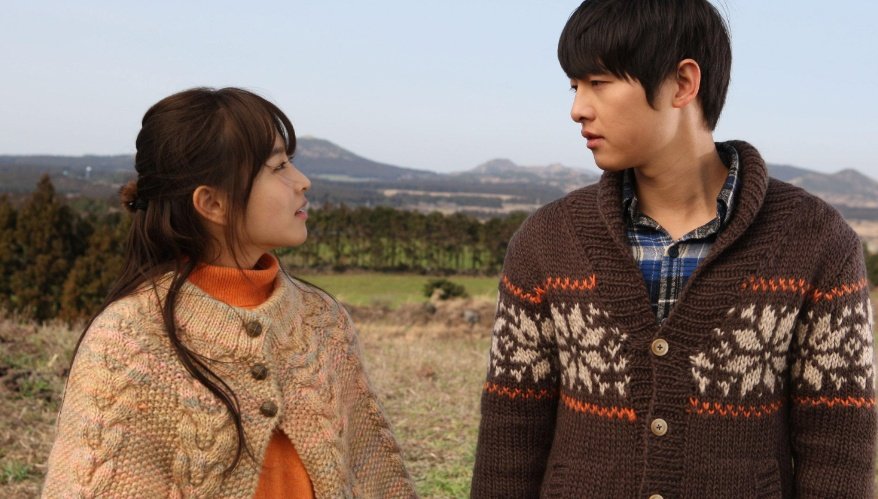
What kind of love can survive for 47 years without changing?
In A Werewolf Boy (2012), a young woman leaves behind a mysterious boy with one simple promise: wait for me, and I will come back. Decades later, she returns to the place where they first met and discovers that he has kept that promise literally.
He has not grown old. He has not forgotten her. And he has not moved on.
At first glance, this seems like the perfect ending to a tragic fantasy romance. But the more closely we examine the film, the more complicated the relationship becomes.
Did Chul-soo wait because he understood romantic love? Did he simply obey the only person who had ever shown him kindness? And what does Suni’s return mean when the two of them have experienced time so differently?
The emotional power of A Werewolf Boy comes from these unanswered questions. Beneath its supernatural romance is a story about loneliness, human cruelty, memory, and the extraordinary weight of a promise.
1. Why Does a Werewolf Story Begin With a Lonely Girl?
Before Chul-soo enters her life, Suni is already isolated.
Her family moves to the countryside because of her fragile health, and she struggles with a world that seems to offer her very little freedom. She is physically vulnerable, emotionally withdrawn, and separated from the ordinary experiences of other young people.
This detail is important because Suni does not meet Chul-soo as a confident person looking for an extraordinary romance.
She meets him while she is also searching for a reason to feel connected to the world.
Chul-soo initially appears to be a frightening and inconvenient presence. He cannot speak, behaves like a wild animal, and has no understanding of ordinary social rules.
Yet Suni gradually recognizes something familiar in him.
They are both outsiders, although for very different reasons. She is isolated by illness and circumstance. He is isolated because he has never been allowed to develop a normal human identity.
Their relationship begins not with attraction, but with recognition.
Each sees another person who does not quite belong.
2. Is Chul-soo Really a Monster?
The film deliberately encourages viewers to associate Chul-soo with the image of a monster.
He growls, eats without manners, reacts violently to danger, and possesses physical abilities that ordinary humans cannot understand.
But these characteristics do not automatically make him evil.
Chul-soo does not initially understand social expectations because nobody has taught him how to participate in human society.
His behavior is closer to that of an abandoned creature than a conventional villain.
This distinction changes the meaning of the entire film.
A monster story usually asks whether a dangerous creature can be controlled. A Werewolf Boy asks a more uncomfortable question: what happens when society encounters someone it cannot understand?
Chul-soo is judged before anyone makes a serious effort to understand him.
His appearance and unusual abilities become reasons to fear him, while his capacity for affection is gradually revealed through his relationship with Suni.
The film’s central irony is that the person most frequently treated as a monster may be the one with the least intention of harming others.
3. Why Does Suni Teach Him Like a Dog?
One of the film’s most unusual elements is Suni’s use of a dog-training manual to teach Chul-soo how to behave.
She teaches him when to eat, how to wait, how to wear clothes, and eventually how to communicate.
At first, this produces much of the film’s comedy.
Chul-soo’s reactions are unpredictable, and Suni becomes increasingly frustrated by his lack of ordinary manners.
But the training process gradually takes on a deeper meaning.
Suni is not simply teaching him to behave.
She is giving him a structure through which he can understand the world.
For someone who has never experienced ordinary human relationships, rules become a form of communication. Waiting for food teaches patience. Responding to his name gives him an identity. Learning to write creates a way to express thoughts that he cannot yet speak.
However, there is also an uncomfortable side to this process.
The relationship begins with a clear imbalance: Suni gives instructions, and Chul-soo learns to obey.
The film invites us to see this as affection, but it also raises a question about the difference between caring for someone and controlling them.
That tension becomes important when Chul-soo eventually develops the ability to make choices of his own.
4. Was Chul-soo Learning to Become Human, or Learning to Love Suni?
Chul-soo’s transformation is often described as becoming more human.
He learns language, manners, emotional expression, and the basic rules of living with other people.
But there is another interpretation.
Perhaps he is not simply becoming human. He is discovering what it means to form an attachment.
Before meeting Suni, his world appears to be defined by survival and isolation. He has no meaningful social connection and no obvious reason to trust anyone.
Suni changes that.
He begins to recognize her emotions, respond to her needs, and understand that his actions can affect another person.
His loyalty develops into something much more complicated than obedience.
When Suni is threatened, he does not merely follow a command. He reacts because her safety has become important to him.
This is the beginning of his emotional independence.
The film’s most moving transformation is therefore not physical.
It is the moment when a creature who once understood only survival begins to care about another person’s happiness.
5. Why Is Ji-tae More Human Than Chul-soo in Appearance but Less Human in Behavior?
Ji-tae represents the opposite side of the film’s central contrast.
He belongs to ordinary society. He understands social rules, speaks fluently, and occupies a position of influence.
Yet his behavior is driven by entitlement and the desire to control others.
His interest in Suni is not simply affection. He expects her attention and becomes increasingly hostile when she refuses to behave according to his wishes.
Chul-soo, by contrast, does not initially understand the rules of society, but he gradually learns to respect Suni’s feelings.
This creates one of the film’s clearest moral contrasts.
Ji-tae looks civilized but uses his social position to intimidate and manipulate people.
Chul-soo looks uncivilized but develops the ability to protect someone without demanding ownership over her.
The film does not suggest that every human being is cruel or that every outsider is innocent.
Rather, it challenges the assumption that civilization and morality are automatically the same thing.
Being able to speak, dress properly, and occupy a respectable position does not necessarily make someone humane.
6. Why Does Chul-soo Become Dangerous Only When Someone He Loves Is Threatened?
Chul-soo’s supernatural strength is initially presented as something frightening.
But the film gradually connects his violence to situations in which Suni or her family are in danger.
This is an important narrative choice.
His physical power does not define his emotional identity. The way he uses that power does.
When he becomes violent, the people around him see confirmation that he is a monster.
They focus on the destruction and fear his abilities can produce, rather than the circumstances that caused him to react.
The audience, however, has already witnessed his gentleness.
We understand that the same person who can become terrifying is also capable of quiet affection.
This contrast makes the villagers’ reaction more disturbing.
They judge Chul-soo by the moment when he loses control, while ignoring the many moments when he demonstrates restraint.
The film asks whether a society can recognize someone’s humanity once fear has already decided what that person is.
7. Why Does the Military Experiment Matter?
Chul-soo is not simply a supernatural creature who happens to appear in a rural village.
His background is connected to scientific experimentation and military interests.
This detail changes the meaning of his existence.
He was created or transformed through human intervention, and his extraordinary physical abilities were connected to the idea of producing a weapon.
In other words, the very society that fears him also helped create the conditions that made him different.
This is one of the film’s most interesting ideas.
Chul-soo is treated as an unnatural threat, but his unusual nature is not entirely separate from human ambition.
People experimented on him, attempted to control him, and then feared what they had made.
The story could have developed this science-fiction element into a much larger political thriller.
Instead, it keeps the military background relatively restrained, allowing the emotional relationship between Chul-soo and Suni to remain at the center.
That decision has a cost: some questions about his origin remain unanswered.
But it also prevents the film from becoming a conventional story about secret experiments and supernatural violence.
The experiment explains why Chul-soo is different. It does not explain why he deserves to be treated without compassion.
8. Was Suni’s Decision to Leave an Act of Betrayal?
The most painful decision in the film comes when Suni realizes that staying with Chul-soo will put his life in danger.
The villagers and authorities cannot accept him. His strength has frightened people, and his existence has become associated with violence.
Suni understands that if she continues to protect him openly, the situation may end in his death.
She therefore makes a decision that appears cruel.
She pushes him away, even though she knows how much pain this will cause him.
For Chul-soo, the rejection is devastating because Suni is the only person who has ever given him a sense of belonging.
But Suni’s behavior must be understood in the context of the choices available to her.
She is not choosing between a comfortable life with Chul-soo and an uncomfortable life without him.
She is trying to prevent him from being killed.
Her rejection is an act of protection disguised as cruelty.
That does not make the emotional damage disappear.
In fact, the scene is so painful precisely because both characters are suffering for different reasons, and neither can fully explain their feelings to the other.
9. What Does Chul-soo’s First Word Really Mean?
One of the most important moments in the film occurs when Chul-soo finally speaks.
After spending so much time learning language, his first meaningful words are not an elaborate declaration of love.
He says, “Don’t go.”
The simplicity of the words is what makes them devastating.
For most of the film, Chul-soo has communicated through expressions, gestures, and physical reactions.
Now he finally possesses the ability to express what he feels.
But the moment comes when Suni is preparing to leave.
His language arrives at exactly the moment when it can no longer change the situation.
This is a cruel form of dramatic irony.
He has learned how to speak, but he cannot use words to persuade the person he loves to stay.
The scene also marks a turning point in his identity.
Chul-soo is no longer merely repeating instructions or responding to commands. He is expressing a personal desire.
He wants Suni to remain with him.
That is not obedience. It is an independent emotional choice.
10. What Does the Promise to Wait Mean?
Before leaving, Suni gives Chul-soo a promise that he will remember for decades.
She tells him to wait and says she will return.
For an ordinary person, such a promise might be an emotional way of saying goodbye.
For Chul-soo, it becomes a literal instruction.
He does not understand time in the same way Suni does. He does not know that a year can become a decade or that a person can grow old while someone else remains unchanged.
His world is built around the few rules and relationships he has learned.
Suni told him to wait.
So he waits.
This is where the film moves beyond ordinary romance.
Chul-soo’s devotion is not measured by the passage of time in the way human love usually is.
He does not gradually replace his memories with new experiences. He does not build another life or develop a different set of relationships.
His promise becomes the organizing principle of his existence.
The tragedy is that something beautiful can also become a form of imprisonment.
11. Why Does Forty-Seven Years Mean Something Different to Each of Them?
The passage of 47 years is the central emotional device of the film.
For Suni, those years contain an entire human life.
She grows older, experiences relationships, and moves through the ordinary responsibilities of adulthood.
Her memories of Chul-soo become part of a past that she cannot return to.
For Chul-soo, however, the years do not produce the same transformation.
His body remains young, and his emotional world remains tied to the moment when Suni left.
This difference creates a profound imbalance.
Suni can remember Chul-soo while continuing to live.
Chul-soo remembers Suni while remaining physically and emotionally suspended in the past.
That is why their reunion is not a conventional happy ending.
They meet again, but they do not arrive at the same moment in life.
One has experienced decades of change. The other has preserved a promise.
The film’s fantasy premise allows it to ask a question that ordinary romance rarely explores:
Can two people still belong to each other when time has given them completely different lives?
12. Why Does the Final Reunion Feel Both Beautiful and Cruel?
When the elderly Suni returns to the house, she discovers that Chul-soo is still there.
He has not forgotten her.
The note remains meaningful to him, and he continues to behave as though the promise is still waiting to be fulfilled.
The reunion is beautiful because it confirms that their relationship was not something Suni imagined or exaggerated in memory.
Chul-soo really did wait.
But the scene is also deeply uncomfortable.
Suni has lived a complete human life. Chul-soo has spent decades waiting for someone who may never return.
His loyalty is extraordinary, but it also exposes the loneliness of his existence.
The film does not give them a conventional reunion in which they begin a new life together.
Instead, it allows them to share a brief moment of recognition.
That restraint is essential to the emotional effect.
If the film simply reunited them as a young couple, it would remove the central tragedy of their different experiences of time.
The reunion matters because it cannot undo what happened.
13. Why Does Chul-soo Build a Snowman?
The snowman in the closing sequence is one of the film’s most meaningful images.
It is easy to see it as a sentimental final gesture.
But the image also reflects Chul-soo’s character.
He has not become bitter about waiting. He does not appear to blame Suni for leaving. He continues to preserve the small emotional world that they created together.
In an interview reproduced by AsianWiki, director Jo Sung-hee explained that the snowman represents Chul-soo himself. The director emphasized that Chul-soo does not blame Suni and continues to keep his promise.
That interpretation gives the final image a different meaning.
A snowman is temporary by nature. It exists only under certain conditions and eventually disappears.
Chul-soo, however, remains.
The contrast is striking.
The snowman becomes a quiet representation of a being who has preserved his emotional identity even while the world around him has changed.
It is not simply a symbol of waiting.
It is a symbol of someone who has never learned how to stop loving the person who first gave him a place in the world.
14. Why Did the Director Release an Alternative Ending?
An especially interesting part of the film’s history is that the director released a modified version with an alternative ending in December 2012.
The original theatrical ending left viewers with the emotional distance between elderly Suni and the still-young Chul-soo.
The revised version included additional scenes and a different final exchange between the characters. Director Jo Sung-hee also said that he knew some male viewers had disliked the original ending and that the new version would give Park Bo-young’s character a larger role in the finale.
This decision is revealing.
The original ending emphasizes the tragedy of time.
The alternative ending gives viewers a different emotional experience by allowing Suni and Chul-soo to share a more direct reunion.
Neither approach completely eliminates the central conflict.
The original asks viewers to accept that love can remain meaningful even when two people cannot share the same future.
The alternative gives more attention to the emotional desire for reunion.
The existence of two endings demonstrates how differently audiences can interpret the same relationship.
Some viewers want the pain of waiting to remain unresolved because that is what makes the story memorable.
Others want the characters to receive a more direct emotional reward after everything they have endured.
The director’s decision to release another version did not erase the original meaning. It revealed a different way of experiencing it.
15. Was It Love, or a Promise That Lasted 47 Years?
The most important question about A Werewolf Boy is whether Chul-soo truly understood love.
If love means choosing another person, recognizing their feelings, and wanting their happiness, then Chul-soo gradually demonstrates those qualities.
But his devotion also begins with an unusual relationship.
Suni is the first person who gives him affection, teaches him how to communicate, and offers him a place in the human world.
His attachment to her is therefore connected to more than romance.
She is his first teacher, his first friend, and the person who gives meaning to his existence.
That makes his waiting both beautiful and tragic.
Perhaps Chul-soo does not remain because he fully understands what 47 years means.
Perhaps he remains because the promise is the only thing he has been given that can connect his present to the person he lost.
And perhaps that is the film’s most heartbreaking idea.
Suni’s life continues because time moves forward. Chul-soo’s life remains centered on a promise because time does not change him in the same way.
The two characters love each other, but they do not experience love under equal conditions.
One must eventually leave the past behind to live.
The other can only preserve the past because it is the only world he knows.
That is why A Werewolf Boy is more than a fantasy romance about a girl and a supernatural creature.
It is a story about what happens when a promise becomes someone’s entire life.
And after 47 years, the most painful question is not whether Chul-soo remembered Suni.
He clearly did.
The question is whether anyone should have to spend an entire lifetime waiting for a promise that was never meant to last that long.