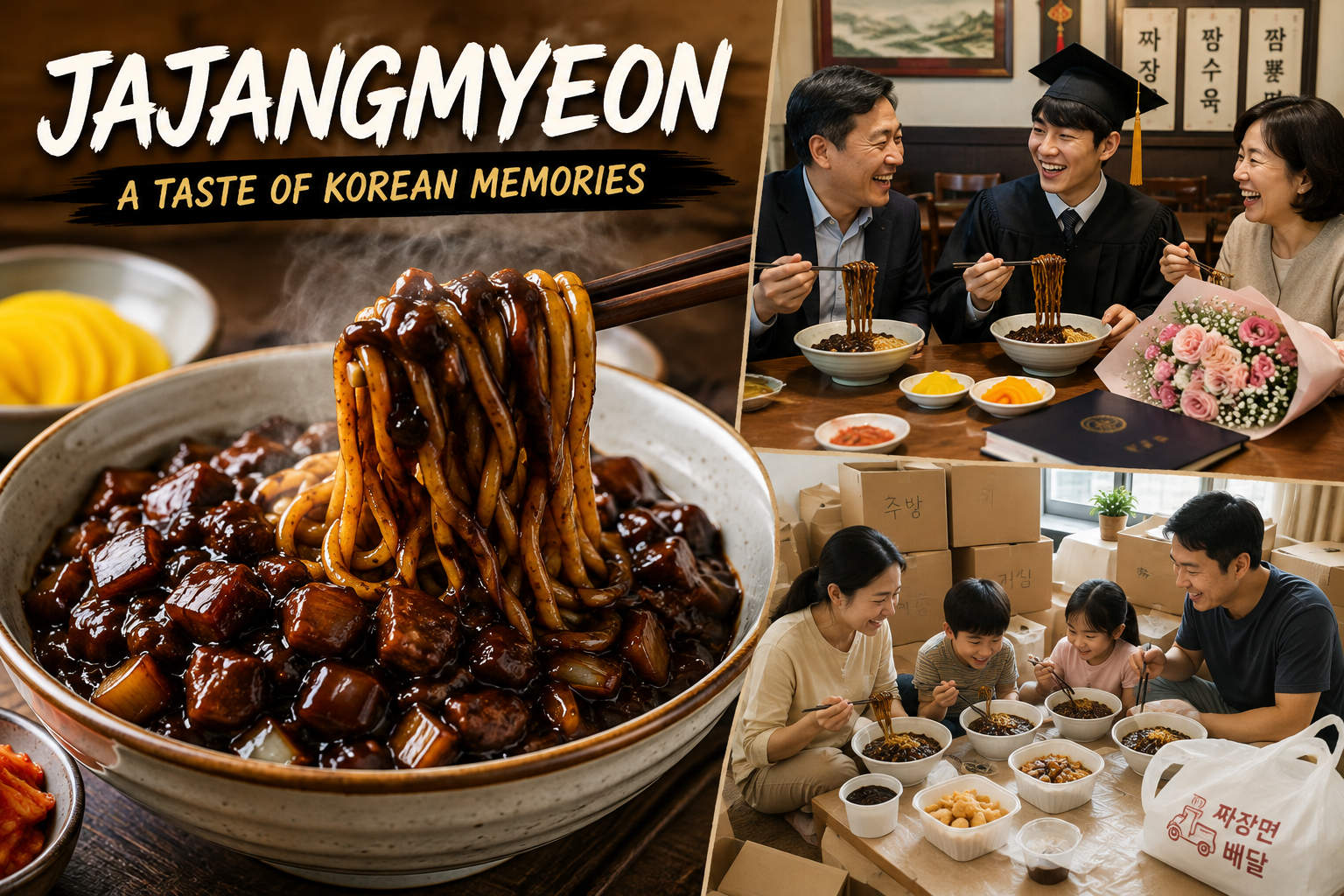
There are foods Koreans remember not because they were expensive or luxurious, but because they were simply there at important moments in life.
Jajangmyeon is one of those foods.
A graduation day.
A family moving into a new home.
An evening when nobody wants to cook.
A quick delivery meal.
Or a sudden craving so strong that you already know exactly which restaurant you want to order from.
For many Koreans, jajangmyeon is more than noodles covered in black bean sauce.
It tastes like everyday life—and sometimes, like an old memory.
What Is Jajangmyeon?
Jajangmyeon is one of Korea’s most beloved noodle dishes.
It is made with chewy noodles covered in a thick, dark sauce usually made from chunjang, a Korean-style fermented black bean paste, along with onions, pork and vegetables.
The sauce is rich, savory and slightly sweet.
Although jajangmyeon developed from Chinese culinary roots, it evolved in Korea into a distinctive dish and became deeply connected with Korean everyday food culture.
Today, walk into a Korean Chinese restaurant and jajangmyeon will almost certainly be one of the first dishes people think about ordering.
But its importance in Korea goes far beyond the recipe.
Graduation Day Meant Jajangmyeon
For generations of Koreans, graduation day was one of the days associated with jajangmyeon.
After the ceremony, families would go out together to celebrate.
And for many students, that celebration meant sitting down at a Korean Chinese restaurant for a bowl of jajangmyeon.
It wasn’t an extravagant meal.
That was part of its charm.
A simple bowl of black bean noodles could become part of the memory of finishing school, taking family photographs and beginning the next chapter of life.
Years later, the taste can bring those memories back.
Moving Day? Order Jajangmyeon
There is another scene that feels unmistakably Korean.
Imagine moving into a new home.
Boxes are everywhere. Furniture hasn’t been arranged. Pots and dishes are still packed away, and nobody wants to start cooking.
So what do you eat?
For countless Korean families, the traditional answer has been simple:
Order jajangmyeon.
Delivery arrives, everyone finds somewhere to sit among the boxes, and the family eats together before returning to unpacking.
It is such an ordinary moment.
But that is exactly why jajangmyeon became part of Korean life.
Sometimes food becomes a tradition without anyone deliberately deciding that it should.
The Perfect Food When You Don’t Want to Cook
Jajangmyeon isn’t only connected to special memories.
It is also wonderfully ordinary.
There are evenings when you come home tired and simply don’t want to cook.
You don’t necessarily want an expensive restaurant meal either.
You just want something filling, comforting and satisfying.
That’s when jajangmyeon works perfectly.
Go to the neighborhood Korean Chinese restaurant, sit down and have one bowl.
Or stay home and order delivery.
This combination of affordability, convenience and comfort helped jajangmyeon become one of Korea’s classic everyday meals.
You Can Smell Jajangmyeon Before You Taste It
One of the most irresistible things about jajangmyeon is its aroma.
Sometimes you don’t even need to see it.
You smell it first.
The aroma of black bean sauce cooking with onions and pork can suddenly make you hungry—even if you weren’t thinking about food a moment earlier.
Then the bowl arrives.
Dark, glossy sauce covers the noodles. Steam rises as you begin mixing everything together.
And somehow your appetite becomes even stronger.
For many Koreans, the craving for jajangmyeon begins before the first bite.
Everyone Has Their Favorite Jajangmyeon Restaurant
Jajangmyeon looks like a simple dish.
Noodles and black bean sauce.
But making a truly memorable bowl isn’t nearly as simple as it looks.
The texture of the noodles matters.
So does the way the chunjang is cooked, the sweetness of the onions, the amount of pork, the balance between savory and sweet flavors, and the thickness of the sauce.
That’s why two jajangmyeon restaurants can taste surprisingly different.
And that’s also why many Koreans have their own favorite place.
I sometimes suddenly remember the jajangmyeon from a particular restaurant in another area.
When that craving hits, I will even get in my car and drive there just to eat that one bowl.
It might seem strange to travel for such an inexpensive and simple-looking food.
But sometimes you don’t crave jajangmyeon.
You crave the jajangmyeon from that one particular restaurant.
Jajangmyeon or Jjamppong? Koreans Found a Solution
Visit a Korean Chinese restaurant and eventually you may face one of Korea’s classic food dilemmas:
Jajangmyeon or jjamppong?
Jajangmyeon gives you rich, savory-sweet black bean noodles.
Jjamppong gives you spicy noodles and a hot, flavorful broth.
Sometimes you want both.
Korean restaurants came up with a wonderfully practical solution: jjamjjamyeon.
A divided bowl serves jajangmyeon on one side and jjamppong on the other.
Take a bite of rich jajangmyeon, then have a spoonful of hot, spicy jjamppong broth.
Sweet and savory. Then hot and spicy.
Sometimes the best choice is not to choose at all.
Jjapagetti: When Koreans Want Jajang Flavor at Home
Restaurant-style jajangmyeon can take some effort to make from scratch.
You need chunjang, meat, vegetables, noodles, and time to properly cook the sauce.
But what happens when you’re at home and suddenly crave that familiar black bean noodle flavor?
Koreans have another famous option:
Jjapagetti.
Jjapagetti is an instant noodle inspired by Korean-style black bean noodles.
It isn’t the same as freshly made restaurant jajangmyeon, and it shouldn’t be expected to be.
It is something different: quick, convenient and deeply familiar to many Koreans.
Jajangmyeon is the dish you order. Jjapagetti is the craving you can solve in minutes.
Can’t Find Jajangmyeon? Try Jjapagetti
If you live outside Korea, authentic Korean-style jajangmyeon may not be easy to find.
In that case, Jjapagetti can be a fun introduction to Korea’s love for black bean noodles.
One simple way to make it richer is to avoid using too much water.
Cook the noodles with a relatively small amount of water and allow the liquid to reduce as the noodles cook. Add the seasoning so the sauce becomes thick and coats the noodles rather than becoming watery.
Finish with the included oil once the sauce has thickened.
Then make it your own.
Try adding a soft fried egg, thin cucumber strips, green onions or a little cheese.
For something more substantial, add grilled beef or pork.
And if you can find Korean kimchi—especially green onion kimchi—try eating it alongside the noodles.
The fresh, spicy acidity works beautifully against the rich black bean flavor.
From Jjapagetti to Jjapaguri
There is another Korean instant noodle combination that became famous around the world.
Jjapaguri.
It combines Jjapagetti with Neoguri, a spicy seafood-flavored instant noodle with thicker noodles.
International audiences discovered it through Bong Joon-ho’s movie Parasite, where the noodles are served with expensive beef.
That small addition transforms a humble instant noodle combination into something much more luxurious.
The Jjapagetti brings dark, savory-sweet flavor, while Neoguri adds spice and a different noodle texture.
Add pieces of seared beef, and a simple instant meal becomes something surprisingly indulgent.
It is another example of how Koreans enjoy adapting familiar foods rather than always following one fixed recipe.
How to Make Authentic Korean Jajangmyeon at Home
If you want to go beyond instant noodles, you can make Korean-style jajangmyeon from scratch.
The most important ingredient is chunjang, Korean black bean paste.
And one of the most important steps is cooking that paste properly.
Ingredients — About 3 Servings
Main ingredients
- 3 servings fresh Korean/Chinese-style wheat noodles
- 250 g pork, cut into small pieces
- 100–120 g chunjang
- 1 large onion
- About 200 g cabbage
- 1 green onion
- 1 small zucchini, optional
- 1 small potato, optional
- Cooking oil
For the sauce
- 2–3 tbsp sugar, adjusted to taste
- 1 tbsp soy sauce
- 1 tbsp oyster sauce
- About 500 ml water or light stock
- Black pepper, optional
- 1/2 tbsp sesame oil for finishing
For thickening
- 2 tbsp potato or corn starch
- 2 tbsp water
Optional garnish
- Thin cucumber strips
- Fried egg
- Green peas
Step 1: Fry the Chunjang
This is one of the secrets to better jajangmyeon.
Heat a generous amount of cooking oil over low to medium-low heat and gently fry the chunjang for several minutes, stirring frequently.
This mellows its harsh edge and develops a rounder, richer flavor.
Don’t burn it.
Once fragrant and glossy, remove the cooked paste and keep it nearby.
Step 2: Cook the Pork and Vegetables
Add chopped green onion to the pan and let it become fragrant.
Add the pork and cook until the outside is nicely browned.
Then add the onions, cabbage and any other vegetables you are using.
Cook over relatively high heat so the ingredients develop flavor rather than simply steaming.
The onions are particularly important.
Their natural sweetness becomes part of the character of the sauce.
Step 3: Build the Black Bean Sauce
Add the fried chunjang back to the pan.
Mix it thoroughly with the pork and vegetables.
Add sugar, soy sauce and oyster sauce, adjusting the sweetness to your preference.
Pour in the water or light stock and bring everything to a simmer.
Cook until the vegetables are tender and the flavors come together.
Step 4: Thicken the Sauce
Mix the starch with an equal amount of cold water.
Add it gradually while stirring the sauce.
Don’t pour it all in at once.
Stop when the sauce becomes glossy and thick enough to cling beautifully to the noodles.
Finish with a small amount of sesame oil.
Step 5: Cook the Noodles
Boil the noodles according to the package directions.
Fresh noodles generally cook quickly, so watch them carefully.
Drain and rinse briefly to remove excess surface starch, then drain thoroughly.
Place the noodles in a large bowl and spoon a generous amount of hot jajang sauce over the top.
Add cucumber strips if you like.
Now comes the best part.
Mix everything thoroughly.
The pale noodles should almost disappear beneath the glossy black sauce.
Then eat it while it’s hot.
Gan-Jajang and Yuni-Jajang
Once you start exploring Korean Chinese restaurants, you’ll discover that jajangmyeon doesn’t have just one form.
Gan-jajang is generally stir-fried with less added liquid, giving it a thicker, more intensely stir-fried character.
Yuni-jajang uses finely chopped or minced ingredients, creating a smoother sauce that coats the noodles easily.
Different restaurants develop their own styles, which is another reason finding a favorite jajangmyeon restaurant can become such a personal thing.
True Taste Korea Tip
Don’t judge jajangmyeon by how simple it looks.
A great bowl depends on small details.
The noodles should have a pleasant chew.
The sauce should be rich but not overwhelmingly sweet.
The onions should bring natural sweetness.
The chunjang should taste deep and savory rather than harsh.
And there should be enough sauce to coat every strand of noodle generously.
When it arrives at the table, mix it well.
Jajangmyeon is supposed to be messy, glossy and delicious.
FAQ
Is jajangmyeon Chinese or Korean?
Jajangmyeon has Chinese culinary roots, but the dish evolved significantly in Korea and became a distinctive part of Korean Chinese cuisine and everyday Korean food culture.
Is jajangmyeon spicy?
Usually, no.
Traditional jajangmyeon is more savory and slightly sweet than spicy, making it approachable for people who find many Korean dishes too hot.
What is chunjang?
Chunjang is the dark fermented bean paste used to make Korean jajang sauce. It gives jajangmyeon its distinctive dark color and deep savory flavor.
Is Jjapagetti the same as jajangmyeon?
No.
Jjapagetti is an instant noodle inspired by Korean black bean noodles. It offers some familiar flavors but is different from freshly cooked restaurant jajangmyeon.
What should I eat with jajangmyeon?
In Korean Chinese restaurants, danmuji (yellow pickled radish) is a classic companion. Its sweet, tangy crunch cuts through the rich sauce.
Jajangmyeon is also commonly enjoyed alongside dishes such as tangsuyuk, Korean-style sweet-and-sour pork.
More Than a Bowl of Black Noodles
To someone seeing it for the first time, jajangmyeon might simply look like noodles covered in a very dark sauce.
But for many Koreans, that bowl can contain much more.
A graduation.
A moving day.
A family sitting together among unpacked boxes.
A night when nobody wanted to cook.
The smell coming from a neighborhood Chinese restaurant.
Or a particular restaurant you suddenly remember years later—and decide is worth driving across town to visit.
That’s why jajangmyeon has remained so close to everyday Korean life.
It doesn’t need to be expensive.
It doesn’t need to be elegant.
Sometimes the foods we remember most are simply the foods that were there when life was happening.
And for many Koreans, jajangmyeon is one of those foods.