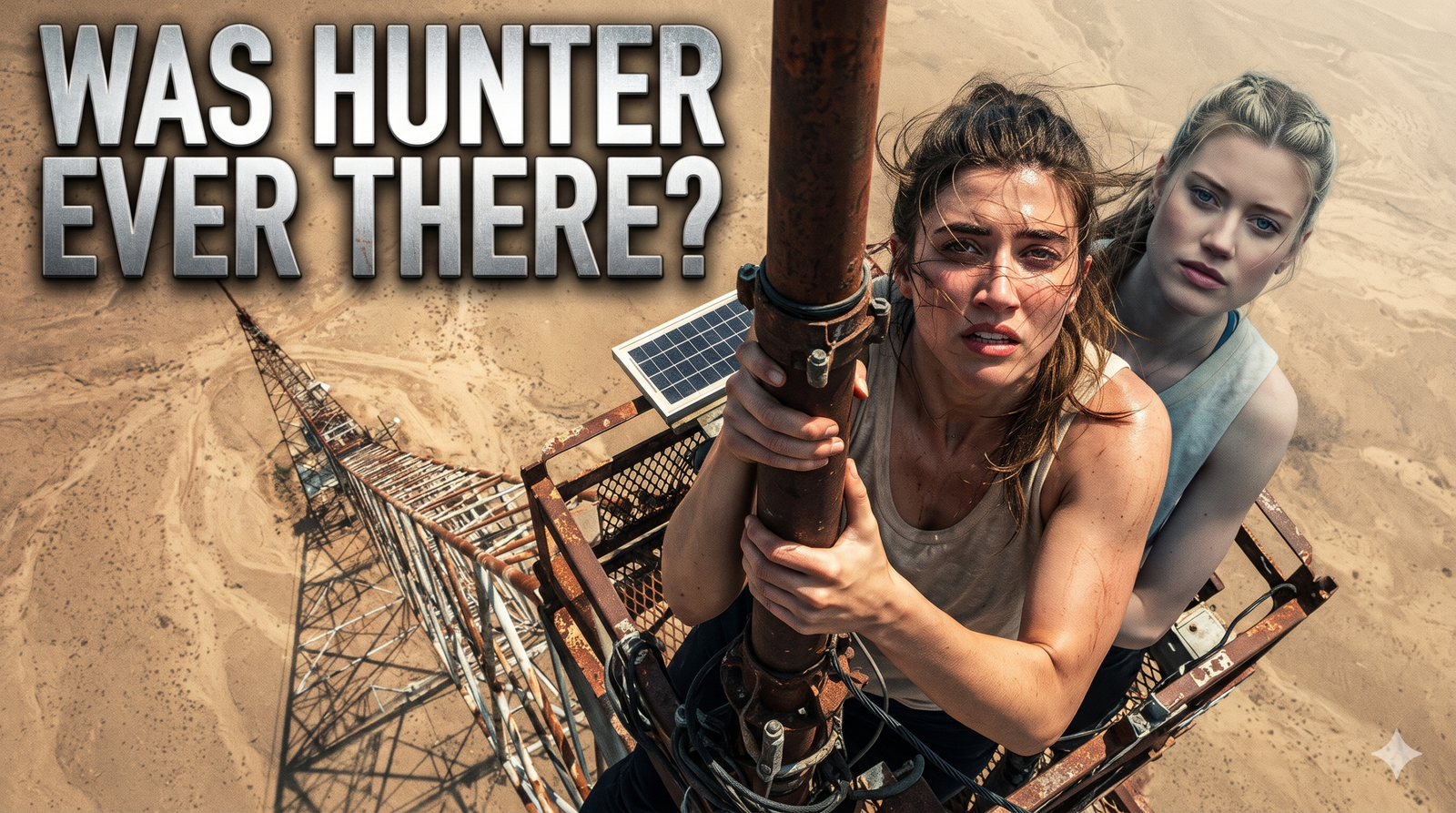
At first glance, Fall looks like a straightforward survival thriller. Two friends climb a 2,000-foot abandoned television tower, a ladder collapses, and they become trapped hundreds of feet above the ground with almost no supplies.
But the film’s most disturbing moment is not the collapse of the ladder.
It is the discovery that one of the two women has been dead for much longer than the audience realizes.
Directed by Scott Mann, Fall (2022) follows Becky Connor, a woman struggling to recover from the death of her husband, Dan. Her friend Shiloh Hunter, usually called Hunter, persuades her to climb an abandoned tower as a way of confronting her fear and grief. What begins as an attempt to move forward becomes a terrifying struggle for survival.
Yet the story gradually reveals another conflict beneath the physical danger. Becky is carrying unresolved grief, anger toward her father, and the emotional consequences of a betrayal she never expected.
The film’s central twist changes how we understand Hunter. The person helping Becky survive is not simply the friend she remembers. She is also a psychological presence shaped by Becky’s desperate need not to be alone.
This raises a more interesting question than whether Becky can escape the tower.
Was Hunter really saving Becky, or was Becky creating the version of Hunter she needed in order to survive?
1. The Tower Is More Than a Dangerous Location
The abandoned B-67 television tower is the obvious source of danger in Fall.
Its height creates immediate physical anxiety. The narrow ladders, exposed platforms, corroded metal, and enormous distance to the ground make even ordinary movements feel life-threatening.
But the tower also works as a visual representation of Becky’s psychological condition.
Before the climb, Becky is already isolated. She has withdrawn from ordinary life after Dan’s death, drinks heavily, and avoids her father. Her grief has effectively separated her from the people who might help her.
The tower makes that isolation physical.
Once Becky and Hunter reach the top, there is nowhere to hide from the consequences of their decisions. They cannot walk away from an argument, return home, or ask someone to resolve their problems.
Every emotional conflict becomes harder to escape because their physical world has become so small.
The tower is therefore not merely a spectacular setting. It is a place where the characters’ unresolved problems are forced into the open.
2. Becky Is Not Simply Afraid of Heights
Becky initially appears to be a woman who has lost her confidence.
Before Dan’s death, climbing was part of her identity. She was adventurous, physically capable, and willing to accept danger.
After the accident, she stops climbing and becomes increasingly disconnected from her former life.
It would be easy to describe her condition as a fear of returning to the activity that killed her husband.
But the deeper issue is that Becky has lost the person she believed herself to be.
Dan’s death did not simply remove someone she loved. It destroyed the future she had imagined and changed her relationship with the activity that once gave her excitement and purpose.
Her hesitation before climbing the tower is therefore not just physical fear.
It is a confrontation with the person she used to be.
The question is whether she can return to that identity without being overwhelmed by the memory of what happened.
3. Hunter’s Invitation Looks Like Friendship, but It Also Contains Pressure
Hunter believes that climbing the tower will help Becky move forward.
Her intention appears understandable. She sees her friend suffering and wants to give her a reason to experience life again.
However, Hunter’s approach raises an important question.
Does helping someone overcome grief mean encouraging them to confront their fear before they are ready?
Hunter is energetic, confident, and comfortable with risk. Becky is emotionally fragile and uncertain. Their different personalities create an imbalance that becomes increasingly important as the story develops.
Hunter often treats fear as something that must be defeated through action.
But grief does not always respond to that kind of pressure.
A person may need time, support, and the freedom to decide when they are ready to move forward.
Hunter’s invitation can therefore be interpreted in two ways. It is an attempt to help Becky, but it also reflects Hunter’s belief that she knows what Becky needs.
That difference between intention and understanding becomes one of the film’s central tensions.
4. The First Climb Recreates the Confidence Becky Lost
As the women climb the tower, Becky repeatedly encounters moments when she wants to stop.
Hunter encourages her to continue, sometimes using humor and sometimes applying direct pressure.
Eventually, Becky reaches the top.
The moment is important because she experiences a temporary return of confidence. She has accomplished something that seemed impossible when she first arrived.
Scattering Dan’s ashes also gives the climb an emotional purpose.
The action appears to represent a final farewell. Becky has carried the memory of her husband for a year, and the tower offers a dramatic place to release that burden.
But the film deliberately complicates the idea of closure.
Scattering someone’s ashes does not automatically resolve grief. A symbolic gesture can mark a decision, but it cannot erase the emotions attached to the person who has died.
The climb gives Becky a moment of achievement. It does not yet give her emotional freedom.
5. The Broken Ladder Turns a Symbolic Journey Into a Trap
The ladder collapses as the women begin their descent.
Suddenly, the tower is no longer a place where Becky can prove her courage. It becomes a structure that threatens to kill her.
The timing is significant.
Becky has just completed what she believed would be a healing experience. She has confronted her fear, reached the top, and scattered Dan’s ashes.
Then the route back down disappears.
The film uses this physical reversal to challenge the idea that emotional progress follows a simple upward path.
People often imagine recovery as a journey in which each difficult step brings them closer to peace.
But psychological recovery is rarely so orderly. A person can make progress and still experience a sudden setback.
In Fall, the women discover that reaching the top is not the same as finding a way home.
6. The Tower Removes the Comfort of Ordinary Life
Once stranded, Becky and Hunter lose access to the things that normally make survival possible.
Their water and equipment are out of reach. Their phones cannot reliably connect to a network. Their attempts to attract attention fail.
The women are forced to think about basic physical needs.
Water becomes more important than reputation. A small amount of food becomes more valuable than any personal possession. A working phone becomes more important than the emotional arguments that previously occupied their attention.
This change in priorities is one of the film’s most effective ideas.
In ordinary life, people can avoid difficult conversations by changing the subject, leaving a room, or postponing a decision.
At the top of the tower, those options disappear.
The women cannot escape one another, and they cannot escape the consequences of what they have done.
The setting turns survival into a test of both physical endurance and emotional honesty.
7. The 1-4-3 Tattoo Destroys Becky’s Understanding of Her Friendship
One of the film’s most important revelations occurs when Becky notices Hunter’s tattoo.
The numbers 1-4-3 represent the phrase “I love you,” a private code associated with Dan and Becky.
Hunter eventually admits that she had an affair with Dan for four months before his marriage to Becky.
This confession changes the emotional meaning of the story.
Until this moment, Hunter has appeared to be the loyal friend who came back to help Becky after a devastating loss.
Now Becky must reconsider the relationship.
The betrayal is particularly painful because Hunter has remained close to her while keeping this secret.
The problem is not only that Hunter had a relationship with Dan. It is that Becky has been living with an incomplete understanding of the people closest to her.
Her grief was already built around the loss of her husband. The confession adds another layer: the possibility that the marriage she remembers was not exactly what she believed it to be.
The tower has forced a hidden truth into the open.
8. Was Hunter’s Confession an Act of Honesty or an Attempt to Escape Guilt?
Hunter’s confession can be interpreted in more than one way.
On one level, she finally tells Becky the truth. Keeping the affair secret has allowed their friendship to continue without confronting the damage it caused.
On another level, the timing is deeply problematic.
Becky and Hunter are stranded in a life-threatening situation. Becky cannot leave, seek advice, or process the revelation in a normal environment.
Hunter’s decision to confess at that moment places an enormous emotional burden on someone who is already physically vulnerable.
Perhaps Hunter feels that the secret must be revealed before they die.
Perhaps she wants to stop carrying the guilt.
But telling the truth does not automatically repair the harm caused by hiding it.
This distinction matters because the film does not present confession as a magical act of redemption.
Becky has to absorb the revelation while still fighting for her life.
Hunter may be seeking honesty, but Becky is the one forced to live with its consequences.
9. The Affair Changes the Meaning of Hunter’s Earlier Support
After the confession, earlier scenes begin to look different.
Hunter’s encouragement may still have been motivated by genuine concern, but the friendship is no longer emotionally uncomplicated.
She is not simply helping the widow of a dead friend.
She is helping someone whose husband she once betrayed.
This creates a difficult psychological question.
Can someone genuinely care about a person they have seriously hurt?
The answer is not necessarily no.
Human relationships can contain affection, selfishness, regret, loyalty, and dishonesty at the same time.
Hunter may care about Becky while also having protected herself through silence.
That contradiction makes the character more interesting than a simple villain or heroic friend.
However, the film does not provide enough evidence to establish every motive behind Hunter’s actions. It is more accurate to say that the confession exposes a conflict between her apparent loyalty and her past behavior.
The friendship cannot return to its earlier form simply because the truth has finally been spoken.
10. Hunter’s Death Is the Film’s Most Important Turning Point
After confessing, Hunter attempts to retrieve the backpack containing their supplies.
She climbs down toward the communications dish, but the situation becomes dangerous. The film later reveals that she falls onto the structure and dies.
This is the event that changes the entire meaning of the second half.
The audience initially sees Hunter return with the backpack and continue helping Becky.
But that apparent survival is part of the film’s deception.
Hunter has already died.
Becky is alone on the tower, although she does not fully recognize that reality.
The revelation is more than a conventional surprise ending.
It forces the audience to reconsider the scenes that followed Hunter’s fall. The conversations, encouragement, arguments, and attempts at rescue must now be understood through Becky’s altered perception.
The film has not merely hidden information about a character.
It has allowed the audience to experience the protagonist’s distorted understanding of reality.
11. The Imaginary Hunter Is Not Just a Memory
Why does Becky continue to see Hunter after her death?
The most direct explanation is that Becky is suffering from severe physical and psychological stress.
She is injured, dehydrated, exhausted, and increasingly desperate. Under these conditions, her perception of events becomes unreliable.
But the film’s psychological meaning goes further.
The Hunter Becky sees after the fall is different from the real Hunter in an important way.
The imagined Hunter continues to help her. She offers advice, encourages her, and remains present when Becky is close to giving up.
This version of Hunter is not simply a memory replaying past conversations.
She behaves like the companion Becky desperately needs at that moment.
The distinction suggests that the hallucination is shaped by Becky’s emotional requirements.
She cannot easily accept that she has lost another person. Her mind produces a version of Hunter who remains beside her.
The illusion does not remove the pain of reality. It temporarily makes that reality bearable.
12. Hunter Becomes the Friend Becky Needs, Not Necessarily the Friend She Had
This is where the film offers its most interesting psychological interpretation.
The real Hunter betrayed Becky by having an affair with Dan and keeping the truth hidden.
The imagined Hunter, however, becomes a supportive presence who helps Becky survive.
The two versions are emotionally different.
One represents a friendship damaged by secrecy. The other represents the comfort of believing that someone is still there.
It would be too simple to say that Becky is merely forgiving Hunter.
She may also be reconstructing their relationship into something she can emotionally tolerate.
The imagined friend gives Becky support without requiring her to resolve every contradiction in their real relationship.
This is not necessarily a conscious decision.
It is a possible reading of how the film uses hallucination to express the mind’s struggle with isolation and unbearable loss.
The most painful part is that Becky receives the support she needs only after the real Hunter is gone.
13. The Hallucination Reveals Becky’s Need to Avoid Being Completely Alone
The tower is physically isolated, but Becky’s emotional isolation began long before the climb.
She has distanced herself from her father. She has lost Dan. Her relationship with Hunter has been damaged by the confession.
By the time Hunter dies, Becky has almost no emotional support left.
The hallucination can therefore be read as a response to more than physical loneliness.
It represents the collapse of the relationships that once gave Becky a sense of belonging.
Her mind preserves a companion because the alternative is to confront the possibility that she has been abandoned by everyone she loved.
This interpretation also explains why the imagined Hunter becomes more helpful after her death.
The real friendship was complicated. The imagined friendship is simplified into the support Becky needs.
The film suggests that loneliness can change not only how people feel but also how they understand the world around them.
14. The Vulture Represents the Physical Reality Becky Cannot Escape
The vultures are among the film’s most disturbing images.
They circle the tower, waiting for an opportunity to feed. Their presence reminds the audience that the human body is vulnerable and that death is not an abstract possibility.
For Becky, the birds become a direct threat when one attacks her injured leg.
She eventually kills the vulture and eats it.
The scene is shocking because it marks the point at which survival takes priority over ordinary ideas of comfort and disgust.
But the vulture also has a symbolic function.
It represents a reality that cannot be negotiated with.
The bird does not care about Becky’s grief, her friendship, or her memories of Dan. It responds to weakness and opportunity.
The tower has stripped away the social world in which Becky could find meaning in relationships.
Now she must confront the basic biological struggle to remain alive.
The vulture is not a supernatural enemy. It is part of the natural environment, indifferent to the human drama unfolding above it.
15. Why the Drone’s Failure Matters More Than It First Appears
Becky and Hunter attempt to use a drone to send a message for help.
The plan briefly appears to offer a way out. They manage to power the device, attach a message, and send it toward a nearby location.
But the drone is destroyed before it can deliver the message.
This failure is important because it removes the last apparent solution that does not require Becky to take an extreme personal risk.
It also changes the film’s structure.
Until this point, the women have been trying to make technology solve their problem. They use phones, signals, lights, and the drone.
But each attempt fails.
The final solution will depend on Becky’s own physical judgment and willingness to act.
The failed drone therefore prepares the audience for a different kind of survival strategy.
It also reinforces the film’s recurring idea that a plan can look convincing while remaining vulnerable to circumstances outside human control.
16. The Twist Changes the Meaning of Every Conversation After Hunter’s Fall
When Becky finally realizes that Hunter is dead, the audience must reconsider what it has watched.
The conversations after the fall were not exchanges between two survivors.
They were part of Becky’s altered experience.
This makes the twist emotionally effective, but it also creates a difficult storytelling challenge.
A mystery ending works best when earlier scenes contain clues that make the truth understandable in retrospect.
In Fall, the audience can revisit the later scenes and notice how the film has encouraged it to accept Hunter’s continued presence.
The imagined Hunter also behaves in ways that can be interpreted as a reflection of Becky’s needs rather than the real woman’s personality.
Some viewers on Reddit have described the twist as a strong rewatch experience, comparing the imagined Hunter to an idealized alter ego. Others have criticized the reveal as a contrived development that weakens the story’s realism.
Both reactions point to the same issue: the twist is central to the film’s identity, but its success depends on whether the audience accepts the film’s visual and psychological deception.
The reveal is not simply surprising. It asks viewers to reconsider how much of what they saw was objective reality.
17. Becky Finally Survives When She Stops Depending on the Imaginary Hunter
Once Becky recognizes that Hunter is dead, she has to face the situation alone.
This is the most important emotional change in the final act.
Until then, she has been able to imagine that someone is still beside her.
Now that illusion is gone.
She must use whatever strength remains, descend toward Hunter’s body, and find a way to send a message.
The physical challenge is extreme, but the psychological challenge is just as important.
Becky can no longer rely on the comforting presence her mind created.
She must accept the death of her friend and act without the support she thought she had.
This is where the film’s survival story and emotional story finally become connected.
Becky does not survive because the tower becomes less dangerous.
She survives because she begins making decisions based on the reality in front of her.
18. Hunter’s Body Becomes the Final Means of Rescue
The final rescue plan is one of the film’s most disturbing images.
Becky places her phone inside Hunter’s shoe and uses Hunter’s body as protection for the device when she pushes it down from the tower.
The plan is desperate, but it gives Becky a chance to get a message through.
The symbolism is difficult to ignore.
For much of the film, the imagined Hunter has been helping Becky remain alive.
In the final sequence, the real Hunter’s body becomes part of the physical mechanism that makes rescue possible.
The person who once represented emotional support now becomes the means by which Becky reaches the outside world.
This is not a sentimental reunion.
It is a brutal reminder that the dead cannot return to repair what they have damaged.
Becky must use what remains of the relationship, even when doing so is painful.
The scene also completes the film’s reversal: the illusion of companionship is replaced by the undeniable reality of death.
19. The Final Reunion With Her Father Is About More Than Being Rescued
After the message reaches her father, emergency services are alerted and Becky is rescued.
Her reunion with James is emotionally important because their relationship was already broken before the climb.
James had tried to encourage Becky to move forward after Dan’s death, but his comments were painful to her. She believed he was dismissing her grief, and she responded by distancing herself.
The tower forces Becky to confront how much she has lost through isolation.
Her father cannot bring Dan back. He cannot undo Hunter’s betrayal or death. He cannot erase the time Becky spent trapped above the ground.
But he can still be present.
The final embrace suggests that survival is not only about returning to physical safety.
It is also about reopening a relationship that grief had closed.
The film does not show every conversation they will need to have. It does not magically resolve their past.
Instead, it offers a beginning.
Becky has survived, and she is no longer completely alone.
Conclusion: The Real Escape Was Accepting That Hunter Was Gone
Fall succeeds because it turns a simple survival premise into a story about the psychological cost of unresolved grief.
The tower creates the physical danger, but the emotional conflict began long before Becky arrived there.
She lost her husband, withdrew from her father, and discovered that her closest friend had betrayed her. When Hunter died, Becky was left with no one beside her.
Her mind created a version of Hunter who could remain.
That imagined companion was supportive, encouraging, and willing to help. In many ways, she was the friend Becky needed rather than the complicated person Hunter had actually been.
This does not mean the hallucination was a deliberate act of forgiveness. It is more interesting to understand it as a psychological response to isolation, trauma, and the inability to accept another devastating loss.
The final rescue becomes possible only when Becky recognizes the truth and acts without the illusion.
That is why the film’s most important moment is not the collapse of the ladder, the attack of the vulture, or even the final descent.
It is the moment Becky understands that Hunter is dead.
She cannot repair the friendship. She cannot ask for an explanation. She cannot recover the life she had before the climb.
But she can choose to keep living.
The tower was the place where Becky almost lost her life. Accepting the truth about Hunter was the moment she finally began to reclaim it.