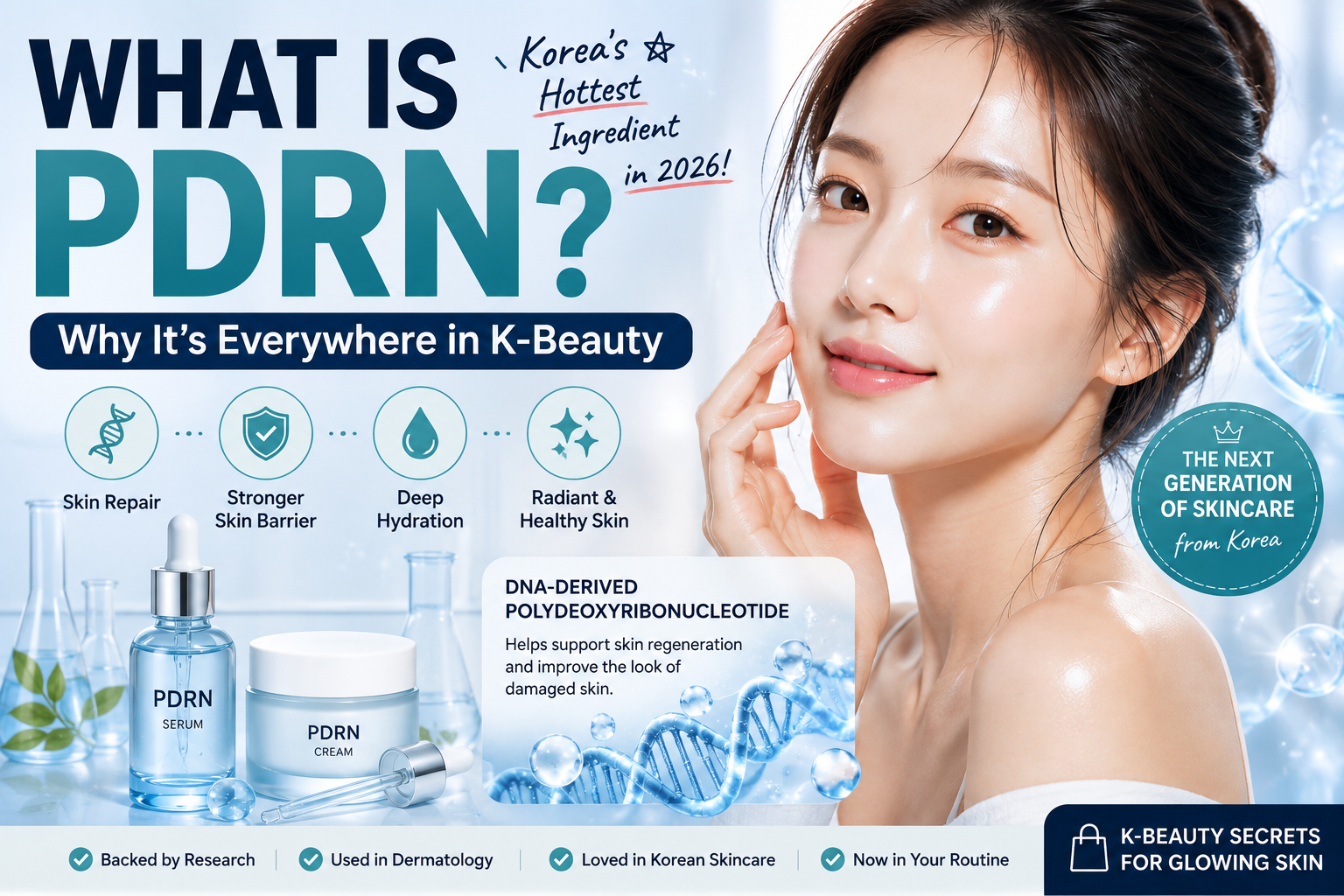
If you’ve been following Korean skincare lately, you may have noticed four letters appearing everywhere:
PDRN.
Serums, creams, masks and professional Korean skincare treatments are increasingly using the term.
So what exactly is PDRN?
And more importantly:
Does it actually do anything for your skin — or is it just another K-beauty trend?
Let’s separate the science from the hype.
What Is PDRN?
PDRN stands for polydeoxyribonucleotide.
In simple terms, PDRN consists of DNA fragments that have been studied for their potential role in tissue repair and regeneration.
PDRN has a history of medical and regenerative applications, but the ingredient has increasingly crossed into the beauty world.
That’s one reason PDRN has become one of the ingredients attracting attention in Korea’s rapidly evolving skincare market.
Vogue included PDRN among the bio-regenerative actives expected to help shape K-beauty in 2026.
Why Is PDRN Suddenly So Popular in Korean Skincare?
K-beauty trends have gradually shifted beyond simple hydration.
Consumers are increasingly interested in products associated with:
skin barrier support, elasticity, soothing, hydration and healthy-looking aging.
This has created enormous interest in ingredients inspired by regenerative dermatology.
PDRN fits directly into that trend.
And it isn’t confined to Korean clinics anymore.
The ingredient is increasingly appearing in consumer skincare products that can be incorporated into everyday routines.
Wait — Is PDRN Really Made From Salmon?
This is probably one of the first questions many shoppers ask.
Traditionally, PDRN has commonly been associated with DNA fragments derived from salmon or trout.
That’s why you may encounter phrases such as:
“salmon DNA skincare.”
However, PDRN research isn’t limited to fish-derived sources.
Researchers are also investigating alternatives. A 2026 study, for example, examined low-molecular-weight PDRN derived from Paeonia lactiflora — peony — as a potential plant-based alternative.
So don’t automatically assume every PDRN product has exactly the same source or formulation.
Check the individual product.
What Can PDRN Potentially Do for Skin?
This is where things become interesting.
Research into PDRN and related polynucleotides has examined areas including tissue repair, wound healing, skin rejuvenation and photoaging.
A 2026 systematic review of randomized trials found encouraging outcomes across skin rejuvenation, scar and wound-healing applications, while also showing that the overall evidence base remains relatively small.
A separate 2026 study investigated a topical medium-length PDRN formulation on photodamaged skin.
Researchers reported improvements in several measured skin parameters in their study, while also noting that topical PDRN delivery and mechanisms have historically been insufficiently defined.
That’s an important distinction.
Promising research does not mean every PDRN cosmetic will produce the same result.
Formulation, concentration, molecular characteristics and delivery can all matter.
PDRN Skincare vs. PDRN Treatments in Korea
This distinction is extremely important.
PDRN cosmetics
These include products such as:
serums
creams
masks
ampoules
They’re topical skincare products intended for everyday cosmetic use.
Professional treatments
PDRN and related polynucleotide products may also be used in professional aesthetic or dermatological settings.
These are not the same thing as applying a PDRN serum at home.
Clinical literature concerning professional or post-procedure applications shouldn’t automatically be interpreted as proof that an over-the-counter cosmetic produces identical effects. Recent reviews also point out limitations including small studies, formulation differences and limited long-term follow-up.
If you’re considering professional treatment in Korea, see our guide:
Dermatology in Korea for Foreigners 2026: Treatments, Costs & How to Book
How Do You Use a PDRN Serum?
Always follow the directions for the particular product you’ve purchased.
For a typical serum-style skincare product, the routine may look something like:
Cleanser → Toner → PDRN Serum → Moisturizer → Sunscreen in the morning
You don’t need to completely rebuild your skincare routine just because PDRN is trending.
Start simple.
Introduce a new product gradually and watch how your skin responds.
Who Might Be Interested in PDRN Skincare?
PDRN products may appeal particularly to people interested in:
hydration
skin barrier care
healthy-looking aging
elasticity-focused routines
post-stress skin care
But skincare is highly individual.
People with sensitive skin should pay attention to the entire ingredient list, not merely the word PDRN printed on the bottle.
Is PDRN Better Than Retinol?
Not necessarily.
They aren’t interchangeable ingredients.
Retinoids have a much longer history of dermatological research and use.
PDRN is a newer and rapidly developing area of interest in consumer skincare.
Interestingly, a recent randomized split-face study compared one specific 0.1% topical PDRN formulation with 0.1% retinol over 28 days and reported favorable results for that PDRN formulation on several measured periocular parameters.
But that doesn’t establish that every PDRN serum is superior to every retinol product.
That’s exactly the kind of marketing leap consumers should avoid.
How to Choose a PDRN Product
Don’t buy something simply because PDRN appears in giant letters on the package.
Look at:
the manufacturer
the complete ingredient list
the product’s intended purpose
directions for use
your own skin type
other active ingredients in your routine
And buy through a retailer or brand you trust.
PDRN Is Already Reaching Olive Young Shoppers
This isn’t merely an abstract beauty trend.
Olive Young Global has recently featured Anua PDRN Hyaluronic Capsule 100 Serum in promotional skincare selections.
That combination is interesting because it illustrates where consumer K-beauty is heading:
trending active + hydration-focused ingredients + easy home routine.
And we already have this exact ANUA product in our True Taste Korea Picks collection.
Is PDRN Worth Trying?
PDRN is one of the more interesting K-beauty ingredients to watch in 2026.
There is emerging scientific research behind PDRN and polynucleotide applications.
But there’s also plenty of marketing hype.
The sensible position sits somewhere between:
“PDRN is a miracle ingredient.”
and
“PDRN is meaningless marketing.”
Research is developing, formulations differ, and consumer skincare should not be confused with professional medical treatment.
If you decide to try PDRN skincare, choose the product carefully and judge it as part of your overall routine — not as a miracle in a bottle.