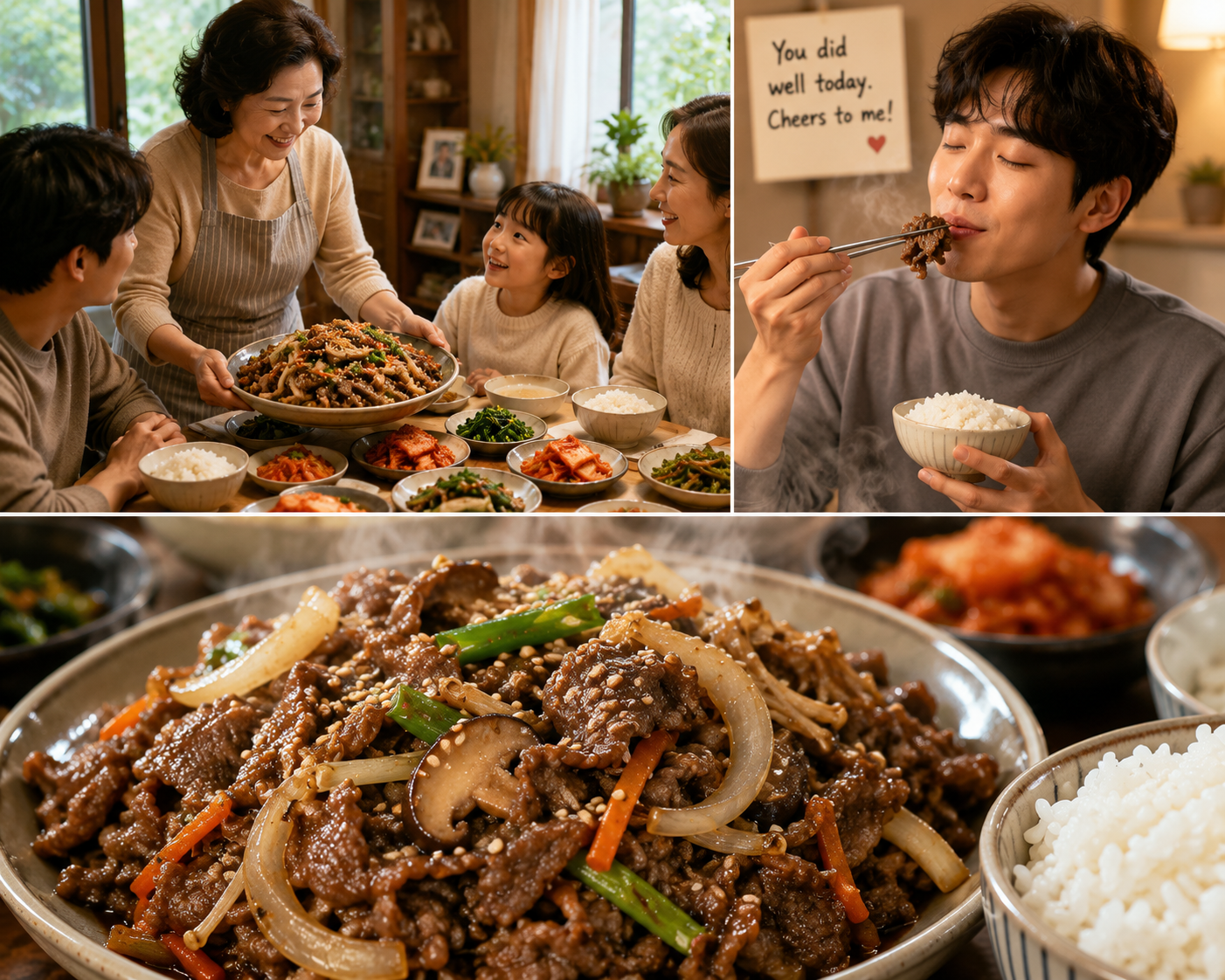
There are foods you eat because you are hungry.
And there are foods that tell you something.
“Congratulations.”
“You did well.”
“Today is a special day.”
For many Koreans, bulgogi has carried memories like these.
Today, beef is much easier to find in Korea than it once was. But for ordinary families in the past, beef was relatively expensive and was not necessarily something eaten every day.
So when something good happened in the family, bulgogi could make an appearance.
A graduation.
Passing an important exam.
Getting into college.
Starting a new job.
A birthday.
A family gathering.
Or an important guest coming to the house.
A mother might buy beef, prepare a sweet and savory soy sauce marinade, and put bulgogi on the table.
The message did not always have to be spoken.
The special meal said it for her.
What Is Bulgogi?
Bulgogi (불고기) literally means “fire meat.”
Today, when Koreans simply say bulgogi, they are often referring to thinly sliced beef seasoned with a soy sauce-based marinade.
The classic flavor is savory and gently sweet, with garlic, sesame oil, and other seasonings adding aroma and depth.
Unlike spicy Korean dishes built around gochujang or gochugaru, traditional beef bulgogi is usually not spicy.
That makes it one of the easiest Korean dishes to introduce to someone trying Korean food for the first time.
Tender beef.
Sweet and savory sauce.
Hot rice.
It is a simple combination that is very difficult not to like.
Bulgogi Was Food for a Good Day
Imagine coming home after receiving some wonderful news.
You passed an important examination.
You graduated.
You got the job you had been hoping for.
And waiting at home is the smell of beef cooking with soy sauce, garlic, onions, and sesame oil.
For some Korean families, food has long been one way of expressing emotions that are not always spoken directly.
Preparing a special meal can mean:
“I’m proud of you.”
“You worked hard.”
“Let’s celebrate together.”
And because beef once felt more special than an ordinary everyday ingredient, bulgogi was well suited to those moments.
It was not merely beef for dinner.
Sometimes, it was a celebration served with rice.
Every Family Can Have Its Own Bulgogi
Ask several Korean home cooks for their bulgogi recipe and you may receive several different answers.
One family likes it sweeter.
Another uses more garlic.
Someone adds grated Korean pear.
Another remembers a stronger sesame oil aroma.
Some families add plenty of onions and mushrooms, while others prefer to keep the dish focused on the beef.
That means there can be something called “our family’s bulgogi.”
And taste has a remarkable relationship with memory.
Years later, the aroma of soy sauce, garlic, beef, and sesame oil hitting a hot pan can suddenly remind someone of a family table from childhood.
A recipe can tell you how many tablespoons of soy sauce to use.
But it cannot completely reproduce the memory of the person who used to make it for you.
That is part of what makes home cooking special.
Sometimes, You Can Celebrate Yourself
The meaning of celebration has changed too.
Today, many people live alone.
People work long hours, deal with pressure, and sometimes experience important moments without a family gathering waiting for them at home.
Maybe nobody knows how difficult your week was.
Maybe you completed something that seemed small to everyone else but was important to you.
Maybe nothing extraordinary happened at all.
You simply survived a difficult day.
On a day like that, perhaps you can make bulgogi for yourself.
You do not need a birthday.
You do not need a graduation.
You do not need to wait for someone else to decide that today deserves a special meal.
Make some hot rice.
Cook the beef.
Sit down.
And give yourself the message that Korean mothers once expressed through a special dinner:
“You did well today.”
Sometimes the person who deserves your congratulations is you.
Two Delicious Ways to Enjoy Bulgogi
Bulgogi does not always arrive at the table in exactly the same form.
Two styles are particularly useful for understanding how Koreans enjoy it.
Pan-Cooked Bulgogi
This is an easy style for home cooking.
Thin slices of marinated beef are cooked with onions, green onions, mushrooms, and other vegetables.
The sauce coats the meat, and the edges can become slightly caramelized as the liquid reduces.
Put it over steaming rice and some of the sauce will soak into the grains.
For a simple Korean home meal, you may not need much more.
Bulgogi with Broth
Another style keeps more liquid around the beef.
Vegetables, mushrooms, and sometimes glass noodles can cook alongside the meat in a savory-sweet broth.
The experience becomes somewhere between grilled or pan-cooked bulgogi and a comforting hot-pot meal.
And there is an important rule when delicious bulgogi broth remains:
Do not waste it.
Let your rice absorb some of that sweet and savory broth.
Sometimes the sauce left behind is almost as good as the beef itself.
Why Korean Pear Is Used in Bulgogi
One ingredient that may surprise people outside Korea is pear.
Korean cooks have long used pear in meat marinades.
Grated Korean pear or pear juice contributes gentle sweetness and fresh fruit flavor, and it can also help create a more tender eating experience.
Korean pear is not always easy to find overseas.
That is okay.
You can still make excellent bulgogi without it.
For an easy home version, pear juice can be convenient, or you can simply make the marinade without pear and rely on thinly sliced, tender beef.
The important lesson is this:
Bulgogi should be tender enough to eat comfortably with rice, but flavorful enough that the rice keeps disappearing.
How to Make Korean Beef Bulgogi at Home
Here is a practical version designed for home cooking.
Ingredients — 2 to 3 Servings
- Thinly sliced beef — 500 g
- Onion — 1/2
- Green onion — 1
- Carrot — 1/3
- Mushrooms — 100 g
Shiitake, oyster, or other mushrooms can work well.
Bulgogi Marinade
- Soy sauce — 6 tbsp
- Sugar — 2 tbsp
- Honey or corn syrup — 1 tbsp
- Minced garlic — 1 tbsp
- Grated Korean pear or pear juice — 3 tbsp
- Mirin or cooking wine — 2 tbsp
- Sesame oil — 1 tbsp
- Black pepper — a few pinches
- Toasted sesame seeds — 1 tbsp
This gives you a classic sweet-savory starting point.
If your soy sauce is particularly salty or you prefer a lighter flavor, reduce it slightly.
Step 1: Prepare the Beef
Bulgogi works best with beef sliced thinly across the grain.
Thin slices cook quickly and allow the marinade to coat more of the meat.
If there is excess surface moisture, gently pat the beef with a paper towel.
Separate the slices carefully so the marinade can reach the meat evenly.
Step 2: Make the Marinade
Combine the soy sauce, sugar, honey or corn syrup, garlic, pear, cooking wine, sesame oil, black pepper, and sesame seeds.
Taste the marinade.
It should be clearly savory but also gently sweet.
Remember that the flavor will become less intense once it is mixed with the beef and vegetables.
Step 3: Marinate the Beef
Add the beef to the marinade and mix gently.
Allow it to marinate for about 30 minutes.
You can marinate it longer in the refrigerator if convenient, but thinly sliced beef does not necessarily need hours and hours to become flavorful.
While the beef marinates, slice the vegetables.
Step 4: Cook Over High Enough Heat
Heat a large frying pan.
Add the marinated beef without overcrowding the pan.
This matters.
If you put too much cold meat into a small pan, the temperature drops and the beef can release a large amount of liquid.
Instead of developing delicious browned edges, it may simply boil in its own juices.
If necessary, cook the beef in two batches.
Let some of the sauce reduce and coat the meat.
Step 5: Add the Vegetables
Add the onions, carrots, mushrooms, and green onions.
Cook until the vegetables are tender but still have some texture.
The onions should become sweet, the mushrooms should absorb some of the bulgogi sauce, and the beef should remain tender.
Finish with a small drizzle of sesame oil and toasted sesame seeds if desired.
The aroma should tell you that dinner is ready.
The Easiest Way to Eat Bulgogi
You do not need an elaborate Korean table.
Start with a bowl of steaming white rice.
Put hot bulgogi beside it or directly over the rice.
Spoon a little of the sauce over the top.
Take a bite of beef.
Then rice.
Then another bite.
You will quickly understand why bulgogi and rice work so well together.
Try Bulgogi as a Lettuce Wrap
Bulgogi can also be enjoyed as ssam, a Korean lettuce wrap.
Take a lettuce leaf and add:
- A little rice
- Bulgogi
- Garlic, if you like
- A small amount of ssamjang
- Green chili, optional
Fold the leaf around everything and eat it in one bite.
The fresh lettuce provides contrast to the sweet, savory beef.
Turn Leftover Bulgogi Into Tomorrow’s Meal
Do not worry if you make too much.
Leftover bulgogi is useful.
Put it over rice with a fried egg for an easy bulgogi rice bowl.
Add it to fried rice.
Put it into a sandwich.
Or use it as a filling for kimbap.
A little leftover bulgogi, seasoned rice, seaweed, and vegetables can become tomorrow’s lunch.
Yesterday’s celebration can become today’s easy meal.
True Taste Korea Tip: Don’t Make It Too Sweet
Bulgogi should have sweetness.
But sweetness should not be the only thing you taste.
Good bulgogi has balance.
Soy sauce brings saltiness and savory depth.
Garlic adds aroma.
Pear can contribute gentle sweetness.
Sesame oil adds its distinctive nutty fragrance.
And the beef still needs to taste like beef.
If your first thought after tasting the sauce is simply “sugar,” you have probably gone too far.
Sweetness should support the meat, not hide it.
Bulgogi FAQ
What does bulgogi mean?
Bulgogi literally means “fire meat” in Korean. Today, the word commonly refers to thinly sliced marinated beef cooked on a grill or in a pan.
Is bulgogi spicy?
Traditional beef bulgogi is generally not spicy. Its characteristic flavor is sweet, savory, garlicky, and slightly nutty from sesame oil.
What kind of beef should I use?
Tender beef that can be sliced thinly works best. Ribeye, sirloin, or other suitable thin-cut beef can be used depending on what is available where you live.
Do I need Korean pear?
No. Korean pear is a traditional and delicious addition, but you can make good bulgogi without it.
How long should I marinate bulgogi?
About 30 minutes is enough for a simple home version using very thinly sliced beef. Longer refrigeration is also possible.
Can I make bulgogi without a grill?
Absolutely. A frying pan is one of the easiest ways to make bulgogi at home.
What should I eat with bulgogi?
Steamed rice is the simplest choice. Lettuce wraps, kimchi, vegetables, and other Korean side dishes also pair well with it.
A Meal That Says, “You Did Well”
Bulgogi may be famous around the world today as Korean marinated beef.
But food can carry meanings that do not appear on a restaurant menu.
For one person, the smell of bulgogi may bring back a graduation dinner.
For another, it may recall relatives gathered around a table.
Someone else may remember the particular sweetness of their mother’s marinade.
Those memories are difficult to measure with tablespoons.
And perhaps we can create new ones.
You do not always need to wait for someone else to celebrate you.
Maybe you finished something difficult.
Maybe you took one small step forward.
Maybe today was simply harder than anyone else knows.
Cook something special.
Fill a bowl with hot rice.
Put bulgogi on top.
And before you take the first bite, tell yourself:
“You did well today.”
Sometimes the person who deserves your congratulations is you.