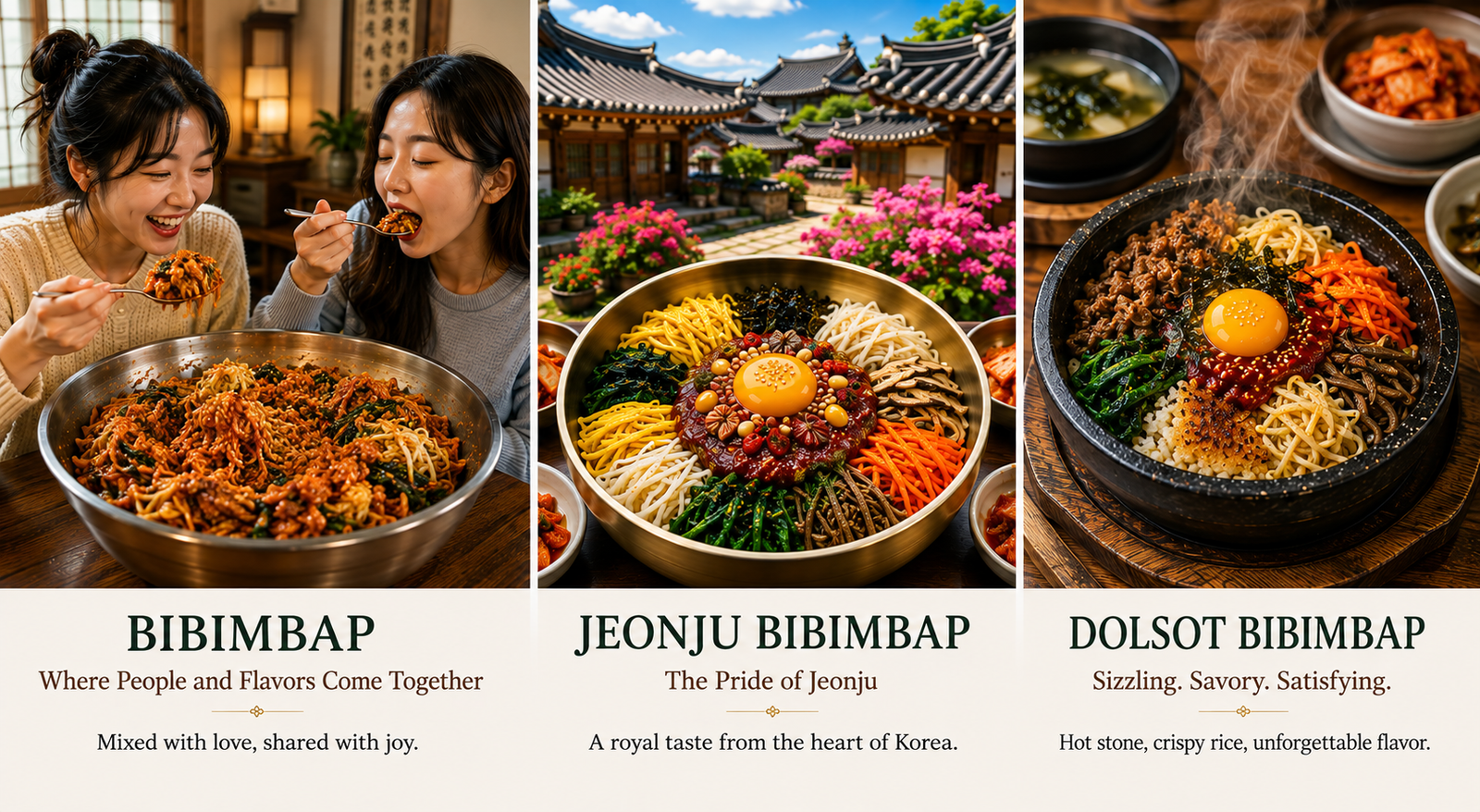
Bibimbap is often introduced as one of Korea’s most colorful dishes.
A bowl of rice is topped with vegetables, meat, egg, and gochujang, then everything is mixed together before eating.
That description is correct.
But it does not completely explain what bibimbap means in everyday Korean life.
Bibimbap can be a carefully prepared dish served with beautifully arranged vegetables. It can also be something you make when you open the refrigerator and find a little spinach, some kimchi, leftover meat, and an egg.
Sometimes it is served beautifully in an individual bowl.
Sometimes two close friends sit in front of one enormous bowl, mix everything together, and eat while talking and laughing.
That freedom is part of what makes bibimbap special.
Different ingredients come together.
Different flavors come together.
And sometimes, people come together around the same bowl.
Bibimbap is where people and flavors come together.
What Is Bibimbap?
The word bibimbap (비빔밥) is wonderfully simple.
“Bibim” means mixing, and “bap” means cooked rice.
So bibimbap literally means mixed rice.
Rice forms the base, and different ingredients are placed on top. Common additions include spinach, bean sprouts, carrots, mushrooms, zucchini, beef, egg, and kimchi.
Gochujang gives the bowl its spicy, savory flavor, while sesame oil adds its unmistakable nutty aroma.
Then comes the most important step.
You mix everything.
And you really mix it.
The beautiful arrangement you saw when the bowl arrived disappears, but something better takes its place: all those individual ingredients become one meal.
There Is No Single Perfect Bibimbap
One of the best things about bibimbap is that it does not have to follow one strict formula.
Open a Korean refrigerator and you may already have the beginning of bibimbap.
Some spinach left from yesterday?
Add it.
A little kimchi?
Add it.
Carrots, mushrooms, cucumber, or bean sprouts?
Use them.
Leftover bulgogi or samgyeopsal?
Even better.
You can add tuna, ham, chicken, cheese, or almost anything else you enjoy.
This is why the everyday version of bibimbap can be very different from the beautifully arranged bowl you might see in a Korean restaurant.
Bibimbap is not about having every “correct” ingredient.
It is about making different ingredients work together.
The Big Bowl Bibimbap Koreans Make at Home
There is another kind of bibimbap that you may not always see in Korean restaurants.
It starts with a very big bowl.
Imagine a stressful day when you do not want to cook another complicated meal.
You open the refrigerator.
There are a few vegetables here, some side dishes there, perhaps some kimchi and an egg.
Instead of preparing a new dish, everything goes into the bowl.
Add a generous serving of rice, a spoonful of gochujang and a drizzle of sesame oil.
Then mix.
Sometimes this kind of bibimbap is less about following a recipe and more about satisfying a sudden craving.
Two close friends might share a big bowl while talking about their day, laughing, complaining, and telling stories.
The bibimbap may not look as perfect as a restaurant version.
But that is not the point.
Sometimes the best bibimbap is the one eaten comfortably with someone who knows you well.
Bibimbap, Sharing, and Korean Jeong
There is a Korean word that is difficult to translate perfectly into English: jeong (정).
Jeong can describe the affection, attachment, warmth, and connection that gradually grows between people.
Food is one of the places where you can see it.
A big bowl of bibimbap shared between people can be a very simple expression of that closeness.
Everyone may like different things.
One person wants more kimchi.
Another loves meat.
Someone wants extra gochujang.
Someone else cannot handle much spice.
Yet everything can still come together around the same meal.
In that sense, bibimbap feels surprisingly symbolic.
Different ingredients do not need to become identical to belong in the same bowl.
They simply need to find a way to taste good together.
Perhaps people are not so different.
When You Don’t Know What to Cook, Make Bibimbap
Bibimbap is especially useful on those days when you look into the refrigerator and think:
“What am I supposed to make with all of this?”
You do not necessarily need another recipe.
You may just need a bowl of rice.
Leftover vegetables can become toppings.
Yesterday’s meat can become today’s bibimbap.
A fried egg can turn a very simple bowl into a satisfying meal.
Add gochujang and sesame oil, mix everything together, and dinner is ready.
It is one of the reasons bibimbap remains such a practical home meal in Korea.
A Clever Way to Help Kids Enjoy Vegetables
Some children are not excited when vegetables are served separately.
Bibimbap can make those same ingredients feel completely different.
Vegetables can be chopped into smaller pieces and mixed with rice, egg, meat, tuna, or another ingredient the child enjoys.
And bibimbap does not have to be spicy.
For children who do not eat gochujang, a mild version can be made with a little soy sauce and sesame oil instead.
The important thing is not to force one fixed recipe on everyone.
A child’s bibimbap can be different from an adult’s bibimbap.
That is exactly the beauty of this dish.
Winter Comfort: Dolsot Bibimbap
Bibimbap has another delicious personality in winter.
Dolsot bibimbap (돌솥비빔밥) is served in a hot stone bowl.
When the rice touches the heated stone, you can hear it sizzling.
The vegetables stay warm, the egg cooks with the heat, and the bottom layer of rice gradually becomes golden and crispy.
That crispy rice is one of the best parts.
Do not be in too much of a hurry to scrape everything from the bottom.
Give the rice a little time against the hot stone and let the crust develop.
On a cold Korean day, the sound of bibimbap sizzling in a stone bowl can be almost as satisfying as the first bite.
Jeonju: The Korean City of Bibimbap
If you visit Korea and want to experience bibimbap beyond your own kitchen, remember the city of Jeonju.
Jeonju is famous for traditional Korean culture, its hanok architecture, and its association with bibimbap.
Walking through the traditional streets and then sitting down to a beautifully prepared bowl of Jeonju bibimbap can be a memorable Korean food experience.
The contrast is interesting.
At home, bibimbap might be made spontaneously from whatever is available in the refrigerator.
In Jeonju, you can encounter a much more elaborate presentation, with colorful ingredients carefully prepared and arranged.
They look very different.
But the basic idea remains the same.
Many ingredients come together to create one bowl.
Bibimbap Beyond the Dinner Table
Bibimbap’s connection with Jeonju goes beyond restaurants.
The city has celebrated bibimbap through food festivals and cultural activities, showing how deeply a local dish can become connected with the identity of a place.
For a traveler, that makes bibimbap more than something to taste.
It can become a way to experience Korean food, history, local culture, and community together.
True Taste Korea Tip: If you travel to Jeonju, combine a walk through the hanok area with a traditional Jeonju bibimbap meal. Don’t just photograph the bowl—mix it thoroughly and eat it the Korean way.
How to Make Bibimbap at Home
You do not need a dozen perfectly prepared toppings to make good bibimbap.
Start with a basic version and make it your own.
Ingredients — 2 Servings
Rice
- 2 bowls cooked short-grain rice
Vegetables
- Spinach — 100 g
- Bean sprouts — 100 g
- Carrot — 1/2
- Zucchini — 1/2
- Mushrooms — 100 g
Other toppings
- Beef — 150 g
- Eggs — 2
- Sesame oil
- Toasted sesame seeds
You can replace the beef with pork, chicken, tuna, ham, tofu, or leftovers from another meal.
Simple Bibimbap Sauce
- Gochujang — 2 tbsp
- Sesame oil — 1 tbsp
- Sugar — 1 tsp
- Rice vinegar — 1 tsp
- Minced garlic — 1/2 tsp
- Sesame seeds — 1 tsp
Mix everything together.
If you prefer a milder sauce, reduce the gochujang.
How to Make It
Prepare the vegetables separately so each one keeps some of its own texture and flavor.
Lightly blanch the spinach and bean sprouts.
Thinly slice the carrot, zucchini, and mushrooms and sauté them briefly.
Cook the beef in a pan until browned.
Fry the eggs, preferably leaving the yolks slightly soft if you like them that way.
Put hot rice into each bowl.
Arrange the vegetables and meat over the rice and place the egg in the center.
Add bibimbap sauce and a little sesame oil.
Then do the thing that gives bibimbap its name:
Mix everything thoroughly.
Do not worry about destroying the beautiful presentation.
Bibimbap is supposed to be mixed.
Easy Refrigerator Bibimbap
Here is an even easier version.
Take one bowl of hot rice.
Look inside your refrigerator.
Choose three or four things you already have.
Kimchi + fried egg + leftover pork?
Perfect.
Tuna + cucumber + carrot + egg?
Perfect.
Ham + kimchi + cheese?
Why not?
Add gochujang and sesame oil and mix.
Rice + what you have + sauce = bibimbap.
That may be closer to the spirit of everyday bibimbap than trying to reproduce a perfect restaurant photograph.
True Taste Korea Tip: Use Yesterday’s Dinner
Leftovers can become excellent bibimbap toppings.
If you have some samgyeopsal left from Korean barbecue, cut it into small pieces and add it to your bowl.
Leftover bulgogi works beautifully.
Chicken works.
Even a small amount of meat can add plenty of flavor when it is mixed throughout the rice.
Korean food does not always have to begin again from zero.
Sometimes today’s meal begins with yesterday’s dinner.
Bibimbap FAQ
Does bibimbap have to contain beef?
No. Beef is popular, but bibimbap can be made without meat or with pork, chicken, tuna, ham, tofu, or whatever you enjoy.
Does bibimbap have to be spicy?
No. Gochujang is traditional and popular, but you can use less of it or make a mild version with soy sauce and sesame oil.
What is the difference between bibimbap and dolsot bibimbap?
Regular bibimbap is served in a normal bowl. Dolsot bibimbap is served in a heated stone bowl, which keeps the food hot and creates crispy rice on the bottom.
Do I need all the traditional vegetables?
No. Use what you have. A simpler bibimbap can still be delicious.
Can I use leftover rice?
Yes. Reheat it thoroughly so it is hot before assembling your bibimbap.
Should I mix bibimbap before eating it?
Yes. Mixing is the whole idea. Mix the rice, toppings, sauce, and sesame oil until the flavors are distributed throughout the bowl.
Where People and Flavors Come Together
A bowl of bibimbap can be carefully prepared with many colorful ingredients.
Or it can begin with a simple question:
“What do we have in the refrigerator?”
It can be eaten alone when you do not feel like cooking.
It can be shared from a big bowl while two friends talk for an hour.
It can help turn vegetables into something a child enjoys.
It can arrive sizzling in a stone bowl on a cold winter day.
And in Jeonju, it can become part of an entire city’s food culture.
There is no single perfect bibimbap.
Different vegetables, different meats, different tastes, and different people can all find their place.
Bibimbap is not about making everything the same.
It is about discovering how different things can become better when they come together.