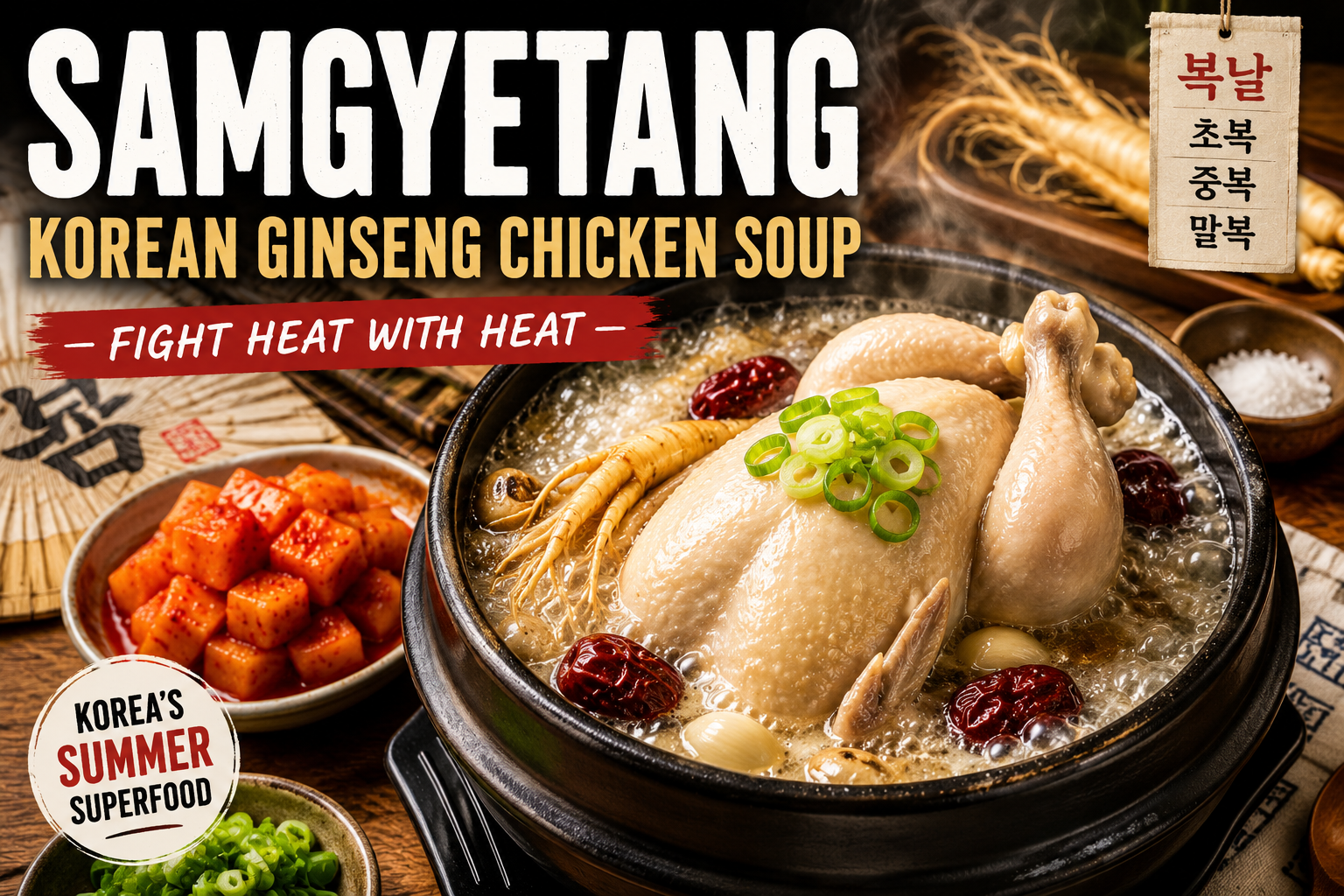
Imagine the hottest day of summer in Korea.
The temperature is soaring. The humidity is exhausting.
What would you want for lunch?
Ice cream?
Cold noodles?
An iced drink?
Many Koreans choose something completely different:
a bubbling-hot pot containing an entire chicken.
This is Samgyetang (삼계탕), Korea’s famous ginseng chicken soup.
And eating it on the hottest days of summer is not a mistake.
It’s a Korean tradition.
What Is Samgyetang?
Samgyetang is a traditional Korean chicken soup made by simmering a whole young chicken with ingredients such as ginseng, glutinous rice, garlic and jujubes.
But there’s an interesting detail.
The rice and other ingredients aren’t simply placed beside the chicken.
They are stuffed inside it.
Cut open the tender chicken and you may find soft glutinous rice infused with chicken broth and the aroma of ginseng and garlic.
The Korea Tourism Organization describes samgyetang as a young chicken stuffed with sweet rice, garlic, jujube and ginseng and simmered until tender. It is particularly associated with summer as a nourishing food.
But that leads to an obvious question.
Why would Koreans eat something this hot during summer?
Fight Heat With Heat: Iyeolchiyeol
There is a traditional Korean expression:
Iyeolchiyeol (이열치열, 以熱治熱).
It can be understood as:
“Fight heat with heat.”
Instead of always trying to escape hot weather with cold food, Korean tradition also embraced the idea of eating a steaming, nourishing meal during exhausting summer weather.
You eat hot chicken.
You drink hot broth.
You sweat.
And traditionally, the meal has been regarded as a way to replenish energy during the hottest period of the year.
This cultural idea is one of the reasons Samgyetang became so closely connected with Korean summer.
Official Korean tourism material describes the sight perfectly: during Boknal, people can line up outside Samgyetang restaurants and then sit inside sweating over bubbling-hot chicken soup.
For a foreign visitor seeing it for the first time, it can look completely backwards.
For Koreans, it’s summer.
What Is Boknal?
Samgyetang is especially associated with Boknal (복날).
Traditionally, the hottest period of the Korean summer is divided into three Bok days:
Chobok (초복) — the first Bok day
Jungbok (중복) — the middle Bok day
Malbok (말복) — the final Bok day
Together, they are called Sambok (삼복).
These days are traditionally regarded as the hottest part of summer, and Samgyetang has become one of the foods most strongly associated with them.
On Boknal, famous Samgyetang restaurants can become extremely busy.
That’s one of the clearest signs that this isn’t simply chicken soup.
It’s part of Korea’s seasonal food culture.
Korea Has Two Opposite Ways to Survive Summer
Here’s where Korean summer food becomes particularly interesting.
Koreans have another famous summer dish:
Naengmyeon — ice-cold Korean noodles.
So Korea effectively has two completely opposite culinary answers to the summer heat.
Naengmyeon: Fight heat with cold.
Samgyetang: Fight heat with heat.
One bowl can arrive with icy broth.
The other can arrive still bubbling.
Yet both are iconic Korean summer foods.
That’s one of the fascinating contradictions of Korean food culture.
What’s Inside Samgyetang?
A traditional Samgyetang usually begins with a small whole young chicken.
Inside you’ll commonly find:
- Glutinous rice
- Fresh ginseng
- Garlic
- Jujube
Depending on the recipe or restaurant, other ingredients may also be used.
Traditional or herbal versions can include ingredients such as hwanggi (황기, astragalus root) to add another layer to the broth.
The chicken is simmered until tender, while the rice inside absorbs the chicken broth.
The result isn’t supposed to taste like an aggressively seasoned spicy Korean dish.
Samgyetang is generally much gentler.
The chicken, broth, garlic and aromatic ingredients are the focus.
Samgyetang Is a Korean Boyangsik
To understand the dish culturally, another Korean word is useful:
Boyangsik (보양식).
It refers broadly to foods traditionally eaten for nourishment or to replenish energy.
Samgyetang is one of Korea’s representative examples.
That’s why Koreans don’t necessarily eat it only because they’re hungry for chicken.
People may seek out Samgyetang when they feel exhausted or want a substantial meal traditionally associated with restoring energy.
VISITKOREA describes ginseng chicken soup as one of Korea’s representative nourishing dishes and specifically connects it with Boknal and iyeolchiyeol.
This is best understood as Korean food tradition and culture, rather than a medical treatment.
Korean Fried Chicken vs. Samgyetang
Koreans love chicken in completely different forms.
At one end you have:
Korean Fried Chicken
Crispy.
Seasoned.
Perfect with an ice-cold beer.
Connected with chimaek, delivery, sports and nights out with friends.
At the other end:
Samgyetang
A whole chicken slowly cooked in broth with rice, garlic, ginseng and jujube.
Hot, comforting and deeply connected with Korea’s traditional summer food culture.
Same main ingredient.
Completely different experience.
This diversity is part of what makes Korean chicken culture so interesting.
How Do Koreans Actually Eat Samgyetang?
If a whole chicken arrives bubbling in front of you, don’t worry.
It’s easier than it looks.
First, taste the broth.
Samgyetang may initially seem lightly seasoned compared with many other Korean foods.
That’s normal.
Salt and pepper may be provided so you can adjust the seasoning yourself.
The Korea Tourism Organization specifically recommends adding salt to the soup according to taste and enjoying pieces of chicken with a little salt.
Next, pull the tender chicken apart.
You can dip pieces of chicken into salt or eat them with the broth.
Then open the chicken.
Inside you’ll find the soft glutinous rice and other ingredients that have been cooking in the broth.
Eat the rice together with the soup.
By the end, the dish almost becomes a chicken-and-rice porridge.
Don’t Ignore the Kimchi
Like many Korean soups, Samgyetang becomes even better when paired with kimchi.
Kkakdugi (깍두기) — cubed radish kimchi — is an especially satisfying partner.
The soup is mild and comforting.
The kimchi is fermented, crunchy and flavorful.
Alternating between hot chicken broth and crisp kimchi gives the meal balance.
Some Samgyetang restaurants are remembered almost as much for their kimchi as for the chicken.
Traditional Samgyetang Recipe
If you want to experience a more traditional version at home, here’s the basic idea.
Ingredients
For approximately 2 servings:
- 2 small young chickens
- 1/2 cup glutinous rice
- 2 small fresh ginseng roots
- 6–8 garlic cloves
- 2–4 dried jujubes
- Green onion
- Salt
- Black pepper
Optional for a more traditional herbal broth:
- Astragalus root (hwanggi)
Step 1: Soak the Rice
Wash the glutinous rice and soak it in water for about 1–2 hours.
Drain well.
Step 2: Prepare the Chicken
Remove excess fat and any remaining internal parts from the cavity.
Wash and prepare the chicken carefully.
Step 3: Stuff the Chicken
Place some soaked glutinous rice inside each chicken along with:
- Ginseng
- Garlic
- Jujube
Don’t pack the rice too tightly because it will expand during cooking.
Step 4: Close the Chicken
Traditionally, the legs can be crossed or secured to help keep the filling inside while the chicken cooks.
Step 5: Prepare the Broth
For an herbal version, simmer hwanggi in water first to create a light herbal broth.
Remove the root before serving.
Step 6: Cook the Chicken
Place the stuffed chickens in the pot and cover them generously with water or the prepared herbal broth.
Bring to a boil.
Then reduce the heat and simmer until the chicken is completely cooked and tender.
Depending on the size of the bird, expect roughly 50–70 minutes, but always judge doneness by the chicken itself rather than time alone.
For food safety, poultry should reach a safe internal temperature throughout.
Step 7: Season at the Table
Add chopped green onion.
Instead of making the entire pot strongly salty, serve salt and pepper separately.
Each person can season the broth and chicken according to taste.
That’s very much part of the Samgyetang experience.
Easy Samgyetang for Beginners
If you’re outside Korea, finding fresh ginseng and several traditional herbs may be difficult.
There’s an easier solution.
Many Korean supermarkets sell Samgyetang or Baeksuk herbal packets.
These may contain a combination of dried ingredients intended for Korean chicken soup.
For an easy version, prepare:
- 1 small whole chicken
- 1 Samgyetang/Baeksuk herbal packet
- 6–8 garlic cloves
- Glutinous rice or cooked rice
- Green onion
- Salt and pepper
Cook the chicken with the herbal packet and garlic until completely tender and safely cooked through.
If stuffing raw glutinous rice into the chicken feels difficult, you can simplify the process by serving cooked rice with the broth instead.
It won’t reproduce every detail of the traditional version.
But it makes Korean-style nourishing chicken soup much more accessible for a first attempt.
What Is Ogolgye Samgyetang?
You may occasionally see another version called Ogolgye Samgyetang (오골계 삼계탕).
Ogolgye refers to a distinctive black-boned or silkie-type chicken.
Some Korean restaurants offer it as an alternative or premium variation.
VISITKOREA lists ogolgye soup alongside traditional Samgyetang and abalone Samgyetang at specialized restaurants, showing how the basic dish has developed into multiple variations.
Want an Even More Luxurious Version? Meet Haesintang
And then Korea takes nourishing chicken soup another step further.
Meet:
Haesintang (해신탕).
Versions of this luxurious soup combine chicken with premium seafood such as abalone and octopus, along with ingredients associated with Korean nourishing soups.
Imagine opening one pot and finding:
whole chicken + abalone + octopus + garlic + jujube + rich broth.
It’s essentially the meeting of the land and the sea in one substantial meal.
Restaurants also commonly offer variations such as abalone Samgyetang and medicinal-herb Samgyetang.
For someone exploring the Korean idea of boyangsik, these upgraded chicken soups are worth discovering after traditional Samgyetang.
Is Samgyetang Spicy?
Usually, no.
This surprises some people who associate Korean food with red chili peppers.
Traditional Samgyetang is generally mild.
Its character comes from chicken broth, garlic, ginseng and other aromatic ingredients rather than gochujang or large amounts of chili.
So if you want to introduce someone to Korean food who doesn’t enjoy spicy dishes, Samgyetang can be a very approachable choice.
When Should You Eat Samgyetang?
You can eat Samgyetang year-round.
But for the most culturally interesting experience, try it during Korean summer — especially around Boknal.
That’s when you can understand the contradiction firsthand.
The weather outside is scorching.
The soup in front of you is bubbling.
Everyone around you is eating the same thing.
And suddenly the Korean expression iyeolchiyeol makes much more sense.
Samgyetang Is More Than Ginseng Chicken Soup
“Ginseng chicken soup” is a useful English translation.
But it doesn’t tell the whole story.
Samgyetang represents something larger:
Korea’s seasonal food traditions.
The three Boknal periods of summer.
The idea of iyeolchiyeol.
The tradition of boyangsik.
A whole chicken filled with rice, ginseng, garlic and jujube.
And generations of Koreans sitting down to a steaming meal when the weather outside is already unbearably hot.
Perhaps that’s the best way to understand Korean summer food.
Sometimes Koreans fight heat with ice-cold Naengmyeon.
Sometimes they fight heat with steaming-hot Samgyetang.
One country. Two completely opposite bowls. Two Korean ways to survive summer.
FAQ
What does Samgyetang mean?
Samgyetang (삼계탕) refers to Korean ginseng chicken soup. The dish typically combines a whole young chicken with ginseng, glutinous rice, garlic and jujube.
Why do Koreans eat Samgyetang in summer?
Samgyetang is traditionally associated with Boknal, the hottest period of the Korean summer. It reflects the cultural idea of iyeolchiyeol, or “fighting heat with heat.”
What is inside a Samgyetang chicken?
The chicken is commonly stuffed with glutinous rice, ginseng, garlic and jujube. Ingredients vary depending on the restaurant and recipe.
Is Samgyetang spicy?
Traditional Samgyetang is generally mild rather than spicy. Diners often add salt and pepper according to their own taste.
What is the difference between Samgyetang and Korean fried chicken?
Both use chicken, but the cooking style and culture are very different. Korean fried chicken is crispy and closely associated with chimaek and casual social occasions, while Samgyetang is a simmered whole-chicken soup associated with traditional nourishing food and summer Boknal culture.