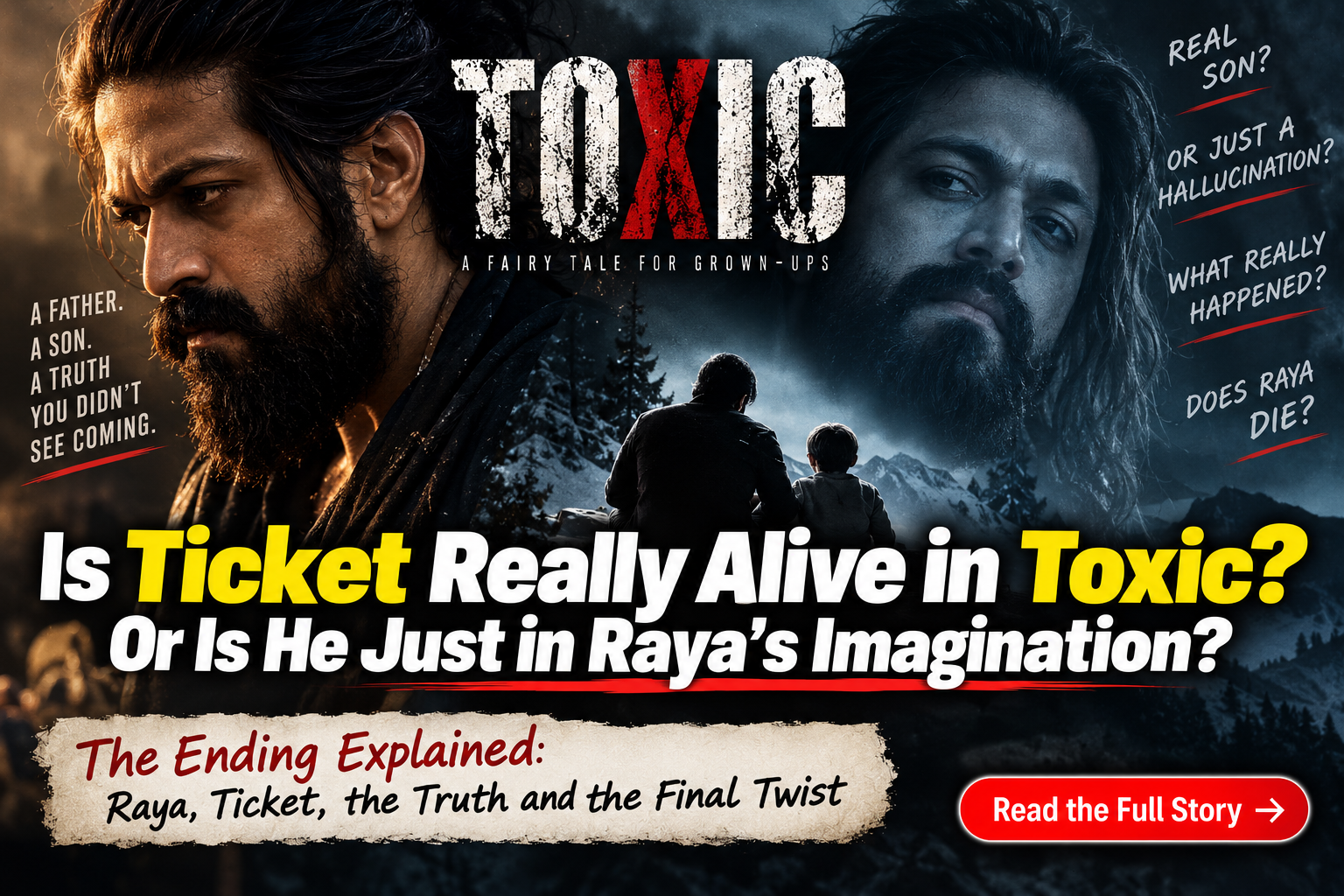
Major Spoiler Warning: This article reveals the ending and biggest twist of Toxic: A Fairy Tale for Grown-Ups.
If you just walked out of Toxic thinking:
Wait… was Ticket even real?
You’re asking exactly the question the ending wants you to ask.
For much of the movie, Ticket appears to be Raya’s grown-up son.
He narrates the story.
He confronts his father.
He attacks the empire Raya spent years building.
He even appears to threaten Raya’s other son, Adam.
So naturally, we assume:
Ticket survived childhood and came back for revenge.
Then the ending changes everything.
No — the adult Ticket is not actually alive.
The climax reveals that the real Ticket died years earlier.
The adult Ticket we’ve been watching is a manifestation of Raya’s guilt, grief and fractured state of mind.
And once you understand that twist, a huge part of Toxic suddenly looks different.
What Really Happened to Ticket in Toxic?
Ticket is Raya and Nadia’s son.
The film initially encourages us to believe that Ticket survived his traumatic childhood and eventually grew into the adult man played by Yash.
But that’s not what really happened.
Raya had tried to kill Ticket when he was a child.
He later changed his mind.
But by then, according to the film’s final reveal, it was too late.
Ticket died.
Raya couldn’t save him.
That truth becomes one of the defining psychological wounds of Raya’s life.
Instead of fully processing what he did, Raya’s mind eventually creates something else:
an adult version of the son who never got to grow up.
That is the Ticket we spend so much time watching.
Then Who Is the Adult Ticket?
The simplest explanation is:
Ticket is Raya’s guilt given a human form.
He’s the son Raya lost.
He’s also the consequence Raya cannot escape.
Ticket grows up in Raya’s mind because the real child never had the opportunity to.
That makes the casting particularly important.
Yash plays both Raya and Ticket.
At first, that looks like a conventional dual role.
By the ending, it means something completely different.
The apparent father-versus-son conflict has also been:
Raya versus Raya.
India Today describes Ticket as part of Raya’s imagination, created by a mind unable to cope with the guilt and trauma of the child’s death.
Why Does Raya Imagine Ticket?
Because Raya cannot escape what he did.
His criminal empire gives him power.
It doesn’t give him peace.
Over the course of the story, he also suffers devastating losses, including Ganga and Nadia.
As those losses accumulate, his psychological state deteriorates.
Ticket becomes the physical representation of something Raya has spent years suppressing:
his guilt over his son.
That’s why Ticket is much more than an imaginary friend.
He’s almost Raya’s punishment.
Every time Ticket threatens Raya’s family, power or empire, the movie can be read as showing Raya’s unresolved trauma destroying the life he built.
Why Does Ticket Want Revenge on Raya?
Before the twist, the answer seems obvious.
Ticket believes his father tried to kill him.
So he grows up.
Returns.
And wants revenge.
But after the reveal, Ticket’s behavior becomes much stranger.
He says he hates Raya.
Yet he doesn’t simply kill him when he gets the opportunity.
At another point, he even saves Raya.
Why?
Because Ticket isn’t an independent revenge-seeking son.
He exists inside Raya’s fractured psychological world.
So Ticket’s contradictory behavior reflects Raya’s own conflict with himself.
Part of Raya wants punishment.
Part wants forgiveness.
Part wants to forget.
And another part desperately wants the son he lost to still exist.
Ticket embodies all of those contradictions.
Wait — If Ticket Isn’t Real, Who Has Been Narrating Toxic?
Now we’ve reached the really clever part.
Ticket.
The imaginary character.
Ticket narrates much of the story.
That means Toxic gives us an unreliable narrator.
Once the movie reveals that the person telling us the story doesn’t physically exist in the present timeline, we’re forced to reconsider everything we’ve watched.
And that’s why the ending isn’t simply:
“Surprise! Ticket was imaginary.”
The bigger question becomes:
How much of Toxic actually happened exactly the way we saw it?
India Today explicitly raises this problem: if Ticket exists inside Raya’s fractured psyche, some events may be real, some distorted by memory and guilt, and some potentially internal to Raya’s mind.
The film doesn’t neatly label every scene for us.
That’s deliberate.
Was Everything in Toxic Just Raya’s Imagination?
No — that’s going too far.
The reveal does not necessarily mean:
“None of the movie happened.”
The criminal world exists.
Raya exists.
His relationships and losses exist within the story.
What becomes uncertain is our perception of events involving Ticket and how accurately Raya’s fractured mind has presented parts of the story.
So a better interpretation is:
The movie happened, but we cannot completely trust the version of reality we were shown.
That’s very different from saying:
“It was all a dream.”
Did Ticket Really Kidnap Adam?
This becomes one of the most interesting questions after the reveal.
Before we know the truth, Ticket appears to kidnap Adam and attempt to recreate the violence Raya once inflicted on him.
But Ticket doesn’t physically exist as the independent adult man we thought he was.
So who is really responsible?
The ending pushes us toward a darker interpretation:
Raya himself is the danger.
The imaginary Ticket is the form through which Raya’s collapsing mind expresses that danger.
People around Raya also appear to recognize that something is seriously wrong with him.
This makes the second half considerably darker on a rewatch.
Raya isn’t fighting an enemy coming to destroy his family.
His own unresolved trauma is destroying it.
Why Are Raya and Ticket Both Played by Yash?
Before the ending, it’s a star-driven dual role.
After the ending, the casting becomes part of the clue.
Raya sees his son as an adult.
But the adult Ticket is also an extension of Raya himself.
Having Yash play both characters visually reinforces that idea.
Father and son appear to be fighting each other.
Psychologically, Raya is fighting himself.
The movie therefore disguises an internal conflict as an external gangster rivalry for much of its runtime.
That’s why the final reveal changes the meaning of earlier scenes rather than merely adding one last surprise.
What Does Ticket Symbolize?
Ticket can be interpreted as several things simultaneously.
He represents:
Raya’s dead son
Raya’s guilt
Raya’s grief
the consequences of his violence
and ultimately
the part of Raya he cannot suppress anymore.
The criminal empire may have survived enemies, betrayals and attacks.
But Raya cannot defeat his own memory.
That’s arguably the central idea behind the title’s psychological ending.
The most dangerous thing in Raya’s life isn’t another gangster.
It’s Raya himself.
Why Does Ticket Save Raya If He Hates Him?
This makes far more sense after the twist.
If Ticket were simply a real son seeking revenge, his inconsistent behavior might seem strange.
He wants to punish Raya.
But he repeatedly stops short of completely destroying him.
And he even saves him.
After the reveal, the contradiction becomes meaningful.
Ticket isn’t operating with his own independent psychology.
He’s part of Raya.
Raya simultaneously hates himself and wants to survive.
He wants punishment and forgiveness.
He wants Ticket gone and wants Ticket alive.
That contradiction is exactly what the imaginary Ticket represents.
What Happens in Toxic’s Final Avalanche Scene?
The movie’s final moments move away from conventional gangster logic.
An avalanche approaches Raya.
Instead of giving viewers a straightforward victory or defeat, the scene becomes psychological.
Raya finally embraces Ticket.
But now we know what Ticket actually represents.
Raya isn’t simply embracing his grown son.
He’s finally embracing the child he failed.
And, metaphorically, he’s accepting the guilt and trauma he spent years trying to escape.
Then the film cuts to black.
Which creates another major question.
Does Raya Die at the End of Toxic?
The film deliberately makes this less certain than Ticket’s fate.
Ticket’s truth is revealed:
the real Ticket died years earlier.
Raya’s final fate is more ambiguous.
The avalanche approaches.
Raya doesn’t receive the kind of clean, conventional death scene that would remove all doubt before the cut to black.
Some coverage interprets the climax as Raya’s death, while other explanations emphasize that the film leaves his literal survival unresolved.
That distinction matters.
So the safest answer is:
Toxic clearly resolves who Ticket is, but leaves more room to interpret exactly what happens to Raya.
And that is likely another reason viewers leave the theatre arguing about the ending.
Why Does Raya Stop Running?
Because by this point, physical survival isn’t really the center of the scene anymore.
Earlier, Raya tried to control everything.
His empire.
His enemies.
His family.
His future.
But the one thing he couldn’t control was the past.
By embracing Ticket as the avalanche approaches, Raya finally stops fighting the memory of his son.
On a psychological level:
he accepts Ticket.
he accepts what he did.
and he accepts what he has become.
Whether that acceptance arrives too late is part of the tragedy.
Is Ticket Raya’s Split Personality?
You’ll probably see this phrase used online.
But it’s better to be careful.
The movie presents Ticket as a manifestation or figment of Raya’s fractured mind. Entertainment coverage also uses terms such as hallucination, imagination and unreliable narrator.
That doesn’t automatically justify diagnosing Raya with a specific real-world psychiatric disorder.
For understanding the movie, you don’t need a medical label.
The important storytelling point is simply:
Adult Ticket exists inside Raya’s psychological reality rather than as the living adult son we initially believed him to be.
Why Is the Ending Called Ambiguous If Ticket’s Death Is Revealed?
Because there are actually two mysteries, not one.
Mystery 1: Is Ticket alive?
This receives a fairly clear answer.
No.
The real Ticket died as a child.
Mystery 2: How much of what we watched can we trust?
This remains much less certain.
Because Ticket narrated the story and exists inside Raya’s fractured perspective, the film deliberately destabilizes our understanding of earlier events.
That’s the clever part.
The movie answers one question and creates a much bigger one.
So Was Ticket Ever Real?
Yes.
And this distinction is important.
Ticket was a real child.
He was Raya and Nadia’s son.
What isn’t real in the present-day story is the adult Ticket who appears to have survived, grown up and returned to confront Raya.
The real child died.
Raya’s mind created the adult he might have become.
So saying:
“Ticket never existed”
would be wrong.
The better answer is:
Ticket existed, but the adult Ticket we follow later does not exist independently of Raya’s mind.
The Simple Answer: Is Ticket Alive in Toxic?
If you came here because the ending confused you, here’s the shortest possible explanation.
No. The adult Ticket isn’t really alive.
The real Ticket died when he was young after Raya tried to kill him and later failed to save him.
Unable to live with that guilt, Raya’s fractured mind creates an adult version of Ticket.
That’s why Ticket can:
return
confront Raya
attack his empire
threaten Adam
and ultimately
stand face-to-face with his father.
Ticket is Raya’s dead son transformed into a manifestation of guilt and trauma.
And that’s why the final embrace matters.
For most of the movie, Raya appears to be fighting Ticket.
By the end, we understand:
Raya has been fighting himself.
The gangster who spent his life defeating enemies finally meets the one enemy he can’t kill—
his own past.