TTK Original — Beyond the Headlines
Spoiler Warning: This analysis discusses the World Government, the Celestial Dragons, the Empty Throne, the Five Elders, and major political revelations from the series. It avoids detailed spoilers from the latest manga developments.
The World Government claims to maintain peace.
It presents itself as the institution responsible for preventing chaos, protecting nations, and preserving order across the seas.
It has the Marines, a vast political structure, intelligence organizations, and the authority to intervene in the affairs of countries around the world.
At first glance, this appears to be the foundation of a functioning global government.
But the longer we follow the story of One Piece, the more difficult it becomes to accept the official explanation.
Why does a government that claims to protect the world tolerate the extraordinary privileges of the Celestial Dragons?
Why does it destroy entire islands when their inhabitants discover forbidden historical information?
Why does its supposedly empty throne conceal a secret ruler?
And why does an institution that speaks so confidently about order react so violently whenever its authority is questioned?
These contradictions point toward a deeper interpretation.
The World Government is not simply trying to preserve peace.
It is protecting a political structure in which a small group possesses the right to decide what peace means, who deserves protection, and whose lives can be sacrificed to preserve the existing order.
This is the real question behind its power.
Does the World Government exist to protect the world, or does the world exist to protect the World Government?
1. The Difference Between Governing the World and Owning It
The World Government is one of the most powerful political institutions in the world of One Piece.
Its influence extends across numerous nations, and its authority is supported by military force, intelligence networks, and political agreements.
But the structure of that authority raises an important question.
What is the purpose of governing?
In a legitimate political system, authority should exist to protect the people who live under it.
Institutions should provide security, establish rules, resolve conflicts, and create conditions in which ordinary people can live without fear.
The World Government often presents itself in these terms.
Yet its behavior suggests that protecting the institution and protecting the population are not always the same priority.
When the interests of the ruling class conflict with the interests of ordinary people, the government repeatedly demonstrates whose interests matter more.
This is the first major contradiction in its political identity.
It claims to govern the world, but it behaves as though the world belongs to those who control the government.
2. The Celestial Dragons: When Privilege Becomes a Political System
The Celestial Dragons represent the most visible expression of inequality in One Piece.
They are descendants of the royal families associated with the founding of the World Government.
Their inherited status places them above ordinary people in ways that go far beyond wealth or social prestige.
They possess extraordinary privileges and can demand the use of government resources to satisfy their desires.
Their treatment of ordinary people exposes the moral weakness at the center of the political system.
The problem is not simply that some individuals are wealthy.
Wealth alone does not necessarily create an unjust political order.
The deeper problem is that their inherited position gives them a different relationship with the law itself.
Ordinary people are expected to obey.
The Celestial Dragons can behave as though the rules were created for everyone else.
This is not equality with a few exceptions.
It is a system in which inequality has become an official principle.
The Celestial Dragons therefore reveal what the World Government protects at its highest level.
It protects a hierarchy in which birth determines whose interests receive priority.
3. The Empty Throne: The Most Important Symbol of a Political Lie
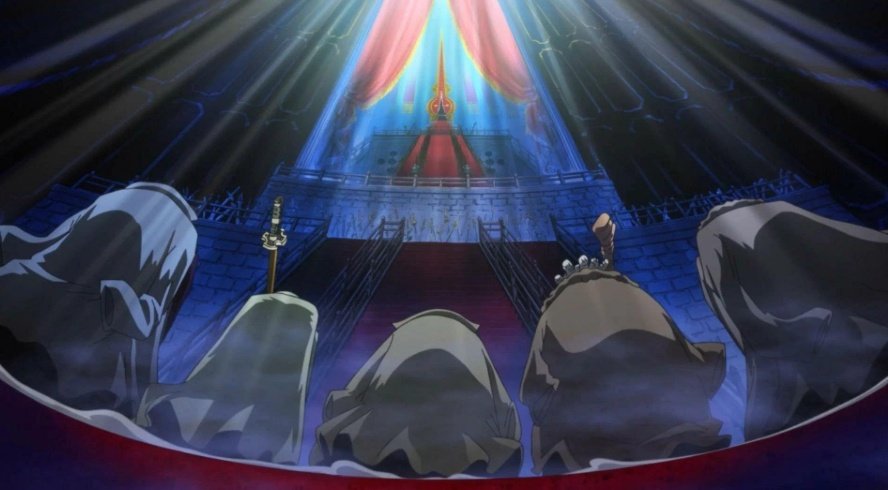
One of the most revealing political symbols in One Piece is the Empty Throne.
The throne is presented as a declaration that no single person rules the world.
According to the official explanation, the founders of the World Government agreed that none of them would claim absolute authority.
The empty seat represents their supposed commitment to equality among the founding kingdoms.
It is an elegant political symbol.
No individual king stands above the others.
The system appears to be based on shared authority rather than personal domination.
But the revelation surrounding the throne transforms its meaning.
The seat is not truly empty.
Its apparent neutrality conceals the existence of a secret ruler.
This changes the way we understand the World Government’s entire political structure.
The institution presents collective leadership to the public while concealing a superior authority from the world.
The Empty Throne is therefore more than a symbol of hypocrisy.
It represents a system in which the appearance of equality is used to conceal the reality of absolute power.
The most revealing feature of this deception is that the government does not merely hide its ruler.
It turns the absence of a ruler into part of its official identity.
4. Imu: The Power That Exists Outside Public Accountability
The existence of Imu introduces another layer to the political structure.
The Five Elders are publicly regarded as the highest authorities of the World Government.
They represent the institution’s senior leadership and oversee its major political and administrative functions.
Yet their relationship with Imu reveals that even these powerful figures answer to someone above them.
This creates a striking contradiction.
The people who appear to represent the highest authority in the world are themselves subordinate to a ruler whose existence is hidden from ordinary citizens.
The political implications are significant.
How can the public hold an institution accountable when it does not know who ultimately controls it?
How can nations understand the source of major decisions when the real authority is concealed?
And how can the principle of shared political power be taken seriously when an undisclosed individual can override the entire structure?
Imu makes the World Government’s problem more fundamental.
Its political system is not simply unequal.
Its highest level of authority is hidden from the people who are supposedly governed by it.
5. The Marines: Protectors of Justice or Defenders of the System?
The Marines are essential to understanding the complexity of the World Government.
They are the most visible military force responsible for maintaining order across the seas.
Many Marines genuinely believe in justice.
Characters such as Smoker, Fujitora, and Koby demonstrate that the organization contains individuals who struggle with the moral consequences of their duties.
This is important because it prevents the story from becoming a simplistic conflict between pirates and heroes.
The Marines are not all motivated by the same values.
Some prioritize obedience.
Others believe in protecting ordinary people.
Some question the actions of their superiors.
Their internal differences reveal a conflict between two ideas of justice.
The first defines justice through institutional authority.
If an order comes from the government, obedience becomes the primary responsibility.
The second defines justice through moral responsibility.
An action does not become right simply because a powerful institution authorizes it.
This distinction is central to the political world of One Piece.
The Marines may protect ordinary people from pirates, but they can also become instruments through which the ruling class protects itself.
The question is not whether the Marines are necessary.
The question is whether an institution can remain just when its loyalty to authority becomes more important than its responsibility to people.
6. Absolute Justice: When a Good Principle Becomes Dangerous
The concept of Absolute Justice, strongly associated with Akainu, provides one of the clearest examples of the dangers of institutional thinking.
At first glance, absolute justice appears to be an admirable principle.
It suggests that evil should never be tolerated and that dangerous criminals must be eliminated.
But the problem emerges when justice becomes so rigid that individual circumstances no longer matter.
When an institution believes its mission is unquestionably correct, it can begin to justify almost any action in the name of that mission.
The destruction of Ohara demonstrates the extreme consequences of this thinking.
The government treats the island’s scholars as an unacceptable threat, and the military operation does not distinguish between the intellectual work of researchers and the lives of ordinary inhabitants.
The result is catastrophic.
The principle of justice becomes a justification for collective destruction.
This is one of Oda’s most important political observations.
A system can use morally attractive language while carrying out profoundly immoral actions.
The danger is greatest when those enforcing the system stop asking whether their methods are compatible with the values they claim to defend.
7. The World Government Needs Enemies to Justify Its Authority
Every powerful institution needs some explanation for why its authority is necessary.
In the case of the World Government, piracy provides a convenient and very real source of danger.
The seas are filled with violent criminals, destructive pirate crews, and individuals capable of threatening entire nations.
The government can therefore present itself as the force preventing the world from descending into chaos.
There is truth in this argument.
Pirates can cause enormous suffering, and ordinary people need protection from violence.
But the existence of real threats does not automatically make every action taken by the government legitimate.
This is where the political structure becomes more complicated.
If the government can define every challenge to its authority as a threat to global stability, it gains the ability to blur the distinction between criminal activity and political opposition.
A person who attacks civilians may be a criminal.
A person who questions the government may be a dissenter.
A person who investigates forbidden history may be a scholar.
Treating all three as the same kind of enemy is not the protection of justice.
It is the expansion of political control.
The World Government’s greatest advantage is that it can use genuine dangers to make its own abuses appear necessary.
8. The World Government’s Greatest Resource Is Not Its Military
Military strength is important, but it is not enough to explain how the World Government maintains its influence.
It also depends on information.
The government has the ability to restrict historical research, manipulate public narratives, and control how certain events are presented to the world.
The destruction of Ohara illustrates this strategy.
The government does not merely eliminate the scholars.
It also creates a public explanation that presents their research as a threat to humanity.
This is a much more sophisticated form of power than simple military occupation.
If people accept the official explanation, the government does not need to explain every action in detail.
Its enemies become dangerous by definition.
Its decisions become necessary by default.
Its authority begins to appear natural.
This is why historical censorship is so central to the story.
A government that controls information can influence not only what people believe happened, but also what they think is possible in the future.
For a deeper examination of this issue, see our third analysis, Why the World Government Fears the Truth of History.
9. The World Government Does Not Need Everyone to Love It
Another interesting feature of the World Government is that it does not necessarily need universal admiration.
Political systems can survive even when large numbers of people are dissatisfied.
What matters is whether those people possess the ability to organize, communicate, and challenge the structure of authority.
The World Government has several advantages.
It has military power.
It has political influence over member nations.
It has intelligence organizations.
It also has the ability to make examples of people who challenge its authority.
These mechanisms create a system in which fear can sometimes be more effective than genuine loyalty.
People may obey because they believe the government is legitimate.
Others may obey because they have no realistic alternative.
Still others may disagree privately while continuing to cooperate publicly.
This distinction is important.
Visible obedience does not necessarily prove that a government has earned the trust of its population.
Sometimes it simply demonstrates that the cost of resistance is too high.
10. The Revolutionary Army: Challenging the Structure Rather Than One Enemy
The Revolutionary Army introduces a different kind of challenge to the World Government.
Unlike individual pirate crews, its conflict is fundamentally political.
It seeks to confront the structure of authority that allows the World Government and the Celestial Dragons to dominate other nations.
This distinction changes the scale of the conflict.
A pirate crew may defeat a powerful enemy and liberate a particular island.
A revolutionary movement questions the political system that makes similar oppression possible across multiple countries.
The Revolutionary Army therefore represents a challenge to the government as an institution.
Its existence raises a difficult question.
If the World Government claims to protect the world, why do so many people see the existing system as something that must be fundamentally changed?
The answer cannot be reduced to the ambition of one pirate or the hatred of one enemy.
It reflects a much wider conflict over who has the right to determine the future of the world.
This is also why the Revolutionary Army and the Straw Hat Pirates should not be treated as interchangeable forces.
They may challenge the same political structure, but their motivations and methods are different.
11. Why Some Kings Cooperate With an Unjust System
The World Government is not sustained by the Celestial Dragons alone.
Its political structure also depends on the participation of member nations.
Kings and political leaders attend the Reverie, negotiate with one another, and participate in the international order.
This creates an interesting contradiction.
Some nations may benefit from the protection and stability provided by the government.
Others may cooperate because they fear the consequences of opposition.
Some rulers may prioritize their own position over the interests of their citizens.
The result is a political structure that does not require every participant to share the same ideology.
It only requires enough people to find cooperation more beneficial than resistance.
This is a realistic dimension of Oda’s political storytelling.
Unjust systems are rarely maintained by one individual acting alone.
They survive through networks of people and institutions whose interests become connected to the continuation of the system.
The World Government is powerful not only because it has rulers.
It is powerful because numerous political actors have reasons to remain inside its structure.
12. The Cost of Preserving the Existing Order
One of the most disturbing aspects of the World Government is how easily the lives of ordinary people can become secondary to the protection of its political structure.
Ohara is a clear example.
The island’s destruction demonstrates that the government is willing to sacrifice an entire community when it believes that its authority is threatened.
Other events throughout the story reinforce this pattern.
The suffering of ordinary people is repeatedly connected to decisions made by powerful individuals who are protected from the consequences of those decisions.
This raises an important distinction between stability and justice.
Stability means that the existing arrangement continues.
Justice means that people are treated according to principles that recognize their dignity and rights.
These two things can sometimes support each other.
But they can also conflict.
A political system may remain stable precisely because those who suffer under it have no effective way to challenge it.
In that situation, stability becomes an excuse for preserving injustice.
The World Government repeatedly exposes this danger.
Its greatest priority appears to be preventing the structure from changing, even when maintaining that structure creates enormous suffering.
13. The One Piece World Is Not Divided Into Simple Heroes and Villains
Despite its political criticism, One Piece does not present every conflict through a simple division between good pirates and evil government officials.
The Marines contain people with different moral beliefs.
Some pirates are cruel and destructive.
Some kingdoms cooperate with the World Government for reasons that cannot be reduced to greed.
Even within powerful institutions, individuals can question the actions of their superiors.
This complexity is important.
It allows the story to distinguish between an individual person’s moral character and the political system in which that person operates.
A Marine may genuinely want to protect civilians while serving an institution that commits injustice.
A king may care about his people while cooperating with a deeply unequal international structure.
A pirate may oppose the government without necessarily representing a better political future.
The story becomes more interesting when we recognize that defeating a villain does not automatically solve the problems that allowed that villain to gain power.
This is one of the reasons the World Government remains such a compelling antagonist.
Its danger lies not only in the personalities of its leaders, but in the institutions and assumptions that protect their authority.
14. What Would Happen If the World Government Lost Its Power?
This is one of the most important questions that the story invites readers to consider.
If the World Government were defeated, would the world automatically become peaceful?
Not necessarily.
The seas would still contain dangerous pirates.
Individual kingdoms would still have competing interests.
Political ambition, greed, and violence would not disappear simply because one institution had collapsed.
A different political structure would still need to address these problems.
This is an important distinction between destroying an unjust system and building a better one.
The first requires resistance.
The second requires responsibility.
Oda has not presented the final political arrangement of the world as a completed answer, and it would be premature to claim that the story has already revealed exactly what should replace the World Government.
But the distinction matters.
The central question is not simply whether the existing rulers should fall.
It is whether the people of the world can build an order in which authority exists to serve them rather than to preserve itself.
This is where the political meaning of the series extends beyond its immediate conflicts.
A revolution is not complete simply because the old rulers have disappeared.
Its real success depends on what happens afterward.
15. Final Reflection: The World Government Is Afraid of Losing the Right to Decide
The World Government presents itself as the guardian of global peace.
But its treatment of the Celestial Dragons, its concealment of the Empty Throne, its suppression of historical research, and its willingness to sacrifice ordinary people reveal a different priority.
It is protecting a structure in which authority is concentrated at the top and accountability becomes increasingly difficult as power increases.
The Celestial Dragons represent inherited privilege.
The Empty Throne represents the illusion of shared authority.
Imu represents power concealed from public accountability.
The Five Elders represent the political machinery that maintains the system.
The Marines represent the complicated relationship between justice and obedience.
Together, these elements reveal a government whose greatest fear may not be disorder itself.
It may be the loss of its exclusive right to define order.
That is what makes the conflict in One Piece so much larger than a battle between pirates and the government.
The real struggle concerns who gets to decide how the world should be organized, whose lives matter, and whether the people who hold power must answer to anyone.
Luffy does not set out to become the ruler of the world.
That is precisely what makes his journey so different from the ambitions of those who occupy the highest levels of the World Government.
He wants to reach the end of the sea without becoming another person who decides how everyone else must live.
And perhaps that is the most important contrast in the entire series.
The World Government wants to preserve a world in which a few people determine the limits of everyone else’s lives.
The Straw Hats represent the possibility of a world in which people can pursue their own dreams.
The ultimate question of One Piece may not be who deserves to rule the world. It may be whether the world needs someone to rule it in the first place.
TTK Original — Beyond the Headlines
