IVE’s comeback initially created a strange kind of confusion.
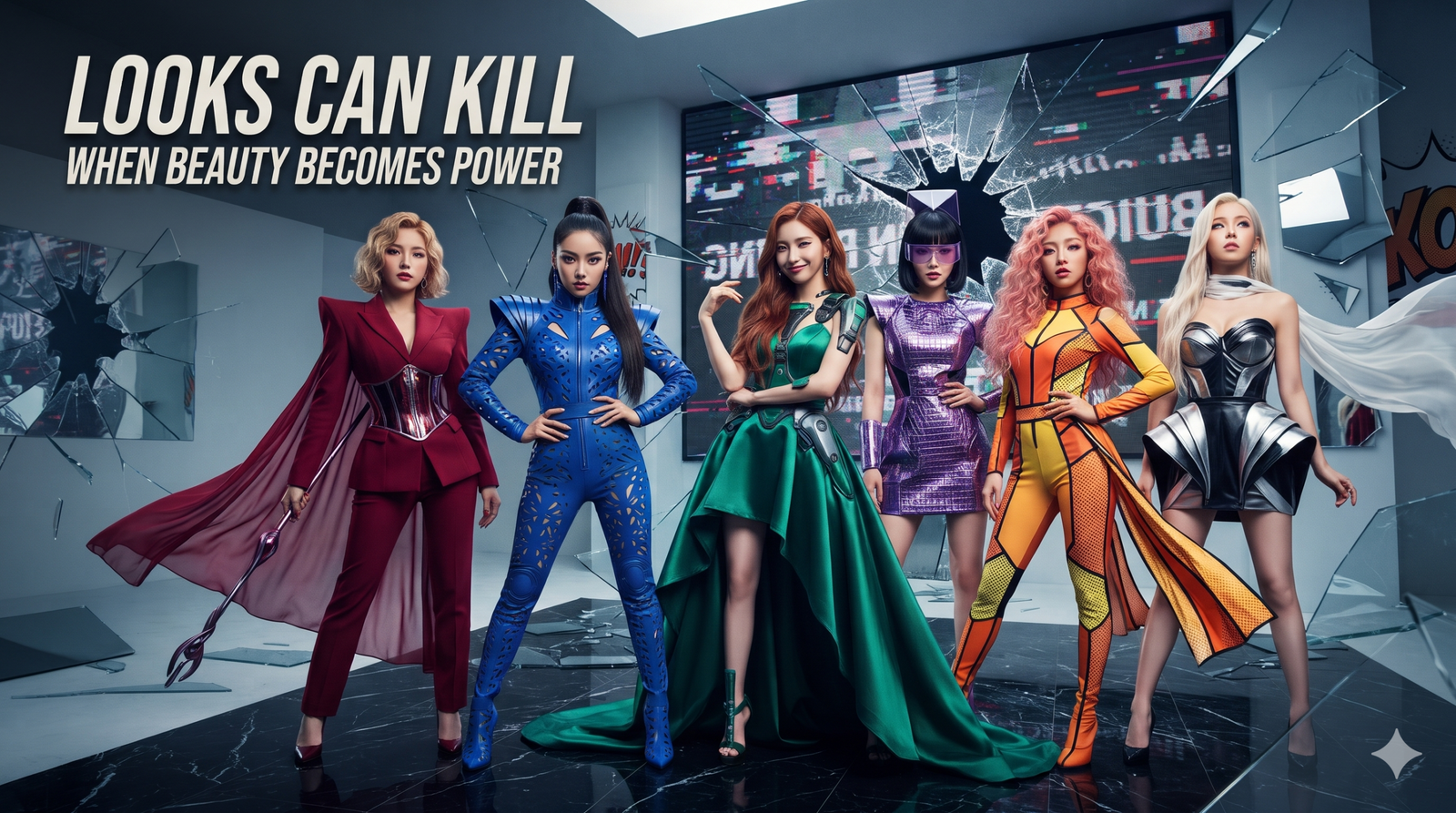
The title was Looks Can Kill. The promotional materials introduced terms such as “Girl Hero,” “Hero Comics,” “Post Credits Scene,” and “SPIN-OFF.” The members appeared in colorful, exaggerated costumes that seemed to belong somewhere between a superhero film, a retro action series, and a fashion campaign.
Some fans immediately loved the concept.
Others were less convinced.
Comparisons to Power Rangers, Totally Spies, and other familiar visual worlds appeared across online discussions. Even people who understood the basic idea were unsure what IVE was trying to communicate.
But now that the fifth EP has been released, a more interesting question can be asked.
Was this simply an unusual visual concept designed to attract attention, or was IVE attempting to challenge the very image that helped make the group famous?
The answer becomes more interesting when we look beyond the costumes.
Looks Can Kill is not just about looking powerful. It is about turning appearance into a form of power—and examining how that power works in a music industry that constantly judges female performers by how they look.
1. The Real Question Behind “Looks Can Kill”
The expression “looks can kill” usually describes someone whose appearance is so striking that it feels almost dangerous.
It is a familiar phrase, but IVE gives it a more literal interpretation.
The members are presented as heroes whose presence alone can dominate a situation. They do not need to demonstrate extraordinary physical strength or defeat an enemy through a complicated story. Their image is already part of their power.
That idea fits IVE’s established identity.
From the beginning, the group has built much of its appeal around confidence, self-assurance, glamour, and an almost theatrical sense of self-worth.
Songs such as “ELEVEN,” “LOVE DIVE,” and “I AM” presented different versions of a confident protagonist. The central character was rarely someone waiting for permission to become important.
Instead, she already believed she was.
Looks Can Kill takes that attitude into a more exaggerated fictional world.
The difference is that confidence is no longer expressed only through lyrics, choreography, or styling. It becomes an entire character concept.
IVE is not simply telling listeners that they are powerful.
The members are being presented as people who have turned that belief into a visual identity.
2. Why the Girl Hero Concept Is More Than a Costume Change
Starship described the album as an expansion of IVE’s existing “Girl Fantasy” identity, introducing “Girl Hero” as another alter ego.
That distinction matters.
A conventional superhero story usually begins with a problem. A character discovers an ability, faces a threat, and eventually learns how to use that ability.
IVE’s concept begins somewhere else.
The members appear to possess their identities before the story even starts.
They are not ordinary characters waiting to become heroes. They enter the fictional world already carrying the confidence, appearance, and attitude associated with their heroic personas.
This changes the meaning of the transformation.
Rather than presenting empowerment as something that must be earned through suffering, the concept presents it as an identity that can be claimed.
There is an important tension here.
Real empowerment often requires effort, sacrifice, and the ability to confront uncomfortable realities. A glamorous superhero fantasy can make empowerment look effortless.
But that does not automatically make the concept meaningless.
Pop music has always used fantasy to express feelings that ordinary life does not easily permit. The fantasy of entering a room and immediately commanding attention can be emotionally powerful precisely because most people do not experience that kind of control in everyday life.
IVE turns that fantasy into entertainment.
The more interesting question is whether the music gives the fantasy enough substance to become more than an attractive costume.
3. The Beauty Paradox: Can Appearance Become a Weapon?
This is where the album’s title becomes more complicated.
IVE is one of the groups most closely associated with polished visual presentation. Its members are frequently discussed in terms of fashion, beauty, styling, and individual visual appeal.
That creates an unusual situation.
The entertainment industry often treats a female idol’s appearance as something to be evaluated by other people. Her image is photographed, compared, ranked, edited, and discussed.
In that environment, beauty can become both an advantage and a restriction.
A performer may receive enormous attention because of her appearance, but that attention can also reduce her identity to the appearance itself.
Looks Can Kill plays with this contradiction.
Instead of presenting beauty as something that makes the members passive objects of admiration, the concept turns it into an active force.
The members are not simply being looked at.
They are presented as the ones controlling the spectacle.
That is an important difference.
The title can therefore be read as a playful reversal of the usual relationship between performer and audience. The visual image that is normally consumed by viewers becomes the source of the performer’s imagined authority.
Of course, a music video cannot solve the larger problem of appearance-based judgment in the entertainment industry.
But it can manipulate that language.
IVE takes a system that places enormous value on visual appeal and turns the image into a declaration of control.
That is a more interesting interpretation than simply saying the members look beautiful in superhero costumes.
4. Why Some Fans Were Confused—and Why That Reaction Matters
The early reaction to the concept was not entirely positive.
On Reddit, the October 18 concept-photo discussion attracted comparisons to Power Rangers and Totally Spies. Some fans loved the colorful styling, while others questioned the costumes and the choice of visual details. The discussion received hundreds of votes, showing that the concept had generated genuine attention.
The reactions were revealing.
Some viewers interpreted the exaggerated presentation as playful and refreshing. Others felt that the styling was too kitschy for a group known for a more polished image.
This disagreement is worth examining.
IVE’s earlier visual identity often relied on elegance, expensive-looking styling, and carefully controlled glamour.
The new concept deliberately moved toward something more theatrical.
That creates a risk.
When an established group changes its visual language, fans do not evaluate the new concept in isolation. They compare it with the identity they already recognize.
A costume that looks exciting on a new group might feel strange on a group whose previous image was built around sophistication.
The question is not simply whether the styling is attractive.
It is whether the audience believes the group can convincingly inhabit the new world.
In that sense, the early confusion was not necessarily evidence of a failed concept. It was evidence that IVE had moved far enough away from familiar expectations to create a debate.
However, attention and approval are not the same thing.
A controversial image can generate discussion, but the music must still give listeners a reason to return.
5. The Music Had to Prove That the Concept Was Not Just Packaging
This is perhaps the most important test of the comeback.
A visually ambitious campaign can create expectations that the actual songs may struggle to satisfy.
IVE’s fifth EP, released on October 26, 2026, contains six tracks:
- “Looks Can Kill”
- “Mirror Mirror”
- “SNAKESKIN”
- “CRUMBS”
- “Girls Girls Girls”
- “Glow Motion”
The album’s structure is interesting because it does not remain trapped in one dark or aggressive mood.
The title track uses electronic dance-pop elements, with a prominent synth-pad rhythm, heavy bass, dynamic drums, and a final chorus designed to deliver a stronger release of energy.
The official description emphasizes the moment when a presence alone can dominate the atmosphere.
That is consistent with the visual concept.
But the rest of the tracklist broadens the picture.
“Mirror Mirror” and “SNAKESKIN” continue the more mysterious and theatrical atmosphere suggested by the album’s imagery. Meanwhile, “CRUMBS” and “Girls Girls Girls” introduce a different kind of energy, and “Glow Motion” moves toward a brighter pop atmosphere.
This variety is important.
If every song had attempted to sound equally aggressive, the album might have become a one-dimensional extension of its promotional photographs.
Instead, the tracklist suggests that the Girl Hero identity is not restricted to a single emotional setting.
A hero can be intimidating, playful, mysterious, or bright.
That gives the concept more room to develop.
It also raises a useful distinction: a coherent album does not necessarily need every track to sound alike. Sometimes coherence comes from a shared attitude rather than a shared musical formula.
6. The Music Video Revealed a Problem With Cinematic Ambition
The title track’s music video created another discussion on Reddit.
One of the recurring criticisms concerned the interruption in the middle of the video. Some viewers felt that the sudden break damaged the song’s momentum, even though they enjoyed the musical section that followed.
This is more than a minor editing preference.
A music video is not simply a visual decoration placed over a song. Its timing influences how the audience experiences the music.
When a video interrupts a song, the director is asking the viewer to accept a temporary loss of musical continuity in exchange for a different kind of visual or narrative effect.
That can work when the interruption creates a meaningful surprise.
But it can also make the audience feel that the video is getting in the way of the song.
The Reddit discussion showed that not everyone considered the interruption successful.
This reveals a broader challenge for IVE’s cinematic approach.
Once a group starts presenting its music as part of a fictional universe, the temptation is to make every visual element feel like a scene from a larger production.
But a K-pop music video still has to function as a music video.
The narrative should strengthen the song, not compete with it.
That distinction is especially important for a group whose musical identity has been built around memorable hooks and strong performance moments.
7. Why the “SPIN-OFF” Idea Is Actually Important
The word “SPIN-OFF” initially contributed to the confusion.
Some fans wondered whether it referred to another song, a separate project, or a different part of the album’s concept.
But the term makes more sense when considered in relation to IVE’s larger identity.
A spin-off does not necessarily abandon the original story.
It takes an established world and explores a different part of it.
That is a useful description of what IVE appears to be attempting.
The group has already introduced different versions of its own fantasy identity. The Girl Hero concept adds another character framework without requiring the group to discard everything that came before.
This is strategically valuable.
A successful K-pop identity needs to be recognizable, but it also needs room to change.
If a group repeats the same visual formula too often, familiarity can become predictability. If it changes everything at once, the audience may no longer recognize what made the group distinctive.
A spin-off offers a middle ground.
It allows a group to experiment while maintaining a connection to its established identity.
For IVE, the challenge is not simply creating another concept.
It is building a larger creative world in which different concepts can coexist without making the group’s identity feel fragmented.
8. IVE’s Biggest Risk Is Becoming Trapped by Its Own Image
There is an uncomfortable irony at the center of this album.
IVE’s visual identity is one of its greatest strengths.
But the stronger that identity becomes, the more difficult it can be to escape expectations built around it.
When audiences become accustomed to seeing a group as elegant, glamorous, and visually polished, even a playful experiment can be judged as a departure from what the group is supposed to be.
This creates a creative dilemma.
Should IVE protect the image that made it recognizable?
Or should it risk confusing some of its audience in order to discover new forms of expression?
The Girl Hero concept suggests that the group is interested in the second option.
The costumes, exaggerated characters, and theatrical promotional language all move away from the restrained version of glamour that audiences may associate with IVE.
But the underlying confidence remains.
That continuity is what prevents the concept from feeling like a completely unrelated identity.
The group is changing the packaging without entirely abandoning the attitude that made its earlier music recognizable.
Whether that evolution will remain convincing over multiple releases is a different question.
One album can introduce a new world.
Building a lasting artistic identity requires more than introducing it.
9. The Real Meaning of “Looks Can Kill”
The most interesting thing about Looks Can Kill is not that IVE has become a group of fictional superheroes.
It is that the album plays with the relationship between appearance, attention, and power.
In the entertainment industry, an idol’s image is often treated as something that belongs partly to the audience. Fans admire it, companies manage it, media outlets discuss it, and online communities evaluate it.
IVE’s new concept imagines a different relationship.
The members are not simply the subjects of the image.
They become the characters who control it.
That does not mean the album completely escapes the beauty standards surrounding K-pop. In some ways, it still depends on the same visual culture that made IVE famous.
But that contradiction is precisely what makes the concept worth discussing.
The group uses beauty as a source of power while working inside an industry that can also turn beauty into a limitation.
And perhaps that is the most revealing interpretation of the title.
“Looks Can Kill” does not have to mean that appearance is everything.
It can also be read as a challenge to the assumption that appearance is all a performer has.
Final Verdict: A New Costume, or a New Way of Seeing IVE?
Looks Can Kill is not simply another attempt to make IVE look different.
Its more ambitious idea is to turn the group’s established visual identity into a fictional world where appearance becomes part of the character’s power.
The concept will not appeal to everyone. The early disagreement over the styling and the debate about the music video’s interruption show that experimentation can create friction as well as excitement.
But that friction is worth examining.
IVE has reached a point where repeating its familiar image would be easy. The more difficult decision is to preserve the confidence audiences recognize while changing the way that confidence is presented.
The Girl Hero concept is one attempt at doing exactly that.
Ultimately, the question is not whether IVE can look like superheroes.
It is whether the group can continue to surprise audiences without losing the identity that made them pay attention in the first place.
Because the most powerful image is not necessarily the one that attracts the most attention. It is the one that gives the person behind it control over what that attention means.