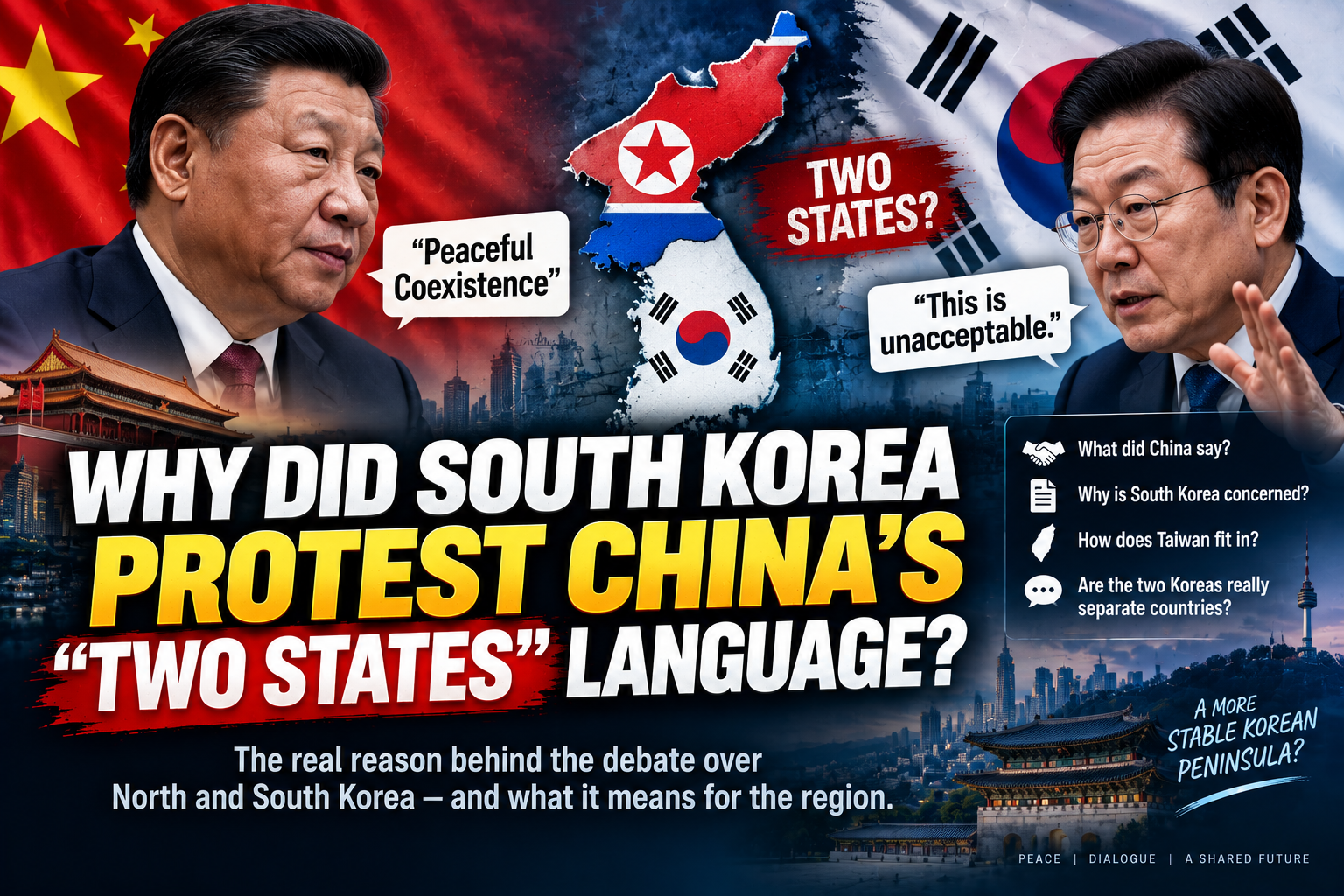
A seemingly simple phrase from China has triggered an unusually sensitive diplomatic dispute with South Korea.
The controversy centers on the relationship between South Korea and North Korea — and whether they should be viewed as two ordinary, separate states.
During recent diplomatic exchanges, Chinese officials used language emphasizing the “peaceful coexistence” of South and North Korea.
To many outside Korea, that may sound harmless.
But in Seoul, the wording immediately touched one of the most complicated political and constitutional questions on the Korean Peninsula:
Are North and South Korea two separate countries — or two sides of a still-divided Korea?
South Korea has now raised concerns with Beijing over language it believes could be interpreted as supporting North Korea’s increasingly explicit “two-state” approach toward the South.
To understand why a few words caused such controversy, we need to go back much further.
What Did China Actually Say?
Chinese Foreign Minister Wang Yi visited Seoul in August and held talks with South Korean Foreign Minister Cho Hyun.
During those discussions, Wang said China hoped that South and North Korea would move toward peaceful coexistence.
China also emphasized its intention to continue playing a constructive role in maintaining peace and stability on the Korean Peninsula.
On the surface, there is nothing particularly confrontational about calling for peaceful coexistence.
The problem is the political meaning behind the wording.
South Korean officials became concerned that language treating Seoul and Pyongyang as two entities that should simply coexist could resemble North Korea’s own changing position toward inter-Korean relations.
And that position has changed dramatically.
North Korea Has Abandoned Its Old Unification Language
For decades, both North and South Korea officially claimed that eventual Korean unification remained a national objective.
They disagreed profoundly about what that unification should look like, but the basic idea of Korea as a divided nation remained.
North Korean leader Kim Jong Un has increasingly moved away from that framework.
Pyongyang now describes relations with South Korea through its “two hostile states” policy and has rejected many of its previous assumptions about eventual reconciliation and unification.
Recent changes to North Korea’s ruling Workers’ Party rules have reinforced that hardened position toward South Korea.
This is why China’s wording matters.
If Beijing begins speaking about the two Koreas primarily as separate states that should peacefully coexist, Seoul worries that this could normalize Pyongyang’s new political framework.
But Aren’t North and South Korea Already Two Countries?
This is where the story becomes especially confusing for international readers.
In practical international relations, the answer appears straightforward.
South Korea and North Korea:
- have separate governments,
- have separate militaries,
- issue separate passports,
- maintain separate diplomatic relationships,
- and have both been members of the United Nations since 1991.
From the outside, they clearly function as separate states.
But inter-Korean relations have historically been treated differently.
The 1991 Inter-Korean Basic Agreement described the relationship between the two sides as not simply an ordinary relationship between states, but a special interim relationship arising from the process toward unification.
That distinction remains politically important in South Korea.
So when China appears to move toward ordinary “state-to-state” terminology, it touches a much deeper question than simple diplomatic vocabulary.
Why Is South Korea So Sensitive About the “Two-State” Idea?
Because accepting the two-state framework could have enormous long-term consequences.
It could affect:
the constitutional concept of Korean territory,
future reunification policy,
inter-Korean agreements,
North Korea policy,
and potentially even the diplomatic framework surrounding the Korean Peninsula.
South Korea’s constitution continues to define the territory of the Republic of Korea as the Korean Peninsula and its adjacent islands.
In practice, Seoul obviously does not govern North Korea.
But the constitutional and historical framework is very different from simply recognizing North Korea as an unrelated foreign country.
That is why language matters so much.
Then Taiwan Entered the Dispute
The controversy became even more interesting because China and South Korea exchanged objections over two different sovereignty questions.
Beijing objected to South Korean-related language and actions concerning Taiwan and reiterated the importance of the One China principle.
Seoul, meanwhile, raised concerns over China’s terminology regarding North and South Korea.
This created an unusual diplomatic symmetry.
China is extremely sensitive about any language that could imply Taiwan is an independent state.
South Korea is sensitive about language that could appear to formalize North and South Korea as permanently separate states.
The historical and legal situations are very different.
But diplomatically, both demonstrate the extraordinary importance countries attach to terminology involving sovereignty and national division.
Why Reddit Is Debating Taiwan
The dispute immediately produced a provocative question online:
If China treats North and South Korea as two states, why shouldn’t South Korea treat China and Taiwan as two states?
It is an attention-grabbing argument.
But legally and diplomatically, the comparison is much more complicated.
South Korea established diplomatic relations with the People’s Republic of China in 1992 and recognizes Beijing under its One China policy.
Changing that policy would represent an enormous shift in South Korean foreign relations.
Likewise, Seoul’s objection to Chinese wording about North Korea does not mean South Korea denies the practical existence of North Korea.
The disagreement concerns the political and legal character of inter-Korean relations.
That distinction is important.
Is China Actually Supporting North Korea’s “Two Hostile States” Policy?
There is not enough evidence to make that conclusion.
China continues publicly to emphasize peace and stability on the Korean Peninsula.
When Wang Yi visited Seoul, he said Beijing would continue playing a constructive role and expressed support for peaceful coexistence.
At the same time, China’s relationship with North Korea has strengthened recently.
Chinese President Xi Jinping visited Pyongyang in June, his first visit to North Korea in nearly seven years, as Beijing sought closer ties with Kim Jong Un.
That makes every change in China’s language toward the Korean Peninsula more closely scrutinized in Seoul.
The question is whether China’s wording represents a genuine policy shift or simply diplomatic language intended to avoid taking sides.
For now, the evidence does not justify saying China has formally adopted North Korea’s “two hostile states” doctrine.
Why This Matters Beyond Korea
The controversy may sound like an argument over words.
It isn’t.
The Korean War ended in 1953 with an armistice rather than a peace treaty.
More than seven decades later, the political status of the peninsula remains unresolved.
South Korean President Lee Jae Myung has recently called for conditions that could restart U.S.–North Korea dialogue and move the peninsula away from confrontation toward a more stable peace framework.
Meanwhile, North Korea has moved in the opposite direction by increasingly rejecting reconciliation with Seoul.
China sits between these competing approaches.
As North Korea’s largest neighboring economic and diplomatic partner, Beijing’s choice of language can therefore carry considerable significance.
What Happens Next?
Three things are worth watching.
First, watch China’s future terminology.
If Beijing repeatedly describes North and South Korea in explicitly state-to-state terms, Seoul’s concerns will grow.
Second, watch North Korea’s reaction.
Pyongyang would likely welcome international language that appears to normalize its two-state framework.
Third, watch the Taiwan connection.
If disagreements over Taiwan and the Korean Peninsula continue to become linked in Seoul-Beijing diplomacy, what began as a dispute over terminology could develop into a larger political problem.
Final Thoughts
Why did South Korea react so strongly to a few words from China?
Because on the Korean Peninsula, words can define political reality.
To an outsider, South Korea and North Korea already look like two separate countries.
But the historical, constitutional and diplomatic framework of inter-Korean relations has never been that simple.
North Korea is now trying to redefine that relationship as one between two hostile states.
South Korea does not want other countries to normalize that change.
And China’s recent language has therefore touched a question that Koreans have debated for more than seven decades:
Is Korea one divided nation — or have North and South Korea finally become two separate states?
That question is far bigger than a diplomatic disagreement with Beijing.
It goes to the heart of what the future of the Korean Peninsula could look like.
This article is for informational purposes and does not advocate a political position.