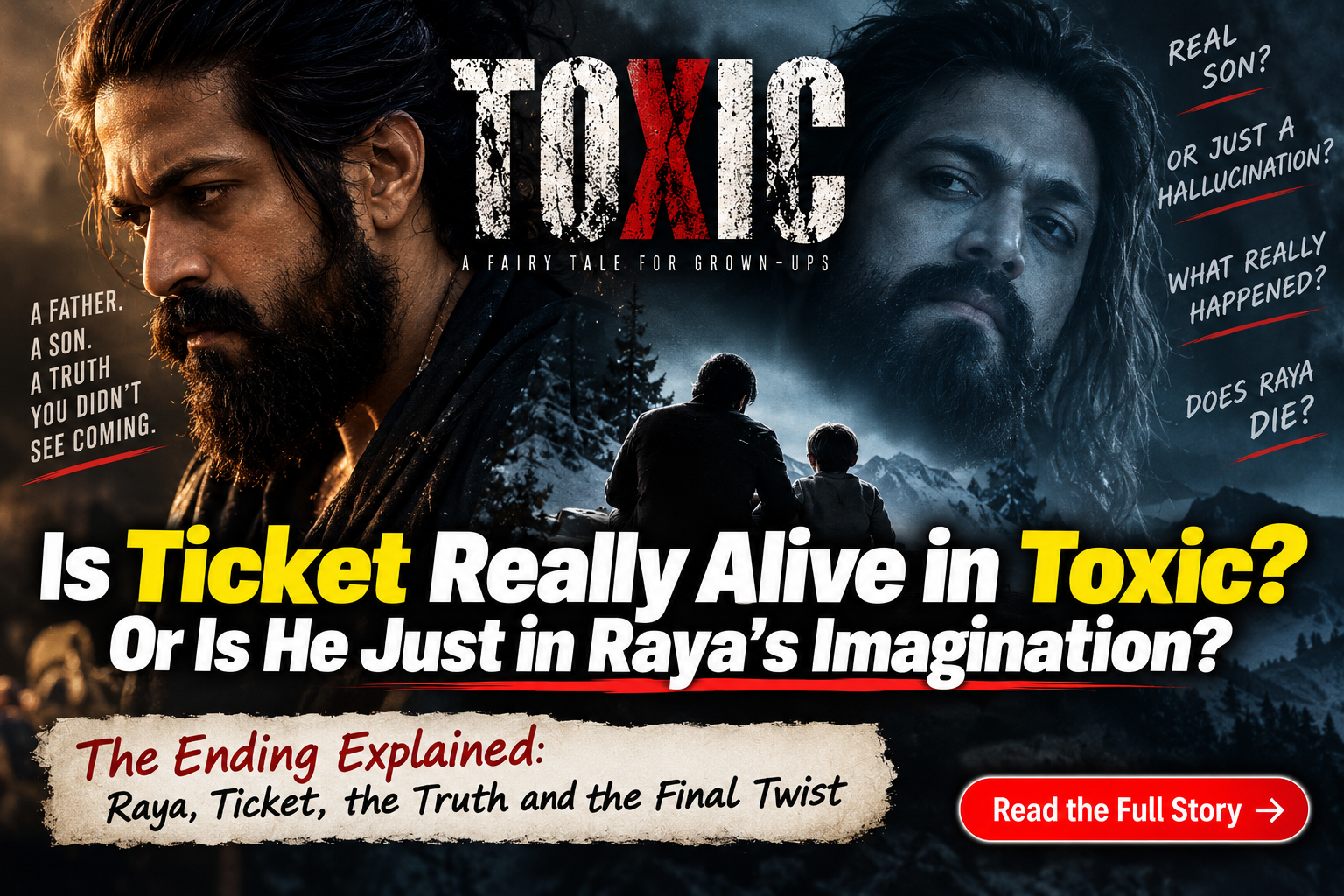
Major Spoiler Warning: This article reveals the central twist, the identity of adult Ticket, and the ending of Toxic: A Fairy Tale for Grown-Ups.
Was Ticket really alive throughout Toxic?
For most of the film, the answer appears obvious. Ticket is introduced as Raya’s grown-up son, a man who has returned to confront the father who abandoned him. He attacks Raya’s criminal empire, challenges his authority, and eventually becomes involved in a dangerous conflict surrounding Adam, Raya’s younger son.
The film encourages us to see their relationship as a familiar gangster-movie conflict: a father who built an empire through violence and a son who has returned to destroy it.
Then the ending changes everything.
The adult Ticket is not a living person. He is a manifestation of Raya’s fractured psychological reality.
The real Ticket was Raya and Nadia’s son, but he died when he was still a child. The adult version who narrates much of the film and confronts Raya is part of the father’s imagination, shaped by guilt, grief, and the consequences of his own actions.
This revelation does more than explain why Yash plays two characters. It forces viewers to reconsider the story they have just watched.
Raya was not simply fighting a son who came back for revenge.
He was confronting the part of himself that could never escape what happened to that child.
1. What Really Happened to Ticket in Toxic?
Ticket was the son of Raya and Nadia.
After Raya’s relationship with Nadia deteriorates, their family is destroyed by the same violence that has shaped his life. For much of the film, viewers are encouraged to believe that Ticket survives his childhood and eventually grows into the adult character played by Yash.
The truth is considerably darker.
The tragedy involving Ticket is connected to a car and water. During a confrontation, Raya leaves the vehicle, which eventually goes into the water. He realizes what has happened and attempts to save his son, but he cannot undo the tragedy.
The film leaves important ambiguity around Raya’s precise intention at that moment. It is safer to say that his anger and actions lead to the circumstances of Ticket’s death than to claim that every detail proves a deliberate murder.
What the ending makes clear is that the real Ticket never grows up.
Raya loses his son, but he cannot fully accept that loss. The adult Ticket who later appears in the story becomes a psychological substitute for the child who died.
This distinction is essential:
- The child Ticket was real.
- His relationship with Raya and Nadia was real.
- His death was real.
- The adult Ticket who returns to confront Raya is not an independent living person.
The tragedy is not that Ticket never existed.
It is that Raya cannot stop imagining the future his son never had.
2. Who Is the Adult Ticket? The Film’s Biggest Twist Explained
The adult Ticket is best understood as a manifestation of Raya’s guilt and fractured psychological state.
Before the reveal, the film presents two apparently separate men. Raya is the aging gangster who has built a powerful criminal empire, while Ticket is the younger man who wants to destroy everything his father has created.
Their conflict initially looks like a straightforward revenge story.
But the final revelation changes the relationship completely.
Ticket is not an independent enemy with his own separate life. He represents the son Raya lost, the violence that destroyed their relationship, and the guilt that has remained unresolved.
This also explains why Yash plays both characters.
The casting is not merely a way to create a visual resemblance between father and son. It reinforces the psychological connection between them.
The two characters look like separate people because Raya’s mind experiences them that way.
But the real conflict is internal.
Raya is fighting the son he failed to save and the part of himself that refuses to forget.
3. Why Does Raya Imagine That Ticket Survived?
Raya has spent his adult life building power.
He has defeated rivals, expanded his criminal operations, and created a world in which other people are expected to obey him.
Yet none of that power can reverse his personal losses.
His relationship with Nadia ends in tragedy. Ganga, the sister who helped shape his rise, is also lost. His growing empire cannot restore the family he destroyed.
Ticket becomes the most painful reminder of that failure.
The adult version of his son allows Raya’s mind to imagine an alternative reality: the child survived, grew up, and returned to confront his father.
That imagined future is both a form of punishment and an expression of grief.
Raya cannot simply remember Ticket as a dead child. Instead, he experiences him as someone who can still speak, argue, accuse, and demand answers.
This makes the imagined Ticket especially threatening.
Raya can eliminate a rival gangster. He can destroy a business or defeat an opposing organization.
But he cannot defeat a memory that has become part of his own mind.
4. Why Does Ticket Want Revenge but Sometimes Save Raya?
Before the twist, Ticket’s behavior appears contradictory.
He returns to punish the father who supposedly abandoned him and tried to kill him. He attacks Raya’s operations and threatens his family.
Yet he also refuses to kill Raya when he has the opportunity. At certain moments, he even protects him.
Why would a son who supposedly wants revenge behave this way?
The ending offers a psychological explanation.
Ticket is not an independent person following a consistent plan. He is part of Raya’s internal conflict.
One side of Raya wants punishment. Another wants forgiveness. He resents the son who reminds him of his failure, but he also desperately wants that son to remain alive.
These conflicting emotions appear as conversations and confrontations between two characters.
The apparent father-son rivalry is therefore also a struggle between different parts of Raya’s own emotional reality.
This is why Ticket’s actions can seem inconsistent.
He is not simply trying to destroy Raya.
He is expressing the guilt, grief, anger, and longing that Raya cannot reconcile within himself.
5. If Ticket Is Imaginary, Who Has Been Narrating the Film?
This is one of the most important consequences of the ending.
Ticket narrates much of Toxic. At first, viewers accept his voice as that of a real character looking back on his life and his relationship with Raya.
But once adult Ticket is revealed to be part of Raya’s psychological reality, the narration becomes much more complicated.
Ticket is not an independent observer describing events from outside the story.
He is part of the mind through which much of the story has been presented.
This makes him an unreliable narrator.
An unreliable narrator is a storytelling device in which the audience cannot automatically trust the perspective through which events are described.
In Toxic, the revelation raises several questions:
- Did every confrontation involving adult Ticket happen as shown?
- Were some events distorted by Raya’s memories?
- Did Raya attribute his own actions to the imagined Ticket?
- How much of the story reflects reality, and how much reflects his psychological collapse?
The film does not provide a separate explanation for every scene.
That uncertainty is important.
The twist is not simply that Ticket was imaginary. It is that viewers may have been experiencing parts of Raya’s world through a perspective that could not be fully trusted.
6. Did Ticket Really Kidnap Adam?
Adam’s kidnapping becomes one of the most disturbing parts of the story after the revelation.
Before the twist, adult Ticket appears to threaten Raya’s younger son. The kidnapping seems to be part of a revenge plan against the father who failed to save him.
But if adult Ticket does not exist independently, who is actually responsible?
The stronger interpretation is that Raya himself is responsible for the actions associated with Ticket.
His mind separates those actions from the identity he recognizes as his own. The imagined son becomes another person through whom his destructive impulses can be expressed.
This changes the meaning of the conflict.
Raya is not simply protecting Adam from an enemy who has returned from the past.
He has become a danger to his own family.
The apparent kidnapping is particularly revealing because it echoes the original tragedy involving Ticket. The father who once failed to save one son now faces the possibility of losing another.
The repetition suggests that Raya’s unresolved guilt is influencing his behavior in the present.
The film turns the father-son conflict into something even darker: a man whose past is beginning to destroy the next generation.
7. Why Does Yash Play Both Raya and Ticket?
Yash’s dual role is central to the film’s storytelling.
At first, the casting creates the visual impression of a father confronting his grown son. Their resemblance is easy to understand as a family connection.
After the reveal, however, the same casting takes on another meaning.
Raya and Ticket are two versions of one psychological conflict.
Raya represents the man who survived, built an empire, and continued living after the death of his child.
Ticket represents the child who never had the opportunity to grow up, along with the guilt that Raya has carried since the tragedy.
The visual similarity is therefore more than a family resemblance.
It reflects the fact that Ticket’s adult identity exists within Raya’s mind.
Yash’s performance allows the film to present the internal conflict as an external confrontation.
Instead of watching Raya argue with his own memories, we see him fight another version of himself.
8. What Does Ticket Symbolize?
Ticket represents several connected ideas.
The child who died: He is the son Raya lost and could never bring back.
Unresolved guilt: He reminds Raya of the consequences of his own actions.
Grief: He represents the future that was taken away before it could happen.
Inherited violence: His imagined revenge reflects the destructive world Raya created.
Conscience: He forces Raya to confront the truth that his power cannot erase.
There is another important layer.
Ticket is not only a symbol of punishment. He is also the son Raya desperately wants to recover.
That is why the imagined relationship remains emotionally complicated.
Raya fears Ticket, fights him, and resents his accusations. Yet he cannot completely let him go.
The adult Ticket represents the impossible wish that the child had survived and grown up.
In this sense, Raya is not merely haunted by the past.
He is haunted by the future he lost.
9. What Happens in the Final Avalanche Scene?
The final avalanche scene brings the psychological conflict to its emotional conclusion.
By this stage, Raya’s world has largely collapsed. His criminal empire, his relationships, and his ability to distinguish his own actions from the imagined Ticket have all been pushed toward destruction.
An avalanche approaches.
Instead of continuing to fight, Raya finally embraces Ticket.
The detail that matters is the form in which Ticket appears.
The final embrace connects Raya with the child he lost, rather than simply presenting a victorious adult son returning to his father.
The scene can be interpreted as Raya finally accepting the loss he has spent years refusing to confront.
For most of the film, he has treated Ticket as an enemy.
At the end, he stops fighting.
The embrace suggests that he is finally acknowledging the child, the tragedy, and his own responsibility.
The avalanche then approaches, and the film cuts to black.
The scene does not offer a conventional victory or a simple resolution. It replaces the expected gangster-movie showdown with a confrontation that is far more personal.
10. Does Raya Die at the End of Toxic?
The film leaves Raya’s final physical fate uncertain.
The climax places him in an extremely dangerous situation. The avalanche approaches as he embraces Ticket, but the film cuts away before showing an unambiguous outcome.
There are interpretations that read the ending as Raya’s death, particularly because the final scene follows the destruction of his criminal world and his apparent surrender to his past.
However, the film does not provide a conventional confirmation of his survival or death in that final image.
It is important to separate two questions:
- What happened to Ticket? The real child died, and adult Ticket is part of Raya’s psychological reality.
- What happened to Raya? The ending leaves his physical fate unresolved.
The film gives viewers a much clearer answer about Ticket’s identity than about Raya’s ultimate survival.
That difference is deliberate enough to preserve the ambiguity of the final scene.
11. Is Ticket Raya’s Split Personality?
Some viewers may describe Ticket as Raya’s split personality.
That phrase can work as informal shorthand, but it should not be treated as a confirmed medical diagnosis.
The film presents Ticket as a manifestation of Raya’s fractured psychological state. Words such as imagination, hallucination, and unreliable narration help explain the storytelling structure.
However, the movie does not establish a specific psychiatric diagnosis.
There is also a difference between interpreting a fictional character’s behavior and diagnosing a real person.
For understanding the ending, the essential point is simpler:
The adult Ticket exists within Raya’s psychological reality, not as the living adult son the audience initially believed him to be.
This distinction explains the twist without assigning a medical label that the film itself does not confirm.
12. Was Everything in Toxic Just a Dream?
No. That interpretation goes too far.
The revelation does not automatically mean that Raya’s entire life, criminal empire, family relationships, and every event in the film were imaginary.
The film establishes that adult Ticket is not an independent living person and that his narration cannot be trusted as an objective account.
But this does not prove that every event involving other characters was invented.
A more careful interpretation is that the story has been filtered through Raya’s fractured perspective.
Some events may have happened as presented. Others may have been distorted by his memories, guilt, and psychological instability. Certain scenes involving adult Ticket may represent actions or conflicts that Raya experiences internally rather than events involving a separate person.
This is why the ending invites viewers to reconsider the second half of the film rather than simply dismissing the entire story as a dream.
The uncertainty is part of the film’s narrative design.
13. Why Is the Final Embrace More Important Than the Father-Son Fight?
The final embrace changes the emotional meaning of the entire film.
Raya has spent his life building power through violence. He has treated control as the solution to almost every problem.
But he cannot control memory.
He cannot reverse his son’s death.
And he cannot eliminate the guilt that follows him.
When he finally embraces Ticket, the relationship changes from confrontation to acceptance.
The moment does not necessarily mean that Raya has been forgiven. It does not erase the consequences of his actions or restore the family he destroyed.
Instead, it suggests that he has finally stopped running from the truth.
For the first time, he is no longer trying to defeat the image of his son.
He is embracing the child he lost.
That makes the final scene more emotionally significant than a conventional revenge climax.
Frequently Asked Questions
Is Ticket alive in Toxic?
No. The real Ticket died when he was a child. The adult Ticket who confronts Raya is a manifestation of Raya’s fractured psychological reality.
Was Ticket really Raya and Nadia’s son?
Yes. Ticket was a real child and the son of Raya and Nadia. The twist concerns the adult version, not the child’s existence.
Why does Yash play both Raya and Ticket?
The dual role visually reinforces the psychological connection between the two characters. Adult Ticket represents the son Raya lost and the guilt he cannot escape.
Did Ticket really kidnap Adam?
The film presents the kidnapping through the apparent adult Ticket. After the reveal, the stronger interpretation is that Raya himself is responsible for the actions associated with Ticket.
Does Raya die in the avalanche?
The final scene does not clearly confirm his physical fate. The avalanche approaches as he embraces Ticket, and the film cuts to black.
Is Ticket a ghost?
The ending points more strongly toward Ticket being a manifestation of Raya’s imagination and guilt than a literal ghost.
Was the entire film a dream?
No. The twist makes the narration and scenes involving adult Ticket unreliable, but it does not establish that Raya’s entire life and criminal empire were imaginary.
Final Answer: Ticket Was Real, But the Adult Ticket Was Not
The central twist of Toxic is not that Ticket never existed.
He did exist.
He was the son of Raya and Nadia, and his death became one of the defining psychological wounds of Raya’s life.
The adult Ticket who returns to confront his father is a creation of Raya’s fractured mind: a version of the son who never had the chance to grow up.
That explains the contradictions in Ticket’s behavior, the unreliable narration, and the growing sense that Raya is losing control of his own reality.
The final embrace brings the conflict to its emotional conclusion.
For most of the film, Raya appears to be fighting his son.
But the truth is darker.
He has been fighting his own guilt, his own memories, and the consequences of the violence that shaped his life.
The criminal empire he built could defeat rivals and silence enemies. It could not bring back the child he lost.
And that is the real tragedy of Toxic.