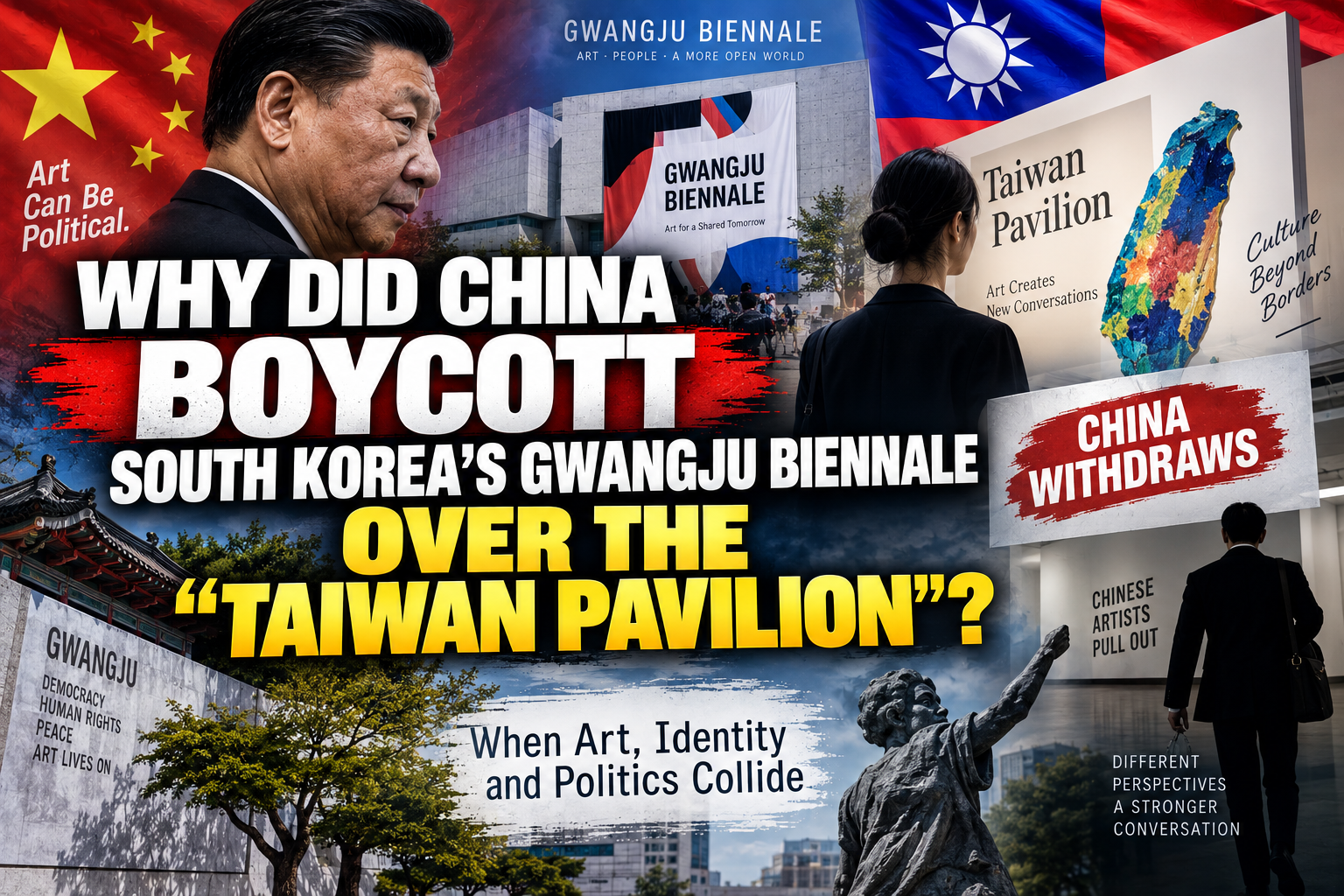
An international art exhibition in South Korea has suddenly become the center of a geopolitical dispute involving China, Taiwan and South Korea.
The controversy began with just two words:
“Taiwan Pavilion.”
Chinese artists and curators withdrew from the 2026 Gwangju Biennale after organizers allowed Taiwanese participants to present their exhibition under that name.
China strongly objected, arguing that the designation violated its “One China” principle.
The dispute became serious enough for the Chinese Embassy in South Korea to intervene — turning what began as an art exhibition naming controversy into a diplomatic issue.
So why does the name “Taiwan Pavilion” matter so much?
And why did a disagreement at an art festival in the South Korean city of Gwangju become an international political story?
What Happened at the Gwangju Biennale?
The Gwangju Biennale is one of Asia’s best-known contemporary art events.
Its 16th edition opened in September 2026 with a main exhibition and a separate Pavilion Project featuring national and institutional participants.
Among the participants was Taiwan’s National Taiwan Museum of Fine Arts, or NTMoFA.
The Taiwanese participants initially planned to use the name:
Taiwan Pavilion
But the Gwangju Biennale Foundation later changed the designation to:
NTMoFA Pavilion
That removed the word “Taiwan.”
Taiwanese artists and curators protested, arguing that removing “Taiwan” from the exhibition materials amounted to political censorship.
The organizers eventually reversed their decision.
On August 25, the name “Taiwan Pavilion” was restored.
And that triggered the opposite reaction.
China protested.
Why Did China Object to the Name “Taiwan Pavilion”?
Beijing considers Taiwan part of China and opposes actions it believes imply that Taiwan is an independent sovereign state.
China’s embassy argued that allowing the exhibition to use the name “Taiwan Pavilion” was inconsistent with the One China principle.
The Chinese Embassy and Chinese Consulate General in Gwangju raised objections with South Korean officials and the Gwangju Biennale Foundation.
Chinese participants then stopped preparing their own exhibition.
On September 3, the Chinese curatorial team formally announced that it was withdrawing from the biennale in protest.
The China Pavilion had been scheduled to feature 18 artists in an exhibition titled “Iron Silk Road.”
Instead, the artists pulled out just before the festival opened.
Why Is the Word “Taiwan” So Politically Sensitive?
This is the key to understanding the entire controversy.
Taiwan has its own democratically elected government, military, currency and political system.
But Beijing claims Taiwan as part of Chinese territory.
Most countries, including South Korea and the United States, maintain formal diplomatic relations with Beijing rather than Taipei.
That creates an unusual situation.
Taiwan participates extensively in global trade, technology, culture and international events, but the terminology used to describe it can become politically sensitive.
Even seemingly simple labels such as:
Taiwan
Taiwan Pavilion
or
Republic of China
can trigger diplomatic disputes depending on the context.
For Beijing, the concern is that treating a Taiwanese exhibition in the same way as a national pavilion could imply recognition of Taiwan as a separate sovereign country.
That is why this art exhibition became much more than an art exhibition.
Did South Korea Recognize Taiwan as a Country?
No.
This is one of the most important points in the story.
The use of the name “Taiwan Pavilion” at the Gwangju Biennale does not mean the South Korean government has recognized Taiwan as an independent country.
South Korea established diplomatic relations with the People’s Republic of China in 1992.
Seoul’s official policy regarding Taiwan has not changed.
South Korea’s Foreign Ministry specifically emphasized during the controversy that the government’s basic position on Taiwan remained unchanged.
The Gwangju Biennale is also operated by a foundation rather than being a foreign-policy body of the South Korean government.
Local authorities and the foundation said the name was an expression allowed to participating artists in the artistic sphere and did not mean that South Korea or the local government recognized Taiwan as a state.
That distinction is crucial.
So Why Didn’t the Organizers Simply Change the Name?
Because that created another controversy.
When the organizers removed “Taiwan” and replaced it with “NTMoFA,” Taiwanese artists and curators accused the biennale of political censorship.
They said the name had originally been agreed upon and that “Taiwan” was later removed from promotional material without their consent.
The organizers therefore faced pressure from opposite directions.
If they removed “Taiwan,” they faced accusations of censoring Taiwanese artists to satisfy political pressure.
If they restored “Taiwan Pavilion,” they risked angering China.
They ultimately restored the original name.
China then withdrew.
It was essentially a diplomatic trap with no easy solution.
What Did the Gwangju Biennale Say?
The foundation apologized for the confusion surrounding the pavilion project.
Gwangju Biennale chief executive Youn Bum-mo said he regretted that the Chinese participants ultimately withdrew.
He also explained that the Taiwanese presentation was technically an institutional pavilion, because the participating organization was the National Taiwan Museum of Fine Arts rather than the Taiwanese government itself.
The controversy exposed a broader problem with the event’s pavilion structure.
The biennale currently includes both national and institutional pavilions.
That can make labels politically complicated.
Youn said the foundation would examine reforms to the pavilion system to prevent similar controversies in the future.
Did China Pressure South Korea?
China did more than simply criticize the exhibition publicly.
Chinese Ambassador to South Korea Dai Bing conveyed China’s concerns to South Korean and local officials.
The Chinese Embassy and consulate also repeatedly raised the issue with the local government and the Gwangju Biennale Foundation.
There was another development.
A delegation from the Guangzhou Municipal People’s Congress canceled a planned visit to the Gwangju region after the dispute escalated.
The cancellation was widely interpreted as another sign of Beijing’s displeasure.
That demonstrates how quickly a cultural controversy can spill into broader relations between China and South Korea.
Why This Story Is Bigger Than an Art Festival
At first glance, the controversy might look almost absurd.
Two words on an exhibition poster caused artists to withdraw from one of Asia’s major art festivals.
But those two words represent a much larger question:
Who gets to decide how Taiwan is described internationally?
This issue appears repeatedly in:
- international sporting events,
- airlines,
- multinational companies,
- maps,
- museums,
- universities,
- entertainment,
- international organizations,
- and cultural festivals.
China frequently objects when terminology appears to present Taiwan as an independent country.
Taiwan, meanwhile, objects when its name is removed or replaced in ways it believes diminish its identity.
The Gwangju Biennale found itself directly between those two positions.
The Timing Is Especially Interesting for South Korea
There is another reason this controversy deserves attention.
South Korea is currently dealing with its own sensitive dispute with China over terminology involving the Korean Peninsula.
Questions have recently emerged over China’s language describing relations between North and South Korea and whether such terminology could appear to normalize North Korea’s evolving two-state approach.
The situations involving Taiwan and Korea are legally and historically very different.
They should not be treated as equivalent.
But there is an interesting common thread.
Countries care enormously about the language other countries use to describe sovereignty.
China is extremely sensitive to terminology that could imply Taiwan is a separate country.
South Korea, meanwhile, is sensitive to language that could affect the special political status historically assigned to relations between North and South Korea.
Sometimes international politics really can turn on a few words.
Why Taiwan’s Name Keeps Causing International Disputes
For international readers, the Gwangju controversy illustrates something important about Taiwan.
Taiwan’s diplomatic status is not merely an abstract debate among governments.
It affects everyday decisions about names.
Should an exhibition say “Taiwan”?
Should a sports team compete under “Chinese Taipei”?
Should a company list Taiwan separately from China?
Should a museum call an exhibition a “Taiwan Pavilion”?
Each decision can carry political meaning.
And because China is one of the world’s largest economies, organizations frequently face substantial pressure when making those choices.
The Gwangju Biennale is now another example.
Could This Damage China–South Korea Relations?
It is too early to say that the dispute will cause lasting damage.
South Korea has emphasized that its official position regarding Taiwan has not changed.
The biennale organizers have also tried to separate the artistic decision from government foreign policy.
But the Chinese Embassy’s direct involvement and the withdrawal of Chinese participants show that Beijing considers the issue significant.
Much will depend on whether the controversy remains limited to the biennale or begins affecting other cultural, economic or diplomatic exchanges.
For now, it is better described as a diplomatic irritant than a major rupture in China–South Korea relations.
What Happens to the Taiwan Pavilion?
Despite the controversy, the Taiwanese exhibition remains part of the Gwangju Biennale.
The broader biennale is continuing as scheduled.
Chinese participants, however, have withdrawn their pavilion presentation.
That creates an ironic result.
A dispute intended to challenge the name “Taiwan Pavilion” has generated significant international media attention around that exact name.
And a contemporary art exhibition in Gwangju has unexpectedly become part of one of Asia’s most sensitive geopolitical debates.
Final Thoughts
Why did China boycott an art festival in South Korea over the words “Taiwan Pavilion”?
Because to Beijing, the issue is not simply the name of an exhibition.
It touches China’s claim that Taiwan is part of its territory and its effort to prevent international language that could imply Taiwanese sovereignty.
For Taiwanese participants, however, removing the word “Taiwan” raised a different concern:
Who has the right to decide what Taiwanese artists are allowed to call themselves?
And South Korea’s Gwangju Biennale became caught directly between those positions.
That is what makes this story interesting beyond China, Taiwan or South Korea.
It shows how a seemingly small decision — just two words on an art exhibition — can reveal some of the biggest unresolved political questions in East Asia.
This article is intended to explain the controversy and does not advocate a political position.