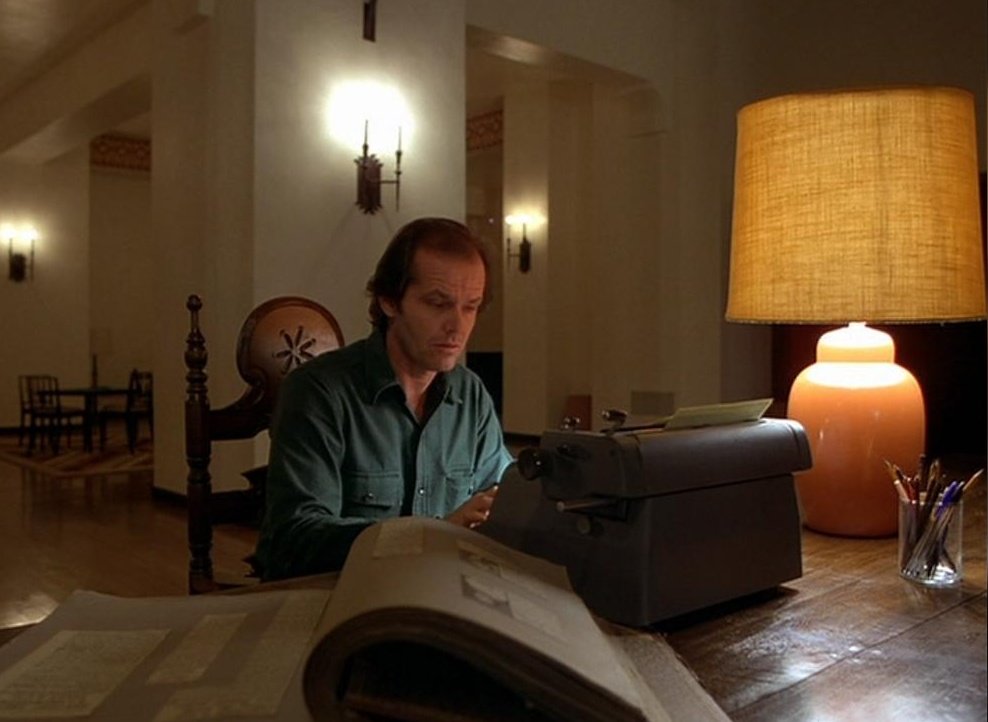
Stanley Kubrick’s The Shining begins with a seemingly ordinary decision.
Jack Torrance accepts a job as the winter caretaker of an isolated mountain hotel. He hopes the quiet environment will give him time to write, help him rebuild his life, and provide a fresh start for his family.
His wife, Wendy, and their young son, Danny, accompany him.
But the Overlook Hotel is not an ordinary workplace. Its history is marked by violence, its corridors seem to conceal something beyond human understanding, and Danny possesses an unusual ability to perceive things that others cannot.
As winter closes in, Jack becomes increasingly hostile and detached from his family. Eventually, he turns against the very people he was supposed to protect.
The supernatural explanation seems obvious: the hotel is haunted, and its evil influence destroys Jack’s mind.
But that explanation leaves a more disturbing question unanswered.
What if the hotel did not create the monster? What if it simply gave the monster inside Jack a place to emerge?
That possibility changes the meaning of almost every major scene in The Shining. The film is no longer only about a haunted hotel. It becomes a story about violence, responsibility, isolation, and the frightening distance between the person someone claims to be and the person they become when no one can stop them.
1. Jack Torrance Arrives at the Overlook Already Carrying a Dark Past
Jack does not enter the Overlook Hotel as a completely innocent man.
Before accepting the caretaker position, he has struggled with alcoholism, anger, and the consequences of his behavior toward his family. His relationship with Wendy is already damaged, and Danny has previously suffered because of Jack’s drinking and violence.
These details matter because they establish that the family’s problems did not begin in the hotel.
The official description of Stephen King’s original story also identifies Jack’s struggle with alcoholism and uncontrolled rage as part of the situation he brings into the isolated winter setting.
The film does not need to explain every detail of his past to establish that his family has reasons to fear him.
Jack wants a new beginning, but wanting to change is not the same as having changed.
His decision to take the job can therefore be interpreted in two ways.
He may genuinely hope to recover his sense of purpose.
Or he may be seeking an environment where the people around him have fewer opportunities to challenge him.
The Overlook offers him isolation, authority, and a seemingly legitimate reason to keep his family away from the outside world.
Those conditions will become increasingly dangerous.
2. The Hotel Offers Jack Something More Dangerous Than a Ghost
The Overlook Hotel is frightening partly because it gives Jack everything he appears to want.
He has a large building to manage, a quiet environment, and an opportunity to work on his writing. There are no ordinary workplace distractions, no crowded streets, and no constant interruptions from other people.
But there is also no meaningful social structure to challenge his behavior.
In a normal environment, Jack would encounter people who could question his decisions, recognize his deteriorating condition, or intervene when his anger became threatening.
At the Overlook, those external restraints gradually disappear.
The hotel becomes a closed system.
Jack has increasing control over the physical environment, while Wendy and Danny become increasingly dependent on his behavior.
This is an important distinction.
Isolation does not automatically turn a person into a violent individual. But when isolation combines with existing aggression, resentment, and a lack of accountability, it can make destructive behavior harder to interrupt.
The hotel is therefore frightening even before its supernatural elements become undeniable.
It creates the conditions in which Jack’s worst impulses can grow.
3. Jack’s Writing Is Not Just a Creative Failure
One of the most revealing details in the film is Jack’s typewriter.
Jack repeatedly claims to be working on a writing project. Wendy tries to respect his need for concentration, believing that his work is important to his recovery and self-respect.
But when she eventually discovers what he has actually been writing, the pages contain the same sentence repeated again and again:
“All work and no play makes Jack a dull boy.”
The scene is disturbing because it destroys the image Jack has constructed around himself.
He has presented his isolation as productive. He has asked his family to leave him alone because he needs to work. Yet the result is not a manuscript or a meaningful creative effort.
It is an empty repetition.
The typewriter becomes a physical representation of his mental condition.
Jack is not progressing toward a new identity. He is trapped inside a repetitive pattern that produces nothing.
There is also an uncomfortable connection between his writing and his relationship with Wendy.
He wants to be recognized as a serious artist, but he becomes increasingly hostile toward the person who supports him. His frustration with his own failure turns outward.
The typewriter does not create his anger.
It exposes the emptiness beneath the identity he wants other people to accept.
4. The Real Horror Is the Collapse of the Father Figure
At the beginning of the film, Jack is still Danny’s father and Wendy’s husband.
Those family roles carry expectations of protection, responsibility, and emotional security.
The horror comes from watching those expectations collapse.
For Danny, his father is not simply a frightening stranger who appears in a haunted building. He is someone he already knows.
That familiarity makes the danger more disturbing.
A stranger’s violence is frightening, but a parent’s violence destroys the sense of safety that a child is supposed to experience at home.
Wendy faces a similar collapse.
She has entered the hotel hoping that the family might recover from its earlier problems. Instead, she discovers that the environment is making her husband increasingly dangerous.
The hotel does not merely threaten the family from outside.
It turns the family’s central relationship into the source of danger.
This is why the film remains powerful even when viewers are familiar with its supernatural imagery.
The most frightening transformation is not the appearance of a ghost.
It is the transformation of a father into someone his own child must escape.
5. The Overlook’s Ghosts May Be Real, but They Do Not Erase Jack’s Responsibility
One of the most persistent questions surrounding The Shining is whether the hotel genuinely contains supernatural forces or whether its strange events can be interpreted as psychological experiences.
The film provides substantial evidence for the supernatural interpretation.
Danny sees visions before the family arrives. He encounters the Grady twins and experiences disturbing images connected to the hotel’s history. Dick Hallorann recognizes Danny’s unusual ability and explains that he possesses a form of psychic perception known as the shining.
The events involving Grady and the hotel also suggest that the supernatural world is not limited to Jack’s imagination.
However, the existence of ghosts does not automatically explain away Jack’s behavior.
Even if the hotel influences him, Jack remains the person whose actions threaten Wendy and Danny.
This distinction is essential.
If the hotel is responsible for everything, Jack becomes primarily a victim of supernatural manipulation.
If the hotel merely intensifies tendencies that already existed, the story becomes a much more complicated examination of human responsibility.
Kubrick’s film leaves room for both interpretations.
The supernatural explanation may describe what happens to Jack.
It does not necessarily excuse what he does.
6. The Ghostly Bartender Gives Jack Permission to Return to His Old Self
<PRIVATE_PERSON>
One of the most important encounters in the film takes place in the Gold Room, where Jack meets Lloyd, the mysterious bartender.
Jack initially appears to be speaking with someone who should not exist.
Yet the conversation becomes strangely ordinary. Lloyd listens to Jack’s complaints, serves him a drink, and allows him to express his frustrations.
This encounter is significant because alcohol is not simply a drink in Jack’s story.
It represents an old pattern of escape.
Jack has struggled to remain sober, and his relationship with alcohol is connected to the damage he has caused his family.
The bartender’s appearance can therefore be understood as a supernatural temptation.
But it can also be read symbolically.
Lloyd gives Jack an imaginary audience that does not challenge him. He listens without asking difficult questions. He offers comfort without demanding accountability.
Jack can complain about Wendy, his responsibilities, and his circumstances without confronting his own role in the family’s suffering.
In that sense, the bartender offers something more dangerous than alcohol.
He offers Jack a version of reality in which Jack is always the injured party.
7. Grady Shows Jack the Future He Is Willing to Accept
The encounter with Delbert Grady is another turning point.
Grady was the previous caretaker who murdered his wife and daughters at the hotel.
When Jack meets him, Grady does not appear as a terrifying monster. He behaves like a polite employee and speaks with the calm confidence of someone who understands the hotel better than Jack does.
The contrast is disturbing.
Grady’s appearance suggests that the Overlook’s violence has become normalized within its own history.
He does not treat the previous murders as an extraordinary moral catastrophe. Instead, he seems to understand them as part of the hotel’s strange order.
The most frightening aspect of this encounter is not simply that Grady exists.
It is that Jack appears increasingly receptive to his way of thinking.
Grady becomes a model for Jack’s transformation.
He represents a version of masculinity in which authority means control, disagreement becomes disrespect, and violence can be justified as a way to restore order.
The hotel may be supernatural, but the attitudes that make its violence possible are disturbingly familiar.
8. Wendy Is Not Weak Because She Is Frightened
Wendy Torrance is sometimes discussed as a frustrating character because she appears frightened, hesitant, and emotionally overwhelmed.
But this interpretation can overlook the situation she faces.
Wendy is isolated with a husband whose behavior is becoming increasingly unpredictable. She is also responsible for protecting a child who is experiencing terrifying visions.
She does not have the same physical power or authority that Jack possesses.
Her fear is therefore not evidence of weakness.
It is a realistic response to an increasingly dangerous environment.
The film’s emotional perspective changes as Jack becomes more threatening.
At first, viewers may see the hotel as the primary source of danger. But as Wendy discovers the extent of Jack’s deterioration, the real conflict becomes much more immediate.
She must decide whether to continue trusting the man she married or accept that her family may not survive if she does.
Her struggle is not about defeating a ghost.
It is about recognizing danger and acting before it is too late.
9. Danny Understands the Danger Before the Adults Do
Danny’s unusual ability gives the film another perspective on the Overlook.
He experiences visions and encounters images that adults either cannot see or cannot understand.
But his most important role is not simply to provide supernatural information.
Danny represents the person in the family who has the least power and yet recognizes the danger most clearly.
He senses that something is wrong long before the adults fully understand the situation.
This creates a painful contrast.
Jack wants to believe that he is rebuilding his life. Wendy hopes that the family can become stable again. Danny, meanwhile, experiences the emotional and supernatural danger directly.
The child is forced to interpret a world that the adults are unable to protect him from.
The film’s horror becomes especially powerful when we understand that Danny’s visions are not simply frightening images.
They are warnings.
He is trying to survive a situation that he cannot control.
10. Why the Hotel’s Endless Corridors Feel Like a Psychological Trap
The Overlook Hotel is one of the film’s most important characters.
Its enormous corridors, symmetrical rooms, long hallways, and seemingly endless spaces create a sense of disorientation.
The camera often follows Danny’s tricycle as he moves through the empty corridors.
Nothing immediately attacks him.
Yet the audience feels that something is wrong.
This effect is partly created through the film’s visual design and camera movement. Kubrick uses carefully controlled compositions and tracking shots to make the hotel feel both familiar and impossible to understand.
The Criterion Collection describes the film’s atmosphere through its dreamlike dread and labyrinthine corridors, emphasizing how the building itself seems to participate in the psychological horror.
The hotel is not merely a setting where frightening events happen.
It shapes the way viewers experience those events.
Its spaces appear orderly, but they never feel completely safe.
Its rooms seem familiar, but their arrangement creates a persistent sense of uncertainty.
The building becomes a visual expression of a mind that can no longer distinguish between safety and danger.
11. The Final Photograph Turns Jack’s Story Into Something Much Larger
The final photograph is one of the most debated images in horror cinema.
After Jack’s death, the camera moves toward an old photograph showing him at a party in the Overlook Hotel in 1921.
The image raises an unsettling question.
How can Jack appear in a photograph taken decades before his birth?
There are several possible interpretations.
One possibility is that the hotel has absorbed Jack into its own history. He is no longer simply a man who worked there during one winter. He has become part of the hotel’s permanent identity.
Another interpretation involves repetition.
The Overlook has a history of violence, and Jack may have become another participant in a cycle that existed long before his arrival.
A third interpretation is that the hotel operates outside ordinary time.
In that reading, the distinction between past and present becomes unstable.
The film does not provide a definitive explanation.
But the photograph changes the meaning of Jack’s fate.
His story no longer appears to be an isolated tragedy involving one troubled family.
It becomes part of something much older.
The hotel seems to preserve the people who surrender themselves to it.
12. The Hotel May Be Haunted, but the Family’s Suffering Is Real
There is a temptation to treat The Shining primarily as a puzzle about ghosts, hidden messages, and supernatural clues.
Those details are important, but they can distract from the human consequences of the story.
Wendy and Danny are not merely characters moving through a haunted building.
They are a wife and child trying to survive a violent family situation.
Jack’s transformation is terrifying because the people closest to him are the ones who pay the price.
This is also where the film’s psychological interpretation becomes particularly powerful.
The hotel can be read as a supernatural force, a symbolic representation of addiction and aggression, or a space in which old patterns of violence are repeated.
But regardless of the explanation, the result is the same.
The family loses its sense of safety.
The supernatural mystery may remain unresolved, but the human damage is visible.
That contrast gives the film much of its emotional weight.
13. Why The Shining Becomes More Disturbing When You Watch It Again
The first time viewers watch The Shining, they often focus on its famous horror images.
The Grady twins. The elevator of blood. Room 237. Jack’s axe. The final photograph.
These scenes are memorable because they are visually striking and difficult to forget.
But a second viewing can shift attention toward something else.
Viewers may notice how early Jack’s behavior becomes hostile, how carefully Wendy tries to avoid conflict, and how Danny reacts to the atmosphere around him.
The story’s emotional structure becomes clearer.
The hotel is frightening from the beginning, but the family is already vulnerable before the supernatural events reach their peak.
This creates a different viewing experience.
The first viewing asks what is happening inside the hotel.
The second asks why the family was so vulnerable to it.
The third may lead to an even more uncomfortable question:
Was Jack ever truly trying to become a better husband and father, or did he simply want a new environment in which he could feel powerful again?
That question has no easy answer.
And that is precisely why the film continues to invite discussion.
14. The Real Monster in The Shining May Not Be the Hotel
So, did the Overlook Hotel create Jack’s madness?
The supernatural interpretation remains compelling. The hotel clearly possesses a history and influence that cannot be explained through ordinary reality alone.
But the psychological interpretation is equally important.
Jack arrives with a history of addiction, anger, and family conflict. The isolation of the hotel removes external restraints. Its ghosts appear to validate his resentment and offer him an alternative version of reality in which he is justified.
The hotel may be influencing Jack.
But it does not erase the history that made him dangerous.
This is what makes The Shining more disturbing than a conventional haunted-house story.
A ghost can be identified as an external threat. A monster can be confronted as something separate from the family.
Jack is different.
He is the person Wendy married and the father Danny once depended on.
The horror comes from watching that familiar person become the greatest danger in their lives.
Perhaps the most important question is not whether the hotel made Jack evil.
It is whether Jack wanted to believe that something outside himself was responsible for the violence he was capable of committing.
The Overlook Hotel may be haunted, but Jack Torrance’s greatest horror is that he never needs a ghost to become dangerous.