South Korea

  • Could Jeong-yo Really Disappear for 10 Years in Korea? The Four Hands Mystery Explained

    Spoiler warning: This article discusses major events from Episodes 5 and 6 of Four Hands, Two Sonatas.

    One of the biggest surprises in Four Hands, Two Sonatas is not simply that Jeong-yo returns.

    It is that he appears to have been gone for 10 years.

    For viewers, that immediately creates a practical question:

    Could an adult really disappear for 10 years in modern South Korea without his family finding him?

    At first, it sounds almost impossible. Korea is highly connected, smartphones are everywhere, CCTV cameras are common, and official records exist for almost every part of modern life.

    But the answer is more complicated than it seems.

    And surprisingly, a current debate in South Korea about missing adults helps explain why.

    Why Jeong-yo’s 10-Year Disappearance Feels So Strange

    Episode 6 caused exactly this reaction among international viewers.

    After Jeong-yo’s long absence, some viewers questioned how nobody — including investigators — could locate him for an entire decade.

    That leads to several mysteries at once:

    • Was Jeong-yo deliberately hiding?
    • Did someone powerful help him?
    • Did his family actually have the legal ability to track him?
    • And if he was an adult who left voluntarily, could police simply tell his family where he was?

    Those are very different questions.

    The important distinction is this:

    Being missing is not always the same as being in danger.

    Can Korean Police Track Any Missing Adult?

    Not automatically.

    This point is especially interesting because South Korea is debating the issue right now.

    In September 2026, Korean police announced plans to seek stronger legal authority to track the locations of adults reported missing.

    Why would they need new authority?

    Because under the current system, police can face restrictions on tracking an adult’s mobile-device location when there is no evidence suggesting that a crime has occurred.

    That means investigators cannot necessarily treat every adult who stops contacting his family as a kidnapping or criminal disappearance.

    This makes Jeong-yo’s situation more plausible than it first appears.

    If an adult intentionally leaves, remains alive, avoids contact and there is no clear evidence of a crime, the situation becomes very different from the disappearance of a child or a person believed to be in immediate danger.

    But Wouldn’t His Family Just Ask the Police Where He Is?

    This is where privacy becomes important.

    An adult does not lose all privacy rights simply because his family wants to find him.

    Korean police publicly state that personal information and private matters learned during police work must be protected.

    There have also been real debates in Korea over how much information police can publicly disclose when adults go missing.

    So even if authorities obtain information about an adult, that does not automatically mean every detail can simply be handed to relatives or released publicly.

    In other words:

    “The police can investigate” and “the family has a right to know exactly where an adult is” are not necessarily the same thing.

    Korea Actually Has a Current Missing-Adult Problem

    This makes the timing of Four Hands, Two Sonatas surprisingly interesting.

    In early September 2026, Korean police said they would push for legal changes allowing them to better confirm or track the locations of missing adults.

    The announcement followed public criticism surrounding a missing-person case in Jeju.

    Police acknowledged that under the current framework, investigators can be restricted from tracking the mobile locations of missing adults unless there are indications of a crime.

    So the strange question raised by a K-drama —

    “How can an adult disappear in such a connected country?”

    — is also a real policy question being discussed in Korea today.

    Does That Mean Jeong-yo Could Easily Hide for 10 Years?

    Not exactly.

    Ten years is still an extraordinarily long time.

    Living a normal public life for a decade while leaving absolutely no trace would be difficult.

    Banking, employment, housing, phones, transportation, medical treatment and digital activity can all create records.

    That is why Four Hands still appears to be hiding another piece of the puzzle.

    The more interesting question may not be:

    “How did nobody find Jeong-yo?”

    It may be:

    “Who made it possible for Jeong-yo not to be found?”

    That distinction matters.

    Was Someone Protecting Jeong-yo?

    Episode 6 naturally encourages this theory.

    International viewers are already asking who might have supported Jeong-yo during those missing years and why he suddenly decided to return.

    But this is where we should separate what the drama has confirmed from fan speculation.

    At this stage, the existence and identity of a secret supporter should not be treated as established fact unless the series explicitly confirms it.

    Still, from a storytelling perspective, ten years is long enough that Jeong-yo probably needed some combination of money, housing, professional connections or assistance if he intended to remain outside Pi-o’s reach.

    And his return as a conductor makes the mystery even bigger.

    He did not simply survive for 10 years.

    He built another life.

    Could Jeong-yo Have Asked Police to Keep His Location Secret?

    This depends heavily on the circumstances.

    If someone is hiding because of threats, stalking, domestic violence or another genuine safety risk, South Korea has protection systems for victims.

    Police can provide measures such as temporary accommodation, increased patrols, personal protection and connections to specialized protection facilities when appropriate.

    That is very different, however, from saying that any healthy adult can simply ask the government to “erase” him.

    There is no magic disappearance button.

    A person attempting to stay away from family would still have to manage the practical realities of everyday life.

    So Is the Drama’s 10-Year Disappearance Realistic?

    Partly.

    The idea that an adult can voluntarily cut contact with family is realistic.

    The idea that relatives do not automatically gain unlimited access to that adult’s private location is also realistic.

    And current Korean debate shows that police powers involving missing adults have genuine legal limitations.

    But disappearing almost completely for 10 years, while developing a new professional life and apparently avoiding people actively searching for you, is much harder to explain.

    That is precisely why the storyline works.

    The legal reality gives Jeong-yo enough room to disappear.

    But the extraordinary length of his disappearance suggests that Four Hands, Two Sonatas still owes viewers another answer.

    The Bigger Mystery Isn’t Where Jeong-yo Was

    For me, Episode 6 changes the central question.

    At first, we ask:

    Where was Jeong-yo for 10 years?

    But perhaps the better questions are:

    Why did he refuse to return?

    Who knew where he was?

    How did he support himself?

    Why did he choose conducting instead of returning as the pianist everyone remembered?

    And most importantly:

    Why has he decided to come back now?

    That is where the real mystery of Four Hands, Two Sonatas may be hiding.


    Quick Answer

    Can an adult voluntarily disappear in South Korea?
    Yes. An adult can cut contact with family, and family members do not automatically have unlimited rights to that person’s location.

    Can police automatically track the phone of every missing adult?
    Not necessarily. South Korea is currently discussing stronger legal authority for missing-adult location tracking.

    Could someone realistically remain completely hidden for 10 years?
    It would be difficult, particularly while living an active professional life.

    Does this prove someone helped Jeong-yo?
    No. That remains a theory unless the drama confirms it.

    So is the Four Hands storyline impossible?
    No — but the 10-year gap is unusual enough that the drama probably has more to reveal.
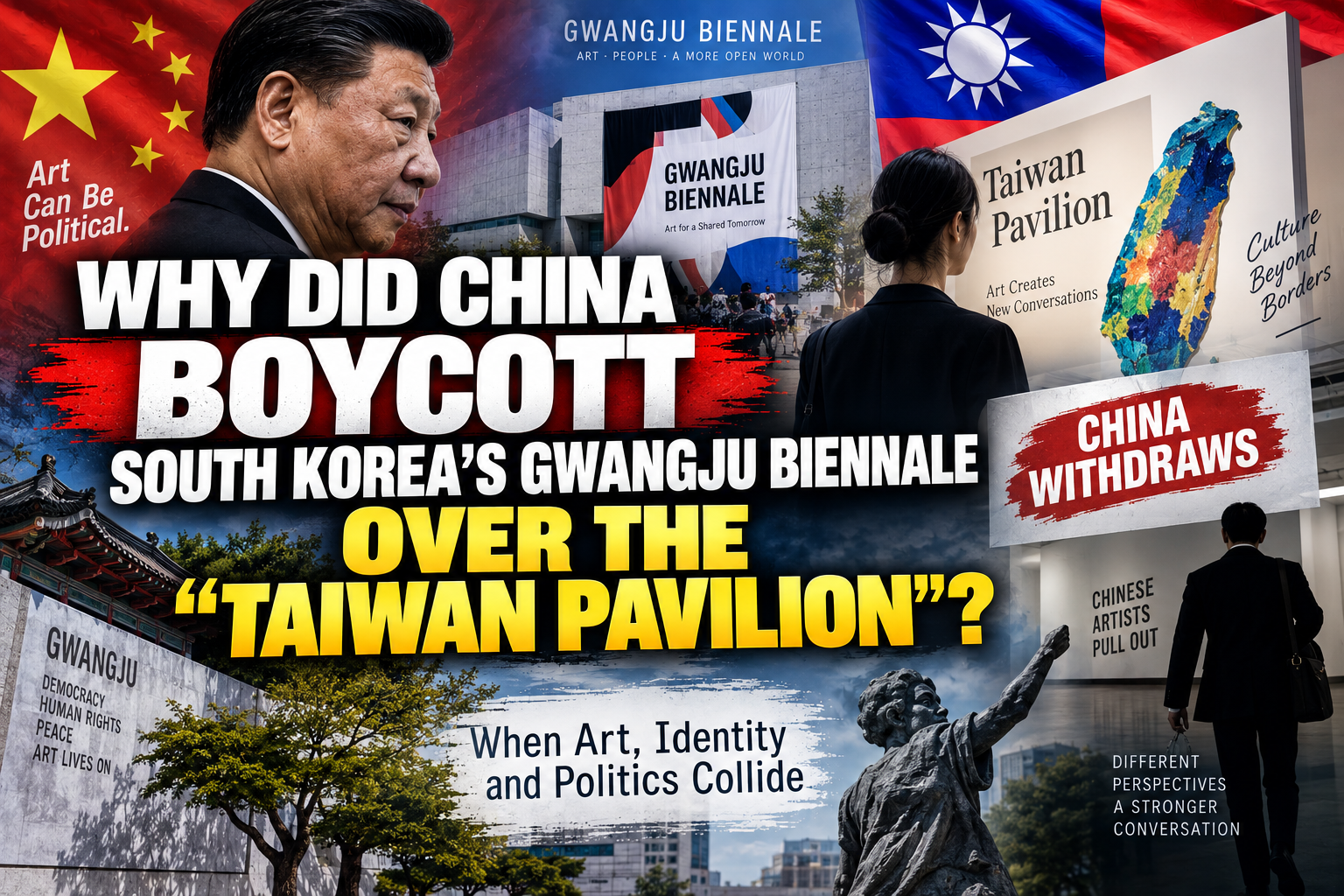
  • Why Did China Boycott South Korea’s Gwangju Biennale Over the “Taiwan Pavilion”?

    Why Did China Boycott South Korea’s Gwangju Biennale Over the “Taiwan Pavilion”?

    An international art exhibition in South Korea has suddenly become the center of a geopolitical dispute involving China, Taiwan and South Korea.

    The controversy began with just two words:

    “Taiwan Pavilion.”

    Chinese artists and curators withdrew from the 2026 Gwangju Biennale after organizers allowed Taiwanese participants to present their exhibition under that name.

    China strongly objected, arguing that the designation violated its “One China” principle.

    The dispute became serious enough for the Chinese Embassy in South Korea to intervene — turning what began as an art exhibition naming controversy into a diplomatic issue.

    So why does the name “Taiwan Pavilion” matter so much?

    And why did a disagreement at an art festival in the South Korean city of Gwangju become an international political story?


    What Happened at the Gwangju Biennale?

    The Gwangju Biennale is one of Asia’s best-known contemporary art events.

    Its 16th edition opened in September 2026 with a main exhibition and a separate Pavilion Project featuring national and institutional participants.

    Among the participants was Taiwan’s National Taiwan Museum of Fine Arts, or NTMoFA.

    The Taiwanese participants initially planned to use the name:

    Taiwan Pavilion

    But the Gwangju Biennale Foundation later changed the designation to:

    NTMoFA Pavilion

    That removed the word “Taiwan.”

    Taiwanese artists and curators protested, arguing that removing “Taiwan” from the exhibition materials amounted to political censorship.

    The organizers eventually reversed their decision.

    On August 25, the name “Taiwan Pavilion” was restored.

    And that triggered the opposite reaction.

    China protested.


    Why Did China Object to the Name “Taiwan Pavilion”?

    Beijing considers Taiwan part of China and opposes actions it believes imply that Taiwan is an independent sovereign state.

    China’s embassy argued that allowing the exhibition to use the name “Taiwan Pavilion” was inconsistent with the One China principle.

    The Chinese Embassy and Chinese Consulate General in Gwangju raised objections with South Korean officials and the Gwangju Biennale Foundation.

    Chinese participants then stopped preparing their own exhibition.

    On September 3, the Chinese curatorial team formally announced that it was withdrawing from the biennale in protest.

    The China Pavilion had been scheduled to feature 18 artists in an exhibition titled “Iron Silk Road.”

    Instead, the artists pulled out just before the festival opened.


    Why Is the Word “Taiwan” So Politically Sensitive?

    This is the key to understanding the entire controversy.

    Taiwan has its own democratically elected government, military, currency and political system.

    But Beijing claims Taiwan as part of Chinese territory.

    Most countries, including South Korea and the United States, maintain formal diplomatic relations with Beijing rather than Taipei.

    That creates an unusual situation.

    Taiwan participates extensively in global trade, technology, culture and international events, but the terminology used to describe it can become politically sensitive.

    Even seemingly simple labels such as:

    Taiwan

    Taiwan Pavilion

    or

    Republic of China

    can trigger diplomatic disputes depending on the context.

    For Beijing, the concern is that treating a Taiwanese exhibition in the same way as a national pavilion could imply recognition of Taiwan as a separate sovereign country.

    That is why this art exhibition became much more than an art exhibition.


    Did South Korea Recognize Taiwan as a Country?

    No.

    This is one of the most important points in the story.

    The use of the name “Taiwan Pavilion” at the Gwangju Biennale does not mean the South Korean government has recognized Taiwan as an independent country.

    South Korea established diplomatic relations with the People’s Republic of China in 1992.

    Seoul’s official policy regarding Taiwan has not changed.

    South Korea’s Foreign Ministry specifically emphasized during the controversy that the government’s basic position on Taiwan remained unchanged.

    The Gwangju Biennale is also operated by a foundation rather than being a foreign-policy body of the South Korean government.

    Local authorities and the foundation said the name was an expression allowed to participating artists in the artistic sphere and did not mean that South Korea or the local government recognized Taiwan as a state.

    That distinction is crucial.


    So Why Didn’t the Organizers Simply Change the Name?

    Because that created another controversy.

    When the organizers removed “Taiwan” and replaced it with “NTMoFA,” Taiwanese artists and curators accused the biennale of political censorship.

    They said the name had originally been agreed upon and that “Taiwan” was later removed from promotional material without their consent.

    The organizers therefore faced pressure from opposite directions.

    If they removed “Taiwan,” they faced accusations of censoring Taiwanese artists to satisfy political pressure.

    If they restored “Taiwan Pavilion,” they risked angering China.

    They ultimately restored the original name.

    China then withdrew.

    It was essentially a diplomatic trap with no easy solution.


    What Did the Gwangju Biennale Say?

    The foundation apologized for the confusion surrounding the pavilion project.

    Gwangju Biennale chief executive Youn Bum-mo said he regretted that the Chinese participants ultimately withdrew.

    He also explained that the Taiwanese presentation was technically an institutional pavilion, because the participating organization was the National Taiwan Museum of Fine Arts rather than the Taiwanese government itself.

    The controversy exposed a broader problem with the event’s pavilion structure.

    The biennale currently includes both national and institutional pavilions.

    That can make labels politically complicated.

    Youn said the foundation would examine reforms to the pavilion system to prevent similar controversies in the future.


    Did China Pressure South Korea?

    China did more than simply criticize the exhibition publicly.

    Chinese Ambassador to South Korea Dai Bing conveyed China’s concerns to South Korean and local officials.

    The Chinese Embassy and consulate also repeatedly raised the issue with the local government and the Gwangju Biennale Foundation.

    There was another development.

    A delegation from the Guangzhou Municipal People’s Congress canceled a planned visit to the Gwangju region after the dispute escalated.

    The cancellation was widely interpreted as another sign of Beijing’s displeasure.

    That demonstrates how quickly a cultural controversy can spill into broader relations between China and South Korea.


    Why This Story Is Bigger Than an Art Festival

    At first glance, the controversy might look almost absurd.

    Two words on an exhibition poster caused artists to withdraw from one of Asia’s major art festivals.

    But those two words represent a much larger question:

    Who gets to decide how Taiwan is described internationally?

    This issue appears repeatedly in:

    • international sporting events,
    • airlines,
    • multinational companies,
    • maps,
    • museums,
    • universities,
    • entertainment,
    • international organizations,
    • and cultural festivals.

    China frequently objects when terminology appears to present Taiwan as an independent country.

    Taiwan, meanwhile, objects when its name is removed or replaced in ways it believes diminish its identity.

    The Gwangju Biennale found itself directly between those two positions.


    The Timing Is Especially Interesting for South Korea

    There is another reason this controversy deserves attention.

    South Korea is currently dealing with its own sensitive dispute with China over terminology involving the Korean Peninsula.

    Questions have recently emerged over China’s language describing relations between North and South Korea and whether such terminology could appear to normalize North Korea’s evolving two-state approach.

    The situations involving Taiwan and Korea are legally and historically very different.

    They should not be treated as equivalent.

    But there is an interesting common thread.

    Countries care enormously about the language other countries use to describe sovereignty.

    China is extremely sensitive to terminology that could imply Taiwan is a separate country.

    South Korea, meanwhile, is sensitive to language that could affect the special political status historically assigned to relations between North and South Korea.

    Sometimes international politics really can turn on a few words.


    Why Taiwan’s Name Keeps Causing International Disputes

    For international readers, the Gwangju controversy illustrates something important about Taiwan.

    Taiwan’s diplomatic status is not merely an abstract debate among governments.

    It affects everyday decisions about names.

    Should an exhibition say “Taiwan”?

    Should a sports team compete under “Chinese Taipei”?

    Should a company list Taiwan separately from China?

    Should a museum call an exhibition a “Taiwan Pavilion”?

    Each decision can carry political meaning.

    And because China is one of the world’s largest economies, organizations frequently face substantial pressure when making those choices.

    The Gwangju Biennale is now another example.


    Could This Damage China–South Korea Relations?

    It is too early to say that the dispute will cause lasting damage.

    South Korea has emphasized that its official position regarding Taiwan has not changed.

    The biennale organizers have also tried to separate the artistic decision from government foreign policy.

    But the Chinese Embassy’s direct involvement and the withdrawal of Chinese participants show that Beijing considers the issue significant.

    Much will depend on whether the controversy remains limited to the biennale or begins affecting other cultural, economic or diplomatic exchanges.

    For now, it is better described as a diplomatic irritant than a major rupture in China–South Korea relations.


    What Happens to the Taiwan Pavilion?

    Despite the controversy, the Taiwanese exhibition remains part of the Gwangju Biennale.

    The broader biennale is continuing as scheduled.

    Chinese participants, however, have withdrawn their pavilion presentation.

    That creates an ironic result.

    A dispute intended to challenge the name “Taiwan Pavilion” has generated significant international media attention around that exact name.

    And a contemporary art exhibition in Gwangju has unexpectedly become part of one of Asia’s most sensitive geopolitical debates.


    Final Thoughts

    Why did China boycott an art festival in South Korea over the words “Taiwan Pavilion”?

    Because to Beijing, the issue is not simply the name of an exhibition.

    It touches China’s claim that Taiwan is part of its territory and its effort to prevent international language that could imply Taiwanese sovereignty.

    For Taiwanese participants, however, removing the word “Taiwan” raised a different concern:

    Who has the right to decide what Taiwanese artists are allowed to call themselves?

    And South Korea’s Gwangju Biennale became caught directly between those positions.

    That is what makes this story interesting beyond China, Taiwan or South Korea.

    It shows how a seemingly small decision — just two words on an art exhibition — can reveal some of the biggest unresolved political questions in East Asia.

    This article is intended to explain the controversy and does not advocate a political position.

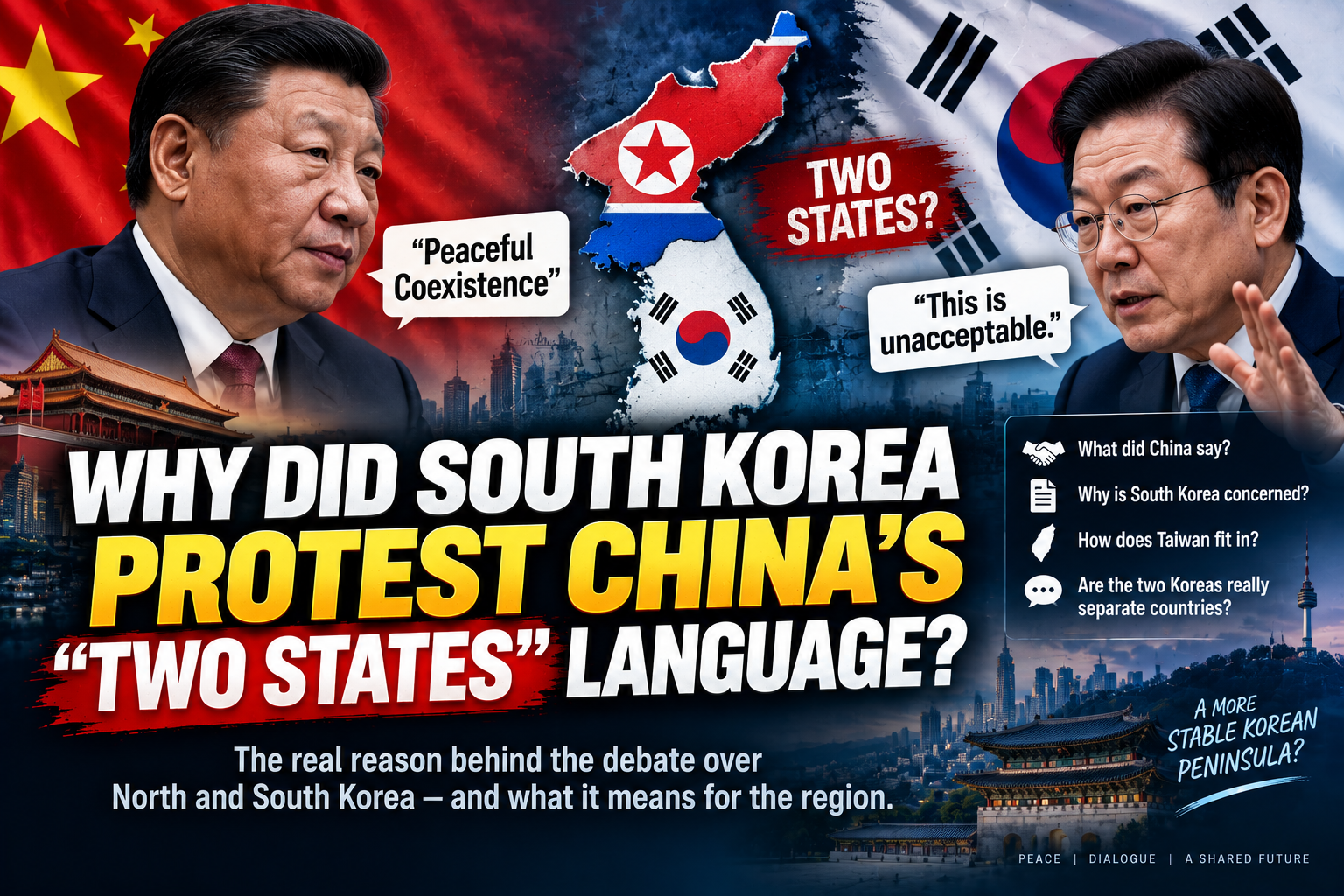
  • Why Did South Korea Protest China’s “Two States” Language About the Korean Peninsula?

    Why Did South Korea Protest China’s “Two States” Language About the Korean Peninsula?

    A seemingly simple phrase from China has triggered an unusually sensitive diplomatic dispute with South Korea.

    The controversy centers on the relationship between South Korea and North Korea — and whether they should be viewed as two ordinary, separate states.

    During recent diplomatic exchanges, Chinese officials used language emphasizing the “peaceful coexistence” of South and North Korea.

    To many outside Korea, that may sound harmless.

    But in Seoul, the wording immediately touched one of the most complicated political and constitutional questions on the Korean Peninsula:

    Are North and South Korea two separate countries — or two sides of a still-divided Korea?

    South Korea has now raised concerns with Beijing over language it believes could be interpreted as supporting North Korea’s increasingly explicit “two-state” approach toward the South.

    To understand why a few words caused such controversy, we need to go back much further.


    What Did China Actually Say?

    Chinese Foreign Minister Wang Yi visited Seoul in August and held talks with South Korean Foreign Minister Cho Hyun.

    During those discussions, Wang said China hoped that South and North Korea would move toward peaceful coexistence.

    China also emphasized its intention to continue playing a constructive role in maintaining peace and stability on the Korean Peninsula.

    On the surface, there is nothing particularly confrontational about calling for peaceful coexistence.

    The problem is the political meaning behind the wording.

    South Korean officials became concerned that language treating Seoul and Pyongyang as two entities that should simply coexist could resemble North Korea’s own changing position toward inter-Korean relations.

    And that position has changed dramatically.


    North Korea Has Abandoned Its Old Unification Language

    For decades, both North and South Korea officially claimed that eventual Korean unification remained a national objective.

    They disagreed profoundly about what that unification should look like, but the basic idea of Korea as a divided nation remained.

    North Korean leader Kim Jong Un has increasingly moved away from that framework.

    Pyongyang now describes relations with South Korea through its “two hostile states” policy and has rejected many of its previous assumptions about eventual reconciliation and unification.

    Recent changes to North Korea’s ruling Workers’ Party rules have reinforced that hardened position toward South Korea.

    This is why China’s wording matters.

    If Beijing begins speaking about the two Koreas primarily as separate states that should peacefully coexist, Seoul worries that this could normalize Pyongyang’s new political framework.


    But Aren’t North and South Korea Already Two Countries?

    This is where the story becomes especially confusing for international readers.

    In practical international relations, the answer appears straightforward.

    South Korea and North Korea:

    • have separate governments,
    • have separate militaries,
    • issue separate passports,
    • maintain separate diplomatic relationships,
    • and have both been members of the United Nations since 1991.

    From the outside, they clearly function as separate states.

    But inter-Korean relations have historically been treated differently.

    The 1991 Inter-Korean Basic Agreement described the relationship between the two sides as not simply an ordinary relationship between states, but a special interim relationship arising from the process toward unification.

    That distinction remains politically important in South Korea.

    So when China appears to move toward ordinary “state-to-state” terminology, it touches a much deeper question than simple diplomatic vocabulary.


    Why Is South Korea So Sensitive About the “Two-State” Idea?

    Because accepting the two-state framework could have enormous long-term consequences.

    It could affect:

    the constitutional concept of Korean territory,

    future reunification policy,

    inter-Korean agreements,

    North Korea policy,

    and potentially even the diplomatic framework surrounding the Korean Peninsula.

    South Korea’s constitution continues to define the territory of the Republic of Korea as the Korean Peninsula and its adjacent islands.

    In practice, Seoul obviously does not govern North Korea.

    But the constitutional and historical framework is very different from simply recognizing North Korea as an unrelated foreign country.

    That is why language matters so much.


    Then Taiwan Entered the Dispute

    The controversy became even more interesting because China and South Korea exchanged objections over two different sovereignty questions.

    Beijing objected to South Korean-related language and actions concerning Taiwan and reiterated the importance of the One China principle.

    Seoul, meanwhile, raised concerns over China’s terminology regarding North and South Korea.

    This created an unusual diplomatic symmetry.

    China is extremely sensitive about any language that could imply Taiwan is an independent state.

    South Korea is sensitive about language that could appear to formalize North and South Korea as permanently separate states.

    The historical and legal situations are very different.

    But diplomatically, both demonstrate the extraordinary importance countries attach to terminology involving sovereignty and national division.


    Why Reddit Is Debating Taiwan

    The dispute immediately produced a provocative question online:

    If China treats North and South Korea as two states, why shouldn’t South Korea treat China and Taiwan as two states?

    It is an attention-grabbing argument.

    But legally and diplomatically, the comparison is much more complicated.

    South Korea established diplomatic relations with the People’s Republic of China in 1992 and recognizes Beijing under its One China policy.

    Changing that policy would represent an enormous shift in South Korean foreign relations.

    Likewise, Seoul’s objection to Chinese wording about North Korea does not mean South Korea denies the practical existence of North Korea.

    The disagreement concerns the political and legal character of inter-Korean relations.

    That distinction is important.


    Is China Actually Supporting North Korea’s “Two Hostile States” Policy?

    There is not enough evidence to make that conclusion.

    China continues publicly to emphasize peace and stability on the Korean Peninsula.

    When Wang Yi visited Seoul, he said Beijing would continue playing a constructive role and expressed support for peaceful coexistence.

    At the same time, China’s relationship with North Korea has strengthened recently.

    Chinese President Xi Jinping visited Pyongyang in June, his first visit to North Korea in nearly seven years, as Beijing sought closer ties with Kim Jong Un.

    That makes every change in China’s language toward the Korean Peninsula more closely scrutinized in Seoul.

    The question is whether China’s wording represents a genuine policy shift or simply diplomatic language intended to avoid taking sides.

    For now, the evidence does not justify saying China has formally adopted North Korea’s “two hostile states” doctrine.


    Why This Matters Beyond Korea

    The controversy may sound like an argument over words.

    It isn’t.

    The Korean War ended in 1953 with an armistice rather than a peace treaty.

    More than seven decades later, the political status of the peninsula remains unresolved.

    South Korean President Lee Jae Myung has recently called for conditions that could restart U.S.–North Korea dialogue and move the peninsula away from confrontation toward a more stable peace framework.

    Meanwhile, North Korea has moved in the opposite direction by increasingly rejecting reconciliation with Seoul.

    China sits between these competing approaches.

    As North Korea’s largest neighboring economic and diplomatic partner, Beijing’s choice of language can therefore carry considerable significance.


    What Happens Next?

    Three things are worth watching.

    First, watch China’s future terminology.

    If Beijing repeatedly describes North and South Korea in explicitly state-to-state terms, Seoul’s concerns will grow.

    Second, watch North Korea’s reaction.

    Pyongyang would likely welcome international language that appears to normalize its two-state framework.

    Third, watch the Taiwan connection.

    If disagreements over Taiwan and the Korean Peninsula continue to become linked in Seoul-Beijing diplomacy, what began as a dispute over terminology could develop into a larger political problem.


    Final Thoughts

    Why did South Korea react so strongly to a few words from China?

    Because on the Korean Peninsula, words can define political reality.

    To an outsider, South Korea and North Korea already look like two separate countries.

    But the historical, constitutional and diplomatic framework of inter-Korean relations has never been that simple.

    North Korea is now trying to redefine that relationship as one between two hostile states.

    South Korea does not want other countries to normalize that change.

    And China’s recent language has therefore touched a question that Koreans have debated for more than seven decades:

    Is Korea one divided nation — or have North and South Korea finally become two separate states?

    That question is far bigger than a diplomatic disagreement with Beijing.

    It goes to the heart of what the future of the Korean Peninsula could look like.

    This article is for informational purposes and does not advocate a political position.