So technically, Rumi, Mira, Zoey and the Saja Boys never filmed a single scene on the streets of Seoul.
But here is the surprising part:
You can actually visit many of the places you saw in the movie.
Netflix says the filmmakers researched real locations across Korea, and the team even used real satellite data to help build its animated version of Seoul.
That is why parts of the movie can feel strangely familiar if you have ever visited Korea.
From Rumi and Jinu’s emotional meetings to the Saja Boys’ performances, several of the film’s most memorable backgrounds were inspired by real places.
So if you are planning a trip to Seoul, where should you go?
1. Bukchon Hanok Village — Rumi and Jinu’s Seoul
If there is one place KPop Demon Hunters fans should recognize immediately, it is Bukchon Hanok Village.
This historic neighborhood filled with traditional Korean houses inspired the setting where Rumi and Jinu meet and later share one of the movie’s most emotional moments.
The tiled roofs, narrow alleys and traditional architecture create a completely different atmosphere from Seoul’s skyscrapers only a short distance away.
And unlike a movie set, Bukchon is real.
People actually live here.
That also means visitors should remember that Bukchon is a residential neighborhood, not a theme park.
Visit quietly, respect local restrictions and enjoy the strange feeling of walking into a landscape that suddenly looks very familiar.
2. Naksan Park — Want the Rumi and Jinu night view?
This may be the location fans underestimate.
Naksan Park appears as the setting for another private meeting between Rumi and Jinu.
The old Seoul Fortress Wall runs through the park, while modern Seoul spreads out below it.
And yes — that view is real.
The Korea Tourism Organization specifically highlights Naksan Park as the place where visitors can walk beside the illuminated fortress wall while looking across Seoul at night.
If Bukchon gives you traditional Korea, Naksan gives you something KPop Demon Hunters does especially well:
old Seoul and modern Seoul in the same frame.
3. Myeongdong — Where are the Saja Boys?
Remember the Saja Boys performing “Soda Pop” surrounded by crowds and bright signs?
That scene draws on Myeongdong, one of Seoul’s busiest shopping districts.
This one is particularly fun because you do not need much imagination.
Bright signs?
Everywhere.
Crowds?
Definitely.
Korean street food?
Even better.
The official Korea tourism guide specifically connects Myeongdong with the Saja Boys’ performance and recommends trying foods such as tteokbokki, hotteok and gyeranppang while exploring the area.
In other words, this is one movie location you can experience with your stomach too.
4. N Seoul Tower — Yes, the tower is real. The stadium isn’t.
One of the biggest scenes in the movie takes place beneath N Seoul Tower, where the Saja Boys perform “Your Idol.”
The tower dominating the Seoul skyline is absolutely real.
The enormous supernatural concert venue beneath it?
Unfortunately, no.
Netflix explains that the climactic concert was staged around Namsan Tower because it acts almost like a beacon at the center of the city.
In real life, you can go up Namsan and visit the tower for panoramic views of Seoul.
No demons are included with admission.
Hopefully.
5. COEX K-Pop Square — This one already feels like the movie
If you want futuristic Seoul rather than traditional Seoul, go to COEX K-Pop Square in Gangnam.
Its enormous digital screen appears reimagined in the movie, and the real location regularly displays giant digital media and K-pop content.
The Seoul Tourism Organization identifies it as one of the major real-world locations connected to the film.
And because COEX Mall and Starfield Library are nearby, this is an easy stop even for someone who is not doing a dedicated KPop Demon Hunters tour.
6. Cheongdam Bridge — Remember the subway fight?
One of the movie’s most exciting sequences takes place on top of a subway train crossing the Han River.
That setting is inspired by Cheongdam Bridge and the Line 7 subway route.
The nearby Jayang Station and riverside area let visitors see the bridge and Han River landscape that helped inspire the sequence.
Just one important travel tip:
Enjoy the view from the ground.
Do not attempt the Rumi version.
7. Gyeongbokgung — Jinu’s past becomes real history
The movie does not only borrow modern Seoul.
Jinu’s past takes viewers back toward Joseon-era Korea, with Gyeongbokgung Palace providing an important real historical reference.
The palace was founded in 1395 and served as the principal royal palace of the Joseon dynasty.
Today, visitors can walk through the palace grounds and see the architecture and visual traditions that helped inspire the historical side of the movie.
This is where KPop Demon Hunters becomes more than a K-pop location hunt.
Behind its demons, tiger imagery, architecture and costumes are pieces of actual Korean history and culture.
So can you really take a KPop Demon Hunters trip to Seoul?
Absolutely.
Just remember one thing:
These are not traditional “filming locations.”
There were no actors standing in Bukchon.
No Saja Boys concert actually happened beneath N Seoul Tower.
KPop Demon Hunters is animation.
But its Seoul was built using real Seoul as inspiration — sometimes closely enough that fans can stand in front of the real location and immediately recognize the scene.
And that may actually make this trip more interesting.
You are not visiting a temporary film set.
You are visiting the city that inspired the movie.
If you only have one day, try this:
Bukchon in the morning → Naksan Park → Myeongdong → N Seoul Tower at night.
You will move from traditional hanok rooftops to fortress walls, neon shopping streets and finally the Seoul skyline.
Basically, from Rumi and Jinu…
to the Saja Boys…
in a single day.
Just keep an eye out for suspiciously handsome K-pop idols offering you a soda.
Seoul is one of Asia’s most visited and talked-about cities. K-pop, K-dramas, Korean food, beauty, shopping, and traditional culture attract travelers from around the world.
But an interesting debate keeps appearing among travelers online.
Is Seoul actually overrated?
Some visitors say yes. Others argue that tourists who leave disappointed may simply be visiting the wrong parts of the city.
Why Some Travelers Say Seoul Is Overrated
A recent traveler on Reddit shared a list of Seoul experiences that were worth the hype — and several that were not.
Among the disappointments were Myeongdong street food, long waits at famous cafés, and visiting Namsan Seoul Tower when the weather was poor.
Myeongdong is especially controversial.
It is one of the most famous tourist districts in Korea, filled with cosmetics stores, fashion shops, restaurants, street food stalls, and international visitors.
For a first-time traveler, it can be exciting.
However, some travelers complain that the street food is expensive compared with food found elsewhere in Seoul. Others feel that the neighborhood has become so focused on tourism that it offers only a limited picture of everyday Korean life.
The debate is not new. Discussions among Korea travelers frequently describe Myeongdong as both a convenient place for first-time visitors and one of Seoul’s biggest tourist traps.
So which side is correct?
Perhaps both.
The Problem May Not Be Seoul
There is another argument gaining attention among travelers and Seoul residents.
The problem may not be that Seoul has nothing interesting to offer.
The problem may be that many tourists visit almost exactly the same Seoul.
A typical first-time itinerary often includes Myeongdong, Gangnam, Hongdae, Gyeongbokgung Palace and Bukchon Hanok Village.
These places are famous for good reasons.
But Seoul is a city of nearly 10 million people, and the experience can change dramatically within only a few subway stops.
Leave the major tourist routes and the city begins to look different.
University neighborhoods such as Hyehwa have small theaters, restaurants and independent cafés. Traditional areas around Changdeokgung and Changgyeonggung can feel very different from the busiest sections around Gyeongbokgung.
Residential neighborhoods reveal another Seoul entirely: small restaurants, local markets, neighborhood cafés and ordinary streets where tourism is not the main attraction.
This is the Seoul that many short-term visitors never see.
Even Koreans Debate the Famous Markets
The same argument applies to food.
Foreign travelers often search for the most famous Korean food destinations before arriving. That naturally sends thousands of people toward places such as Myeongdong and Gwangjang Market.
But popularity does not necessarily mean that a place represents everyday Korean dining.
One Korean Reddit user described visiting Gwangjang Market after living in Seoul for more than 20 years and expressed disappointment with the quality and prices of several foods there.
Other travelers disagree and still consider traditional markets an enjoyable part of visiting Korea.
That disagreement reveals something important.
A tourist attraction does not have to be “fake” to be touristy.
But tourists should understand what they are experiencing.
Should First-Time Visitors Avoid Myeongdong?
Not necessarily.
Myeongdong remains extremely convenient for shopping, transportation and sightseeing. It is centrally located and easy for international visitors to navigate.
For someone visiting Korea for the first time, spending an evening there can still be fun.
The mistake may be expecting Myeongdong to represent all of Seoul.
Eat the street food if you are curious. Visit the cosmetics stores. Enjoy the lights and crowds.
Then get on the subway the next morning and go somewhere completely different.
Walk through a neighborhood that was not recommended by TikTok.
Eat at a restaurant without a giant line outside.
Visit a smaller market.
Sit beside the Han River with convenience-store ramen.
That contrast may actually be the best way to understand Seoul.
So, Is Seoul Overrated?
Perhaps the better question is:
Which Seoul did you visit?
Someone who spends three days moving between internationally famous attractions may experience a very different city from someone who explores its neighborhoods.
Seoul can be crowded, commercial and highly polished.
It can also be quiet, old-fashioned, inexpensive and surprisingly local.
Both versions exist at the same time.
So before deciding that Seoul is overrated, it may be worth leaving the most famous itinerary behind for just one day.
You might discover that the Seoul you were looking for was only a few subway stops away.
If you are planning a trip to South Korea in late September 2026, you may have suddenly discovered something that was not in your original itinerary:
Chuseok.
Then comes the panic.
Will everything be closed?
Will I be able to get a KTX ticket?
Should I cancel my trip to Busan?
Will Seoul be empty?
Can I still find restaurants?
These questions are appearing repeatedly among travelers planning Korea trips around Chuseok.
The good news is simple:
You do not need to cancel your trip to Korea because of Chuseok.
But you should change the way you travel.
The biggest mistake is not visiting Korea during Chuseok.
The biggest mistake is trying to travel around Korea as if Chuseok were an ordinary weekend.
When Is Chuseok in 2026?
In 2026, the main Chuseok holiday falls around:
September 24–26, 2026
with Chuseok Day on Friday, September 25.
For tourists, however, it is better to think of the holiday as a wider travel period rather than just one day.
Millions of Koreans traditionally travel to their hometowns or visit family during Chuseok.
That creates one enormous problem for visitors:
intercity transportation.
The Biggest Problem Is Not Seoul — It Is Moving Between Cities
This is the most important advice I can give foreign travelers.
If possible, avoid major intercity travel during the peak Chuseok period.
A normal Seoul-to-Busan trip is easy.
During Chuseok, it can become one of the most difficult transportation reservations of your entire Korea trip.
KTX and other long-distance trains are heavily used by Koreans traveling home for the holiday.
For 2026, KORAIL introduced a separate Chuseok reservation process for trains operating during the holiday period rather than simply selling them through the normal booking window.
That is why some travelers checking the KORAIL calendar became confused when trains suddenly appeared unavailable.
The trains had not disappeared.
They were being sold through the special holiday reservation system.
If You Already Have a KTX Ticket
Great.
Keep it.
If You Do Not Have One
Do not build an important itinerary around the assumption that you will simply arrive at Seoul Station and buy a seat.
Especially for popular routes such as:
Seoul–Busan
Seoul–Daegu
Seoul–Gyeongju
Seoul–Daejeon
Seoul–Gwangju
Seoul–Jeonju
availability can become extremely limited.
If your international flight depends on getting back to Seoul, leave yourself a safety margin.
Missing one tourist attraction is disappointing.
Missing your flight home because you could not get transportation back to Seoul is a much bigger problem.
Should I Stay in Seoul During Chuseok?
For many first-time international visitors, my answer is:
Yes.
If your itinerary allows it, Seoul is one of the easiest places to spend the core Chuseok holiday.
This may sound strange because many Koreans leave Seoul to visit their hometowns.
But that can actually work in a tourist’s favor.
The city does not shut down.
Major tourist districts remain alive, public transportation continues operating, and cultural events are often organized specifically for the holiday.
Instead of trying to fight millions of Koreans for long-distance transportation, you can slow down and experience Seoul differently.
Is Everything Closed During Chuseok?
No.
This is probably the biggest misunderstanding among first-time visitors.
Korea does not completely shut down for three days.
But neither should you assume that everything operates normally.
The businesses most likely to close are smaller independent businesses where the owner and family want to spend Chuseok together.
That can include:
small local restaurants
traditional markets or individual stalls
independent cafés
family-run stores
neighborhood businesses
This is especially important on Chuseok Day itself, September 25.
If there is one restaurant you absolutely want to visit, check its opening hours shortly before going.
Do not assume Google Maps or an old blog post is correct for a national holiday.
What About Convenience Stores, Shopping and Tourist Areas?
In major Seoul tourist districts, you are unlikely to find a completely deserted city.
Convenience stores are among the easiest places to find open, and many large commercial businesses operate during at least part of the holiday.
Areas such as:
Myeongdong, Hongdae, Gangnam, Itaewon and major shopping districts
are very different from a small neighborhood where many family-run businesses may close.
Still, individual stores can set their own holiday schedules.
So think of Chuseok this way:
The city is open. Every individual business is not guaranteed to be open.
That distinction will save you a lot of frustration.
Chuseok Can Actually Be a Great Time to Experience Korean Culture
There is another side to the holiday that travelers sometimes overlook.
Chuseok is not merely an inconvenience.
It is one of Korea’s most important traditional holidays.
Seoul organizes cultural events around the holiday, including traditional performances, games and hands-on cultural programs.
For example, Seoul’s official September 2026 cultural calendar includes Chuseok programs at locations such as the Seoul Baekje Museum and Seoul Urban Life Museum, with performances, traditional games and family activities.
For a foreign visitor, this can be an opportunity rather than a problem.
Instead of treating Chuseok as a day when your normal itinerary has been ruined, consider making Chuseok itself part of your itinerary.
Be Careful With Museums and Attractions
Here is where planning becomes important.
Do not assume that every museum follows the same holiday schedule.
Some cultural attractions remain open or organize special programs, while others may close on Chuseok Day.
That means you should check the official website of each major attraction shortly before visiting.
This is especially important for museums.
A traveler can easily make the mistake of thinking:
“It’s a national holiday, so tourist attractions must be open.”
Or the opposite:
“It’s a national holiday, so everything must be closed.”
Neither assumption is reliable.
Check individually.
What About Restaurants?
You will find food.
You are not going to starve in Seoul during Chuseok.
But your carefully planned list of five famous restaurants may not work exactly as planned.
Small family-run restaurants are the biggest uncertainty.
This is one reason I recommend having several backup restaurants in the same neighborhood.
If Restaurant A is closed, do not spend an hour crossing Seoul to reach Restaurant B.
Open Naver Map or KakaoMap and look nearby.
Major tourist districts usually provide plenty of alternatives.
And if everything goes wrong?
There is one institution that has rescued countless hungry travelers and Koreans alike:
the Korean convenience store.
A convenience-store meal may not have been part of your dream Korea vacation, but Korean convenience stores are an experience of their own.
Should You Visit Busan or Gyeongju During Chuseok?
You can.
But I would separate two questions.
Is Busan worth visiting?
Absolutely.
Should you casually travel from Seoul to Busan during peak Chuseok without confirmed transportation?
No.
The same principle applies to Gyeongju, Jeonju and other popular destinations.
If your transportation and accommodation are already confirmed, enjoy your trip.
If they are not, I would rather reorganize the itinerary than spend an important vacation day fighting for transportation.
For first-time visitors, there is more than enough to do in Seoul for several days.
A Simple Chuseok Strategy for Foreign Tourists
If I were helping a friend from overseas plan a Korea trip during Chuseok 2026, I would keep it simple.
Before the holiday: Do your long-distance travel.
Visit Busan, Gyeongju, Jeonju or other cities before the peak movement begins if your schedule allows.
September 24–26: Stay primarily in one city.
For many first-time visitors, Seoul is the easiest choice.
Explore palaces, parks, neighborhoods and confirmed-open cultural attractions. Look for Chuseok events.
September 25 — Chuseok Day: Make this your most flexible day.
Do not create an itinerary that depends on six specific restaurants and stores being open.
Enjoy the city, experience a cultural event, walk along the Han River or explore an area where you have several alternatives.
After the holiday: Resume your normal itinerary, but remember that return traffic can remain heavy around the end of the holiday period.
What Travelers on Reddit Are Worried About
Looking at recent Korea travel discussions, the same concerns appear again and again.
Foreign travelers are asking whether they can get from Busan or Andong back to Seoul during Chuseok, whether KTX reservations will be available to foreigners, whether restaurants will close, and even whether they should change their entire Korea trip.
Those concerns are understandable.
But travelers who have previously spent Chuseok in Seoul also describe another experience: a quieter city, cultural events and plenty of things still available to do.
Both experiences can be true.
The difference is usually planning.
Someone trying to cross the country without a train reservation may remember Chuseok as a transportation nightmare.
Someone already staying in Seoul may remember it as one of the most interesting days of the trip.
A Korean’s Advice: Don’t Fight Chuseok
This is the most important point.
When Koreans know Chuseok is approaching, we change our plans.
We think about traffic.
We think about train tickets.
We check whether businesses will be open.
We avoid unnecessary long-distance movement.
Foreign visitors should do the same.
Do not try to force your normal itinerary through one of the biggest travel periods of the Korean year.
Travel with the holiday instead of against it.
Stay in one place.
Slow down.
Check opening hours.
Experience some traditional Korean culture.
And if you can avoid competing with millions of Koreans for a KTX seat during the busiest period of the year, do it.
Final Answer: Should You Travel to Korea During Chuseok 2026?
Yes.
I would not cancel a Korea vacation simply because it overlaps with Chuseok.
But I would change the itinerary.
The safest approach for most foreign tourists is:
Avoid unnecessary intercity travel during the peak holiday, secure transportation early, stay flexible on Chuseok Day, and check individual businesses before visiting.
If you do that, Chuseok does not have to ruin your Korea trip.
It may actually give you something most tourists never experience:
Korea during one of the most important holidays of the year.
Maybe BLACKPINK, Stray Kids, SEVENTEEN, aespa, IVE or another artist you’ve followed from thousands of miles away.
The concert may last only a few hours.
But if you are flying all the way to South Korea, don’t make the concert your entire trip.
Make it the beginning.
K-pop fans are increasingly traveling to Korea not only to see their favorite artists, but to experience the country behind the music.
And for a first visit, there is one itinerary I recommend more than almost any other:
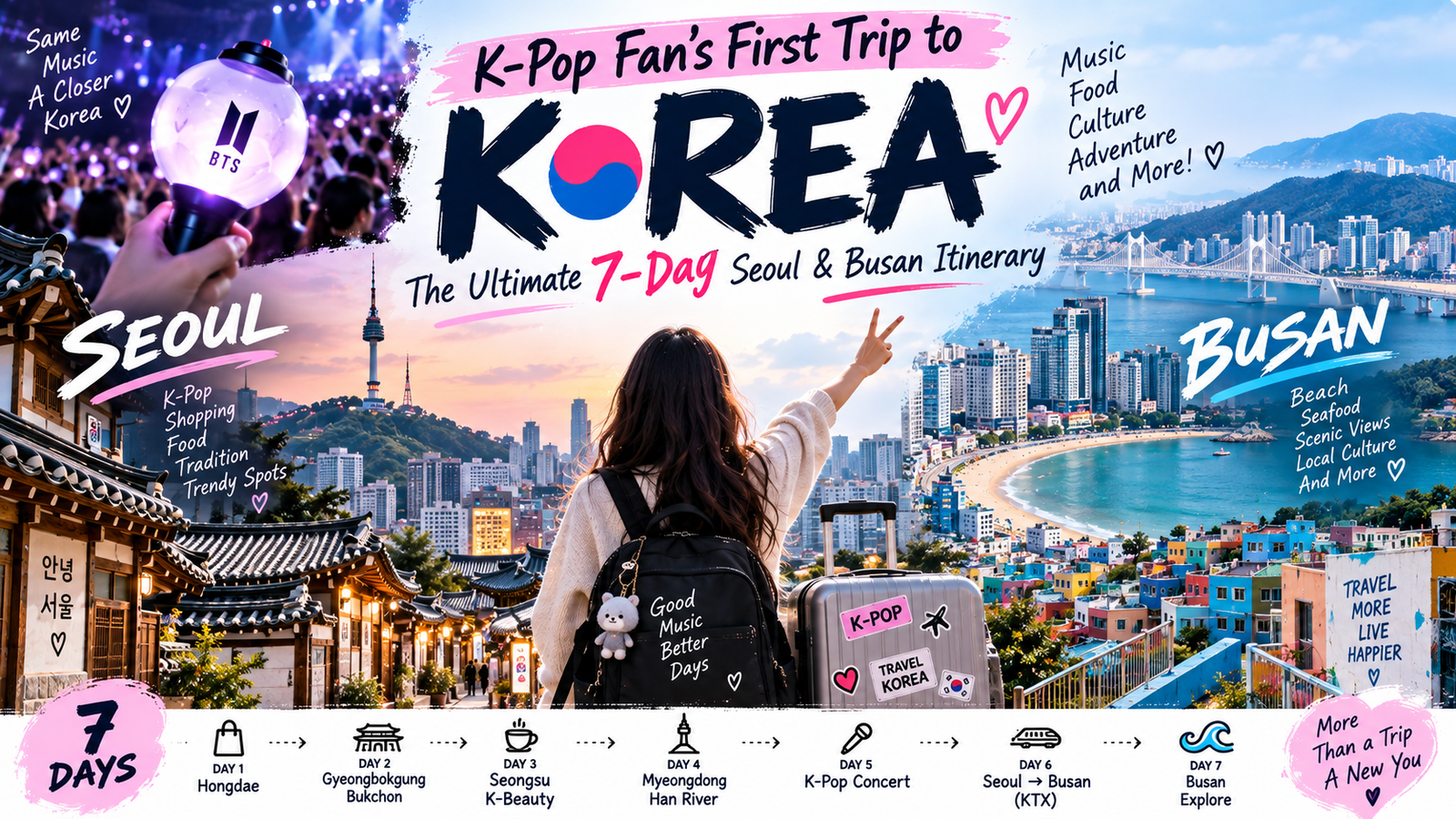
5 Days in Seoul + 2 Days in Busan
Seven days is long enough to experience modern Seoul, traditional Korea, K-pop culture, Korean food, K-beauty and the country’s most famous coastal city — without turning your vacation into an exhausting race between tourist attractions.
This itinerary is designed especially for a first-time international visitor to South Korea who loves K-pop.
You don’t need to spend seven days visiting idol-related locations.
Instead, we’ll use K-pop as the doorway and experience the Korea that exists beyond the concert.
Why 7 Days Is a Great First Korea Trip
You can technically visit Seoul in three or four days.
But if you are flying from North America, Europe or another long-distance destination, that can feel painfully short.
Seven days gives you time for:
K-pop
Korean food
K-beauty
traditional Korea
modern Seoul
shopping
the Han River
and
Busan
without changing hotels every night.
There is another advantage.
If your main reason for visiting Korea is a concert, arriving several days early gives you protection against flight delays.
Never schedule an international arrival only hours before a concert you spent months trying to attend.
For this itinerary, I would ideally place the concert around Day 4 or Day 5.
Before You Arrive: The Three Things You Need
Before discussing the itinerary, prepare three things.
1. A Transportation Card
Seoul’s subway and bus network makes traveling around the city relatively easy.
A rechargeable transportation card can be used across much of Korea’s public transit system.
You’ll use public transportation constantly, so this should be one of the first things you organize after arriving.
2. Korean Map Apps
One surprise for many international travelers is that Google Maps is not always the best navigation option in South Korea.
Install at least one Korean navigation app before your trip.
Naver Map and KakaoMap are widely used for navigating Korean cities.
Save your hotel and important destinations in advance.
This will make your first day considerably easier.
3. Comfortable Shoes
This sounds trivial.
It isn’t.
You are going to walk.
A lot.
Subway stations can be large, neighborhoods are best explored on foot, and several attractions involve hills or long walking routes.
Your fashionable concert shoes and your sightseeing shoes do not necessarily need to be the same pair.
Your feet will thank you by Day 5.
DAY 1 — Arrive in Seoul, Hongdae and Your First Korean Night
Don’t plan too much for your first day.
After immigration, baggage collection and transportation from the airport, you may already be tired.
Check into your hotel, take a short break and begin with one of Seoul’s easiest neighborhoods for younger international visitors.
Hongdae
Hongdae is an excellent introduction to modern Seoul.
The neighborhood is filled with:
cafés,
restaurants,
fashion shops,
street performers,
music,
beauty stores
and nightlife.
If K-pop was your introduction to Korea, Hongdae will probably feel surprisingly familiar and completely new at the same time.
Don’t spend your first evening checking boxes on a sightseeing list.
Walk.
Explore.
Eat.
Watch the city.
What Should You Eat on Your First Night?
For your first Korean meal, keep it fun.
Try:
samgyeopsal — Korean grilled pork belly
or
Korean fried chicken
If you are traveling with friends, Korean barbecue is particularly good because eating together around the grill is part of the experience.
And if you still have energy afterward?
Find a Korean convenience store.
Buy a drink and some snacks.
Congratulations.
Your Korea trip has officially started.
DAY 2 — Traditional Korea: Gyeongbokgung, Bukchon and Insadong
Yesterday was modern Korea.
Today, go backwards in time.
Start at:
Gyeongbokgung Palace
Built during the Joseon Dynasty, Gyeongbokgung is one of Seoul’s most important historical landmarks.
If this is your first visit to Korea, don’t skip it simply because it appears on every tourist itinerary.
There is a reason it does.
The contrast between the palace architecture and modern Seoul surrounding it is one of the city’s defining experiences.
Many visitors also rent hanbok, traditional Korean clothing, near the palace.
If that interests you, allow extra time.
Walk Toward Bukchon
After the palace, explore the traditional streets around Bukchon Hanok Village.
But remember something important:
Bukchon is not a theme park.
People actually live there.
Keep your voice down, respect restricted areas and avoid blocking residential entrances while taking photographs.
That small amount of consideration makes tourism better for everyone.
Lunch: Try a Traditional Korean Meal
This is a good day to move beyond the most internationally famous Korean foods.
Consider:
bibimbap
bulgogi
mandu
samgyetang
or a Korean set meal with multiple side dishes.
One of the best parts of traveling in Korea is discovering that Korean food is much larger than barbecue and kimchi.
Finish the Day in Insadong
Insadong is an easy continuation from the palace area.
You’ll find:
traditional crafts,
tea houses,
souvenirs,
galleries
and smaller streets worth exploring.
If Day 1 showed you the Korea of K-pop, Day 2 shows you part of the cultural foundation underneath modern Korea.
DAY 3 — Seongsu, K-Beauty and Contemporary Seoul
Today is about the Korea that is changing right now.
Head to:
Seongsu
Seongsu has become one of Seoul’s most interesting neighborhoods for fashion, beauty, cafés and pop-up culture.
This is particularly relevant for K-pop fans.
K-pop does not exist separately from Korean:
fashion,
beauty,
design,
brands
and youth culture.
They constantly influence one another.
And Seongsu is one of the easiest places to see those worlds overlap.
Don’t Overplan Seongsu
This is important because pop-ups change constantly.
A store that everyone was posting about three months ago may already be gone.
Instead of building your entire itinerary around one old viral TikTok, check what events and pop-ups are operating shortly before your trip.
Then spend time simply exploring the neighborhood.
Sometimes the most interesting place will be something that did not exist when you booked your flight.
K-Beauty Shopping
If you’ve wanted to try Korean skincare or makeup, today is a good day.
But don’t feel that you need to buy everything immediately.
Korean beauty stores are everywhere in Seoul.
Compare products.
Check what actually suits your skin.
And remember that a giant shopping bag becomes much less exciting after carrying it around for six hours.
DAY 4 — Myeongdong, Namsan and the Han River
Start with one of Korea’s most famous shopping districts.
Myeongdong
Myeongdong is touristy.
And that’s perfectly fine.
For a first-time visitor, it is convenient.
You can find:
K-beauty,
fashion,
restaurants,
cafés,
street food,
currency exchange
and easy transportation.
It is also a good place to buy gifts for people back home.
Try Korean Street Food
Depending on what is available, look for foods such as:
tteokbokki
hotteok
eomuk
dakgangjeong
and various grilled snacks.
Don’t worry about eating every famous Korean dish in one afternoon.
You have seven days.
N Seoul Tower and Namsan
From Myeongdong, you can continue toward Namsan.
Whether you actually go to the top of N Seoul Tower is up to you.
The more important experience is seeing Seoul from above and understanding just how enormous the city really is.
Evening: Do Something Very Korean — Nothing
After several busy days, slow down.
Go to the:
Han River
Buy food.
Get a drink.
Sit.
Talk.
Watch bicycles pass.
Look at Seoul’s skyline.
If you’ve watched Korean dramas, variety shows or idol content, you’ve probably seen people spending time beside the Han River.
It may not sound as exciting as a palace or concert.
But ordinary experiences are often what travelers remember most.
DAY 5 — K-Pop Day and Concert Night
This is the day you came for.
But don’t ruin it by exhausting yourself beforehand.
Keep the daytime schedule light.
Sleep a little longer.
Eat properly.
Charge your phone.
Check your ticket.
Check the venue’s official rules.
Check transportation.
Check prohibited items.
And most importantly:
Follow the organizer’s official instructions rather than random social-media posts.
Concert procedures can change.
What to Do Before a K-Pop Concert
If official merchandise is being sold, queues can be long.
There may also be:
fan events,
pop-up stores,
photo zones,
special cafés,
album events
or citywide promotions.
Plan those around your concert rather than trying to squeeze them into the final hour.
If the venue is outside central Seoul — for example, Goyang or Incheon — allow significantly more transportation time than the map initially seems to suggest.
Thousands of other people may be traveling to the same place.
The Most Important Concert Tip: Plan the Trip Home
Everyone plans how to reach the concert.
Fewer people think carefully about what happens when tens of thousands of fans leave simultaneously.
Before entering the venue, know:
your subway route,
the last train time,
alternative routes,
taxi possibilities,
and where you will meet friends if your phones stop working.
Your concert ends when you are safely back at your hotel.
Not when the encore ends.
DAY 6 — Take the KTX to Busan
Now we change cities.
And this is where your first Korea trip becomes much more interesting.
Take the KTX high-speed train from Seoul to Busan.
The journey is roughly 2.5 to 3 hours depending on the service.
For many international visitors, the train ride itself becomes part of the experience.
You leave the enormous capital behind and begin seeing a different side of Korea.
First Stop in Busan: The Sea
Seoul is one of the world’s great metropolitan cities.
Busan feels different almost immediately.
It is Korea’s largest port city, surrounded by mountains and the sea.
For a short first visit, I would focus on a few major areas rather than trying to see everything.
Haeundae Beach
Haeundae is one of Korea’s most famous beaches.
Walk along the coast, explore nearby restaurants and enjoy the slower atmosphere.
If your Seoul days have been packed with subway transfers and shopping streets, the contrast feels wonderful.
Gwangalli at Night
If you can choose only one Busan night view, Gwangalli is hard to beat.
The illuminated Gwangan Bridge stretches across the water in front of you.
Find somewhere to eat nearby or simply walk along the beach.
This is one of those moments when you’ll realize:
Korea is much more than Seoul.
What to Eat in Busan
Busan has its own strong food identity.
Depending on your preferences, consider trying:
dwaeji gukbap — pork soup with rice
milmyeon — wheat noodles
eomuk — Busan-style fish cake
and, if you enjoy seafood, visit one of the city’s seafood districts.
This is exactly why adding Busan to a K-pop trip is worthwhile.
The music may be the same.
But the Korea around you has changed.
DAY 7 — Gamcheon, Jagalchi and Goodbye to Korea
Your final day should combine one more memorable neighborhood with food and a little shopping.
Start with:
Gamcheon Culture Village
Gamcheon is famous for its colorful hillside houses and narrow streets.
It has become one of Busan’s most recognizable destinations.
Take your time.
The neighborhood is hilly.
Again: comfortable shoes.
Jagalchi Market
Then experience another side of Busan at Jagalchi Market, one of Korea’s best-known seafood markets.
Even if you don’t eat seafood, the area around the market offers an interesting look at Busan’s identity as a port city.
Nearby streets are also good for exploring traditional markets and local food.
One Last Korean Meal
Your final meal does not need to be expensive.
In fact, one of the joys of Korea is that memorable meals can come from very ordinary places.
A small gukbap restaurant.
A noodle shop.
A gimbap restaurant.
A market stall.
A neighborhood barbecue restaurant.
By Day 7, you’ll probably already have your own opinion about which Korean food deserves one final meal.
That’s when you know you’ve actually traveled.
The Complete 7-Day Korea Itinerary
Here is the entire route in one place:
Day
Destination
Main Experience
Day 1
Hongdae
Arrival, modern Seoul, Korean food
Day 2
Gyeongbokgung–Bukchon–Insadong
Traditional Korean culture
Day 3
Seongsu
K-pop culture, cafés, K-beauty, pop-ups
Day 4
Myeongdong–Namsan–Han River
Shopping, street food, Seoul lifestyle
Day 5
Concert Day
K-pop concert and fan experiences
Day 6
Seoul → Busan
KTX, Haeundae, Gwangalli
Day 7
Busan
Gamcheon, Jagalchi, local food
Where Should a First-Time Visitor Stay in Seoul?
For this particular itinerary, three areas stand out.
Hongdae
Best if you want:
youthful atmosphere,
nightlife,
cafés,
easy airport access
and lots of restaurants.
Excellent for younger travelers and K-pop fans.
Myeongdong
Best if you want:
central location,
shopping,
K-beauty,
tourist convenience
and relatively easy access to major attractions.
For a first visit to Korea, Myeongdong is difficult to beat for convenience.
Seoul Station Area
Best if you plan to take the KTX to Busan and value transportation convenience.
It is not necessarily the neighborhood I would choose purely for atmosphere, but it makes moving around Korea easier.
How Much Money Should You Budget?
There is no single answer because Korea can accommodate very different travel styles.
Your biggest expenses are likely to be:
international airfare,
hotel,
concert ticket,
and shopping.
Public transportation and everyday Korean food can be relatively affordable compared with many major global cities.
A budget traveler can use:
guesthouses,
subways,
local restaurants
and convenience stores.
A higher-budget traveler can easily spend much more on:
hotels,
fine dining,
beauty treatments,
taxis,
shopping
and premium concert experiences.
The important thing is to separate your concert budget from your daily travel budget.
K-pop merchandise has a mysterious ability to make carefully planned budgets disappear.
Should You Visit Only K-Pop Locations?
I wouldn’t.
And I’m saying that in a guide specifically written for K-pop fans.
If BTS, BLACKPINK, Stray Kids or another artist made you curious about Korea, that’s wonderful.
Visit the places connected to them.
Go to the concert.
Buy the album.
Take the photos.
But don’t leave Korea having experienced only your fandom.
Spend one day learning about Korean history.
Eat food you’ve never seen your favorite idol eat.
Visit a neighborhood you discovered by accident.
Talk to people.
Take the train to another city.
Sit beside the Han River without doing anything.
Let K-pop bring you to Korea.
Then let Korea surprise you.
Why This Trip Is Bigger Than K-Pop
Recent tourism data shows that K-pop concerts can have a remarkable effect on international travel to Korea.
Foreign accommodation bookings during selected major K-pop concert weeks rose dramatically compared with non-concert periods, while government research around BTS performances found international concertgoers staying longer and spending more than the average foreign visitor.
That’s the phenomenon I explored in our previous article:
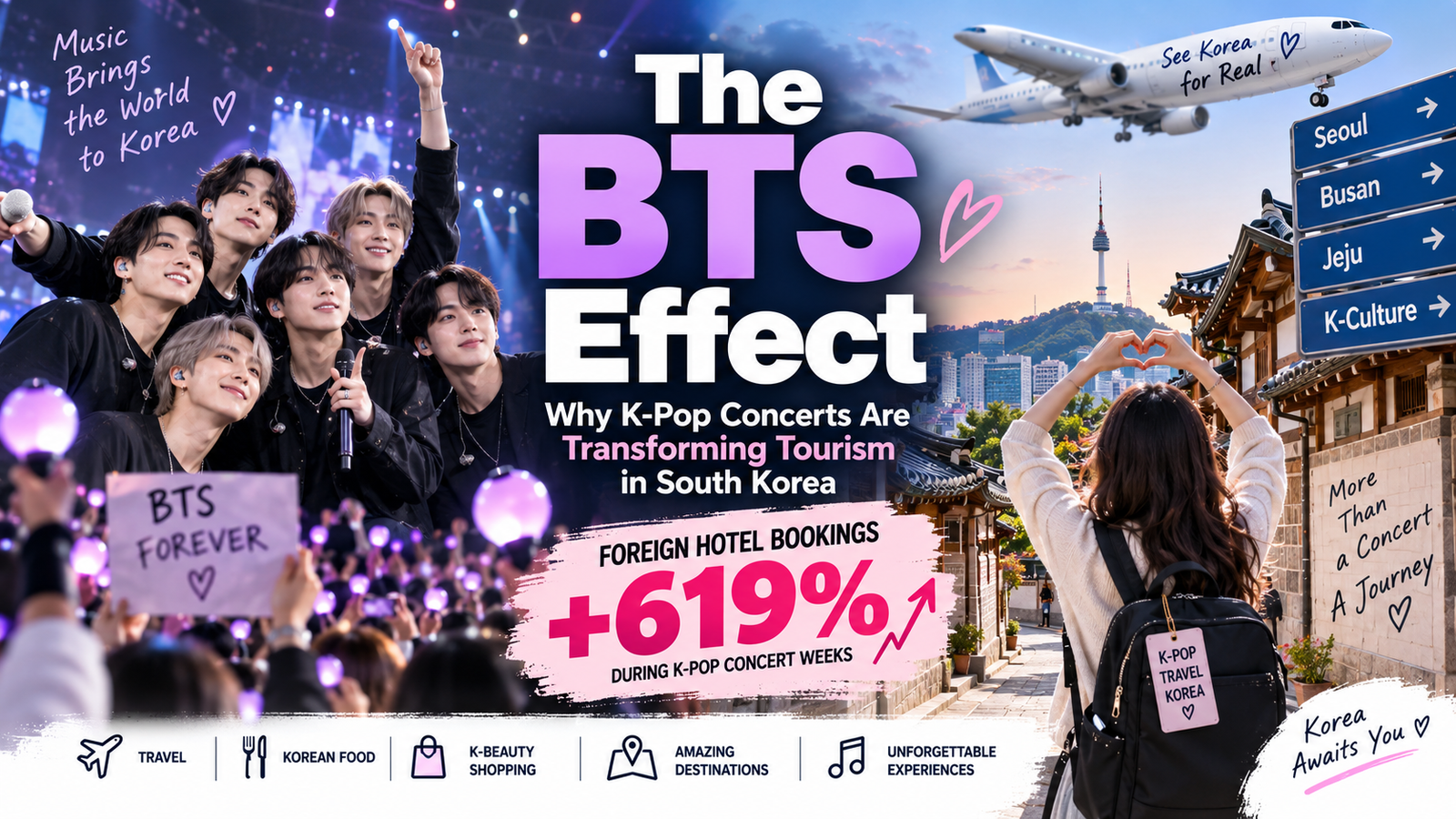
The BTS Effect: Why K-Pop Concerts Are Transforming Tourism in South Korea
But statistics only tell half the story.
The other half begins when the fan walks out of the stadium.
What happens next?
They eat tteokbokki.
They discover Seongsu.
They walk beside the Han River.
They shop in Myeongdong.
They ride the KTX.
They see Busan.
And suddenly the concert they flew across the world to attend becomes only one chapter of a much bigger memory.
A Few Mistakes First-Time Korea Travelers Should Avoid
Don’t schedule your flight too close to the concert.
Don’t rely entirely on one navigation app without preparing alternatives.
Don’t carry your passport, wallet and every valuable item carelessly in one place.
Don’t try to visit ten Seoul neighborhoods in one day.
Don’t assume every viral restaurant is worth waiting two hours for.
Don’t forget that residential areas such as parts of Bukchon require respectful behavior.
And don’t spend your entire vacation looking through your phone camera.
You traveled a long way.
Look at Korea with your own eyes too.
What If You Have More Than 7 Days?
Excellent.
Then I would not add more Seoul.
I would add more Korea.
With 9–10 days, consider:
Seoul → Gyeongju → Busan
Gyeongju offers a completely different experience from both Seoul and Busan.
It was the capital of the ancient Silla kingdom and is filled with archaeological and historical sites.
With 10–12 days, you could consider adding Jeju Island.
That gives you four dramatically different versions of Korea:
Seoul — modern metropolis
Gyeongju — history
Busan — coastal city
Jeju — nature
That’s a far richer introduction to Korea than spending the entire trip in one city.
Final Thoughts: Come for the Concert, Stay for Korea
Maybe your journey starts with a notification.
“World Tour Announced.”
Then comes the ticket battle.
The flight search.
The hotel reservation.
The countdown.
Finally, you arrive in Korea.
And for one night, thousands of people inside a stadium sing the same songs together.
That may be the reason you came.
But years later, you might remember something else just as clearly.
The smell of Korean barbecue on your first night.
The rooflines of Gyeongbokgung.
A random café in Seongsu.
Convenience-store ramyeon beside the Han River.
The KTX pulling out of Seoul Station.
The lights of Gwangan Bridge reflecting on the sea.
That is the wonderful thing about traveling because of music.
K-pop may give you the ticket to Korea.
But Korea gives you the journey.
So if you’re traveling thousands of miles for a concert, don’t simply attend the show and fly home.
For rail schedules and KTX reservations, use KORAIL. Because schedules, fares, concert rules, pop-ups and opening hours can change, verify these details shortly before traveling.
K-Beauty Shopping
If you want to explore Korean skincare, cosmetics and beauty products before or after your trip, you can browse OLIVE YOUNG Global.
For millions of international travelers, a trip to South Korea once began with a familiar checklist:
Seoul.
Gyeongbokgung Palace.
Myeongdong.
Korean barbecue.
Maybe Jeju Island or Busan.
But a new kind of traveler is changing Korean tourism.
Their trip may begin with something completely different:
A concert ticket.
A BTS performance. A BLACKPINK concert. A Stray Kids show.
Fans fly thousands of miles to Korea for a few hours of music — but they rarely leave after the concert.
They stay in hotels.
They eat Korean food.
They shop.
They visit neighborhoods connected to their favorite artists.
They travel to other cities.
And increasingly, K-pop is becoming not simply something tourists enjoy while visiting Korea.
K-pop is becoming the reason they visit Korea in the first place.
New tourism data shows just how powerful this phenomenon has become.
According to an analysis by the Korea Tourism Organization, accommodation bookings by foreign visitors surged 619.2% during weeks featuring concerts by three major K-pop acts compared with non-concert weeks in the dataset.
And BTS provides perhaps the clearest example yet of what happens when global fandom turns into actual travel.
Welcome to the new era of K-pop tourism in South Korea.
The BTS Effect Is Bigger Than a Concert
When BTS returned to the stage in South Korea in 2026, thousands of international ARMYs traveled to the country.
But Korea’s Ministry of Culture, Sports and Tourism wanted to know something beyond concert attendance:
What did those fans do after they arrived?
Together with the Korea Culture & Tourism Institute and Korea Tourism Organization, the ministry surveyed concertgoers and analyzed mobile-network and credit-card data surrounding BTS performances in Seoul and Goyang.
The results were remarkable.
Foreign visitors who attended BTS’s March 21 Gwanghwamun performance stayed in South Korea for an average of:
8.7 days
and spent approximately:
KRW 3.53 million per person.
By comparison, the average international visitor during the first quarter of 2026 stayed 6.1 days and spent approximately KRW 2.45 million.
In other words, BTS concert visitors stayed about 2.6 days longer and spent roughly KRW 1.08 million more per person than the average international tourist.
That changes the way we should think about a K-pop concert.
It is not simply a three-hour entertainment event.
For international fans, it can become the anchor around which an entire Korean vacation is built.
73.6% Came to Korea Primarily Because of BTS
There is an even more important number.
Among foreign visitors surveyed around BTS’s Gwanghwamun performance:
73.6% said the BTS event was their primary reason for visiting South Korea.
Another 17.4% were already visiting Korea for another purpose and added the event to their trip.
Think about what that means.
Without the concert, many of those international visitors might not have booked:
a flight to Korea,
a hotel room,
airport transportation,
restaurant meals,
shopping trips,
or visits to Korean attractions.
The concert created the trip.
This is why the phrase “BTS Effect” is more than fan language.
It increasingly describes a measurable tourism phenomenon.
BTS Fans Didn’t Just Attend the Concert and Go Home
The Goyang concerts provide an even clearer picture.
International fans attending BTS’s Goyang shows stayed in Korea for an average of 7.4 days and spent approximately KRW 2.91 million per person.
And they traveled well beyond the stadium.
Visitors connected their concert trips with places such as:
Yongsan
Myeongdong
Dongdaemun Design Plaza (DDP)
and the National Museum of Modern and Contemporary Art.
These destinations were linked to the broader “BTS THE CITY Seoul” experience surrounding the performances.
This is exactly why K-pop matters so much to tourism.
A concert may last several hours.
But the trip surrounding it can last more than a week.
One BTS Concert Area Saw Foreign Spending Jump 38-Fold
Perhaps the most dramatic evidence comes from the neighborhood surrounding the Goyang concert venue.
The Korea Tourism Organization compared mobile and card data around Daehwa-dong, where the concerts took place, with the same period a year earlier.
During the three BTS concert days, foreign visitors increased from 1,397 to 48,581.
That’s approximately:
35 times more foreign visitors.
Foreign card spending in the area increased from approximately KRW 8.9 million to KRW 337.8 million.
That’s roughly:
38 times more spending.
These numbers show why cities around the world compete aggressively to host major concerts.
The economic impact does not stop at the ticket booth.
It reaches:
hotels,
restaurants,
cafés,
convenience stores,
taxis,
subways,
shopping centers,
tourist attractions
and local businesses.
Then Came an Even Bigger Number: 619%
BTS is not an isolated case.
A newer Korea Tourism Organization analysis examined accommodation behavior surrounding major events.
The results suggest that the concert-tourism effect extends across K-pop.
During weeks featuring concerts by BTS, BLACKPINK and Stray Kids in the analyzed data, accommodation bookings increased dramatically.
Domestic bookings rose around 99.4%.
But bookings by foreign visitors increased by approximately:
619%
compared with non-concert periods in the analysis.
That number deserves attention.
Fans are not merely streaming Korean music from Los Angeles, Tokyo, Paris, Bangkok or London.
Increasingly, they are getting on airplanes.
K-Pop Has Changed the Meaning of a “Tourist Attraction”
Traditionally, tourism promotion centered around physical landmarks.
For Korea, that meant places such as:
Gyeongbokgung Palace,
Bukchon Hanok Village,
N Seoul Tower,
Jeju Island,
or Haeundae Beach.
Those places remain important.
But younger international travelers increasingly build trips around something less traditional.
They want to visit places connected to Korean culture they already love.
A café visited by an idol.
A music-video filming location.
A neighborhood featured in Korean entertainment.
A pop-up store.
A concert venue.
A K-pop agency district.
A restaurant associated with an artist.
A beauty store selling products used by Korean celebrities.
The tourist attraction is no longer always a monument.
Sometimes the attraction is a connection to a story, artist or fandom.
Why K-Pop Fans Often Stay Longer
Traditional sightseeing trips can be surprisingly short.
A visitor might spend three or four days checking off famous attractions and then leave.
Fandom tourism works differently.
Imagine flying to Seoul for a Saturday concert.
You may arrive several days early because international travel is expensive and you don’t want to risk missing the event.
Then you discover that your favorite group has:
a pop-up event,
a merchandise store,
a themed café,
a photo exhibition,
or related attractions elsewhere in the city.
After the concert, you might add another few days for Korean food, shopping and sightseeing.
Suddenly, a concert weekend becomes:
a seven- or eight-day Korea vacation.
The BTS data shows exactly this pattern.
Where Do K-Pop Fans Go in Korea Beyond the Concert?
This is where K-pop tourism becomes particularly interesting for first-time visitors.
You don’t have to spend your entire vacation searching for idol-related locations.
The best K-pop trip combines fandom with Korea itself.
Here are several places that fit naturally into that itinerary.
1. Hongdae
Hongdae is one of Seoul’s most energetic neighborhoods.
Street performances, cafés, fashion, nightlife and music culture make it especially popular with younger travelers.
For a K-pop fan visiting Korea for the first time, Hongdae is one of the easiest places to experience contemporary Seoul.
2. Myeongdong
Myeongdong remains one of the most convenient areas for international visitors.
You can combine:
K-beauty shopping,
Korean street food,
restaurants,
fashion
and easy transportation.
BTS concert visitors were also observed traveling to Myeongdong during their wider Korea itinerary.
3. Yongsan
Yongsan has become increasingly relevant to K-pop travelers.
The area combines major transportation connections, shopping and proximity to entertainment-related destinations.
It also appeared among locations visited by international BTS concertgoers.
4. Dongdaemun Design Plaza
DDP is one of Seoul’s most recognizable modern landmarks.
It frequently hosts exhibitions, pop-ups, fashion events and cultural programs.
Its late-night surroundings also make it easy to combine sightseeing with shopping and food.
5. Seongsu
If you want to understand modern Korean pop culture beyond music, visit Seongsu.
The neighborhood has become known for:
brand pop-ups,
fashion,
cafés,
beauty launches
and collaborations involving celebrities and entertainment brands.
It represents another important part of contemporary Korean youth culture.
6. The Han River
Not everything needs to be a paid attraction.
One of the simplest Seoul experiences is spending an evening along the Han River.
Buy convenience-store food, order Korean fried chicken, sit by the river and watch Seoul slow down after sunset.
For international visitors who first discovered Korea through highly produced music videos and dramas, ordinary experiences like this often become some of the most memorable moments of the trip.
And K-Pop Tourism Is Moving Beyond Seoul
This may ultimately be the most important change.
Historically, international tourism to Korea has been heavily concentrated in Seoul.
But recent tourism data shows foreign travelers are increasingly exploring other regions.
The share of international visitors staying outside the greater Seoul region rose from 39.5% to 43%, according to the recent tourism analysis.
Growth was particularly notable in destinations including:
Busan
Jeju
Andong
and Gyeongju.
K-pop can accelerate that trend.
If a major concert takes place outside central Seoul, thousands of international fans suddenly need:
accommodation,
transportation,
food,
shopping
and things to do nearby.
A concert can therefore become a gateway to regional Korea.
Busan May Be the Perfect Example
For many international visitors, Busan is already Korea’s obvious second destination after Seoul.
It offers something completely different:
beaches,
seafood,
traditional markets,
mountains,
coastal temples,
night views
and a more relaxed atmosphere.
K-pop events can give travelers the initial reason to visit.
But once they arrive, places such as:
Haeundae,
Gwangalli,
Jagalchi Market,
Gamcheon Culture Village
and Haedong Yonggungsa Temple
turn a concert trip into a broader Korean travel experience.
This is the real tourism value of K-pop.
Music gets people onto the plane.
Korea gives them reasons to stay.
K-Pop Is Also Selling Korean Food
There is another powerful effect that tourism statistics alone don’t fully capture.
Fans often arrive in Korea already familiar with Korean food.
They have seen idols eating:
tteokbokki,
ramyeon,
samgyeopsal,
fried chicken,
gimbap,
kimchi jjigae
and Korean convenience-store food.
So when they finally visit Korea, eating those foods can feel like participating in the culture they have followed from abroad.
This is one reason K-pop tourism connects naturally with food tourism.
A fan who travels to Korea for BTS may return home remembering the concert.
But they may also remember:
their first Korean barbecue dinner,
late-night fried chicken,
tteokbokki from a street stall,
or convenience-store ramyeon eaten beside the Han River.
That emotional connection is extremely powerful.
K-Pop Also Leads Travelers Into K-Beauty
The same phenomenon occurs with Korean beauty.
K-pop fans are constantly exposed to:
Korean skincare,
makeup,
fashion,
hairstyles
and beauty trends.
Once they arrive in Korea, stores in Myeongdong, Hongdae, Gangnam and Seongsu become part of the tourism experience.
This is why the economic value of Korean popular culture extends far beyond music sales.
One song can eventually influence spending on:
travel,
hotels,
restaurants,
beauty,
fashion,
transportation
and entertainment.
That is the larger K-Culture economy.
K-Pop Tourism Is Different From Ordinary Celebrity Tourism
Celebrity tourism is not new.
People have always traveled to see musicians.
But K-pop has several characteristics that make the effect unusually powerful.
First, K-pop fandoms are highly organized internationally.
Fans communicate through social media and online communities across national borders.
When a concert is announced, information about:
tickets,
flights,
hotels,
transportation,
restaurants
and fan events
can spread globally within hours.
Second, K-pop provides a constant stream of content between concerts.
Music videos, livestreams, variety shows, social media, documentaries and fan platforms create continuous engagement.
For many international fans, Korea does not feel like a completely unfamiliar country by the time they arrive.
They have already been experiencing parts of Korean culture digitally for years.
The physical trip becomes the final step of a relationship that began online.
From “Korean Wave” to “Travel to Korea”
For years, people talked about the Korean Wave — Hallyu — primarily in terms of exports.
Korean music was exported.
Korean dramas were exported.
Korean movies were exported.
Korean beauty products were exported.
But something more interesting is now happening.
Instead of Korean culture only traveling overseas, overseas consumers are traveling to Korea.
That represents a major change.
A Spotify stream generates one type of economic value.
A tourist who flies to Korea and stays for eight days generates something completely different.
They may buy:
airfare,
accommodation,
concert tickets,
food,
transportation,
cosmetics,
fashion,
souvenirs
and additional travel experiences.
The BTS tourism data makes this difference visible.
What This Means for Someone Planning a Korea Trip
If you are considering traveling to Korea for a K-pop concert, there is one piece of advice worth remembering:
Don’t make the concert your entire trip.
Make it the beginning.
If your concert is in Seoul or Goyang, consider spending several days exploring Seoul before or after the event.
Then add another destination.
For example:
Days 1–4: Seoul Day 5: K-pop concert Days 6–7: Seoul neighborhoods and shopping Days 8–9: Busan or Gyeongju
Even a shorter trip can combine K-pop with Korean food, history and everyday culture.
And that is often where the best memories happen.
The BTS Effect May Be Showing Us the Future of Korean Tourism
The most interesting thing about the BTS tourism data isn’t simply that BTS is popular.
We already knew that.
What matters is what fans do because of that popularity.
They cross borders.
They stay longer.
They spend more.
They explore neighborhoods.
They eat Korean food.
They shop for Korean products.
And increasingly, they travel beyond Seoul.
Government data showed foreign visitors around BTS’s Goyang concert increased about 35-fold, while their card spending increased about 38-fold compared with the same period a year earlier.
More recent tourism data found foreign accommodation bookings surging roughly 619% during selected major K-pop concert weeks.
Those aren’t streaming numbers.
They represent people physically moving around Korea.
Final Thoughts: They Come for BTS — But They Discover Korea
Perhaps the simplest way to understand K-pop tourism is this:
Fans may buy the plane ticket because of BTS.
But BTS isn’t necessarily what they remember most about every day of the trip.
They may remember eating grilled pork with friends in Seoul.
Getting lost on the subway.
Walking along the Han River at night.
Buying skincare in Myeongdong.
Discovering a tiny restaurant they had never seen on TikTok.
Taking the KTX to Busan.
Seeing the Korean coastline for the first time.
That is where K-pop’s tourism power becomes much larger than music.
K-pop gives millions of people a reason to become curious about Korea.
And once they arrive, Korea itself becomes the experience.
That may be the real BTS Effect — not simply selling more concert tickets, but turning global music fans into travelers who want to experience the country behind the music.