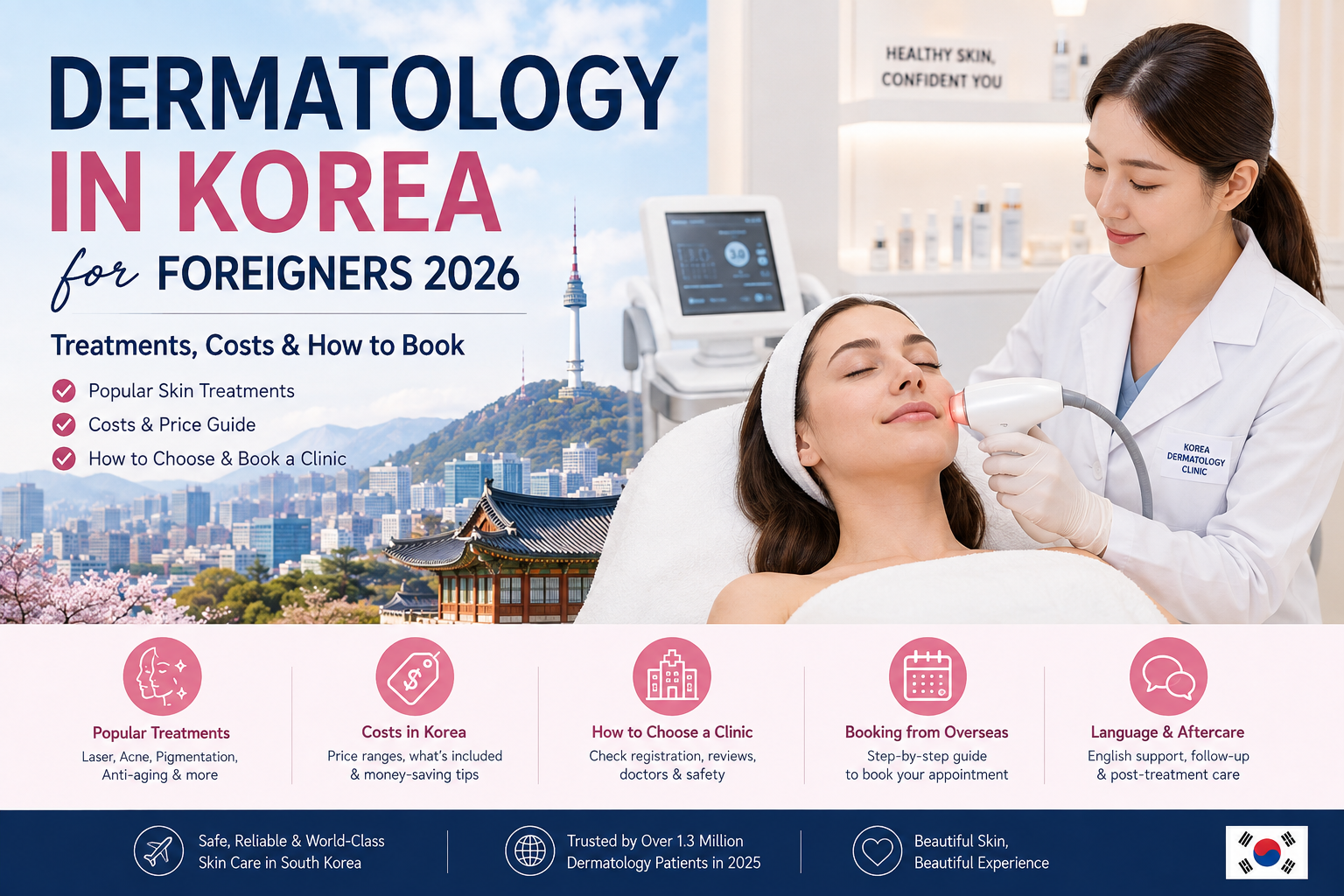
If you are considering traveling to South Korea for skin treatment, you are far from alone.
Korea has become one of the world’s most popular destinations for dermatology and aesthetic skin treatments, driven in part by the global popularity of K-beauty and growing international interest in Korean medical services.
According to official Korean government statistics, approximately 1.31 million foreign patients visited dermatology departments in Korea in 2025.
Dermatology represented 62.9% of foreign-patient treatment by medical department, making it by far the largest category. The number increased 86.2% from the previous year.
But traveling to another country for skin treatment raises important questions.
Which treatment should you choose? How much does Korean dermatology cost? How do you find a clinic? Can you book from overseas? Will the staff speak English?
This guide explains what foreigners should know before booking dermatology treatment in Korea in 2026.
Medical notice: This article is for general travel and medical-tourism information only. It does not recommend a particular procedure or clinic. Treatment suitability, risks, results, recovery time and prices vary by individual and provider. Consult a qualified medical professional before undergoing treatment.
Why Is Korean Dermatology So Popular With Foreigners?
Korean skincare is already familiar to millions of consumers through K-beauty.
But skincare products and medical dermatology are very different things.
Visitors to Korea can find a large market of dermatology clinics and other medical providers offering consultations, medical skin care and aesthetic procedures.
The scale of international demand is remarkable.
Korea received 2,011,822 foreign patients from 201 countries in 2025, up 71.9% from 2024. Dermatology alone accounted for approximately 1.31 million patients.
Many foreign visitors combine a trip to Korea with a dermatology consultation or skin treatment.
However, popularity does not mean every clinic or procedure is appropriate for every patient.
The goal should not be to find the clinic with the most viral social-media video.
The goal should be to find an appropriately registered medical provider and receive a proper consultation for your individual skin condition.
What Skin Treatments Are Available in Korea?
The Korean dermatology and aesthetic medicine market offers many different procedures.
The exact options vary between medical institutions, but international patients commonly research treatments related to:
Acne and Acne Scars
Treatment may focus on active acne, inflammation, pigmentation left after acne or different types of acne scarring.
Because acne scars vary considerably, there is no single procedure that is appropriate for everyone.
A medical consultation should come before choosing a treatment simply because it is popular online.
Pigmentation and Dark Spots
Foreign patients may seek consultations for freckles, sun damage, uneven pigmentation, melasma or other pigmentation concerns.
Different pigmentation conditions can look similar but may require different approaches.
This is one reason diagnosis matters before laser treatment.
Laser Skin Treatments
Korean clinics use many types of laser and energy-based devices.
These may be marketed for pigmentation, redness, texture, scars, hair removal and other purposes.
Don’t choose a treatment solely by the machine’s brand name.
Ask why that particular device or treatment is appropriate for your skin.
Skin Texture and Pores
Treatments marketed for improving skin texture, pores and overall skin appearance are common in Korea.
These may involve lasers, energy-based devices, injections or combinations of procedures depending on the clinic and the patient’s condition.
Anti-Aging and Lifting Treatments
Visitors will also encounter treatments marketed for wrinkles, elasticity, facial contouring or lifting.
These can range from relatively simple outpatient procedures to more intensive treatments.
Ask about expected results, side effects and recovery time before deciding.
Dermatology vs. Beauty Clinic: Know What You Are Booking
This is especially important for foreign visitors.
The words “skin clinic,” “beauty clinic,” and “dermatology clinic” may appear similar in English-language marketing, but you should verify what type of medical institution you are actually booking.
Check who will diagnose your condition and who will perform the procedure.
You should also verify whether the institution is registered to treat foreign patients.
Korea operates an official registration system for medical institutions serving international patients. Registered institutions are required to carry medical malpractice liability insurance as part of Korea’s foreign-patient protection system.
You can search registered medical providers directly through the Korean government’s Medical Korea Registered Hospitals directory.
This should be one of your first checks before making an appointment.
Where Should Foreigners Get Skin Treatment in Korea?
Seoul dominates Korea’s international medical market.
Of approximately 2.01 million foreign patients in Korea in 2025, about 1.76 million received treatment in Seoul, representing 87.2% of the national total.
For dermatology travelers, areas of Seoul frequently associated with large numbers of clinics include:
Gangnam
One of Seoul’s largest medical and beauty districts.
Sinsa and Apgujeong
Known for concentrations of cosmetic, dermatology and aesthetic medical services.
Cheongdam
Another area with numerous skin and cosmetic medical institutions.
Myeongdong
Convenient for international tourists because of its central location, shopping and accommodation.
But don’t assume that Gangnam automatically means better treatment.
The right provider depends on the condition you want treated, the medical professional, communication, aftercare and your individual circumstances.
Korea’s official Medical Korea directory includes registered dermatology clinics not only in Seoul but also in cities such as Busan, Incheon, Gwangju and elsewhere.
How Much Does Dermatology Cost in Korea?
This is probably one of the first questions most international visitors ask.
Unfortunately, there is no single useful answer such as:
“A Korean skin treatment costs $100.”
Prices vary enormously depending on:
- the procedure
- number of treatment areas
- device or technique
- doctor
- clinic
- number of sessions
- medication
- anesthesia or numbing
- additional treatments
- aftercare
Promotional prices can also differ from the final amount paid.
For that reason, request a written quotation from the clinic before traveling whenever possible.
Ask:
What exactly is included in this price?
For example, determine whether the quote includes:
consultation + procedure + medication + anesthesia/numbing + aftercare + follow-up visit.
If a clinic advertises an unusually low starting price, ask what a typical patient receiving the treatment you are considering actually pays.
Don’t Compare Korean Clinics Only by Price
Suppose Clinic A advertises a procedure at a very low price while Clinic B charges considerably more.
That doesn’t necessarily mean one is a bargain and the other is expensive.
The treatment area, number of shots, device settings, doctor’s involvement, medication and aftercare may differ.
Instead of asking only:
“How much?”
ask:
“What exactly will I receive for that price?”
For someone flying thousands of kilometers for treatment, this distinction matters much more than saving a small amount on the advertised price.
How to Book a Korean Dermatology Clinic From Overseas
You do not necessarily need to arrive in Seoul before arranging treatment.
Many institutions serving foreign patients provide online inquiries or international-patient contact channels.
A practical booking process looks like this:
Step 1: Decide What You Want Evaluated
Start with your skin concern rather than a trendy procedure.
For example:
acne scars → pigmentation → redness → wrinkles → skin texture
You don’t need to diagnose yourself.
The purpose is simply to explain clearly what concerns you.
Step 2: Shortlist Several Clinics
Don’t immediately book the first clinic you see on TikTok, Instagram or YouTube.
Create a shortlist and check whether the medical institution appears in the official Medical Korea provider directory.
Step 3: Contact the Clinic
Ask whether it accepts international patients and whether consultation is available in English or another language you speak.
Step 4: Send Relevant Information
The clinic may ask about:
- age
- skin concern
- previous treatments
- allergies
- medications
- medical conditions
- photographs
Provide accurate information.
Step 5: Request an Estimate
Ask for an estimated treatment price before booking your flight.
Step 6: Ask About Recovery
This is particularly important for tourists.
Ask:
Can I fly after treatment?
Can I exercise?
Can I wear makeup?
Should I avoid sunlight?
How long will redness or swelling last?
Do I need a follow-up appointment?
Your travel itinerary should be planned around the treatment — not the other way around.
Can I Get Dermatology Treatment in Korea Without Speaking Korean?
Potentially, yes.
Many medical institutions that actively serve international patients provide coordinators or interpretation in one or more languages.
But never assume English support is available.
Confirm it before booking.
Ask specifically:
Is an English-speaking coordinator available on the day of my appointment?
And more importantly:
Will I be able to communicate clearly with the medical professional about risks, treatment choices and aftercare?
Translation during payment or reception is not the same as adequate communication during a medical consultation.
For general information about Korea’s medical-tourism system, international visitors can also use the official Medical Korea portal.
Questions to Ask Before Paying a Deposit
Before paying, save the clinic’s answers to several important questions.
- Who will perform the procedure?
- Why is this treatment suitable for my skin?
- What are the common side effects?
- How much downtime should I expect?
- What is the total estimated cost?
- What exactly is included?
- Will I need more than one session?
- Is English-language support available?
- What happens if I have a problem after treatment?
- Who can I contact after returning home?
A reputable medical consultation should allow you to understand what you are agreeing to.
Be Careful With Before-and-After Photos
Before-and-after photographs can be useful, but they should never be your only reason for choosing a clinic.
Lighting, camera angle, makeup, editing and the time between photographs can dramatically affect appearance.
Also remember that another patient’s result does not guarantee yours.
Your skin type, condition, age, medical history and response to treatment may be different.
Use photographs as one piece of information, not as a medical guarantee.
Should You Get Skin Treatment on the First or Last Day of Your Korea Trip?
For many procedures, doing treatment immediately before an important event or long flight may not be ideal.
Some treatments can cause temporary redness, swelling, sensitivity, bruising or peeling.
On the other hand, undergoing treatment on your first day without allowing time for follow-up can also create problems.
The best timing depends entirely on the procedure.
Before finalizing your itinerary, ask the clinic:
How many days should I remain in Korea after this treatment?
For a simple procedure, the answer may be short.
For a treatment requiring follow-up, you may need to stay longer.
Sun Protection Matters During Your Korea Trip
If your procedure makes your skin more sensitive to sunlight, sightseeing can become part of your recovery planning.
Korea involves plenty of outdoor walking.
Tourists may spend hours exploring palaces, traditional markets, neighborhoods and shopping districts.
Ask your medical provider about appropriate sun protection and activities after treatment.
Follow the provider’s instructions rather than assuming your normal skincare routine is suitable immediately after a procedure.
What Should You Bring to Your Appointment?
Bring your passport or other identification requested by the medical institution.
It can also be useful to have:
- a list of medications
- allergy information
- details of previous skin procedures
- photographs showing changes in your skin
- questions written in advance
- the clinic’s booking confirmation
- emergency contact information
If you have a diagnosed skin condition or previous medical records relevant to the treatment, ask whether the clinic wants them before your visit.
What If You Have a Problem After Returning Home?
This is one of the most overlooked questions in medical tourism.
Before undergoing treatment, ask:
Who do I contact if I develop an unexpected reaction after returning to my country?
Find out whether the clinic provides remote follow-up and what documentation it can provide to your doctor at home.
Korea’s system for institutions serving foreign patients was designed in part to strengthen protections for international patients, including registration requirements and malpractice liability insurance.
But that does not remove the inherent risks of medical treatment.
Planning aftercare before the procedure is much easier than trying to solve a problem from another country afterward.
Can You Combine Dermatology Treatment With a Korea Vacation?
Yes — and many visitors do.
But think of it in this order:
Medical treatment first. Vacation second.
Don’t schedule a demanding hiking trip, beach holiday, sauna visit or all-day outdoor itinerary immediately after a procedure without checking whether it is medically appropriate.
Instead, build your itinerary around your expected recovery.
A traveler receiving a low-downtime treatment may have a very different schedule from someone receiving a more intensive procedure.
This is where medical tourism differs from ordinary tourism.
Your hotel, transportation and sightseeing schedule can all become part of your treatment plan.
Is Korean Dermatology Worth Traveling For?
For some international visitors, it may be.
The extraordinary growth of foreign dermatology patients shows that Korea has become a major destination for this type of medical travel. In 2025, dermatology accounted for 62.9% of foreign-patient treatment by department, and the number of dermatology patients increased 86.2% year over year.
But popularity alone should never determine a medical decision.
Before traveling, consider:
Treatment suitability + provider qualifications + total cost + communication + recovery time + aftercare + travel expenses
rather than simply asking whether Korea is cheaper.
The best treatment is not necessarily the newest, most viral or most heavily discounted procedure.
It is the treatment that is medically appropriate for you.
Korean Dermatology for Foreigners: Quick Checklist
Before flying to Korea:
✓ Identify the skin concern you want evaluated
✓ Research the treatment rather than relying on social media
✓ Check the medical institution
✓ Confirm foreign-patient registration
✓ Confirm language support
✓ Request an estimated total price
✓ Ask what the price includes
✓ Understand risks and expected downtime
✓ Leave enough time for recovery
✓ Confirm follow-up arrangements
✓ Know who to contact after returning home
Planning a Medical Trip to Korea?
Dermatology is only one part of Korea’s rapidly growing international healthcare sector.
Foreign visitors also travel to Korea for health checkups, dentistry, plastic surgery, ophthalmology and treatment at major hospitals.
If you are still deciding whether Korea is the right destination, start with our Medical Tourism in Korea 2026: Costs, Hospitals, Treatments & Complete Guide.
From there, you can plan the entire journey — from choosing medical care and estimating costs to booking, accommodation and recovery in Korea.
True Taste Korea will continue building practical guides designed for international visitors who want to understand Korea before they arrive — not after something goes wrong.