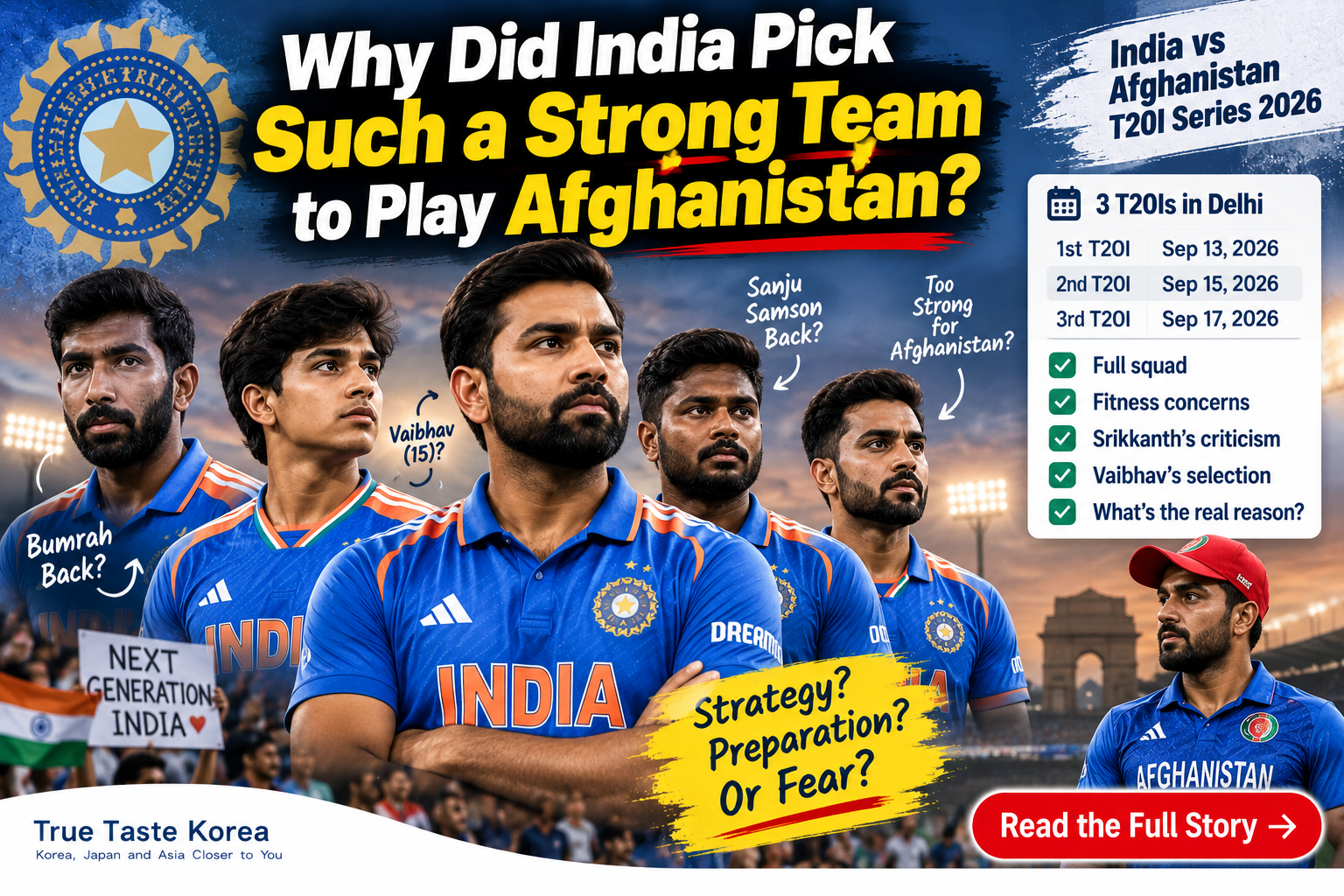
India are about to play Afghanistan in a three-match T20I series.
On paper, that doesn’t sound unusual.
But when the BCCI announced India’s squad, one question immediately stood out:
Why is India taking such a strong team against Afghanistan?
Jasprit Bumrah is there.
Shreyas Iyer is captain.
Tilak Varma is vice-captain.
Abhishek Sharma, Sanju Samson, Ishan Kishan, Axar Patel, Varun Chakaravarthy and Arshdeep Singh are all included.
And 15-year-old sensation Vaibhav Sooryavanshi is in the squad too.
Even more surprisingly, four players — Jasprit Bumrah, Nitish Kumar Reddy, Washington Sundar and Harshit Rana — were selected subject to fitness clearance.
That has led to a bigger debate in Indian cricket.
If some important players are still working their way back to full fitness, why risk them in this series?
And why not use Afghanistan to test more young players before the Asian Games?
Here’s what is going on.
When Is India vs Afghanistan T20I Series 2026?
The three matches are scheduled for:
1st T20I — September 13, 2026
2nd T20I — September 15, 2026
3rd T20I — September 17, 2026
All three will be played at the Arun Jaitley Cricket Stadium in Delhi.
There’s an unusual detail here too.
Afghanistan are technically the hosts of the series, even though all three games are being played in India. Afghanistan has used venues in India for home fixtures in the past.
Who Is in India’s Squad Against Afghanistan?
The BCCI’s official 15-player squad is:
Shreyas Iyer (Captain)
Abhishek Sharma
Vaibhav Sooryavanshi
Sanju Samson (WK)
Ishan Kishan (WK)
Tilak Varma (Vice-Captain)
Shivam Dube
Nitish Kumar Reddy*
Axar Patel
Washington Sundar*
Varun Chakaravarthy
Ravi Bishnoi
Jasprit Bumrah*
Arshdeep Singh
Harshit Rana*
The four players marked with an asterisk are subject to fitness clearance, according to the BCCI.
That’s an extremely experienced T20 squad.
And that’s exactly why the selection has attracted attention.
Why Are People Questioning India’s Team Selection?
One of the strongest criticisms has come from former India captain Krishnamachari Srikkanth.
His basic argument is simple:
Why select such a strong team against Afghanistan when India could use the series to test younger players?
The criticism becomes more interesting because several selected players are not yet guaranteed to be fully fit.
Srikkanth questioned why players such as Washington Sundar were being brought back rather than giving opportunities to other young players.
He also suggested India’s recent poor T20I results may have influenced the selectors’ thinking.
So there are really two competing philosophies here.
Option A
Use Afghanistan as a development series.
Rest major players.
Test youngsters.
Prepare the next generation.
Option B
Stop experimenting.
Play a strong team.
Get India winning again.
Build momentum before the Asian Games.
The selectors appear to be leaning much closer to Option B.
Is India Trying to Get Back to Winning?
This is probably the most important context behind the squad.
India’s recent T20I results have not been good.
Indian Express notes that India came into this selection after unsuccessful tours of Ireland and England, while a second-string Indian side subsequently swept Zimbabwe 3-0.
That changes how the Afghanistan series looks.
If India had been dominating every recent series, selectors might have felt more comfortable resting established players.
Instead, Afghanistan represents an opportunity to:
rebuild confidence
settle combinations
restore winning momentum
and
prepare players for what comes next.
That’s one plausible explanation for why the squad looks stronger than some fans expected.
But Is Afghanistan Really an Easy Opponent?
This is another mistake worth avoiding.
Calling Afghanistan an automatic win in T20 cricket is increasingly dangerous.
Afghanistan have developed into a serious international cricket side, particularly in limited-overs cricket.
So India’s selectors cannot simply assume:
“We’ll send anyone and win.”
And that makes the selection debate more complicated.
There’s a difference between asking:
“Why isn’t India resting everyone?”
and assuming:
“Afghanistan can’t beat India.”
Those are not the same claim.
Then Why Select Players Who Aren’t Fully Cleared for Fitness?
This is probably the most controversial part.
The BCCI didn’t simply announce Bumrah, Washington Sundar, Nitish Kumar Reddy and Harshit Rana as unconditional selections.
It specifically marked all four:
Subject to fitness clearance.
That means being named in the squad does not automatically guarantee participation.
But it still raises the question:
If their fitness needs monitoring, is Afghanistan the right series to bring them back?
Srikkanth’s criticism focuses partly on this issue, particularly with the Asian Games approaching later in September.
From the selectors’ perspective, however, this series can also provide competitive match time before that tournament.
So the exact same fact can support two arguments:
Critics: Don’t risk important players.
Selectors: They need matches before the next major assignment.
Why Is Jasprit Bumrah in the Squad?
Bumrah’s inclusion is particularly eye-catching.
He remains one of India’s most important fast bowlers, and the BCCI has explicitly made his Afghanistan participation dependent on fitness clearance.
There’s another reason his return matters.
Bumrah is also part of India’s squad for the 2026 Asian Games.
So Afghanistan can potentially function as preparation rather than merely an isolated three-match series.
The sequence is:
Afghanistan T20Is: September 13–17
↓
Asian Games cricket later in September
That makes the squad selection easier to understand.
Why Is Vaibhav Sooryavanshi Still in India’s Squad at Just 15?
And now we get to perhaps the most fascinating player in the entire squad.
Vaibhav Sooryavanshi.
He is still only 15.
His selection for India’s senior T20I squads earlier this year made him the youngest player ever selected for the Indian men’s senior team, according to Rajasthan Royals.
His rise has been extraordinary.
His IPL 2026 campaign included:
776 runs in 16 innings
a strike rate of 237.30
72 sixes
and the Orange Cap.
He also produced a 36-ball century during the season.
When he originally received his India call-up, chairman of selectors Ajit Agarkar essentially argued that Sooryavanshi’s performances had made him impossible to ignore.
But his international journey hasn’t been completely smooth.
Reuters reported this week that after a difficult debut series in England, he responded with two half-centuries in Zimbabwe. He has now retained his place for Afghanistan.
That makes this series another important test.
Will Vaibhav Sooryavanshi Actually Play Against Afghanistan?
That’s a much harder question.
India have several players who can occupy the top order.
The squad includes:
Abhishek Sharma
Vaibhav Sooryavanshi
Sanju Samson
Ishan Kishan
among others.
So simply being in the squad does not guarantee Vaibhav a starting position.
This debate isn’t new either.
When Sooryavanshi was waiting for opportunities earlier this year, Indian cricket fans were already arguing over whether a 15-year-old should be pushed immediately or allowed more time to develop.
One Reddit discussion about his dismissal attracted more than 1,000 upvotes, with commenters debating whether he had been promoted to the senior level too early.
Another discussion about whether India should put him into the ODI setup drew more than 600 upvotes, showing just how much attention his development is generating.
So Vaibhav himself is becoming a search topic independent of the Afghanistan series.
Is Sanju Samson Back?
Yes.
Sanju Samson has returned to the squad as one of India’s two designated wicketkeepers, alongside Ishan Kishan.
His presence creates another selection question.
If Samson plays near the top of the order, and India also wants Abhishek Sharma and Vaibhav Sooryavanshi involved, somebody has to miss out or move.
That’s why the Afghanistan series isn’t simply:
India vs Afghanistan.
For Indian fans, it’s also about:
Who gets India’s batting spots?
The competition inside the Indian XI may be nearly as interesting as the opposition.
Why Not Send the Team That Beat Zimbabwe 3-0?
That’s essentially part of Srikkanth’s criticism.
A less experienced Indian side had success in Zimbabwe.
So his argument is that those players could have been rewarded with another opportunity rather than immediately returning to a more established squad.
This is one of Indian cricket’s recurring problems — although it’s a very good problem to have.
India has an enormous player pool.
When a young player performs well, selectors must decide:
Reward him immediately?
or
Bring back the established international player?
There aren’t enough positions for everyone.
Afghanistan has simply brought that old debate back again.
Is India “Afraid” of Losing to Afghanistan?
This needs some context because it’s easy to turn a provocative comment into a misleading headline.
Srikkanth used strong language while criticizing the selection and suggested recent defeats had made India reluctant to experiment again.
But that is Srikkanth’s interpretation of the selection, not an official BCCI explanation.
The BCCI’s official squad announcement lists the players and fitness conditions but does not say:
“We selected this team because we’re afraid of Afghanistan.”
That distinction matters.
So the accurate way to frame the controversy is:
Srikkanth believes India’s recent results may have made the selectors more cautious.
Not:
BCCI says India is afraid of Afghanistan.
Could the Asian Games Be the Real Reason?
It may be an important part of the explanation.
Several of the players in this Afghanistan squad are also involved in India’s Asian Games plans.
The Asian Games therefore change the purpose of these three T20Is.
Instead of thinking:
“Why waste Bumrah against Afghanistan?”
another way of looking at it is:
“Can Afghanistan provide competitive preparation before the Asian Games?”
That doesn’t settle the debate.
But it explains why India might want important players playing competitive cricket rather than simply resting.
So Why Did India Pick Such a Strong Team Against Afghanistan?
There probably isn’t one single reason.
Instead, several things are happening at once.
India have recently suffered disappointing T20I results.
The selectors may want the team to rediscover winning momentum.
The Asian Games are approaching.
Some important players need competitive cricket if they receive fitness clearance.
Afghanistan should not automatically be treated as an easy T20 opponent.
And India still has selection questions to answer around players such as:
Sanju Samson
Ishan Kishan
Vaibhav Sooryavanshi
and its returning bowlers.
That explains why India’s squad looks much stronger than a developmental team.
But the criticism isn’t unreasonable either.
India has an enormous pool of young talent, and a three-match Afghanistan series could have been used to give more of those players international experience.
That’s the real debate:
Should India use this series to rebuild its strongest T20 team?
or
Should India use it to discover the next one?
We’ll start getting the answer when the first T20I begins in Delhi on September 13.