Before watching Four Hands, Two Sonatas, I had a very simple idea of what a great pianist was.
I thought pianists were, in a sense, highly sophisticated machines.
The composer writes the music. The notes are printed on the score. The pianist reads those notes and plays them as accurately as possible.
So I assumed that if two world-class pianists played the same piece correctly, their performances should sound more or less the same.
Four Hands made me realize how wrong that idea was.
And I suspect I am not the only non-musician who thought this way.
The drama taught me something surprisingly profound about classical music:
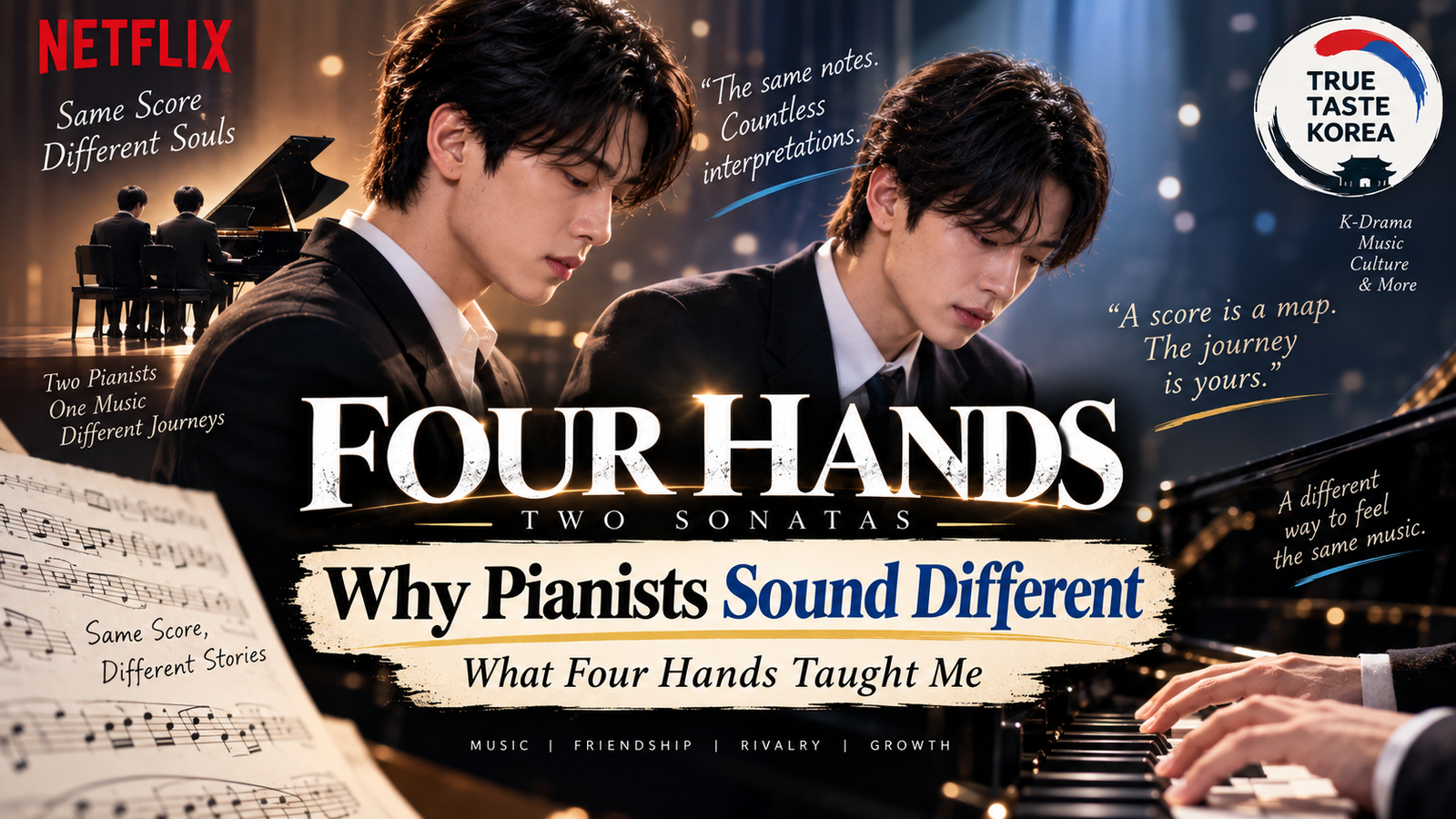
A musical score is not the music itself. It is more like a map.
The map may be the same.
But every great pianist takes a different journey through it.
I Thought Playing Piano Was About Following the Score
For someone without professional musical training, the logic seems obvious.
A score tells the pianist which notes to play.
It contains rhythm, tempo markings, dynamics and instructions from the composer.
So what is left for the pianist to decide?
A great deal, as it turns out.
That realization is one of the most fascinating ideas presented in Four Hands.
The drama repeatedly shows that musical ability cannot be measured simply by asking:
“Did he play the correct notes?”
A pianist can play every note correctly and still produce a performance that feels completely different from another pianist playing exactly the same score.
That was something I had never really understood before watching the drama.
The Score Is a Map, Not a Set of GPS Instructions
The best way I can describe what Four Hands taught me is this:
Imagine giving two travelers the same map.
The starting point is identical.
The destination is identical.
The roads printed on the map are identical.
But that does not mean their journeys will be identical.
One person may move quickly through one section and slow down somewhere else.
Another may stop and notice something the first traveler barely saw.
One may see several landmarks as part of a single landscape.
Another may focus on each landmark individually.
The map hasn’t changed.
Their interpretation of the journey has.
A musical score can work in a similar way.
And this is where Four Hands begins to explain why a truly exceptional pianist is not simply someone capable of following instructions.
The Same Notes Can Become Different Music
One of the ideas that fascinated me most in the drama was how differently notes can be grouped and expressed.
A pianist doesn’t necessarily experience music as:
note → note → note → note.
Several notes can be understood and expressed as one musical phrase — one larger emotional unit.
Another pianist may take a similar passage and give individual notes greater separation.
Neither necessarily needs to change the written notes.
What changes is how those notes are understood and communicated.
This was a revelation to me.
It means that the pianist isn’t merely asking:
“Which note comes next?”
The pianist is also asking:
“What does this entire passage mean?”
That is a completely different way of understanding performance.
Tempo Is Not Just About Playing Fast or Slow
Four Hands also made me notice something else I had previously overlooked.
Speed itself can be expressive.
To an ordinary listener, tempo might seem like another instruction:
Play this piece at this speed.
But a performance breathes.
A pianist may push forward through one phrase, create tension, then allow another passage more space.
Even subtle differences in timing can change how the listener experiences the music.
A phrase can feel impatient.
Another can feel hesitant.
Another can sound confident.
Another can sound almost as though it is asking a question.
The notes themselves haven’t necessarily changed.
The interpretation has.
Why Choi Jeong-yo’s Talent Matters So Much
This is also why I think the drama’s portrayal of Choi Jeong-yo, played by Lee Jun-young, is particularly interesting.
It would have been easy for the writers simply to tell us:
“Jeong-yo is a genius.”
Many dramas do exactly that.
They introduce a gifted character, have everyone around him repeatedly call him a genius, and expect the audience to accept it.
Four Hands attempts something more interesting.
It gradually gives the viewer a language for understanding why his musical ability is special.
His talent isn’t meaningful simply because he can press difficult keys quickly or reproduce complicated music without making mistakes.
What matters is how he understands the music.
And as other characters begin to recognize something unusual in his interpretation, the audience begins learning how to recognize it too.
That distinction is important.
The Audience Learns Along With the Characters
This may be one of the smartest aspects of Four Hands.
At the beginning, many viewers probably listen to piano much like I did.
We hear a difficult performance and think:
“Wow. He can play really fast.”
Or:
“He didn’t make any mistakes. He must be brilliant.”
But the drama gradually gives us other things to listen for.
Why did he slow down there?
Why did those notes feel like one large phrase?
Why did the other pianist separate them?
Why did one interpretation feel restrained while another felt emotional?
Why can two performances of the same composition leave completely different impressions?
Suddenly, the viewer isn’t merely watching characters talk about classical music.
The viewer is learning how to listen.
That is what surprised me most.
Pi-o and Jeong-yo Don’t Just Compete — They Hear Music Differently
This also changes how I see the relationship between Kang Pi-o and Choi Jeong-yo.
On the surface, Four Hands can look like the familiar story of two geniuses competing to determine who is better.
But if music can have countless interpretations, the question “Who is better?” becomes much more complicated.
Pi-o and Jeong-yo don’t simply have different levels of skill.
They have different experiences.
Different personalities.
Different emotions.
Different lives.
And all of those things can influence how a musician understands what is written on the page.
That makes their rivalry much more interesting.
They aren’t simply racing along the same road to see who reaches the finish line first.
They may be reading the same map and seeing completely different landscapes.
Why Can Great Pianists Sound Different Playing the Same Piece?
This is the question Four Hands ultimately made me ask.
If the score is identical, where does the difference come from?
There are many elements of musical interpretation, including:
Tempo — how quickly the music moves and how that pace changes.
Phrasing — how individual notes are shaped into larger musical ideas.
Dynamics — how softly or powerfully different passages are expressed.
Articulation — whether notes feel connected, separated, sharp, delicate or flowing.
Pedaling — how sounds are sustained and blended.
Timing — tiny variations in when notes and phrases arrive.
And beyond all of these technical concepts is something much harder to measure:
the musician’s interpretation.
Two pianists can look at the same score and understand its emotional meaning differently.
That is why great performers can make familiar compositions feel new.
The Composer Writes the Music — But the Pianist Gives It a Voice
This changed another assumption I had.
I used to think almost all of the creativity belonged to the composer.
The composer creates.
The pianist reproduces.
Now I understand that relationship differently.
The composer certainly creates the work.
But a written score cannot physically make sound.
Someone must transform those symbols into an experience that another human being can hear.
That requires choices.
And those choices are part of interpretation.
A great pianist therefore occupies a fascinating position.
The pianist must respect what the composer wrote without becoming merely a machine reproducing instructions.
Too little interpretation, and the music can feel lifeless.
Too much disregard for the score, and the performer may lose what the composer intended.
The art exists somewhere between those two extremes.
Now I Understand Why People Compare Different Recordings
Before Four Hands, I never completely understood why classical music lovers might own or listen to several recordings of the same composition.
If it is the same Beethoven sonata, why listen to five pianists play it?
Shouldn’t one excellent recording be enough?
Now the answer seems obvious.
Because they aren’t really the same performance.
The notes may come from the same score, but the experience can be completely different.
One pianist may make a passage sound intimate.
Another may make it monumental.
One interpretation might emphasize tension.
Another might reveal sadness.
Another might find beauty somewhere I never noticed before.
That means listening to different pianists isn’t simply hearing the same music repeatedly.
It can be like hearing different interpretations of the same story.
Four Hands Made Classical Music Easier to Understand
I think this may be one reason Four Hands has connected so strongly with viewers in Korea.
You don’t need to be a pianist to understand competition.
You don’t need to study classical music to understand insecurity, friendship, pride, jealousy or the desire to be recognized.
The drama uses those emotions to bring the viewer inside a world that might otherwise feel intimidating.
And somewhere along the way, viewers like me begin learning about music almost without realizing it.
I started watching a drama about talented young pianists.
I ended up changing the way I think about piano performance itself.
A Score Is Only a Map
If I had to reduce what Four Hands taught me to one idea, it would be this:
A score is a map.
The composer draws the map.
The notes establish the landscape.
But the performer still has to travel through it.
One pianist may rush toward something another approaches carefully.
One may connect several notes into a single thought.
Another may reveal the individual pieces hidden inside that thought.
One may find sorrow where another finds hope.
The map remains the same.
The journey does not.
And perhaps that is why we still need great performers even when the music they play was written hundreds of years ago.
They aren’t simply repeating old notes.
They are showing us another way to travel through them.
Four Hands and Piano Interpretation FAQ
Why do pianists sound different when playing the same piece?
Because a musical score leaves room for interpretation. Pianists can differ in phrasing, timing, dynamics, articulation, pedaling and their overall understanding of the composition.
Do classical pianists have to follow the score exactly?
The written score provides the essential musical structure and the composer’s instructions, but interpretation remains a fundamental part of performance. The goal isn’t simply to reproduce notes mechanically.
What does phrasing mean in piano playing?
Phrasing is one way musicians organize individual notes into larger musical ideas. Rather than hearing every note as an isolated event, a pianist can shape groups of notes into something resembling a musical sentence.
Why is Choi Jeong-yo considered talented in Four Hands?
The drama portrays Jeong-yo’s ability as going beyond technical accuracy. An important part of his musical identity is the way he understands and interprets what he plays.
What does the title Four Hands mean?
In piano music, four hands generally refers to two pianists playing together on one piano. In the drama, the idea also works beautifully as a metaphor for two very different musicians learning to share the same musical world.