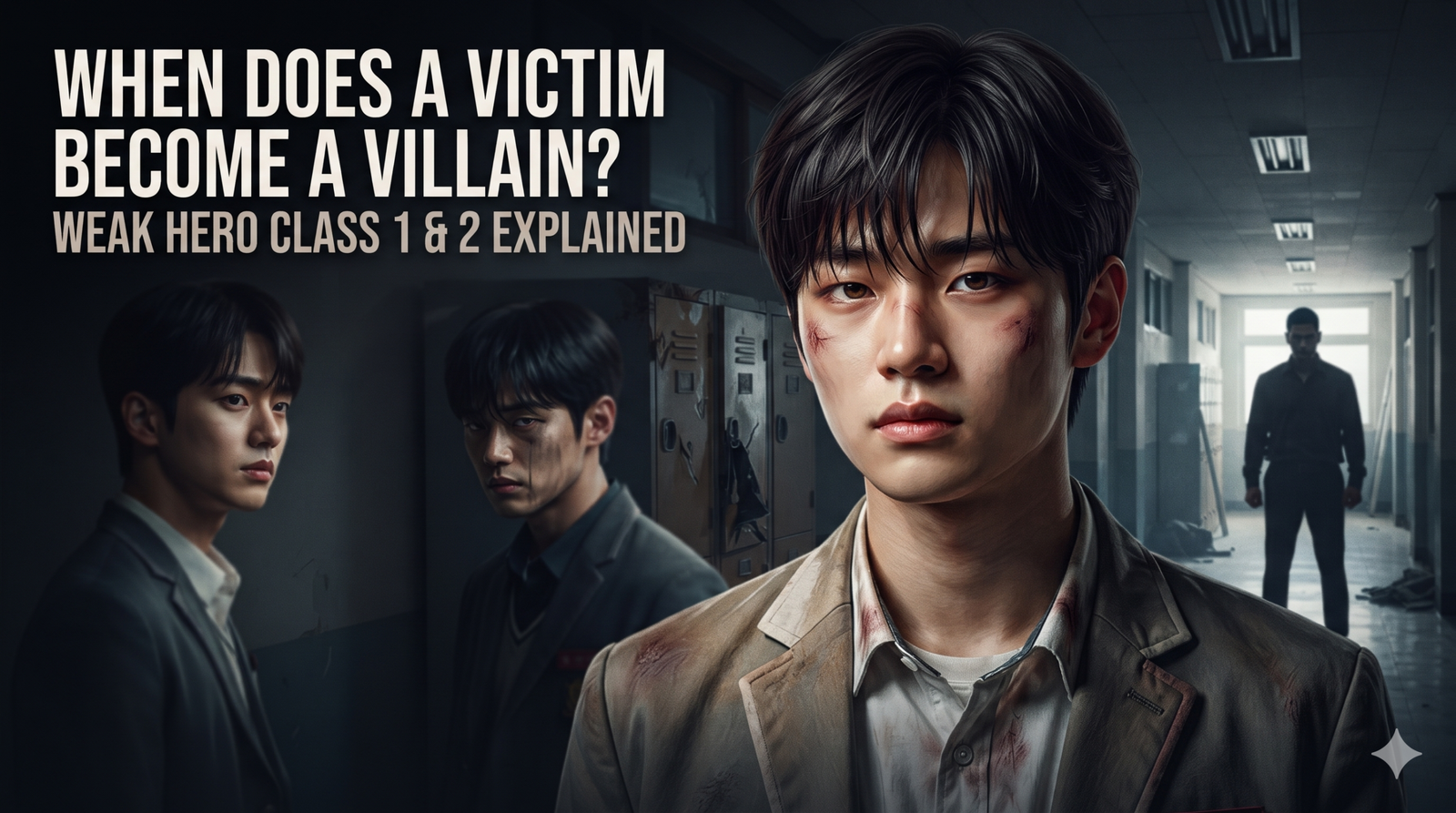
• Weak Hero Explained: When Does a Victim Become a Villain?

    Weak Hero Explained: When Does a Victim Become a Villain?

    An in-depth analysis of Weak Hero Class 1 and Class 2

    Spoiler Warning: This article discusses major character developments and events from both seasons of Weak Hero.

    At first glance, Weak Hero looks like a school action drama about a physically weak student who defeats stronger bullies through intelligence and strategy. Its fights are intense, its characters are memorable, and its action sequences are carefully constructed.

    But the most disturbing part of the series is not the violence itself.

    It is what happens to people after they experience it.

    One student responds to fear by protecting others. Another turns insecurity into betrayal. Some discover that friendship gives them the courage to resist violence, while others learn to use violence as a way to control the people around them.

    Across its two seasons, Weak Hero asks a much more complicated question than who is strong enough to win a fight:

    When does someone who has been hurt become someone who hurts others?

    The difference between understanding a person’s pain and excusing their actions is at the heart of this series. And by following Yeon Si-eun’s journey from Class 1 to Class 2, we can see how violence changes not only its direct victims but also the way they understand friendship, trust, and themselves.

    1. Why Weak Hero Is More Than a School Violence Drama

    The title Weak Hero creates an immediate contradiction.

    A hero is traditionally expected to possess courage, strength, or the ability to protect others. Yet Yeon Si-eun does not look like someone who could dominate a room through physical power. He is academically gifted, quiet, physically unimpressive, and largely uninterested in the social hierarchy around him.

    His apparent weakness makes him an easy target.

    But the series gradually reveals that physical strength is only one form of power. Si-eun studies his opponents, observes their behavior, identifies their weaknesses, and uses whatever is available to survive.

    This changes the meaning of the title.

    The series is not simply asking whether a weak student can defeat stronger students. It is examining what happens when a society measures human worth through the ability to intimidate others.

    Inside the school, violence becomes a language. Students use it to establish rank, demand obedience, protect their reputation, and hide their insecurities.

    The important question is not just who wins each confrontation. It is why so many students accept this system as normal.

    That is what gives Weak Hero its deeper meaning. Its school environment functions like a small society in which power is often mistaken for authority.

    2. Yeon Si-eun: A Different Kind of Strength

    Si-eun’s intelligence is his most visible weapon, but his character is not defined by intelligence alone.

    At the beginning, he appears emotionally distant. He concentrates on studying and avoids unnecessary relationships. This can look like indifference, but it also functions as a form of self-protection.

    Keeping people at a distance reduces the possibility of being hurt.

    His relationships with Ahn Su-ho and Oh Beom-seok gradually challenge that isolation. For perhaps the first time, Si-eun begins to experience a connection that cannot be measured through grades, competition, or personal advantage.

    This matters because friendship changes what he is willing to risk.

    Before meeting them, he mainly fights when someone directly threatens him. As the relationships deepen, however, the safety of other people becomes part of his own responsibility.

    His strength therefore develops in two different directions.

    First, he becomes more capable of defending himself. Second, he becomes emotionally vulnerable because he now has something meaningful to lose.

    That second change is arguably more important.

    Si-eun’s greatest weakness is no longer his physical size. It is the possibility that the people he trusts might disappear.

    3. Ahn Su-ho: The Meaning of Loyalty

    Su-ho is almost the opposite of Si-eun.

    He is physically strong, relaxed, direct, and comfortable confronting people who try to intimidate others. He does not need complicated strategies to demonstrate that he is not afraid.

    Yet his most important quality is not his fighting ability.

    It is his loyalty.

    Su-ho’s friendship with Si-eun begins without a grand promise or dramatic declaration. Their relationship develops through ordinary moments, shared experiences, and the gradual discovery that they can rely on each other.

    He gives Si-eun something that intelligence alone cannot provide: the experience of being protected by someone who does not expect anything in return.

    This is an important contrast.

    Si-eun knows how to calculate risks. Su-ho often acts according to a simpler principle: if someone is being treated unfairly, he should not stand by and watch.

    That does not make Su-ho a perfect character. His straightforward approach cannot solve every problem, especially when violence escalates beyond what an individual can control.

    But his presence changes the emotional direction of the story.

    For Si-eun, Su-ho represents the possibility that another person can be trusted without first having to be understood completely.

    That is why the consequences of their conflict are so devastating.

    4. Oh Beom-seok: When Pain Turns Into Betrayal

    Beom-seok is perhaps the most uncomfortable character in Class 1 because his transformation is difficult to watch.

    He does not begin as the most powerful student. He is timid, insecure, and carries the effects of repeated humiliation and pressure.

    His relationship with Si-eun and Su-ho initially offers him a sense of belonging. For someone who has experienced intimidation, being accepted by two friends should have been an opportunity to rebuild his confidence.

    But belonging does not automatically heal insecurity.

    Beom-seok gradually begins comparing himself with the people around him. Su-ho’s physical strength and confidence become sources of resentment. Instead of feeling grateful for the protection he receives, he increasingly interprets the differences between them as evidence of his own inferiority.

    This is where his character becomes tragic.

    He wants to be valued, but he also wants to control how others value him. He wants friendship, yet he struggles to accept that friendship does not require everyone to be equal in every ability.

    His insecurity eventually becomes destructive.

    It would be too easy to explain Beom-seok’s actions by saying that he was simply a victim of bullying. His experiences help us understand his behavior, but they do not erase the harm he causes.

    This distinction is essential.

    A person can be genuinely wounded and still become responsible for hurting someone else.

    Beom-seok’s story is powerful precisely because the series refuses to make that contradiction comfortable.

    5. Understanding Someone Is Not the Same as Forgiving Them

    One of the strongest ideas in Weak Hero is the difference between explaining an action and justifying it.

    When viewers examine Beom-seok, they can identify the circumstances that contributed to his transformation. His past, family environment, humiliation, and feelings of inferiority all help explain why he becomes increasingly unstable.

    But explanation is not absolution.

    If every harmful action could be excused by the pain that came before it, then the people harmed by that action would disappear from the moral equation.

    This is a problem that extends beyond the series.

    People often ask whether a person who behaves cruelly is actually suffering inside. That can be an important question, but it should not become the only question.

    We must also ask who is paying the price for that suffering.

    Beom-seok’s tragedy is not simply that he was hurt. It is that he begins turning his pain into a reason to hurt people who once stood beside him.

    The series invites viewers to understand him without demanding that they approve of him.

    That is a more mature approach to character writing than dividing everyone into completely innocent victims and completely evil villains.

    6. Class 2: A World Where Survival Has a Different Meaning

    Class 2 begins after Si-eun has lost the friends who gave his previous school life meaning.

    His transfer to Eunjang High School is not simply a change of location. He arrives carrying the emotional consequences of what happened before.

    He is more guarded, more alert, and less willing to trust people quickly.

    This is an important development.

    In Class 1, Si-eun gradually discovers friendship. In Class 2, he must decide whether he can allow himself to build those relationships again.

    The new school introduces a wider network of violence, including the Union and its influence over students.

    The conflict is no longer limited to a small group of classmates. It becomes part of a larger structure in which different individuals hold positions of power.

    Netflix’s official description presents Class 2 as the continuation of Si-eun’s journey after losing his friends, as he encounters new allies and more dangerous opponents at Eunjang High School.

    This change in scale also changes the central question.

    Class 1 asks what happens when friendship is destroyed by violence.

    Class 2 asks whether someone who has experienced that destruction can still choose friendship instead of isolation.

    7. Park Hu-min: Strength Used to Protect, Not Dominate

    Park Hu-min provides an important contrast to the forms of power that Si-eun encounters.

    He is physically capable and confident, but his strength does not automatically make him another version of the bullies Si-eun has already faced.

    What matters is how he uses that strength.

    In a world where physical power is often treated as permission to control others, Hu-min represents a different possibility: strength can create space for other people rather than take that space away.

    This is not a minor distinction.

    The series repeatedly shows characters who possess the ability to intimidate others. But possessing power and using it responsibly are two different things.

    Hu-min’s relationship with Si-eun also helps the latter move beyond the emotional isolation that followed Class 1.

    Their friendship is not a replacement for Su-ho. It is something different.

    This is important because the series does not need to pretend that a new friend can erase an old loss.

    Instead, it suggests that people can carry the memory of someone they lost while still allowing new relationships to develop.

    That is a more believable form of recovery.

    8. Na Baek-jin: Was He Born Cruel, or Shaped by His World?

    Na Baek-jin is one of the most interesting characters in Class 2 because he represents a more organized form of power.

    Unlike students who rely mainly on impulsive aggression, Baek-jin operates within a structure. His position in the Union gives him influence, and his behavior reflects a world in which control and survival are closely connected.

    He is not simply another student who enjoys fighting.

    He represents what happens when violence becomes part of an established system.

    This makes him a useful contrast to Beom-seok.

    Beom-seok’s destructive behavior grows out of personal insecurity and resentment. Baek-jin’s power is connected to a broader hierarchy, where relationships and authority are shaped by the rules of the organization.

    Their circumstances are not identical, and treating them as the same kind of villain would weaken the analysis.

    Baek-jin’s character raises another question:

    Can someone become so accustomed to a violent system that they stop imagining a life outside it?

    The series gives viewers reasons to consider the pressures surrounding him, but understanding his environment does not automatically make his decisions acceptable.

    His story reinforces one of the drama’s central ideas: violence can begin as a response to vulnerability, but it can eventually become a method of maintaining control.

    9. The Real Difference Between Class 1 and Class 2

    The two seasons are connected, but they are not simply repeating the same story with different opponents.

    Class 1 is more intimate.

    Its emotional center is the relationship between Si-eun, Su-ho, and Beom-seok. The drama examines how a friendship forms, how insecurity enters that friendship, and how quickly trust can collapse when people cannot communicate honestly.

    Class 2 expands the world.

    The Union introduces a larger system of violence, while Si-eun’s new relationships test whether he can trust people after what happened previously.

    The contrast can be understood through three changes.

    First, the meaning of friendship changes.

    In Class 1, friendship is something Si-eun discovers almost unexpectedly. In Class 2, friendship becomes a choice he must make despite knowing that people can be hurt or lost.

    Second, the scale of violence changes.

    Class 1 focuses heavily on personal conflict and the emotional damage within a small group. Class 2 shows how violence can become organized through networks of influence and control.

    Third, Si-eun’s understanding of strength changes.

    At first, his intelligence allows him to survive physical confrontations. Later, he must learn that survival is not enough if he remains emotionally disconnected from everyone around him.

    This is why the two seasons work best when viewed together.

    The first shows what Si-eun loses. The second examines what he might still be able to build.

    10. Why Fighting Back Does Not Always Mean Winning

    One of the reasons Weak Hero feels different from a conventional action drama is that its fights rarely offer a simple fantasy of victory.

    Si-eun can defeat opponents who are physically stronger than him, but each confrontation carries consequences.

    Winning a fight does not necessarily restore someone’s dignity. It does not automatically end bullying, repair damaged relationships, or remove the fear that another confrontation may happen tomorrow.

    This is an important distinction.

    If the series were only about a clever student defeating bullies, its central message would be relatively simple: intelligence can overcome physical strength.

    But the emotional consequences of violence complicate that message.

    A person can win a confrontation and still lose something important.

    A person can survive an attack but remain psychologically affected by it.

    And a person can become stronger without necessarily becoming happier.

    The series is at its most convincing when it shows that physical survival and emotional recovery are not the same achievement.

    11. The Adults and the Failure of the Environment

    Although the central conflicts take place among students, the world of Weak Hero also invites questions about the environment surrounding them.

    Why do students repeatedly find themselves trapped in systems of intimidation?

    Why does violence become a way to establish status?

    Why do vulnerable students sometimes feel that they have no meaningful protection?

    It would be inaccurate to suggest that every adult in the story is equally responsible or that every problem can be solved by a single intervention.

    But the repeated presence of violence raises a broader question about responsibility.

    When young people develop their own systems of power, the problem is not only the behavior of individual students. It is also the failure of the environment to provide effective alternatives.

    A school should be a place where students can learn, develop relationships, and make mistakes without fearing that another student can control their lives through intimidation.

    When that environment breaks down, the consequences extend beyond the immediate victims.

    The series does not need to deliver a formal social policy argument to make this point. Its characters demonstrate what happens when protection and accountability are unreliable.

    12. Why Weak Hero Refuses to Offer an Easy Answer

    The most memorable characters in Weak Hero are not necessarily the ones who win the most fights.

    They are the ones who force viewers to reconsider their assumptions.

    Beom-seok makes us confront the uncomfortable possibility that someone who has suffered can still become a source of suffering.

    Baek-jin makes us consider how violence can become institutionalized rather than remaining an individual impulse.

    Su-ho and Hu-min show that physical strength does not have to become domination.

    And Si-eun reveals that intelligence can help someone survive, but it cannot guarantee that they will avoid emotional pain.

    This complexity is one reason the two seasons continue to generate different viewer reactions.

    In a Reddit discussion comparing the seasons, viewers praised different qualities: some preferred Class 1 for its story, chemistry, and atmosphere, while others favored Class 2 for its expanded world and action. A separate discussion also showed strong support for Class 2, particularly its new friendships and action sequences.

    These reactions do not establish which season is objectively better. They do show that viewers are responding to different dimensions of the series rather than agreeing on one simple interpretation.

    For some, the emotional intensity of Class 1 is the defining strength. For others, Class 2 offers a more satisfying continuation of Si-eun’s journey.

    Both perspectives are worth considering because the seasons are trying to accomplish different things.

    13. When Does a Victim Become a Villain?

    This question brings us back to the central idea of Weak Hero.

    There is no single moment when every victim becomes a villain. Nor does every person who experiences violence repeat it.

    Some people respond to pain by withdrawing. Others become protective. Some turn their insecurity against the people closest to them. Others begin to believe that controlling someone else is the only way to avoid being controlled.

    The difference is not simply how much suffering a person experiences.

    It is also what they choose to do with that suffering.

    This does not mean that every person has complete control over the circumstances surrounding them. Family pressure, humiliation, fear, and the absence of support can profoundly shape a person’s behavior.

    But those circumstances do not remove the consequences of their choices.

    That is the difficult balance the series asks its audience to maintain.

    We should be able to recognize the pain behind a harmful action without forgetting the person who was harmed by it.

    We should be able to understand why someone became cruel without pretending that cruelty is unavoidable.

    And we should be able to recognize strength in someone who refuses to turn their suffering into another person’s suffering.

    Final Thoughts: The Strongest Person Is Not Always the One Who Can Fight

    Weak Hero begins with a student who appears physically incapable of defending himself.

    Across two seasons, however, the series gradually changes the meaning of strength.

    Si-eun’s intelligence helps him survive. Su-ho’s loyalty shows him the value of friendship. Beom-seok demonstrates how insecurity can destroy the very relationships a person wants to protect. Hu-min offers a different model of physical strength, while Baek-jin reveals how violence can become part of a larger structure of control.

    None of these characters provides a perfect answer.

    That is precisely why their stories remain interesting.

    The series does not suggest that friendship can solve every problem or that intelligence can defeat every form of violence. It shows how difficult it is to remain connected to other people after experiencing betrayal, fear, and loss.

    Perhaps the most important difference between the characters is not who has suffered the most.

    It is whether they allow their suffering to determine how they treat others.

    A person may be physically weak and still possess the courage to protect someone.

    Another may have been deeply hurt and still choose to hurt others.

    And someone who has lost the people they trusted may eventually find the courage to trust again.

    That is what makes Weak Hero more than a story about school fights.

    Its real question is not who is strong enough to defeat the enemy. It is who can endure pain without becoming the next person who causes it.

  • Was King Danjong Really Weak? How The King’s Warden Challenges History Written by the Victors

    Was King Danjong Really Weak? How The King’s Warden Challenges History Written by the Victors

    The King’s Warden Historical Analysis โ€” King Sejo, the 1453 Coup, and the Question of Who Was Really a Traitor

    Spoiler Warning: This article discusses the historical background, major characters, and ending of the Korean film The King’s Warden (2026).

    A young king inherits the throne.

    His uncle stages a violent coup, eliminates the king’s supporters, and eventually takes the crown.

    Those who defend the original monarch are accused of treason.

    The uncle becomes a celebrated ruler of the dynasty.

    The young king dies in exile.

    Centuries later, a film asks a question that turns the entire story upside down.

    If the man who seized the throne became the legitimate king, why were the people who tried to restore the original king called traitors?

    That question lies at the heart of The King’s Warden (์™•๊ณผ ์‚ฌ๋Š” ๋‚จ์ž), director Jang Hang-jun’s historical drama starring Park Ji-hoon as King Danjong, Yoo Hae-jin as Eom Heung-do, and Yoo Ji-tae as Han Myeong-hoe.

    The film revisits one of the most painful political episodes in Korea’s Joseon dynasty.

    But its deeper subject is not simply the death of a young monarch.

    It is the relationship between power, legitimacy, and historical memory.

    And it raises an even more uncomfortable question.

    Was King Danjong truly a weak ruler, or did his political defeat become the defining story of his life?

    Who Was King Danjong Before He Lost His Throne?

    King Danjong was born in 1441 as Yi Hong-wi.

    He was the grandson of King Sejong the Great, one of the most celebrated rulers in Korean history.

    His father, King Munjong, inherited the throne after Sejong’s death.

    But Munjong’s reign was brief.

    When Munjong died in 1452, Danjong became the sixth king of Joseon at approximately ten years old by modern international age reckoning.

    He was a child surrounded by powerful adults.

    His royal succession was legitimate within the hereditary system of the dynasty.

    But possessing the crown did not mean controlling the political forces around it.

    Senior officials had been entrusted with supporting the young monarch.

    Royal relatives also possessed influence and ambition.

    Among them was Grand Prince Suyang, Danjong’s uncle.

    Suyang was an experienced adult prince with political connections and a growing circle of supporters.

    Danjong’s greatest vulnerability was therefore not necessarily a personal weakness.

    It was the enormous imbalance between his formal authority and the practical power available to those surrounding him.

    Danjong had the throne. His uncle had the ability to take control of the government.

    That distinction explains much of what happened next.

    What Was the 1453 Gyeyu Jeongnan Coup?

    In 1453, Grand Prince Suyang launched the political upheaval known as the Gyeyu Jeongnan.

    The name is commonly translated as the Pacification of the Disturbance of the Gyeyu Year.

    But the language of pacification is itself revealing.

    Suyang and his supporters presented their actions as necessary to eliminate dangerous political opponents and restore order.

    In practice, the coup involved the violent removal of senior officials associated with the young king’s government.

    Kim Jong-seo and Hwangbo In were among the most prominent victims.

    Suyang emerged with control over the state.

    Danjong remained king for a time, but his political position had been fundamentally weakened.

    Two years later, in 1455, Danjong relinquished the throne under pressure.

    Suyang became King Sejo, the seventh ruler of Joseon.

    The sequence matters.

    Sejo did not become king immediately after the 1453 coup.

    He first secured effective control of the government.

    The formal transfer of the crown followed.

    This separation between practical power and official kingship is crucial to understanding how the new regime established itself.

    The coup created the political reality. The later transfer of the throne gave that reality a dynastic form.

    Why Did Sejo Call His Enemies Traitors?

    Every government needs a way to distinguish lawful authority from rebellion.

    But that distinction becomes especially complicated when the government itself was established through force.

    Suyang’s supporters claimed that their enemies threatened the state.

    By presenting the removal of rival officials as the suppression of disorder, they gave their actions an appearance of public necessity.

    After Suyang became king, opposition to his rule could be prosecuted as rebellion against the reigning monarch.

    This created a remarkable reversal.

    Officials who had served Danjong could be portrayed as threats to the kingdom.

    Men who had supported the seizure of power could receive recognition as meritorious subjects.

    The central issue was not simply personal morality.

    It was the power to define which political authority the state would recognize.

    That is why the language of treason deserves scrutiny.

    Under Sejo’s government, a plot to overthrow Sejo was a rebellion against the reigning king.

    But supporters of Danjong believed they were defending the rightful monarch against a usurper.

    Both sides claimed to act in the name of legitimate rule.

    Their positions were not identical, however.

    Sejo had obtained control through a coup and a pressured transfer of the throne.

    Danjong’s supporters appealed to an earlier hereditary succession and to obligations owed to the previous royal line.

    The same act could be called rebellion by the victorious government and loyalty by those who rejected its legitimacy.

    This is the historical contradiction that gives The King’s Warden much of its political force.

    Who Were the Six Martyred Ministers?

    The most famous resistance to Sejo’s rule involved the men later remembered as the Six Martyred Ministers, or Sayuksin.

    They included Seong Sam-mun, Bak Paeng-nyeon, Yi Gae, Ha Wi-ji, Yu Seong-won, and Yu Eung-bu.

    These men were associated with a plan to remove Sejo and restore Danjong.

    The conspiracy was discovered in 1456.

    Its participants and other implicated individuals faced severe punishment.

    The event is often remembered as an extraordinary demonstration of loyalty.

    But the contrast between contemporary punishment and later remembrance is especially important.

    To Sejo’s government, the conspirators threatened the reigning king.

    To later generations, they became examples of fidelity to a ruler they regarded as legitimate.

    Their actions did not change.

    What changed was the framework through which those actions were judged.

    This reveals a central problem of historical interpretation.

    Legal condemnation at the time of an event does not necessarily settle its moral meaning for later generations.

    Nor does later admiration erase the fact that the conspirators were planning a violent political intervention.

    Both realities must be acknowledged.

    The Six Martyred Ministers were not simply passive victims.

    They were active participants in an attempted restoration of Danjong.

    Their cause was rooted in a competing understanding of legitimate authority.

    Was King Danjong Actually a Weak King?

    The familiar image of Danjong is that of a powerless child.

    He loses his throne.

    He is separated from the royal court.

    He is exiled to a remote location.

    He dies while still a teenager.

    From this sequence, it is easy to conclude that he must have been personally weak.

    But that conclusion contains a serious logical problem.

    Losing a political struggle does not prove that the defeated person lacked courage or intelligence.

    Danjong inherited a dangerous political situation at an age when independent control of government would have been extraordinarily difficult.

    He confronted powerful adult relatives and established political networks.

    The senior officials entrusted with protecting him were eliminated.

    The institutions surrounding the monarchy were progressively brought under Suyang’s control.

    These circumstances would have placed almost any child ruler in an extremely vulnerable position.

    Director Jang Hang-jun has challenged the conventional portrayal of Danjong as merely fragile.

    In interviews, he described a young monarch who could be intelligent, dignified, and inwardly strong despite his political defeat.

    The director also referred to traditions concerning Danjong’s intelligence and ability in archery.

    But historical caution remains necessary.

    We cannot reconstruct Danjong’s entire personality from these descriptions.

    Nor can we prove that he would have become an effective adult monarch had he remained on the throne.

    The evidence supports a narrower and more important conclusion.

    His defeat should not be treated as proof of personal cowardice.

    Danjong’s vulnerability was a political condition. It was not a reliable measurement of his character.

    How Does The King’s Warden Change Our Understanding of Danjong?

    Rather than portraying Danjong solely as a helpless victim, the film gives him an emotional development.

    At first, the exiled king is overwhelmed by loss.

    He has been stripped of his royal position and separated from the world in which he was raised.

    His future appears to have disappeared.

    Then he encounters Eom Heung-do and the villagers of Yeongwol.

    Their relationship is not based primarily on royal ceremony.

    It develops through ordinary human contact.

    Food.

    Conversation.

    Care.

    Shared vulnerability.

    Through these experiences, Danjong begins to recover something that political power has taken from him.

    Not his throne.

    His sense of himself as a person.

    This is one of the film’s most important choices.

    Danjong’s dignity is not restored through a successful military campaign.

    He does not return to the palace as a triumphant monarch.

    Instead, he discovers human relationships that allow him to confront his situation with greater resolve.

    The distinction is subtle but powerful.

    The film does not need Danjong to regain political power in order to portray him as strong.

    It asks the audience to recognize forms of strength that history’s account of victory and defeat can easily overlook.

    Why Is Han Myeong-hoe So Important to the Film?

    Han Myeong-hoe was a major political ally of Grand Prince Suyang and an influential figure in Sejo’s rise.

    He played a significant role in the political networks that supported the new regime.

    In The King’s Warden, Yoo Ji-tae portrays Han as an intimidating presence.

    His physical stature, controlled manner, and threatening authority make him more than a conventional scheming court official.

    He embodies the reach of the new political order.

    Even in distant Yeongwol, Danjong cannot escape the consequences of the struggle for the throne.

    This is why Han’s role matters thematically.

    He represents a government capable of extending its will far beyond the royal palace.

    Danjong has lost his political power, but he remains a potential symbol of opposition.

    The regime cannot simply forget him.

    As long as the former king lives, his existence may provide a focus for restoration movements.

    The film therefore places two very different forms of authority in opposition.

    Han represents the machinery of political control.

    Eom represents an ordinary person’s growing moral responsibility.

    Danjong stands between them.

    He is politically powerless but remains deeply significant to both.

    Did Sejo Become a Successful King After Taking the Throne?

    An uncomfortable fact complicates any simple moral account of Sejo.

    His reign cannot be reduced entirely to the coup that brought him to power.

    Sejo consolidated royal authority and pursued administrative, military, and legal initiatives.

    His government contributed to developments in the institutions of the Joseon state.

    These achievements are part of the historical record.

    They should not be ignored.

    But neither should they be used to erase the violence involved in his rise.

    This creates a difficult question.

    Can a ruler govern effectively after obtaining power through illegitimate means?

    Historically, the answer can be yes.

    Effective administration and legitimate accession are different standards.

    A ruler may strengthen institutions while having come to power through coercion.

    A government may produce lasting policies while also suppressing opponents.

    Recognizing administrative achievements does not require celebrating the seizure of the throne.

    Likewise, condemning the coup does not require pretending that nothing of value occurred during Sejo’s reign.

    Political success can explain why a ruler remained in power. It cannot, by itself, establish that the original seizure of power was morally justified.

    This distinction is essential to understanding the film’s deeper argument.

    Did Sejo’s Government Control How History Was Remembered?

    Victorious governments possess considerable influence over official language.

    They can determine who receives titles.

    They can reward supporters.

    They can prosecute opponents.

    They can shape the records and public ceremonies through which political authority is presented.

    But the statement that history is written by the victors should not be taken too literally.

    Joseon’s historical record was not a single document permanently controlled by one ruler.

    The Annals of the Joseon Dynasty were compiled through institutional processes, and later generations preserved accounts that were critical of earlier monarchs.

    Historical memory could change.

    Indeed, Danjong’s story is evidence of that possibility.

    The regime that displaced him initially controlled his political status.

    But later Joseon governments reassessed his position and the actions of those who had defended him.

    This is an important correction to the familiar slogan.

    Victors may control the first official judgment. They do not necessarily control the final historical judgment.

    The distinction makes Danjong’s story more complex and more interesting.

    How Did Danjong Become a King Again After His Death?

    Danjong did not remain permanently disgraced in Joseon’s official memory.

    In 1698, during the reign of King Sukjong, he was posthumously restored to royal status.

    This was a major reversal of the judgment associated with his removal.

    The former monarch, who had been stripped of his position and reduced in rank, was again recognized as King Danjong.

    The loyalists associated with his cause also received renewed recognition.

    Later rulers continued to honor Danjong and the people connected with his memory.

    During the reigns of Yeongjo and Jeongjo, sites associated with Danjong were restored or commemorated, and rituals of remembrance developed further.

    This process did not undo the violence of the fifteenth century.

    Danjong remained dead.

    The executed officials could not return.

    Their families had suffered consequences that later honors could not erase.

    But the restoration changed the official meaning attached to their lives.

    Men condemned under one political order became honored examples of loyalty under another.

    And the young monarch once stripped of his title regained recognition as a legitimate king.

    This is the most remarkable historical reversal in the entire story.

    The state that once treated Danjong’s cause as a threat eventually honored the very loyalty for which his supporters had suffered.

    Why Did It Take More Than Two Centuries to Restore Danjong?

    Danjong’s posthumous restoration did not happen immediately after Sejo’s death.

    It occurred more than two centuries later.

    That long delay reveals how difficult it can be for a political system to revise its own foundational judgments.

    Sejo’s accession was part of the dynasty’s official succession.

    Later kings belonged to the same broader royal order.

    Reassessing Danjong’s removal therefore involved more than correcting a historical detail.

    It required confronting an episode that had become embedded in the dynasty’s understanding of its own legitimacy.

    Over time, however, the memory of Danjong and his loyalists remained important.

    Confucian ideas of loyalty and rightful succession provided a moral framework through which their actions could be reconsidered.

    Later monarchs could honor Danjong without dismantling the dynasty itself.

    The restoration thus demonstrates that political institutions can reinterpret their past.

    But it also shows how slowly that process may occur.

    Recognition came long after it could benefit the people who had suffered.

    What Does The King’s Warden Say About Loyalty?

    One of the film’s most interesting achievements is that it shifts the meaning of loyalty away from the royal court.

    Traditional historical narratives often concentrate on ministers, princes, and generals.

    They examine who served the rightful monarch and who betrayed him.

    The King’s Warden places an ordinary village leader near the center of that moral question.

    Eom Heung-do does not begin as a political philosopher.

    He is concerned with the survival of his community.

    His relationship with Danjong develops through human contact rather than abstract political doctrine.

    This changes the emotional foundation of loyalty.

    Eom comes to recognize Danjong’s suffering before he fully confronts the political meaning of protecting him.

    The film therefore suggests that moral courage can begin with something simple.

    Seeing another person as a human being.

    Danjong is no longer merely a former king whose name appears in official documents.

    He is a young man who is hungry, frightened, lonely, and desperate for connection.

    The closer Eom comes to understanding him, the more difficult it becomes to obey a political system that treats him as disposable.

    This is why Eom’s role is so powerful.

    His loyalty is not merely loyalty to a crown. It is loyalty to a person whose dignity has survived the loss of that crown.

    Was Danjong’s Death a Political Necessity?

    From Sejo’s perspective, Danjong’s continued existence presented a political risk.

    Restoration conspiracies demonstrated that opponents of the new regime could still rally around the deposed monarch.

    The Six Martyred Ministers’ plot in 1456 and the later activity associated with Grand Prince Geumseong intensified those concerns.

    But explaining the political calculations behind Danjong’s death is not the same as justifying it.

    A regime may regard an opponent as dangerous.

    That does not automatically make every measure taken against that opponent morally legitimate.

    This distinction matters because accounts of political violence often present repression as unavoidable.

    A ruler claims that order must be protected.

    Opponents are described as threats.

    Punishment is framed as the defense of the state.

    Yet such language can obscure the earlier choices that created the crisis.

    Sejo’s own seizure of power generated the conflict over legitimate succession.

    The subsequent restoration movements did not arise in a political vacuum.

    The regime’s claim that Danjong was a danger cannot be separated from the fact that the regime had first displaced him.

    That is one of the most uncomfortable truths behind the film.

    Why Does The King’s Warden Focus on a Defeated King Instead of a Victorious Ruler?

    Historical dramas often follow the person who wins.

    A successful general becomes a king.

    A prince defeats his rivals.

    A ruler unifies the country.

    Victory provides a familiar narrative structure.

    The audience watches ambition turn into achievement.

    The King’s Warden takes the opposite approach.

    Its central royal figure has already lost.

    The throne is gone.

    His political allies have been destroyed or scattered.

    The ending is historically predetermined.

    There will be no triumphant restoration.

    Yet the film insists that the defeated person’s story is still worth telling.

    This changes what the audience is invited to admire.

    Not conquest.

    Not strategic brilliance.

    Not the ability to eliminate political enemies.

    Instead, the film asks us to consider dignity, compassion, and the courage to remain human in the face of overwhelming power.

    It also invites us to question why political victory so often becomes the organizing principle of historical storytelling.

    If we tell history only through the lives of those who succeeded, what kinds of courage disappear from the story?

    Danjong’s life offers a painful answer.

    The Real Meaning of the Film: Who Gets to Define Justice?

    The most provocative interpretation of The King’s Warden is not that every victor is evil or every defeated person is virtuous.

    History is rarely that simple.

    Sejo’s government had real political achievements.

    The restoration conspirators engaged in genuine efforts to remove a reigning king.

    Danjong’s personality cannot be reconstructed with certainty from the surviving record.

    These complications matter.

    But they do not eliminate the central moral question.

    Who has the authority to define treason?

    Who decides which ruler is legitimate?

    Can a political victory transform a violent seizure of power into an accepted succession?

    And can later generations challenge the moral judgments established by those who won?

    The story of Danjong demonstrates that official authority and moral legitimacy are not always identical.

    Sejo possessed the throne.

    His opponents could be punished under the authority of his government.

    But the later restoration of Danjong and commemoration of his supporters show that the dynasty itself eventually reconsidered aspects of that earlier judgment.

    The film brings that historical contradiction into an intimate human setting.

    Instead of asking viewers to study a list of political decrees, it asks them to look at a frightened young man and the ordinary person who refuses to abandon him.

    That is where the historical argument becomes emotional.

    Power can decide who sits on the throne. It cannot permanently settle every question about who deserved to sit there.

    Final Analysis: Danjong Did Not Need to Win to Deserve a Different Place in History

    Was King Danjong really weak?

    The surviving evidence does not justify reducing him to that description.

    He inherited the throne as a child.

    He faced a powerful adult uncle who seized control of the government through violence.

    He lost his position in circumstances shaped by forces far beyond his independent control.

    None of this proves that he was a brilliant ruler.

    But neither does it establish that he lacked courage.

    The King’s Warden challenges the habit of interpreting a person’s character through the outcome of a political struggle.

    Its Danjong gradually discovers a form of dignity that does not depend on royal authority.

    Its Eom Heung-do discovers a form of loyalty that does not depend on political reward.

    And its portrayal of Han Myeong-hoe reminds us that the machinery of government can be formidable even when the moral legitimacy of its actions remains disputed.

    The real history makes the story even more remarkable.

    Sejo took the throne.

    Danjong died in exile.

    His supporters were punished.

    Yet more than two centuries later, Danjong’s royal status was restored, and those who had defended him received renewed honor.

    The victorious government had established one political order.

    Later generations reached a different judgment about the defeated king.

    That does not mean history always delivers justice.

    Danjong never lived to see his restoration.

    The dead were not returned to life.

    But it demonstrates that political defeat need not be the final measure of a person’s worth.

    Sejo won the throne. Danjong eventually recovered his royal name.

    And the film asks us to consider something even more important.

    Perhaps the true measure of a king is not simply whether he managed to keep his crown.

    Perhaps it is whether we can still recognize his humanity after the crown has been taken away.


    Frequently Asked Questions

    Was King Danjong really a weak king?

    There is insufficient evidence to define Danjong as personally weak. He became king as a child and faced powerful political opponents. His loss of the throne does not by itself prove cowardice or incompetence.

    Why did King Sejo overthrow Danjong?

    Grand Prince Suyang sought control of the government and ultimately the throne. The 1453 coup removed senior officials supporting Danjong, and Suyang became King Sejo in 1455.

    What was the Gyeyu Jeongnan?

    The Gyeyu Jeongnan was the 1453 coup led by Grand Prince Suyang. It involved the violent removal of political opponents and enabled his eventual accession to the throne.

    Who were the Six Martyred Ministers?

    They were six men remembered for their involvement in a failed 1456 plot to remove Sejo and restore Danjong. They were punished under Sejo’s government and later honored for their loyalty.

    Did King Sejo accomplish anything during his reign?

    Yes. His reign included significant administrative, legal, and military initiatives. Those achievements do not erase the violence and coercion involved in his accession.

    Was King Danjong ever restored to the throne?

    Danjong was posthumously restored to royal status in 1698 under King Sukjong. He was not restored during his lifetime.

    Is The King’s Warden historically accurate?

    The main political events are based on history, but the film dramatizes Danjong’s personality, relationships, and final experiences. Its emotional narrative should be distinguished from established historical facts.

    What is the main message of The King’s Warden?

    One powerful interpretation is that political victory and moral legitimacy are not the same. The film encourages viewers to reconsider the dignity of those defeated by history and the meaning of loyalty beyond political success.


    Historical Sources and Further Reading


    More The King’s Warden Analysis on True Taste Korea

    Part 1 โ€” The King’s Warden True Story: Did Eom Heung-do Really Kill King Danjong?

    Explore the conflicting historical accounts of Danjong’s death, the real story of Eom Heung-do, and why the film combines separate historical traditions in its heartbreaking ending.

    More Korean Film Analysis

    Along with the Gods Ending Explained: Why Did a Mother’s Forgiveness Save Ja-hong?

    Another Korean film exploring the difference between official judgment and the deeper moral meaning of a person’s actions.

    Jeon Woo-chi Ending Explained: The Mysterious Woman and Hwadam’s Defeat

    A fantasy story that examines the relationship between power, moral judgment, and the choices that define a person’s character.

    Internal links use the previously selected WordPress slugs. Confirm that each destination is published before making the links live.

  • The King’s Warden True Story: Did Eom Heung-do Really Kill King Danjong?

    The King’s Warden Ending Explained โ€” The Historical Truth Behind King Danjong’s Death

    Spoiler Warning: This article reveals the ending of the Korean historical film The King’s Warden (2026).

    What if the man remembered for burying a murdered king was also the man who helped him die?

    That is the devastating question at the heart of The King’s Warden (์™•๊ณผ ์‚ฌ๋Š” ๋‚จ์ž), director Jang Hang-jun’s historical drama starring Yoo Hae-jin, Park Ji-hoon, and Yoo Ji-tae.

    The film tells the story of King Danjong, the young Joseon monarch who lost his throne to his uncle, King Sejo, and was eventually exiled to Yeongwol.

    But rather than concentrating on the royal conspiracy that brought Danjong down, the film focuses on an ordinary man named Eom Heung-do.

    At first, Eom is concerned with feeding his villagers and improving their lives.

    He has little interest in the political struggles of the royal court.

    Then he encounters a young man who has lost everything.

    That young man was once the king of Joseon.

    As their relationship develops, Eom becomes one of the few people willing to recognize Danjong’s humanity when the royal court treats him as a political threat.

    And in the film’s most heartbreaking sequence, Eom becomes directly involved in Danjong’s final moments.

    The ending is emotionally powerful.

    But it also raises an extraordinary historical question.

    Did Eom Heung-do really help kill King Danjong, or did the filmmakers transform a historical act of loyalty into something far more tragic?

    The answer reveals a surprising difference between the film, the official Joseon chronicles, and the stories preserved in later historical writings.

    Who Was King Danjong, and Why Was He Exiled?

    King Danjong was the sixth ruler of Korea’s Joseon dynasty.

    He was born in 1441, the grandson of King Sejong the Great.

    When his father, King Munjong, died in 1452, Danjong inherited the throne while still a child.

    His position was extremely vulnerable.

    Although he possessed legitimate royal authority, he lacked the political experience and independent power necessary to control the competing factions surrounding the throne.

    His uncle, Grand Prince Suyang, gradually emerged as the dominant political figure.

    In 1453, Suyang carried out the coup known as the Gyeyu Jeongnan.

    The coup eliminated important political opponents and established Suyang’s control over the government.

    In 1455, Danjong was forced to surrender the throne to his uncle.

    Suyang became King Sejo.

    Danjong initially retained the title of retired king, but his position remained politically dangerous.

    As long as the former monarch lived, those who opposed Sejo could rally around him.

    Attempts to restore Danjong to the throne intensified the new king’s fears.

    Danjong was eventually stripped of his status and exiled to Yeongwol, far from the royal capital.

    In 1457, he died at approximately sixteen years of age by modern age reckoning.

    The circumstances of his death remain one of the most troubling episodes in Joseon history.

    And that uncertainty is precisely where The King’s Warden begins to exercise its imagination.

    What Happens in The King’s Warden’s Ending?

    The film introduces Eom Heung-do as a practical village leader.

    He is not initially motivated by grand ideals of loyalty or political justice.

    He wants his community to survive.

    He believes that hosting an exiled nobleman might bring resources and opportunities to his impoverished village.

    But the exile who arrives is no ordinary aristocrat.

    He is Yi Hong-wi, the deposed King Danjong.

    The young former king is emotionally devastated.

    He has lost his throne, his family, his freedom, and much of his will to live.

    Eom gradually begins to care for him.

    Through ordinary encounters, meals, and the warmth of village life, Danjong experiences a form of human connection that the royal court had denied him.

    The relationship changes both men.

    Danjong begins to recover a sense of dignity and purpose.

    Eom discovers that protecting another person’s life may require more than fulfilling official orders.

    But political events beyond the village continue moving toward tragedy.

    Another attempt to restore Danjong fails.

    The former king’s existence becomes an intolerable threat to Sejo’s regime.

    In the film’s climactic interpretation, Danjong faces his approaching death and asks Eom to help him preserve a final measure of dignity.

    Eom is forced into an impossible emotional position.

    The man who wants to protect Danjong must participate in his death.

    Afterward, he takes responsibility for the young king’s body and burial.

    This creates the film’s central paradox.

    The person who loves and protects Danjong becomes involved in the act that ends his life.

    But did history record such an event?

    Did Eom Heung-do Really Kill King Danjong?

    The short answer is no surviving historical record establishes that Eom Heung-do killed Danjong.

    Eom Heung-do was a real historical figure.

    His connection to Danjong is not invented.

    But the role for which he is remembered is different from the one portrayed in the film’s final sequence.

    Historical accounts associate Eom with recovering Danjong’s body and arranging his burial.

    That action was considered extraordinarily courageous because helping the fallen monarch could expose a person to political punishment.

    Eom was not remembered as an executioner.

    He was remembered as someone who honored a dead king when others feared becoming involved.

    The filmmakers transformed this historical relationship.

    They combined the story of Eom’s burial of Danjong with other accounts describing how the former king may have been killed.

    The result is a dramatic character who embodies both unbearable responsibility and extraordinary loyalty.

    This is a creative interpretation, not a confirmed historical discovery.

    Understanding that difference is essential.

    The film does not simply reproduce the surviving records.

    It asks what might happen if the man who buried Danjong had also been present at the most intimate and terrible moment of his death.

    How Did King Danjong Really Die? Three Conflicting Historical Accounts

    One reason the film’s ending is so fascinating is that the historical record itself does not provide a single uncontested narrative.

    Different Joseon sources preserve different versions of Danjong’s death.

    Account 1: The Annals of King Sejo โ€” Danjong Took His Own Life

    The Annals of King Sejo records that Danjong died by hanging himself after learning of the deaths of people connected to efforts to restore him.

    The account also states that he received a proper burial.

    Taken at face value, this presents his death as suicide rather than an execution ordered by Sejo.

    But historians must consider the political context in which official records were produced.

    Sejo had taken the throne from his nephew.

    A narrative that removed direct responsibility from the reigning monarch could serve the legitimacy of his rule.

    That possibility does not automatically prove every detail of the account false.

    It does mean that the official explanation cannot be accepted without examining other evidence.

    Account 2: Later Royal Chronicles โ€” An Execution Was Ordered

    Later Joseon records preserve a different understanding.

    Accounts associated with the reigns of Seonjo and Sukjong refer to poison being sent to Danjong or describe officials who were unable to carry out the order.

    One later account tells of an attendant who stepped forward to perform the fatal act.

    The details are disturbing, and the precise sequence remains uncertain.

    But the difference from the earlier official version is fundamental.

    In one account, Danjong takes his own life.

    In another tradition, his death results from an execution imposed by the royal authorities.

    These are not minor variations.

    They change how responsibility for the young king’s death is understood.

    Account 3: Yeollyeosil Gisul โ€” Death by Strangulation

    The historical compilation Yeollyeosil Gisul preserves a particularly grim version.

    In this account, an attendant uses a cord attached to a bowstring to strangle Danjong.

    This account became especially relevant to the film.

    The filmmakers drew on the tradition of an attendant involved in Danjong’s death and combined it with Eom Heung-do’s separate historical role.

    That combination gives the film its emotionally devastating ending.

    But there is an important distinction.

    The attendant described in the death narrative is not identified in the surviving account as Eom Heung-do.

    The film’s merging of these figures is a deliberate dramatic choice.

    It should not be confused with a newly established historical fact.

    Why Did Director Jang Hang-jun Change the Historical Story?

    Director Jang Hang-jun has explained that the film was built by imagining the undocumented spaces in Danjong’s final months.

    The historical record provides major political events.

    It tells us who took power, who was exiled, and who died.

    But it reveals much less about the ordinary emotional life of the young king during his exile.

    What did Danjong feel when he arrived in Yeongwol?

    How did he respond to the people who cared for him?

    Could he have formed a meaningful bond with someone outside the royal court?

    And what might have led an ordinary local official to risk his life to bury him?

    These questions provide the foundation of the film.

    By combining Eom with the unnamed attendant from another historical tradition, the screenplay creates a relationship in which the final act carries the emotional weight of everything that came before it.

    Eom is no longer simply the man who honors Danjong after death.

    He becomes the man who must confront Danjong’s death while standing beside him.

    The change is historically speculative.

    But it serves a clear dramatic purpose.

    The film turns a historical mystery about how Danjong died into a moral question about what loyalty demands when every available choice is unbearable.

    That is why the ending is more than a conventional tragic execution scene.

    It is the culmination of the relationship between two men who began as strangers.

    Why Does Danjong Ask Eom Heung-do to Help Him Die?

    Within the film’s interpretation, Danjong’s final request can be understood as an attempt to retain agency over the last decision remaining to him.

    His political authority has already been taken away.

    He cannot choose where to live.

    He cannot restore his throne.

    He cannot protect himself from the consequences of the failed restoration movement.

    Even his continued existence is controlled by the people who overthrew him.

    Against that background, his final request carries a terrible significance.

    He is not presented simply as a helpless victim waiting for others to determine his fate.

    He attempts to decide how he will face the end.

    This does not make the situation less tragic.

    In fact, it makes the tragedy more severe.

    A young man should not have to seek dignity through the circumstances of his own death.

    But the film portrays a political system that has left him with almost no other form of control.

    Eom’s participation is equally painful.

    He does not become a willing servant of Sejo’s political violence.

    He becomes a man caught between his desire to save Danjong and his inability to prevent the outcome.

    The scene should therefore be read as the film’s moral and emotional construction, not as evidence that the historical Danjong made such a request.

    The film gives Danjong a final voice precisely because the surviving historical record tells us so little about his own wishes.

    Why Was Eom Heung-do’s Burial of Danjong So Important?

    The historically documented core of Eom Heung-do’s story comes after Danjong’s death.

    Accounts preserved in later Joseon records describe Eom recovering the former king’s body and arranging his burial.

    This was not an ordinary funeral.

    Danjong had been removed from power by the reigning monarch.

    His supporters had been punished.

    Association with him could be politically dangerous.

    The fear surrounding his death meant that even the basic act of honoring his remains carried risk.

    Eom’s decision therefore had a significance beyond personal compassion.

    It challenged the political attempt to reduce the former king to a disgraced and disposable figure.

    A ruler can strip someone of a title.

    A government can punish supporters.

    Official documents can describe a former monarch as a political criminal.

    But Eom’s burial recognized a dignity that political power could not entirely erase.

    This is the deepest historical foundation of the film.

    Eom did not need to restore Danjong’s throne to reject the idea that the young king’s life had become worthless.

    He needed only to treat his body with the respect that others were afraid to show.

    Was Eom Heung-do a Loyalist or an Ordinary Man Who Made One Extraordinary Choice?

    Traditional historical memory celebrates Eom as a loyal subject.

    That interpretation is understandable.

    He risked his safety to honor a fallen king.

    But the film asks us to imagine something more personal.

    What if Eom’s loyalty did not begin with an abstract commitment to the Joseon monarchy?

    What if it grew from knowing Danjong as a human being?

    The film’s Eom is initially practical and self-interested.

    He wants better conditions for his village.

    He does not begin as a fearless political dissident.

    This makes his transformation more compelling.

    His courage develops through proximity.

    He shares ordinary moments with the exiled king.

    He sees his suffering.

    He recognizes his vulnerability.

    Eventually, Danjong is no longer merely a politically dangerous royal prisoner.

    He is someone Eom cannot abandon.

    The film therefore shifts the meaning of loyalty.

    It is not simply obedience to a title.

    It is a responsibility formed through human connection.

    That is a powerful reinterpretation of the historical record.

    The chronicles remember what Eom did.

    The film imagines why he might have done it.

    Why Did History Remember Eom Heung-do but Not the Attendant Who Killed Danjong?

    This contrast reveals another fascinating aspect of historical memory.

    The different death narratives contain figures whose identities and actions are not equally preserved.

    The attendant associated with Danjong’s death appears in later accounts as part of a disturbing description of the execution.

    Eom Heung-do, by contrast, becomes a recognizable symbol of loyalty.

    His name survives because later generations regarded his treatment of Danjong’s body as morally significant.

    The difference is revealing.

    History does not remember every participant in an event in the same way.

    Some individuals become symbols of cruelty.

    Others become symbols of courage.

    Many disappear into anonymity.

    The film collapses that separation by making Eom responsible for both the final act and the burial.

    This changes the audience’s emotional experience.

    Instead of dividing the story between an unnamed executioner and a named loyalist, the film places both roles on one man’s shoulders.

    That choice makes the ending harder to judge.

    Is Eom betraying Danjong?

    Is he honoring Danjong’s final wish?

    Is he powerless against the royal court?

    Or is his loyalty revealed most fully in the terrible burden he accepts?

    The film refuses to make the answer emotionally simple.

    And that complexity is one of its strongest qualities.

    The Most Important Difference Between Historical Truth and Cinematic Truth

    Historical analysis and film interpretation answer different questions.

    History asks what can be established from surviving evidence.

    Film interpretation asks what meaning the story creates through its chosen events.

    In the historical record, Eom Heung-do is associated with Danjong’s burial.

    There is no reliable basis for asserting that he personally killed the former king.

    In the film, the two roles are combined to create a devastating relationship between protector and victim.

    The distinction matters because emotional plausibility is not historical proof.

    A scene can feel profoundly truthful without depicting an event that actually occurred.

    That is especially important in historical cinema.

    The more powerful a performance becomes, the easier it is for audiences to remember the dramatization as established fact.

    Yoo Hae-jin’s portrayal gives Eom a deeply human presence.

    Park Ji-hoon’s performance transforms Danjong from a distant royal name into a frightened but increasingly resolute young man.

    Their relationship feels real.

    But the emotional credibility of their performances cannot settle the historical uncertainty surrounding Danjong’s death.

    The film may reveal an emotional truth about loyalty while inventing the specific event through which that loyalty is expressed.

    Both statements can be true.

    What Does The King’s Warden’s Ending Really Mean?

    The ending is not simply about how King Danjong died.

    It is about the difference between political authority and moral responsibility.

    Sejo possesses the throne.

    His government controls the law, the army, and the official machinery of punishment.

    Danjong has lost almost everything.

    Eom possesses no comparable political power.

    Yet the film places its moral center with the defeated king and the ordinary man who refuses to abandon him.

    That reversal is crucial.

    Political victory determines who rules.

    It does not automatically determine who deserves admiration.

    The film’s most moving act of loyalty occurs far from the royal palace.

    It is performed by a man whose name would otherwise have been easy for history to forget.

    This leads to a larger question.

    If the powerful can decide who is a traitor, can an ordinary person still preserve a different understanding of justice?

    Eom’s answer is not delivered through a speech or a rebellion.

    It is expressed through his refusal to abandon Danjong, even after the king’s political existence has been erased.

    The film transforms that refusal into an intensely personal tragedy.

    History preserves it as an act of burial.

    Both versions direct attention toward the same moral question:

    What do we owe another human being when helping them offers no reward and may bring punishment?

    Final Analysis: The Man Who Buried a King Became the Man Who Carried His Final Burden

    Did Eom Heung-do really kill King Danjong?

    There is no surviving historical evidence establishing that he did.

    The film’s ending combines separate historical traditions.

    The accounts of Danjong’s death remain contested.

    Eom’s documented historical importance lies in his decision to recover and bury the former king.

    Director Jang Hang-jun transforms those fragments into a fictional relationship that makes Danjong’s final moments emotionally immediate.

    It is a bold artistic decision.

    It also creates a responsibility for viewers to distinguish the historical record from the film’s imagination.

    The real Eom Heung-do did not need to become Danjong’s executioner to demonstrate extraordinary courage.

    His decision to honor a politically disgraced king was already remarkable.

    The film asks us to imagine that the relationship behind that act was even more painful than the surviving records reveal.

    And that is where its deepest tragedy lies.

    History remembers Eom Heung-do because he refused to abandon Danjong after death.

    The King’s Warden imagines a man who could not abandon him even in the moment of death.

    The distinction between those two stories is the key to understanding the film’s ending.


    Frequently Asked Questions

    Is The King’s Warden based on a true story?

    Yes. The film is based on the real exile and death of King Danjong and the historical figure Eom Heung-do. However, much of the relationship between them is dramatized.

    Did Eom Heung-do really kill King Danjong?

    No surviving historical source establishes that he did. The film combines Eom’s historical role in Danjong’s burial with separate accounts involving an attendant and the king’s death.

    How did King Danjong actually die?

    The circumstances remain disputed. The Annals of King Sejo describes suicide, while later records preserve accounts involving an ordered execution, poison, or strangulation.

    Who was Eom Heung-do in real life?

    Eom Heung-do was a local figure in Yeongwol remembered for recovering and burying Danjong’s body despite the political dangers associated with helping the deposed monarch.

    Why did King Sejo want Danjong dead?

    Danjong remained a potential focus for opposition to Sejo’s rule. Failed attempts to restore the former king increased the political threat associated with his continued existence.

    Is the film’s ending historically accurate?

    The broad historical circumstances are real, but the depiction of Eom directly participating in Danjong’s death is fictionalized.

    Why did director Jang Hang-jun change the story?

    The director used the gaps and conflicting accounts in historical records to imagine a personal relationship between Danjong and Eom Heung-do, turning the final events into a moral and emotional drama.


    Historical Sources and Further Reading

    The historical discussion in this article draws on accounts associated with the Annals of the Joseon Dynasty, Yeollyeosil Gisul, and later records of Eom Heung-do’s actions.

    For additional reporting and historical context:


    More Korean Historical and Fantasy Film Analysis on True Taste Korea

    Along with the Gods Ending Explained: Why Did a Mother’s Forgiveness Save Ja-hong?

    A Korean fantasy story exploring how compassion and forgiveness challenge the apparent certainty of judgment.

    Jeon Woo-chi Ending Explained: The Mysterious Woman and Hwadam’s Defeat

    An exploration of power, moral choices, and the limits of supernatural authority.

    Internal links use the previously selected WordPress slugs. Confirm that each article is published before making the links live.