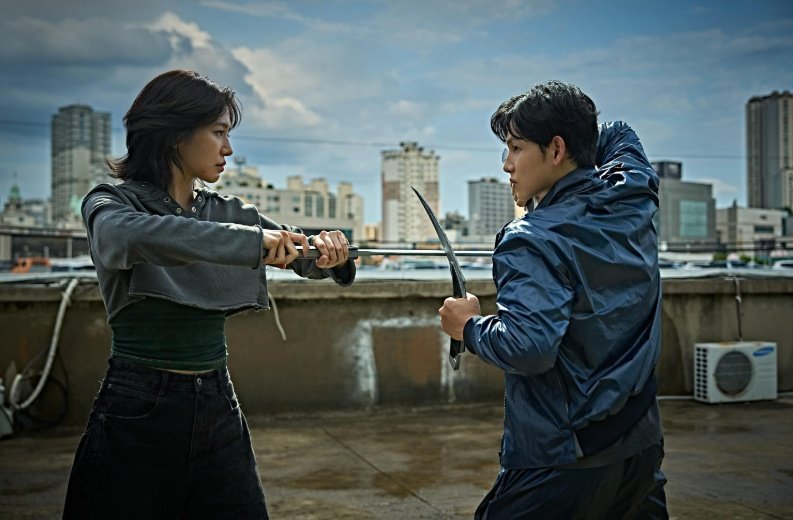
Netflix’s Mantis is more than a story about rival assassins. Beneath its stylish violence lies a conflict about ambition, protection, recognition, and the complicated boundary between caring for someone and controlling their future.
Spoiler Warning: This analysis discusses major character developments and the ending.
1. A World Where Killing Has Become a Business
At first glance, Mantis appears to offer a familiar action-thriller premise: a professional assassin returns to a chaotic industry and finds himself competing against former colleagues, rivals, and mentors.
But the film’s setting is more interesting than a simple criminal underworld. The contract-killing business operates like a corporation. There are companies, executives, contracts, professional reputations, recruitment strategies, and competition for market dominance.
The language of business has replaced much of the traditional language of loyalty. Assassins are not simply feared individuals. They are valuable employees whose abilities can be marketed, negotiated, and exploited.
This is an important continuation of the world introduced in Kill Boksoon. Violence is treated as a profession, and professional success depends on more than physical ability.
Yet Mantis takes this concept in a different direction. Instead of exploring the conflict between professional violence and private family life, it focuses on competition within the industry itself.
That shift creates opportunities, but it also creates a problem: the film’s characters sometimes feel more like pieces in a corporate power struggle than fully developed human beings.
2. Han-ul: A Talented Assassin Who Avoids Making Difficult Choices
Lee Han-ul, known as Mantis, is introduced as an exceptionally capable assassin.
His reputation precedes him, and his skills make him an attractive figure in a market where the old hierarchy is collapsing. However, his personality is not defined by ambition alone.
Han-ul often appears relaxed, playful, and reluctant to take the world too seriously. This attitude makes him different from the conventional image of a cold professional killer.
But his casual personality hides a significant weakness.
He struggles to make clear decisions about the people closest to him. His relationship with Jae-yi is particularly complicated because he wants to protect her while also maintaining a position of emotional importance in her life.
He is capable of making decisive moves when confronting enemies, but much less capable of confronting the consequences of his personal choices.
This contradiction is central to the film. Han-ul understands how to defeat opponents, but he does not fully understand how to respect someone whose ambitions conflict with his own protective instincts.
3. Jae-yi: The Difference Between Being Skilled and Being Recognized
Shin Jae-yi is not simply Han-ul’s female counterpart.
She has her own ambitions, professional identity, and desire to establish herself in a competitive industry. Her frustration comes from more than being underestimated by other assassins.
She also feels that Han-ul does not treat her as an equal.
This distinction matters.
A person can receive assistance while simultaneously feeling that their abilities are being questioned. In Jae-yi’s case, Han-ul’s attempts to protect her become a source of humiliation because she wants to compete on her own terms.
She does not merely want to survive in the industry. She wants to prove that she belongs at the top.
That ambition is not necessarily admirable in every respect. The world she wants to dominate is built on murder. Nevertheless, within the film’s moral framework, her desire for professional recognition is understandable.
Jae-yi’s central conflict is therefore not simply whether she can defeat Han-ul.
It is whether she can establish an identity that does not depend on his judgment.
4. When Protection Becomes a Form of Control
This is arguably the most interesting relationship in Mantis.
Han-ul believes that he is looking after Jae-yi. He tries to manage assignments and shield her from dangerous situations. From his perspective, these actions can be interpreted as affection.
But protection has a hidden danger.
When one person decides what risks another person should take, what opportunities they deserve, and how far they should be allowed to advance, the relationship becomes unequal.
The person being protected loses the right to make their own mistakes.
This is precisely why Jae-yi reacts so strongly. She does not necessarily want Han-ul to stop caring about her. She wants him to stop treating her as someone whose future must be managed.
There is a difference between saying, “I do not want you to get hurt,” and saying, “I will decide what you are capable of handling.”
The first expresses concern. The second assumes authority.
Mantis does not explore this distinction as deeply as it could have, but the tension gives the relationship its strongest dramatic foundation.
5. The Problem With Helping Someone Who Wants Equality
One of the film’s most uncomfortable ideas is that good intentions do not automatically produce respectful behavior.
Han-ul may genuinely care about Jae-yi. His actions do not necessarily come from a desire to destroy her career.
However, intentions are not the only measure of a relationship.
If someone repeatedly makes decisions on behalf of another person, the result can be damaging even when the motivation is affection.
This is particularly relevant in professional environments.
A senior colleague may believe they are helping a younger colleague by keeping difficult assignments away from them. A manager may believe they are protecting an employee by limiting their responsibilities. A partner may believe they are preventing failure by making decisions for someone else.
But assistance becomes oppressive when the recipient has no meaningful say in the matter.
Jae-yi’s anger is rooted in this contradiction. She wants to be treated as a competitor, not as someone whose career depends on another person’s generosity.
The film raises a valuable question: can a person truly support another person’s independence if they cannot accept the possibility that the other person might surpass them?
6. The Assassin Industry: A Corporate World Without Stable Rules
The collapse of the old order creates the film’s larger conflict.
MK Entertainment once represented an established hierarchy. Its structure gave assassins a place within a recognizable professional system.
After the death of its leader, Cha Min-kyu, that structure begins to disintegrate.
Han-ul sees an opportunity to create something new. Dok-go sees an opportunity to restore the old system. Other characters recognize that the changing market may allow them to gain influence.
The result resembles a corporate takeover rather than a conventional gang war.
This is one of the film’s strongest conceptual ideas.
When an organization loses its central authority, the people who once followed its rules must decide whether they believe in the institution or merely benefited from their position within it.
The problem is that the film does not always develop the political and economic implications of this collapse.
We see rivalries and confrontations, but the industry itself could have been explored with much greater depth.
7. Dok-go: The Old Generation Refuses to Disappear
Dok-go represents an older model of authority.
He is not simply another dangerous assassin. He is connected to the previous generation of the industry and has a personal history with Han-ul.
His return introduces a conflict between experience and reinvention.
Han-ul wants to establish a new direction. Dok-go wants to regain control and restore the hierarchy he understands.
Neither position is entirely convincing as a vision for the future.
The old system was built on violence and concentrated power. But the new system is not necessarily more ethical. It simply gives different people an opportunity to compete for dominance.
This makes Dok-go an important figure because he represents the persistence of institutional power.
A system does not disappear merely because its leader dies. Its habits, relationships, and assumptions survive through the people who learned to operate within it.
In this sense, Dok-go is more than Han-ul’s former mentor. He is a reminder that replacing a leader is not the same as changing an organization.
8. Benjamin: When Violence Becomes a Market Opportunity
Benjamin introduces a different kind of power.
Unlike the traditional assassins, he approaches the industry with the instincts of an investor and entrepreneur. He recognizes that the collapse of the old structure creates opportunities for people who can turn violence into a commercial product.
His interest in Jae-yi is particularly revealing.
He recognizes her talent, but his attention is not necessarily an expression of respect. Her abilities also represent an opportunity to build a competing business and weaken existing rivals.
This creates an uncomfortable contrast with Han-ul.
Han-ul tries to protect Jae-yi by limiting her exposure to danger. Benjamin sees her potential as something that can be used to build influence.
Both men approach her through their own interests.
One offers protection that can become restrictive. The other offers opportunity that can become exploitation.
Jae-yi must navigate between these forms of power while trying to establish her own position.
The film could have developed this contrast into a more sophisticated examination of how talented people become valuable assets to competing organizations.
9. Why Recognition Matters More Than Simple Victory
Jae-yi’s conflict with Han-ul is not just about who is stronger.
If physical superiority were the only issue, the relationship would be much simpler. One person wins, the other loses, and the hierarchy becomes clear.
But Jae-yi wants something different.
She wants her abilities to be acknowledged without qualification.
There is a psychological difference between receiving praise and receiving equal treatment. Praise can come from someone who still believes they are superior. Equality requires accepting that the other person has the right to compete independently.
This is why Han-ul’s behavior frustrates her.
Even when he acts out of concern, she interprets his decisions through the larger pattern of their relationship. She does not want to be given opportunities as a favor.
She wants to earn them.
This is a familiar human conflict, even though the film places it inside an extraordinary criminal world.
In workplaces, families, friendships, and romantic relationships, people often become frustrated not because others refuse to help them, but because that help carries an unspoken message: you cannot succeed without me.
10. The Film’s Central Contradiction: Can Love and Competition Coexist?
Han-ul and Jae-yi occupy two conflicting positions.
They have a shared history and emotional connection, but they also want recognition in the same competitive environment.
Their relationship is therefore built on both intimacy and rivalry.
That combination can be dramatically powerful.
Two people can care deeply about each other while wanting different things. They can understand each other’s weaknesses while still refusing to surrender their own ambitions.
But this requires a form of respect that goes beyond affection.
Love does not automatically eliminate competition. Nor does competition necessarily destroy love.
The real problem begins when one person expects affection to take priority over the other’s independence.
Han-ul appears to believe that protecting Jae-yi is an expression of his feelings. Jae-yi wants him to understand that respect means allowing her to make her own decisions.
The film’s most meaningful question is therefore not whether the two characters care about each other.
It is whether they can recognize each other as independent individuals.
11. The Final Confrontation: When Emotional Conflict Becomes Physical Violence
The final confrontation brings the personal and professional conflicts together.
The struggle involving Han-ul, Jae-yi, and Dok-go is not merely a contest between three skilled assassins. It is the moment when unresolved loyalties, competing ambitions, and the collapse of the old hierarchy become impossible to avoid.
Han-ul’s conflict with Dok-go represents his connection to the past. His conflict with Jae-yi represents his inability to separate affection from control.
The confrontation becomes especially tragic because Han-ul’s choices have consequences beyond his own survival.
His desire to protect Jae-yi does not prevent her from entering danger. Instead, it contributes to the misunderstandings that bring them to this point.
Violence becomes the language through which characters express feelings they have failed to resolve through ordinary communication.
This is a familiar device in action cinema, but it works best when the emotional conflict has been developed sufficiently before the fighting begins.
Mantis has the ingredients for such a climax. Whether the film fully earns its emotional impact is a more difficult question.
12. Han-ul’s Death: A Sacrifice That Does Not Resolve Everything
Han-ul’s final fate gives the story its emotional weight.
His death can be interpreted as the ultimate expression of his attachment to Jae-yi. He has spent much of the film trying to protect her, and his final actions reinforce the idea that he is willing to pay the highest price.
But sacrifice does not automatically resolve the problem that caused the conflict.
If Han-ul’s fundamental mistake was failing to recognize Jae-yi as an equal, his death cannot simply erase that mistake.
In fact, there is a painful irony here.
He finally gives everything, but the question remains whether he ever fully understood what she wanted from him.
Jae-yi’s emotional response is important because she is not simply grieving a man who loved her. She is confronting the consequences of a relationship in which affection and misunderstanding existed together.
This is more complicated than a conventional romantic sacrifice.
The film’s tragedy comes from the possibility that two people can care about each other and still fail to give each other what they actually need.
13. Why Mantis Does Not Fully Reach the Potential of Kill Boksoon
The comparison with Kill Boksoon is almost unavoidable.
Both films imagine a professional assassination industry operating according to corporate rules. Both use the contrast between ordinary business language and extraordinary violence to create dark humor.
However, their dramatic priorities differ.
Kill Boksoon builds its central conflict around a woman trying to reconcile two identities: a professional killer and a mother.
That conflict gives the story an emotional structure beyond the criminal organization itself.
Mantis focuses more heavily on the competition between assassins and the struggle for power after the old hierarchy collapses.
This is an interesting direction, but the film’s emotional relationships do not always receive enough development to support its larger ambitions.
Reddit discussions reflect this division. Some viewers appreciated the characters and the continuation of the shared universe, while others criticized the uneven pacing, limited action, and underdeveloped relationships.
One particularly important criticism concerns the final dynamic between Han-ul and Jae-yi: if Han-ul was holding back throughout much of the story, what does that mean for Jae-yi’s efforts to establish herself as his equal?
That question exposes a structural weakness.
The film wants Jae-yi’s independence to matter, but it also preserves Han-ul’s superior position. The result is a conflict that is emotionally interesting but not entirely resolved.
14. The Real Question: Is Protecting Someone the Same as Respecting Them?
Mantis is ultimately more interesting when viewed as a story about recognition than as a story about professional assassins.
Han-ul wants to protect someone he cares about. Jae-yi wants to determine her own future. Dok-go wants to restore an older hierarchy. Benjamin wants to turn the changing industry into an opportunity for power.
Every major character is pursuing a different form of control.
The tragedy is that affection, ambition, and authority repeatedly become confused.
Han-ul’s intentions may be sincere, but sincerity does not guarantee respect. Jae-yi’s ambition may be understandable, but independence does not automatically make her choices morally right. The industry itself may be changing, but a new business model does not make an inherently violent system more humane.
This is where the film offers a question that reaches beyond its fictional world.
When we care about someone, do we give them the freedom to make decisions we disagree with? Or do we try to protect them from every possible failure?
Real respect requires accepting that another person may choose a difficult path, make mistakes, and even become more successful than we are.
That is much harder than simply saying we want the best for them.
Mantis does not completely solve this contradiction. Its uneven storytelling sometimes weakens the emotional force of its ideas. Yet its central relationship leaves behind a worthwhile question:
If you truly care about someone, can you accept that they may no longer need your protection?
Perhaps that is the difference between loving someone and needing to remain important in their life.