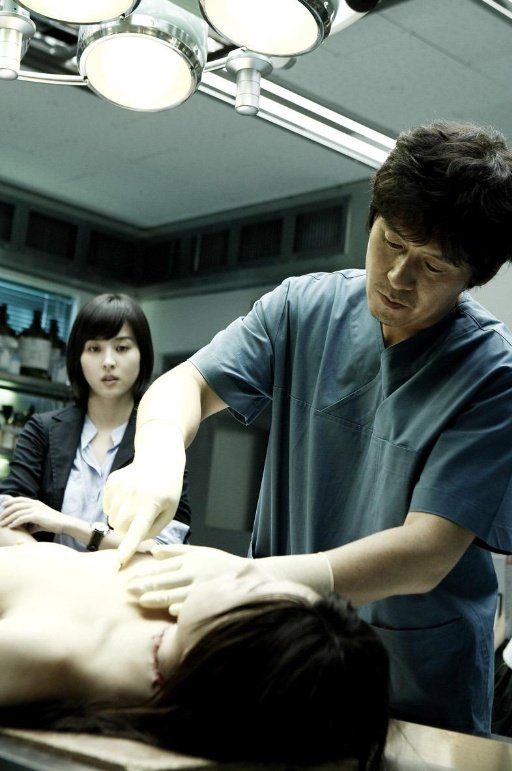
What could be more horrifying than discovering that your missing daughter has been murdered?
In the Korean thriller No Mercy (2010), the answer is even worse: discovering that you have already examined, dissected, and altered the body of your own daughter without knowing it.
Directed by Kim Hyeong-jun and starring Sul Kyung-gu and Ryoo Seung-bum, No Mercy begins as a murder investigation. A woman’s dismembered body is discovered near a river, and forensic pathologist Kang Min-ho is called in to examine the remains. The main suspect, Lee Seong-ho, openly confesses to the crime but makes an extraordinary demand: Kang must help secure his release within three days, or Kang’s daughter will die.
What follows is a psychological battle built around a terrible secret from the past.
But the film’s final twist is not simply about a father losing his daughter. It is about a man being forced to confront the consequences of a lie he once told—and discovering that his professional expertise has become part of his own punishment.
Here is the story, the hidden connection between Kang and Lee, and the ending explained.
1. What Is No Mercy About?
Kang Min-ho is a respected forensic pathologist who is approaching retirement. His daughter, Hye-won, is returning to Korea after spending years abroad, and he hopes to spend more time with her.
Before he can begin that quieter life, he is asked to examine the remains of a woman whose body has been cut into six pieces.
The prime suspect is Lee Seong-ho, an environmental activist who admits to the murder.
Lee claims that the killing was connected to a construction project that would divide a local river into six sections. The explanation sounds ideological, but the evidence does not fit neatly with his confession.
At the same time, Kang receives photographs suggesting that his daughter has been kidnapped.
Lee then makes his demand: Kang must manipulate the forensic evidence and help release him within three days.
The investigation becomes a race against time, but the real mystery is why Lee has chosen Kang for this particular punishment.
2. Why Does Lee Seong-ho Confess So Easily?
Most murder suspects try to deny their involvement, hide evidence, or escape police questioning.
Lee does the opposite.
He admits to the crime almost immediately, but his confession does not make the investigation easier. Instead, it creates more questions.
His explanation about the river construction project appears to provide a political motive for the dismemberment. Yet the forensic evidence and the circumstances surrounding the victim do not support such a simple conclusion.
Lee is not interested in convincing the police that he is innocent.
He wants to control what happens next.
His confession is part of a carefully constructed trap designed specifically for Kang. By appearing cooperative, Lee forces the pathologist into a position where every decision becomes dangerous.
3. Why Does Lee Target Kang Min-ho?
The central conflict is not really between a detective and a criminal.
It is between two men connected by an incident from the past.
Years earlier, Kang was involved in a case concerning Lee’s sister and three men accused of sexually assaulting her. Kang manipulated the forensic findings, helping undermine the case against the accused men.
The consequences were devastating for Lee’s family.
The men escaped meaningful punishment, while Lee’s family was left with the damage caused by the crime and the failure of the justice system.
Lee has never forgotten Kang’s role.
His revenge is designed to make Kang experience the same kind of helplessness and destruction that his own family experienced.
The film gradually reveals that the present murder investigation is not an isolated crime. It is the final stage of a revenge plan rooted in an earlier miscarriage of justice.
4. What Did Kang Do in the Original Case?
Kang’s past is the moral foundation of the entire film.
He was not simply a pathologist who made an innocent mistake. He deliberately manipulated forensic findings for personal reasons.
His actions helped the accused men escape responsibility.
This is important because Kang’s professional reputation is built on the idea that forensic evidence reveals the truth.
He is supposed to be the person who can distinguish fact from speculation, even when a criminal investigation becomes complicated.
But in the earlier case, he used that authority to distort the truth.
The film therefore presents a disturbing contradiction: a man whose career depends on scientific accuracy once used his expertise to help conceal a crime.
His punishment is designed around that contradiction.
5. Why Does Kang Start Tampering With the Evidence?
When Kang receives photographs of his supposedly kidnapped daughter, his priorities change immediately.
He is no longer thinking like a forensic expert.
He is thinking like a desperate father.
Lee tells him that Hye-won will be killed unless he helps secure his release. Kang is given only three days to alter the evidence sufficiently to undermine the case.
He begins changing the forensic findings, even though he understands the consequences.
This is the film’s first major moral reversal.
Kang once manipulated evidence to protect himself and others. Now he manipulates evidence because he believes it is the only way to save his daughter.
The circumstances are different, but the action is disturbingly familiar.
He is once again allowing personal interests to override professional responsibility.
6. Why Is Detective Min Seo-young Important?
Min Seo-young, played by Han Hye-jin, is a young detective involved in the investigation.
She approaches the case with fresh eyes and notices details that do not fit Lee’s confession.
Unlike Kang, she is not emotionally trapped by the supposed kidnapping.
Her investigation gradually exposes the inconsistencies in the case and helps connect the current murder to the earlier events involving Lee’s family.
Seo-young also serves as a moral contrast to Kang.
She is still trying to establish the truth through police work, while Kang is actively destroying the evidence that should lead investigators toward it.
Her growing suspicion makes it increasingly difficult for Kang to control the investigation.
7. Why Does the Murder Victim’s Body Have Six Parts?
The dismemberment is one of the film’s most disturbing visual elements.
Lee claims that the six pieces represent the division of the river caused by the construction project.
On the surface, this makes the murder appear to be an extreme act of environmental protest.
But the explanation is deliberately misleading.
The body itself becomes a message. Lee is using the murder investigation to force Kang into a sequence of decisions, while the police attempt to understand why the evidence does not match the confession.
The six pieces also have a deeper significance once the ending is revealed.
What Kang has been treating as an anonymous collection of forensic clues is actually connected to the person he most wants to protect.
8. Why Does Kang Believe His Daughter Is Still Alive?
Lee provides Kang with photographs and allows him to hear a voice that appears to be Hye-won’s cries for help.
For a father desperate to save his daughter, this is enough to keep hope alive.
Kang believes that she is being held somewhere and that his actions can still determine whether she survives.
That belief becomes the foundation of Lee’s psychological manipulation.
Every time Kang considers refusing the demand, he remembers the photographs and the voice.
He cannot afford to wait for the police to solve the case.
But the film has already planted clues that something is wrong with Lee’s story.
The voice is not proof that Hye-won is alive. It is simply another part of the trap.
9. Why Does Lee Need Kang to Release Him?
Lee could have simply attacked Kang or killed him.
Instead, he creates a situation in which Kang must actively participate in his escape.
That distinction is crucial.
Lee wants Kang to become responsible for the destruction of his own professional integrity.
By forcing him to falsify evidence, Lee makes him repeat the kind of wrongdoing that destroyed Lee’s family.
The revenge is not only physical.
It is psychological and moral.
Lee wants Kang to understand what it feels like to know that the truth is within reach but that the people with power can manipulate it.
The release of Lee is therefore not the final objective. It is one step in a much larger punishment.
10. Why Does Kang Continue Examining the Body?
Kang is a highly experienced forensic pathologist.
He repeatedly examines the remains, searching for details that might help him manipulate the investigation and satisfy Lee’s demands.
There is an especially cruel irony in his professional attitude.
In the morgue, a dead body becomes evidence. The pathologist must examine it objectively, even when the details are unpleasant.
Kang’s expertise allows him to separate his emotions from the work.
But that professional distance is about to become unbearable.
The body he has been examining is not an unknown victim in the way he believes.
The film’s final revelation transforms every earlier autopsy scene into something much more horrifying.
11. What Does Min Seo-young Discover About the Past?
As Seo-young investigates Lee’s background, she begins to uncover the connection between the present case and the earlier incident involving his sister.
The three men connected to that case are no longer simply names from an old investigation.
They are part of a chain of events that has continued into the present.
She also realizes that the current murders and Lee’s confession are connected to a carefully planned revenge operation.
The investigation points toward a terrible possibility: Lee has not merely kidnapped Kang’s daughter to force a confession or secure his release.
He has arranged events so that Kang will suffer a loss that cannot be repaired.
Seo-young’s discoveries arrive too late to stop the full consequences of the plan.
12. Why Does Kang Finally Find Lee?
After Lee is released, Kang follows him.
His desperation has become anger.
He believes that Lee has used his daughter as a bargaining chip and that he can still force Lee to reveal her location.
The confrontation becomes increasingly violent.
Kang is no longer acting like the controlled medical professional seen at the beginning of the film. His fear has turned into rage, and he attacks Lee in an attempt to obtain the truth.
Eventually, Lee gives him an address.
Kang believes he is finally being taken to Hye-won.
But the location is not a rescue site.
It is the place where Lee intends to reveal the final part of his revenge.
13. No Mercy’s Biggest Twist: Whose Body Did Kang Autopsy?
When Kang arrives at the location, he discovers the truth.
His daughter is dead.
But the most devastating part is not simply that Lee has killed her.
The dismembered body that Kang examined throughout the film—the body identified as Oh Eun-ah—was actually Hye-won’s.
The person Kang had been treating as an unidentified murder victim was his own daughter.
He had already performed the autopsy and handled her remains before he understood what had happened.
The photographs and the voice that made him believe she was still alive were part of Lee’s deception.
Hye-won had been dead before Kang began trying to save her.
This is why the ending is so devastating.
Kang did not merely fail to rescue his daughter. He unknowingly participated in the examination and manipulation of her remains while believing he was doing everything possible to protect her.
The earlier scenes are suddenly transformed.
Every clinical decision, every observation, and every alteration of the evidence becomes part of a tragedy he cannot undo.
14. Why Did Lee Make Kang Autopsy His Own Daughter?
This is the most important question in the film.
Lee could have killed Kang’s daughter and simply shown him the body.
But that would not have created the same psychological punishment.
Lee wanted Kang to experience a specific kind of horror: to discover that his professional actions had already become part of the destruction of his own family.
Kang had once manipulated forensic evidence in a case that devastated Lee’s family.
Now Lee makes him manipulate evidence while unknowingly examining his own daughter’s remains.
The parallel is deliberate.
In the past, Kang used his professional authority to help conceal another family’s suffering.
In the present, he is forced to confront the consequences of that decision through his own family.
Lee’s revenge is therefore not simply an eye-for-an-eye punishment.
It is designed to make Kang understand the emotional and moral cost of treating human suffering as something that can be altered on paper.
15. Why Does Kang Shoot Lee and Then Himself?
After discovering the truth, Kang is overwhelmed by grief and guilt.
Lee tells him that he will now have to live with the same pain that destroyed Lee’s family.
Detective Seo-young tries to stop Kang from killing Lee.
But Kang shoots Lee.
When the police arrive, Kang turns the gun on himself and dies.
His suicide can be understood in several ways.
First, he has lost the daughter he was desperately trying to save.
Second, he has discovered that his own professional actions have become part of her death.
Finally, he has to face the truth about the earlier case. His suffering is not simply the result of an innocent man being targeted by a cruel criminal. It is also connected to a serious wrongdoing he committed himself.
Kang’s death does not restore justice.
Lee is dead, Hye-won is dead, and the original victims of the earlier case cannot recover what they lost.
The revenge has destroyed the people involved without repairing the original injustice.
16. No Mercy Ending Explained: Is Lee’s Revenge Justice or Another Crime?
The final voiceover leaves the audience with the film’s central question: hatred is easy, but forgiveness is difficult.
The statement is not a simple invitation to forgive Lee.
His revenge is horrific. Hye-won was not responsible for Kang’s past wrongdoing, yet she becomes the central victim of his punishment.
Lee has transformed his legitimate anger over an injustice into a new act of violence against an innocent person.
At the same time, Kang cannot claim to be entirely innocent.
He helped distort the truth in the earlier case, and that decision contributed to the suffering of Lee’s family.
The film refuses to give the audience a comfortable moral answer.
Kang deserves to be held accountable for his actions, but does that mean his daughter deserves to die?
Lee was failed by the justice system, but does that give him the right to destroy another family?
The answer is no.
That is what makes the title No Mercy so meaningful.
There is no mercy in the original injustice. There is no mercy in Lee’s revenge. And there is no mercy in the final punishment Kang inflicts on himself.
The tragedy is that every character becomes trapped in a cycle of suffering that no one can reverse.
The cruelest twist is not simply that Kang autopsied his own daughter. It is that he spent the entire film believing he was fighting to save her, when the truth was already lying on his examination table.
Is There a Post-Credits Scene in No Mercy?
There is no widely documented additional narrative scene after the credits that changes the story.
The film’s final voiceover is part of the ending itself. Its reflection on hatred and forgiveness provides the final thematic statement.
Viewers should not confuse that closing narration with a separate post-credits scene.
The Real Horror of No Mercy
Many revenge thrillers ask whether revenge can ever be justified.
No Mercy asks a more uncomfortable question: what happens when the person seeking revenge has genuinely been wronged, but chooses to punish someone who is not responsible for that original crime?
Lee’s anger has a history. Kang’s guilt has a history. Neither man can escape the past.
But the person who pays the highest price is Hye-won, who becomes a victim of a conflict she did not create.
That is why the film’s ending remains so difficult to forget.
The final horror is not just a shocking plot twist. It is the realization that professional corruption, institutional failure, and personal revenge can combine to destroy people who never had a chance to defend themselves.