The NFL is about to do something it has never done before.
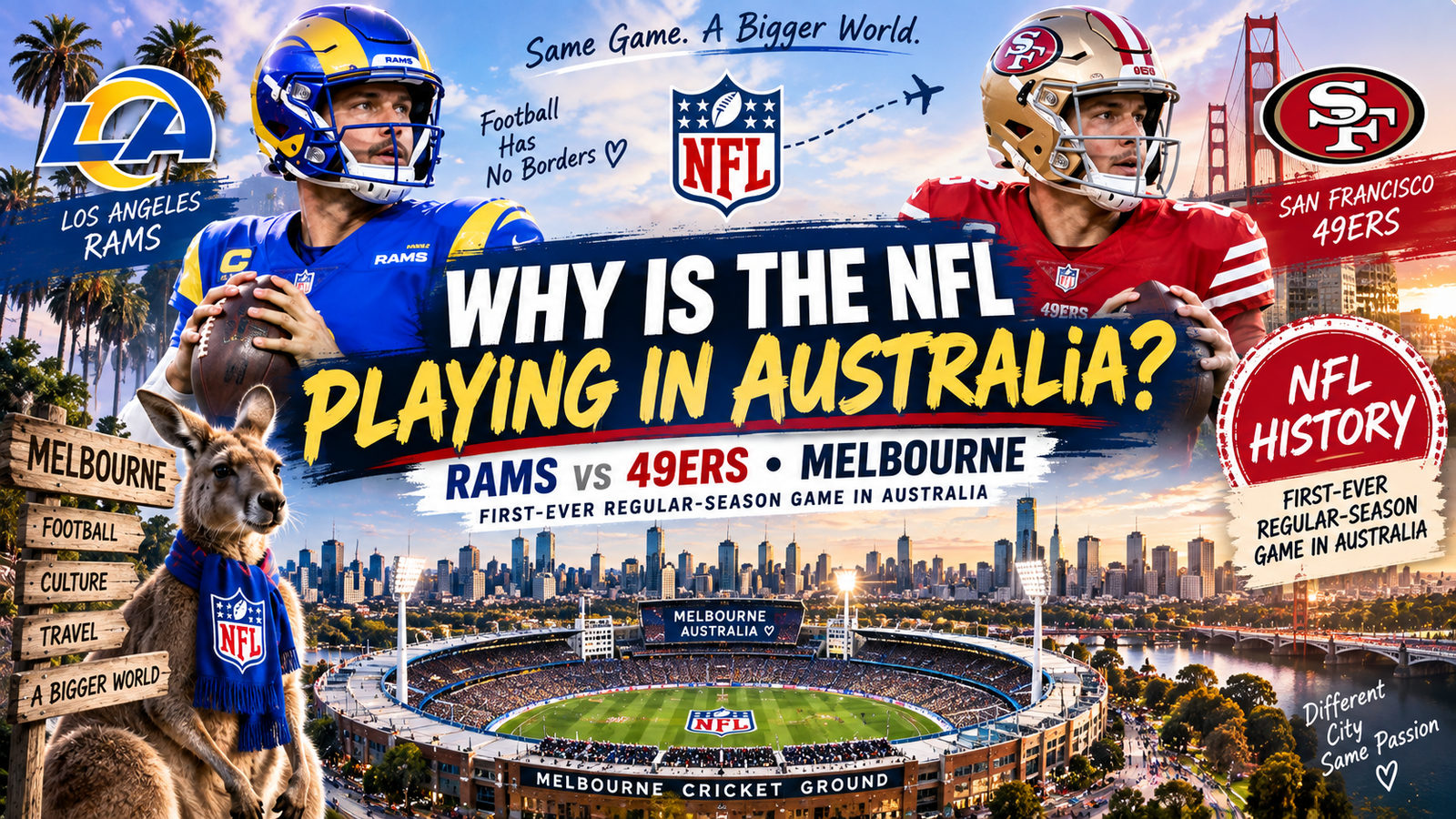
On September 11, the Los Angeles Rams and San Francisco 49ers will walk onto one of the world’s most famous sporting grounds.
But they won’t be in Los Angeles.
They won’t be in San Francisco.
They won’t even be in the United States.
They’ll be nearly 8,000 miles away in:
Melbourne, Australia.
The Rams and 49ers will play at the iconic Melbourne Cricket Ground (MCG) in the first NFL regular-season game ever held in Australia.
Kickoff is scheduled for 10:35 a.m. Australian Eastern Standard Time on Friday, September 11, which is 8:35 p.m. ET on Thursday, September 10 in the United States.
And this isn’t an exhibition.
It counts.
Two NFC West rivals will begin their season thousands of miles from home, playing a real regular-season game with playoff implications.
Which raises an obvious question:
Why is the NFL playing a game in Australia?
The answer is much bigger than one game.
Australia is part of the NFL’s increasingly aggressive plan to transform American football into a genuinely global sport.
And Melbourne may be only the beginning.
Rams vs. 49ers Melbourne Game: The Basics
First, here is what has been officially confirmed.
Game: Los Angeles Rams vs. San Francisco 49ers
Date: Friday, September 11, 2026 in Australia
Kickoff: 10:35 a.m. AEST
U.S. time: Thursday, September 10 at 8:35 p.m. ET
Venue: Melbourne Cricket Ground
City: Melbourne, Victoria, Australia
Status: NFL regular-season game
U.S. broadcast: Netflix
The NFL describes it as its first-ever regular-season game in Australia.
That alone makes the game historic.
But it is also part of something much larger happening to the NFL in 2026.
Why Australia?
The simplest answer is:
The NFL wants more fans outside the United States.
The league has already spent years expanding internationally.
London has hosted NFL games for years.
Games have also been played in markets including Germany, Mexico, Brazil, Spain and Ireland.
But 2026 represents a major acceleration.
The NFL will stage a record:
9 international games
across:
7 countries
and:
4 continents.
The international schedule includes games in Australia, Brazil, England, France, Germany, Mexico and Spain.
Melbourne isn’t a random experiment.
It’s part of a deliberate global expansion strategy.
The NFL Wants Its Next 50 Million Fans
Here’s where the story becomes much more interesting.
The NFL’s international ambitions are not small.
The league is targeting approximately:
50 million additional fans outside the United States.
Reuters recently reported that the NFL sees international markets as one of the major opportunities for future growth.
Australia is considered one of those strategic markets.
Why?
Because Australians already love sports.
Australia has enormous audiences for:
Australian rules football,
rugby league,
rugby union,
cricket,
soccer,
tennis,
Formula One
and other major competitions.
The NFL isn’t trying to introduce sports culture to Australia.
It’s trying to convince one of the world’s most passionate sporting populations to add American football to the list.
Australia Already Has Millions of NFL Fans
The NFL isn’t arriving in a country where nobody knows what a touchdown is.
The league says Australia already has millions of NFL fans.
Earlier NFL figures put the Australian fan base at more than 7.5 million, while more recent industry estimates cited by Reuters put the potential self-identified NFL audience even higher.
The league has also been building infrastructure in Australia for years.
It opened an Australia and New Zealand office in 2022.
It expanded flag football programs.
And in 2024, the NFL launched its Academy APAC, designed to help develop young American-football talent from the Asia-Pacific region.
So the Melbourne game isn’t the beginning of the NFL’s Australian strategy.
It’s the most visible result of a strategy that has already been developing for years.
Why the Rams?
The Los Angeles Rams are particularly important to this story.
NFL teams can receive international marketing rights through the league’s Global Markets Program.
The Rams have held marketing rights in Australia since 2021 and have been actively building their presence in the country.
That has included partnerships, promotional events and player appearances.
The Rams therefore make sense as one of the teams chosen to headline Australia’s first regular-season game.
But the opponent makes the matchup even better.
Why the 49ers?
The San Francisco 49ers are one of the NFL’s most recognizable franchises.
They also bring something extremely valuable to an international event:
an established rivalry.
Rams vs. 49ers isn’t a manufactured international exhibition.
Both teams play in the NFC West.
They meet regularly.
They compete directly for divisional position.
And both entered the 2026 season with serious expectations.
NFL.com described the Australian game as one of the highest-profile international matchups of the season, featuring two 2025 playoff teams.
That matters.
If the NFL wants Australians to care about American football, sending two recognizable rivals is far more compelling than sending a meaningless preseason matchup.
This Is a Real Game — Not an Exhibition
This is probably one of the biggest questions casual fans will have.
Does the Melbourne game actually count?
Yes.
It is a regular-season NFL game.
The result goes into the Rams’ and 49ers’ official records just like a game played in Los Angeles or San Francisco.
Division standings matter.
Playoff positioning matters.
Tiebreakers can matter.
Every win matters.
That gives the Australian event something previous overseas promotional tours in many sports often lacked:
consequences.
The players aren’t traveling across the Pacific simply to entertain a foreign audience.
They’re trying to win an NFL game.
Why Play at the Melbourne Cricket Ground?
Then there is the stadium.
The Melbourne Cricket Ground — better known simply as the MCG — is one of the world’s great sporting venues.
It is famous for cricket and Australian rules football.
Now it is being transformed for American football.
The contrast is part of what makes the event visually fascinating.
Imagine an NFL field, goalposts, sidelines, massive video production, team facilities and American-football operations installed inside one of Australia’s most iconic sporting venues.
Reuters reported that staging the event has required a huge logistical operation developed over nearly two years.
This isn’t simply:
Fly two teams to Australia and play football.
An entire NFL game-day ecosystem has to travel with them.
The Logistics Are Wild
NFL teams normally operate inside a highly controlled environment.
Equipment managers know the stadium.
Players know the travel schedule.
Teams move equipment using familiar domestic logistics.
Australia changes everything.
The Pacific Ocean is suddenly part of the road trip.
Reuters reported that the operation involves moving roughly 59 metric tons of equipment into Australia as the NFL transforms the MCG for the event.
Think about what an NFL team requires:
helmets,
shoulder pads,
uniforms,
medical equipment,
training equipment,
communications systems,
technology,
sideline equipment,
footballs,
coaching equipment
and countless smaller items.
Then add the broadcast infrastructure and stadium conversion.
This is closer to moving a temporary sporting industry across the Pacific than simply organizing a football game.
What About the 15-Hour Flight?
And then there are the players.
The 49ers have already arrived in Melbourne following a flight of roughly 15 hours, giving the team several days to adjust before kickoff.
That’s important because crossing the Pacific introduces one of the most unusual variables in an NFL game:
jet lag.
Players have to adapt to:
a different time zone,
different sleeping hours,
a different daily routine,
long-distance travel,
and an unfamiliar stadium environment.
Teams already spend enormous amounts of time optimizing sleep, nutrition and recovery.
An intercontinental flight adds another layer.
That’s why teams aren’t simply arriving the night before the game.
They need time to acclimate.
Why Is the Game on Friday Morning in Australia?
Another strange detail for Australian fans is the kickoff time.
The game starts at:
10:35 a.m. Friday in Melbourne.
Why would the NFL play professional football on a weekday morning?
Because television changes everything.
At 10:35 a.m. Friday in Melbourne, it is Thursday evening in the United States.
That allows the game to fit into a prime U.S. viewing window while still taking place during the day in Australia.
For American audiences, the game begins at:
8:35 p.m. Eastern Time Thursday
and approximately:
5:35 p.m. Pacific Time Thursday.
The unusual schedule is a perfect example of the challenge facing global sports leagues.
The NFL isn’t scheduling for one country anymore.
It has to serve audiences on opposite sides of the planet simultaneously.
And Netflix Is Broadcasting It
Another reason this game deserves attention:
Netflix will carry the game in the United States.
That fits another major change happening in sports.
Live sports are increasingly moving beyond traditional television networks.
Streaming platforms want the kind of programming people feel they must watch live.
Sports provides exactly that.
The Melbourne game combines two experiments at once:
geographic expansion
and
streaming expansion.
The NFL is testing how far its product can travel — both physically and digitally.
The Jonas Brothers Are Playing Halftime
The NFL is also treating Melbourne like a major entertainment event rather than simply dropping a football game into Australia.
The league announced that the Jonas Brothers will headline the halftime show at the MCG.
That tells us something about the NFL’s strategy.
The league understands that many Australians attending the game may not be lifelong American-football fans.
So the event needs to be bigger than football.
It becomes:
football,
music,
fan festivals,
American sports culture,
merchandise,
food,
and entertainment.
In other words:
The NFL is selling the experience before it sells the sport.
Melbourne Is Getting an NFL Festival Too
The game itself isn’t the only event.
The NFL is also staging a multi-day Kickoff Festival in Melbourne around the historic matchup.
The league has promoted several days of football-themed fan experiences surrounding Australia’s first regular-season game.
Again, this shows the long-term strategy.
If the NFL simply wanted television viewers, it could broadcast games into Australia from the United States.
Instead, it is creating a physical NFL experience inside Melbourne.
That’s how a television viewer becomes a fan.
And eventually, perhaps, a customer.
Why the NFL Doesn’t Want This to Be a One-Off
This might be the most important part of the story.
The NFL doesn’t appear to view Melbourne as a one-time publicity stunt.
League executives have said Australia is a strategic market and that they would like games there to become a regular fixture.
NFL Commissioner Roger Goodell has also said the league could return as early as 2027.
So September 11 may eventually be remembered not simply as:
the NFL’s Australian game
but as:
the first NFL Australian game.
That’s a much bigger distinction.
Could Australia Get an NFL Team?
This is where fans inevitably go next.
If the NFL keeps playing games in Australia, could Melbourne or Sydney eventually get a permanent franchise?
Realistically, that would be extraordinarily difficult.
The distance from the United States is enormous.
A permanent Australian NFL team would create major challenges involving:
player travel,
scheduling,
recovery,
free agency,
families,
taxation,
broadcasting
and competitive fairness.
Even London — much closer to the United States and a long-established NFL international market — still does not have a permanent franchise.
So an Australian NFL team should not be confused with what the league is currently doing.
Regular Australian games are plausible.
A permanent Australian NFL franchise is a completely different question.
For now, the NFL appears focused on building the audience rather than relocating or creating a team.
The NFL’s Global Strategy Is Accelerating
Australia is only one piece of a remarkable 2026 international schedule.
The league’s nine international games span seven countries.
New markets include:
Melbourne
Paris
and
Rio de Janeiro
alongside established or returning destinations such as London, Munich, Madrid and Mexico City.
The 49ers themselves will play internationally again later in the season when they face the Minnesota Vikings in Mexico City.
The NFL is no longer asking:
Should we play internationally?
The question has become:
How many international markets can we develop simultaneously?
Why Does the NFL Need International Growth?
The NFL already dominates American sports financially.
So why bother?
Because the United States has a finite population.
International growth creates new potential:
viewers,
streaming subscribers,
merchandise buyers,
sponsors,
media-rights deals,
fantasy-football players,
youth participants
and future generations of fans.
Reuters reported that the league’s owners are prepared to support the international strategy over the long term rather than expecting immediate returns from every market.
That’s important.
Building a sports culture takes time.
You can’t create generations of fandom with one game.
But you can start.
Flag Football Could Make the NFL Even More Global
Another development may help enormously.
Flag football will make its Olympic debut at Los Angeles 2028.
That gives the NFL an international growth tool traditional tackle football has never had.
Flag football is:
cheaper,
safer,
easier to organize,
and requires less specialized equipment.
The NFL says almost 100,000 participants across more than 500 Australian schools are already involved in flag football programs.
A child in Australia doesn’t need to become a 300-pound offensive lineman to participate in American football culture.
They can play flag football.
Watch the NFL.
Choose a team.
Buy a jersey.
Follow players.
And potentially become a fan for decades.
That is the long game.
Why Australia Could Be Especially Valuable
Australia also occupies a strategically interesting position geographically.
Success there could strengthen the NFL’s presence throughout the Asia-Pacific region.
And the league is already looking farther north.
NFL international executives recently identified Japan as another market of interest as the league evaluates future expansion opportunities.
Imagine the longer-term possibilities:
Australia.
Japan.
Perhaps additional Asian markets.
The NFL’s center of gravity would still remain overwhelmingly American.
But its audience would become increasingly global.
Is This Good for Rams and 49ers Fans?
Not everyone will love it.
If you’re a season-ticket holder, losing a domestic home game to another continent can be frustrating.
Players also have to deal with enormous travel.
And because Rams vs. 49ers is a divisional rivalry, fans may reasonably argue that such an important game belongs in California.
Those concerns are legitimate.
International expansion creates winners and trade-offs.
The NFL gains global exposure.
Australian fans get a historic event.
But some American fans lose the opportunity to attend a regular-season matchup at home.
As international games increase, that tension may become more important.
Could International Games Eventually Become Normal?
Probably.
The NFL already has approval to schedule up to 10 international games per season beginning in 2027, according to Reuters.
That doesn’t mean it will immediately use every available slot.
But the direction is obvious.
For an earlier generation of NFL fans, a regular-season game in Europe seemed strange.
Now London games are routine.
Germany followed.
Brazil followed.
Spain followed.
Australia is next.
Paris and Rio are joining the map.
At some point, the unusual thing may no longer be an NFL game played overseas.
It may be a season without one.
Why Rams vs. 49ers in Melbourne Matters
It’s tempting to see this simply as another Week 1 game.
It isn’t.
On the field, it is:
Rams vs. 49ers.
Off the field, it is:
NFL vs. geography.
Can America’s most powerful sports league export an experience deeply rooted in American culture to the opposite side of the planet?
Can Australian sports fans develop the same emotional attachment Americans have to NFL teams?
Can a 15-hour flight become a normal part of an NFL season?
Can a cricket ground become an American-football stadium?
Can international games create lifelong fans rather than temporary curiosity?
The NFL is about to find out.
What to Watch on September 11
Of course, the football matters.
The Rams and 49ers are division rivals, and both have major ambitions.
But if you’re interested in the future of American sports, watch something else too.
Watch the crowd.
Listen to how Australians react.
Look at the jerseys.
Watch the fan events.
See whether the atmosphere feels like an imported American spectacle — or the beginning of an Australian NFL tradition.
Because that may tell us more about the importance of this game than the final score.
Final Thoughts: This Game Is About Much More Than Football
On September 11, the ball will be kicked off at the Melbourne Cricket Ground.
For approximately three hours, the Rams and 49ers will play football.
One team will probably win.
One will lose.
Then the NFL standings will move on.
But the more important result may take years to measure.
The NFL wants tens of millions of new fans outside the United States.
Australia is one of its biggest new experiments.
The league has already built local programs, invested in the market and transported an enormous event across the Pacific.
Now comes the real test.
Will Australians simply watch an NFL game?
Or will they start becoming NFL fans?
If Melbourne works, don’t expect the NFL to stop there.
The next frontier of America’s biggest sport may increasingly be found outside America.
And on September 11, one of the most important steps in that journey will happen at a cricket ground in Australia.
Official Game Information
The official NFL Melbourne page confirms the Rams vs. 49ers game at the MCG on Friday, September 11 at 10:35 a.m. AEST.
Official NFL Melbourne Game Page
For official game-day procedures, entry information and stadium guidance:
NFL Melbourne Game Day Guide