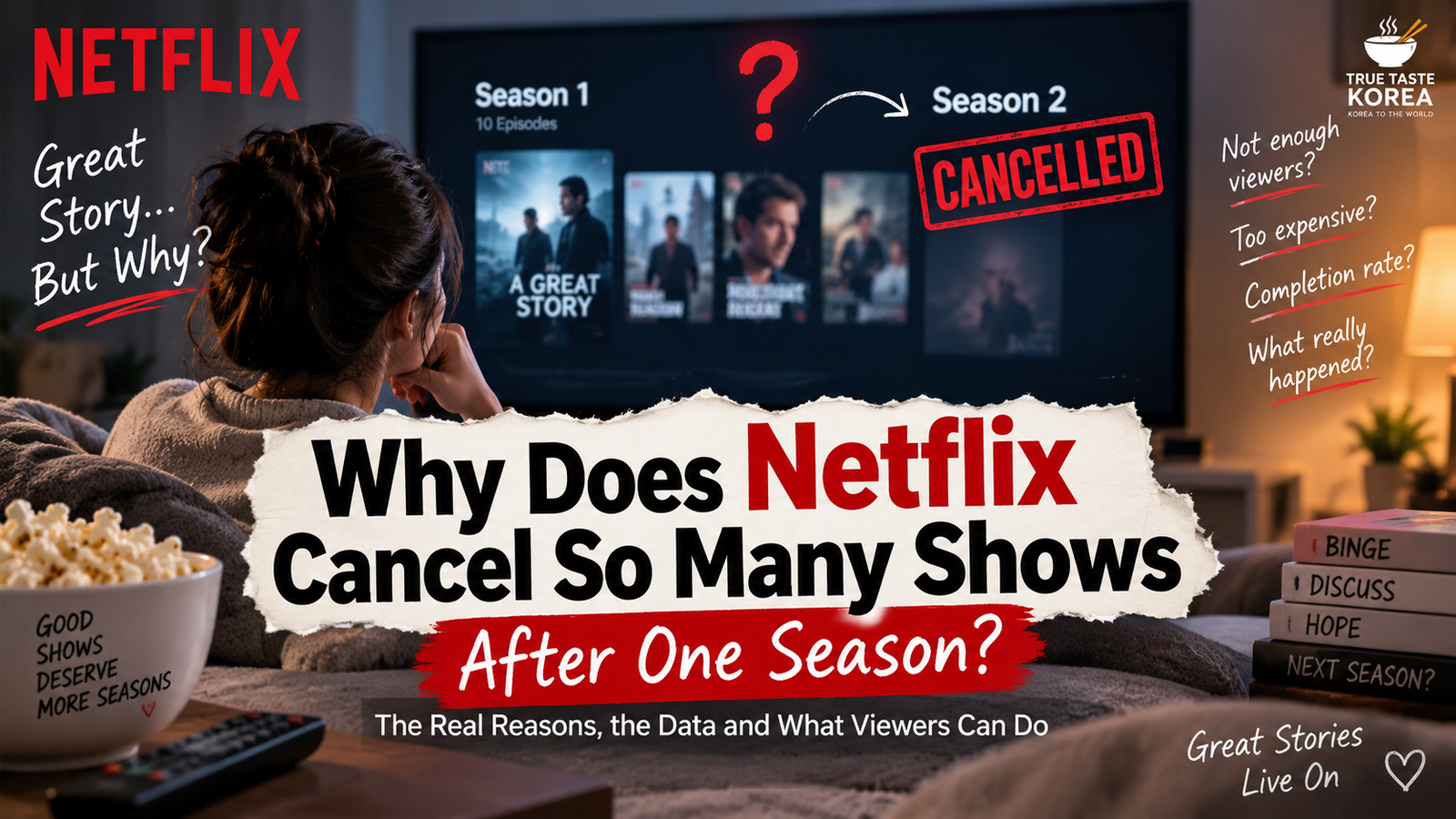
You find a new Netflix series.
You watch one episode, then another. By the weekend, you’ve finished the entire season.
Then comes the cliffhanger.
You wait for Season 2.
And a few weeks or months later, the news arrives:
Canceled.
If this sounds familiar, you’re not alone.
One of the most persistent complaints among Netflix viewers is that the streaming service seems willing to cancel shows before they have enough time to build an audience.
In September 2026, the frustration resurfaced strongly on Reddit. One discussion asking why viewers should invest in new shows when so many disappear after one season attracted hundreds of votes. Just days later, another highly active discussion complained specifically about shows being canceled after ending on major cliffhangers.
So why does Netflix cancel shows so quickly?
The answer is more complicated than simply:
“Not enough people watched.”
Netflix considers audience size, cost, viewer behavior and whether a show continues growing after people press play.
And Netflix’s own executives have actually explained some of those factors.
Let’s break it down.
Why Does Netflix Cancel Shows?
Netflix co-CEO Ted Sarandos gave one of the clearest explanations in 2026.
When discussing cancellation decisions, Sarandos said they are business decisions based on the audience relative to the cost of the show.
But he also pointed to several other signals.
Netflix looks at questions such as:
- Do people press play?
- Do viewers continue watching until the end?
- Do they respond positively to the show?
- Does the audience continue growing?
In other words, getting millions of people to sample Episode 1 isn’t necessarily enough.
Netflix wants to know what happens after people start watching.
That distinction explains a lot.
1. A Show Can Be Popular and Still Be Too Expensive
Imagine two Netflix series.
Show A
10 million viewers
Production cost: relatively low
Show B
15 million viewers
Production cost: extremely high
At first glance, Show B looks like the bigger success.
But Netflix isn’t judging those numbers in isolation.
The company has previously explained that success depends partly on the size of an audience relative to the economics of the title.
That means an expensive fantasy or science-fiction series may need a much larger audience than a relatively inexpensive drama or reality series.
Big sets, visual effects, international locations and large casts can make subsequent seasons increasingly expensive.
So the real question isn’t simply:
How many people watched?
It’s closer to:
Was the audience large enough to justify what this show costs?
2. Starting a Show Isn’t the Same as Finishing It
This is one of the most important pieces of the puzzle.
Imagine 20 million people start watching a new series.
That sounds fantastic.
But what if a huge percentage of those viewers abandon it after Episodes 1 or 2?
Netflix can see that behavior.
Sarandos specifically mentioned whether viewers who press play continue through to the end when describing the factors behind business decisions.
This helps explain why two shows with apparently similar popularity can receive very different renewal decisions.
One may have an audience that binges the entire season.
Another may attract enormous curiosity initially but lose viewers rapidly.
From Netflix’s perspective, those are very different signals.
3. Netflix Also Wants to See Growth
Another important signal is momentum.
Sarandos also referenced whether a show keeps growing.
Think about what happens when a genuine streaming hit emerges.
Someone watches it.
They recommend it to a friend.
Clips spread across TikTok.
People discuss it on Reddit.
Google searches increase.
More people start watching.
Netflix’s own 2026 engagement report emphasizes this idea of discovery and continued engagement. In the first half of 2026 alone, Netflix members watched more than 97 billion hours of programming.
For Netflix, the strongest series aren’t merely watched.
They become something viewers continue discovering.
4. Returning Seasons Can Revive Older Seasons
This is where Netflix’s strategy becomes particularly interesting.
A successful Season 2 doesn’t only generate views for Season 2.
It can revive Season 1.
Netflix reported that when Bridgerton Season 4 arrived, viewing of every earlier season nearly tripled compared with the second half of 2025.
The entire Bridgerton franchise generated approximately 180 million views during the first half of 2026.
Netflix reported similar renewed interest in earlier seasons of shows including:
ONE PIECE, The Night Agent, Virgin River and The Lincoln Lawyer.
That helps explain why Netflix values franchises that can keep bringing audiences back.
A successful renewal can make the entire catalog more valuable.
5. So Does Netflix Really Cancel Almost Everything?
This is where perception and data start to diverge.
Netflix unquestionably cancels shows.
But the popular idea that virtually every new Netflix series gets canceled after one season is exaggerated.
An independent analysis of U.S. scripted Netflix originals found that in recent years, approximately:
40–45% of new series were renewed,
35–40% were limited series designed to end,
and roughly 20–25% were outright cancellations.
For U.S. scripted series released in 2025, the analysis found that approximately one-quarter of new shows ended prematurely.
When returning shows were included, the overall cancellation rate was about 19%.
That is still enough canceled shows to frustrate viewers.
But it isn’t the same as Netflix canceling most of its programming.
The Real Danger May Be Getting to Season 3
Here’s an even more interesting finding.
According to that same decade-long analysis of U.S. scripted Netflix originals, excluding limited series, roughly two-thirds of new series eventually received a second season.
But only around one-third reached Season 3.
That’s a dramatic drop.
Why?
One likely reason is economics.
Successful actors can negotiate higher salaries.
Production becomes more complicated.
Expectations increase.
Meanwhile, Netflix needs the audience to remain large enough to justify continuing the investment.
So Season 1 isn’t the only dangerous point.
The transition from Season 2 to Season 3 can be even more difficult.
Why Netflix Cancellations Feel Worse Than the Numbers Suggest
If roughly one in five shows gets canceled, why does it feel like Netflix cancels everything?
There are several reasons.
Cliffhangers make cancellations memorable
A completed limited series can disappear from public conversation without much anger.
But when a series ends with:
a missing character,
an unresolved murder,
a surprise villain,
a secret identity,
or a giant cliffhanger…
and then gets canceled?
People remember it.
That’s exactly what viewers were complaining about in a fast-growing Reddit discussion this week, citing unfinished shows such as Lockwood & Co., Fate: The Winx Saga and Shadow and Bone.
The emotional impact is much stronger.
A Strange Problem: Viewers May Start Waiting for Renewal
This leads to a fascinating feedback loop.
Some Reddit users are now saying they hesitate to start new Netflix shows until they know another season is coming.
One highly active discussion essentially asked:
Why get attached if Netflix might cancel it?
Another commenter suggested that cancellations themselves may discourage people from watching later seasons.
That creates a potential paradox.
Netflix wants strong early engagement before renewing a show.
But some viewers may delay watching because they want renewal certainty first.
The cycle looks like this:
Netflix wants early viewers
↓
Viewers fear cancellation
↓
Some wait before watching
↓
Early engagement may weaken
↓
Renewal becomes harder
This doesn’t prove that viewer hesitation causes cancellations.
But it does explain why the issue has become such an emotional topic among streaming audiences.
Does Netflix Care Whether You Finish a Show?
Yes — based on Sarandos’ own explanation, viewing behavior beyond simply pressing play matters.
He specifically cited whether viewers who start a program watch through to the end, along with positive feedback and continued audience growth.
That means finishing a series can send a different engagement signal than abandoning it after one episode.
However, there is an important caveat.
Netflix does not publicly release a simple formula such as:
“60% completion guarantees Season 2.”
There is no publicly disclosed universal threshold.
Anyone claiming that a specific completion percentage automatically determines renewal is oversimplifying the process.
What About Netflix’s Thumbs-Up Button?
Viewer feedback appears to matter too.
Sarandos included whether viewers give a show positive feedback among the factors Netflix can consider.
But again, this shouldn’t be interpreted as:
“Hit thumbs-up and Netflix will save your favorite show.”
Audience size and economics still matter.
A small but passionate fanbase may love a series while the production remains too expensive relative to the total audience.
Netflix is balancing both.
Why Limited Series Have Become So Common
You’ve probably noticed another trend.
Netflix releases a lot of shows labeled:
Limited Series.
That’s not accidental.
The independent analysis of Netflix’s U.S. scripted catalog found that limited series represented only about 7% of new releases in 2016, but had grown to roughly 35–40% in recent years.
For viewers, a limited series offers one major advantage:
You know you’re supposed to get an ending.
For Netflix, it reduces the pressure of making repeated renewal decisions.
And that may explain why self-contained stories have become such an important part of streaming television.
One Important Distinction: Canceled vs. Removed From Netflix
These two things are often confused.
A Netflix original series being canceled means another season isn’t being produced.
A movie or series leaving Netflix can be an entirely different issue.
Netflix licenses many titles from outside studios.
When those licenses expire, Netflix says it considers factors such as whether the rights remain available, regional popularity and licensing cost before deciding whether to renew them.
So when an older show disappears from Netflix, it doesn’t necessarily mean Netflix “canceled” it.
It may simply be a licensing decision.
What Can Viewers Actually Do?
There is no magic button that guarantees renewal.
But if you genuinely want a show to continue, the signals that appear most relevant are straightforward:
Watch it.
Finish it if you enjoy it.
Recommend it to other people.
Use Netflix’s rating tools.
And perhaps most importantly:
Don’t assume that simply adding a show to your list sends the same signal as actually watching it.
Netflix’s business ultimately depends on people choosing something and staying to watch it.
So Why Does Netflix Cancel So Many Shows After One Season?
The simplest answer is:
Because popularity alone isn’t enough.
Netflix appears to weigh several factors together:
Audience size + viewer retention + audience growth + viewer response + production economics.
A show can have passionate fans and still fail that equation.
A cheaper show with a smaller but highly engaged audience may survive.
An expensive show with more viewers may not.
And sometimes a show that feels enormously popular online may simply not have enough actual viewing behind it.
That’s the uncomfortable reality of streaming television.
The Bigger Problem Netflix May Eventually Face
Netflix’s cancellation strategy makes sense from a business perspective.
But there’s another side to the equation.
Trust.
If enough viewers become convinced that starting a new Netflix series is risky, they may begin waiting for renewal announcements before watching.
The Reddit discussions appearing this week suggest that at least some viewers already feel this way.
And that’s where the economics become interesting.
Netflix needs viewers to take a chance on new shows.
But viewers increasingly want Netflix to take a chance on those shows first.
That may be the real tension behind the question:
“Why does Netflix keep canceling shows?”
What do you think?
Have you ever stopped watching — or refused to start — a Netflix series because you were worried it would be canceled?
And which canceled Netflix show do you most wish had received one more season?
Tell us in the comments.
Related Reading
Want to explore Netflix’s official viewing data? Check out Netflix — What We Watched: First Half of 2026 for Netflix’s latest engagement report.
Discover K-Beauty at OLIVE YOUNG Global
Interested in Korean skincare, makeup, and beauty products? Explore popular K-Beauty products at OLIVE YOUNG Global.
Shop K-Beauty at OLIVE YOUNG Global
This is an affiliate link. I may earn a commission from qualifying purchases at no additional cost to you.