Mousetrap Explained

  • Why Did the Rat Do It in Mousetrap? The Ending’s Real Meaning Explained

    If you finished Mousetrap knowing who the Rat is but still felt that something was missing, you are probably asking the more important question:

    Why did the Rat do it?

    Discovering the Rat’s identity solves the mystery on the surface.

    But Mousetrap becomes much more interesting when we stop asking only “Who?” and start asking “Why?”

    The ending is not simply about revealing a hidden person.

    It is about understanding how suspicion, fear and manipulation can change the way people see everyone around them.

    Knowing the Rat’s Identity Is Only Half the Ending

    Mystery dramas train us to look for a culprit.

    We collect clues, suspect different characters and wait for the final reveal.

    That makes the identity of the Rat the most obvious question surrounding Mousetrap.

    But once that question is answered, another one remains.

    What was the Rat actually trying to achieve?

    That question matters because the Rat’s actions affect much more than the immediate mystery.

    They change relationships.

    They create distrust.

    And most importantly, they force other characters to make decisions while they do not fully understand what is happening around them.

    The Rat’s Greatest Weapon Is Not Physical Power

    One of the most interesting ways to understand the Rat is to stop thinking of the character simply as an enemy hiding among other people.

    The Rat’s real advantage is information.

    The Rat knows more than the people being manipulated.

    That imbalance creates power.

    When one person understands the situation while everyone else is working with incomplete information, even ordinary actions can become dangerous.

    A conversation can create suspicion.

    A missing detail can change an interpretation.

    And one carefully timed action can make innocent people begin doubting each other.

    That is why the Rat becomes frightening.

    The Rat does not need to control everyone directly.

    The characters can begin destroying their own trust for the Rat.

    Why Does Everyone Become Suspicious?

    This is where the title Mousetrap becomes especially interesting.

    A trap works because the victim does not fully understand the environment.

    The characters believe they are making independent decisions.

    But many of those decisions are influenced by fear and incomplete information.

    Once suspicion enters the group, almost anyone can look guilty.

    A strange expression becomes evidence.

    Silence becomes suspicious.

    Even an attempt to help someone can be interpreted as manipulation.

    The mystery therefore becomes larger than the identity of one hidden person.

    The entire group is psychologically trapped.

    The Rat Needs Other People to React

    A successful manipulator rarely does everything personally.

    Instead, the manipulator creates conditions in which other people behave predictably.

    Fear makes people defensive.

    Jealousy makes people suspicious.

    Guilt makes people hide information.

    And uncertainty makes people search desperately for simple answers.

    The Rat benefits from those reactions.

    This is why some of the most important moments in Mousetrap are not necessarily the Rat’s direct actions.

    They are the moments when other characters begin changing because of what the Rat has created.

    The Real Trap Is Trust

    Before the mystery takes over, relationships depend on a basic assumption:

    I know the person standing beside me.

    The Rat destroys that assumption.

    Once characters begin asking whether someone close to them might secretly be working against them, every relationship becomes unstable.

    And that may be the cruelest part of the trap.

    Even after the truth is revealed, trust cannot automatically return to its previous state.

    Knowing the truth explains what happened.

    It does not erase what people did to each other while they were afraid.

    Why the Ending Can Feel Uncomfortable

    A conventional mystery gives viewers satisfaction.

    The culprit is revealed.

    The puzzle is solved.

    Order returns.

    But Mousetrap leaves a more uncomfortable question behind:

    What happens after people discover that their judgment could be manipulated so easily?

    The Rat may be exposed, but the characters have already learned something disturbing about themselves.

    Under enough pressure, they can suspect people they trusted.

    They can misread intentions.

    They can hurt others while believing they are protecting themselves.

    That psychological damage cannot be solved by simply identifying the culprit.

    The Rat Is Only One Part of the Mousetrap

    This leads to a different interpretation of the title.

    Perhaps the “mousetrap” is not merely a physical or narrative trap designed by one person.

    It is also the environment created by uncertainty.

    The Rat creates the conditions.

    But fear completes the trap.

    That distinction matters.

    Without the characters’ reactions, the manipulation would be far less powerful.

    In other words:

    The Rat builds the trap, but human fear closes it.

    Why This Makes the Ending Better

    A simple villain reveal can be entertaining.

    But a mystery becomes more memorable when the villain exposes something about everyone else.

    That is what makes the ending worth discussing beyond the question of identity.

    The Rat shows how quickly certainty can disappear.

    The characters believe they know one another.

    Then a few pieces of information change, and suddenly the same people look completely different.

    The audience experiences the same process.

    We suspect.

    We reconsider.

    We become confident.

    Then another clue changes everything.

    That makes viewers part of the trap too.

    Final Thought

    So why did the Rat do it?

    The most interesting answer may not be found in one action or one explanation.

    The Rat’s purpose is revealed through the effect the deception has on everyone else.

    The Rat creates uncertainty.

    Uncertainty creates suspicion.

    Suspicion destroys trust.

    And once trust disappears, people become capable of hurting each other without the Rat needing to do everything personally.

    That is why the ending of Mousetrap works as more than a simple identity reveal.

    The mystery asks:

    Who is the Rat?

    But the story leaves us with a more disturbing question:

    How much damage can one hidden person cause when everyone else stops trusting each other?

    The Rat’s actions reveal how deeply identity, revenge, and fear are connected in Mousetrap. But the ending adds another disturbing layer: Moon-jae may have escaped one trap only to become part of another. Explore why Moon-jae becomes the Rat in Mousetrap’s final twist to understand how the story turns its central mystery back on its protagonist.

  • Why Are There Multiple Je Moon-jaes in Mousetrap? The Identity Twist Explained

    Spoiler Warning: This article contains major spoilers for all 10 episodes of Netflix’s Mousetrap.

    If you finished Netflix’s Mousetrap wondering how many Je Moon-jaes there actually are, you are not alone.

    At first, the mystery seems simple.

    There is Je Moon-jae, the reclusive novelist.

    Then another man appears with Moon-jae’s face and begins living under his identity.

    So the obvious question is:

    Which one is the real Je Moon-jae?

    But Mousetrap deliberately makes that question more complicated.

    By the final episodes, the name “Je Moon-jae” is connected to more than one person — including detective Park Sun-yong.

    That is not a random extra twist.

    It is the key to understanding what the drama is really saying about identity.

    So here is the simplest way to untangle the Moon-jae mystery.

    The Short Answer: Why Are There Multiple Je Moon-jaes?

    There are multiple “Je Moon-jaes” because the name itself has passed through different lives.

    The novelist we follow is the legal Je Moon-jae whose identity is stolen.

    Seo Yu-min becomes another public version of Je Moon-jae after changing his appearance and taking over Moon-jae’s life.

    And detective Park Sun-yong is connected to the name through his own childhood and adoption history.

    In other words, Mousetrap separates three things that we normally assume are the same:

    a name

    a face

    a person

    By the ending, they no longer belong neatly together.

    1. The Je Moon-jae We Follow: The Reclusive Novelist

    The main character played by Ryu Jun-yeol is the man viewers initially understand to be Je Moon-jae.

    He lives alone.

    He rarely leaves his apartment.

    He is known publicly as a successful novelist.

    Then his life begins disappearing piece by piece.

    His fingerprint no longer works.

    His accounts and property are no longer under his control.

    People insist they have recently met “Je Moon-jae,” even though Moon-jae has barely left his home.

    Eventually he discovers the impossible:

    another man is living as Je Moon-jae.

    This is the central identity-theft mystery that begins the series.

    And importantly, the protagonist is still the legal Je Moon-jae fighting to reclaim that identity.

    But being legally Je Moon-jae does not mean the story of that identity is simple.

    2. Seo Yu-min: The Man Who Becomes Je Moon-jae

    The second “Moon-jae” is Seo Yu-min.

    Yu-min is the Rat.

    He is connected to Moon-jae’s past and ultimately takes his revenge by stealing the very thing Moon-jae values most:

    his identity.

    Yu-min changes his appearance and presents himself to the outside world as Je Moon-jae.

    This creates one of the drama’s most disturbing paradoxes.

    The real Moon-jae has the name but cannot prove who he is.

    Yu-min is not Moon-jae, but the world increasingly accepts him as Moon-jae.

    That distinction matters.

    Identity in Mousetrap is not simply biological.

    It also depends on documents, memories, social recognition and what other people believe.

    Why Did Yu-min Choose Moon-jae’s Identity?

    Yu-min does not steal Moon-jae’s identity simply because he wants money.

    His revenge is personal.

    The finale reveals that Moon-jae and Yu-min’s past is much darker than Moon-jae initially remembers.

    Moon-jae’s literary success is tied to Yu-min’s writing and ideas.

    Their past involving Min-young also becomes central to Yu-min’s resentment.

    From Yu-min’s perspective, Moon-jae had already taken something fundamental from him.

    So Yu-min’s revenge becomes a twisted exchange:

    You took the life I could have had.

    Now I will take the life you have.

    That is why stealing Moon-jae’s identity is much more meaningful than simply killing him.

    Yu-min wants Moon-jae to experience what it feels like to watch another person possess something that should have been his.

    3. Park Sun-yong: Why Is the Detective Also Connected to Je Moon-jae?

    This is the twist that leaves many viewers confused.

    Detective Park Sun-yong spends much of the series investigating the Rat and the strange identity case surrounding Moon-jae.

    Then his own past becomes part of the mystery.

    Sun-yong discovers information connected to his childhood and adoption history.

    The revelation links him to the name Je Moon-jae as well.

    This means the detective investigating the identity of Je Moon-jae has his own buried connection to that same identity.

    And that changes the entire question.

    Until this point, viewers have been asking:

    Which man currently using the name is the real Moon-jae?

    The Sun-yong twist asks something deeper:

    What does “real Moon-jae” even mean?

    Was Park Sun-yong the Original Je Moon-jae?

    This is where the drama’s adoption twist becomes important.

    Sun-yong’s past indicates that the name Je Moon-jae had been connected to him during childhood before his life continued under the name Park Sun-yong.

    So when viewers discover another Moon-jae buried inside Sun-yong’s history, the series is not saying that the novelist suddenly becomes a completely fake person.

    Instead, it shows that the name itself has a history that predates the identity battle we have been watching.

    That is why the twist feels so disorienting.

    The audience has spent hours treating “Je Moon-jae” as if it were one fixed identity.

    It isn’t.

    So Who Is the “Real” Je Moon-jae?

    There is no single answer that solves every meaning of the question.

    If you mean:

    Who is the legal Je Moon-jae at the center of the identity theft?

    It is the reclusive novelist we follow through the series.

    Who publicly impersonates Je Moon-jae?

    Seo Yu-min.

    He changes his appearance and steals Moon-jae’s identity.

    Who has an earlier childhood connection to the name Je Moon-jae?

    Park Sun-yong.

    His adoption history reveals that the name is also connected to his past.

    That is why asking “Who is the real Je Moon-jae?” becomes increasingly difficult.

    Different characters can have legitimate connections to different parts of the identity.

    Why Doesn’t DNA Simply Solve Everything?

    This is another question viewers naturally ask.

    If there are multiple people claiming or being connected to one identity, why not just perform a DNA test?

    Because Mousetrap deliberately constructs the mystery so that identity cannot be reduced to one simple biological comparison.

    Adoption, altered identities, unreliable memories and missing or complicated family relationships make the evidence far less straightforward than it initially appears.

    More importantly, the series is interested in something beyond a forensic answer.

    A DNA test can help establish biological relationships.

    It cannot answer:

    Who owns a name?

    Who owns a reputation?

    Who owns a story?

    Who becomes the person society recognizes?

    Those are the questions Mousetrap ultimately cares about.

    Why Does Everyone Believe Yu-min Is Moon-jae?

    This is one of the cruelest parts of Moon-jae’s situation.

    The protagonist knows who he is.

    But knowing it himself is useless if nobody else can verify it.

    Yu-min has the appearance.

    He has access to the identity.

    He appears publicly.

    People meet him.

    The media sees him.

    Meanwhile, the real Moon-jae spent years isolated inside his apartment.

    That isolation becomes his greatest weakness.

    There are fewer people who can confidently say:

    “I know this man. This is the real Je Moon-jae.”

    So the man who hid from society becomes incredibly easy to erase from society.

    That is one of the smartest ideas in the drama.

    Moon-jae’s Face Doesn’t Even Completely Belong to Moon-jae Anymore

    Yu-min’s transformation creates another disturbing problem.

    Once the public has seen Yu-min presenting himself as the polished, recognizable Je Moon-jae, that image becomes part of Moon-jae’s public identity.

    So even if the legal Moon-jae gets his name back, the outside world’s idea of “Je Moon-jae” has already been altered.

    The fake has influenced the original.

    That is why the ending cannot simply reset everything.

    Moon-jae cannot return to the person he was before the identity theft.

    Someone else has already lived his identity for him.

    Why the Sun-yong Twist Matters So Much

    Without Sun-yong’s backstory, Mousetrap could remain a relatively straightforward revenge thriller.

    Moon-jae is the original.

    Yu-min is the fake.

    Moon-jae defeats Yu-min.

    Identity restored.

    End of story.

    But Sun-yong destroys that simplicity.

    His history demonstrates that identity existed before the current owner and can continue after that owner.

    Names can be given.

    Names can be lost.

    Faces can be changed.

    Memories can disappear.

    Documents can be manipulated.

    Other people can decide who they believe you are.

    Suddenly, “Je Moon-jae” stops functioning as one man’s name.

    It becomes something closer to a role that different people have occupied.

    The Three Moon-jae Identities Explained Simply

    The easiest way to remember the twist is this:

    The Novelist

    The legal Je Moon-jae at the center of the story.

    He is the man whose identity is stolen and the character we follow.

    Seo Yu-min

    The stolen/public Je Moon-jae.

    He becomes Moon-jae through appearance, impersonation and identity theft.

    Park Sun-yong

    The Je Moon-jae connected to the name’s earlier history.

    His childhood and adoption reveal that the name itself has a past beyond the novelist-versus-Rat conflict.

    Three different people.

    Three different relationships to one identity.

    Is Seo Yu-min the “Fake” Moon-jae?

    Legally and literally, yes.

    Yu-min steals another man’s identity.

    But thematically, the series intentionally makes the word “fake” uncomfortable.

    Moon-jae’s identity as a successful writer is itself complicated by what he took from Yu-min.

    Yu-min’s identity as Moon-jae is fraudulent, yet the public recognizes him.

    Sun-yong lives under another name even though Je Moon-jae is connected to his earlier history.

    So every character complicates the distinction between authentic and fake.

    That is exactly what the drama wants.

    What Does the Multiple Moon-jae Twist Actually Mean?

    At the beginning of Mousetrap, Moon-jae believes identity is something he possesses.

    His name.

    His face.

    His home.

    His money.

    His career.

    His books.

    Take those things away, and he assumes the solution is simply to get them back.

    But the series gradually dismantles that assumption.

    A face can be copied.

    A name can move between people.

    A reputation can be performed.

    A career can be built from someone else’s ideas.

    Memories can be incomplete.

    And society may recognize the impersonator more easily than the original.

    By Episode 10, Netflix itself frames Moon-jae as standing inside a trap built over a lifetime, surrounded by lies and stolen identities.

    The question is no longer simply:

    “Who stole Moon-jae’s identity?”

    It becomes:

    “Was there ever one completely pure and unquestionable Je Moon-jae identity to begin with?”

    FAQ

    How many Je Moon-jaes are there in Mousetrap?

    The drama connects three major characters to the Je Moon-jae identity in different ways: the reclusive novelist, Seo Yu-min and detective Park Sun-yong.

    Is the novelist the real Je Moon-jae?

    He is the legal Je Moon-jae whose identity is stolen and the protagonist we follow. However, the drama complicates the history and meaning of the name through Sun-yong’s past.

    Is Seo Yu-min Je Moon-jae?

    No. Seo Yu-min is the Rat who impersonates Moon-jae after changing his appearance and stealing his identity.

    Why is Park Sun-yong also connected to the name Je Moon-jae?

    The later episodes reveal a connection between Sun-yong’s childhood, adoption history and the name Je Moon-jae. The twist demonstrates that the identity has a history beyond the protagonist.

    Is Park Sun-yong the real Moon-jae?

    It depends on what “real” means. Sun-yong has an earlier connection to the name, while the novelist is the legal Je Moon-jae at the center of the present-day identity theft.

    Why are there so many Moon-jaes?

    Because Mousetrap uses the name to separate biological identity, legal identity, public identity and personal identity. Different characters possess different pieces of what viewers initially assume belongs to one person.

    Final Thoughts

    The multiple Je Moon-jae twist is confusing on purpose.

    Mousetrap begins with what appears to be a simple nightmare:

    Someone stole my identity.

    But by the finale, the nightmare has changed.

    Seo Yu-min can steal Moon-jae’s face.

    Moon-jae can build a career from Yu-min’s creative work.

    Park Sun-yong can discover that a name he thought belonged to someone else is connected to his own forgotten past.

    Everyone is carrying pieces of someone else’s identity.

    That is why the mystery cannot ultimately be solved by pointing at one character and saying:

    “There. That’s the real Je Moon-jae.”

    The novelist has the legal identity.

    Yu-min takes the public identity.

    Sun-yong carries part of the name’s buried history.

    And by the end, even Moon-jae himself is no longer certain what remains when all those layers are stripped away.

    That is the real identity twist at the center of Mousetrap.

    The existence of multiple Je Moon-jaes makes the identity mystery in Mousetrap even more disturbing. But the confusion over who owns a name also points toward the deeper meaning of the drama’s title. Explore what Mousetrap really means and who the mouse is at the end to see how the identity twist connects to the story’s central metaphor.
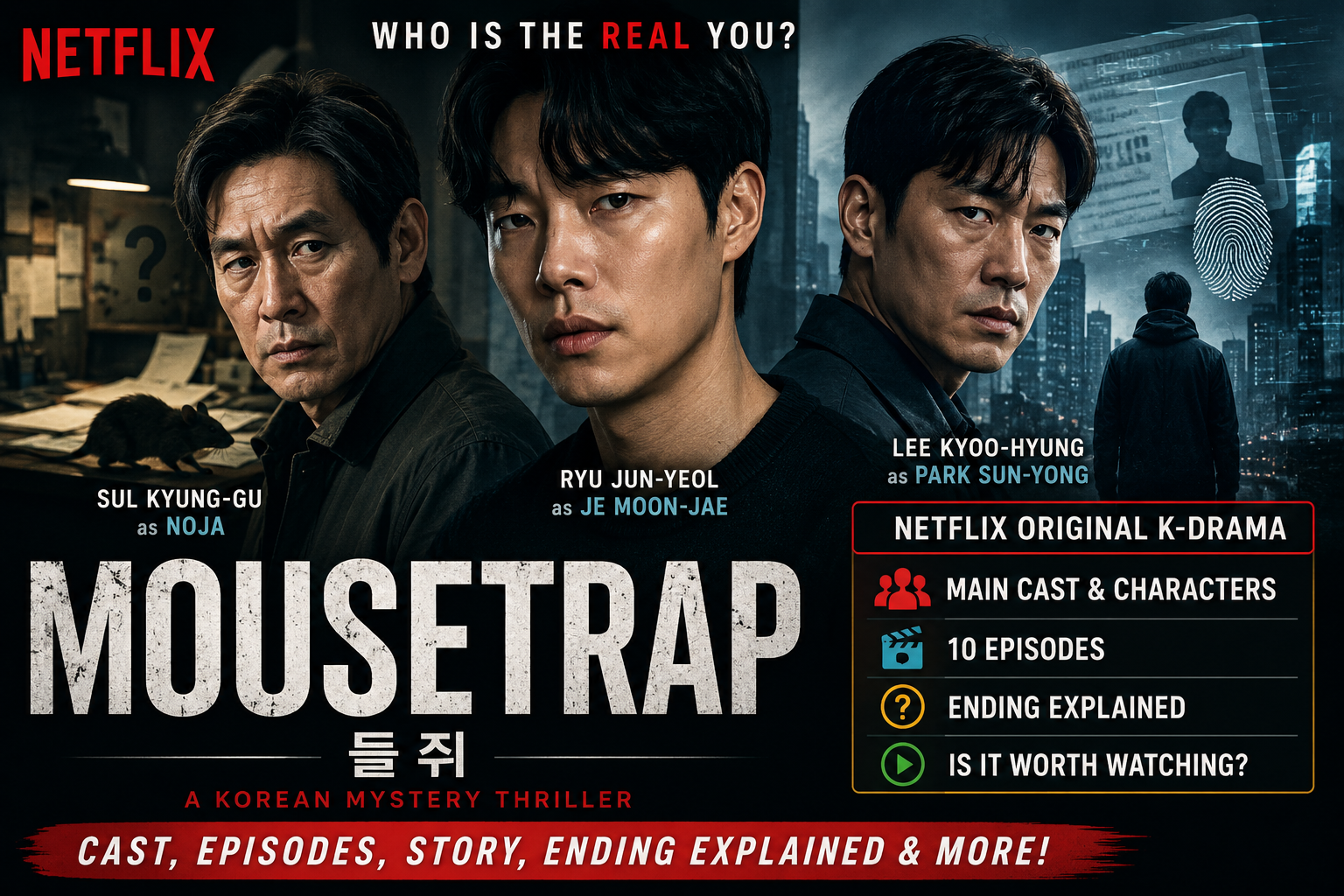
  • Mousetrap K-Drama Cast, Characters, Episodes & Ending Explained

    Mousetrap K-Drama Cast, Characters, Episodes & Ending Explained

    Netflix’s Mousetrap (들쥐) is one of the most intriguing Korean mystery thrillers of 2026.

    Released globally on Netflix on August 28, 2026, the 10-episode limited series stars Ryu Jun-yeol, Sul Kyung-gu and Lee Kyoo-hyung in a dark story about identity theft, memory, deception and a mysterious figure known as “The Rat.”

    But Mousetrap has something that makes it particularly interesting to Korean viewers.

    The story is inspired by an old Korean folktale about a field mouse that eats a person’s clipped fingernails and transforms into that person. Netflix confirms that this Korean folktale is the starting point for the series.

    That cultural background makes Mousetrap much more than a conventional identity-theft thriller.

    Mousetrap K-Drama Cast and Characters

    Ryu Jun-yeol as Je Moon-jae

    Ryu Jun-yeol plays Je Moon-jae, a genius novelist who lives almost completely isolated from society.

    His carefully controlled life begins to collapse when his fingerprint suddenly stops unlocking his phone, his passwords no longer work and he gradually discovers that his identity, money and even his name are being taken away from him.

    Eventually, another person appears claiming his identity.

    Moon-jae now faces an almost impossible question:

    How do you prove that you are really you?

    Ryu Jun-yeol previously appeared in Netflix titles including Revelations and The 8 Show.

    Sul Kyung-gu as Noja

    Sul Kyung-gu plays Noja, a ruthless loan shark who initially pursues Moon-jae because of money.

    But the two eventually form an unlikely alliance.

    Noja becomes one of the central figures in Moon-jae’s attempt to discover who stole his identity and uncover the truth behind “The Rat.”

    The relationship between the frightened, isolated writer and the intimidating loan shark is one of the most unusual dynamics in the series.

    Lee Kyoo-hyung as Park Sun-yong

    Lee Kyoo-hyung plays detective Park Sun-yong.

    While Moon-jae and Noja pursue The Rat from one direction, Sun-yong investigates the strange case from the perspective of law enforcement.

    As the investigation progresses, however, Sun-yong discovers disturbing connections involving his own past.


    What Is Mousetrap K-Drama About?

    The basic premise sounds simple.

    Someone steals Moon-jae’s identity.

    But this isn’t ordinary online identity theft.

    The mysterious person known as The Rat takes virtually everything that defines Moon-jae’s existence—his identity, property and place in society.

    Even worse, Moon-jae has spent years living as a recluse.

    That means relatively few people can personally confirm who he really is.

    The person pretending to be Moon-jae can therefore appear more convincing to the outside world than the real Moon-jae himself.

    Netflix describes the story as a chase thriller in which Moon-jae, Noja and detective Sun-yong pursue the true identity of The Rat.


    The Korean Folktale Behind Mousetrap

    This is something international viewers may easily miss.

    The Korean title of the drama is 들쥐, meaning “field mouse.”

    There is an old Korean folktale in which a mouse eats a person’s discarded fingernail clippings and takes on that person’s appearance.

    The Netflix series transforms that disturbing old idea into a modern question about identity:

    What happens if another person can become a more convincing version of you than you are?

    Netflix itself highlighted this folktale when introducing the series before its premiere.

    For international viewers, knowing this background makes the title and the central mystery much easier to understand.


    How Many Episodes Does Mousetrap Have?

    Mousetrap has 10 episodes.

    It is officially listed by Netflix as a Limited Series, rather than a conventional multi-season drama.

    Approximate episode lengths are:

    EpisodeRuntime
    Episode 156 min
    Episode 256 min
    Episode 350 min
    Episode 458 min
    Episode 555 min
    Episode 660 min
    Episode 763 min
    Episode 855 min
    Episode 949 min
    Episode 1064 min

    All 10 episodes are currently listed on Netflix.


    Is Mousetrap on Netflix?

    Yes.

    Mousetrap premiered globally on Netflix on August 28, 2026.

    Netflix currently lists the series with Korean original audio as well as English audio and English subtitles, making it particularly accessible to international viewers.

    Watch Mousetrap on Netflix


    Is Mousetrap Based on a Webtoon?

    Yes.

    Netflix categorizes Mousetrap as a K-drama based on a webtoon, and Netflix’s official announcement identifies the source as the webtoon Field Mouse.

    That source material itself draws on the unsettling Korean field-mouse folktale, giving the drama multiple layers: Korean folklore → webtoon → Netflix thriller.


    Is Mousetrap K-Drama Worth Watching?

    If you enjoy psychological thrillers, identity mysteries, dark Korean dramas and stories filled with twists, Mousetrap is certainly worth considering.

    The strongest element is its premise.

    Instead of simply asking:

    “Who is the criminal?”

    Mousetrap asks something more disturbing:

    “What if you could no longer prove who you are?”

    Early critical reaction has been mixed but interesting. Decider recommended streaming the series and highlighted its gripping premise and performances, while another review praised the ending and psychological-horror elements but criticized the middle section for having too many twists.

    So viewers who like straightforward thrillers may find parts of the story complicated.

    But viewers who enjoyed darker Korean mystery dramas built around unreliable identities and repeated revelations may find plenty to enjoy.


    Mousetrap Ending Explained

    ⚠️ Major spoilers for Episode 10 begin below.

    This is the section I would not fully write yet unless we deliberately make the article spoiler-heavy.

    There’s an SEO reason.

    People searching:

    mousetrap kdrama cast

    should be able to enter this article without immediately encountering the ending.

    At the same time, Search Console is already showing interest in:

    mousetrap kdrama explained

    So we should retain an ending section but clearly separate it with a spoiler warning.

    For now I’d place this teaser:

    The final episode brings Moon-jae to the center of a trap that has been built over many years, forcing the series to confront its central question of who is genuine, who is an impostor and who has really been manipulating the game. Netflix’s official Episode 10 description deliberately frames the conclusion around whether Moon-jae is the predator or the prey.

    Then we can create a separate deep-dive article:

    Mousetrap K-Drama Ending Explained: Who Is The Rat?

    and internally link the two.

    That is better SEO than stuffing the entire ending explanation into this article because we already have two different search intents showing up: cast and explained.


    Mousetrap K-Drama Quick Facts

    Korean Title들쥐
    English TitleMousetrap
    Release DateAugust 28, 2026
    StreamingNetflix
    Episodes10
    FormatLimited Series
    GenreMystery, Crime, Psychological Thriller
    Lead CastRyu Jun-yeol, Sul Kyung-gu, Lee Kyoo-hyung
    DirectorKim Hong-sun
    WriterLee Jae-gon
    Based OnField Mouse webtoon / Korean field-mouse folktale

    FAQ

    Who is in the Mousetrap K-drama cast?

    The main Mousetrap cast includes Ryu Jun-yeol as Je Moon-jae, Sul Kyung-gu as Noja and Lee Kyoo-hyung as detective Park Sun-yong.

    How many episodes are in Mousetrap?

    There are 10 episodes in the Netflix limited series.

    Is Mousetrap available on Netflix?

    Yes. All 10 episodes are listed on Netflix, following its August 28, 2026 premiere.

    What is Mousetrap called in Korean?

    The Korean title is 들쥐 (Deuljwi), literally meaning “field mouse.”

    Is Mousetrap based on a true story?

    No. It is based on the webtoon Field Mouse, with its central idea drawing inspiration from a Korean folktale about a mouse taking human form after eating a person’s clipped fingernails.

    Is Mousetrap worth watching?

    It is most likely to appeal to viewers who enjoy dark psychological mysteries, Korean thrillers and identity-based stories with multiple twists. Critical reaction so far has praised the premise and performances while being more divided about the amount of plot twists.


    Tags