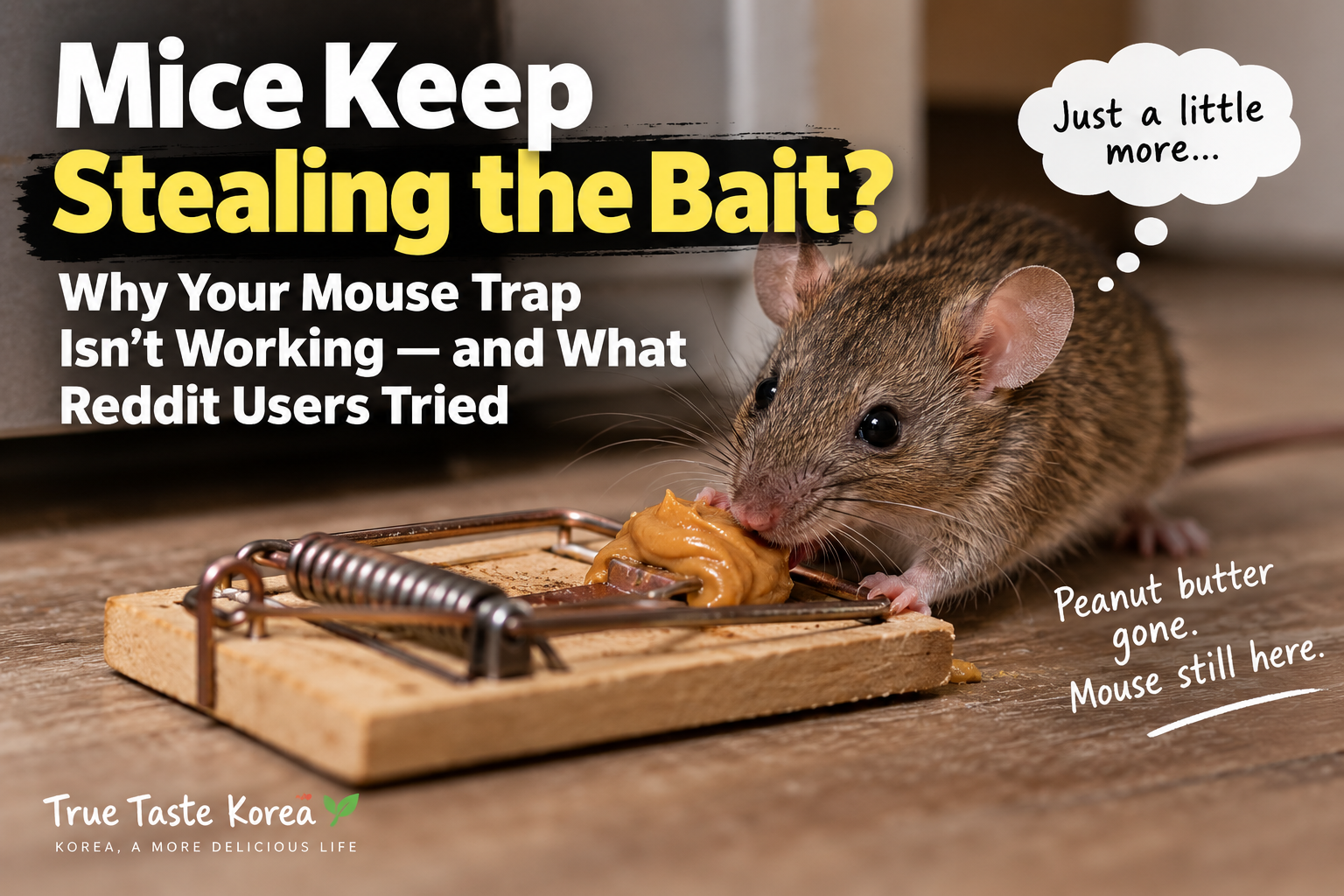
You set the mouse trap before going to bed.
You put peanut butter on it.
You place it exactly where you think the mouse has been running.
The next morning, you check the trap.
The peanut butter is gone.
The mouse is not.
Even worse, sometimes there are fresh mouse droppings nearby.
If this has happened to you, you are definitely not alone.
Across Reddit pest-control and home-improvement communities, homeowners repeatedly describe the same frustrating problem: mice eating bait without triggering snap traps, ignoring traps completely, or continuing to appear even after several mice have already been caught.
So what is going wrong?
The answer may not be the bait.
Sometimes the bigger problem is how much bait you use, where you put the trap, how the trap is positioned — and whether new mice are still entering your house.
Here are the most common reasons a mouse trap doesn’t work and what you can do about them.
1. You’re Probably Using Too Much Bait
This is one of the simplest mistakes.
A giant blob of peanut butter might seem more attractive to a hungry mouse.
But you don’t need much.
The CDC recommends placing only a small amount of bait on the bait pan of a snap trap. Chunky peanut butter is one of the baits it specifically recommends.
Why can too much bait be a problem?
A mouse may be able to nibble or lick at accessible bait without applying enough pressure to the trigger.
That exact frustration appears repeatedly on Reddit.
One 2026 r/HomeImprovement discussion began with a homeowner saying mice were repeatedly eating bait from snap traps. Other users immediately asked whether too much peanut butter was being used and suggested working a small amount into the trigger area rather than leaving a large, easily accessible serving.
Try this instead
Use a very small amount of peanut butter concentrated on the bait pan/trigger, following your trap manufacturer’s directions.
Think:
tiny target, not free dinner.
2. The Trap May Be in the Wrong Place
This may be even more important than changing from peanut butter to another food.
Mice don’t usually wander randomly across an open room looking for your trap.
They commonly travel close to walls and objects where they feel protected.
That’s why the CDC recommends placing snap traps against the wall with the baited end next to the wall, forming a “T” shape with it.
Good places to investigate include:
- Behind the refrigerator
- Behind the stove
- Under the sink
- Inside the back of cabinets
- Near droppings
- Near gnaw marks
- Along baseboards
- Near suspected entry points
- In basements, attics and crawlspaces
The CDC specifically recommends targeting places where you’ve found droppings, urine, nesting material, gnawed food or other evidence of rodent activity.
The important lesson:
Don’t put the trap where it’s convenient for you.
Put it where the mouse actually travels.
3. Peanut Butter Isn’t Necessarily the Problem
Search Reddit for mouse traps and you’ll quickly discover an entire underground science of mouse bait.
People suggest everything imaginable.
Peanut butter.
Pet food.
Chocolate.
Nuts.
Bacon.
Sticky candy.
And combinations of several foods.
One Reddit thread specifically asked:
“Mice keep stealing my bait on the snap trap — what can I put on it that they can’t steal?”
The discussion has continued receiving replies years after the original post, with users sharing their own experiments.
Another pest-control discussion involved someone whose peanut butter had initially caught mice but later seemed to be ignored completely.
Before turning your kitchen into a mouse-bait laboratory, however, remember something important.
Peanut butter itself is not a bad bait.
The CDC specifically lists chunky peanut butter as an appropriate snap-trap bait.
So if peanut butter isn’t working, don’t immediately conclude that you need some magical secret food.
Check your bait amount, trap position and mouse travel route first.
4. Reddit Users Have an Interesting Theory: Make the Mouse Work for the Bait
Here’s where the Reddit discussions get interesting.
Several users describe trying to make the bait more difficult to remove.
Some report pressing peanut butter into or around the trigger.
Others describe combining peanut butter with a small piece of dry food so the mouse has to tug at it.
Another Reddit user reported warming a sticky candy and molding it onto the trap so the mouse had to exert more force while feeding.
These are anecdotal Reddit experiences, not official CDC recommendations, so I wouldn’t treat them as scientifically proven techniques.
But they reveal an important practical idea:
If a mouse can casually lick food from a trap without interacting properly with the trigger, simply adding more bait may make the problem worse rather than better.
Before modifying a trap, always follow the manufacturer’s instructions and don’t alter safety mechanisms.
5. Your Mouse May Be Walking Around the Trap
One of the funniest — and most frustrating — Reddit mouse stories involves people actually watching mice avoid traps.
In one discussion, a homeowner installed a Wi-Fi camera in the kitchen.
The mouse appeared two or three times a day.
The owner could literally watch it.
But it ignored or avoided multiple types of traps and several different baits.
The kitchen eventually became, in the homeowner’s words, essentially a collection of useless traps while the mouse kept coming back.
That story illustrates why location matters so much.
Instead of asking:
“What food does this mouse want?”
ask:
“Where does this mouse actually walk?”
Look for physical evidence.
Droppings are particularly useful.
So are gnaw marks, nesting materials and damaged food packages.
The EPA lists all of these as common signs of rodent infestation.
Find the highway.
Then put the trap on the highway.
6. One Trap May Not Be Enough
Another common mistake is buying one mouse trap and expecting the problem to disappear overnight.
If you see one mouse, you don’t necessarily know how many are present.
The CDC recommends setting traps throughout affected areas and continuing to trap until rodent activity has stopped.
Older CDC technical guidance also recommends using multiple traps in infested areas because more traps increase the likelihood that rodents will encounter them.
So don’t think:
One mouse = one trap.
Think:
Where is the activity occurring, and how can I intercept those routes?
7. What If the Mouse Seems Afraid of the Trap?
This issue is especially important when dealing with rats, which the CDC notes can be cautious around new objects.
For cautious rodents, the CDC suggests pre-baiting: placing bait on the trap without setting it at first, allowing the animal to become accustomed to it.
Once the bait begins disappearing, the trap can then be set.
Don’t automatically assume the animal has developed some genius understanding of mechanical engineering.
Rodents can simply be cautious about unfamiliar objects.
8. The Real Problem May Not Be Your Mouse Trap at All
This is the part many homeowners miss.
Imagine that you successfully catch a mouse tonight.
Then another tomorrow.
Then another two days later.
At some point you have to ask:
Where are they coming from?
One recent Reddit user described an infestation lasting many months despite regular exterminator visits and bait stations. The homeowner’s frustration was that trapping and baiting seemed to reduce individual mice without eliminating the underlying problem.
This is where official pest-control guidance becomes especially important.
The EPA recommends inspecting for and sealing holes inside and outside the home, while also removing food, water and potential nesting sources.
The CDC gives essentially the same broader strategy:
Find how rodents are entering.
Seal the openings.
Then trap the rodents still inside.
This means catching mice is only one part of mouse control.
9. Check These Mouse Entry Points
Look carefully around your home.
Pay particular attention to areas around:
- Plumbing penetrations
- Pipes beneath sinks
- Utility lines
- Doors
- Wall openings
- Floors
- Cabinets
- Basement areas
- Attics
- Crawlspaces
- Areas behind appliances
The EPA notes that holes chewed through walls and floors can create rodent entry points and recommends sealing openings inside and outside the home.
If mice continue entering faster than you’re catching them, experimenting with increasingly exotic bait isn’t going to solve the real problem.
You’re operating a mouse removal service.
You need to close the entrance.
10. Food Sources Around the House Matter Too
Your peanut butter trap is competing with everything else a mouse can eat.
Pet food.
Crumbs.
Garbage.
Pantry food.
Compost.
Food left beneath appliances.
The EPA recommends removing food and water sources, keeping garbage in containers with tight-fitting lids and reducing other potential sources of food and shelter.
This is an overlooked point.
If your kitchen offers an all-you-can-eat buffet every night, your tiny dab of peanut butter isn’t necessarily the irresistible attraction you imagine.
11. What About Glue Traps?
This is where internet advice and official health guidance can differ.
You will find plenty of Reddit users discussing glue traps.
However, the CDC currently recommends traditional snap traps for household rodent control and advises against glue traps and live traps because frightened rodents may urinate, potentially increasing exposure to disease.
For that reason, I would follow the CDC guidance rather than simply copying whatever trap happens to be popular in an online discussion.
12. Be Careful With Poison — Especially Around Children and Pets
Poison bait is another subject that appears constantly in online discussions.
But this isn’t something to improvise.
The EPA says rodenticide bait products should be used according to label directions and emphasizes tamper-resistant bait stations and protection of children, pets and wildlife.
The CDC recommends considering poison or bait stations when infestations persist and recommends EPA-registered products.
If you’re dealing with a significant infestation or can’t identify the entry points, professional pest control may be the better option.
The 5-Minute Mouse Trap Checklist
Before buying another trap, check these seven things:
- Am I using only a small amount of bait?
- Is the bait positioned correctly on the trigger/bait pan?
- Is the trap against the wall on a known mouse route?
- Have I found droppings or gnaw marks showing where mice travel?
- Am I using enough traps for the affected area?
- Have I removed competing food sources?
- Have I found and sealed possible entry points?
If you answer “no” to several of these questions, changing the bait probably isn’t your first priority.
What Reddit Gets Right — and What It Doesn’t
Reddit is extremely useful for one reason:
People describe what actually happened in their homes.
They tell you when peanut butter disappeared.
They describe mice walking around traps.
They post about traps that mysteriously vanished.
They return months later to report what they tried.
For example, one homeowner reported catching around 11 mice in two days — only to discover that several traps themselves subsequently disappeared. Other users discussed the possibility of partially trapped mice dragging them away.
That’s fascinating practical information.
But Reddit is still Reddit.
Individual experiences aren’t controlled experiments, and advice from anonymous commenters can be wrong.
So the best approach is:
Use Reddit to discover the problem.
Use authoritative sources to verify the solution.
For this article, the key recommendations on trap type, placement, bait quantity, sanitation and exclusion are based primarily on guidance from the CDC and U.S. EPA.
The Mouse Isn’t Necessarily Smarter Than You
After three mornings of finding an empty trap, it can certainly feel that way.
But don’t overcomplicate the problem.
A mouse trap that isn’t working usually doesn’t mean you have discovered the world’s smartest mouse.
Start with the basics.
Use a small amount of bait.
Place the trap where mice actually travel.
Put the baited end against the wall.
Use multiple traps where necessary.
Remove competing food sources.
And most importantly:
Find out how the mice are getting inside.
Because catching tonight’s mouse feels satisfying.
Stopping tomorrow night’s mouse from entering is how you actually solve the problem.
Related Mouse Control Guides
If you’re dealing with an ongoing mouse problem, also read our other mouse-control guides on choosing the right mouse trap and using mouse traps safely and effectively.
Next in this series:
Best Mouse Trap Bait: Peanut Butter vs. Other Baits — What Actually Works?
That article will compare official recommendations with the strange, clever and sometimes surprisingly successful bait experiments shared by homeowners online.
K-Beauty Shopping
Interested in Korean skincare and beauty products?
Shop K-Beauty at OLIVE YOUNG Global
If you purchase through the link above, the site operator may receive a commission at no additional cost to you.