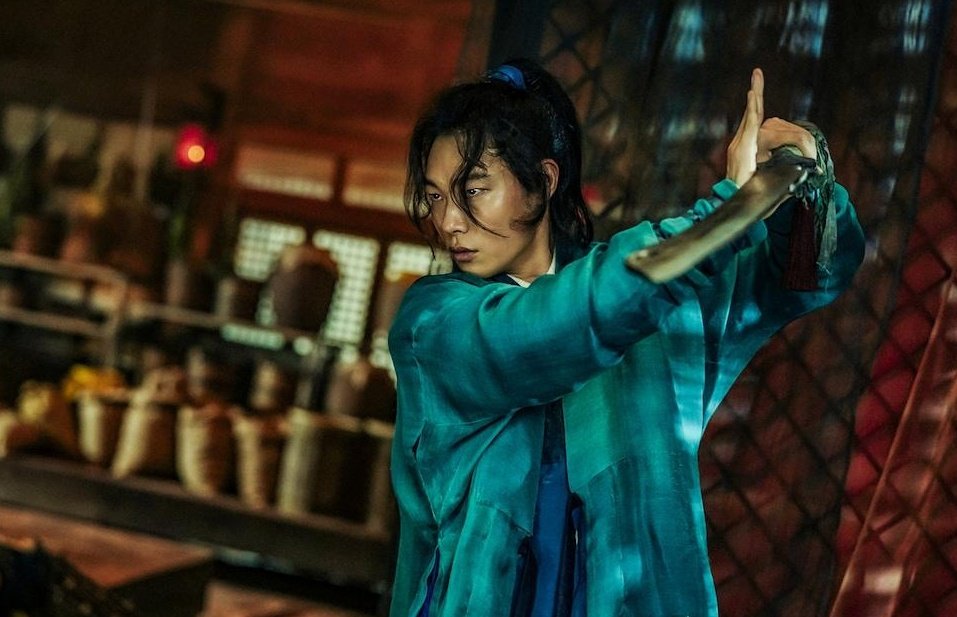
• Alienoid Part 2: Could Mureuk Escape a Fate He Never Chose?

    Alienoid Part 2: Could Mureuk Escape a Fate He Never Chose?

    Spoiler Warning: This article discusses major plot developments and the ending of Alienoid: Return to the Future (2024), the second part of the Korean science-fantasy film series.

    1. The Second Film Begins Where the First One Left Us

    The first Alienoid film introduced an extraordinary world in which alien prisoners, human bodies, futuristic technology, Goryeo-era Taoist magic, and time travel exist within the same story.

    But it ended with a revelation that changed everything.

    Mureuk, the seemingly carefree Taoist magician, was connected to the Controller, the dangerous alien intelligence that threatened humanity. He had lived without understanding what was inside him or how his forgotten past had shaped his identity.

    Alienoid: Return to the Future picks up that unfinished story.

    Lee Ahn is still trapped in the past, the future remains in danger, and the people caught between two eras must finally confront the consequences of decisions made long before they understood them.

    The second film is not simply about stopping an alien invasion.

    It is about discovering whether people can escape a fate that was decided without their permission.

    2. Mureuk: The Man Who Was Never Fully Himself

    Mureuk initially appears to be an amusing and somewhat unreliable Taoist magician.

    He is interested in rewards, money, and the practical advantages of possessing the Divine Blade. His personality seems far removed from the traditional image of a serious hero.

    Yet Part 1 had already revealed that something was wrong.

    Mureuk’s extraordinary abilities, unexplained memories, and unusual physical resilience were connected to the alien presence inside his body.

    Part 2 turns this mystery into an identity crisis.

    Mureuk must confront the possibility that some of the things he considers part of himself may have another origin.

    This is more disturbing than simply discovering that an alien lives inside his body.

    If another consciousness has influenced his memories, abilities, and behavior, how much of his life has actually belonged to him?

    3. The Controller: An Enemy Living Inside a Human Life

    The Controller is more than a powerful alien antagonist.

    It represents the terrifying possibility that one consciousness can occupy another being’s life without permission.

    The alien system was originally designed to imprison dangerous criminals inside human hosts. But the Controller’s presence in Mureuk reveals how easily the boundaries between imprisonment, survival, and control can become complicated.

    Mureuk is not responsible for the circumstances that placed the Controller inside him.

    He did not choose to become a host, and he did not understand the truth when he was growing up.

    This distinction matters.

    A person should not automatically be defined by something that was forced upon them.

    The film’s most interesting identity question is therefore not whether Mureuk is human or alien.

    It is whether he can remain himself when another existence has become part of his body.

    4. Is Mureuk a Victim, a Threat, or Both?

    Mureuk occupies an uncomfortable position.

    To those who understand the danger of the Controller, his body represents a potential disaster. To himself, however, he is a person trying to understand an increasingly frightening reality.

    This creates a conflict between individual identity and public safety.

    If a person carries something dangerous without knowing it, should society treat that person as guilty?

    The question becomes even more difficult when the threat is powerful enough to endanger everyone.

    Mureuk is both a victim of circumstances and a possible source of danger.

    The film does not need to make him completely innocent or completely responsible. Its strongest emotional tension comes from the fact that both descriptions can exist at the same time.

    5. Lee Ahn: Freedom Requires More Than Returning Home

    Lee Ahn’s mission appears straightforward.

    She must recover the Divine Blade, find a way back to the future, and prevent the catastrophe that threatens humanity.

    But her journey is more complicated than a simple rescue mission.

    She has spent years in an unfamiliar historical period. She has lost the life she was supposed to have, and the people she once depended on are separated from her by time.

    Her determination is not merely about returning to 2022.

    She wants to protect the people who matter to her and reclaim the future that was taken away.

    In Part 1, Lee Ahn began discovering that powerful beings had made decisions about her life without telling her the truth.

    In Part 2, she acts on what she has learned.

    She no longer waits for others to decide what she should do.

    Her freedom becomes something she must actively defend.

    6. The Divine Blade: A Key to the Past and the Future

    The Divine Blade is one of the most important objects in the entire story.

    To the people of Goryeo, it appears to be a mysterious weapon with supernatural power. But its true significance is connected to the advanced technology and time-travel system introduced in the first film.

    The blade is not simply a weapon that can defeat an enemy.

    It is a means of crossing the boundary between historical periods.

    For Lee Ahn, it represents the possibility of returning to her own time. For other characters, it offers power, knowledge, or the opportunity to change their circumstances.

    This creates an interesting contrast.

    Many characters want the same object, but they do not want the same future.

    The Divine Blade reveals that possessing the means to change the world does not necessarily mean understanding what should be changed.

    7. Why the Goryeo Characters Matter to the Final Conflict

    The Goryeo storyline is not a separate fantasy adventure that exists only to provide comic relief.

    The Taoist magicians, bounty hunters, and other historical characters gradually become part of a much larger conflict.

    Their understanding of the world is different from that of the modern characters.

    What they interpret as ghosts, spirits, or supernatural phenomena is often connected to alien technology and beings from another time.

    This difference in knowledge creates misunderstandings, but it also creates unexpected possibilities.

    The historical characters are not simply powerless people waiting for modern technology to save them.

    They have their own abilities, relationships, and reasons to become involved.

    The second film brings these different worlds together to suggest that saving humanity requires more than one kind of knowledge.

    8. Min Gae-in: The Ordinary Person Who Gets Pulled Into an Extraordinary Disaster

    Min Gae-in offers another important perspective.

    Unlike Lee Ahn, Guard, or the Taoist magicians, she is not someone who begins with a clear understanding of the alien system.

    She becomes involved after witnessing events that ordinary people cannot easily explain.

    Her presence reminds viewers that the consequences of the alien conflict do not belong only to the people who understand it.

    Ordinary citizens are the ones who suffer when powerful beings fight over the future of the planet.

    This is an important contrast with the characters who possess extraordinary abilities.

    The people making decisions may be aliens, advanced machines, or powerful magicians, but the consequences reach people who never asked to participate.

    9. The 48-Minute Countdown: When There Is No Time Left for Perfect Decisions

    The threat of Haava gives the second film a much more immediate sense of urgency.

    The central conflict moves beyond the question of how the characters became connected.

    They now have to stop a disaster before time runs out.

    The countdown changes the nature of their choices.

    There is no opportunity to understand every mystery, resolve every disagreement, or develop a perfect plan.

    The characters must act with incomplete information.

    This is one of the film’s most effective ideas.

    Real crises rarely provide enough time for people to understand everything before making a decision.

    The important question is not whether the characters can find a flawless solution.

    It is whether they can cooperate despite their differences and accept responsibility for the consequences.

    10. Guard and Thunder: The Cost of Protecting Humanity

    Guard and Thunder have always represented the system responsible for controlling the alien prisoners.

    But their relationship with Lee Ahn makes their role more personal.

    Guard is not simply a machine carrying out an assignment. His connection with Lee Ahn has developed into something resembling a family bond.

    That relationship complicates his original mission.

    Protecting humanity is an enormous responsibility, but protecting one person can become just as meaningful.

    The film places these forms of responsibility beside each other.

    Guard’s choices are not only about following the rules of the alien prison system. They are also about the people he has come to care about.

    Thunder’s role further reinforces the emotional connection between technology and human relationships.

    The film repeatedly suggests that the meaning of a being cannot be reduced to the purpose for which it was originally created.

    11. The Final Battle: Different Eras Must Finally Work Together

    The climax brings together characters from the modern world and the Goryeo period.

    Their different abilities and experiences become necessary in the struggle against the alien threat.

    The final conflict is therefore not just a battle between humans and aliens.

    It is a confrontation between different kinds of power, knowledge, and responsibility.

    The modern characters possess advanced technology and knowledge of the alien system. The historical characters bring their own forms of combat, magic, and determination.

    Neither side can solve the crisis alone.

    This is a meaningful development from Part 1.

    The first film introduced two apparently disconnected timelines. The second film reveals why those timelines must eventually become one story.

    The future cannot be saved by the future alone.

    12. The Ending: Does Mureuk Finally Become His Own Person?

    The resolution of Mureuk’s story is central to the emotional meaning of Part 2.

    His connection to the Controller initially makes him appear to be someone whose identity has already been compromised.

    But the important distinction is between what exists inside him and what he chooses to do.

    Mureuk’s identity cannot be reduced to the alien presence that entered his body when he was a child.

    His relationships, experiences, decisions, and willingness to stand with others are also part of who he is.

    The final confrontation gives this conflict its meaning.

    Mureuk is no longer simply an unaware host carrying a dangerous secret. He becomes an active participant in deciding what happens next.

    The film’s resolution is not a philosophical explanation of exactly where one consciousness ends and another begins.

    Instead, it emphasizes that identity is also revealed through choices.

    A person may not control everything that happens to them.

    But the response to those circumstances can still belong to them.

    13. Why Viewers Were Divided Over Part 2

    The second film received mixed reactions, and the reasons are worth examining.

    Some viewers appreciated that the sequel finally connected the different timelines and resolved the mysteries introduced in Part 1.

    Others enjoyed the action, visual effects, unusual mixture of Korean fantasy traditions and science fiction, and the emotional payoff of the characters’ journeys.

    However, the film’s ambitious structure remained a source of criticism.

    Some reviewers felt that the story contained too many genres and ideas competing for attention. The large cast, rapid transitions, and complicated mythology could make the narrative difficult to follow.

    The contrast between critical reactions is revealing.

    Rotten Tomatoes listed a 78% audience score alongside a 69% critics’ score in its displayed ratings, while individual reviews ranged from enthusiastic praise to strong criticism.

    The divide is not simply about whether the film is entertaining.

    It is also about what viewers expect from a science-fiction story.

    Some want a tightly controlled mythology with clear rules. Others are willing to accept narrative chaos in exchange for imagination, spectacle, and originality.

    Neither response represents every viewer.

    But the disagreement helps explain why Alienoid remains such an unusual entry in Korean genre cinema.

    14. Could Mureuk Escape a Fate He Never Chose?

    The central question of Alienoid Part 2 is different from the one introduced in the first film.

    Part 1 asked whether human beings were ever truly in control of their own destiny.

    Part 2 takes that question further.

    What happens when someone discovers that an important part of their identity was shaped by something they never chose?

    Mureuk did not choose to become connected to the Controller.

    Lee Ahn did not choose to have her childhood and future shaped by decisions made by others.

    The human hosts did not choose to become prisons for alien criminals.

    Even Guard and Thunder began their existence within a system that assigned them a particular purpose.

    Yet the story does not end by declaring that everyone is powerless.

    The characters make decisions, form relationships, challenge expectations, and accept risks for people beyond themselves.

    Perhaps freedom is not the ability to control every circumstance.

    Perhaps it is the ability to decide what kind of person to become after those circumstances have already changed your life.

    That is what makes Mureuk’s journey more than a story about an alien living inside a human body.

    It is a story about whether a person can claim ownership of a life that began with a choice they never made.


    Final Thought

    Alienoid: Return to the Future completes the two-part story by bringing its scattered timelines, characters, and mysteries into a final confrontation.

    Its crowded storytelling and constant shifts in tone will not work for every viewer. But its central question is more emotionally grounded than its enormous science-fiction setting might initially suggest.

    Mureuk cannot choose how the Controller entered his life. Lee Ahn cannot undo the decisions that shaped her childhood. The human hosts cannot change the fact that they were used by an alien prison system.

    But they can still make choices about what happens next.

    The first film asked whether people were ever in control of their destiny.

    The second film offers a more hopeful possibility:

    Even when we cannot choose what happens to us, we may still have the power to choose who we become.

    Continue the story: Read Alienoid Part 1: Were Humans Ever in Control of Their Own Destiny? to understand the origins of Mureuk’s mystery and the world that leads to this conclusion.

  • Alienoid Part 1: Were Humans Ever in Control of Their Own Destiny?

    Alienoid Part 1: Were Humans Ever in Control of Their Own Destiny?

    Spoiler Warning: This article discusses major story developments and the ending of Alienoid Part 1 (2022). It does not reveal the full resolution of the story in Part 2.

    1. A Science-Fiction Film That Refuses to Stay in One Genre

    At first glance, Alienoid Part 1 seems almost impossible to categorize.

    It combines extraterrestrial prisoners, futuristic robots, time travel, Goryeo-era Taoist magicians, mystical weapons, and traditional martial arts. One moment, the film resembles a science-fiction thriller. The next, it becomes a fantasy adventure filled with supernatural characters and comic misunderstandings.

    This unusual mixture is both the film’s greatest strength and its biggest risk.

    Rather than following one familiar genre, director Choi Dong-hoon creates a world in which different eras and belief systems collide. The question is not simply whether aliens exist. It is what happens when people discover that the world they understand is only a small part of a much larger system.

    Beneath its spectacular action, Alienoid Part 1 introduces a surprisingly serious question: How much control do human beings really have over their own lives?

    2. The Most Disturbing Idea: Human Beings as Alien Prisons

    The film begins with an unsettling concept.

    For a very long time, alien criminals have been imprisoned inside human bodies. Their human hosts continue living ordinary lives, often without knowing that another existence is trapped within them.

    This arrangement changes the meaning of an ordinary human life.

    A person may believe that their body, thoughts, and future belong entirely to them. But the film introduces a hidden reality in which their body can become a prison for someone else’s crime.

    The most disturbing aspect is not simply the presence of aliens. It is the possibility that human beings have become part of a system they never agreed to join.

    The film asks viewers to consider an uncomfortable distinction: being alive is not necessarily the same as being free.

    3. Guard and Thunder: Protectors or Prison Wardens?

    Guard and Thunder are responsible for managing the alien prisoners.

    They are not ordinary humans. They possess advanced technology, extraordinary abilities, and a mission that stretches across time.

    Their job appears straightforward: locate escaped aliens, prevent dangerous incidents, and maintain the prison system.

    But their role creates an ethical problem.

    If the alien prisoners are dangerous criminals, containing them may be necessary. Yet the method of imprisonment involves using human bodies without the hosts’ knowledge or consent.

    Can a system be considered just simply because it prevents a greater disaster?

    Guard and Thunder represent institutional authority. They have rules, responsibilities, and a clear understanding of their mission. But the film gradually shows that following a mission and doing what is morally right are not always identical.

    4. Lee Ahn: The Human Being Who Was Never Supposed to Be There

    Lee Ahn is one of the most important characters because her existence challenges the rules of the system.

    As a baby, she is brought from the past into the future. Guard initially insists that interfering in human affairs is forbidden, but Thunder secretly takes the child with them.

    This decision creates a contradiction at the heart of the story.

    The beings responsible for maintaining order have already violated their own principles.

    Lee Ahn grows up surrounded by people who know more about her history than she does. She senses that something is wrong and gradually discovers the truth about Guard, Thunder, and her own origins.

    Her curiosity is not merely a personality trait. It is a refusal to accept a reality that other people have decided for her.

    She wants answers because she understands that her life has been shaped by decisions she never had the opportunity to make.

    5. The Difference Between Protecting Someone and Controlling Them

    Guard’s relationship with Lee Ahn is complicated.

    He raises her, protects her, and tries to keep her away from the dangers surrounding the alien prisoners. Yet he also withholds important information and repeatedly treats her as someone who should remain outside the mission.

    His intentions may be protective, but his behavior can also become controlling.

    This creates one of the film’s most interesting emotional conflicts.

    A person can genuinely care about someone while still denying that person’s right to make decisions.

    Guard believes that he knows what is best for Lee Ahn. Lee Ahn, however, wants to understand the truth and participate in decisions that affect her own future.

    The conflict is familiar even though the setting is extraordinary.

    Parents, governments, institutions, and powerful organizations often justify control by claiming that they are protecting those who have less information or less power.

    Alienoid Part 1 asks whether protection remains meaningful when the protected person has no voice.

    6. The Controller: What Happens When Prisoners Reject the System?

    The Controller represents a much greater threat than an ordinary escaped prisoner.

    It is connected to a rebellion against the system that imprisons aliens inside human bodies. Its followers want to release the prisoners and change Earth’s atmosphere through a substance called Haava.

    The Controller’s actions threaten humanity on an enormous scale.

    This creates an important moral distinction.

    The alien prisoners may have legitimate reasons to resist imprisonment, but their rebellion does not automatically make their actions justified. If their freedom requires the destruction of another species, their struggle becomes another form of domination.

    The film therefore avoids a simple division between freedom fighters and villains.

    It presents a conflict in which both sides can claim that their actions are necessary while refusing to accept the suffering imposed on others.

    7. Haava: The Price of One Species’ Survival

    Haava is more than a science-fiction device.

    It represents a conflict over whose survival matters.

    The alien plan requires changing Earth’s atmosphere so that their own species can exist more comfortably. But that transformation would make Earth unsuitable for human life.

    From the aliens’ perspective, this may be a path toward survival. From humanity’s perspective, it is an extinction-level threat.

    The conflict exposes a dangerous assumption: that one group’s survival can justify destroying another group’s home.

    The question becomes larger than the struggle between humans and aliens.

    How far can any civilization go in protecting itself before it becomes the very threat it claims to oppose?

    8. Two Different Eras, One Connected Mystery

    One of the film’s most ambitious choices is its movement between the modern world and the Goryeo period.

    The modern storyline follows Guard, Thunder, Lee Ahn, and the alien prisoners. The historical storyline introduces Mureuk, Taoist magicians, mystical weapons, and competing figures searching for the Divine Blade.

    At first, these stories seem almost unrelated.

    The viewer must gradually understand how the events in one era influence the other. The film deliberately withholds information, making the two timelines pieces of a larger puzzle.

    This structure creates curiosity, but it also demands patience.

    Some viewers may find the constant transitions exciting. Others may feel that the film introduces too many characters and ideas before giving them enough time to settle.

    That division is understandable. The film’s ambition is also the source of its narrative difficulty.

    9. Mureuk: A Man Who Does Not Understand His Own Power

    Mureuk initially appears to be a humorous Taoist bounty hunter.

    He is interested in money, rewards, and the practical benefits of obtaining the Divine Blade. He does not behave like a traditional heroic figure who begins with a clear moral mission.

    Yet there is something unusual about him.

    He possesses extraordinary abilities, survives injuries that should be fatal, and seems to have a connection to events that he cannot fully understand.

    His lack of self-awareness is important.

    Mureuk believes he is pursuing a reward, but the film gradually suggests that he himself may be part of the mystery he is trying to solve.

    His character raises a question that connects directly to the film’s larger theme: Can someone truly understand their identity when the most important parts of their past have been hidden from them?

    10. The Divine Blade: A Weapon That Connects Two Worlds

    The Divine Blade is one of the central objects in the film.

    To the people of the Goryeo period, it appears to be a mysterious and powerful weapon. But its actual significance is connected to the technology and history of the future.

    This contrast is central to Alienoid Part 1.

    What one era understands as magic may be technology from another era. What appears supernatural may have an explanation that the people of that time simply cannot recognize.

    The film does not treat traditional fantasy and science fiction as completely separate worlds. Instead, it places them beside each other and asks whether the difference between magic and technology is sometimes only a matter of knowledge.

    The Divine Blade becomes a physical connection between two periods, but it also represents the limits of human understanding.

    11. Why the Film’s Genre Mixture Both Works and Fails

    Alienoid Part 1 has an unusually large collection of characters and story elements.

    Its action sequences, visual effects, comic moments, fantasy battles, and science-fiction ideas compete for attention. This gives the film an energetic and unpredictable quality.

    However, the same abundance can weaken its emotional focus.

    A character may disappear from the story just as the viewer begins to understand their importance. A new explanation may arrive before the previous one has had time to settle.

    This is where audience reactions tend to divide.

    Some viewers appreciate the film’s originality, visual ambition, and willingness to combine Korean fantasy traditions with futuristic science fiction. Others find its storytelling overcrowded and its tonal changes difficult to follow.

    The criticism is not necessarily that the ideas are bad. It is that the film sometimes introduces more ideas than one installment can comfortably develop.

    That distinction matters when evaluating its ambition.

    12. The Ending: Mureuk Is Connected to the Controller

    The final revelation changes how viewers understand Mureuk.

    The film suggests that the Controller, after being separated from its previous host, found a new human host in the past.

    Mureuk was the overlooked person who had been present when the events unfolded. As a young boy, he rescued Lee Ahn after she fell into the water. The Controller became connected to him, while Mureuk lost the memory of what had happened.

    This revelation gives new meaning to his unusual abilities and unexplained experiences.

    The person who appeared to be an independent Taoist bounty hunter was unknowingly carrying the central danger of the entire story.

    It also creates a disturbing identity problem.

    If a person’s body contains another consciousness, and that consciousness influences their abilities or memories, where does one identity end and the other begin?

    The film does not fully answer that question in Part 1. Instead, it leaves the audience with a much larger mystery.

    13. Why the Cliffhanger Is Both a Strength and a Weakness

    Alienoid Part 1 does not provide a conventional, fully resolved ending.

    The revelation about Mureuk gives the story a major turning point, but the larger conflict remains unfinished. Lee Ahn’s mission, the future of Guard and Thunder, and the threat posed by the Controller still require answers.

    For viewers who enjoy long-form storytelling, this can create anticipation.

    For viewers who expect a complete cinematic experience, it can feel frustrating.

    The difference comes down to expectations.

    A two-part story can justify leaving certain questions unanswered, but the first installment still needs to provide a satisfying experience of its own.

    Alienoid Part 1 offers a substantial world, memorable characters, and a major revelation. Yet its unresolved conflict means that some viewers may feel they have watched the first half of a much longer film rather than a complete story.

    14. Was Humanity Ever in Control of Its Own Destiny?

    The most interesting question in Alienoid Part 1 is not whether aliens exist.

    It is whether human beings have ever had complete control over their own lives.

    Lee Ahn grows up without knowing the truth about her origins. Mureuk lives without understanding the hidden presence inside him. Human hosts become prisons for alien criminals. Even Guard and Thunder operate under rules that do not always match the moral complexity of their actions.

    Almost every major character is influenced by forces beyond their understanding.

    But the film does not suggest that human beings are completely powerless.

    Lee Ahn chooses to investigate the truth. She refuses to remain a passive observer. Mureuk’s journey brings him closer to an identity he never knew existed. Even the decisions made by Guard and Thunder show that rules can be questioned and sometimes broken.

    Perhaps freedom does not mean controlling every event that shapes our lives.

    Perhaps it begins when we recognize the forces controlling us and decide whether we will continue to obey them.

    That is the question Alienoid Part 1 leaves behind.

    And it is also the question that makes the second part necessary.


    Final Thought

    Alienoid Part 1 is an ambitious Korean science-fantasy film that may frustrate viewers who prefer a simple, tightly focused narrative. But beneath its crowded timelines and unusual genre combinations lies a compelling idea: a person cannot truly be free if they do not even know who is controlling their life.

    The first film introduces that question. The second film must determine whether its characters can finally answer it.